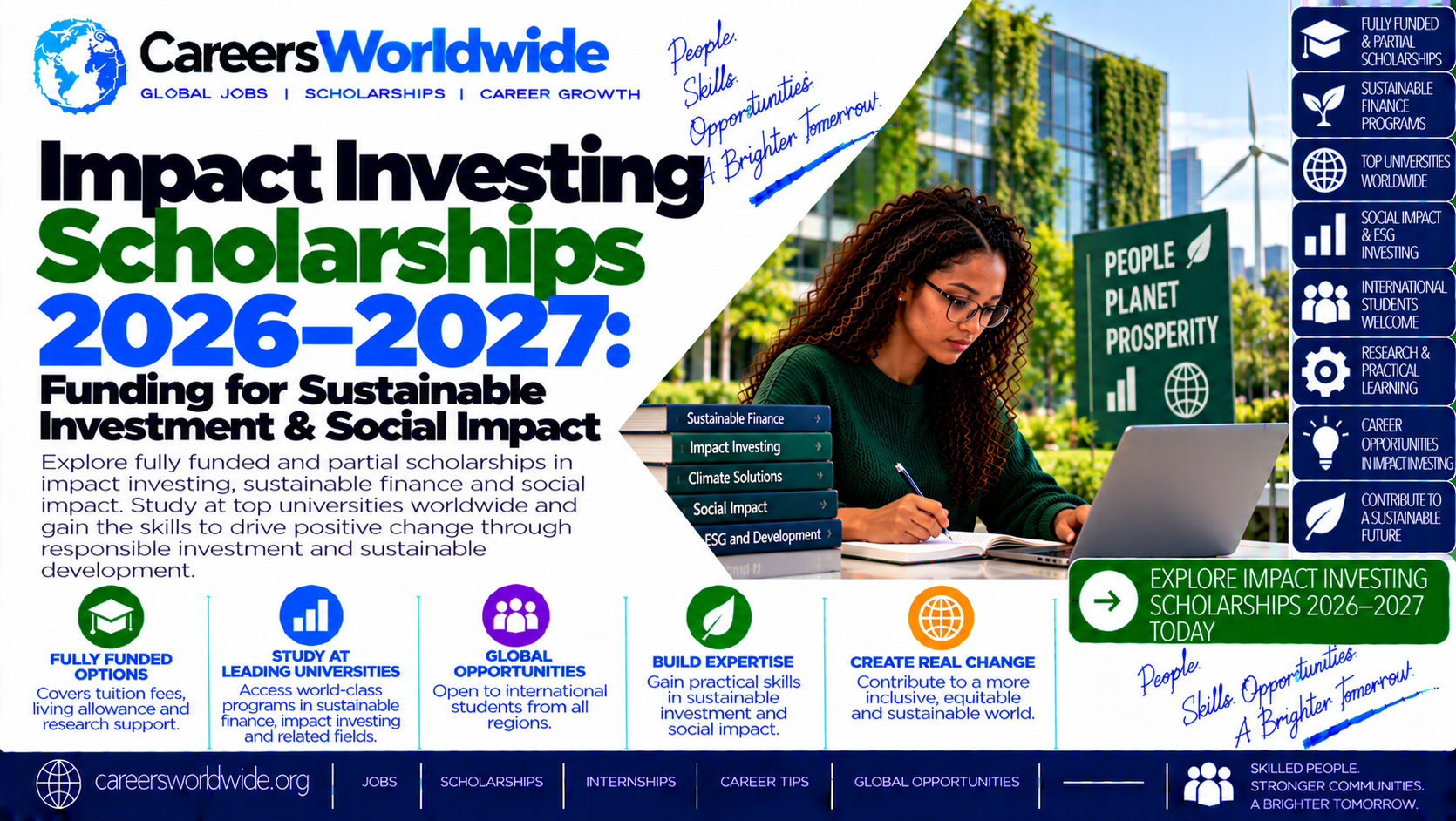

Excerpt: Interested in building a career in sustainable finance, impact investing, or responsible investment? Impact investing scholarships for 2026–2027 can help eligible students explore funding opportunities for postgraduate degrees, sustainability programmes, finance courses, and professional development related to social and environmental impact. Discover where to look for funding, which qualifications may be relevant, how to prepare a competitive application, and how to identify legitimate scholarship opportunities for the next generation of impact investors.
Impact Investing Scholarships 2026–2027: Overview
Impact investing is attracting attention from students and professionals who want to combine financial performance with measurable social and environmental benefits. From financing renewable energy projects to supporting affordable housing, healthcare, education, and small businesses, impact investing offers a way to connect investment decisions with real-world outcomes.
For students interested in this growing field, scholarships and related funding opportunities can make advanced education more accessible.
However, Impact Investing Scholarships 2026–2027 should not be understood as one universal scholarship programme offered by a single organisation. Instead, the term describes a range of potential funding routes, including university scholarships, sustainable finance fellowships, development finance programmes, responsible investment courses, and awards supporting students interested in social entrepreneurship and environmental sustainability.
The availability of funding depends on the institution, course, country, applicant profile, and application cycle. Some opportunities support tuition fees, while others offer partial fee reductions, stipends, research grants, or financial assistance for professional training.
Students should therefore identify a suitable programme first, then confirm whether it offers a scholarship specifically connected to impact investing or a broader award that can support relevant studies.
This guide explains how to approach these opportunities for the 2026–2027 academic year, where to find official information, which documents to prepare, and how to make a stronger application.
1. What Are Impact Investing Scholarships?
Impact investing scholarships are funding opportunities that support education or professional development in fields connected to investments that seek both financial returns and measurable positive social or environmental outcomes.
Depending on the provider, relevant study areas may include:
- Sustainable and responsible finance.
- Environmental, social and governance (ESG) investing.
- Social impact measurement and management.
- Development finance and inclusive investment.
- Climate finance and renewable energy investment.
- Social entrepreneurship and enterprise development.
- Sustainable business and corporate responsibility.
- Public policy, economics, and international development.
- Financial inclusion and small-business financing.
- Green bonds and sustainable capital markets.
Some funding programmes explicitly mention impact investing. Others support broader qualifications in finance, economics, sustainability, development studies, or business administration that can lead to related careers.
For example, a student pursuing a master’s degree in sustainable finance might investigate university merit scholarships, while a professional seeking to specialise in social impact measurement might consider fellowships or professional development awards.
The important distinction is that a scholarship does not necessarily need to carry the words “impact investing” in its title to be relevant. What matters is whether the funding provider permits the intended course of study and whether the programme supports the applicant’s academic and professional objectives.
2. Impact Investing Scholarships 2026–2027: Summary Table
| Scholarship information | Details |
|---|---|
| Opportunity category | Sustainable investment and social impact education funding |
| Academic period | 2026–2027 |
| Funding providers | Universities, foundations, professional bodies and development organisations |
| Potential study levels | Undergraduate, postgraduate and professional development, depending on the provider |
| Relevant subjects | Impact investing, sustainable finance, ESG, climate finance and development finance |
| Funding types | Tuition scholarships, partial fee awards, stipends, fellowships and research grants |
| Eligible applicants | Varies by scholarship and institution |
| Geographic eligibility | Depends on the individual programme |
| Academic requirements | Set by the relevant university or funding organisation |
| Work experience | May be required for some professional programmes, but not all |
| Application method | Through the official scholarship provider |
| Deadlines | Vary by institution and funding cycle |
| Main application resources | University scholarship portals and official funding organisations |
Important: This is a guide to a category of funding opportunities, not a confirmed list of awards with one shared application form. Individual scholarships must be verified before applicants rely on a particular amount, deadline, or eligibility requirement.
3. Why Study Impact Investing in 2026–2027?
Impact investing sits at the intersection of financial decision-making and the search for measurable solutions to social and environmental challenges.
Traditional investment analysis often concentrates on risk, return, and financial performance. Impact investing adds a deliberate intention to generate positive outcomes alongside financial returns, with an emphasis on measuring whether those outcomes occur.
This approach can be relevant to investors financing renewable energy, agricultural innovation, affordable healthcare, education technology, financial inclusion, and sustainable infrastructure.
Growing demand for specialised knowledge
Professionals working in sustainable finance may need to understand financial modelling, portfolio analysis, climate risk, development economics, impact measurement, and investment due diligence.
A relevant degree or professional qualification can help students build these skills, although employment outcomes depend on individual experience, market conditions, and the requirements of each employer.
Opportunities across different sectors
Impact investing is not limited to investment banks or specialist investment funds. Related work can take place in:
- Development finance institutions.
- Private equity and venture capital firms.
- Foundations and philanthropic investment organisations.
- Social enterprises and mission-driven businesses.
- Commercial banks with sustainable finance activities.
- Climate investment and renewable energy companies.
- Consulting firms specialising in sustainability.
- International development organisations.
- Non-governmental organisations working on economic inclusion.
A combination of financial and social analysis
Students interested in both finance and social outcomes may find the field especially appealing. The work can involve assessing a company’s financial viability while also examining its potential contribution to employment, access to essential services, emissions reduction, or other measurable outcomes.
Scholarships can reduce the cost of acquiring the specialist knowledge needed to pursue these career paths.
4. Where to Find Impact Investing Scholarships for 2026–2027
The most reliable approach is to search established universities, professional investment organisations, and development-focused institutions. The following resources are useful starting points, although not all represent scholarships specifically named for impact investing.
<text color=”secondary” size=”sm”>The opportunities below are distinct funding routes. Confirm eligibility, current availability, and whether the funding can be used for your intended course before applying.</text>
A. University scholarships in sustainable finance and development
Universities offering programmes in finance, economics, sustainability, business, and development studies may provide merit-based scholarships or financial assistance to eligible international students.
Search the official scholarship pages of universities offering relevant degrees. Look for funding categories such as international merit scholarships, postgraduate taught scholarships, sustainability awards, development studies funding, and faculty-specific bursaries.
When comparing awards, check whether they cover tuition fees, living costs, or both. Some scholarships are automatically considered during admission, while others require a separate application.
B. CFA Institute scholarship opportunities
The <Entity value=”CFA Institute” category=”organization” disambig=”Global investment education and professional standards organisation”/> offers scholarship programmes that can reduce the cost of eligible professional investment qualifications.
Its Student Scholarship programme is available to eligible students enrolled at participating affiliated universities who have not yet registered for their next CFA Program exam. For scholarships awarded from 4 March 2026, the registration fee is reduced to US$600 under the applicable package. The published application window runs from 1 September through 15 July.
This is not a dedicated impact investing degree scholarship. Nevertheless, the CFA Program may be relevant to people developing broader investment analysis and portfolio management skills.
Applicants should review the official eligibility rules before applying.
C. CFA Institute Sustainable Investing Certificate
The CFA Institute Sustainable Investing Certificate is a professional education option for learners interested in incorporating environmental, social, and governance factors into investment decisions.
The curriculum covers ESG analysis, investment integration, portfolio construction, stewardship, and client reporting. The programme is available online in most countries, subject to examination arrangements.
The certificate is a paid professional qualification rather than a scholarship. However, some learners may qualify for regional subsidies, employer-supported training, or other funding arrangements listed by the provider.
For example, CFA Institute identifies funding schemes for eligible residents of Hong Kong and Macau, as well as a professional training subsidy arrangement in Singapore. These schemes have their own residence and programme conditions; they should not be assumed to be available to applicants worldwide.
D. Development finance and social impact fellowships
Students interested in investment for poverty reduction, healthcare, agriculture, climate resilience, or financial inclusion should also investigate development finance organisations and social impact institutions.
Potential funding categories include research grants, graduate fellowships, entrepreneurship programmes, and professional development opportunities.
Some programmes support people who already have work experience, while others target university students or early-career professionals. Review each provider’s official website for the current intake and funding conditions.
E. Climate finance and sustainability funding
Climate finance is closely related to impact investing because it can direct capital towards renewable energy, clean transport, climate adaptation, energy efficiency, and other environmental objectives.
Applicants can search for university funding in climate economics, sustainable finance, environmental management, and energy policy.
A scholarship may not use the term “impact investing,” but it could still support a relevant academic pathway. Confirm that the intended programme meets the funding provider’s requirements.
5. Which Courses Should You Consider?
5. Which Courses Should You Consider?
Choosing the right course is an important step toward building a career in impact investing. The best programme should help you understand how to evaluate investment opportunities, measure social and environmental outcomes, and make financially sound decisions.
Depending on your academic background and career goals, consider the following study areas.
1. Master’s in Sustainable Finance
This programme focuses on integrating sustainability considerations into financial decision-making. Students may study ESG analysis, sustainable investment strategies, portfolio management, financial risk, and responsible investment.
Career opportunities: Sustainable Finance Analyst, ESG Investment Analyst, Portfolio Analyst, and Responsible Investment Specialist.
Funding options: Explore university postgraduate scholarships, international student merit awards, and sustainable finance fellowships.
2. Climate Finance and Environmental Economics
This field examines how capital can support climate action, renewable energy, environmental protection, and sustainable infrastructure. Students may learn about green bonds, climate risk assessment, carbon markets, and financing renewable energy projects.
Career opportunities: Climate Finance Analyst, Green Investment Analyst, Environmental Economist, and Renewable Energy Finance Associate.
Funding options: Search for climate finance scholarships, environmental economics awards, and postgraduate funding in sustainability or energy policy.
3. Development Finance and International Development
Development finance focuses on financing projects and businesses that contribute to economic growth, poverty reduction, job creation, and improved access to essential services. It is relevant to students interested in investment funds, development banks, and inclusive economic development.
Career opportunities: Development Finance Analyst, Investment Associate, Financial Inclusion Specialist, and Development Programme Finance Officer.
Funding options: Investigate university scholarships in development economics, international development, finance, and economic policy.
4. Social Entrepreneurship and Impact Investment Management
These programmes explore how businesses and investment funds can address social challenges while maintaining financial sustainability. Relevant subjects may include business modelling, venture capital, investment appraisal, social enterprise management, and impact measurement.
Career opportunities: Impact Investment Analyst, Social Enterprise Finance Manager, Investment Associate, and Social Impact Consultant.
Funding options: Look for scholarships in entrepreneurship, business administration, social innovation, and impact-oriented investment programmes.
5. Social Impact Measurement and Management
This study area focuses on evaluating whether investments achieve their intended social and environmental benefits. Students may learn to assess job creation, financial inclusion, healthcare access, educational outcomes, and environmental improvements using evidence-based measurement methods.
Career opportunities: Impact Measurement Analyst, ESG Reporting Specialist, Sustainability Analyst, and Social Impact Evaluation Officer.
Funding options: Explore scholarships in sustainability management, public policy, development studies, and social impact research.
How to Choose the Right Programme
Before applying, compare the curriculum, entry requirements, tuition fees, scholarship availability, and career outcomes of each programme. Prioritise courses that combine financial analysis with practical methods for measuring impact.
Remember that a relevant degree does not automatically qualify you for a scholarship. Confirm that the funding provider accepts your chosen course and that you meet its eligibility requirements.
6. Eligibility Requirements: Who Can Apply?
There is no single eligibility standard for all impact investing-related scholarships. Each university or funding organisation determines its own criteria.
Nevertheless, the following requirements are common across many academic funding programmes.
Academic qualifications: Undergraduate scholarships may require school-leaving qualifications, while postgraduate awards usually require a recognised bachelor’s degree. Competitive awards may require grades above the minimum admission threshold.
Relevant academic interests: Applicants may need to demonstrate a connection between their proposed studies and finance, investment, sustainability, economics, development, or social enterprise.
Country of residence or nationality: Some awards are open internationally, while others are restricted to applicants from particular countries or regions.
Admission to an eligible programme: University scholarships may require an offer of admission before funding can be awarded.
English-language requirements: International applicants may need to meet the institution’s language requirements through accepted qualifications or other approved evidence.
Professional experience: Certain fellowships and executive programmes require relevant work experience. Many university scholarships, however, are open to students without an established career.
Financial need or merit: Some awards prioritise academic excellence, while others assess financial circumstances, leadership potential, community impact, or a combination of factors.
Do not assume that every scholarship requires financial need or that all awards are exclusively merit-based. Read the official conditions carefully.
7. How to Apply for Impact Investing Scholarships 2026–2027
The application process becomes easier when you approach it systematically.
Step 1: Identify your preferred study pathway
Decide whether you want to pursue a full degree, a short professional qualification, a research programme, or a fellowship.
For example, a recent graduate may prefer a master’s degree in sustainable finance, while an investment professional may benefit from a specialised certificate or executive programme.
Step 2: Search for verified funding opportunities
Use official university scholarship portals, professional education providers, and recognised development organisations.
Search using phrases such as:
- Sustainable finance scholarships 2027.
- ESG investing postgraduate funding.
- Impact investment fellowships.
- Climate finance scholarships for international students.
- Development finance master’s scholarships.
- Social entrepreneurship funding for graduate students.
Treat these as search terms rather than confirmed scholarship titles.
Step 3: Verify the course and funding conditions
Read the full eligibility criteria. Confirm that the award applies to your nationality or domicile, academic level, course, and intended start date.
Check whether funding is automatic or requires a separate application.
Step 4: Apply for admission if necessary
If the scholarship requires an offer, submit your academic application through the institution’s official admissions system.
Pay attention to course prerequisites, transcript requirements, application fees, and any language tests that may be required.
Step 5: Prepare your scholarship statement
Explain why you want to study impact investing, what you hope to learn, and how your studies connect to a clear professional or social objective.
Use specific examples from your academic work, employment, volunteering, or community involvement where relevant.
Step 6: Submit the required documents
Upload all documents in the requested format. Follow word limits and ensure that names, dates, grades, and other information match your official records.
Step 7: Track the deadline and decision
Keep a record of submission dates, confirmation emails, interview invitations, and requests for further information.
Scholarship deadlines can fall well before the academic year begins, so do not wait until the last moment.
<WritingBlock id=”62915″ variant=”document”>## 8. Documents to Prepare Before Applying
The exact documents depend on the funding provider, but preparing a standard application folder can save time.
Commonly requested documents include:
- Academic transcripts and certificates.
- A current CV or résumé.
- A personal statement or scholarship essay.
- A university admission offer, if required.
- References or recommendation letters, where requested.
- Proof of English-language proficiency, if applicable.
- A valid passport or other identification when required.
- Evidence of financial circumstances for need-based awards.
- A research proposal for scholarships supporting research degrees.
- Evidence of relevant employment, volunteering, or leadership experience, if required.
Not every programme requires all these documents. Avoid sending sensitive financial or identification documents to unofficial websites. Submit them only through the provider’s verified application system.
9. How to Write a Strong Impact Investing Scholarship Essay
A compelling scholarship statement should demonstrate that you understand both the financial and impact dimensions of investment.
Explain your motivation
Describe what led you to become interested in impact investing. You might be interested in financing small businesses, expanding access to healthcare, supporting clean energy, or developing financial services for underserved communities.
Make the explanation personal and specific without exaggerating your experience.
Identify the skills you want to develop
Explain whether you want to improve your financial analysis, investment valuation, ESG research, impact measurement, or understanding of development finance.
Connect these skills directly to the programme’s curriculum.
Demonstrate your potential contribution
If you have participated in community initiatives, research projects, business activities, or sustainability programmes, explain what you learned and how that experience influenced your goals.
Applicants without professional experience can use relevant academic projects, volunteer activities, or independent research where appropriate.
Describe your intended impact
Explain how you hope to apply your education after completing the programme. For instance, you might aim to help assess investments in renewable energy, support small enterprises, or measure the social outcomes of development projects.
Avoid promising outcomes that are unrealistic or outside your control.
Show why the funding matters
If the scholarship asks about financial need, explain your circumstances accurately and provide any evidence requested.
If it is a merit-based award, focus on your academic achievements, initiative, and suitability for the programme.
10. Career Opportunities After Studying Impact Investing
Impact investing combines knowledge from several disciplines, so graduates may pursue different career paths depending on their qualifications and experience.
Potential roles include:
- Impact Investment Analyst: Evaluates investment opportunities alongside their intended social or environmental outcomes.
- ESG Analyst: Examines environmental, social, and governance risks and practices relevant to companies or investments.
- Sustainable Finance Analyst: Supports the analysis of financial products and investment strategies connected to sustainability.
- Development Finance Associate: Works on financing initiatives that support economic development and private-sector growth.
- Social Impact Measurement Specialist: Develops methods to assess and report the outcomes of funded programmes or investments.
- Climate Finance Analyst: Supports analysis of funding for climate mitigation, adaptation, and related projects.
- Responsible Investment Researcher: Researches investment practices, sustainability risks, stewardship, and corporate performance.
- Social Enterprise Finance Officer: Helps mission-driven organisations assess funding needs and financial sustainability.
These are potential career directions, not guaranteed outcomes of receiving a scholarship. Employers may require additional qualifications, financial modelling experience, research skills, or relevant work experience.
Students should review job descriptions in their preferred market to identify the most useful technical and professional skills.
11. Practical Advice for International Applicants
International students should assess the total cost of studying before accepting a scholarship or enrolling in a programme.
Start by calculating the tuition fee after any confirmed scholarship deduction. Then estimate accommodation, food, transport, insurance where applicable, travel, visa costs, and personal expenses.
If the scholarship covers only a small portion of tuition, investigate whether other legitimate funding sources can help bridge the gap.
Applicants should also consider the following:
Check the academic calendar. A scholarship listed for 2026–2027 may have an application deadline in 2026, while another may accept applications into 2027.
Understand the award duration. Some scholarships cover one academic year, while others may be renewable subject to academic progress or other conditions.
Confirm payment arrangements. Tuition discounts are different from cash awards. Read the award letter to establish how funding is applied.
Investigate alternative programmes. If a particular scholarship is closed or unavailable in your country, consider other relevant university awards or professional training options.
Avoid scholarship scams. Be cautious of organisations demanding unexplained upfront payments, guaranteeing awards, or requesting banking passwords. Verify the provider and application process independently.
For applicants planning to study abroad, consult official immigration information before making travel or financial commitments.
12. Official Application Resources
The following resources provide starting points for researching legitimate opportunities in sustainable investment, finance, and related fields.
Professional investment education
- CFA Institute scholarships: https://www.cfainstitute.org/programs/cfa-program/scholarships/student
- CFA Institute Sustainable Investing Certificate: https://www.cfainstitute.org/programs/sustainable-investing-certificate
- CFA Institute sustainable investing programmes: https://www.cfainstitute.org/programs/sustainable-investing
These resources cover professional investment education and selected funding arrangements. They should not be interpreted as a guarantee of a dedicated impact investing scholarship.
University funding
Visit the official websites of universities offering programmes in sustainable finance, development finance, economics, environmental economics, and responsible investment.
Look for dedicated pages covering international student funding, postgraduate scholarships, faculty awards, and sustainability-related courses.
Development and sustainability organisations
Research established organisations involved in climate finance, inclusive economic development, social enterprise, and responsible investment. Some may publish fellowships, research grants, or professional development opportunities.
Confirm that each opportunity is currently accepting applications and that the award supports your intended programme.
Official application checklist
Before submitting an application, confirm:
- The provider’s official name and website.
- The scholarship’s current availability.
- The eligible countries and study levels.
- The precise funding amount and what it covers.
- The application deadline and time zone.
- The required supporting documents.
- Whether an admission offer is required.
- Whether there are restrictions on combining awards.
13. Frequently Asked Questions
1. What are Impact Investing Scholarships 2026–2027?
The term refers to funding opportunities that may support education or professional development in impact investing, sustainable finance, ESG, climate finance, and related disciplines. It does not refer to one universal scholarship with a single application process.
2. Are there fully funded impact investing scholarships?
Some broader postgraduate or development-related scholarships may cover tuition and living expenses, but funding varies significantly. Applicants must verify the benefits of each individual award rather than assume that an impact investing-related scholarship is fully funded.
3. Can international students apply?
Some university scholarships and professional funding schemes accept international applicants, while others have nationality, residence, or institutional restrictions. Eligibility must be confirmed with the provider.
4. Can students from Zimbabwe apply?
Zimbabwean applicants can investigate international university scholarships and relevant professional funding opportunities. However, eligibility depends on the specific programme, country restrictions, academic requirements, and application cycle. Do not assume that every opportunity accepts Zimbabwean applicants.
5. Which degree is best for a career in impact investing?
Suitable pathways may include sustainable finance, finance, economics, development finance, environmental economics, and business administration. The best choice depends on your career goals and the skills required by prospective employers.
6. Do I need work experience?
Not always. Some university scholarships accept recent graduates, while professional fellowships and executive programmes may require relevant employment experience. Check the eligibility rules before applying.
7. Can I receive funding for a professional certificate?
Potentially. Some professional education providers offer scholarships or fee reductions, and some employers or governments subsidise eligible training. Availability depends on the provider and the applicant’s circumstances.
8. Is the CFA Institute Student Scholarship an impact investing scholarship?
No. It is a scholarship that reduces the cost of registering for the CFA Program for eligible students. The broader investment knowledge may be relevant to an impact investing career, but the award is not specifically a scholarship for an impact investing degree.
9. When should I apply for 2026–2027 funding?
As early as possible. Some funding opportunities open months before the academic year begins, and others have deadlines that depend on the institution or programme. Check official pages regularly for current dates.
10. What documents are usually required?
Depending on the programme, applicants may need academic transcripts, a CV, a personal statement, references, an admission offer, and evidence of financial need or relevant experience.
11. How can I avoid scholarship scams?
Use official university and funding-provider websites, verify contact information, read the terms and conditions, and avoid guarantees of selection in exchange for unexplained fees. Never disclose banking passwords or security credentials.
12. Does a scholarship guarantee employment after graduation?
No. A scholarship supports education or training but does not guarantee employment. Career outcomes depend on qualifications, experience, skills, labour-market conditions, and individual circumstances.
Conclusion
Impact investing offers an opportunity to connect financial decision-making with measurable social and environmental objectives. For students and professionals interested in sustainable finance, development finance, ESG analysis, or social enterprise, relevant scholarships can help make education and specialist training more accessible.
The most effective approach is to identify a suitable programme, investigate its official funding opportunities, confirm eligibility, and prepare a focused application that explains your academic interests and future goals.
For the 2026–2027 academic period, explore university scholarships, professional investment education funding, and relevant development or sustainability fellowships. Remember that not every funding opportunity is dedicated exclusively to impact investing, and availability varies by provider.
Always verify the award amount, eligibility requirements, and deadline directly with the organisation offering the funding before applying.
Disclaimer
This article is for general informational and educational purposes. “Impact Investing Scholarships 2026–2027” describes a category of potential funding opportunities rather than one confirmed scholarship programme. Funding availability, eligibility, award values, application requirements, and deadlines may change. The inclusion of an organisation or resource does not mean that it offers a dedicated impact investing scholarship. Applicants should consult official provider websites and confirm all details before submitting documents or making financial commitments. No scholarship or employment outcome is guaranteed.
SEO Keywords
Impact Investing Scholarships 2026–2027,
impact investing scholarships for international students,
sustainable finance scholarships 2027,
ESG investing scholarships,
social impact investment funding,
impact investment fellowships 2026,
climate finance scholarships 2027,
development finance scholarships for international students,
responsible investment education funding,
sustainable investment postgraduate scholarships,
scholarships for sustainable finance master’s degrees,
social entrepreneurship scholarships 2026–2027,
international scholarships for finance students,
CFA Institute Student Scholarship 2027,
CFA Institute Sustainable Investing Certificate,
ESG analyst education and funding,
green finance scholarships for students,
impact measurement and management courses,
scholarships for social enterprise students,
how to apply for impact investing scholarships,
ALSO CHECK: Global Futures Scholarships 2027: University of Manchester Funding for International StudentsOctober 11, 2026
Japanese Government MEXT Scholarships 2027: Study Opportunities in JapanOctober 11, 2026
2027 Africa International Scholarship at Edith Cowan University: 20% Tuition Fee ReductionOctober 10, 2026