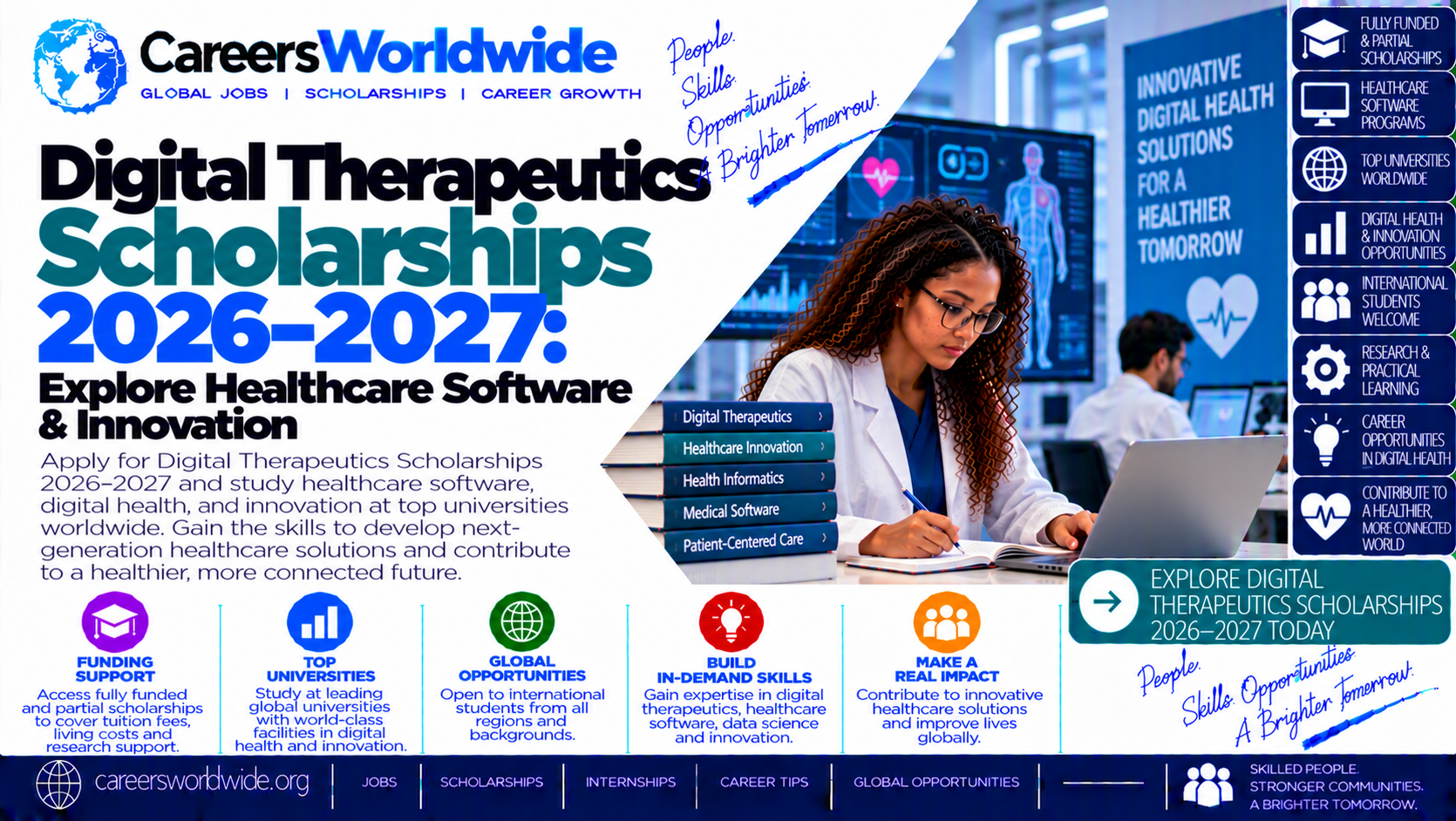

Excerpt: Discover digital therapeutics scholarships for 2026–2027 and explore funding opportunities in healthcare software, digital health, medical technology, artificial intelligence, and personalized medicine. Learn which universities, foundations, and scholarship programmes may support your studies, how to identify eligible funding, and how to prepare a competitive application for digital health and healthcare innovation programmes.
The healthcare industry is undergoing a major transformation as software, data science, artificial intelligence, and evidence-based digital interventions become increasingly important in patient care. From mobile applications that support diabetes management to software designed to help patients manage chronic conditions, digital therapeutics is creating new opportunities for students interested in combining technology with healthcare.
For the 2026–2027 academic year, students interested in this emerging field can investigate scholarships in digital health, biomedical engineering, health informatics, medical technology, computer science, public health, and related disciplines.
An important distinction: “Digital Therapeutics Scholarships 2026–2027” is a topic for finding relevant funding, not the name of one verified, universal scholarship programme. The opportunities discussed below are potential funding routes through established scholarship schemes, universities, and specialist programmes. Eligibility, award amounts, application deadlines, and course availability must be confirmed through official sources.
This guide explains how to identify suitable funding, which qualifications to consider, where to search for legitimate opportunities, and how to prepare an application that connects your academic goals with healthcare software innovation.
1. What Are Digital Therapeutics?
Digital therapeutics, often abbreviated as DTx, refers to evidence-based therapeutic interventions delivered through software to prevent, manage, or treat medical conditions. These interventions may be provided through mobile applications, web platforms, connected devices, or other digital systems.
Unlike general wellness applications, digital therapeutics are designed around specific health outcomes and may require clinical evidence to demonstrate their effectiveness. Depending on the product and intended use, regulatory requirements may also apply.
Examples of areas where digital therapeutics and related digital health technologies are being developed include:
- Diabetes self-management and remote monitoring.
- Digital programmes supporting mental health treatment.
- Software-assisted rehabilitation and recovery.
- Medication adherence and chronic disease management.
- Personalized healthcare and patient education.
- Digital interventions supporting sleep and behavioural change.
- Remote patient monitoring and care coordination.
- Clinical decision-support systems and healthcare analytics.
Students entering this field may combine knowledge of software engineering, medicine, psychology, data science, human-computer interaction, public health, and clinical research.
Scholarship applicants should understand that studying digital therapeutics does not necessarily require a medical degree. The appropriate qualification depends on whether the student wants to develop software, evaluate clinical outcomes, conduct research, design patient experiences, or manage digital health products.
2. Why Consider Digital Therapeutics Scholarships in 2026–2027?
Digital health innovation requires professionals who understand both technology and the needs of patients and healthcare providers. However, postgraduate education, specialist training, and international study can be expensive.
Scholarships can help eligible students cover tuition fees, living costs, research expenses, travel, or other approved educational expenses.
The 2026–2027 academic cycle is a useful time to investigate funding because students can search across multiple academic disciplines rather than limiting their options to programmes explicitly labelled “digital therapeutics.”
For example, a student interested in developing software for chronic disease management might qualify for a health informatics scholarship. Another applicant planning to evaluate the clinical effectiveness of digital interventions might find more relevant funding through public health, clinical research, or health technology assessment programmes.
Potential benefits include:
Reduced study costs: Depending on the award, funding may cover part or all of the tuition fee.
Access to specialist education: Students may be able to pursue master’s degrees, doctoral research, or professional training in digital health-related subjects.
Research opportunities: Some funded programmes support research projects involving medical software, patient outcomes, digital health data, or healthcare delivery.
International exposure: Eligible students may gain access to universities, research institutions, and interdisciplinary teams in other countries.
Career development: Relevant education can help graduates prepare for roles in health technology companies, hospitals, research institutions, public health organisations, and medical software development.
It is important to distinguish scholarships from fellowships, research assistantships, tuition discounts, and paid internships. All can support education or career development, but they have different eligibility rules and financial arrangements.
3. Who Can Apply for Digital Therapeutics Scholarships?
Eligibility varies by scholarship provider and university. There is no single set of requirements that applies to every digital health funding opportunity.
Potential applicants include undergraduate students seeking financial assistance, graduates pursuing a master’s degree, doctoral researchers, and professionals planning to specialise in digital healthcare innovation.
Students from technology backgrounds
Applicants with degrees or diplomas in software engineering, computer science, information technology, data science, cybersecurity, or artificial intelligence may be interested in developing therapeutic applications, secure healthcare platforms, and clinical software.
Depending on the university, these students may be eligible for postgraduate programmes in health informatics, biomedical informatics, digital health, or health technology.
Students from healthcare backgrounds
Graduates in nursing, medicine, pharmacy, psychology, public health, physiotherapy, and other health-related fields may explore digital interventions that improve treatment adherence, rehabilitation, patient engagement, or disease management.
Their clinical understanding can be particularly valuable when studying how software should be designed, evaluated, and integrated into healthcare services.
Students interested in research
Research-focused candidates may investigate scholarships supporting doctoral study or master’s research in areas such as clinical trials, digital mental health, medical software evaluation, health economics, and artificial intelligence in medicine.
Research funding often has more specific requirements, including a suitable academic background, a research proposal, or the agreement of a potential supervisor.
International students
International applicants should look for funding that explicitly accepts their nationality and country of residence.
Some scholarships are open to applicants worldwide, while others are restricted by citizenship, residency, development priorities, or participating institutions. English-language qualifications, academic equivalency, and visa requirements may also apply.
Practical advice: Search for the degree you want to study first, then identify scholarships that accept applicants for that specific programme. This is usually more effective than looking only for awards containing the words “digital therapeutics.”
4. Scholarship Opportunities to Investigate for 2026–2027
The following are established funding routes that may help students pursue relevant healthcare software and innovation studies. They are not all dedicated digital therapeutics scholarships, and funding is not guaranteed for every course or intake.
Important: The academic year, funding call, course availability, and deadlines differ by provider. Confirm each programme’s current application status before applying.
Opportunity 1: Erasmus Mundus Joint Masters scholarships
Location: Europe and participating international institutions
The Erasmus Mundus Joint Masters programme is a useful starting point for international students interested in interdisciplinary master’s education. Participating degrees are delivered by international consortia of higher education institutions.
The official programme explains that full scholarships are available to highly ranked students on selected courses. Depending on the award, financial support can contribute to participation costs, travel, visa expenses, and living costs.
Erasmus+
+1
Relevant subjects to investigate include:
- Health data science and medical informatics.
- Biomedical engineering and medical technology.
- Artificial intelligence and computational science.
- Public health and health systems.
- Digital innovation and interdisciplinary research.
Not every Erasmus Mundus course covers these subjects, so check the current course catalogue carefully.
How to apply: Find a relevant master’s degree through the official Erasmus Mundus website, review the consortium’s eligibility requirements, and apply directly to the institution or programme coordinator.
The official programme indicates that many courses accept applications between October and January for the following academic year, although individual schedules differ. Consequently, students planning to start in 2027 should investigate upcoming calls early.
Erasmus+
Official resource: Erasmus Mundus Joint Masters
Opportunity 2: Chevening Scholarships
Location: United Kingdom
Chevening supports eligible emerging leaders pursuing one-year master’s degrees at UK universities.
Students interested in digital therapeutics can investigate eligible courses in health informatics, health technology, biomedical engineering, public health, or related disciplines. The scholarship is not restricted to these fields, and applicants must satisfy the programme’s own requirements.
Chevening
+1
Chevening may be particularly relevant to professionals who want to use advanced training to improve healthcare services, build technology-led organisations, or influence health policy in their home countries.
Applicants should be prepared to explain:
- Why their chosen master’s degree is necessary.
- How the course connects to their previous experience.
- What healthcare problem they want to address.
- How their plans align with leadership and future impact.
2026–2027 application status: As of 11 October 2026, the published application timeline for the 2027–2028 Chevening cycle shows a closing date of 6 October 2026. That deadline has passed. Students should check official announcements for any future cycle rather than assume applications remain open.
Chevening
+1
Official resources:
Opportunity 3: University-funded digital health and biomedical research
Location: Varies by university and country
Many universities offer scholarships, tuition reductions, graduate assistantships, or funded research positions in technology and healthcare disciplines.
Rather than assuming a university has a dedicated digital therapeutics award, look for its official postgraduate funding pages and research vacancies.
Search for courses and projects involving:
- Biomedical informatics.
- Digital health and healthcare innovation.
- Medical device software.
- Clinical artificial intelligence.
- Human-computer interaction in healthcare.
- Health data analytics.
- Digital mental health interventions.
For master’s students, support may take the form of merit scholarships, need-based financial assistance, or awards for international applicants. Doctoral students may find funded projects where tuition support or a stipend is linked to a specific research position.
How to apply: Identify a university with relevant research expertise, check admission and funding requirements, and contact the programme coordinator or prospective supervisor if the university permits pre-application enquiries.
A strong research application should demonstrate how your proposed work relates to an existing research group without simply repeating the description of its project.
Opportunity 4: Government and international postgraduate scholarships
Students can also investigate government-funded scholarships in their preferred destination country.
These programmes may support postgraduate study in science, technology, engineering, health, or development-related fields. However, the subjects covered and nationalities accepted depend on the specific award.
Potential sources include:
- National scholarship agencies.
- Government international education programmes.
- Bilateral education agreements.
- Public research funding agencies.
- Official embassy scholarship announcements.
Before applying, confirm whether the scholarship permits your chosen subject, whether the university is eligible, and whether the funding covers tuition, living costs, insurance, and travel.
A general government scholarship can be an excellent funding route for digital therapeutics study, even when the scholarship itself is not dedicated to healthcare software.
Opportunity 5: Research assistantships and doctoral funding
For applicants interested in developing or evaluating digital therapeutics, a research position can provide an alternative to a conventional scholarship.
Universities and research institutions sometimes recruit graduate researchers to work on funded projects involving clinical informatics, medical devices, digital interventions, or health data.
Depending on the position, the funding package may include a stipend, tuition support, salary, or project expenses. These arrangements vary considerably.
Search university vacancies using phrases such as:
- Funded PhD in digital health.
- Doctoral researcher in health informatics.
- Digital therapeutics clinical research.
- Research assistant in medical software.
- AI in healthcare funded studentship.
Read the vacancy carefully to establish whether it is a salaried position, a studentship, or an unpaid research opportunity. Also check whether international candidates are eligible.
5. Summary Table: Digital Therapeutics Funding Routes
| Funding route | Relevant study areas | What to verify |
|---|---|---|
| Erasmus Mundus Joint Masters | Interdisciplinary technology and health-related master’s degrees | Course catalogue, scholarship availability, intake |
| Chevening Scholarships | Eligible UK master’s degrees in related fields | Country eligibility, cycle status, course requirements |
| University scholarships | Digital health, informatics, biomedical engineering | Award rules, tuition coverage, nationality |
| Government scholarships | Science, health, technology and research | Eligible countries, subjects and universities |
| Research assistantships | Clinical software, health data, digital interventions | Funding package, supervisor, employment terms |
| Doctoral studentships | Medical technology and digital health research | Research fit, stipend, fees and entry requirements |
The funding categories above are starting points for research, not a guarantee that an award is open or that a particular degree qualifies.
6. Which Courses Should You Study?
Choosing the right academic programme is one of the most important decisions when applying for digital therapeutics funding. Your course should match the career you want to pursue and the skills you need to develop.

Health Informatics
Suitable for students who want to connect information technology with clinical records, healthcare data, patient information systems, and digital service delivery.
Potential careers: health informatics analyst, clinical systems specialist, digital health consultant.

Software Engineering and Computer Science
Relevant to applicants interested in building secure healthcare applications, patient-facing software, medical platforms, and data-driven digital interventions.
Potential careers: healthcare software engineer, mobile application developer, health technology product engineer.

Biomedical Engineering
Combines engineering principles with biological and medical applications. Depending on the programme, it can support work involving medical devices, sensors, connected health systems, and software-enabled treatments.
Potential careers: biomedical engineer, medical technology researcher, digital medical device specialist.

Public Health and Clinical Research
Appropriate for students who want to assess whether digital interventions improve health outcomes, reach underserved populations, or deliver value within healthcare systems.
Potential careers: clinical research coordinator, public health researcher, digital health evaluation specialist.

Artificial Intelligence and Health Data Science
Focuses on analysing healthcare information, developing predictive models, and supporting evidence-based decisions. Applicants should pay particular attention to privacy, bias, clinical validation, and responsible use of patient data.
Potential careers: health data scientist, medical AI researcher, clinical analytics specialist.
These are related academic pathways rather than a list of confirmed scholarship-funded courses. Check the actual curriculum and entry requirements before selecting a programme.
7. Eligibility Requirements to Prepare For
Although requirements differ, applicants should prepare for the following common criteria.
Academic qualifications: Many master’s scholarships require a recognised undergraduate degree. Doctoral positions generally require appropriate postgraduate preparation or equivalent research experience. Some programmes accept applicants with different backgrounds if they meet prerequisite requirements.
Academic performance: Competitive awards may assess grades, research achievements, professional experience, or evidence of academic potential.
English-language proficiency: Applicants studying in English may need to provide an accepted language test or qualify for an exemption.
Relevant experience: Some scholarships value professional experience, leadership, community involvement, research, or demonstrated interest in healthcare innovation.
Course admission: Funding may require an admission offer, an application to an eligible course, or acceptance into a research project.
Nationality and residency: Government and international scholarships may have strict country-specific rules.
Financial documentation: Some awards assess financial need or require evidence of funding for costs that the scholarship does not cover.
Do not assume that an IT qualification automatically qualifies you for a health-related postgraduate degree. Universities can require specific mathematics, programming, biological science, clinical, or research prerequisites.
8. How to Apply for Digital Therapeutics Scholarships in 2026–2027
Use the following process to organise your applications and reduce the risk of missing a requirement.
- Step 1: Define your specialisationDecide whether you want to develop healthcare software, research digital interventions, work in clinical informatics, or evaluate digital treatment outcomes. A clear direction makes it easier to identify suitable courses and funding.
- Step 2: Identify recognised universitiesSearch official university websites for relevant master’s degrees, doctoral projects, research groups, and postgraduate programmes. Check whether the course is available for your intended start date.
- Step 3: Find the associated fundingReview the university’s scholarships page and the official website of any external funding provider. Record the exact award name, eligible subjects, funding coverage, application deadline, and country restrictions.
- Step 4: Check eligibility before applyingCompare your qualifications, academic results, nationality, language proficiency, and professional experience with the published rules. Contact the admissions office if your qualifications or eligibility are unclear.
- Step 5: Prepare your documentsGather your academic transcripts, certificates, CV, statement of purpose, references, proof of English proficiency where required, and any requested research proposal.
- Step 6: Write a focused personal statementExplain why digital therapeutics interests you, what problem you want to solve, why the course is suitable, and how the training will contribute to your career or community.
- Step 7: Submit the correct applicationsSome funding schemes require separate scholarship and university applications. Others assess scholarship eligibility through the course application. Follow the specific instructions for every programme.
- Step 8: Monitor your applicationCheck your email and application portal for requests, interviews, document verification, and admission decisions. Keep copies of submitted materials and proof of submission.
Documents checklist
Application preparation
0 of 9Updated CV or résuméAcademic certificates and transcriptsPersonal statement or motivation letterTwo or more references, if requiredProof of English-language proficiency, if requiredResearch proposal, where applicablePassport or accepted identity documentAdmission application or offer, if requiredFunding and financial documents, if required
Copy checklistReset
This checklist is a preparation aid. Only submit documents required by the specific scholarship or university.
9. How to Write a Strong Scholarship Personal Statement
A competitive personal statement should show how your interests, experience, and future goals connect with the programme.
Instead of saying only that healthcare technology is growing, explain what you want to achieve through your studies.
For example, a software engineering graduate could describe an interest in developing accessible applications that help patients manage chronic conditions. A public health graduate might explain an interest in evaluating whether digital interventions improve access to care in underserved communities.
A useful statement structure is:
Paragraph 1 — Your motivation: Introduce your academic background and explain why digital therapeutics or digital health innovation interests you.
Paragraph 2 — Your preparation: Describe relevant coursework, professional experience, programming projects, research, volunteering, or healthcare-related work.
Paragraph 3 — Your proposed direction: Identify the skills or knowledge you need from the chosen course and explain why its curriculum is relevant.
Paragraph 4 — Your intended impact: Explain how you intend to apply the knowledge after graduation. Where appropriate, connect your plans to a specific healthcare challenge.
Paragraph 5 — Why you need the scholarship: Explain how funding would make the educational opportunity possible and why you are prepared to use it effectively.
Avoid claiming that a software application will treat or cure a medical condition without evidence. Scholarship committees are more likely to take a carefully defined, realistic project seriously than an exaggerated promise.
For research-focused programmes, consider discussing patient privacy, informed consent, clinical evidence, accessibility, and the ethical use of health data.
10. How to Find Official Scholarship Application Resources
The safest way to find legitimate funding is to begin with official scholarship providers, university admissions offices, and recognised government education websites.
The following resources can help you identify suitable opportunities.

Erasmus Mundus Joint Masters
Explore international master’s programmes and check which participating degrees offer scholarships.
Best for: eligible international master’s applicants.
Visit the official programme website

Chevening Scholarships
Check eligible countries, scholarship requirements, application guidance, and future application cycles.
Best for: eligible applicants pursuing UK master’s degrees.
Visit the official Chevening website

University postgraduate funding offices
Search the websites of universities offering health informatics, biomedical engineering, digital health, or medical technology programmes.
Best for: course-specific awards and funded research.
Tip: Search the university’s official domain for “digital health scholarships,” “funded PhD,” or “postgraduate funding.”

Government scholarship agencies
Investigate official national scholarship portals and embassy announcements for awards available to your nationality.
Best for: government-funded postgraduate study and research.
Always confirm the application process through the responsible government or university website.
Important application timing for 2026–2027
Because it is October 2026, some programmes for the 2026–2027 academic year may already have started or closed their scholarship applications. Other universities may still be accepting applications, while programmes for the 2027–2028 academic year may be opening their next funding rounds.
For Erasmus Mundus programmes, many applications for the following academic year are submitted between October and January, but each consortium sets its own dates.
Erasmus+
Do not assume that an opportunity is open just because its webpage is online. Verify the intake year, deadline, and scholarship availability before preparing your application.
11. Career Opportunities After Studying Digital Therapeutics
A qualification in digital health or a related field can support several career pathways. The opportunities available will depend on your degree, technical skills, experience, and local employment requirements.
| Career path | Typical responsibilities |
|---|---|
| Healthcare software developer | Build and maintain digital health applications. |
| Health informatics specialist | Improve healthcare information systems and data workflows. |
| Digital health product manager | Coordinate product development and user needs. |
| Clinical research specialist | Support research evaluating healthcare interventions. |
| Health data analyst | Analyse healthcare data and communicate findings. |
| Biomedical engineer | Develop or evaluate medical technologies. |
| Digital health researcher | Investigate the effectiveness and implementation of digital interventions. |
| Healthcare AI specialist | Develop or assess AI-based healthcare tools. |
Students interested in these roles should build practical skills alongside their academic qualifications.
Depending on their intended career, useful skills may include programming, database management, statistics, user experience design, research methods, cybersecurity, clinical evidence evaluation, and health data privacy.
A portfolio can also help demonstrate your abilities. For example, you could develop a non-clinical prototype of a medication reminder, create a dashboard using synthetic healthcare data, or evaluate the usability of an existing patient-facing application.
Any prototype intended for real patient use requires appropriate clinical, privacy, safety, and regulatory assessment. A student project should not be presented as a clinically validated treatment without supporting evidence.
12. Practical Tips for International Applicants
Students applying from outside their intended study destination should pay particular attention to the practical details of funding.
- Check nationality rules. Confirm that your country is eligible before investing significant time in an application.
- Check qualification equivalency. Ask the university whether your existing degree or diploma meets its entry requirements.
- Compare the full cost of study. Tuition coverage alone may not cover accommodation, insurance, food, transport, and visa expenses.
- Confirm visa requirements. Scholarship selection and university admission do not automatically guarantee a student visa.
- Apply to multiple suitable opportunities. Where permitted, consider several scholarships and courses that fit your academic background.
- Prepare references early. Academic and professional referees may need time to write detailed recommendations.
- Avoid application scams. Use official application portals and verify the identity of any organisation requesting money or personal information.
Students who cannot secure a full scholarship may also consider partial tuition awards, university assistantships, lower-cost programmes, or research opportunities in their home countries.
A carefully selected, affordable programme may be more practical than pursuing an expensive degree based only on the possibility of receiving funding.
13. Frequently Asked Questions (FAQ)
1. Are there dedicated Digital Therapeutics Scholarships for 2026–2027?
The phrase describes a search category rather than one universally available scholarship. Students can investigate related funding in digital health, biomedical engineering, health informatics, clinical research, and healthcare software. Each opportunity must be verified independently.
2. Can international students apply?
Yes, some funding programmes accept applicants from around the world. Erasmus Mundus Joint Masters scholarships, for example, are available to eligible students worldwide on participating programmes. Other scholarships impose nationality or residency restrictions.
Erasmus+
3. Can software engineering graduates study digital therapeutics?
Potentially. Software engineering graduates may be suitable for programmes in health informatics, medical software, digital health, computer science, or biomedical informatics. Admission depends on the university’s prerequisites and the applicant’s qualifications.
4. Do I need a medical degree?
Not necessarily. Many technology-oriented roles involve software development, data science, cybersecurity, product design, or information systems. Clinical research and healthcare practice roles may require additional specialist qualifications.
5. Are fully funded scholarships available?
Some programmes offer substantial or full funding, but coverage differs by award. Erasmus Mundus scholarships can cover participation costs and contribute to travel, visa, and living expenses. Confirm the package offered by the specific programme.
Erasmus+
6. What is the deadline for digital therapeutics scholarships?
There is no single deadline. Each university and scholarship provider sets its own schedule. For the 2026–2027 academic year, check whether the programme is still accepting applications. Students planning for 2027–2028 should begin researching upcoming application rounds now.
7. Can I apply without work experience?
Some scholarships and university programmes accept applicants directly after undergraduate study. Others require professional experience or evidence of research and leadership. Review the requirements for each award before applying.
8. What documents are normally required?
Common documents include academic transcripts, certificates, a CV, a motivation letter, references, and proof of language proficiency where applicable. Research programmes may also request a proposal or evidence of relevant technical skills.
9. Can a scholarship cover living expenses?
Some awards include a living allowance, while others cover only tuition or provide a partial contribution. Check the scholarship’s official funding terms and budget for any uncovered costs.
10. How can I avoid fake scholarship advertisements?
Confirm the award on the official university, government, or scholarship provider’s website. Be cautious of guaranteed scholarship claims, unofficial payment requests, suspicious email addresses, and offers that demand money to release an award.
14. Final Advice: Start Your Digital Health Scholarship Search Today
Digital therapeutics brings together software engineering, clinical research, health informatics, data science, and healthcare innovation. For students who want to work at this intersection, the right academic programme can provide a foundation for developing technology that supports better healthcare delivery.
For the 2026–2027 period, the most practical strategy is to search for recognised degrees in related fields and then match those courses with legitimate scholarships, funded research positions, or university financial aid.
Begin by identifying your preferred specialisation, checking your academic eligibility, and reviewing the official funding resources listed in this guide. Keep track of deadlines and make sure you understand exactly what each award covers.
Your next step: Select two or three relevant postgraduate programmes, verify their admission requirements, and identify the funding options associated with each one. This focused approach will help you build a realistic application plan for digital health and healthcare software innovation.
Disclaimer
This article is provided for educational and informational purposes. “Digital Therapeutics Scholarships 2026–2027” does not refer to a single verified scholarship scheme. Funding opportunities, eligibility requirements, application deadlines, course availability, and award values can change. Inclusion of a scholarship provider does not guarantee funding for a digital therapeutics programme or endorsement of a particular course. Applicants should verify all information through official sources before submitting applications or making financial commitments. Never pay an unverified individual or agency in exchange for a guaranteed scholarship.
SEO Keywords
digital therapeutics scholarships 2026–2027,
digital health scholarships for international students,
healthcare software scholarships 2026,
digital health innovation funding,
biomedical engineering scholarships 2026–2027,
health informatics scholarships for international students,
medical technology scholarships 2026,
healthcare AI scholarships,
digital medicine postgraduate scholarships,
Erasmus Mundus digital health scholarships,
Chevening health technology scholarships,
fully funded digital health master’s programmes,
clinical informatics scholarships,
health data science scholarships 2026,
digital therapeutics master’s programmes,
healthcare software engineering scholarships,
medical software research funding,
digital health research scholarships,
biomedical informatics postgraduate funding,
health technology innovation courses,
international postgraduate scholarships 2027,
digital health PhD funding,
clinical research scholarships 2026–2027,
healthcare technology education funding,
digital therapeutics career opportunities,
ALSO CHECK: Precision Medicine Scholarships 2026–2027: Funding for Genomics & Personalized HealthcareOctober 11, 2026
Climate Adaptation Scholarships 2026–2027: Funding for Resilience & Disaster PreparednessOctober 11, 2026
Disaster Risk Management Scholarships 2026–2027: Study Emergency Planning & ResilienceOctober 11, 2026