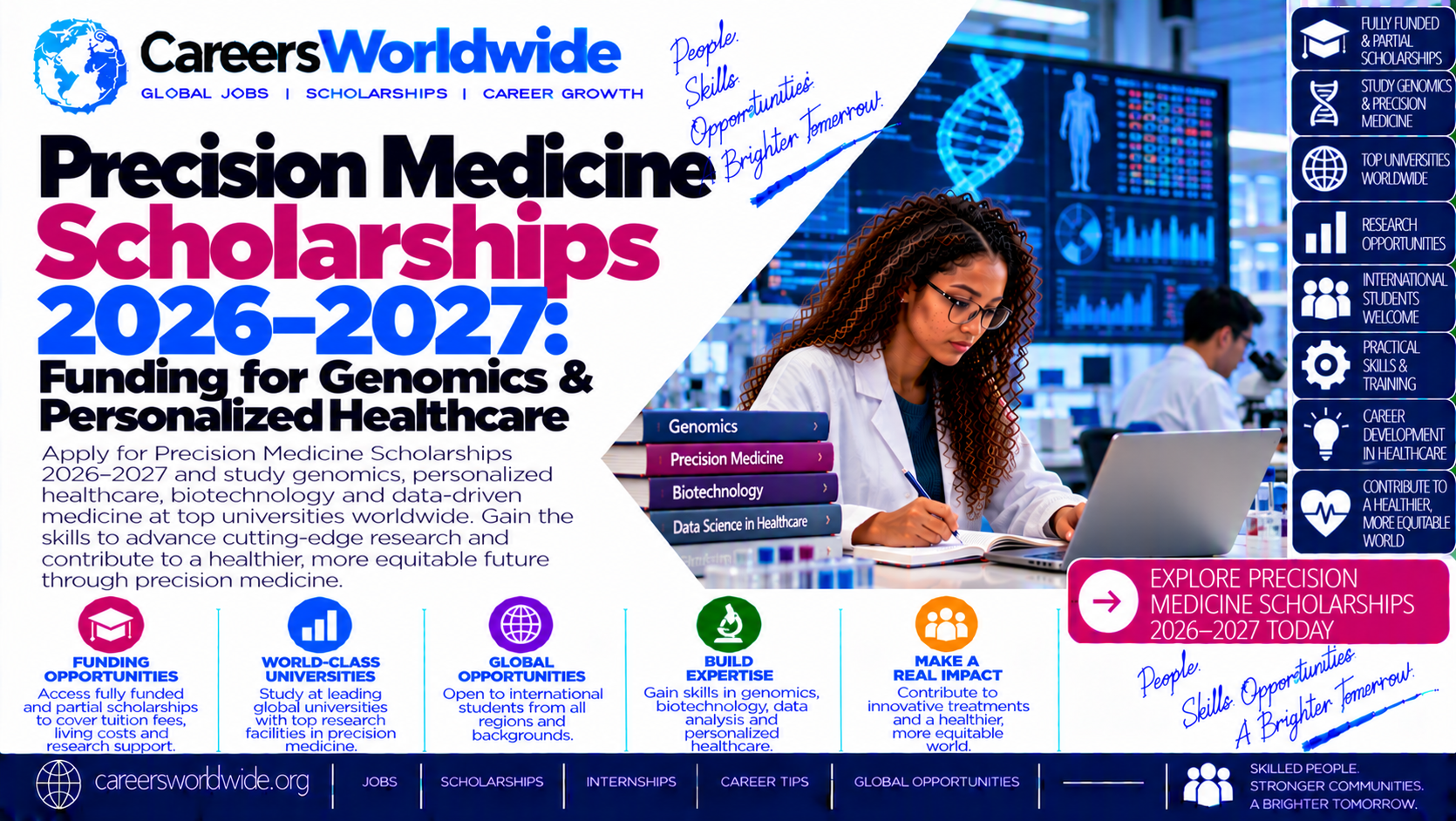

Excerpt: Discover precision medicine scholarships for 2026–2027 that can help students pursue advanced studies in genomics, genetic medicine, bioinformatics, pharmacogenomics, molecular diagnostics, and personalized healthcare. Explore university funding opportunities, international scholarship programmes, research grants, eligibility requirements, application strategies, and official resources for finding financial support for your next academic step.
Introduction: Why Precision Medicine Scholarships Matter in 2026–2027
Precision medicine is transforming healthcare by helping researchers and medical professionals tailor prevention, diagnosis, and treatment to individual patients. Instead of relying exclusively on a one-size-fits-all approach, precision medicine considers differences in genetics, environment, lifestyle, and other biological factors that influence health outcomes.
Advances in genomic sequencing, artificial intelligence, molecular diagnostics, cancer research, and biomedical data science have created growing opportunities for students interested in the future of healthcare.
However, postgraduate education and specialist research training can be expensive. Tuition fees, laboratory expenses, accommodation, research materials, insurance, and international travel can place considerable pressure on students and their families.
Precision medicine scholarships offer a potential pathway to overcoming these financial barriers. Depending on the programme, funding may cover full or partial tuition, living expenses, research costs, conference participation, or laboratory training.
For the 2026–2027 academic year, students should explore funding across several related disciplines rather than limiting their searches to scholarships explicitly labelled “precision medicine.” Many relevant opportunities are advertised under genomics, molecular biology, biomedical sciences, computational biology, cancer research, public health genomics, and bioinformatics.
This guide explains where to look for funding, which scholarship routes may be suitable, how to prepare a competitive application, and how to verify opportunities before applying.
Important: Scholarship availability, funding amounts, deadlines, and eligibility rules vary by institution and programme. The opportunities and funding routes discussed below are research starting points, not a guarantee that a particular award is currently open or specifically dedicated to precision medicine.
1. What Is Precision Medicine?
Precision medicine is an approach to healthcare that uses information about a person’s biological characteristics and circumstances to support more informed decisions about disease prevention, diagnosis, and treatment.
Genomic information can help identify inherited disease risks, explain how certain cancers develop, or predict how a patient may respond to particular medicines. When combined with clinical records, laboratory findings, and other data, it can support more targeted healthcare decisions.
Precision medicine overlaps with several academic and professional fields.
Genomics and genetic medicine
Genomics examines the structure, function, and interactions of genes across an organism’s genome. Students in this area may study genetic variation, inherited disorders, genome sequencing, gene regulation, and the relationship between genetic changes and disease.
Scholarship applicants interested in genomics may pursue degrees in human genetics, medical genetics, genomic medicine, or related biomedical sciences.
Bioinformatics and computational biology
Modern genomic research produces enormous quantities of biological data. Bioinformatics specialists use computational tools, statistical methods, and programming to analyse this information.
Students may learn sequence analysis, biological databases, statistical genetics, machine learning, and computational modelling.
These programmes can be suitable for applicants with backgrounds in computer science, mathematics, statistics, biology, or biomedical engineering.
Pharmacogenomics and personalised drug treatment
Pharmacogenomics examines how genetic differences influence responses to medicines. The field can help researchers understand why a treatment works well for one patient but causes side effects or provides limited benefits for another.
Relevant degrees may include pharmacology, pharmaceutical sciences, clinical pharmacology, and genomic medicine.
Molecular diagnostics and cancer research
Molecular diagnostics uses biological markers and laboratory techniques to help identify or characterise disease. In oncology, genomic testing can identify tumour characteristics that inform treatment decisions.
Students interested in this area may pursue molecular pathology, cancer biology, translational medicine, laboratory medicine, or related research programmes.
AI and precision healthcare
Artificial intelligence can help researchers analyse complex biomedical datasets, identify patterns, and investigate possible relationships between genetic variation and health outcomes.
Relevant study areas include health data science, biomedical informatics, biostatistics, medical AI, and computational medicine.
2. Who Can Apply for Precision Medicine Scholarships?
Eligibility depends on the scholarship provider, university, degree level, and research project. Nevertheless, students from several academic backgrounds may qualify for relevant funding.
Undergraduate students: Applicants interested in biology, biomedical science, biotechnology, computer science, or related fields can investigate university scholarships that support foundational training.
Master’s applicants: Students with bachelor’s degrees in biomedical sciences, genetics, pharmacy, public health, statistics, computer science, or related disciplines may qualify for specialised postgraduate programmes.
PhD candidates: Doctoral applicants can search for funded research positions in human genomics, computational biology, cancer genetics, molecular diagnostics, and personalised therapeutics.
Medical and healthcare professionals: Doctors, pharmacists, laboratory scientists, and other healthcare professionals may find funding for advanced training in genomic medicine, clinical genetics, or translational research.
International students: Applicants seeking education outside their home countries should examine international scholarship programmes, university awards, government funding, and funded doctoral positions.
Students from underrepresented research communities: Some programmes support applicants from particular countries, disadvantaged backgrounds, or groups underrepresented in biomedical research. Eligibility must be confirmed with each provider.
A degree in medicine is not always necessary. Some precision medicine programmes focus on computational, laboratory, statistical, or public health skills rather than clinical practice.
Likewise, applicants do not necessarily need previous professional experience in genomics. Some programmes welcome students who have relevant foundational qualifications and a clear interest in the field.
3. Precision Medicine Scholarships and Funding Routes for 2026–2027
The following programmes and funding sources are useful starting points for students exploring genomics and personalised healthcare education. Each has its own eligibility rules, application procedures, and funding conditions.
3.1 Erasmus Mundus Joint Masters Scholarships
Erasmus Mundus Joint Masters programmes provide an established route for international students seeking postgraduate education across participating European universities.
Selected programmes offer scholarships that can contribute substantially towards participation costs and may include support for living expenses, depending on the applicable award arrangements.
Students interested in precision medicine should search the official Erasmus Mundus catalogue for programmes related to biomedical sciences, bioinformatics, molecular biology, biotechnology, medical data science, and related disciplines.
Not every Erasmus Mundus programme specialises in genomics or precision medicine. Applicants must identify a relevant participating master’s degree and review its individual requirements.
Best suited for: Eligible students seeking international master’s education in a related scientific discipline.
Official resource: https://erasmus-plus.ec.europa.eu/
3.2 Commonwealth Scholarships
Commonwealth Scholarships support eligible students from participating Commonwealth countries through designated scholarship schemes and approved study opportunities.
Depending on the scheme, awards may support master’s or doctoral education and can include tuition, travel, and living-cost assistance under the relevant terms.
Students interested in genomic medicine, biomedical research, public health genomics, or computational biology should investigate whether an eligible course or research programme aligns with the objectives of the available scheme.
Eligibility is not automatic for all Commonwealth citizens. Nationality, residency, academic qualifications, nomination procedures, development priorities, and participating institutions can affect eligibility.
Best suited for: Eligible applicants from participating Commonwealth countries seeking approved postgraduate study or research opportunities.
Official resource: https://cscuk.fcdo.gov.uk/
3.3 Chevening Scholarships
Chevening Scholarships support eligible applicants pursuing qualifying one-year master’s degrees in the United Kingdom.
A candidate interested in precision medicine might consider a suitable master’s programme in genomic medicine, biomedical sciences, health data science, molecular medicine, or a related discipline.
Applicants should remember that Chevening is not a dedicated precision medicine scholarship. It is a broader leadership-focused award with specific eligibility and application requirements.
Students should verify the current application cycle, eligible countries, work-experience requirements, course selection rules, and funding conditions before applying.
Best suited for: Eligible applicants with a strong academic and professional profile who want to pursue a qualifying UK master’s degree.
Official resource: https://www.chevening.org/
3.4 Fulbright Foreign Student Program
The Fulbright Foreign Student Program provides opportunities for eligible international students, young professionals, and researchers to pursue graduate study or research in the United States, subject to country-specific arrangements.
Relevant applicants may explore graduate programmes in human genetics, bioinformatics, biomedical sciences, cancer research, computational biology, or related fields.
Application procedures, eligible subjects, award benefits, and deadlines differ between participating countries. Some programmes also have specific restrictions regarding degree types or professional training.
Applicants should contact the Fulbright office or the designated programme administrator in their country for accurate information.
Best suited for: Eligible international applicants pursuing approved graduate study or research in the United States.
Official resource: https://foreign.fulbrightonline.org/
3.5 DAAD Scholarships and German University Funding
The German Academic Exchange Service, commonly known as DAAD, offers scholarship opportunities for eligible international students and researchers.
Applicants interested in precision medicine can search for relevant master’s degrees, doctoral research opportunities, and postgraduate programmes in molecular medicine, genetics, bioinformatics, biotechnology, and biomedical sciences.
Funding varies considerably. Some DAAD schemes focus on particular countries, degree levels, academic disciplines, or development-related objectives. German universities and research institutions may also advertise independent funding opportunities.
A programme appearing in a university catalogue does not automatically qualify for a DAAD scholarship.
Best suited for: Students and researchers who meet the requirements of a relevant DAAD scheme or German institutional funding opportunity.
Official resource: https://www.daad.de/en/
3.6 University-Funded Master’s and PhD Opportunities
University funding can be particularly relevant for precision medicine because many specialised programmes are administered by medical schools, biomedical research centres, public health schools, and science faculties.
Potential funding arrangements include:
- Merit-based postgraduate scholarships.
- Research scholarships for master’s or doctoral students.
- Graduate assistantships.
- Tuition waivers.
- Laboratory-funded doctoral positions.
- Departmental awards for outstanding applicants.
- Scholarships linked to specific research centres or supervisors.
For example, applicants can investigate institutions with established genetics, genomics, cancer research, biomedical data science, or translational medicine programmes.
Funding availability must be checked individually. A university offering a genomics degree may not provide full funding to every student, and some awards are restricted to domestic applicants.
Best suited for: Applicants with a clearly defined research interest who can identify an eligible degree programme or supervisor.
3.7 NIH-Funded Research Training and Graduate Opportunities
The United States National Institutes of Health supports biomedical research and various training and research programmes through participating institutions.
Students interested in precision medicine can investigate NIH-supported research environments involving human genetics, cancer genomics, pharmacogenomics, computational biology, and biomedical data science.
However, NIH research funding is not equivalent to an individual scholarship. Some grants fund institutions or research projects rather than paying tuition or providing stipends directly to students.
Applicants should confirm whether a particular opportunity is a funded graduate position, training programme, institutional fellowship, or research appointment.
Best suited for: Students exploring biomedical research training and eligible graduate positions at participating institutions.
Official resource: https://www.nih.gov/
3.8 Cancer Research and Genomic Medicine Funding
Cancer research is one of the major application areas for precision medicine. Researchers use tumour sequencing, molecular biomarkers, and other diagnostic tools to investigate treatment options and improve understanding of disease.
Students may find relevant funding through cancer research institutes, medical schools, charitable research organisations, and doctoral training programmes.
Search terms include cancer genomics studentship, precision oncology PhD, molecular pathology fellowship, translational cancer research scholarship, and genomic medicine doctoral funding.
These awards may be restricted to specific diseases, research projects, institutions, or nationalities.
Applicants should distinguish between funding for laboratory research, clinical training, and tuition-based degree programmes.
3.9 Scholarships in Bioinformatics and Biomedical Data Science
Bioinformatics is particularly valuable for students who want to combine computational skills with biomedical research.
Scholarship opportunities may be advertised under computational biology, health informatics, statistical genetics, biomedical engineering, data science, or artificial intelligence in healthcare.
Applicants with experience in Python, R, statistics, biological databases, or machine learning may be able to demonstrate relevant preparation. Some programmes, however, accept beginners and provide foundational training.
Potential funding sources include university scholarships, government postgraduate awards, research assistantships, and funded PhD projects.
3.10 Public Health Genomics and Global Health Funding
Precision medicine also has public health implications. Researchers must consider whether genomic technologies are accessible, affordable, culturally appropriate, and supported by adequate healthcare infrastructure.
Students interested in population genetics, genomic surveillance, ethical data governance, health equity, or implementation of genomic services may find relevant funding through public health schools and global health programmes.
These programmes may not use the term precision medicine in their titles, so applicants should search broadly.
Students from countries with limited genomic research infrastructure may also explore projects focused on building local research capacity, strengthening laboratory systems, or improving the representation of diverse populations in genomic studies.
4. Summary Table: Precision Medicine Scholarships 2026–2027
The table below compares the principal funding routes discussed in this guide. Confirm the current award terms and whether a suitable genomics or precision medicine programme is eligible before applying.
| Scholarship or funding route | Study level | Potential relevance |
|---|---|---|
| Erasmus Mundus Joint Masters | Master’s | Biomedical sciences, bioinformatics and related fields |
| Commonwealth Scholarships | Master’s and PhD, depending on scheme | Genomics, biomedical research and public health |
| Chevening Scholarships | Master’s | Genomic medicine, health data science and related courses |
| Fulbright Foreign Student Program | Graduate study or research, depending on country | Genetics, biomedical sciences and computational biology |
| DAAD scholarships | Varies by scheme | Biotechnology, molecular medicine and bioinformatics |
| University-funded scholarships | Undergraduate, master’s or PhD | Institution-specific precision medicine programmes |
| NIH Graduate Partnerships Program | Doctoral research partnership | Biomedical research, bioinformatics and related disciplines |
| Cancer research studentships | Usually postgraduate research | Cancer genomics and precision oncology |
| Bioinformatics research funding | Master’s or PhD, depending on award | Computational genomics and biomedical data analysis |
| Public health research funding | Varies by programme | Population genomics and equitable access to genomic healthcare |
For Erasmus Mundus, the official programme page confirms that selected joint master’s programmes offer full scholarships to top-ranked students, including support for participation costs and contributions towards travel, visa and living expenses. Applications are submitted directly to the institution running the chosen programme.
Erasmus+
The NIH Graduate Partnerships Program is another relevant route for doctoral researchers. Its individual and institutional pathways have distinct eligibility requirements, and applicants must review the details of the specific partnership.
training.nih.gov
+1
5. How Much Funding Can Students Receive?
There is no universal scholarship amount for precision medicine studies. Financial support depends on the award, institution, country, programme length, and whether the funding supports coursework or research.
Scholarship packages may include one or more of the following:
- Tuition coverage: Payment of some or all approved academic fees.
- Living allowance: A stipend or maintenance payment for eligible expenses.
- Research support: Funding for approved laboratory materials, fieldwork, data analysis, or dissertation expenses.
- Travel assistance: Support for eligible journeys to and from the host institution.
- Health insurance: Coverage where explicitly included in the award.
- Conference funding: Assistance with presenting research at approved academic meetings.
- Relocation support: Limited assistance with eligible moving costs under some research arrangements.
Before accepting an award, calculate the total cost of attendance. A tuition-only scholarship may leave substantial expenses uncovered, while a funded doctoral position may provide a stipend but impose specific research and employment responsibilities.
International applicants should also budget for visa fees, initial accommodation, deposits, local transport, and costs incurred before the first stipend payment.
Never assume that a scholarship is fully funded simply because its title contains the word “scholarship.” Read the official funding conditions and identify any costs that remain the student’s responsibility.
6. Essential Documents for a Competitive Application
Preparing documents early can make the application process more manageable, particularly when several scholarship deadlines overlap.
Academic transcripts and certificates
Prepare official transcripts showing your courses, grades, and completed qualifications. Some institutions require certified copies or formal translations.
If you are completing your current degree, check whether the scholarship accepts provisional transcripts or predicted results.
Curriculum vitae
Your CV should highlight relevant academic training, laboratory experience, research projects, programming skills, publications, presentations, and professional experience.
For a genomics-related application, relevant skills might include molecular biology, statistical analysis, Python, R, sequence analysis, or experience with biological datasets. Include only skills you can accurately demonstrate.
Statement of purpose
Explain why you want to study precision medicine, which questions interest you, and how the programme connects with your future goals.
Avoid relying on general statements about wanting to improve healthcare. Describe a specific interest, such as improving genetic diagnosis, understanding treatment resistance, developing computational tools, or expanding access to genomic testing.
Research proposal
Some master’s and doctoral applications require a research proposal. A useful proposal identifies the research question, explains its significance, outlines a feasible methodology, and acknowledges ethical or practical limitations.
Applicants should ensure that the proposed work matches the expertise and resources of the intended research group.
Recommendation letters
Request references from lecturers, research supervisors, or employers who can discuss your academic ability, research potential, reliability, and relevant achievements.
Give referees sufficient time and provide them with your CV, programme information, and application deadlines.
English-language test results
Some institutions require evidence of English proficiency through an approved examination or an accepted alternative. Requirements vary by university and scholarship.
Confirm the minimum score, accepted tests, validity period, and any exemption rules before booking an examination.
7. How to Apply for Precision Medicine Scholarships in 2026–2027
A practical application roadmap for international and domestic students.
Step 1: Choose your specialisation
Decide whether your primary interest is genomics, bioinformatics, pharmacogenomics, cancer research, molecular diagnostics, or public health genomics. This will help you identify relevant courses and supervisors.
Step 2: Find an eligible academic programme
Search official university websites and scholarship catalogues. Confirm the entry requirements, teaching language, research facilities, degree duration, and availability of your intended specialisation.
Step 3: Verify scholarship eligibility
Check nationality restrictions, academic requirements, work experience, age limits if applicable, financial-need criteria, and whether the award supports your intended degree.
Step 4: Prepare your application
Update your CV, collect transcripts, write a focused personal statement, arrange references, and prepare any required research proposal or language-test evidence.
Step 5: Submit through the official channel
Some scholarships require a separate funding application, while others consider candidates through the university admission process. Follow the instructions for each award and save your submission confirmation.
Step 6: Track deadlines and follow up
Record application dates, reference deadlines, interview schedules, and expected decisions. Respond promptly to requests for additional documents.
8. Official Application Resources
Use these official websites to identify suitable programmes and verify application requirements. They are starting points for funding research, not a list of guaranteed open precision medicine scholarships.
- Erasmus Mundus Joint Masters: Explore European joint master’s programmes and scholarships. Review the catalogue and apply directly to the institution offering your chosen course.
Erasmus+
- Commonwealth Scholarship Commission: Explore Commonwealth scholarship schemes. Check the individual scheme’s eligible countries, subjects, nomination arrangements, and deadlines.
- Chevening: Review UK scholarship eligibility and application guidance. Identify eligible master’s courses and check the application cycle for your country.
- Fulbright Foreign Student Program: Explore graduate study opportunities in the United States. Check country-specific requirements with the appropriate Fulbright office.
- DAAD: Search German scholarships and academic programmes. Filter opportunities by country of origin, degree level, and subject.
- National Institutes of Health: Explore NIH Graduate Partnerships Program opportunities. Review doctoral research pathways and partnership-specific requirements.
training.nih.gov
- NIH Intramural Research Program: Browse biomedical research training opportunities. Explore research training options for different academic stages.
NIH Intramural Research Program
Application timing for the 2026–2027 academic year
Timing is important because academic admission and scholarship deadlines may be different.
For Erasmus Mundus, many programmes accept applications between October and January for courses beginning in the following academic year, although the exact dates depend on the programme.
Erasmus+
For other awards, do not assume that applications are still open in October 2026. Check the official application page and confirm whether the relevant deadline concerns admission, scholarship consideration, references, or supporting documents.
Students applying for 2027 entry should begin identifying programmes now, especially where research supervisors, language tests, or multiple recommendations are required.
9. Practical Advice for Applicants from Africa and Other Underrepresented Regions
Students from Africa and other regions with developing biomedical research infrastructure can explore international funding alongside opportunities at regional universities and research institutes.
A strong application should explain not only why the applicant wants to study precision medicine, but also how the proposed training connects with realistic research or healthcare priorities.
Potential areas of interest include:
- Improving diagnosis of inherited and rare diseases.
- Expanding access to molecular diagnostics.
- Developing locally relevant genomic datasets.
- Studying genetic diversity in underrepresented populations.
- Improving cancer diagnosis and treatment selection.
- Strengthening laboratory capacity and bioinformatics expertise.
- Supporting responsible genomic data governance and patient privacy.
Applicants should avoid suggesting that genetic ancestry alone determines a person’s health or treatment needs. Precision medicine requires careful interpretation of evidence, consideration of environmental and social factors, and appropriate clinical validation.
For applicants from Zimbabwe and elsewhere in Southern Africa, it can be useful to search for scholarships available to citizens of the applicant’s country, regional research partnerships, and programmes that support health research capacity building. Always verify country eligibility directly rather than assuming that an international scholarship accepts applicants from every country.
Another practical strategy is to contact a prospective supervisor before applying for a research degree. A concise email should explain your academic background, identify the supervisor’s relevant research, and ask whether they expect to recruit funded students. Contacting a supervisor does not guarantee admission or funding, but it can help establish whether your interests match the research group.
10. How to Avoid Scholarship Scams
Scholarship searches can expose applicants to misleading advertisements and fraudulent application services.
Protect yourself by following these precautions:
- Use the official university or scholarship-provider website to confirm every opportunity.
- Be suspicious of guaranteed awards in exchange for a processing fee.
- Never share banking passwords, one-time security codes, or unnecessary identity documents with an unverified contact.
- Check the official application portal and confirm that contact details match those published by the institution.
- Verify funding amounts and conditions before making financial commitments.
- Do not assume that an offer letter is genuine merely because it uses a university logo.
- Be cautious of social media posts that promise guaranteed visas, admission, or fully funded scholarships without verifiable details.
Some legitimate programmes charge application fees, while others do not. A fee alone does not establish whether an opportunity is fraudulent. Confirm any requested payment directly with the official institution and understand what it covers.
11. Career Opportunities After Studying Precision Medicine
A qualification in precision medicine can support careers across academic research, healthcare, biotechnology, pharmaceuticals, and health technology. The roles available depend on the degree, practical experience, professional licensing requirements, and the country in which the graduate intends to work.
Possible career directions include:
- Genomics researcher: Investigates genetic variation, disease mechanisms, and genomic technologies.
- Bioinformatics analyst: Processes and interprets biological data using computational methods.
- Clinical research associate: Supports the conduct and monitoring of clinical studies, subject to the role’s requirements.
- Pharmacogenomics researcher: Studies how genetic differences influence medicine response.
- Molecular diagnostics specialist: Works with laboratory methods used to identify biological markers of disease.
- Biomedical data scientist: Applies statistical and computational methods to biomedical questions.
- Cancer genomics researcher: Investigates genetic changes associated with tumour development and treatment response.
- Genomic medicine researcher: Studies the application of genomic information to clinical practice.
- Public health genomics specialist: Examines population-level applications, implementation, ethics, and equitable access.
- Biotechnology research scientist: Contributes to the development and evaluation of biomedical technologies.
Some clinical and laboratory positions require additional professional registration, specialised certification, or a medical qualification. A master’s degree in bioinformatics, for example, does not automatically qualify someone to practise as a clinical geneticist.
Students should therefore compare career requirements in their target country before choosing a programme.
12. Frequently Asked Questions (FAQs)
1. Are there fully funded precision medicine scholarships for 2026–2027?
Potentially, yes. Students can explore fully funded opportunities through selected international master’s programmes, university-funded doctoral positions, government scholarships, and biomedical research training programmes. However, funding availability depends on the specific award, and not every opportunity covers all expenses.
2. Can international students apply for genomics scholarships?
Yes, some scholarships accept international applicants. Erasmus Mundus, Fulbright, DAAD, and certain university funding programmes offer opportunities to eligible students from different countries. Each programme has its own nationality, academic, and subject requirements.
3. Do I need a medical degree to study precision medicine?
No. Many programmes accept applicants from biology, genetics, biotechnology, pharmacy, computer science, statistics, biomedical engineering, and related disciplines. Clinical training is necessary for some professional medical roles, but it is not a universal requirement for precision medicine research.
4. Can computer science graduates apply for bioinformatics scholarships?
Yes. Computer science graduates may be suitable for bioinformatics and computational biology programmes, particularly those involving programming, statistical analysis, machine learning, or biological data processing. Some courses require prior biology knowledge, so check the entry requirements carefully.
5. Are there scholarships for precision medicine PhD programmes?
Yes, some universities and research institutions offer funded doctoral positions in relevant disciplines. Funding may include a stipend, tuition support, or research expenses. Applicants should search for funded PhD projects in genomics, cancer biology, pharmacogenomics, computational biology, and molecular medicine.
6. Can students from Zimbabwe apply?
Eligibility depends on the scholarship. Students from Zimbabwe should check each programme’s eligible-country list, degree requirements, and application procedures. They can also investigate university awards and research programmes that accept international applicants.
7. What GPA or academic grade is required?
There is no universal minimum. Some awards require a particular degree classification or grade average, while others assess academic performance alongside research experience, leadership, professional achievements, and the quality of the proposed study.
8. Do these scholarships cover accommodation and living expenses?
Some awards include a living allowance, while others cover tuition only or provide partial financial support. Read the funding terms carefully and budget for any uncovered expenses.
9. When should I apply for 2026–2027 scholarships?
Check each programme’s official calendar immediately. Some deadlines for the 2026 intake may have passed, while opportunities for later 2026 or 2027 entry may still be available or may open in the coming months. Do not rely on a previous year’s deadline.
10. How can I improve my chances of receiving a scholarship?
Choose a programme that matches your academic background, demonstrate a clear interest in precision medicine, prepare a focused personal statement, obtain strong references, and submit complete documents before the deadline. For research degrees, explain how your interests align with the proposed supervisor’s work.
Conclusion: Start Your Precision Medicine Scholarship Search Today
Precision medicine offers opportunities for students interested in genetics, genomics, biomedical research, molecular diagnostics, bioinformatics, and personalised healthcare. Scholarships can make this specialised education more accessible, but finding the right award requires careful research and realistic financial planning.
For 2026–2027, begin by identifying a suitable degree or research project, then investigate international scholarships, university funding, government programmes, and relevant research partnerships. Pay particular attention to eligibility requirements, application deadlines, funding coverage, and the academic preparation required.
Most importantly, look beyond scholarship titles. A biomedical sciences scholarship or funded bioinformatics PhD may be more relevant to your goals than an award that mentions precision medicine but does not support your intended course.
Prepare your documents early, use official application channels, and submit applications that clearly connect your academic background with your future research ambitions.
The next generation of personalised healthcare will depend on researchers and professionals who can combine scientific knowledge, responsible data analysis, and a commitment to improving patient outcomes. The right scholarship could help you take the next step towards that career.
Disclaimer
This article is intended for educational and informational purposes. The funding routes listed are not all dedicated precision medicine scholarships, and inclusion does not confirm that an award is open, available to every nationality, or applicable to every course in the 2026–2027 academic year. Scholarship amounts, eligibility rules, deadlines, and application procedures may change. Applicants should verify all details through official scholarship providers, universities, and research institutions before applying. CareersWorldwide does not guarantee admission, scholarship selection, visa approval, or employment.
SEO Keywords
Precision Medicine Scholarships 2026–2027,
Precision Medicine Scholarships for International Students,
Genomics Scholarships 2026,
Personalized Healthcare Scholarships,
Fully Funded Biomedical Science Scholarships,
Genomic Medicine Scholarships,
Bioinformatics Scholarships 2026–2027,
Pharmacogenomics Scholarships,
Biomedical Research Scholarships for International Students,
Molecular Diagnostics Scholarships,
Precision Oncology PhD Funding,
Cancer Genomics Scholarships,
Computational Biology Scholarships,
Genetics Scholarships for International Students,
Biomedical Data Science Scholarships,
Erasmus Mundus Biomedical Scholarships,
Commonwealth Scholarships for Biomedical Research,
Chevening Scholarships for Health Sciences,
Fulbright Biomedical Research Scholarships,
DAAD Scholarships for Biotechnology,
Funded Genomics PhD Programmes,
Public Health Genomics Scholarships,
Artificial Intelligence in Healthcare Scholarships,
International Biomedical Science Funding,
Precision Medicine Research Opportunities,
Scholarships for African Students in Genomics,
Precision Medicine Graduate Programmes,
Personalized Medicine Research Funding,
Genomics and Bioinformatics Graduate Scholarships,
How to Apply for Precision Medicine Scholarships,
CareersWorldwide,
ALSO CHECK: Climate Adaptation Scholarships 2026–2027: Funding for Resilience & Disaster PreparednessOctober 11, 2026
Disaster Risk Management Scholarships 2026–2027: Study Emergency Planning & ResilienceOctober 11, 2026
Impact Investing Scholarships 2026–2027: Funding for Sustainable Investment & Social ImpactOctober 11, 2026