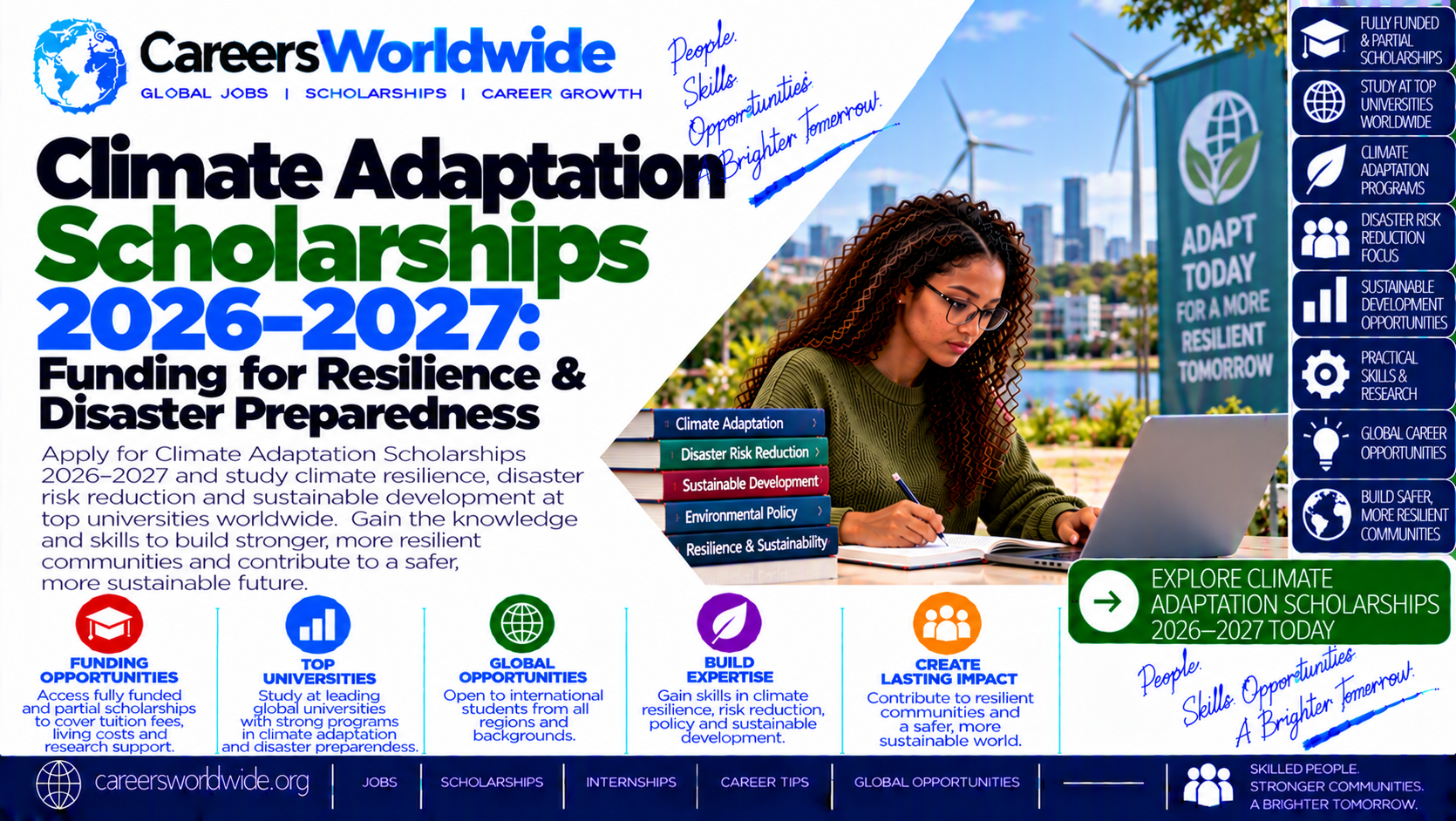

Excerpt: Climate adaptation scholarships can help students pursue education in climate resilience, disaster preparedness, environmental management, and sustainable development. For the 2026–2027 academic period, international students can explore university scholarships, development-focused postgraduate funding, and specialised programmes connected to climate risks and community resilience. Discover relevant courses, potential funding routes, eligibility requirements, application steps, and official resources to help you prepare a competitive scholarship application.
1. Why Climate Adaptation Scholarships Matter
Climate change is increasing the importance of preparing communities, infrastructure, and economies for environmental risks. Flooding, droughts, extreme heat, coastal erosion, and severe storms can threaten livelihoods, disrupt essential services, and place pressure on public resources.
Climate adaptation focuses on reducing vulnerability to these impacts. It includes improving early-warning systems, strengthening infrastructure, developing drought-resistant agriculture, protecting water resources, and helping communities prepare for emergencies.
For students interested in addressing these challenges, climate adaptation offers opportunities to combine scientific knowledge with practical planning and policy development.
Scholarships can help make relevant education more accessible, particularly for students who want to work in countries and communities facing substantial climate risks.
There is no single global scholarship programme covering every climate adaptation course. Instead, relevant funding may be available through international master’s programmes, university awards, government bursaries, development scholarships, and research grants.
Students should distinguish between scholarships that fund individual students and grants designed for organisations implementing climate projects.
2. Climate Adaptation Scholarships 2026–2027: Summary Table
| Scholarship detail | Information |
|---|---|
| Opportunity category | Climate adaptation, resilience and disaster preparedness funding |
| Academic period | 2026–2027 |
| Study levels | Undergraduate, master’s and doctoral, depending on the award |
| Relevant subjects | Climate science, adaptation, disaster management and environmental policy |
| Funding providers | Universities, governments and international programmes |
| Funding types | Tuition scholarships, living allowances, bursaries and research funding |
| International eligibility | Depends on the individual programme |
| Academic requirements | Set by the provider |
| Work experience | Required for some development scholarships |
| Application method | Official university or funding-provider portal |
| Deadlines | Vary by programme and academic intake |
| Main resources | Erasmus Mundus, World Bank scholarship programmes and university funding pages |
This table describes the general funding landscape. It does not imply that all listed funding routes have an open application for every climate-related course.
3. Important Scholarships and Funding Routes to Explore
A. Erasmus Mundus Joint Masters
The <Entity value=”Erasmus Mundus Joint Masters” category=”organization” disambig=”European Union-supported international joint master’s degree programme”/> offers international master’s programmes delivered by consortia of higher education institutions.
Full scholarships are available for selected programmes and highly ranked applicants. Depending on the award, funding can cover participation costs and contribute towards travel, visa expenses, and living costs. Students apply directly to the institution or consortium running their chosen master’s programme. <Cite refs={[“turn378127search2″,”turn378127search10”]}/>
Climate adaptation is not a standalone scholarship category covering every course. Applicants should search the official catalogue for programmes in environmental science, climate resilience, natural hazards, sustainable development, and related disciplines.
Most programmes set their own application deadlines, commonly between October and January for courses beginning in the following academic year. <Cite refs={[“turn378127search2”]}/>
Official resource: https://erasmus-plus.ec.europa.eu/opportunities/individuals/students/erasmus-mundus-joint-masters
B. Joint Japan/World Bank Graduate Scholarship Program
The <Entity value=”Joint Japan/World Bank Graduate Scholarship Program” category=”organization” disambig=”Graduate scholarship programme for eligible development professionals”/> supports eligible citizens of participating developing countries who meet its professional and academic requirements and gain admission to a participating master’s programme.
Its published benefits include tuition, a monthly living allowance, economy-class travel, and basic medical insurance. Eligibility is restricted to specified participating master’s programmes and eligible countries. <Cite refs={[“turn378127search0”]}/>
For the 2027 cycle, the World Bank has announced two application windows for eligible developing-country nationals: 18 January–26 February 2027 and 29 March–21 May 2027. Applicants must meet the programme’s requirements, including the relevant admission and professional-experience conditions. <Cite refs={[“turn378127search0”]}/>
This scholarship does not cover every climate adaptation degree. Check whether a participating programme is relevant to your intended specialisation.
Official resource: https://www.worldbank.org/en/programs/scholarships/jj-wbgsp
C. University scholarships in climate science and environmental management
Many universities provide scholarships for eligible students pursuing environmental science, climate policy, sustainable development, geography, engineering, and natural resource management.
Funding may be awarded based on academic merit, financial need, research potential, or a combination of factors.
Applicants should visit university scholarship pages and check whether their intended programme qualifies. A university offering a climate science degree does not necessarily offer a dedicated climate adaptation scholarship.
D. Climate adaptation research funding
Research students can investigate funding for projects related to flood risk, drought resilience, water security, climate modelling, environmental policy, and disaster preparedness.
These opportunities may be provided through university research groups, government research councils, or international research partnerships.
Some grants fund research institutions rather than individual students. Confirm the funding arrangement before preparing an application.
E. Regional and government bursaries
Students should also explore government funding in their home countries, particularly where climate adaptation and disaster resilience are national development priorities.
Check whether bursaries support environmental management, meteorology, hydrology, disaster management, agriculture, or civil engineering.
Residency, citizenship, approved institutions, and academic performance may determine eligibility.
4. Which Courses Should You Consider?
The best course depends on your academic background and the climate-related problems you want to address.
1. Climate Change Adaptation and Resilience
This field examines how communities, governments, and organisations can prepare for climate impacts and reduce vulnerability.
Relevant subjects may include adaptation planning, vulnerability assessment, climate risk analysis, resilience policy, and community-based adaptation.
Potential careers: Climate Adaptation Officer, Resilience Specialist, Climate Risk Analyst, and Adaptation Programme Coordinator.
2. Disaster Risk Management and Emergency Preparedness
These programmes focus on identifying hazards, preparing emergency plans, strengthening early-warning systems, and coordinating disaster response.
Students may learn risk assessment, emergency operations, crisis communication, and disaster recovery planning.
Potential careers: Disaster Risk Reduction Officer, Emergency Planning Officer, Disaster Management Coordinator, and Preparedness Specialist.
3. Environmental Science and Natural Resource Management
These courses explore ecosystems, environmental monitoring, water resources, land management, and the environmental effects of climate change.
They can be useful for students interested in ecosystem resilience, sustainable land use, conservation, and environmental policy.
Potential careers: Environmental Analyst, Natural Resource Management Officer, Environmental Consultant, and Conservation Programme Officer.
4. Climate Science and Meteorology
Climate science programmes examine atmospheric processes, climate patterns, forecasting, and the analysis of climate-related risks.
Students may develop skills in data interpretation, climate modelling, and weather-related risk assessment.
Potential careers: Climate Research Assistant, Climate Data Analyst, Meteorological Officer, and Climate Risk Researcher.
5. Water Resources Management and Climate-Smart Agriculture
These programmes focus on water security, irrigation, drought preparedness, agricultural resilience, and sustainable food production.
They are particularly relevant to regions where climate variability affects farming, drinking water, and rural livelihoods.
Potential careers: Water Resources Analyst, Climate-Smart Agriculture Specialist, Irrigation Planner, and Food Security Programme Officer.
Before choosing a course, compare its curriculum, practical training, research opportunities, entry requirements, and total cost. Confirm that the scholarship you intend to apply for accepts the programme.
5. Who Can Apply for Climate Adaptation Scholarships?
Eligibility varies by funding provider, but common requirements include:
- Academic qualifications: A recognised secondary school qualification for undergraduate study or an appropriate university degree for postgraduate study.
- Academic performance: Some awards require strong grades or a minimum academic classification.
- Relevant study interests: Applicants should demonstrate a connection between their intended course and climate resilience, environmental management, or disaster preparedness.
- Nationality or residency: Some awards are international, while others are restricted to specified countries.
- Admission requirements: Certain scholarships require an offer from an eligible university or programme.
- Professional experience: Development-focused scholarships may require relevant employment experience.
- Language proficiency: Applicants may need to satisfy the university’s English-language requirements.
- Research suitability: Research awards may require a proposal that aligns with the institution’s research priorities.
Meeting the minimum requirements does not guarantee funding. Competitive programmes may assess academic performance, motivation, relevant experience, leadership, and future development goals.
6. How to Apply for Climate Adaptation Scholarships 2026–2027
Step 1: Identify your preferred specialisation
Decide whether you want to focus on climate science, adaptation policy, disaster management, environmental protection, water resources, or agricultural resilience.
A clear study objective will help you identify appropriate courses and funding sources.
Step 2: Research eligible courses
Use official university websites and recognised scholarship portals to find programmes that match your background and career goals.
Review course modules, tuition fees, study duration, practical training, and entry requirements.
Step 3: Find a suitable scholarship
Search for international postgraduate funding, environmental science scholarships, climate research grants, and development-related scholarships.
Read the full terms and conditions to establish whether your course, country, and study level qualify.
Step 4: Apply for admission
If required, submit your university application before the scholarship deadline.
Prepare your academic transcripts, certificates, references, and language test results where applicable.
Step 5: Prepare your scholarship application
Write a focused motivation statement explaining why you want to study climate adaptation and how the qualification will support your professional objectives.
Use relevant examples from academic projects, employment, community activities, or research.
Step 6: Submit supporting documents
Follow the provider’s instructions carefully. Check word limits, file formats, certification requirements, and reference procedures.
Step 7: Monitor deadlines and decisions
Keep records of application submissions and check your email regularly.
If you receive an offer, read the funding conditions carefully, including the amount covered, payment arrangements, and any academic requirements for retaining the award.
7. Documents to Prepare
Applicants should prepare the documents requested by their chosen provider. These may include:
- Academic transcripts and certificates.
- A current CV or résumé.
- A motivation letter or personal statement.
- Letters of recommendation.
- Proof of English-language proficiency, where applicable.
- An admission offer, if required.
- A passport or other identification, where requested.
- A research proposal for research-based programmes.
- Evidence of relevant employment or volunteering.
- Financial information for need-based scholarships.
Not every programme requires every document. Follow the official checklist and avoid sending personal documents to unverified organisations.
8. How to Write a Strong Motivation Letter
A strong motivation letter should explain your interests, academic preparation, and future plans.
Identify a climate challenge. Explain whether you are interested in drought preparedness, flood management, water security, extreme heat, or another climate-related issue.
Connect the issue to your course. Describe the skills you want to develop and why the programme is appropriate.
Demonstrate your preparation. Highlight relevant coursework, research, employment, or community activities.
Explain your future contribution. Describe how you hope to apply your knowledge in government, research, humanitarian work, environmental management, or community development.
Follow the funding criteria. If the scholarship prioritises financial need, leadership, or development impact, address those requirements directly and truthfully.
Avoid unsupported claims or promises of guaranteed outcomes. A clear, specific statement is more effective than a generic explanation of why climate change matters.
9. Career Opportunities After Graduation
A qualification in climate adaptation can lead to opportunities across research, government, environmental management, humanitarian assistance, and development programmes.
Potential roles include:
- Climate Adaptation Analyst.
- Environmental Policy Officer.
- Disaster Risk Reduction Specialist.
- Climate Resilience Programme Coordinator.
- Climate Data Analyst.
- Water Resources Management Officer.
- Sustainable Agriculture Specialist.
- Environmental Research Assistant.
- Climate Risk Consultant.
- Disaster Preparedness Officer.
Employers may include government departments, environmental consultancies, research institutes, universities, humanitarian organisations, development agencies, and private-sector sustainability teams.
Career outcomes depend on qualifications, technical skills, work experience, location, and employer requirements. A scholarship does not guarantee a job.
10. Practical Guidance for International Applicants
Before accepting an award, calculate the full cost of studying.
Start with the tuition fee and subtract the confirmed scholarship amount. Then estimate accommodation, food, transport, travel, visa expenses, insurance where applicable, and other living costs.
Check whether the award covers the entire degree or only part of the programme. Some scholarships require continued academic progress or other conditions for renewal.
For applicants from countries facing droughts, floods, or agricultural vulnerability, courses in climate resilience, water management, and disaster preparedness may be particularly relevant. However, choose a programme based on its quality, curriculum, and suitability for your career goals.
If an application cycle has closed, check whether the provider plans another intake rather than relying on outdated advertisements.
Be cautious of scholarship scams. Use official websites, verify contact information, and never assume an award is guaranteed because a third-party site claims to offer it.
11. Official Application Resources
The following resources can help you identify legitimate funding opportunities.
Erasmus Mundus Joint Masters
Search for eligible international master’s programmes and scholarship opportunities.
https://erasmus-plus.ec.europa.eu/opportunities/individuals/students/erasmus-mundus-joint-masters
Joint Japan/World Bank Graduate Scholarship Program
Review eligible countries, participating master’s programmes, application windows, and scholarship benefits.
https://www.worldbank.org/en/programs/scholarships/jj-wbgsp
EU Mission on Adaptation to Climate Change
Explore European climate resilience initiatives, research activities, and programme funding. Much of this funding is directed towards regions, institutions, and projects rather than individual students.
University scholarship portals
Visit the official websites of universities offering climate science, environmental management, sustainable development, and disaster risk management courses. Search their international funding and postgraduate scholarship pages.
Always verify the award amount, eligible course, nationality requirements, and deadline before applying.
12. Frequently Asked Questions
1. What are climate adaptation scholarships?
They are funding opportunities that support education or research related to preparing for climate impacts, reducing vulnerability, and strengthening community and infrastructure resilience.
2. Are these scholarships fully funded?
Some programmes provide substantial support for tuition and living costs, while others offer partial funding. Benefits depend on the individual award.
3. Can international students apply?
Yes, some programmes accept applicants worldwide. Erasmus Mundus Joint Masters scholarships, for example, are available to eligible students from different countries, subject to programme requirements.
4. Can students from Zimbabwe apply?
Zimbabwean students can investigate international university scholarships and development-related funding. Eligibility depends on the specific programme and its nationality, academic, and professional requirements.
5. Which course is best for climate adaptation?
Relevant fields include climate science, disaster risk management, environmental science, water resources management, climate policy, and sustainable agriculture.
6. Do I need work experience?
Not always. Many university scholarships accept recent graduates, while certain development scholarships require professional experience.
7. When should I apply for 2026–2027 funding?
Check the official calendar for each programme. Some application windows may already have closed, while others may be accepting applications for later starts. Do not assume every scholarship follows the same schedule.
8. What documents are required?
Common requirements include academic transcripts, certificates, a CV, a motivation letter, references, and proof of admission where applicable.
9. Can I study climate adaptation online?
Some universities offer online or blended courses, but scholarship rules vary. Confirm that distance learning is eligible before applying.
10. Does receiving a scholarship guarantee employment?
No. Scholarships provide financial assistance for study or research but do not guarantee employment.
Conclusion
Climate Adaptation Scholarships 2026–2027 offer a useful starting point for students interested in climate resilience, disaster preparedness, and environmental sustainability.
Potential funding routes include Erasmus Mundus Joint Masters, the Joint Japan/World Bank Graduate Scholarship Program for eligible development-related degrees, university scholarships, and research opportunities.
The most effective strategy is to choose a relevant course, confirm eligibility, prepare a strong application, and verify all funding details through official sources.
Climate adaptation requires professionals who can assess risks, develop practical solutions, and help communities prepare for environmental change. The right qualification can provide a foundation for contributing to this important work.
Disclaimer
This article is for general informational purposes and is not an official publication of any university, government, or scholarship provider. Funding opportunities, eligibility criteria, award amounts, and deadlines may change. Some programmes support development-related study or institutional projects rather than individual climate adaptation courses. Applicants must verify all details through the official provider. No scholarship, admission, or employment outcome is guaranteed.
SEO Keywords
Climate Adaptation Scholarships 2026–2027,
climate resilience scholarships for international students,
climate change adaptation scholarships 2027,
fully funded climate change scholarships,
climate adaptation master’s scholarships,
disaster preparedness scholarships 2027,
climate resilience postgraduate funding,
environmental science scholarships for international students,
climate change scholarships for African students,
climate adaptation scholarships for Zimbabwean students,
Erasmus Mundus climate resilience scholarships,
Joint Japan World Bank Graduate Scholarship Program 2027,
climate risk management scholarships,
environmental management scholarships 2027,
disaster risk reduction and resilience funding,
sustainable development scholarships 2026–2027,
climate finance and adaptation scholarships,
water resources management scholarships,
flood risk management scholarships,
drought resilience research scholarships,
climate change research funding for students,
how to apply for climate adaptation scholarships,
international scholarships for environmental studies,
climate adaptation courses with scholarships,
ALSO CHECK: Impact Investing Scholarships 2026–2027: Funding for Sustainable Investment & Social ImpactOctober 11, 2026
Global Futures Scholarships 2027: University of Manchester Funding for International StudentsOctober 11, 2026
Japanese Government MEXT Scholarships 2027: Study Opportunities in JapanOctober 11, 2026