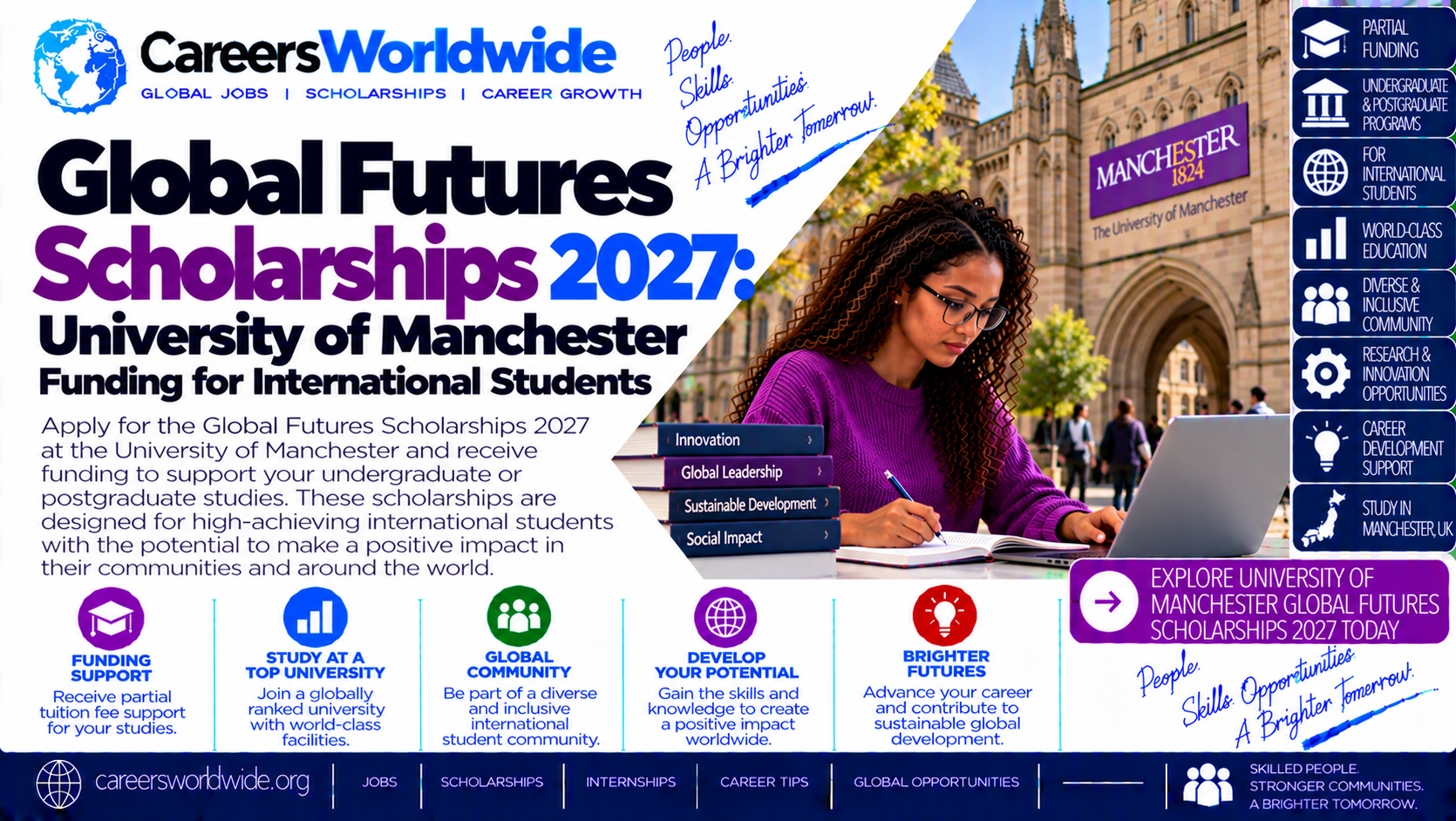

Excerpt: The University of Manchester is offering more than 350 Global Futures Scholarships for international students planning to begin undergraduate or master’s studies in September 2027. With a scholarship fund exceeding £6 million, the programme provides merit-based tuition fee support for eligible students from selected countries worldwide. Find out who can apply, the potential award values, eligibility requirements, important deadlines, and how to secure your opportunity to study in the United Kingdom.
Global Futures Scholarships 2027: Overview
International students hoping to study in the United Kingdom may have an opportunity to reduce their tuition costs through the Global Futures Scholarships 2027 at the University of Manchester.
The university has announced more than 350 partial, merit-based scholarships for international students beginning their studies in September 2027. The total scholarship funding exceeds £6 million, with awards available for eligible undergraduate and postgraduate taught master’s applicants from selected countries.
The programme is particularly relevant to students who have strong academic records but need financial assistance to make studying abroad more affordable.
Unlike a scholarship that automatically covers every expense, Global Futures funding is generally designed to reduce tuition fees. Applicants should therefore prepare a realistic budget that accounts for any remaining tuition balance, accommodation, food, transport, visa-related expenses, and other living costs.
The university publishes country-specific eligibility criteria, award amounts, and application deadlines. Consequently, applicants should not assume that the funding value or application process is identical for every country.
Official scholarship page: https://www.manchester.ac.uk/study/international/finance-and-scholarships/funding/global-futures-scholarship/
1. What Are the Global Futures Scholarships?
The Global Futures Scholarships are international student awards offered by the University of Manchester to recognise academic merit and support eligible students pursuing higher education in Manchester, England.
For the September 2027 intake, the university has announced more than 350 awards with a combined value exceeding £6 million.
The programme covers two principal study levels:
- Undergraduate degrees for eligible students entering bachelor’s programmes.
- Postgraduate taught master’s degrees for eligible students pursuing advanced academic or professional qualifications.
The scholarships are intended for students who meet the university’s country-specific requirements and receive an offer for an eligible course.
One important distinction is that the programme does not necessarily operate as a single worldwide competition with identical rules. Different regional scholarship schemes may have different award amounts, qualifying countries, academic requirements, and deadlines.
Students should therefore begin by identifying the scholarship category that applies to their country of domicile and intended degree.
2. Global Futures Scholarships 2027: Key Details
| Scholarship detail | Information |
|---|---|
| Scholarship name | Global Futures Scholarships 2027 |
| Host institution | University of Manchester |
| Study destination | Manchester, United Kingdom |
| Academic intake | September 2027 |
| Number of awards | More than 350 |
| Total scholarship funding | More than £6 million |
| Study levels | Undergraduate and taught master’s |
| Funding type | Partial, merit-based scholarship |
| Main purpose | Reduction of eligible international tuition fees |
| Study format | Full-time, on-campus study in Manchester |
| Eligible applicants | International students domiciled in selected countries |
| Application method | Online scholarship application for eligible offer-holders |
| Application deadline | Varies by country and study level |
| Official information | University of Manchester website |
Applicants should confirm all details against the official page and the terms and conditions for their specific regional award before making financial or academic commitments.
3. How Much Is the Global Futures Scholarship Worth?
The value depends on the applicant’s country, programme, and scholarship category.
For the 2027 intake, the university’s published information includes the following indicative award values for selected regional schemes.
Undergraduate scholarships
Eligible undergraduate applicants from selected countries may receive awards worth up to £36,000 over three years, equivalent to £12,000 per year for three years.
This is a substantial contribution towards tuition fees, although it should not be interpreted as a universal award available to every applicant.
The amount, duration, renewal conditions, and qualifying academic requirements depend on the relevant regional scholarship terms.
Master’s scholarships
The university has published a £19,000 award for eligible African master’s applicants under the applicable regional scheme.
For example, the university’s published information for African applicants identifies Botswana, Egypt, Ghana, Kenya, Nigeria, South Africa, and Zimbabwe as eligible domiciles for the relevant master’s award.
Other regions may have different funding values. For example, selected South Asian applicants may be eligible for awards worth £12,000, subject to the specific country and programme requirements.
These figures illustrate why applicants must consult the correct country profile rather than rely on a general scholarship advertisement.
What expenses does the scholarship cover?
The award is generally applied as a discount against eligible international tuition fees. It should not automatically be treated as a cash stipend.
Students may still need to fund:
- Any tuition fees remaining after the scholarship deduction.
- Accommodation and household expenses.
- Food, transport, and personal expenses.
- Immigration and visa-related costs.
- Travel to and from the United Kingdom.
- Books, equipment, and other study materials.
Before accepting an offer, calculate the difference between the published tuition fee and the scholarship amount, then estimate your remaining annual expenses.
4. Which Countries Are Eligible for Global Futures Scholarships 2027?
The Global Futures Scholarships are available to students domiciled in selected countries across Africa, Asia, Europe, North America, and other regions.
The university’s published 2027 scholarship information identifies the following countries and markets:
- Bangladesh
- Botswana
- Canada
- Egypt
- Ghana
- India
- Indonesia
- Kenya
- Malaysia
- Mauritius
- Nigeria
- Pakistan
- Saudi Arabia
- Singapore
- South Africa
- Sri Lanka
- Taiwan, for postgraduate taught master’s awards only
- Thailand
- Türkiye
- United Arab Emirates
- United States
- Vietnam
- Zimbabwe
This list is subject to the study-level restrictions and other conditions attached to individual regional schemes.
Being a citizen of a listed country may not, by itself, establish eligibility. The university uses domicile requirements for the relevant awards, and these can involve where applicants have ordinarily lived during the preceding three years.
Students who have moved abroad for education should examine the official definition carefully. Living in a country temporarily for full-time study may not establish domicile there.
Applicants from countries not listed should explore other University of Manchester scholarships and external funding opportunities.
5. Eligibility Requirements for Applicants
Meeting the eligibility requirements is essential before submitting a scholarship application. Although the precise criteria differ by country and study level, several conditions are particularly important.
Academic excellence
The Global Futures Scholarships are merit-based. Applicants should demonstrate strong academic performance and satisfy the entry requirements for their intended degree.
For master’s applicants, the university’s country-specific requirements may include a minimum undergraduate classification or its international equivalent.
For undergraduate applicants, eligibility may depend on the qualifications accepted under the relevant regional scheme, predicted grades, completed examinations, and direct entry requirements.
Meeting the minimum academic requirements does not guarantee a scholarship because the university selects candidates competitively.
An eligible course offer
Applicants generally need an offer for an eligible full-time course beginning in September 2027.
For many regional schemes, the scholarship application form becomes available only after the student has applied for a course and received an offer.
Some country-specific arrangements may have different rules, so applicants should check the official guidance applicable to them.
International fee-paying status
The scholarships are intended for eligible international students who are liable for overseas tuition fees.
Applicants should confirm their fee status with the university if there is any uncertainty about whether they qualify as international students.
Country of domicile
Applicants must meet the domicile requirements for their regional award. The university may assess where they have predominantly lived during the preceding three years and where they are ordinarily resident.
Domicile and nationality are not necessarily interchangeable.
Full-time, on-campus study
The 2027 scholarship programme is intended for eligible courses delivered full-time on campus in Manchester.
Blended and distance-learning programmes are generally excluded from the relevant schemes.
Self-funding and other scholarships
Some regional awards require applicants to be self-funded and exclude students receiving sponsorship or a full scholarship.
Restrictions on combining awards may also apply. Applicants should disclose existing funding and read the terms before accepting multiple scholarships.
6. Undergraduate Scholarships: Opportunities for Future Students
The undergraduate Global Futures Scholarships may help international students pursuing their first university degree.
For eligible students in selected countries, the university advertises awards worth up to £36,000 across three years, with £12,000 allocated per year under the relevant scheme.
These awards can be particularly valuable for students planning to study subjects such as business, engineering, computing, economics, life sciences, social sciences, and other eligible disciplines.
However, applicants must check whether their intended course is covered and whether their school-leaving qualifications meet the scholarship requirements.
Certain courses may be excluded. For example, published undergraduate criteria for regional schemes have excluded Medicine, Dentistry, Architecture, and courses incorporating an integrated foundation year. The exact exclusions must be checked in the terms for the 2027 award.
How undergraduate applicants can improve their chances
Start by identifying the entry requirements for your preferred degree. Then prepare a strong academic application and submit it early enough to receive an offer before the relevant scholarship deadline.
If your final examination results are not yet available, check whether your regional scheme permits applications based on predicted grades.
Keep track of any conditions attached to your academic offer, including final examination results and English-language requirements.
7. Master’s Scholarships: Funding for Postgraduate Study
The Global Futures Scholarships also provide funding opportunities for international students seeking taught master’s qualifications.
A master’s degree can help students develop specialist knowledge, strengthen professional credentials, or prepare for careers in research, business, technology, public policy, international development, and other fields.
For eligible applicants under the published African master’s scheme, the scholarship value is £19,000, deducted from the applicable international tuition fees.
Eligibility is not automatic for all African students or all postgraduate programmes. The published list of eligible countries for this particular master’s scheme includes Botswana, Egypt, Ghana, Kenya, Nigeria, South Africa, and Zimbabwe.
The university also identifies exclusions involving certain professional degrees and research programmes. Students must consult the full 2027 criteria to establish whether their chosen course qualifies.
Academic requirements for master’s applicants
Applicants should check the minimum degree classification required for their regional scheme. A strong undergraduate degree is important, but selection may also consider the quality of the scholarship application.
Prepare a concise explanation of your academic interests, relevant experience, future plans, and reasons for choosing Manchester.
Your application should explain how the intended programme connects with your professional or academic goals rather than simply stating that you want to study in the United Kingdom.
8. How to Apply for the Global Futures Scholarships 2027
The scholarship application process begins with applying for admission to the university. Eligible applicants should not assume that submitting a course application automatically enters them into the scholarship competition.
Follow these steps.
Step 1: Choose an eligible course
Visit the University of Manchester website and identify a full-time undergraduate or taught master’s course starting in September 2027.
Review the entry requirements, tuition fees, course duration, and any programme-specific conditions.
Official course information: https://www.manchester.ac.uk/study/
Step 2: Confirm your regional scholarship
Visit the official Global Futures Scholarships page and select the information relevant to your country.
Check the award value, eligible courses, academic requirements, domicile rules, and application deadline.
This step is especially important because different regions have different scholarship arrangements.
Step 3: Submit your academic application
Apply for admission through the university’s official application route for your intended programme.
Undergraduate applicants should follow the university’s instructions for the relevant undergraduate application system. Master’s applicants should follow the postgraduate application instructions for their course.
Ensure that your application is complete and that all required supporting documents are submitted.
Step 4: Receive your offer
Monitor your email and university application account for updates.
Where required by the regional scholarship scheme, you must receive an eligible offer before applying for the scholarship.
Some schemes may require an unconditional offer by the deadline, while others may accept conditional offers. Do not assume the rules are the same for every country.
Step 5: Look for the scholarship invitation
The university states that the scholarship application form is emailed to relevant eligible offer-holders.
Check your inbox, spam folder, and junk folder regularly after receiving your academic offer.
If the form does not arrive and you believe you meet the eligibility requirements, contact the university’s International Office.
Step 6: Complete the online scholarship application
Follow the instructions in the official invitation and complete every required section.
Provide accurate academic information and a clear supporting statement if requested. Explain your achievements, motivation for your chosen programme, and future plans.
Review the application carefully before submitting it. Incomplete applications may not be considered.
Step 7: Submit before the deadline
Scholarship deadlines vary according to country and study level. Make sure you use the deadline specified for your particular award rather than relying on a date published for another region.
Keep a copy of your submitted application and any confirmation message.
Step 8: Monitor the decision
Check your email for the outcome and read any conditions attached to a scholarship offer.
If successful, follow the instructions for accepting the award and the academic offer. You may also need to satisfy course conditions, provide final results, or complete other university requirements.
9. Important Application Deadlines for 2027
There is no single deadline that applies to every Global Futures Scholarship applicant.
The university’s country-specific pages set out separate deadlines and decision dates for different regional awards.
For example, the published information for the African master’s scheme specifies 20 April 2027 as the deadline for eligible applicants to hold an unconditional offer and submit their scholarship application.
That date should not be treated as the deadline for all undergraduate or master’s applicants worldwide.
Other regional schemes have different dates. The university’s South Asian guidance, for example, gives a separate deadline for master’s applicants from eligible countries in that region.
Because deadlines and conditions may be updated, verify your country-specific requirements directly on the official website.
Practical advice: Apply for admission well before the scholarship deadline. Waiting until the final weeks could leave insufficient time to receive an offer, obtain documents, or complete the scholarship application.
10. Documents to Prepare Before Applying
The precise documents depend on your course and scholarship category. Preparing the following materials in advance can make the process easier.
- Academic transcripts and examination results.
- Degree certificates, where applicable.
- Predicted grades if you are still completing your current qualification and the scheme accepts them.
- Evidence of English-language proficiency, where required for admission.
- A current email address that you check regularly.
- Information about your country of domicile and residency history.
- A personal or supporting statement if requested.
- Your university application reference and offer details.
- Any additional documents specified in the official application instructions.
Not every applicant will need every item on this list. Follow the exact instructions issued by the university rather than uploading unnecessary documents or assuming that one document substitutes for another.
11. Tips for Writing a Strong Scholarship Application
The university assesses applicants on academic merit, and the relevant scholarship application may also consider the quality of the submitted application or supporting statement.
A thoughtful, specific application is therefore preferable to a generic statement.
Explain your academic motivation. Describe the subjects, experiences, or questions that have shaped your interest in the chosen field.
Connect the programme to your goals. Explain what you hope to learn at Manchester and how the qualification will support your next academic or professional steps.
Use concrete examples. Mention relevant projects, research, leadership responsibilities, work experience, or academic achievements where appropriate.
Demonstrate informed course selection. Show that you understand the programme you are applying for and why it is suitable for your goals.
Be realistic about funding. Understand how the scholarship affects your tuition fees and identify how you would cover any remaining costs.
Follow the instructions. Respect word limits, answer the questions directly, and submit all required information before the deadline.
There is no guaranteed formula for winning a competitive scholarship. The objective is to present a truthful, well-supported application that meets the published requirements.
12. Why Study at the University of Manchester?
The University of Manchester is a major UK university offering undergraduate and postgraduate programmes across a broad range of academic disciplines.
For international students, studying in Manchester can provide access to university facilities, academic support, research opportunities, student societies, and a diverse student community.
The city is known for its universities, cultural institutions, transport connections, and varied employment and professional networks.
The value of these opportunities depends on the student’s course, interests, and personal goals. Applicants should compare programmes carefully rather than selecting a university based solely on the availability of a scholarship.
Before accepting an offer, consider the curriculum, teaching format, career relevance, living costs, and total cost of attendance.
13. How to Budget for Studying in the UK
A tuition fee scholarship can reduce the cost of a degree, but international students should still plan for expenses beyond tuition.
Start by identifying the published international tuition fee for your chosen course. Subtract only the scholarship amount you have been officially awarded, taking account of any renewal or continuation conditions.
Then prepare a separate living-cost budget.
Your budget should account for accommodation, utilities where applicable, food, local travel, telephone and internet expenses, course materials, personal needs, and travel to the United Kingdom.
You should also check current visa, immigration health surcharge, and other applicable requirements using official UK government guidance.
Do not rely on the scholarship to cover living expenses unless your award letter explicitly confirms that support.
If you need additional funding, investigate other university awards, eligible external scholarships, and any permitted funding arrangements. Read the conditions carefully before combining different awards.
14. Official Application Resources
Use the following resources to verify scholarship information and submit applications through the appropriate channels.
- Global Futures Scholarships 2027:
https://www.manchester.ac.uk/study/international/finance-and-scholarships/funding/global-futures-scholarship/ - International student funding and scholarships:
https://www.manchester.ac.uk/study/international/finance-and-scholarships/funding/ - University of Manchester course search:
https://www.manchester.ac.uk/study/ - UK student visa information:
https://www.gov.uk/student-visa - International Office enquiries:
Email: international@manchester.ac.uk
Always prioritise the university’s official scholarship page and the full terms and conditions for the relevant regional award. Third-party summaries can help you discover opportunities, but they should not replace the university’s published eligibility rules.
15. Frequently Asked Questions
1. Are the Global Futures Scholarships open for 2027 entry?
Yes. The University of Manchester has published Global Futures Scholarships for international students starting in September 2027, with more than 350 awards announced across eligible undergraduate and master’s applicants.
2. How much funding can students receive?
The award depends on the student’s country and study level. Eligible undergraduate applicants under certain regional schemes may receive up to £36,000 over three years, while the published African master’s award is £19,000. Other regions may have different award values.
3. Is the Global Futures Scholarship fully funded?
The scholarship is generally a partial tuition fee award, not a comprehensive full scholarship covering all tuition and living expenses. Applicants should plan for any remaining tuition fees and living costs.
4. Can Zimbabwean students apply?
Zimbabwe is included in the university’s published list of eligible countries. The relevant undergraduate and master’s schemes have different criteria, so applicants from Zimbabwe should review the official requirements for their intended degree.
5. Can applicants from Nigeria apply?
Nigeria is listed among the eligible countries. Nigerian applicants should check the country-specific requirements, including the eligible study level, academic conditions, and applicable deadline.
6. Do I need an admission offer before applying?
For many regional schemes, yes. The university indicates that eligible applicants receive the scholarship application form after applying for a course and obtaining an offer. Check the specific rules for your country, because arrangements can vary.
7. What is the deadline for the 2027 scholarship?
The deadline varies by country and study level. For the published African master’s scheme, the specified deadline is 20 April 2027. Applicants must check their own regional page to confirm the applicable date.
8. Can I apply if I have not received my final examination results?
This depends on the regional scheme and qualification type. Some undergraduate schemes may consider predicted grades, subject to conditions. Applicants should consult the relevant eligibility criteria before applying.
9. Are online or distance-learning courses eligible?
The Global Futures Scholarships are intended for eligible full-time, on-campus courses in Manchester. Blended and distance-learning programmes are generally excluded under the relevant schemes.
10. Can I combine this scholarship with another award?
Some combinations may be permitted, while others are restricted. Eligibility depends on the terms of both awards. Disclose existing funding and confirm compatibility with the university before accepting an additional scholarship.
11. Does receiving a scholarship guarantee a UK student visa?
No. A scholarship does not automatically guarantee a visa. Students must meet the applicable UK immigration requirements and follow the official visa application process.
12. How will I know if I have been selected?
The university communicates scholarship application outcomes through its official channels, generally using the contact details supplied during the application process. Monitor your email and follow the instructions in any award notification.
Conclusion
The Global Futures Scholarships 2027 offer an important funding opportunity for eligible international students planning to study at the University of Manchester in September 2027.
With more than 350 awards and a scholarship fund exceeding £6 million, the programme may help successful undergraduate and master’s applicants reduce their international tuition costs.
The most important steps are to confirm your eligibility, choose an eligible full-time course, submit your academic application early, monitor your email for the scholarship invitation, and meet the deadline for your specific regional scheme.
Because award amounts, eligibility requirements, and deadlines differ, always verify the latest information on the official University of Manchester website before applying.
Disclaimer
This article is intended for general informational purposes and is not an official publication of the University of Manchester. Scholarship availability, award amounts, eligibility criteria, application procedures, and deadlines may change. The university’s official website and the applicable scholarship terms and conditions are the authoritative sources. An offer of admission does not guarantee a scholarship, and a scholarship does not guarantee a UK visa. Applicants are responsible for checking the requirements and submitting accurate information by the applicable deadline.
SEO Keywords
Global Futures Scholarships 2027,
University of Manchester scholarships 2027,
University of Manchester Global Futures Scholarship,
UK scholarships for international students 2027,
fully funded scholarships UK 2027,
partial scholarships in the UK 2027,
University of Manchester undergraduate scholarships,
University of Manchester master’s scholarships,
international student funding UK 2027,
scholarships for African students in the UK 2027,
scholarships for Zimbabwean students 2027,
scholarships for Nigerian students 2027,
£19,000 master’s scholarship UK,
£36,000 undergraduate scholarship UK,
September 2027 university scholarships,
study in Manchester UK 2027,
UK postgraduate scholarships for international students,
how to apply for University of Manchester scholarships,
Global Futures Scholarship eligibility,
Global Futures Scholarship application deadline 2027,
ALSO CHECK: Japanese Government MEXT Scholarships 2027: Study Opportunities in JapanOctober 11, 2026
2027 Africa International Scholarship at Edith Cowan University: 20% Tuition Fee ReductionOctober 10, 2026
UK Commonwealth Scholarships 2027–2028: Funding Opportunities for International StudentsOctober 10, 2026