
International Scholarships • Undergraduate and Postgraduate Study • Japan
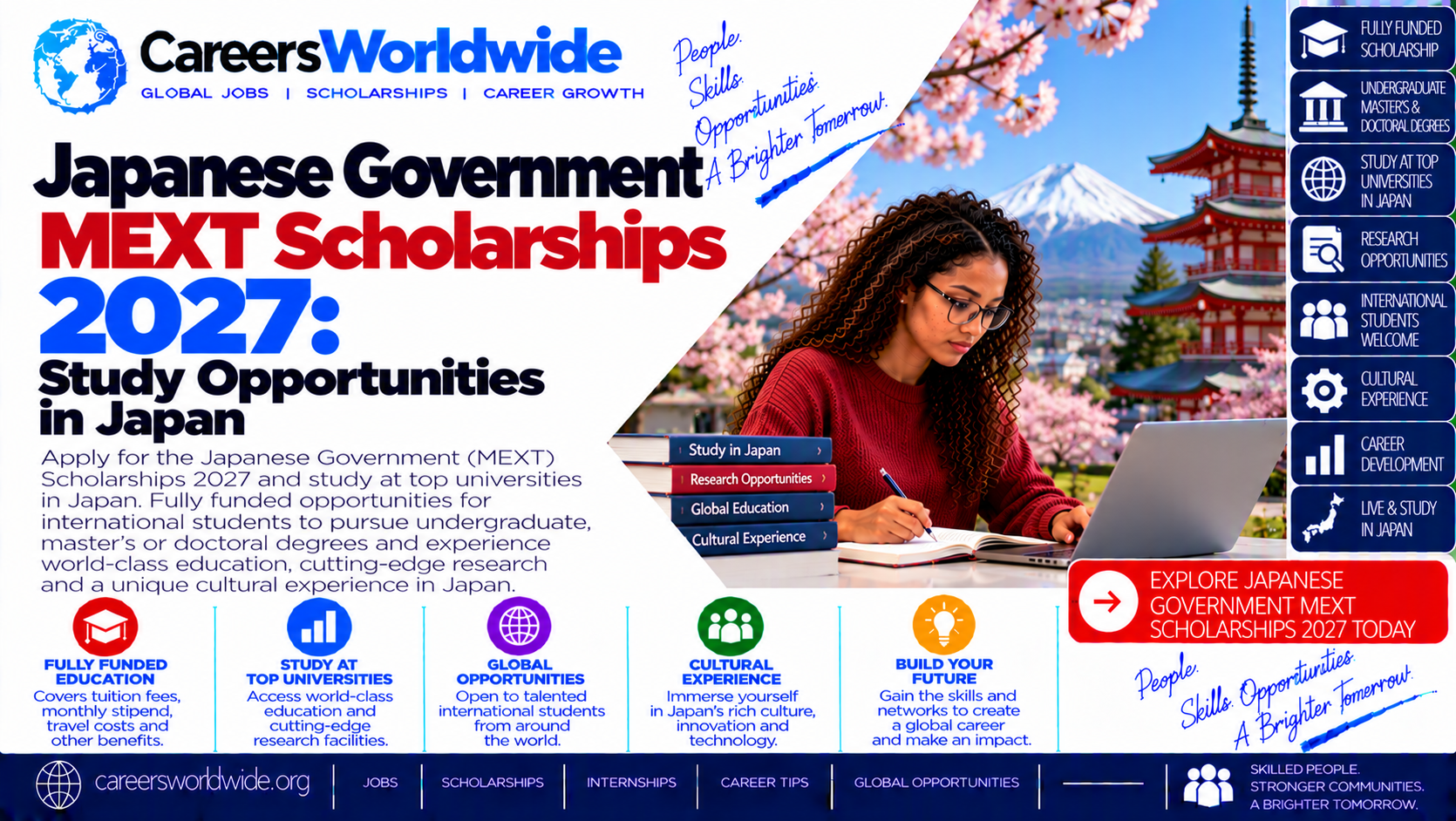
Excerpt: The Japanese Government MEXT Scholarship 2027 offers international students opportunities to pursue higher education in Japan with financial support from the Ministry of Education, Culture, Sports, Science and Technology (MEXT). Depending on the scholarship category, eligible students may receive a monthly stipend, exemption from entrance examination and tuition fees, and round-trip airfare under the programme’s applicable conditions. Opportunities include undergraduate study, master’s and doctoral-level research, teacher training, Japanese studies, colleges of technology and specialised training colleges. Learn about the scholarship benefits, eligibility requirements, application routes, required documents and official resources before preparing your application.
Japan is an attractive destination for international students seeking high-quality education, advanced research facilities and exposure to a different academic and cultural environment. For students who want to study there without carrying the full cost of international education themselves, the Japanese Government’s MEXT Scholarship programme is one of the most important funding opportunities to investigate.
Administered by Japan’s Ministry of Education, Culture, Sports, Science and Technology, the MEXT programme supports international students across several educational levels and academic specialisations. It includes scholarships for undergraduate students, research students pursuing graduate-level study, teacher training students and other specialised categories.
日本留学情報サイト Study in Japan
+1
However, applicants must understand an important timing issue: the 2027 embassy-recommendation application cycle generally opened in 2026, and many countries have already closed their applications by October 2026. The precise schedule varies by country and category. The Japanese Embassy in Zimbabwe, for example, announced a deadline of 29 May 2026 for its 2027 MEXT scholarship applications. Students should therefore verify their local embassy’s current notices rather than assume applications remain open.
Embassy of Japan in Zimbabwe
+1
This guide explains the different MEXT scholarship categories, the financial benefits, eligibility rules, application procedures and practical steps students can take to prepare.
1. Japanese Government MEXT Scholarship 2027: Overview
Scholarship provider
Japanese Government – MEXT
Study opportunities
Undergraduate, graduate-level research, teacher training, Japanese studies, colleges of technology and specialised training colleges.
Financial support
Monthly stipend, tuition and entrance-fee exemption, and travel support, subject to the applicable category and conditions.
Study destination
Participating universities and educational institutions in Japan.
Application timing
Varies by country, category and recommendation route. Many 2027 embassy applications closed during 2026.
Source: Official Study in Japan scholarship information and MEXT application pages.
日本留学情報サイト Study in Japan
+2
The MEXT Scholarship is not a single award with identical requirements for every applicant. It is a group of scholarship categories, each designed for a particular level of study or academic purpose.
The first step is to identify the category that matches your qualifications and goals. A secondary school graduate applying for an undergraduate degree, for example, follows a different process from a university graduate seeking master’s or doctoral research.
2. What Does the MEXT Scholarship Cover?
MEXT scholarship benefits are a major reason students investigate the programme. The official Study in Japan website describes support that includes a monthly scholarship allowance, exemption from entrance examination and tuition fees, and round-trip airfare under the relevant programme conditions.
日本留学情報サイト Study in Japan
Monthly living allowance
MEXT provides a monthly stipend to help recipients meet living expenses in Japan. The amount depends on the scholarship category and applicable programme rules.
The official overview lists monthly allowances in the following ranges for several major categories:
| Scholarship category | Published monthly allowance |
|---|---|
| Research students | ¥143,000–¥145,000 |
| Teacher training students | ¥117,000 |
| Undergraduate students | ¥117,000 |
| Japanese studies students | ¥117,000 |
| College of technology students | ¥117,000 |
| Specialized training college students | ¥117,000 |
These figures reflect the official scholarship overview and are provided for general guidance. Confirm the applicable allowance in the specific FY2027 guidelines; amounts and additional allowances may depend on the programme and circumstances.
日本留学情報サイト Study in Japan
A stipend helps with day-to-day costs, but students should still create a budget. Housing, food, transport and personal expenses vary by city, accommodation type and lifestyle.
Tuition and entrance fees
MEXT scholarship recipients are generally exempt from entrance examination fees, admission fees and tuition fees under the relevant scholarship arrangements. The exact treatment should be checked in the category-specific guidelines and offer documents.
日本留学情報サイト Study in Japan
This support can substantially reduce the cost of studying at a Japanese institution.
Round-trip airfare
The programme includes travel support for eligible scholarship recipients under the applicable rules. The official terms determine the conditions, travel arrangements and eligible routes.
Applicants should not assume that every travel expense is reimbursed. Costs such as local transport, accommodation before the approved arrival date, extra baggage and personal travel may not be covered.
Is MEXT fully funded?
MEXT is commonly described as a fully funded scholarship because it can cover tuition, provide a monthly allowance and support approved travel. Nevertheless, students should rely on the precise benefits stated in their category’s official guidelines and scholarship offer rather than assume that every possible expense is covered.
The award should not be treated as a guarantee of unlimited financial support or payment for every personal cost.
3. The Seven MEXT Scholarship Categories for 2027
MEXT has seven main scholarship categories. Each serves a different type of student, so applicants should select the route that fits their academic background.
日本留学情報サイト Study in Japan

1. Research Students Scholarship
Designed for university graduates who want to pursue graduate-level study or research in Japan. Depending on their qualifications and placement, recipients may undertake non-degree research, a master’s degree or doctoral study.
This is a particularly relevant category for applicants interested in science, engineering, public health, agriculture, economics, technology, environmental studies and other academic disciplines.

2. Undergraduate Students Scholarship
Intended for eligible secondary school graduates planning to study for an undergraduate qualification in Japan. The programme generally includes preparatory Japanese-language education where required.
Applicants should be prepared for academic examinations and a selection process that can include language and subject tests.

3. College of Technology (KOSEN) Students
This route is intended for students seeking practical and technical education in fields such as engineering and applied technology. The programme typically involves entry into the third year of a Japanese college of technology, following preparatory education where applicable.

4. Specialized Training College Students
This category supports eligible students who want to pursue specialised vocational education in Japan. It may suit applicants interested in technical skills and practical professional training.

5. Japanese Studies Students
Intended for eligible international undergraduates already studying Japanese language or Japanese culture at a university outside Japan. Recipients normally undertake a one-year programme and return to their home institution to continue their studies.

6. Teacher Training Students
Designed for eligible teachers from other countries who want to undertake teacher training and educational research at a Japanese university. Applicants generally need at least five years of relevant teaching experience and must meet the category’s other conditions.

7. Young Leaders’ Program (YLP)
A specialised programme for eligible young professionals, including public administrators and other individuals with relevant practical experience. It focuses on developing leadership and professional capabilities. Its recruitment arrangements differ from the general embassy-recommendation process.
The categories have different age limits, educational requirements, durations and application routes. Not every category is available through both embassy and university recommendation.
日本留学情報サイト Study in Japan
4. Who Can Apply for the MEXT Scholarship?
Eligibility depends on the scholarship category and the applicable FY2027 guidelines. The following criteria provide a general starting point, but the official category-specific rules take precedence.
Research students
Applicants generally must be under 35 years old and qualify for admission to a master’s or doctoral programme at a Japanese graduate school. Their intended research should normally relate to their previous field of study or an area in which they can demonstrate a credible academic foundation.
日本留学情報サイト Study in Japan
A well-prepared research plan is particularly important. It should explain the proposed research question, why the subject matters, how the research could be conducted and why studying in Japan would be appropriate.
Undergraduate students
Applicants generally must be under 25 years old and have completed 12 years of school education, or be expected to complete the required equivalent education.
日本留学情報サイト Study in Japan
Academic preparation matters because undergraduate applicants may be required to sit examinations in subjects such as mathematics, English, Japanese and science, depending on their intended field.
College of technology students
Applicants generally must be under 25 and have completed at least 11 years of education, or meet the corresponding eligibility provisions. The precise educational pathway and placement rules should be checked in the official guidelines.
Specialized training college students
Applicants generally must be under 25 and meet the specified school education requirements, including the required 12 years of schooling or recognised equivalent. The intended course must fit the scholarship category.
Japanese studies students
This category generally requires applicants to be between 18 and 29 years old, enrolled as undergraduates in a programme related to Japanese language or culture at a university outside Japan, and able to return to their home institution after the programme.
日本留学情報サイト Study in Japan
Teacher training students
Applicants generally must be under 35, have graduated from a college or teacher-training institution, and have at least five years of active teaching experience at an eligible school or teacher-training institution in their home country. The general programme excludes currently active university and college teachers from this category.
日本留学情報サイト Study in Japan
Young Leaders’ Program
YLP applicants are generally under 40 in principle and are expected to have relevant professional experience and leadership potential. Eligibility and recruitment are programme-specific, so candidates should consult the relevant official YLP information rather than rely solely on the general MEXT scholarship page.
Nationality and health requirements
Applicants must meet the nationality and other eligibility conditions in the applicable guidelines. Health documentation may be required, and some categories have specific rules regarding Japanese-language ability, academic preparation and previous scholarship participation.
Important: Age limits, graduation dates, nationality rules and exceptions can be defined precisely by the official guidelines. Check the rules for the specific category and intake before applying.
5. Summary Table: MEXT Scholarship Opportunities
| Scholarship category | Intended applicants | Typical duration or structure |
|---|---|---|
| Research students | Graduates seeking graduate-level research or study | Varies by research status and degree pathway |
| Undergraduate students | Eligible secondary school graduates | Usually five years, or seven for specified medical-related fields, including preparatory education |
| College of technology | Students seeking technical education | Usually four years, including preparatory education |
| Specialized training college | Students seeking vocational training | Usually three years, including preparatory education |
| Japanese studies | Undergraduates studying Japanese language or culture | One academic year |
| Teacher training | Experienced school teachers | Up to 1 year and 6 months, including language education where applicable |
| Young Leaders’ Program | Eligible professionals and public administrators | Generally one year |
Durations are based on the general official programme overview. Individual placement, preparatory education and programme rules can affect the actual period. Verify the FY2027 guidelines for your category.
日本留学情報サイト Study in Japan
6. How to Apply for the Japanese Government MEXT Scholarship 2027
MEXT has two main application routes: embassy recommendation and university recommendation. Applicants should not assume that the routes have the same deadlines, available categories or selection procedures.
日本留学情報サイト Study in Japan
Route 1: Embassy recommendation
In this route, applicants apply through the Japanese embassy or consulate responsible for their country. The diplomatic mission conducts the initial screening and provides instructions about documents, examinations and interviews.
For the 2027 intake, many embassy-recommendation application periods took place in April and May 2026, with initial screenings following during 2026. The precise dates depend on the country and scholarship category.
日本留学情報サイト Study in Japan
+1
If you have already missed the deadline, do not send documents to MEXT in Japan and assume they will be accepted. Instead, ask the embassy whether any official late application provision exists and prepare for the next announced recruitment cycle if the 2027 route is closed.
Route 2: University recommendation
Some Japanese universities can recommend international candidates to MEXT under approved recommendation arrangements. The university first recruits and screens eligible candidates, then recommends selected applicants to MEXT.
Not every Japanese university has a recommendation quota, and the available categories, eligibility requirements and deadlines differ between institutions.
日本留学情報サイト Study in Japan
To explore this route:
- Identify Japanese universities that offer your intended academic subject.
- Check the international admissions or scholarship pages of each institution.
- Look for official MEXT university-recommendation opportunities.
- Confirm whether the university is accepting candidates for the relevant 2027 intake.
- Follow the university’s nomination and admissions procedures.
Do not assume that finding a Japanese university with a suitable course means you can independently submit a MEXT university-recommendation application. The institution must participate in the relevant scheme and nominate candidates through its own process.
7. Documents to Prepare for a MEXT Scholarship Application
Required documents vary by category, country and recommendation route. Embassy-recommendation applications commonly involve an application form, academic records, recommendation letters and a health certificate. Research applicants also need a field of study and research plan.
日本留学情報サイト Study in Japan
+1
Use the checklist below to organise your preparation.
MEXT document checklist
0 of 10Completed MEXT application form for the correct categoryAcademic transcripts and examination resultsGraduation certificate or expected graduation certificateRecommendation letter from the required academic or professional authorityCertificate of health completed by a qualified medical doctor, if requiredResearch plan or field of study plan, where applicableProof of nationality or passport, as requestedJapanese- or English-language proficiency evidence, if requiredCertified translations for documents not accepted in their original languageCategory-specific forms and any additional documents in the official guidelines
Copy document checklist
This is a preparation checklist, not a substitute for the official application instructions. Do not submit every item automatically. Check the correct FY2027 form and the requirements issued by your embassy or university.
How to prepare a strong research plan
For research applicants, the research plan is an opportunity to demonstrate academic focus and readiness for graduate study.
A useful plan should explain:
- Research topic: State the problem or question you want to investigate.
- Background: Explain what is already known and identify the issue your work will address.
- Objectives: Set out clear, achievable research goals.
- Methodology: Describe how you intend to collect evidence, analyse information or conduct experiments.
- Relevance to Japan: Explain why the proposed research would benefit from study at a Japanese institution.
- Expected contribution: Show how the work could contribute to your discipline or address a practical problem.
Avoid choosing a topic simply because it sounds impressive. A credible proposal is one that connects your previous education, realistic methods and future goals.
How to prepare your recommendation letter
Ask a lecturer, academic supervisor or other appropriate recommender who knows your work well. Give them enough time to prepare the letter and provide a current CV, academic transcript and summary of your goals.
Follow the official instructions for the number, format and submission method of recommendation letters. Do not assume that a generic reference letter will meet every requirement.
8. MEXT Examinations and Interviews
Applicants using the embassy-recommendation route may be required to sit written examinations and attend an interview. The subjects depend on the scholarship category.
日本留学情報サイト Study in Japan
The official programme overview lists the following general examination subjects:
| Category | Typical examination subjects |
|---|---|
| Research students | Japanese and English |
| Undergraduate students | Japanese, English, mathematics and, for relevant science applicants, specified science subjects |
| College of technology | Japanese, English, mathematics and physics or chemistry |
| Specialized training college | Japanese, English and mathematics |
| Japanese studies | Japanese |
| Teacher training | Japanese and English |
Always verify the precise examination requirements for the category and year you are applying for.
Practical examination preparation
Start with the official past examination questions available through the Study in Japan website. These can help you understand the format and the level of preparation required.
A sensible preparation routine includes:
- Review the subjects specified for your category.
- Practise with past papers and time yourself.
- Identify topics where your knowledge is weak.
- Study consistently rather than relying on last-minute revision.
- Prepare to explain your academic interests and study goals in an interview.
For research applicants, be ready to discuss your proposed topic, previous academic work, intended research methods and reasons for choosing Japan.
For undergraduate applicants, strengthen your foundational knowledge in the required subjects. Do not neglect Japanese-language preparation simply because you expect some academic instruction to be available in English.
9. Important Dates for the 2027 Intake
The main consideration for applicants reading this article in October 2026 is that the 2027 embassy-recommendation process is already well advanced.
The official Study in Japan website explains that recruitment for many embassy-recommendation programmes takes place in April and May of the previous year. It also states that schedules vary by nationality and applicants must consult their local embassy.
日本留学情報サイト Study in Japan
+1
| Milestone | What applicants should know |
|---|---|
| Embassy recruitment | Commonly April–May 2026 for many 2027 programmes |
| Initial screening | Commonly May–August 2026, depending on category |
| Current position | By October 2026, many 2027 embassy application windows have closed |
| University recommendation | Deadlines are set by participating universities and may differ |
| Next recruitment cycle | Monitor official announcements for the next intake |
The schedule above describes the general process, not a universal deadline for every country or scholarship type.
What if you missed the 2027 deadline?
You still have practical options.
- Check your embassy’s official website to confirm whether your category’s recruitment is closed.
- Ask whether any later or separate recruitment applies to your circumstances.
- Investigate eligible university-recommendation opportunities, but only where a participating institution confirms that the relevant intake is available.
- Prepare your academic records, recommendation letters and research proposal for the next announced cycle.
- Monitor the official embassy website so you do not miss future application dates.
Do not pay an agent who promises to reopen a closed government scholarship application or guarantee selection.
10. How to Choose the Right Japanese University
Selecting the right institution is particularly important for research applicants and those exploring university recommendation.
Begin with your intended subject, then identify institutions with relevant departments, laboratories, supervisors or programmes. Avoid selecting a university only because it is well known.
Consider these factors:
- Academic fit: Does the institution offer the course or research area you want?
- Research supervision: For graduate applicants, are there supervisors whose expertise matches your proposal?
- Language requirements: Is the programme taught in Japanese, English or both?
- Admissions pathway: Does the university accept international applicants through the relevant MEXT route?
- Location and cost: Can you manage housing, transport and other expenses in the university’s city?
- Career goals: Will the qualification help you pursue your intended professional or academic pathway?
For research students, the official embassy-recommendation process may involve obtaining provisional acceptance from a Japanese university after passing the first screening, in accordance with the applicable guidelines. Follow the current instructions carefully and do not contact universities in ways that conflict with the official process.
11. Practical 30-Day Preparation Plan
If you are preparing for a future MEXT application, use the following plan to organise your work. If you are already applying for an open university-recommendation opportunity, adjust the schedule to meet that institution’s actual deadlines.
Days 1–7
Confirm your category and eligibility
Review the official guidelines, check the age and educational requirements, identify the correct application route and shortlist relevant courses or research areas.
Days 8–14
Collect academic documents
Request transcripts, graduation certificates and recommendation letters. Check translation and certification requirements before paying for these services.
Days 15–21
Develop your academic application
Prepare your research proposal or study plan where required, revise your CV and practise the relevant examination subjects.
Days 22–30
Review and verify
Compare every document with the official checklist, confirm the submission method, save copies and verify the deadline with the responsible embassy or university.
The purpose of this plan is to help you become application-ready. It does not imply that a closed 2027 application can still be submitted.
12. Official MEXT Scholarship Application Resources
Use these official resources to obtain application forms, confirm eligibility and find the relevant diplomatic mission.

Japanese Government MEXT Scholarship Overview
The main official guide to scholarship categories, general eligibility, funding and application routes.
Visit the official MEXT overview
FY2027 Research Students Application
Official guidelines, application form, placement preference form, research plan and health certificate for the research-student route.
View research scholarship documents
FY2027 Undergraduate Application
Official undergraduate scholarship guidelines, application forms and examination-related information.
View undergraduate scholarship documents
Embassies and Consulates of Japan
Find the Japanese diplomatic mission responsible for your country and verify local application announcements.
Find Japanese embassies and consulates
Embassy of Japan in Zimbabwe
For applicants in Zimbabwe, check the embassy’s notices and contact it to confirm the status of the relevant scholarship cycle.
Visit the official Zimbabwe embassy website
Applicants in Zimbabwe can also consult the embassy’s published contact information. Its general contact email is info.emb-japan@hz.mofa.go.jp. Use this channel to ask where official scholarship notices and category-specific instructions are published.
zw.emb-japan.go.jp
13. Frequently Asked Questions (FAQ)
1. What is the Japanese Government MEXT Scholarship 2027?
It is a Japanese government scholarship programme administered by MEXT that supports eligible international students in several categories, including undergraduate study, graduate-level research, teacher training, Japanese studies, technical education and specialised vocational training.
日本留学情報サイト Study in Japan
2. Is the MEXT Scholarship fully funded?
The programme generally provides tuition and entrance-fee exemptions, a monthly allowance and travel support under the relevant conditions. However, applicants should read the specific category guidelines and award terms to establish exactly what is covered.
3. How much is the monthly stipend?
The amount depends on the category. The official overview lists ¥143,000–¥145,000 for research students and ¥117,000 for several other major categories. Confirm the exact allowance in the FY2027 guidelines before budgeting.
日本留学情報サイト Study in Japan
4. Can African students apply?
Applicants from African countries may be eligible if they meet the relevant nationality, academic, age and other requirements. The applicable Japanese embassy determines the local recruitment arrangements and which categories are available.
5. Can students from Zimbabwe apply?
Zimbabwean applicants should check the Embassy of Japan in Zimbabwe’s official scholarship announcements. The embassy announced a deadline of 29 May 2026 for its 2027 MEXT scholarship applications. As of October 2026, applicants should not assume that this application window remains open.
Embassy of Japan in Zimbabwe
6. Are MEXT Scholarship 2027 applications still open?
Many embassy-recommendation application periods for the 2027 intake have already closed. However, university-recommendation recruitment is institution-specific. Check directly with the relevant embassy or participating university for the current status of your category.
7. Do I need IELTS or TOEFL?
Language requirements vary by category, institution and programme. English-language test results may be useful or required in particular circumstances, but applicants should not assume that IELTS or TOEFL is mandatory for every MEXT category. Check the official guidelines and university requirements.
8. Can I apply without knowing Japanese?
Some applicants may receive preparatory Japanese-language education, and language requirements vary by programme. Nevertheless, Japanese-language proficiency may be important for examinations, daily life and academic study. Check the requirements for your chosen category.
9. Can I apply directly to MEXT in Japan?
For the embassy-recommendation route, applicants must submit documents through the designated Japanese embassy or consulate rather than sending them directly to MEXT. University-recommendation applicants must follow the participating university’s nomination process.
日本留学情報サイト Study in Japan
+1
10. Can I choose my Japanese university?
Applicants can express placement preferences where the relevant process permits, but final placement depends on the scholarship category, university acceptance and MEXT’s procedures. A preferred institution is not guaranteed.
11. What happens if I miss the 2027 deadline?
Check whether an official alternative route remains available for your intended intake. If not, prepare for the next announced recruitment cycle and monitor official embassy and university notices.
12. Is an application fee required?
Use only the official application instructions. Be cautious if an individual or agency asks for payment in exchange for a guaranteed MEXT award or promises to bypass the selection process.
14. Final Thoughts
The Japanese Government MEXT Scholarship remains an important opportunity for international students seeking financial support to study in Japan. Its seven scholarship categories cover different academic and professional pathways, from undergraduate education and technical training to graduate research and teacher development.
The programme can offer substantial support through a monthly allowance, tuition and entrance-fee exemptions, and approved travel benefits. However, eligibility, award duration and application procedures vary by category.
For students targeting the 2027 intake, the most important step is to verify application status immediately. Many embassy-recommendation deadlines took place during 2026, and the 2027 cycle may already be closed in your country. University recommendation is a separate route, not a guaranteed late-application alternative.
Start with the official MEXT scholarship overview, identify the appropriate category, read the latest guidelines and contact the responsible embassy or university. If the 2027 window has closed, use the time to strengthen your academic record, prepare your documents and research plan, and get ready for the next official recruitment cycle.
Disclaimer
This article is for general informational purposes and is not an official MEXT announcement. Scholarship amounts, eligibility requirements, application procedures, available categories and deadlines may vary by year, country and institution. Information about the 2027 cycle should be verified through official Japanese government, embassy and university resources. Meeting the general criteria does not guarantee selection, admission or a scholarship award.
SEO Details for CareersWorldwide
SEO title: Japanese Government MEXT Scholarships 2027: Study in Japan
Meta description: Explore Japanese Government MEXT Scholarships 2027, including eligibility, monthly stipends, tuition support, application routes and official resources for international students.
Focus keyword: Japanese Government MEXT Scholarships 2027
Suggested URL slug: japanese-government-mext-scholarships-2027
Suggested image alt text: Japanese Government MEXT Scholarships 2027 for international students studying at universities in Japan
Suggested image filename: japanese-government-mext-scholarships-2027.jpg
SEO Keywords
Japanese Government MEXT Scholarships 2027, MEXT Scholarship 2027, study in Japan scholarships 2027, Japanese government scholarships for international students, fully funded scholarships in Japan, MEXT undergraduate scholarship 2027, MEXT postgraduate research scholarship, Japan master’s scholarships 2027, Japan PhD scholarships for international students, MEXT scholarship eligibility requirements, MEXT scholarship application process, MEXT scholarship monthly stipend, Japanese government scholarship application forms, MEXT embassy recommendation 2027, MEXT university recommendation scholarship, Japan scholarships for African students, Japan scholarships for Zimbabwean students, Japanese university scholarships for international students, MEXT scholarship research proposal, MEXT scholarship deadline 2027, study abroad in Japan 2027, Japan government-funded education opportunities, MEXT scholarship official website, Japanese language and culture scholarships, Japan technical college scholarships, teacher training scholarships Japan, Japan undergraduate scholarships for international students, MEXT scholarship application documents, Japanese government education funding, international student opportunities in Japan,
ALSO CHECK: 2027 Africa International Scholarship at Edith Cowan University: 20% Tuition Fee ReductionOctober 10, 2026
UK Commonwealth Scholarships 2027–2028: Funding Opportunities for International StudentsOctober 10, 2026
Quantum Computing Scholarships 2026–2027: Study Next-Generation ComputingOctober 10, 2026