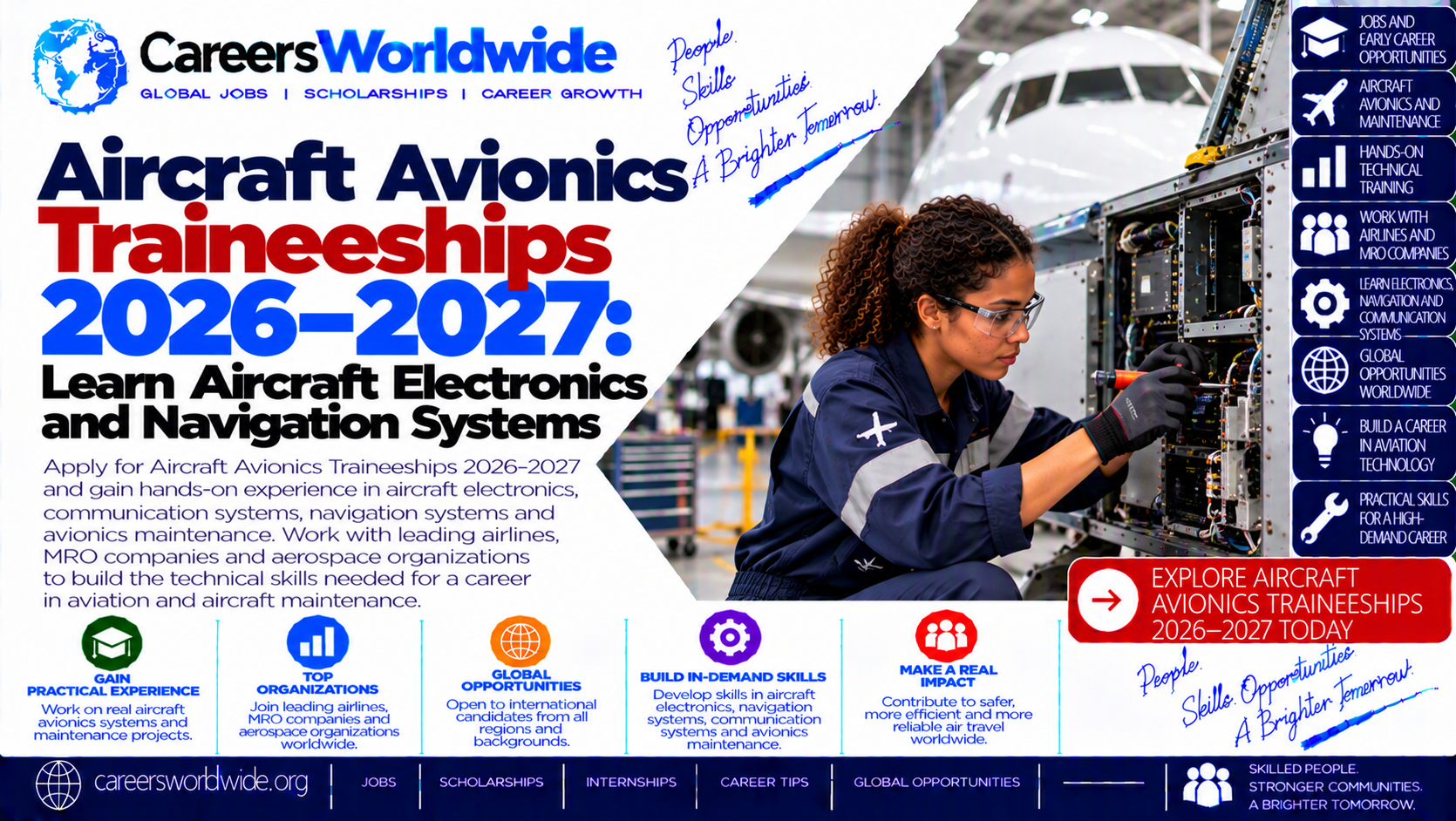

Excerpt: Aircraft Avionics Traineeships 2026–2027 offer aspiring aviation technicians an opportunity to explore aircraft electronics, navigation systems, communication equipment, flight instruments, and electrical troubleshooting. These training pathways can help school leavers, technical college graduates, engineering students, and early-career professionals develop practical skills for the aviation industry. Discover the qualifications to consider, potential training providers, application requirements, career opportunities, and official resources for finding aircraft avionics traineeships for the 2026–2027 intake.
Aircraft technology is becoming increasingly sophisticated, with modern aircraft relying on interconnected electronic systems to support navigation, communication, flight monitoring, and operational safety. Behind these systems are skilled avionics technicians and engineers who inspect equipment, diagnose faults, perform maintenance tasks, and help ensure that aircraft systems operate according to approved technical standards.
For people interested in electronics, engineering, aviation, and hands-on technical work, an aircraft avionics traineeship can provide a valuable starting point. Depending on the employer and country, training opportunities may be available through airlines, aircraft maintenance organisations, aviation colleges, aerospace companies, and approved maintenance training institutions.
However, applicants should understand that a traineeship is not automatically a paid position, an internationally recognised licence, or a guaranteed route to employment. Programmes differ in their entry requirements, duration, funding, practical training arrangements, and licensing outcomes.
This guide explains how to explore Aircraft Avionics Traineeships 2026–2027, prepare a competitive application, and identify legitimate opportunities through official aviation and training resources.
1. What Are Aircraft Avionics Traineeships?
Aircraft avionics traineeships are structured learning or workplace training opportunities focused on the electronic and electrical systems used in aircraft.
The term avionics combines aviation and electronics. It covers the systems that allow pilots and aircraft operators to communicate, determine aircraft position, monitor flight information, and use electronic instruments and control interfaces.
Depending on the programme, trainees may study electrical principles, electronic components, aircraft wiring, navigation equipment, communication systems, digital instrumentation, and approved maintenance procedures.
Some opportunities are designed for beginners, while others require a technical certificate, diploma, engineering qualification, or previous experience in electronics or aircraft maintenance.
Training may combine classroom instruction, laboratory exercises, supervised workplace experience, practical assessments, and examinations. Certain programmes also prepare candidates for specific aircraft maintenance licensing pathways, although licensing eligibility depends on the applicable aviation authority and the programme’s recognition.
Why consider avionics training in 2026–2027?
Aircraft avionics offers an opportunity to develop specialised technical skills in a safety-critical industry. As aircraft systems incorporate increasingly sophisticated digital equipment, technicians need a strong understanding of electronics, electrical safety, technical documentation, and systematic fault diagnosis.
A structured traineeship can help participants:
- Build a foundation in aircraft electrical and electronic systems.
- Learn how navigation and communication equipment works.
- Develop technical troubleshooting and inspection skills.
- Understand aviation safety procedures and maintenance documentation.
- Gain supervised experience where the programme provides practical placements.
- Explore further training and professional certification options.
- Prepare for potential careers in aircraft maintenance and related technical fields.
Applicants should verify the actual curriculum and practical components before enrolling. A general electronics course may be useful preparation, but it is not necessarily equivalent to an aircraft avionics training programme.
2. What Do Avionics Trainees Learn?
The exact curriculum depends on the training provider, aircraft types covered, and relevant aviation regulations. Many programmes introduce learners to several core technical areas.
Aircraft electrical systems
Trainees may learn about electrical power generation and distribution, batteries, circuit protection, wiring diagrams, connectors, grounding, and electrical safety.
These fundamentals help technicians understand how aircraft equipment receives power and how electrical faults can affect connected systems.
Navigation systems
Navigation equipment helps flight crews determine aircraft position, direction, and route information.
Training may introduce learners to systems such as:
- Global Navigation Satellite Systems (GNSS), including GPS.
- Instrument landing systems (ILS).
- VHF omnidirectional range (VOR) equipment.
- Distance measuring equipment (DME).
- Flight management systems and associated displays.
The depth of instruction varies. An introductory course might explain the principles of these systems, whereas a more advanced programme may cover testing, maintenance documentation, and supervised troubleshooting.
Aircraft communication systems
Aircraft communication equipment enables pilots to communicate with air traffic control, other aircraft, and operational teams.
Trainees may study aviation radio principles, antennas, signal transmission, transceivers, audio systems, and communication-related fault diagnosis.
Because aviation communications are safety-critical, practical maintenance must follow approved procedures and applicable regulatory requirements.
Flight instruments and electronic displays
Modern cockpits use electronic displays and sensors to present flight information. Trainees may learn about instrument systems, data inputs, display units, sensor interfaces, and the relationship between electronic equipment and cockpit indications.
Some programmes introduce digital flight displays and electronic flight instrument systems, while more advanced courses may cover integrated avionics architectures.
Aircraft wiring and electronic components
Aircraft wiring must be installed, inspected, and maintained according to strict technical requirements.
Training may cover connectors, cable routing, shielding, continuity testing, component identification, electrical schematics, and approved wiring repair practices.
Learners also need to understand electrostatic discharge precautions and the correct handling of sensitive electronic equipment.
Maintenance documentation and safety
Technical ability alone is not enough for aircraft maintenance work. Trainees must learn to follow approved instructions, record work accurately, observe workplace safety rules, and understand the limits of their authorisation.
Depending on the jurisdiction and role, maintenance tasks may require supervision, certification, or approval by appropriately authorised personnel.
Important: Aircraft systems should never be repaired, adjusted, or returned to service based solely on information from an introductory course. Safety-critical work must follow the applicable approved maintenance data and regulatory requirements.
3. Who Can Apply for Aircraft Avionics Traineeships 2026–2027?
Eligibility depends on the employer, country, training level, and whether the programme leads to a recognised technical qualification.
The following groups may find relevant opportunities.
School leavers
Applicants with secondary education and a strong interest in mathematics, physics, and technical subjects can look for entry-level aircraft maintenance apprenticeships.
Some employers accept candidates without previous aviation experience if they meet the required academic standards and demonstrate a willingness to learn.
For example, a published UK aircraft maintenance apprenticeship for the 2027 intake lists English and mathematics among its essential GCSE requirements. Its specific conditions should not be assumed to apply to other programmes.
GOV.UK
Technical college graduates
Candidates with certificates or diplomas in electrical engineering, electronics, telecommunications, instrumentation, computer engineering, or related fields may have a useful foundation.
Relevant technical qualifications can help applicants understand aircraft electrical systems and electronic equipment. However, employers may still require aviation-specific training.
Engineering students and recent graduates
Students pursuing electrical, electronic, aerospace, or mechanical engineering can investigate internships, industrial attachments, graduate training, and maintenance apprenticeships.
Applicants should check whether a programme accepts students who have not completed their qualifications.
Career changers
People with experience in electronics repair, industrial maintenance, telecommunications, or electrical installation may possess transferable skills.
They should demonstrate how their existing experience relates to technical troubleshooting, equipment testing, safety procedures, and accurate documentation.
International applicants
Candidates applying from outside the country where a traineeship is based must check nationality requirements, work authorisation, visa eligibility, relocation costs, and any restrictions on international recruitment.
A programme advertised online is not necessarily open to applicants worldwide. Some apprenticeships are restricted to local residents or require the right to work in the host country before employment begins.
4. Essential Skills for Avionics Trainees
You do not need to be an experienced aircraft engineer before applying for a beginner programme. Nevertheless, developing relevant skills can improve your readiness.
Mathematics and physics
Revise algebra, basic trigonometry, electrical calculations, voltage, current, resistance, and power. These concepts underpin much of electronics training.
Electronics fundamentals
Learn about resistors, capacitors, diodes, transistors, circuit diagrams, multimeters, and basic digital electronics.
Troubleshooting
Practise a systematic approach: identify the reported fault, review the available information, test only as authorised, record findings, and escalate issues appropriately.
Technical reading and communication
Develop the ability to interpret technical instructions, understand diagrams, write clear reports, and communicate problems accurately.
Safety and attention to detail
Aircraft maintenance requires procedural discipline, careful record-keeping, responsible teamwork, and an understanding of the consequences of technical errors.
5. Aircraft Avionics Traineeships 2026–2027: Where to Find Opportunities
There is no single international application portal for every aircraft avionics traineeship. The most reliable approach is to check official employers, aviation authorities, recognised training institutions, and government apprenticeship websites.
The resources below are useful starting points. They are not a guarantee that every organisation currently has an open avionics vacancy.

KLM UK Engineering apprenticeships
KLM UK Engineering has published a Level 3 aircraft maintenance apprenticeship for a 2027 start, based at Norwich Airport. The advertised programme includes technical-college learning followed by supervised hangar experience. It is an aircraft maintenance apprenticeship, not necessarily an avionics-only placement.
Check the closing date and eligibility before applying.
View the official apprenticeship listing

Ryanair Engineering Training Academy
Ryanair publishes information about engineering training and apprenticeship pathways at selected locations. Review its official programme page to identify the available training route, location, entry requirements, and progression arrangements.
Explore Ryanair engineering training

Boeing aircraft maintenance training
Boeing’s careers website lists technical and engineering opportunities, including apprenticeship-related aircraft maintenance pathways in some locations. Check each vacancy for its actual specialisation and eligibility requirements.

FAA-approved aviation maintenance schools
In the United States, the Federal Aviation Administration provides information on approved Aviation Maintenance Technician Schools. Some offer avionics-related coursework covering electronics and instrumentation.
Find FAA-approved maintenance schools

Zambia Air Services Training Institute (ZASTI)
ZASTI describes aircraft maintenance engineering training that includes avionics-related study. Prospective students should confirm current programme availability, admission requirements, fees, and applicable approvals directly with the institution.
Review ZASTI engineering programmes

Air Zimbabwe careers and apprenticeship enquiries
Zimbabwean applicants can check the airline’s careers information for engineering opportunities. A previous 2026 aircraft engineering apprenticeship advertisement circulated in January had a January 23 deadline; that deadline has passed, so it should not be presented as an open vacancy.
Check Air Zimbabwe careers information
These resources cover different countries and types of training. Before committing to any programme, establish whether it is an apprenticeship, academic course, practical placement, or licensing-oriented training route.
6. Summary Table: Aircraft Avionics Traineeships 2026–2027
Use this table to compare the main pathways and determine which resources best match your qualifications and career goals.
| Training pathway | Who should consider it? | What to verify |
|---|---|---|
| Aircraft maintenance apprenticeship | School leavers and eligible beginners | Entry grades, age rules, pay, duration |
| Avionics technical course | Electronics and engineering students | Curriculum, practical facilities, recognition |
| Airline engineering traineeship | Applicants interested in airline maintenance | Recruitment eligibility, location, training structure |
| Approved maintenance school | Candidates pursuing a regulated training pathway | Approval status, curriculum, examination eligibility |
| Engineering internship or attachment | Students and recent graduates | Placement dates, supervision, insurance |
| Aircraft electronics manufacturer training | Candidates interested in equipment and systems | Technical specialisation, prerequisites, certification |
| International aviation training | Applicants willing to study abroad | Visa, tuition, accommodation, licensing recognition |
The best option is not necessarily the programme with the most attractive title. Prioritise the quality of practical training, the credibility of the provider, the qualification awarded, and the pathway to your intended career.
7. Are Aircraft Avionics Traineeships Paid?
Some traineeships and apprenticeships provide a salary or training allowance, while others require students to pay tuition and related expenses.
Payment depends on the employer, country, programme structure, and contractual arrangements. Do not assume that an opportunity is paid simply because it uses the words trainee, intern, or apprentice.
For example, the published UK aircraft maintenance apprenticeship listing from KLM UK Engineering specifies first-year pay of £15,600, with possible increases depending on age. This is an example of a particular advertised programme, not a standard salary for avionics trainees worldwide.
GOV.UK
Before accepting an offer, ask about:
- Monthly or annual gross pay.
- Whether pay increases during training.
- Tuition fees and examination charges.
- Accommodation and transport expenses.
- Personal protective equipment and tools.
- Insurance and workplace safety arrangements.
- Whether the employer sponsors additional certification.
- The conditions attached to continued employment after training.
What if the programme is unpaid?
An unpaid placement may still provide educational value, but applicants should assess its cost and credibility carefully.
Check whether the placement offers structured supervision, meaningful practical learning, recognised academic credit, or another concrete benefit. Also confirm whether unpaid work is lawful under the employment rules of the host country.
Be particularly cautious about recruiters who request large upfront payments in exchange for a guaranteed job, visa, or airline placement.
8. How Long Do Avionics Traineeships Last?
Training duration varies substantially.
Short introductory courses may last weeks or months. Technical diplomas may require a longer period of study, while comprehensive aircraft maintenance apprenticeships can extend over several years.
The FAA explains that many approved Aviation Maintenance Technician School programmes take approximately 18–24 months, depending on the programme and ratings pursued. A separate UK Level 3 aircraft maintenance apprenticeship listing specifies a three-year duration. Neither duration should be treated as universal for avionics traineeships.
Federal Aviation Administration
+1
Ask the provider to explain the difference between:
- Classroom or academic training.
- Workshop and laboratory training.
- Supervised on-the-job experience.
- Examinations and practical assessments.
- Additional experience required after graduation.
- The process for obtaining any relevant licence or authorisation.
A certificate of course completion does not automatically mean that a graduate can independently certify aircraft maintenance work.
9. Aircraft Avionics Career Opportunities After Training
Avionics training can support several career directions, depending on the qualification achieved, practical experience, employer requirements, and relevant regulations.

Avionics technician
Works with aircraft electronic systems, equipment inspections, fault diagnosis, testing, and maintenance tasks within the scope of their training and authorisation.

Aircraft electrical technician
Focuses on electrical wiring, power distribution, connectors, circuit protection, and related maintenance activities.

Radio and communications technician
Supports approved maintenance and testing of communication equipment, antennas, and related electronic systems.

Aerospace electronics technician
May work with electronic assemblies, test equipment, components, and technical documentation for aerospace products.

Aircraft maintenance engineer
With the appropriate training, experience, and authorisations, professionals may progress into broader aircraft maintenance responsibilities.
Other potential directions include avionics equipment testing, maintenance planning, technical support, component repair, and aerospace systems engineering after further education.
The U.S. Federal Aviation Administration identifies airlines, maintenance and repair organisations, manufacturers, repair stations, and aviation maintenance schools among the settings where aviation maintenance professionals may work.
Federal Aviation Administration
Can avionics trainees become avionics engineers?
Yes, but the pathway depends on the role.
A technician generally focuses on testing, maintenance, installation, and troubleshooting within their authorised scope. An avionics engineer may undertake system design, integration, analysis, testing, or technical development, often requiring an engineering degree or other specialised qualifications.
A traineeship can provide useful experience, but it does not replace any required engineering education or professional registration.
10. Licensing and International Recognition
One of the most important decisions is choosing training that supports your intended career destination.
A qualification recognised in one country may not automatically satisfy the licensing requirements in another. Applicants planning to work internationally should investigate this before paying tuition or relocating.
United States
The FAA provides pathways to aviation mechanic certification through approved training or qualifying practical experience. Its guidance also explains the training and knowledge requirements relevant to aviation maintenance careers. Avionics-specific employment requirements can differ from the requirements for an aviation mechanic certificate.
Federal Aviation Administration
+2
Official resource: FAA aviation maintenance and avionics technician guidance.
United Kingdom and European pathways
Applicants should distinguish between an aircraft maintenance apprenticeship, a technical qualification, approved maintenance training, and the requirements for a maintenance licence.
The relevant civil aviation authority and the exact approval status of the training organisation determine whether a programme supports a particular licensing pathway.
Official starting points:
- UK government apprenticeship service
- UK Civil Aviation Authority
- European Union Aviation Safety Agency
Zimbabwe and other African countries
Candidates should check the requirements of the national civil aviation authority and the recognition of the institution offering the programme. In Zimbabwe, applicants can also investigate apprenticeship information through the Higher Education Examinations Council.
When comparing providers, ask for the exact qualification title, awarding body, applicable regulatory approval, and any further examinations or experience needed.
Do not rely solely on a provider’s statement that its course is “internationally recognised.” Request documentary evidence and verify the claim with the relevant authority.
11. How to Apply for Aircraft Avionics Traineeships 2026–2027
A strong application should demonstrate technical interest, academic readiness, attention to detail, and a willingness to learn in a safety-critical environment.
Follow these steps when applying for a traineeship or apprenticeship.
Step 1: Identify the right programme
Search official airline careers pages, aircraft maintenance companies, aviation training institutions, government apprenticeship portals, and aerospace manufacturers.
Use targeted search terms such as:
- Aircraft avionics traineeships 2026–2027.
- Aircraft maintenance apprenticeships 2027.
- Avionics technician trainee vacancies.
- Aircraft electronics apprenticeships.
- Aircraft radio and telecommunications training.
- Aviation maintenance engineering internships.
- Entry-level avionics technician jobs.
Check the exact vacancy title, country, closing date, eligibility criteria, and application method.
Step 2: Review the entry requirements
Read the vacancy description carefully before preparing your documents.
Check whether the programme requires secondary school certificates, mathematics and physics, a technical diploma, previous engineering experience, English proficiency, or a specific right to work.
If your qualification is from another country, ask whether an equivalency assessment is required.
Step 3: Prepare your CV
Your CV should be concise, accurate, and tailored to the position.
Include:
- Contact details and current location.
- Educational qualifications and grades.
- Relevant electronics or engineering modules.
- Technical projects and laboratory experience.
- Computer skills and any relevant software.
- Industrial attachments or previous work experience.
- Safety training and relevant certifications.
- Referees, if requested by the employer.
Avoid claiming aircraft maintenance experience or licences you do not hold.
If you have not worked on aircraft before, highlight transferable experience such as circuit testing, electrical troubleshooting, electronics repair, technical documentation, and engineering projects.
Step 4: Write a targeted application letter
Explain why you want to enter aircraft avionics and how your background prepares you for the training.
A convincing letter should show that you understand the programme, are interested in learning aircraft electronics, and appreciate the importance of aviation safety.
Avoid sending an identical generic letter to every employer. Mention the organisation and programme you are applying for, and connect your skills to its published requirements.
Step 5: Gather supporting documents
Depending on the programme, you may need:
- Academic certificates and transcripts.
- A current CV.
- An application or motivation letter.
- Identification or proof of eligibility to work.
- Technical certificates.
- Referee details or recommendation letters.
- Evidence of English proficiency, where required.
Only submit sensitive personal documents through verified recruitment channels and when legitimately requested.
Step 6: Submit the application correctly
Follow the official instructions. Some organisations use online application forms, while others request documents through a designated recruitment email address.
Use the exact vacancy title in your application where appropriate. Check file formats, attachment limits, and the deadline, including the relevant time zone.
Keep a copy of your application and any confirmation you receive.
Step 7: Prepare for assessments and interviews
Potential assessments may cover basic mathematics, electrical principles, problem-solving, mechanical reasoning, communication, and safety awareness.
Practise explaining how you would approach a technical fault without making unauthorised repairs. Employers may also ask why you chose avionics, how you handle detailed work, and how you respond when you do not know the answer.
12. How to Prepare a Competitive Application
Use this checklist before submitting your application.
Application readiness checklist
0 of 8I meet the advertised academic and eligibility requirements.I have checked the closing date and official application channel.My CV highlights relevant electronics, mathematics, or engineering skills.My application letter explains why I want to train in aircraft avionics.My certificates and supporting documents are accurate and readable.I have checked fees, pay, location, and training conditions.I have verified the provider’s qualifications and regulatory claims.I have saved a copy of my application and the vacancy details.
Copy checklist
13. Official Application Resources
The following resources are useful for finding training programmes, checking requirements, and researching aviation career pathways.
| Resource | Purpose | Official website |
|---|---|---|
| Federal Aviation Administration | U.S. aviation maintenance training and certification guidance | FAA |
| FAA-approved maintenance schools | Find approved aviation maintenance training institutions | AMTS directory |
| UK government apprenticeship service | Search aircraft maintenance and engineering apprenticeships | Find an apprenticeship |
| Ryanair Engineering | Review engineering training and apprenticeship routes | Ryanair Careers |
| Boeing Careers | Search aerospace and aircraft maintenance opportunities | Boeing Jobs |
| Zambia Air Services Training Institute | Explore aircraft maintenance engineering training | ZASTI |
| Air Zimbabwe Careers | Check airline recruitment and engineering opportunities | Air Zimbabwe |
| Zimbabwe apprenticeship information | Research designated trades and apprenticeship training | HEXCO |
Application reminder: These are official starting points, not a statement that every provider is recruiting avionics trainees at the time of reading. Confirm that a vacancy is open before applying. Where a programme has no published intake, contact the organisation through its official recruitment channel and ask whether a 2027 intake is planned.
14. Frequently Asked Questions
1. Are Aircraft Avionics Traineeships 2026–2027 open to beginners?
Some programmes accept school leavers and candidates without aviation experience, while others require technical qualifications. Check the individual vacancy’s academic requirements, experience criteria, and eligibility conditions.
2. Can I apply with a diploma in software engineering?
A software engineering diploma may provide relevant skills in computer systems, problem-solving, and technical documentation. However, acceptance depends on the employer. You may need additional qualifications in electronics, electrical engineering, mathematics, or aircraft maintenance.
Applicants with software backgrounds can also investigate aviation systems testing, embedded software, and aerospace electronics pathways where the entry requirements align with their skills.
3. Do avionics traineeships pay a salary?
Some employer-sponsored apprenticeships pay wages, while academic programmes and other placements may be unpaid or charge tuition. Check the written offer for salary, allowances, fees, and other conditions.
4. Can international applicants apply?
Some programmes accept international applicants, but others restrict recruitment by nationality, residency, or work authorisation. Confirm visa requirements and whether the employer sponsors eligible applicants before spending money on travel or applications.
5. Do I need mathematics and physics?
Many aircraft maintenance and avionics programmes require or strongly value mathematics and science. The precise subjects and grades depend on the training provider and country.
6. How long does aircraft avionics training take?
Duration can range from short introductory courses to multi-year apprenticeships and technical programmes. Ask how much time is spent studying, practising in workshops, and completing supervised workplace training.
7. Does completing a traineeship make me a licensed aircraft engineer?
Not automatically. Licensing may require approved training, examinations, relevant practical experience, and additional requirements imposed by the applicable aviation authority.
8. What is the difference between an avionics technician and an avionics engineer?
Technicians generally focus on equipment installation, testing, maintenance, and troubleshooting. Engineers may design, integrate, analyse, and develop electronic systems. The responsibilities and qualification requirements vary by employer and jurisdiction.
9. Are there aircraft avionics traineeships in Zimbabwe?
Applicants can monitor Air Zimbabwe’s official careers information and investigate apprenticeship pathways through relevant Zimbabwean training and technical education bodies. Availability, entry conditions, and the specialisations offered should be confirmed directly. A previous 2026 advertisement is not proof of an open 2027 intake.
10. How can I avoid fraudulent aviation training offers?
Verify the organisation independently, check the official vacancy, request written information about the qualification, and confirm relevant regulatory approvals. Be suspicious of personal email addresses impersonating recruiters, guaranteed jobs in exchange for payment, and requests to pay for a visa through an unverified intermediary.
11. Can an avionics qualification help me work abroad?
It may help, but recognition is not automatic. Check the licensing and employment requirements in the destination country before choosing a course. Some employers require additional training, examinations, experience, or local authorisation.
12. When should I apply for a 2027 traineeship?
Apply as soon as a suitable official vacancy is published, while allowing enough time to prepare documents and complete any required assessments. Some employers advertise months ahead of a training start date, while others recruit on different schedules.
15. Final Advice for Aspiring Avionics Technicians
Aircraft Avionics Traineeships 2026–2027 can be a valuable route into a specialised technical field for applicants who enjoy electronics, engineering, and practical problem-solving.
The strongest starting point is to identify the training route that matches your current qualifications. School leavers may prefer entry-level apprenticeships, while technical college graduates may be better suited to specialised avionics courses or engineering placements.
Build your knowledge of electrical principles, practise technical problem-solving, and prepare a CV that accurately demonstrates your abilities. Most importantly, investigate the quality of the training, the status of the qualification, and the requirements for working in your intended country.
Do not select a programme based on its title alone. A credible training opportunity should have clear entry requirements, transparent costs or remuneration, appropriate supervision, and a verifiable qualification pathway.
With careful preparation and a realistic understanding of licensing requirements, aspiring technicians can use these opportunities to begin developing the knowledge and experience needed for a career in aircraft electronics and navigation systems.
Disclaimer
This article is for educational and career-information purposes only. It is not an official recruitment announcement or a guarantee of admission, employment, salary, funding, visa sponsorship, or professional licensing. Training availability and recruitment conditions may change. Applicants should verify all details directly with the relevant employer, training institution, or aviation authority before submitting an application or making financial commitments.
CareersWorldwide is an independent career-information resource and is not affiliated with the organisations listed unless expressly stated.
SEO Keywords
Aircraft Avionics Traineeships 2026–2027,
Aircraft Avionics Apprenticeships 2027,
Aircraft Electronics Training Programs,
Avionics Technician Trainee Jobs,
Aircraft Maintenance Apprenticeships 2027,
Aircraft Navigation Systems Training,
Aircraft Radio and Telecommunications Traineeships,
Aviation Engineering Internships 2026,
Entry-Level Avionics Technician Careers,
Aircraft Electrical Systems Training,
Aviation Maintenance Technician Schools,
Aircraft Instrumentation Training,
Avionics Engineering Career Path,
Paid Aircraft Maintenance Apprenticeships,
International Aviation Training Opportunities,
Aircraft Electronics Technician Qualifications,
Aviation Apprenticeships for School Leavers,
Aircraft Maintenance Engineering Training,
Avionics Traineeships for International Applicants,
Aircraft Engineering Jobs for Beginners,
Aircraft Maintenance Training in Zimbabwe,
Aviation Technical Training 2027,
Aircraft Avionics Careers 2026–2027,
How to Become an Avionics Technician,
Aircraft Maintenance Certification Requirements,
ALSO CHECK: Robotics Field Service Engineer Jobs 2026–2027: Maintain Automated EquipmentOctober 13, 2026
Solar Project Engineer Jobs 2026–2027: Support Utility-Scale Solar DevelopmentsOctober 13, 2026
Veterinary Laboratory Technician Jobs 2026–2027: Support Animal Disease TestingOctober 13, 2026