
Excerpt
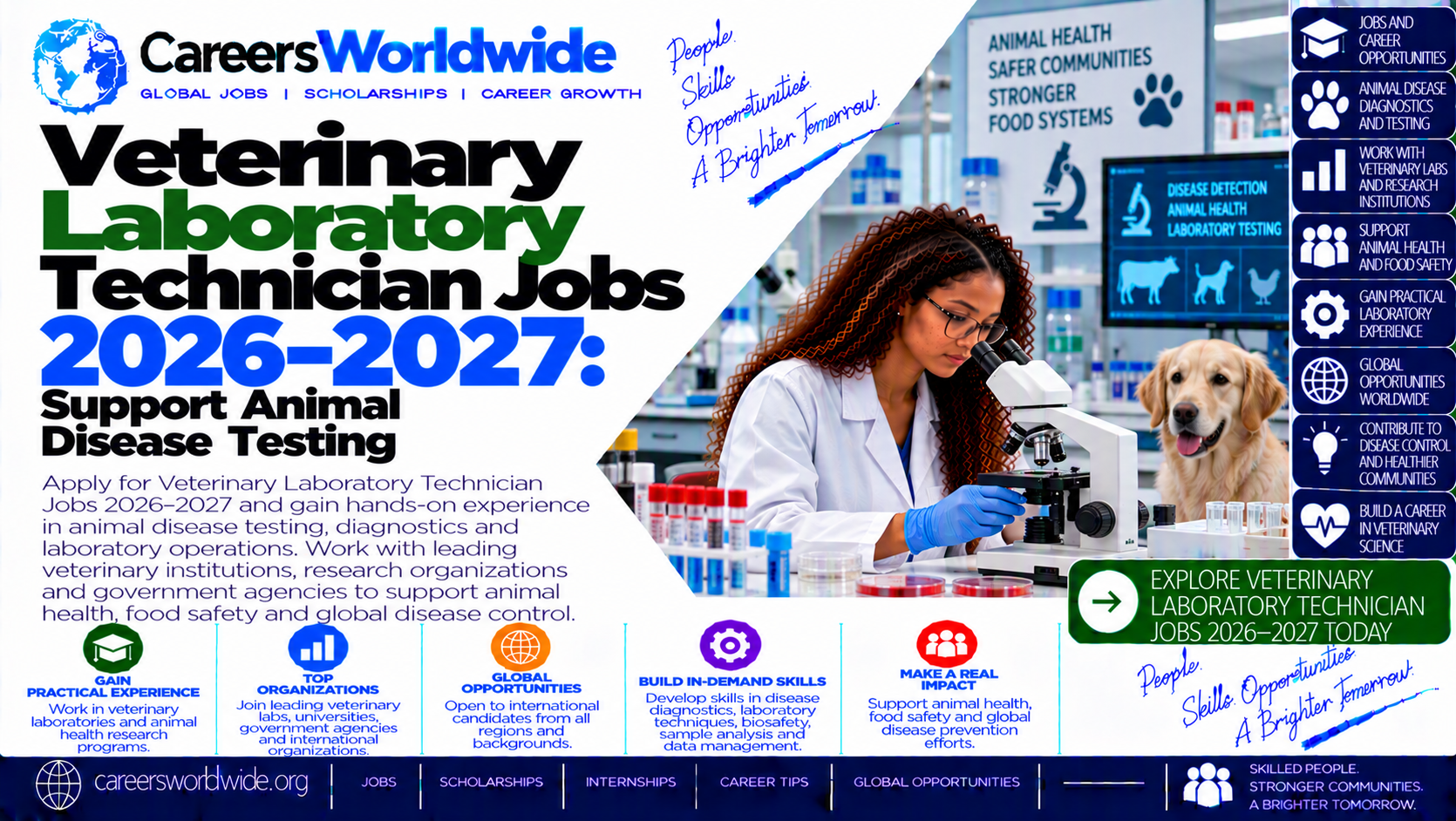
Discover veterinary laboratory technician jobs for 2026–2027 and explore career opportunities in animal disease testing, veterinary diagnostics, livestock health, laboratory research, and zoonotic disease surveillance. Learn about qualifications, essential laboratory skills, potential employers, salary considerations, international opportunities, and how to apply for veterinary laboratory positions with research institutes, universities, government agencies, and animal health organizations.
Introduction: Build a Career Supporting Animal Health
Veterinary laboratories play a vital role in protecting animal populations, supporting livestock production, and helping scientists investigate diseases that affect animals and, in some cases, people. Behind many veterinary diagnoses is a laboratory team responsible for processing specimens, conducting approved tests, maintaining equipment, and ensuring that results are accurately documented.
This creates career opportunities for people interested in veterinary laboratory technician jobs in 2026–2027. These positions combine laboratory science, animal health, diagnostic testing, quality assurance, and research support.
Veterinary laboratory technicians may work with samples collected from livestock, companion animals, wildlife, or other animal populations. Their work supports investigations into infectious diseases, parasites, animal health conditions, and disease outbreaks.
Employers can include veterinary diagnostic laboratories, universities, government veterinary departments, agricultural research institutes, livestock companies, veterinary hospitals, and international organizations involved in animal health.
The field also offers several career pathways. Some technicians focus on routine specimen processing and laboratory administration, while others develop expertise in microbiology, parasitology, molecular diagnostics, hematology, pathology, or research operations.
For graduates and early-career applicants, understanding the different roles and their requirements can help identify suitable vacancies and training opportunities.
This guide explains the responsibilities of veterinary laboratory technicians, the qualifications employers may seek, essential technical skills, salary considerations, official recruitment resources, and practical steps for preparing a competitive application.
Important: This article provides career information and resources for finding opportunities. It does not represent a list of individually verified open vacancies. Always confirm current recruitment status, eligibility, deadlines, and compensation through official employer channels.
1. What Does a Veterinary Laboratory Technician Do?
A veterinary laboratory technician supports laboratory investigations involving animal specimens. The precise responsibilities depend on the laboratory, the technician’s training, and the diagnostic procedures they are authorized to perform.
Common duties may include:
- Receiving and registering animal specimens.
- Checking sample labels and accompanying documentation.
- Preparing specimens for approved diagnostic procedures.
- Assisting with microscopy, hematology, microbiology, or parasitology workflows.
- Supporting authorized molecular diagnostic testing.
- Preparing laboratory materials and reagents according to established procedures.
- Operating, cleaning, and checking laboratory equipment.
- Recording observations and test data accurately.
- Maintaining laboratory records and sample traceability.
- Following quality assurance and quality control procedures.
- Reporting equipment faults, sample discrepancies, and procedural problems.
- Supporting animal disease surveillance and research activities.
- Following biosafety, biosecurity, and laboratory waste management requirements.
For example, a veterinary diagnostic laboratory may receive blood, fecal, or tissue specimens from livestock and companion animals. A technician may register the specimens, check their condition, prepare them for the appropriate workflow, and document the results for review by authorized personnel.
At a veterinary research institution, a technician may support studies investigating livestock diseases or evaluating diagnostic methods.
The role requires patience and consistency. Errors in specimen identification, documentation, or handling can affect the reliability of laboratory investigations. Consequently, attention to detail and adherence to standard operating procedures are important qualities for applicants.
2. Types of Veterinary Laboratory Technician Jobs to Explore
Employers use different job titles depending on their services and the level of specialization required. Searching for related titles can help you identify a broader range of relevant vacancies.

Veterinary Laboratory Technician
Supports diagnostic laboratory operations, specimen preparation, equipment checks, documentation, and approved testing procedures.

Veterinary Microbiology Technician
Assists with authorized microbiology workflows, specimen processing, laboratory quality checks, and accurate recordkeeping.

Molecular Diagnostics Technician
Supports molecular testing workflows, specimen preparation, equipment checks, and documentation under approved procedures.

Veterinary Parasitology Technician
Supports investigations involving parasites and related animal diseases through authorized laboratory procedures.

Animal Health Research Technician
Assists with research projects, laboratory experiments, data collection, sample tracking, and preparation of scientific records.
Other useful search terms include Veterinary Diagnostic Assistant, Laboratory Assistant, Veterinary Pathology Technician, Animal Disease Surveillance Technician, Livestock Health Laboratory Technician, and Research Laboratory Technician.
Some roles concentrate on specimen reception and administration, while others require advanced laboratory training. Always review the job description to determine the actual duties, qualifications, and level of responsibility.
3. Who Can Apply for Veterinary Laboratory Technician Jobs?
Qualifications vary depending on the employer, laboratory services, and level of responsibility. Applicants should distinguish between entry-level support roles and positions requiring specialized diagnostic expertise.
Educational qualifications
Employers may consider candidates with qualifications in:
- Veterinary laboratory technology.
- Biological or medical laboratory sciences, where accepted.
- Microbiology and biotechnology.
- Veterinary science and animal health.
- Biomedical science.
- Zoology and animal biology.
- Molecular biology.
- Animal science and agricultural sciences.
Certificates, diplomas, and bachelor’s degrees may all be relevant, depending on the position. Some vacancies require a specific laboratory qualification, supervised practical experience, professional registration, or other credentials recognized in the hiring country.
A general laboratory qualification does not automatically authorize someone to perform every veterinary diagnostic procedure. Always check the professional and regulatory requirements stated in the vacancy.
Can fresh graduates apply?
Yes, when employers advertise graduate technician, laboratory assistant, trainee, or junior research positions.
Recent graduates can demonstrate their suitability through academic laboratory work, research projects, internships, and training in microscopy, specimen handling, data recording, equipment use, and quality assurance.
If you have limited practical experience, prioritize vacancies that explicitly provide supervision or on-the-job training.
Can technicians from other laboratory fields transition?
Potentially. Experience in biological research, agricultural testing, food safety, biotechnology, or biomedical laboratories can provide transferable skills.
Employers may value experience with accurate sample identification, standard operating procedures, equipment checks, laboratory records, and quality control. Additional veterinary-specific training may still be necessary.
International applicants
International recruitment opportunities may be available through research institutes, universities, government laboratories, and animal health programmes.
Before applying, check whether your qualifications are recognized, whether professional registration is required, and whether the employer accepts applications from your country of residence.
For applicants in Zimbabwe and other African countries, relevant pathways may include national veterinary services, agricultural research organizations, livestock health laboratories, and regional research collaborations.
4. Essential Skills for Veterinary Laboratory Technicians
Veterinary laboratory work combines scientific knowledge with disciplined procedures, accurate recordkeeping, and responsible handling of biological materials.

1. Specimen handling and traceability
Understand specimen registration, labelling, storage, and documentation. Correct identification and traceability help prevent sample mix-ups and support reliable diagnostic investigations.

2. Laboratory techniques
Depending on training and authorization, useful skills may include microscopy, hematology, microbiology, parasitology, serology, and molecular diagnostic workflows.

3. Equipment operation
Learn equipment checks, cleaning, routine maintenance, and accurate documentation. Follow approved procedures and report faults instead of attempting unauthorized repairs.

4. Quality assurance
Understand standard operating procedures, quality control, document management, sample traceability, and the reporting of deviations. These practices help laboratories maintain consistent testing standards.

5. Biosafety and biosecurity
Follow risk assessments, protective equipment requirements, containment procedures, and approved waste disposal practices. Potentially infectious specimens must only be handled within authorized laboratory systems.
Digital and administrative skills
Laboratories increasingly depend on electronic records and structured data. Useful skills include Excel, accurate data entry, laboratory information management systems, report preparation, and inventory tracking.
Communication is equally important. Technicians must be able to identify documentation problems, report equipment faults, and escalate unexpected findings through the correct channels.
The World Organisation for Animal Health (WOAH) publishes international guidance on veterinary diagnostic methods, specimen management, laboratory quality, and biological risk management. These are valuable areas of knowledge for people pursuing animal disease testing careers.
6ème �dition
+1
5. Where to Find Veterinary Laboratory Technician Jobs in 2026–2027
Focus on employers that operate diagnostic laboratories, conduct animal health research, or provide veterinary and agricultural services.

USDA Animal and Plant Health Inspection Service (APHIS)
Explore United States animal health services and search federal recruitment listings for laboratory technician, biological science, diagnostic support, and animal health positions.
Visit USDA APHIS · Search USAJOBS

Agricultural Research Council (ARC)
The ARC conducts agricultural and veterinary research. Check for technical opportunities in animal health, laboratory support, research projects, and diagnostic services.

Food and Agriculture Organization of the United Nations (FAO)
FAO works on agriculture, livestock, food security, and animal health programmes. Search for relevant technical support, research, and project-based vacancies.
Visit FAO Employment · Search FAO vacancies

World Organisation for Animal Health (WOAH)
Explore animal disease diagnostic standards and its international reference laboratory network. These resources can also help identify specialist institutions working on particular animal diseases.
Visit WOAH · Explore reference laboratories

University veterinary schools and research institutes
Search institutional employment pages for laboratory assistants, veterinary research technicians, diagnostic support personnel, and project-funded research positions.
These are relevant recruitment starting points, not confirmation that a specific vacancy is currently open.
For applicants in Zimbabwe, also monitor official announcements from government veterinary services, agricultural research institutions, universities, and livestock health organizations. Local and regional positions may provide valuable experience in animal disease testing and laboratory quality systems.
You can supplement these searches with LinkedIn Jobs at LinkedIn Jobs and Indeed at Indeed. When you find a vacancy on a job board, verify it through the original employer before applying.
6. Salary Expectations for Veterinary Laboratory Technician Jobs
Compensation depends on the employer, country, qualification level, technical specialization, and years of experience. A trainee laboratory assistant may have a different salary from an experienced molecular diagnostics technician or a specialist employed by a national veterinary reference laboratory.
What influences salary?
| Factor | Potential effect |
|---|---|
| Qualifications | Specialized education may be required for higher-responsibility roles. |
| Experience | Diagnostic and research experience can strengthen a candidate’s position. |
| Technical specialization | Different laboratory disciplines have different requirements. |
| Employer | Government agencies, universities, private laboratories, and research organizations use different pay structures. |
| Location | Local labour markets and living costs influence compensation. |
| Contract type | Permanent, temporary, and project-funded roles may offer different benefits. |
How to research realistic salaries
For United States positions, consult the U.S. Bureau of Labor Statistics and compare relevant laboratory occupational categories. Veterinary diagnostic technicians may not fit neatly into one general category, so check the definitions before using published figures.
Start with the official Bureau of Labor Statistics occupational profiles.
For vacancies in Zimbabwe, South Africa, the United Kingdom, or other markets, compare local salary information with the compensation stated in individual advertisements. Consider the complete package, including medical benefits, pension contributions, shift allowances, transport, overtime, and training opportunities where offered.
Applicants should be cautious about advertisements promising unusually high salaries without a clear job description or verifiable employer.
7. Remote and International Opportunities
Most veterinary laboratory technician positions are site-based because specimen processing, equipment operation, and diagnostic testing require access to laboratory facilities.
Nevertheless, some related activities may be suitable for remote or hybrid arrangements, depending on the employer.
Examples include:
- Laboratory data entry and records administration.
- Research data validation and reporting.
- Quality documentation support.
- Laboratory inventory administration.
- Research coordination and project support.
- Data analysis for animal health surveillance.
These are related opportunities rather than a guarantee that diagnostic laboratory technician jobs can be performed remotely.
International applicants: What to check
Before applying for a role abroad, confirm:
- Whether candidates from your country are eligible.
- Whether your qualifications are recognized.
- Whether professional registration or certification is required.
- Whether visa sponsorship or relocation support is available.
- Whether the role requires specific language skills.
- Whether the contract includes shift work or emergency diagnostic responsibilities.
For applicants based in Zimbabwe, a practical strategy is to search local veterinary services and agricultural research institutions while monitoring opportunities in neighbouring countries and international research organizations.
Relevant experience gained locally can help demonstrate knowledge of laboratory procedures, animal health priorities, sample management, and quality assurance.
8. How to Apply for Veterinary Laboratory Technician Jobs in 2026–2027
A strong application should demonstrate technical competence, attention to detail, responsible laboratory practice, and the ability to follow established procedures.
- Search for suitable vacanciesUse terms such as “Veterinary Laboratory Technician,” “Animal Health Research Technician,” “Veterinary Diagnostic Assistant,” and “Molecular Diagnostics Technician.” Include your preferred location and experience level.
- Check the eligibility criteriaRead the qualification, experience, registration, and training requirements carefully. Confirm the application deadline and any restrictions on international applicants.
- Prepare a tailored CVHighlight relevant laboratory techniques, supervised practical experience, equipment familiarity, quality procedures, and accurate recordkeeping.
- Write a focused cover letterExplain your interest in veterinary diagnostics and show how your qualifications and practical experience match the responsibilities.
- Gather supporting documentsDepending on the employer, prepare academic certificates, transcripts, professional registration details, training certificates, references, and relevant research documentation.
- Submit through the official recruitment channelFollow the instructions on the employer’s website and ensure that all required information is included before the deadline.
- Prepare for the interviewReview laboratory quality control, specimen traceability, biosafety, equipment maintenance, and the technical procedures relevant to the vacancy.
How to prepare a competitive CV
Your CV should make it easy for recruiters to identify your qualifications and relevant practical experience.
Recommended sections include:
- Professional summary.
- Education and technical qualifications.
- Laboratory employment and internships.
- Relevant laboratory techniques.
- Equipment and software knowledge.
- Quality assurance and biosafety training.
- Research projects and achievements.
- Professional registration, where applicable.
- References, if requested.
A sample summary for a suitably qualified applicant could read:
Detail-oriented laboratory professional with training in biological laboratory procedures, specimen documentation, quality control, and laboratory safety. Interested in supporting veterinary diagnostics, animal disease surveillance, and laboratory research. Experienced in [insert relevant techniques, equipment, or practical placements].
Recent graduates should emphasize supervised practical work and academic projects. Experienced applicants should explain their specific responsibilities and demonstrate achievements wherever possible.
Do not claim to have independently performed diagnostic tests, handled high-risk pathogens, or held professional credentials unless those claims are accurate.
Useful CV keywords
Where they reflect your actual skills, consider including:
- Veterinary laboratory diagnostics.
- Animal disease testing.
- Specimen handling and traceability.
- Laboratory quality assurance.
- Biosafety and biosecurity.
- Microbiology laboratory techniques.
- Molecular diagnostics.
- Parasitology.
- Hematology.
- Laboratory equipment maintenance.
- Standard operating procedures.
- Laboratory information management systems.
- Research data collection.
- Animal health surveillance.
Use keywords naturally alongside evidence of your experience. A focused CV with concrete examples is more persuasive than a list of technical terms without context.
9. How to Gain Experience Before Your First Veterinary Laboratory Job
If you are a recent graduate or changing careers, there are practical ways to prepare for entry-level laboratory work.
Step 1: Strengthen laboratory fundamentals.
Review microscopy, pipetting principles, specimen identification, measurement accuracy, contamination prevention, and routine equipment care through formal instruction or supervised training.
Step 2: Seek supervised practical experience.
Explore placements at veterinary schools, agricultural research institutions, diagnostic laboratories, animal health agencies, and approved research facilities.
Step 3: Learn quality management principles.
Understand standard operating procedures, equipment logs, sample tracking, internal quality control, corrective actions, and accurate recordkeeping.
Step 4: Develop data management skills.
Practice organizing fictional laboratory records in spreadsheets. Learn how to identify missing values, maintain sample identifiers, and prepare clear reports without exposing confidential information.
Step 5: Document your learning.
Maintain a professional record of completed training, authorized techniques, academic projects, and supervised placements. Include only information you are permitted to share.
Step 6: Consider adjacent roles.
If direct veterinary laboratory vacancies are limited, consider laboratory assistant, biological research technician, agricultural laboratory assistant, or animal health project support positions. These roles may help you build transferable experience.
Training must take place within an appropriate institution and under the required supervision. Never attempt to collect or process potentially infectious animal specimens independently as a substitute for professional laboratory training.
10. What to Expect During a Veterinary Laboratory Technician Interview
Employers may assess technical knowledge, safety awareness, accuracy, teamwork, and your ability to follow standard operating procedures.
Prepare for questions such as:
How would you handle a specimen with an incorrect or mismatched label?
Explain that you would follow the laboratory’s sample acceptance and discrepancy procedures, document the issue, and notify the responsible person. You should never guess the specimen’s identity or change records without authorization.
Why is quality control important in diagnostic testing?
Quality control helps identify problems with equipment, reagents, procedures, or other factors that could affect the reliability of test results.
What would you do if laboratory equipment appeared to be malfunctioning?
Describe how you would follow the approved procedure, suspend affected work when required, document the issue, and inform the responsible supervisor. Explain that you would not report results that have failed required acceptance checks.
Why are biosafety and biosecurity important?
They help protect laboratory workers, animals, the public, and the environment from biological hazards. They also reduce the risk of accidental exposure or inappropriate release of biological materials.
How do you prevent sample mix-ups?
Discuss correct identification, traceable records, consistent labelling, verification procedures, and adherence to standard operating procedures.
Use examples from employment, internships, or academic projects. Strong responses show that you recognize your responsibilities, work within your training, document actions accurately, and escalate problems appropriately.
11. Official Application and Technical Resources
The following resources can help you research employers, understand diagnostic laboratory standards, and develop relevant knowledge.
1. FAO Employment
Explore international recruitment opportunities related to agriculture, livestock, animal health, and technical support.
2. USDA APHIS and USAJOBS
Research United States animal health services and search federal employment listings for relevant laboratory and diagnostic support positions.
USDA APHIS · USAJOBS vacancies
3. Agricultural Research Council, South Africa
Investigate veterinary and agricultural research activities and monitor institutional recruitment announcements.
4. World Organisation for Animal Health (WOAH)
Learn about veterinary diagnostic methods, specimen management, laboratory quality, and biological risk management. Its diagnostic manuals are useful references for understanding the standards that guide animal disease testing.
6ème �dition
+1
Explore diagnostic testing standards · Explore reference laboratories
5. LinkedIn Jobs
Search for veterinary laboratory technician, animal health research technician, and diagnostic laboratory assistant vacancies.
These resources are starting points rather than confirmation of current vacancies. Check each employer’s official recruitment page for deadlines, required documents, location restrictions, and eligibility.
12. Summary Table: Veterinary Laboratory Technician Jobs 2026–2027
| Category | Details |
|---|---|
| Career field | Veterinary diagnostics, animal health, laboratory research |
| Common job titles | Veterinary Laboratory Technician, Diagnostic Laboratory Assistant, Research Technician |
| Main responsibilities | Specimen handling, diagnostic support, laboratory documentation, quality control |
| Relevant qualifications | Veterinary laboratory technology, microbiology, biotechnology, biomedical or animal sciences |
| Essential skills | Laboratory techniques, accuracy, recordkeeping, biosafety |
| Potential employers | Veterinary laboratories, universities, government agencies, research institutes |
| Experience levels | Trainee, entry-level, experienced technician, specialist support |
| Work arrangements | Primarily laboratory-based; some related data and research support may be remote |
| Salary | Varies by country, qualifications, experience, and employer |
| Application period | Search throughout 2026–2027; deadlines vary |
| Recommended approach | Tailored CV, relevant training, official recruitment portals, interview preparation |
13. Frequently Asked Questions (FAQ)
1. What does a veterinary laboratory technician do?
A veterinary laboratory technician supports animal disease testing by preparing specimens, assisting with approved diagnostic procedures, maintaining equipment, recording data, and following laboratory quality and safety requirements.
2. Are veterinary laboratory technician jobs available in 2026–2027?
Veterinary diagnostic laboratories, research institutions, universities, and animal health agencies recruit technical staff as needs arise. Confirm actual vacancies and closing dates through official recruitment websites.
3. Can fresh graduates apply?
Yes, where employers offer trainee, graduate, assistant, or junior laboratory positions. Practical training, academic projects, and relevant laboratory skills can strengthen applications.
4. Which qualifications are required?
Requirements vary. Employers may accept certificates, diplomas, or degrees in veterinary laboratory technology, microbiology, biotechnology, animal health, or related fields. Some positions require recognized registration or specialized training.
5. Can biomedical laboratory technicians work in veterinary laboratories?
Some skills may transfer, but acceptance depends on the employer, local regulations, and the nature of the work. Additional veterinary-specific training may be necessary.
6. Can veterinary laboratory technicians work remotely?
Most specimen-processing and diagnostic testing positions require physical laboratory attendance. Certain related activities, such as research data management and documentation support, may allow remote work.
7. What laboratory skills should I learn?
Prioritize specimen identification, microscopy, accurate documentation, quality control, equipment handling, biosafety, and the techniques specified in your target vacancies.
8. How much do veterinary laboratory technicians earn?
Compensation varies by location, experience, qualifications, and employer. Compare relevant local salary information and the compensation stated in individual vacancy announcements.
9. Can I apply for international positions from Zimbabwe?
Some international vacancies may accept Zimbabwe-based applicants. Check work authorization, qualification recognition, language requirements, professional registration, and relocation arrangements before applying.
10. What is the difference between a veterinary laboratory technician and a veterinary scientist?
A technician generally supports laboratory testing and operations within their training and authorized responsibilities. Veterinary scientists and diagnosticians may have broader responsibilities for scientific interpretation, diagnosis, research, or professional decisions, depending on their qualifications and local regulations.
11. How can I gain experience without a laboratory job?
Consider supervised internships, university research placements, formal laboratory training, and entry-level biological or agricultural laboratory positions. Build experience through approved practical activities rather than independently handling potentially infectious specimens.
12. How can I identify fraudulent laboratory job advertisements?
Verify vacancies on the employer’s official website, confirm the recruiter’s identity, and be suspicious of unexplained recruitment fees or requests for banking credentials. Contact international organizations through their published official channels.
14. Final Thoughts: Build Your Career in Animal Disease Diagnostics
Veterinary laboratory technician careers provide opportunities to contribute to animal health, livestock productivity, veterinary research, and disease surveillance. The work requires technical discipline, accurate documentation, careful specimen handling, and a strong commitment to laboratory safety.
For 2026–2027, focus on building skills that employers can assess. Develop your laboratory fundamentals, pursue relevant supervised training, learn quality management procedures, and prepare a CV that clearly explains your qualifications and practical experience.
If you are a recent graduate, target entry-level laboratory assistant and trainee positions. If you already have laboratory experience, emphasize your relevant diagnostic techniques, equipment knowledge, quality control responsibilities, and research contributions.
Your next step: Identify three veterinary laboratories or animal health research institutions, check their official recruitment pages, and prepare a targeted CV that matches the requirements of their technical vacancies.
Consistent applications, verified opportunities, and relevant practical training can help you build a stronger pathway into veterinary laboratory work.
Disclaimer
This article is provided for general career information and educational purposes. It does not guarantee employment, salary levels, recruitment outcomes, or international work eligibility. Job availability, application deadlines, qualifications, and compensation may change. Applicants should verify all details through official employer websites and relevant regulatory bodies before applying. Laboratory activities involving biological specimens must follow applicable biosafety, biosecurity, professional, and institutional requirements. CareersWorldwide is not responsible for third-party recruitment decisions or losses arising from fraudulent job advertisements.
SEO Keywords
veterinary laboratory technician jobs 2026, veterinary laboratory technician jobs 2027, animal disease testing jobs, veterinary diagnostic laboratory jobs, animal health laboratory technician vacancies, veterinary research technician jobs, veterinary microbiology laboratory jobs, molecular diagnostics laboratory technician jobs, veterinary parasitology technician jobs, animal disease surveillance jobs, veterinary laboratory assistant vacancies, livestock disease testing jobs, animal health research careers, laboratory technician jobs in Africa, veterinary laboratory jobs in Zimbabwe, international veterinary laboratory jobs, entry-level veterinary laboratory jobs, graduate laboratory technician jobs, veterinary laboratory technician qualifications, animal disease diagnostic careers, veterinary laboratory biosafety training, veterinary laboratory technician CV tips, veterinary diagnostic research opportunities, animal health laboratory careers 2027, CareersWorldwide
ALSO CHECK: E-Commerce Merchandising Specialist Jobs 2026–2027: Manage Online Product CataloguesOctober 13, 2026
Open Banking Internships 2026–2027: Explore Digital Payments and Financial InnovationOctober 12, 2026
Real-World Evidence Internships 2026–2027: Explore Healthcare Research and Outcomes DataOctober 12, 2026