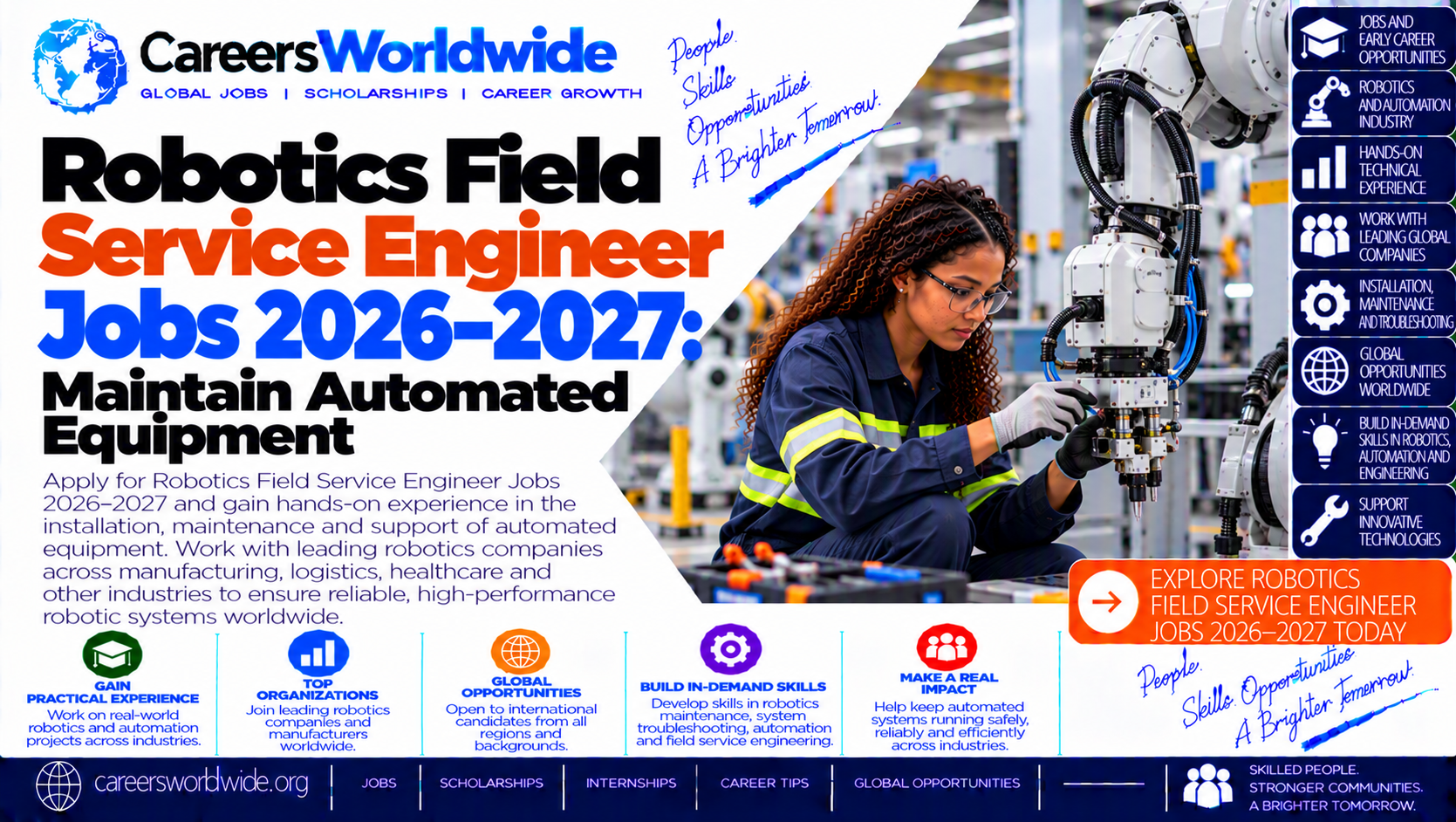

Excerpt: Robotics Field Service Engineer jobs for 2026–2027 offer opportunities for technically skilled professionals to install, maintain, troubleshoot, and repair automated equipment across manufacturing, logistics, healthcare, and other technology-driven industries. Discover the qualifications, technical skills, responsibilities, career pathways, and practical application strategies that can help you pursue robotics field service engineering opportunities worldwide.
Robotics Field Service Engineer Jobs 2026–2027: Career Opportunities in Automation
Robotics is changing how companies manufacture products, manage warehouses, move materials, inspect equipment, and deliver essential services. As organizations introduce industrial robots, autonomous mobile robots, robotic inspection systems, and automated production lines, they need professionals who can keep these technologies operating safely and reliably.
This demand creates career opportunities for robotics field service engineers, automation technicians, mechatronics specialists, and maintenance professionals with relevant technical experience.
Unlike engineers who work exclusively in research laboratories or product design departments, field service engineers often work directly at customer sites. They install equipment, investigate faults, carry out preventive maintenance, replace defective components, configure software, and train customers to operate systems correctly.
For job seekers exploring robotics field service engineer jobs in 2026–2027, this career can provide a practical route into industrial automation and advanced manufacturing. Opportunities may be available with robotics manufacturers, system integrators, industrial equipment suppliers, warehouse automation companies, and engineering service providers.
However, job titles and requirements vary by employer. Some positions focus on mechanical maintenance, while others require electrical troubleshooting, industrial networking, programming, or experience with particular robot platforms.
Important: This guide explains the types of roles to target and where to find official vacancies. It does not claim that every employer listed currently has an opening.
1. What Does a Robotics Field Service Engineer Do?
A robotics field service engineer helps ensure that robotic and automated systems are installed correctly, function as intended, and remain reliable throughout their working life.
The role combines hands-on engineering, technical problem-solving, customer support, and documentation. Depending on the employer, an engineer may spend time at factories, distribution centres, customer facilities, workshops, or remote support offices.
Common responsibilities
Installation and commissioning
Field service engineers help install new robotic equipment, verify mechanical and electrical connections, configure control systems, and perform commissioning tests. They may confirm that sensors, safety devices, robot controllers, and communication networks operate according to specifications.
Preventive maintenance
Routine maintenance helps reduce unexpected downtime. Tasks may include inspecting cables, checking mechanical components, cleaning sensors, testing safety circuits, verifying calibration, reviewing diagnostic logs, and replacing parts according to manufacturer recommendations.
Fault diagnosis and troubleshooting
When equipment stops working, engineers investigate the cause. Problems may involve damaged wiring, sensor failures, mechanical wear, communication errors, software configuration, power supplies, or incorrect operating parameters.
The engineer identifies the underlying fault, performs approved repairs, tests the equipment, and documents the outcome.
Repairs and component replacement
Depending on training and authorization, responsibilities may include replacing motors, encoders, sensors, grippers, controllers, cables, power supplies, or other approved components.
Software and configuration support
Some roles require engineers to review alarms, interpret diagnostic information, restore approved configurations, update software under controlled procedures, or support robot programming and calibration.
Customer training and technical support
Field service engineers explain equipment operation, routine maintenance, safe shutdown procedures, and basic troubleshooting to customer teams. They may also prepare technical reports and recommend improvements.
Service documentation
Accurate records are essential. Engineers document faults, repairs, replacement parts, testing results, maintenance activities, and recommendations for preventing recurring problems.
2. Industries Hiring Robotics and Automation Service Professionals
Robotics field service work extends beyond traditional manufacturing. The equipment, technical requirements, and working environment differ across industries.
Industrial manufacturing
Factories use robotic arms for welding, painting, assembly, machine tending, packaging, material handling, and quality inspection. Engineers in this environment may work with industrial robot controllers, programmable logic controllers (PLCs), machine vision systems, and production-line safety equipment.
Warehousing and logistics
Distribution centres increasingly use automated conveyors, robotic picking systems, autonomous mobile robots, automated storage and retrieval systems, and sorting equipment.
Service professionals help reduce downtime, diagnose navigation or sensor problems, inspect charging systems, and support the integration of automated equipment with warehouse operations.
Food and beverage processing
Robots may be used for palletizing, packaging, sorting, inspection, and repetitive handling tasks. Engineers must understand the facility’s hygiene requirements, equipment protection measures, and maintenance procedures.
Healthcare and laboratory technology
Hospitals, laboratories, and medical technology providers use robotic and automated systems for selected clinical, diagnostic, pharmaceutical, and sample-handling applications.
These roles can require additional training, strict documentation, and adherence to equipment-specific procedures. Work on regulated medical systems may involve requirements that differ substantially from ordinary factory maintenance.
Agriculture and environmental technology
Robotics is also used in precision agriculture, automated harvesting research, inspection, environmental monitoring, and selected processing operations. Field engineers may support outdoor equipment, sensor systems, and automated machinery exposed to challenging environmental conditions.
Robotics manufacturers and system integrators
Robot manufacturers and automation integrators are particularly relevant employers to investigate. Manufacturers may provide installation and repair services for their own products, while system integrators design and maintain complete automated solutions that combine robots, conveyors, sensors, controls, and safety equipment.
3. Qualifications and Educational Requirements
There is no single qualification required for every robotics field service engineering position. Employers select candidates according to the complexity of their equipment and the level of responsibility involved.
Common educational backgrounds include:
- Electrical or electronic engineering.
- Mechanical engineering.
- Mechatronics engineering.
- Robotics and automation engineering.
- Industrial automation and control engineering.
- Instrumentation and control.
- Electromechanical engineering.
- Engineering technology or an appropriate technical diploma.
A bachelor’s degree may be preferred for complex engineering positions, while technician-level roles may accept a diploma, apprenticeship, or relevant vocational qualification.
Practical experience can be especially important. Candidates who have repaired machinery, maintained industrial equipment, installed electrical systems, configured PLCs, or worked with automated production lines may possess transferable skills.
Can you enter the field without a robotics degree?
Potentially, yes. A candidate with a mechanical, electrical, electronics, or mechatronics background may qualify if they can demonstrate the required troubleshooting skills.
For example, an industrial maintenance technician who understands motors, sensors, electrical schematics, and fault-finding procedures could target junior automation service positions while developing robotics-specific knowledge.
Candidates without formal engineering qualifications may find entry-level opportunities as automation technicians, maintenance assistants, field service technicians, or equipment support specialists. The exact eligibility criteria depend on the employer and local regulations.
Certifications and specialist training
Relevant training can strengthen an application, particularly when it is recognized by equipment manufacturers or industry bodies. Consider training in:
- Industrial robotics operation and maintenance.
- PLC programming and troubleshooting.
- Electrical safety and industrial control systems.
- Mechatronics and automated machinery.
- Industrial networking.
- Machine safety and risk assessment.
- Robot programming for a specific manufacturer.
- Preventive maintenance and reliability engineering.
A certification is not a substitute for hands-on competence. Choose courses that match the systems used in the jobs you intend to pursue.
4. Technical Skills Employers May Look For
Robotics field service engineers need to understand how mechanical, electrical, electronic, and software components work together.
Electrical troubleshooting
Candidates should learn to read electrical schematics, identify components, understand control circuits, and diagnose common faults. Depending on the role, familiarity with motors, drives, relays, contactors, sensors, and power supplies may be essential.
Mechanical maintenance
Knowledge of bearings, gears, belts, couplings, actuators, grippers, lubrication, alignment, and mechanical wear can be useful when maintaining industrial equipment.
PLCs and automation controls
Programmable logic controllers coordinate equipment and communicate with other devices. Understanding PLC inputs and outputs, alarms, interlocks, and basic logic can help engineers investigate production-line faults.
Robot controllers and programming
Employers may use different robot platforms, each with its own controller, programming language, diagnostic tools, and maintenance procedures. Experience with one platform may be transferable, but candidates should not assume that all systems operate identically.
Sensors and machine vision
Robotic systems may depend on proximity sensors, encoders, cameras, laser scanners, force sensors, and other feedback devices. Engineers need to understand how sensor failures or incorrect calibration affect system performance.
Industrial communication networks
Equipment may communicate through industrial Ethernet and protocols such as PROFINET, EtherNet/IP, Modbus TCP, or other manufacturer-supported technologies. Networking knowledge helps with diagnosing communication faults between robots, PLCs, drives, and supervisory systems.
Software and diagnostic tools
Engineers may use service applications, event logs, remote diagnostics, configuration utilities, and computerized maintenance management systems. Basic scripting or data analysis can be useful in some advanced roles, but it is not mandatory for every position.
Safety awareness
Robots can create serious hazards through unexpected movement, crushing, electrical exposure, or interaction with automated machinery. Engineers must follow the applicable safety procedures, understand emergency stops and protective devices, and use approved isolation and lockout/tagout procedures where required.
Safety interlocks must never be bypassed to force equipment to operate. Repairs and testing should be carried out only by appropriately trained and authorized personnel.
5. Soft Skills and Working Conditions
Technical knowledge alone may not be enough to succeed in field service engineering.
Employers often value candidates who can communicate clearly with customers, explain complicated faults in plain language, manage service calls, and work methodically under pressure.
Important professional skills include:
- Analytical thinking and structured troubleshooting.
- Clear written reports and service documentation.
- Customer service and professional communication.
- Time management and prioritization.
- Teamwork with maintenance and production staff.
- Adaptability when working with unfamiliar equipment.
- Attention to detail and safety discipline.
- Willingness to travel when the role requires it.
Field service positions can involve early starts, emergency callouts, overnight travel, rotating shifts, or extended periods at customer facilities. Some employers provide company vehicles, travel reimbursement, overtime, or on-call allowances, but these benefits are not universal.
Before accepting an offer, review the travel expectations, working hours, training arrangements, insurance coverage, overtime policy, and responsibility for travel costs.
6. Robotics Field Service Engineer Jobs 2026–2027: Summary Table
| Category | What to expect |
|---|---|
| Common job titles | Robotics Field Service Engineer, Automation Service Engineer, Robot Maintenance Engineer, Field Service Technician |
| Main industries | Manufacturing, logistics, warehousing, food processing, healthcare technology, robotics integration |
| Typical qualifications | Mechanical, electrical, electronics, mechatronics, robotics, or automation training |
| Core technical skills | Troubleshooting, electrical systems, mechanical maintenance, controls, sensors, diagnostics |
| Additional skills | PLCs, industrial networking, robot programming, technical reporting |
| Work locations | Customer sites, factories, warehouses, workshops, service centres |
| Work arrangements | On-site, regional field service, shift-based, or hybrid support where available |
| Experience levels | Trainee, junior technician, experienced technician, field service engineer, senior specialist |
| Potential benefits | Technical training, travel reimbursement, overtime, tools, vehicle allowances, depending on employer |
| Application channels | Official employer career portals and verified recruitment pages |
| Key application documents | CV/resume, cover letter when requested, qualification records, relevant certificates |
| Important consideration | Confirm the vacancy, location, qualifications, and work authorization requirements before applying |
7. Where to Find Robotics Field Service Engineer Vacancies
The most reliable starting point is an employer’s official careers website. Search for both robotics-specific titles and broader service engineering positions because companies may classify similar work under different departments.
Useful job-search terms include:
- Robotics Field Service Engineer.
- Field Service Engineer – Robotics.
- Automation Service Engineer.
- Industrial Robot Technician.
- Robotics Maintenance Technician.
- Mechatronics Field Service Engineer.
- PLC Field Service Engineer.
- Robot Installation and Commissioning Engineer.
- Warehouse Automation Service Engineer.
- Industrial Automation Support Engineer.
Search with the country, city, or work arrangement you prefer. For example, use “robotics field service engineer Germany,” “automation service engineer United States,” or “robot maintenance technician remote support.”
Many field service roles require physical access to equipment, so fully remote positions may be less common than on-site jobs. Remote technical support and diagnostic roles do exist, but applicants should verify the actual duties.
Official employer resources
The following organizations are useful starting points for researching robotics, automation, and industrial service careers. They are not a guarantee of current vacancies.
ABB
Explore careers related to robotics, automation, industrial service, and technical support through the official ABB Careers website.
FANUC
FANUC manufactures industrial robots and automation equipment. Check the official FANUC website and navigate to its careers or regional employment pages.
KUKA
KUKA works in industrial robotics and automation. Visit KUKA’s official website and look for career opportunities in your preferred country.
Yaskawa
Yaskawa supplies robotics, motion control, and industrial automation technologies. Start at the official Yaskawa website and follow the relevant regional careers links.
Siemens
Siemens operates across industrial automation, control systems, and digital industries. Search the Siemens Careers portal for service engineering, automation, commissioning, and support positions.
Dematic
Dematic provides automated material-handling and logistics solutions. Visit Dematic’s official website and locate its careers section for opportunities related to warehouse automation and field service.
Rockwell Automation
Rockwell Automation works in industrial automation and control technologies. Explore its official careers website for relevant technical and service roles.
Universal Robots
Universal Robots develops collaborative robots used in various industrial applications. Check its official website for company information and available career pathways.
For every employer, select the appropriate country or regional site when necessary. Availability, job titles, application deadlines, and eligibility rules can differ by location.
8. How to Apply for Robotics Field Service Engineer Jobs
A strong application should show that you can diagnose technical problems, work safely around automated machinery, and communicate effectively with customers and colleagues.
Follow these steps to make your application more competitive.
Step 1: Identify suitable vacancies
Search official company career portals using several job-title variations. Do not search only for “robotics field service engineer.” A suitable position may be advertised as an automation engineer, service technician, commissioning engineer, or industrial maintenance specialist.
Read the full job description before applying. Check the required qualification, experience level, travel requirements, location, and any mandatory certifications.
Step 2: Prepare a targeted CV
Your CV should emphasize relevant technical experience rather than simply listing every duty you have performed.
Include:
- Your engineering qualification and relevant training.
- Experience maintaining or repairing industrial equipment.
- Knowledge of PLCs, sensors, motors, drives, and control systems.
- Experience diagnosing faults and restoring equipment operation.
- Familiarity with electrical drawings, technical manuals, and diagnostic tools.
- Safety training and compliance with maintenance procedures.
- Experience working at customer sites or supporting production teams.
Whenever possible, describe results accurately. For example, you might state that you diagnosed recurring sensor faults, completed preventive maintenance on automated machinery, or helped reduce equipment downtime. Include measurable results only when you can substantiate them.
Step 3: Write a focused cover letter
Explain why your background fits the specific role. If the vacancy emphasizes electrical troubleshooting, discuss your relevant experience. If it focuses on warehouse automation, highlight your experience with conveyors, sensors, material-handling equipment, or automated systems.
Avoid sending the same generic cover letter to every employer. A short, specific application is often more effective than a lengthy letter filled with broad claims.
Step 4: Submit through the official application system
Complete the employer’s online application form, attach the requested documents, and verify your contact information. If the application requires qualification certificates, references, or work authorization details, provide them in the requested format.
Keep a record of the job title, employer, submission date, and application reference. This makes it easier to follow up professionally.
Step 5: Prepare for technical interviews
Review common troubleshooting scenarios, such as:
- A robot stops unexpectedly during a production cycle.
- A sensor fails to detect an object.
- A PLC cannot communicate with a robot controller.
- A motor or drive reports a fault.
- A machine repeatedly stops because of a safety-related alarm.
- An automated conveyor fails to move materials correctly.
Explain your diagnostic process step by step. Start with safety and the fault information available, inspect the relevant documentation, isolate likely causes, carry out authorized tests, and verify the repair before returning equipment to service.
Never suggest bypassing a safety device as a troubleshooting shortcut.
9. How to Build Experience if You Are a Beginner
Not every applicant will have worked directly with industrial robots. If you are entering the field, focus on building transferable skills and practical evidence of competence.
Start with foundational knowledge. Learn electrical principles, mechanical systems, sensors, motors, basic control logic, and industrial safety. These subjects provide the foundation for understanding more advanced robotic equipment.
Practice with training equipment. Where available, use educational PLC kits, robotics training cells, manufacturer learning resources, and supervised laboratory exercises. Do not experiment on live industrial machinery without appropriate training and authorization.
Create a technical portfolio. Document suitable training projects, such as a small automated sorting demonstration, a PLC-controlled motor project, or a simulated troubleshooting exercise. Describe the equipment, your role, the problem, the diagnostic process, and the outcome.
Target entry-level roles. Search for junior maintenance technician, automation technician, field service trainee, mechatronics technician, and commissioning assistant positions. These jobs can provide exposure to real equipment and customer environments.
Pursue manufacturer-specific training. Once you know which robot platforms are common in your target market, investigate the relevant training options. Employers may provide further product training after hiring, depending on the position.
10. Salary Expectations and Career Progression
Pay for robotics field service engineers varies widely by country, employer, experience, industry, travel obligations, and technical specialization. A reliable salary estimate should be based on current vacancies in the country where you intend to work.
Entry-level technicians may earn less than experienced engineers who commission complex systems, support major industrial customers, or handle advanced control and robotics problems.
When comparing offers, look beyond the basic salary. Consider overtime, on-call compensation, travel allowances, accommodation, insurance, retirement benefits, paid training, and opportunities for promotion.
Potential career progression includes:
- Automation or maintenance technician: Develop foundational skills in equipment maintenance and fault diagnosis.
- Junior field service engineer: Support installations, repairs, inspections, and customer service visits.
- Field service engineer: Manage service calls, diagnose complex faults, and perform commissioning and maintenance.
- Senior field service engineer: Handle escalations, mentor colleagues, and support difficult technical cases.
- Robotics or automation specialist: Develop deeper expertise in a particular robot platform, control system, or application.
- Service team leader or service manager: Coordinate field teams, service schedules, customer relationships, and operational performance.
Some professionals also move into automation integration, reliability engineering, technical training, project management, or robotics applications engineering.
11. Opportunities for International Applicants
Candidates interested in working outside their home country should check whether the employer accepts international applications and whether the position requires existing authorization to work in the destination country.
A vacancy advertised internationally does not automatically include visa sponsorship or relocation assistance.
Before applying, confirm:
- Whether applicants from your country are eligible.
- Whether the employer provides visa sponsorship.
- Whether your qualifications meet local requirements.
- Whether the position requires a valid driving licence.
- Whether frequent travel is part of the role.
- Whether you need local language proficiency.
- Whether any professional registration or safety certification is required.
For applicants based in Zimbabwe or elsewhere in Africa, regional industrial automation companies, manufacturing plants, mining operations, logistics facilities, and engineering service providers may also offer relevant experience. Check each employer’s recruitment process and local eligibility requirements.
Do not pay an individual or unofficial recruiter for a promised job offer. Verify recruitment communications through the employer’s official website and published contact details.
12. Official Application Resources
Use these official resources to begin your search:
- ABB Service Careers — information about service career pathways and field-based technical work. <Link url=”https://careers.abb/global/en/service-careers” title=”Explore ABB service careers”/>. <Cite refs={[“turn374012search0″,”turn374012search3”]}/>
- FANUC Careers — search opportunities by region, job function, and experience level. <Cite refs={[“turn374012search9”]}/>
- KUKA Vacancies — browse current vacancies and filter by country, job category, and job type. <Cite refs={[“turn374012search4”]}/>
- Siemens Careers — search for industrial automation, commissioning, service engineering, and technical support opportunities.
- Dematic — explore careers connected with automated material handling and logistics systems.
- Rockwell Automation — research opportunities in industrial automation and control technologies.
- Universal Robots — learn about collaborative robotics and related career opportunities.
Example of a relevant role: KUKA published a Robotics Service Engineer vacancy based in Hanoi dated September 30, 2026. The listing describes customer technical support, training, field service, planned maintenance, and a relevant engineering diploma or degree with industrial robotics experience. Check the original KUKA vacancy for its current status and full requirements before applying. <Cite refs={[“turn374012search1”]}/>
Vacancies can close or change without notice. Always use the live employer listing to confirm that a position is still accepting applications.
13. Frequently Asked Questions
1. What is a robotics field service engineer?
A robotics field service engineer installs, maintains, diagnoses, and repairs robotic systems at customer locations. The role may include commissioning equipment, providing technical support, training users, and documenting repairs.
2. What qualifications are needed?
Common backgrounds include robotics, mechatronics, electrical engineering, mechanical engineering, electronics, and industrial automation. Some technician-level positions accept vocational qualifications or relevant practical experience.
3. Can I apply without previous robotics experience?
Yes, for some entry-level and related technical positions. Experience with industrial maintenance, electrical systems, PLCs, motors, sensors, or automated machinery can be relevant. Review the minimum requirements for each vacancy.
4. Are robotics field service jobs remote?
Most hands-on service positions require on-site work because engineers must inspect and repair physical equipment. Some employers offer remote diagnostics or technical support positions, but the work arrangement depends on the role.
5. Do these jobs require travel?
Many field service engineers travel to customer facilities. Some roles cover a local area, while others involve regional or international travel. Check the job description and clarify expected travel frequency during the interview.
6. Which skills should I learn first?
Start with electrical troubleshooting, mechanical maintenance, industrial safety, sensors, motors, control systems, and reading technical diagrams. Develop PLC and industrial networking skills next, then pursue training relevant to your preferred robotics platform.
7. Are robotics field service engineer jobs available internationally?
Robotics and automation employers operate in multiple countries, but individual vacancies have specific location and eligibility requirements. International applicants should confirm work authorization and sponsorship policies before applying.
8. Where can I find verified vacancies?
Start with official company career portals, including ABB, FANUC, KUKA, Siemens, and other automation providers. Search several related job titles and confirm the application deadline on the original listing.
9. Do employers provide training?
Some employers provide product training, mentoring, and technical development, especially for employees working with proprietary equipment. Training availability varies, so ask about onboarding and certification opportunities during recruitment.
10. How can I make my CV stand out?
Highlight relevant equipment, troubleshooting methods, safety training, maintenance experience, and verified results. Tailor your CV to the vacancy and explain how your technical experience relates to the employer’s systems.
Final Thoughts
Robotics field service engineering offers a practical career pathway for people interested in machinery, automation, technical problem-solving, and customer support. As you explore opportunities for 2026–2027, focus on the skills employers actually request rather than relying on job titles alone.
Build a strong technical foundation, gain supervised hands-on experience, and develop the ability to diagnose faults systematically. Search official employer career portals regularly, tailor your CV to each suitable vacancy, and verify all application requirements before submitting your documents.
For CareersWorldwide readers, the most important step is to match your current qualifications with realistic opportunities and continue building the technical skills needed for more advanced robotics roles.
Disclaimer
CareersWorldwide provides career information for educational and informational purposes. This article is not a guarantee of employment, salary, visa sponsorship, or current vacancies. Job availability, qualifications, compensation, and recruitment procedures vary by employer and country. Applicants should verify all vacancy details through official employer websites before applying. Never pay unofficial recruiters for guaranteed job offers.
SEO Keywords
robotics field service engineer jobs 2026,
robotics field service engineer jobs 2027,
robotics engineer vacancies,
robotics maintenance jobs,
automation service engineer jobs,
industrial robotics careers,
robot technician jobs,
mechatronics field service engineer,
robotics installation engineer jobs,
industrial automation jobs,
robotics troubleshooting careers,
PLC field service engineer jobs,
robotics commissioning engineer,
automation maintenance technician jobs,
robotics jobs for international applicants,
robotics engineering career opportunities,
field service engineer qualifications,
robotics technician training,
automated equipment maintenance jobs,
CareersWorldwide robotics jobs,
ALSO CHECK: E-Commerce Merchandising Specialist Jobs 2026–2027: Manage Online Product CataloguesOctober 13, 2026
Open Banking Internships 2026–2027: Explore Digital Payments and Financial InnovationOctober 12, 2026
Real-World Evidence Internships 2026–2027: Explore Healthcare Research and Outcomes DataOctober 12, 2026