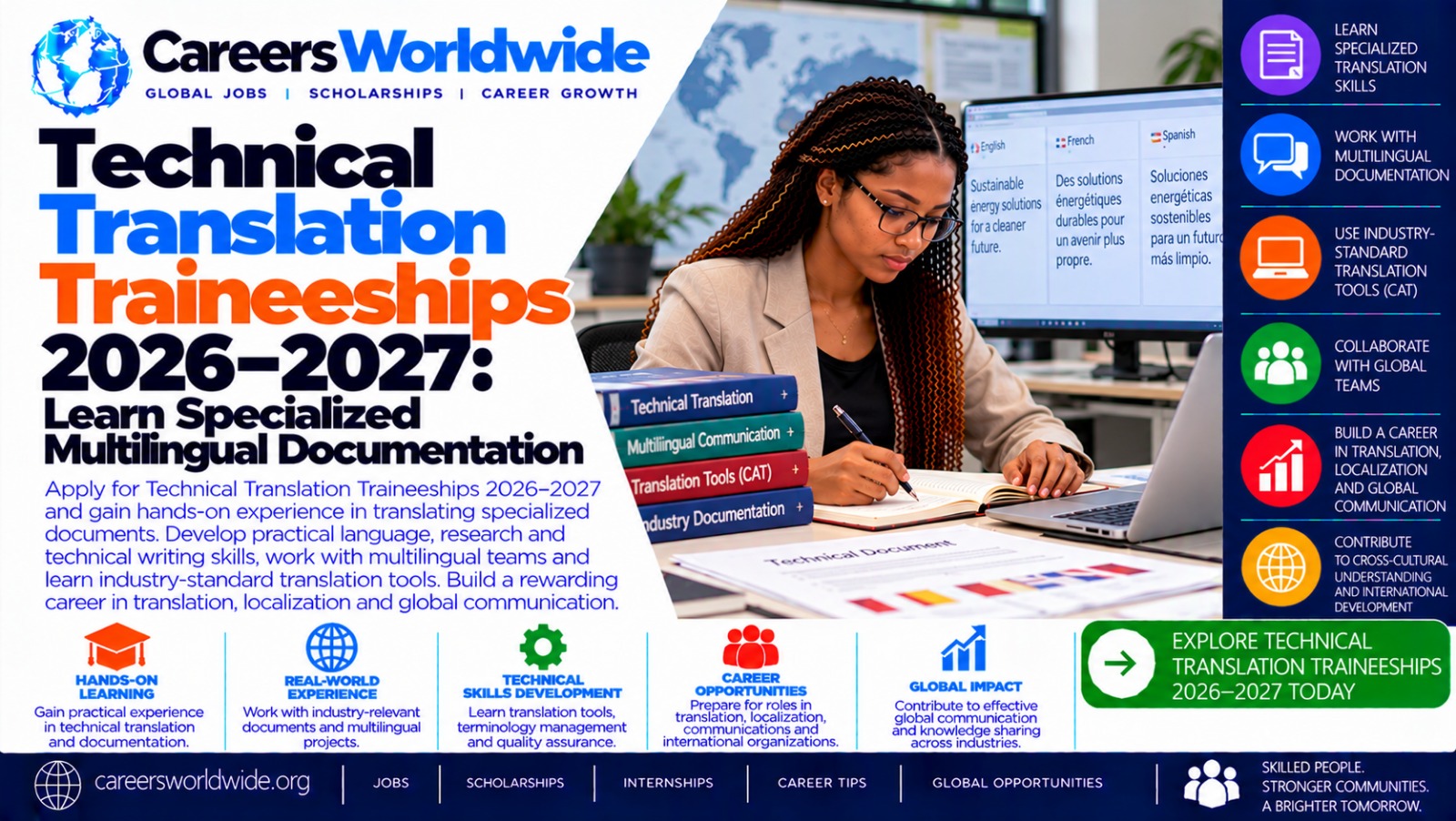

Excerpt: Technical Translation Traineeships 2026–2027 offer aspiring translators, language graduates, and multilingual communication professionals an opportunity to develop practical skills in specialized documentation. From engineering manuals and software interfaces to scientific reports, legal materials, and multilingual digital content, technical translation combines language proficiency with subject knowledge, terminology management, and modern translation technology. This comprehensive guide explains what traineeships involve, who may qualify, how to prepare an application, where to find official opportunities, and how to build a competitive profile for the 2026–2027 training cycle.
Introduction: Why Technical Translation Traineeships Matter in 2026–2027
As organizations expand across international markets, the demand for accurate multilingual documentation continues to create opportunities for translators with specialized knowledge. Companies, public institutions, research organizations, manufacturers, and technology providers must communicate complex information clearly across different languages and professional environments.
Technical translation helps make that communication possible. It involves translating documents that explain products, processes, systems, regulations, scientific findings, and technical procedures. Unlike general translation, it often requires familiarity with industry terminology, document formatting, quality assurance, and the intended use of the translated material.
Technical Translation Traineeships 2026–2027 are therefore a useful career-development pathway for people who want to combine language skills with practical experience. A traineeship may introduce participants to translation workflows, terminology databases, computer-assisted translation tools, proofreading procedures, and the preparation of documentation for international audiences.
However, applicants should understand an important distinction: Technical Translation Traineeships 2026–2027 is a broad career and training topic, not the name of one universal recruitment programme. Eligibility, funding, application deadlines, qualifications, and selection procedures depend on the organization offering the placement.
One established option is the European Commission’s Blue Book translation traineeship, which provides experience in translation and related language services. Other opportunities may be offered by translation agencies, technical manufacturers, software companies, research institutions, localization providers, and international organizations.
This guide explains how to identify legitimate opportunities and prepare for them without assuming that every trainee position has identical requirements.
1. What Are Technical Translation Traineeships?
A technical translation traineeship is a supervised training placement in which participants learn to translate, review, organize, or support the production of specialized multilingual content.
Depending on the host organization, trainees may work with technical writers, professional translators, localization specialists, engineers, editors, terminology managers, or documentation teams.
The objective is to develop the practical skills needed to produce translations that are linguistically accurate, technically consistent, and appropriate for their intended readers.
Common areas of specialization
Engineering and manufacturing: Trainees may encounter equipment manuals, assembly instructions, product specifications, maintenance procedures, and industrial safety documentation.
Information technology and software: Tasks may involve user interfaces, software documentation, installation guides, cybersecurity information, release notes, and help-center articles.
Scientific and research documentation: Participants may assist with technical reports, laboratory procedures, research summaries, project deliverables, and specialized terminology.
Medical and life-sciences documentation: Depending on the host organization’s requirements and supervision, work may include device instructions, technical product information, research materials, and related documentation. Regulated materials require appropriate subject expertise and quality controls.
Energy and environmental documentation: Translation projects may cover renewable energy systems, equipment specifications, environmental assessments, technical proposals, and sustainability reports.
Legal and regulatory documentation: Some placements include standards, compliance materials, contracts, policy documents, or technical regulations. These assignments demand careful attention to jurisdiction-specific terminology and meaning.
Not every traineeship covers all these fields. Applicants should examine each vacancy to determine the actual subject area and responsibilities.
2. Skills You Can Develop During a Traineeship
Technical translation requires more than knowing two languages. Successful practitioners understand how to transfer meaning accurately while preserving technical relationships, instructions, and document structure.
Language proficiency and translation accuracy
Trainees develop the ability to identify meaning in source documents and communicate it naturally in the target language. They learn to recognize ambiguity, resolve terminology questions, and avoid literal translations that distort technical meaning.
Depending on the employer, proficiency requirements may include formal language qualifications, translation-related education, native or near-native target-language competence, or demonstrated professional ability.
Terminology management
Technical terminology must remain consistent throughout a document and across related publications.
Trainees may learn to build glossaries, research approved equivalents, record terminology decisions, and use terminology databases. These skills are especially valuable when translating product documentation that uses the same technical concepts repeatedly.
Computer-assisted translation tools
Computer-assisted translation, commonly abbreviated as CAT, helps translators manage bilingual text, reuse approved translations, and maintain consistency.
Depending on the workplace, trainees may receive exposure to translation memories, terminology-management systems, quality-assurance software, and localization platforms.
A CAT tool is not the same as a fully automated translator. It supports the human translation process and does not eliminate the need for subject knowledge or careful review.
Document formatting and quality assurance
Technical documents may contain tables, diagrams, numbered procedures, warnings, references, units of measurement, and cross-references.
Trainees learn to check that translated content preserves these elements correctly. They may also review spelling, punctuation, terminology consistency, formatting, and compliance with project-specific instructions.
Research and problem-solving
Technical translators frequently encounter unfamiliar concepts. A strong trainee learns to research reliable sources, consult approved reference materials, document uncertainties, and ask subject-matter experts for clarification when necessary.
These habits are essential for producing dependable multilingual documentation.
3. Who Can Apply for Technical Translation Traineeships?
There is no single eligibility standard for every technical translation placement. Employers establish their own criteria according to the role, the complexity of the material, and the level of supervision available.
Potential applicants may include:
- Graduates in translation, interpreting, linguistics, or applied languages.
- Students seeking an eligible internship as part of an academic programme.
- Graduates in engineering, information technology, science, or another technical discipline who have strong language skills.
- Multilingual communication graduates interested in localization and documentation.
- Early-career translators seeking supervised experience with professional workflows.
- Candidates with relevant writing, editing, terminology, or localization experience.
Some positions require a completed university degree, while others accept current students or vocational graduates. Certain public-sector programmes impose nationality requirements or specify which languages candidates must know.
For example, the European Commission’s translation traineeship has specific requirements relating to completed higher education, European Union nationality, and proficiency in designated official EU languages. Those requirements must not be assumed to apply to private employers or other international organizations.
Applicants should also distinguish between a technical translation traineeship and a general translation traineeship. A general placement may focus on institutional, policy, legal, or administrative documents rather than engineering or product documentation.
Before applying, confirm the following:
- Whether the opportunity is open to students, graduates, or both.
- Whether a completed degree is mandatory by the application deadline.
- Which nationalities and countries of residence are eligible.
- Which source and target languages are required.
- Whether previous professional experience is necessary or restricted.
- Whether the placement is paid, funded, or unpaid.
- Whether the position is remote, hybrid, or office-based.
- Whether applicants need work authorization or permission to undertake an internship.
Meeting the minimum requirements makes an application eligible for consideration; it does not guarantee an interview or placement.
4. What Does a Technical Translation Trainee Actually Do?
Responsibilities depend on the organization, but a typical supervised placement may involve several stages of the documentation process.
Translation and revision
Trainees may translate short passages, prepare draft translations, compare source and target documents, or revise content under the supervision of an experienced translator.
Assignments should match the trainee’s competence and the organization’s review procedures.
Terminology research
A trainee may be asked to identify technical terms, compare definitions, research preferred equivalents, and update a shared terminology list.
For example, a software documentation team may need consistent translations for interface labels, error messages, and installation instructions.
Localization support
Localization adapts content for a particular language and market. In addition to translating words, it may require attention to date formats, units, cultural conventions, text expansion, and interface constraints.
A trainee supporting software localization may check whether translated buttons fit within their allocated space or whether help instructions match the current version of a product.
Quality checks
Quality assurance can include identifying missing text, inconsistent terminology, formatting problems, punctuation errors, and incorrect references.
For technical content, the trainee may also need to verify that warnings, measurements, model numbers, and procedural steps remain consistent with the source.
Documentation and teamwork
Participants may help organize files, record translation decisions, maintain project notes, and communicate questions to editors or subject-matter specialists.
These activities teach trainees how professional translation projects move from source material to reviewed and approved deliverables.
5. Practical Guidance for Finding the Right Opportunity
A successful search begins with a clear specialization. Rather than searching only for the phrase “technical translation traineeship,” applicants should also search for related job titles.
Useful search terms include:
- Technical translation intern
- Translation and localization trainee
- Multilingual documentation intern
- Terminology management trainee
- Technical writer and translator intern
- Software localization internship
- Language technology trainee
- Translation quality assurance intern
- Scientific translation internship
- Documentation localization assistant
Search for both the desired language combination and the relevant technical field. For example, a candidate interested in French-English software documentation might search for software localization internships requiring French and English.
Where to search
Official institutional career portals: Public institutions may publish structured traineeship programmes with formal eligibility criteria and fixed application periods.
Translation agencies and localization companies: These employers may offer internships involving translation production, terminology research, editing, and quality assurance.
Technology and manufacturing companies: Organizations that sell products internationally may have localization, technical communication, or multilingual content teams.
Universities and research institutions: Language departments, engineering faculties, and research projects may advertise placements or collaborate with external organizations.
Professional associations: Translation associations can help applicants identify training resources, industry events, and reputable professional-development opportunities.
Official company career pages: Search for internship and graduate opportunities directly on the employer’s website rather than relying exclusively on reposted advertisements.
Check whether each listing identifies a real organization, a responsible recruitment contact, specific duties, eligibility criteria, and a credible application process.
Be cautious of advertisements promising guaranteed selection in exchange for a fee, requesting unnecessary sensitive information, or using unofficial payment channels. A legitimate opportunity should be verifiable through the organization responsible for the recruitment.
6. How to Prepare a Competitive Application
A strong application demonstrates that the candidate can combine language ability, research discipline, and an interest in technical communication.
Prepare a targeted CV
Your CV should make relevant qualifications easy to identify. Include your education, language combinations, translation experience, technical knowledge, writing skills, and familiarity with documentation tools.
Where appropriate, mention academic projects involving technical texts, bilingual reports, terminology databases, software localization, or scientific communication.
If you have limited professional experience, describe relevant coursework and practical projects honestly. Do not present classroom exercises as paid employment or claim professional expertise you have not acquired.
Create a focused cover letter
A good cover letter explains why the particular organization and subject area interest you. It should connect your language background with the tasks described in the vacancy.
For example, a candidate applying to a software localization team might explain an interest in accessible multilingual interfaces, experience researching technology terminology, and familiarity with reviewing translated user instructions.
Avoid sending an identical, generic letter to every employer. Refer to the organization’s actual activities and explain how your skills relate to its requirements.
Build a small translation portfolio
A portfolio can help demonstrate your ability when the employer accepts work samples.
Consider preparing two or three short samples from different technical categories, such as an equipment instruction, a software help article, or a scientific information sheet.
For each sample, identify the subject, language direction, intended reader, and research approach. Include a glossary or short note explaining important terminology choices if appropriate.
Use material you are authorized to reproduce. Do not publish confidential documents, proprietary client content, personal information, or copyrighted material without permission.
Strengthen your technical knowledge
You do not necessarily need an engineering degree to become a technical translator. However, you should understand the subject matter well enough to recognize when a translation may be inaccurate.
Choose one area to study consistently. Read product manuals, technical explanations, industry glossaries, and reputable specialist publications in both your source and target languages.
Learning how a product works often improves translation quality more than memorizing isolated vocabulary.
Practice professional research
Develop a repeatable method for verifying terminology. Start with official product documentation, recognized standards where accessible, trusted technical dictionaries, and established specialist publications.
Record the source of important terms and note any uncertainty. Where an authoritative equivalent cannot be confirmed, explain the issue to the reviewer instead of inventing a translation.
7. Summary Table: Technical Translation Traineeships 2026–2027
The following table summarizes what prospective applicants should expect. Actual conditions depend on the individual vacancy.
| Category | What applicants should know |
|---|---|
| Opportunity type | Supervised internship, traineeship, graduate placement, or entry-level language-services role |
| Typical candidates | Translation and language graduates, multilingual students, technical graduates, and early-career translators |
| Possible specializations | Engineering, software, science, manufacturing, energy, regulatory content, and technical communication |
| Core skills | Language proficiency, terminology research, accurate writing, proofreading, and attention to detail |
| Digital tools | CAT tools, translation memories, terminology databases, localization platforms, and quality-assurance software |
| Common documents | CV, cover letter, academic records, language certificates, and authorized translation samples |
| Experience | May range from student projects to previous internship or professional experience |
| Funding | Paid, grant-supported, unpaid, or otherwise funded, depending on the provider |
| Work arrangements | On-site, hybrid, or remote, where offered |
| Application schedule | Set by the employer; some programmes recruit twice yearly, while others publish individual vacancies |
| Selection | May include document screening, translation tests, interviews, or practical exercises |
| Main preparation priority | Match the vacancy’s requirements and provide accurate evidence of qualifications |
The table is a general planning guide, not a guarantee that every category or benefit will be available in a particular traineeship.
8. How to Apply for Technical Translation Traineeships 2026–2027
Follow these steps to move from searching for opportunities to submitting a well-prepared application.
Step 1: Identify suitable vacancies
Search official career websites using relevant terms such as “technical translation intern,” “localization trainee,” and “multilingual documentation internship.”
Filter opportunities by your language combination, education level, location, and preferred specialization.
Record the employer, deadline, eligibility conditions, application link, and required documents in a simple tracking spreadsheet.
Step 2: Verify eligibility
Read the complete vacancy notice before preparing your application.
Check whether the employer requires a completed degree, specific language levels, relevant subject knowledge, nationality or residency conditions, or previous work experience.
Pay particular attention to application deadlines and the time by which qualifications must have been obtained. Do not assume that completing a degree shortly before the placement begins will satisfy a programme’s rules.
Step 3: Collect supporting documents
Prepare clear copies of the documents specifically requested by the employer. These may include:
- An updated CV.
- A tailored cover letter or motivation statement.
- Academic certificates and transcripts.
- Language proficiency certificates, if required.
- Evidence of relevant experience.
- A portfolio or translation sample, if permitted.
- References or recommendation letters, when requested.
- Work authorization documents, where applicable.
Ensure that names, dates, qualifications, and employment information are consistent across your application.
Some institutional programmes require supporting documents to be combined into a single PDF. Others use separate upload fields. Follow the relevant instructions rather than applying one format to every vacancy.
Step 4: Tailor the application to the specialization
Highlight evidence relevant to the position. For an engineering documentation traineeship, emphasize technical reading and terminology research. For a software localization role, focus on digital content, user-facing language, interface constraints, and quality assurance.
Explain how your current abilities match the duties and which skills you hope to develop under supervision.
Step 5: Complete any required assessment
Some employers use translation exercises to evaluate comprehension, terminology, grammar, and attention to detail.
Practice translating short, authorized technical texts. Check the finished work against the source, confirm terminology, preserve numbers and units, and review formatting.
If the assessment provides instructions about dictionaries, machine translation, generative AI, or external assistance, follow them exactly. Never misrepresent assisted work as unaided work where independent performance is required.
Step 6: Submit before the deadline
Allow enough time to complete the online form, upload documents, and resolve technical issues.
Save the confirmation email or application reference where provided. Monitor the official portal and your email account for requests, assessment invitations, and decisions.
Step 7: Prepare for an interview
Be ready to discuss your language combination, interest in technical translation, approach to terminology research, and response to difficult source material.
You may be asked to explain a translation decision, describe how you would handle ambiguous instructions, or demonstrate how you maintain consistency across a document.
A strong response shows sound judgment: research the issue, consult authoritative references, document uncertainty, and seek appropriate review when necessary.
9. Official Application Resources
The following resources provide verified starting points for identifying relevant programmes, understanding professional standards, and developing technical translation skills. They do not represent a single combined application scheme.
European Commission Blue Book Translation Traineeship
Official portal: https://traineeships.ec.europa.eu/
Translation traineeship information: https://traineeships.ec.europa.eu/translation-traineeship_en
Application instructions: https://traineeships.ec.europa.eu/translation-traineeship/how-apply-translation-traineeship_en
Eligibility criteria: https://traineeships.ec.europa.eu/translation-traineeship/eligibility-criteria-translation-traineeship_en
The Directorate-General for Translation offers traineeships involving translation and related language services. The programme can provide relevant experience in multilingual institutional documentation, but it is not exclusively an engineering or technical translation internship.
Important for the 2026–2027 cycle: The European Commission announced that registration for its March 2027 Blue Book traineeship opened on 22 July 2026 and closed on 4 September 2026 at 10:00 Brussels time. As of 18 October 2026, that advertised application window has passed. Applicants should check the official calendar for subsequent sessions and should not assume that applications remain open.
The programme also has specific nationality, degree, and language requirements. Review the official eligibility page before investing time in an application.
European Union Translation Centre
Official website: https://www.cdt.europa.eu/en/traineeships
The Translation Centre for the Bodies of the European Union publishes information about its traineeships, eligibility requirements, and selection procedures. Its placements provide experience in the European institutional translation environment. Applicants should verify the current call, eligible nationalities, duration, and funding arrangements.
International Organization for Standardization
Official website: https://www.iso.org/
ISO develops international standards used across numerous technical and industrial sectors. Its resources can help trainees understand standardization concepts and learn how technical terminology is used in professional documentation.
Consult official careers information for actual vacancies. Access to standards, their translations, and associated materials may be subject to licensing or payment requirements.
International Organization for Standardization and IEC terminology resources
Official ISO website: https://www.iso.org/
International Electrotechnical Commission: https://www.iec.ch/
These organizations are useful starting points for researching standards-related terminology in industrial and electrical documentation. They should be treated as technical reference resources, not as confirmation that a translation traineeship is currently being recruited.
International Federation of Translators
Official website: https://www.fit-ift.org/
The International Federation of Translators connects professional associations and supports the translation and interpreting professions. Its resources may help applicants discover professional communities, training activities, and opportunities to learn about industry expectations.
American Translators Association
Official website: https://www.atanet.org/
The American Translators Association provides information about professional development, language services, and translation careers. Its resources can help candidates understand professional practice and identify ways to improve their skills.
Membership or certification is not automatically required for every traineeship; follow the employer’s stated criteria.
University career services and employer websites
Applicants should also consult the career services offices of their universities and the official careers pages of localization agencies, technology companies, engineering firms, and research institutions.
These sources may advertise specialized opportunities that do not appear under the title “technical translation traineeship.” Searching by duties and specialization can reveal a wider range of relevant roles.
Always confirm that an advertised position exists on the official website of the responsible organization before submitting personal documents.
10. Frequently Asked Questions (FAQ)
1. Are Technical Translation Traineeships 2026–2027 open to international applicants?
Some opportunities accept applicants internationally, while others impose nationality, residency, or work authorization requirements. The European Commission’s translation traineeship, for example, has specific EU nationality requirements. Always check the official vacancy notice.
2. Do I need a degree in translation?
Not necessarily. Some employers accept candidates with degrees in engineering, science, computing, or other technical disciplines if they demonstrate the necessary language proficiency. Other programmes require a completed translation-related degree or equivalent qualifications.
3. Are these traineeships paid?
Funding varies. Some placements provide a stipend or grant, while others are unpaid or funded through a university or external programme. Check the official terms before accepting an offer, including any travel, accommodation, insurance, or relocation costs.
4. Can I apply without professional translation experience?
Yes, if the vacancy accepts beginners or recent graduates. Relevant academic projects, translation samples, terminology research, and localization exercises can demonstrate your potential. Never assume that every programme is entry-level.
5. Which languages are most useful?
The answer depends on the employer, industry, and target market. Strong proficiency in a source language and excellent writing skills in the target language are essential. Additional languages can broaden your options, but specialization and accuracy remain important.
6. Can I work remotely?
Some localization companies offer remote internships, while other employers require office attendance or hybrid work. International applicants should also verify whether the employer can legally engage trainees in their country of residence.
7. What documents should I prepare?
Common requirements include a CV, cover letter, academic records, and evidence of language proficiency. Some employers request references, work samples, or translation tests. Submit only the documents requested through the official application channel.
8. When is the deadline for the 2026–2027 intake?
There is no universal deadline. Each employer establishes its own recruitment calendar. The European Commission’s advertised registration period for its March 2027 translation traineeship closed on 4 September 2026. Other employers may have different deadlines or advertise opportunities throughout the year.
9. What career opportunities can follow a traineeship?
Possible career paths include technical translator, localization specialist, terminology manager, translation editor, multilingual content specialist, technical writer, and translation quality-assurance professional. Progress depends on experience, language competence, subject expertise, and employer requirements.
10. How can I avoid fraudulent traineeship advertisements?
Verify the vacancy on the official employer website, check the organization’s contact details, and review the written terms. Be wary of guaranteed job offers in exchange for payment, requests for banking credentials, and recruitment messages that cannot be independently verified.
11. Final Advice for Aspiring Technical Translators
Technical Translation Traineeships 2026–2027 can help aspiring professionals develop the practical skills needed to work with specialized multilingual documentation. The strongest candidates combine language proficiency with research ability, technical curiosity, terminology discipline, and a commitment to quality.
Start by choosing a field that interests you, preparing a targeted CV, developing a small portfolio where appropriate, and identifying organizations whose actual requirements match your qualifications.
Most importantly, use official recruitment portals to confirm eligibility, application deadlines, funding, and selection procedures. Treat each traineeship as a specific opportunity rather than assuming that a general programme title guarantees an available position.
With focused preparation and consistent practice, a traineeship can provide a valuable foundation for a career in technical translation, localization, and multilingual communication.
Disclaimer
This article is provided for general educational and career-information purposes. It is not an official recruitment announcement, an offer of employment, or a guarantee of selection, funding, or placement. Technical translation traineeships differ by organization, country, language requirements, and application period. Details may change without notice. Applicants should verify all eligibility criteria, deadlines, financial arrangements, and application procedures directly with the relevant official organization before applying. No affiliation with or endorsement by any organization mentioned is implied.
SEO Keywords
Technical Translation Traineeships 2026–2027,
technical translation internships 2026,
multilingual documentation traineeships,
technical translator internship,
translation traineeship application,
technical translation career opportunities,
translation and localization internships,
multilingual technical writing,
specialized translation training,
technical documentation translation,
translation internship for graduates,
language services traineeships,
engineering translation internships,
software localization traineeships,
scientific translation opportunities,
translation technology training,
terminology management internship,
translation quality assurance training,
international translation traineeships,
technical translation eligibility requirements,
translation traineeship application process,
multilingual documentation career,
translation internship requirements,
technical translation skills development,
2026–2027 translation opportunities,
ALSO CHECK: Product Lifecycle Management Traineeships 2026–2027: Coordinate Product Data and Design ChangesOctober 18, 2026
Actuarial Reserving Traineeships 2026–2027: Learn Insurance Liability EstimationOctober 18, 2026
Satellite Communications Traineeships 2026–2027: Support Ground Station OperationsOctober 18, 2026