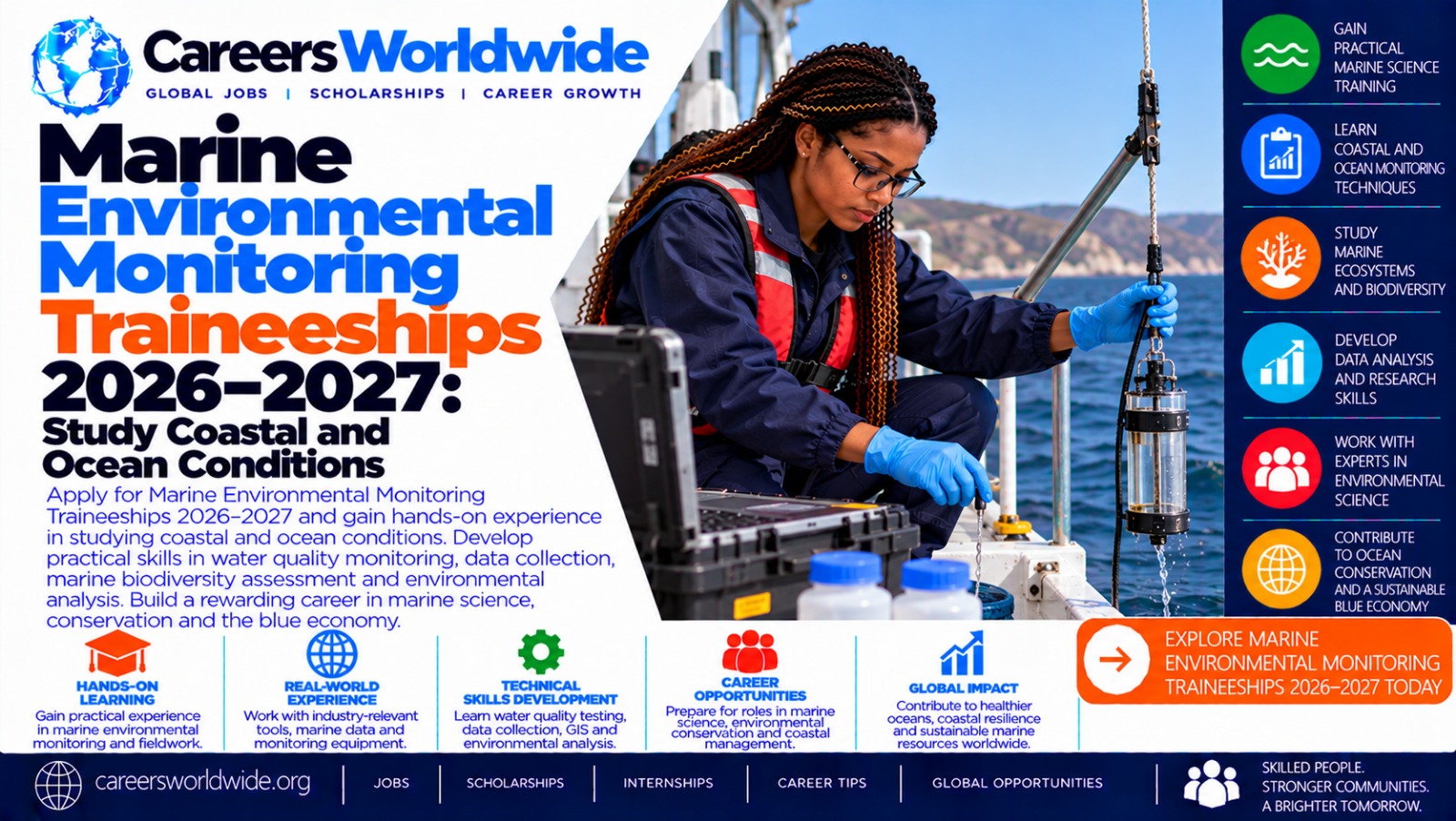

Excerpt: Marine Environmental Monitoring Traineeships 2026–2027 offer aspiring marine scientists, environmental graduates, oceanography students and early-career professionals an opportunity to explore practical training in coastal and ocean monitoring. Participants may develop skills in water-quality testing, marine biodiversity surveys, pollution assessment, oceanographic data collection, laboratory analysis and environmental reporting. Although opportunities differ by country and institution, prospective applicants can prepare by identifying suitable programmes, checking eligibility requirements, strengthening their CVs and applying through verified official channels. This guide explains what marine environmental monitoring traineeships involve, who may qualify, what skills applicants can gain, how to prepare a competitive application and where to find legitimate training opportunities for 2026–2027.
Marine Environmental Monitoring Traineeships 2026–2027: An Overview
Marine environmental monitoring plays an essential role in understanding the health of oceans, estuaries, beaches, coral reefs and coastal ecosystems. Governments, research institutions, universities and environmental organisations collect scientific information to determine how marine environments change over time and how human activities affect aquatic ecosystems.
For students and recent graduates interested in environmental science, a traineeship can provide a practical introduction to this work. Depending on the host institution, training may involve collecting water samples, recording coastal observations, identifying marine organisms, assisting with laboratory tests, processing environmental datasets or supporting scientific research projects.
The phrase Marine Environmental Monitoring Traineeships 2026–2027 describes a field of training opportunities rather than one universal international recruitment programme. Applicants should therefore identify individual programmes and verify their published requirements, application dates, funding arrangements and eligibility conditions.
There are relevant official opportunities to investigate. UNESCO’s Intergovernmental Oceanographic Commission (IOC) runs ocean-science capacity-building activities, while the Partnership for Observation of the Global Ocean (POGO) has advertised shipboard training fellowships for early-career scientists and students. Government marine departments and research institutes may also offer environmental monitoring placements.
For example, POGO published a 2026 call describing potential shipboard training opportunities extending into early 2027, subject to confirmation of funding. UNESCO’s IOC also announced its 2026 Ocean Traineeship programme, which focuses on practical training with host institutions. These are distinct programmes with their own conditions, not evidence that a single worldwide traineeship is open to everyone.
Official references:
- POGO shipboard training: https://oceantrainingpartnership.org/training-call/oc26/
- UNESCO IOC Ocean Traineeship: https://iocaribe.ioc-unesco.org/fr/node/3204
What Is Marine Environmental Monitoring?
Marine environmental monitoring is the systematic collection and analysis of information about ocean and coastal conditions. Scientists use monitoring results to establish environmental baselines, identify changes, assess pollution, protect biodiversity and inform decisions about marine resources.
Monitoring programmes may focus on physical, chemical or biological conditions.
Physical monitoring examines factors such as water temperature, salinity, currents, tides, wave conditions, turbidity and other characteristics affecting marine habitats.
Chemical monitoring investigates water chemistry, dissolved oxygen, pH, nutrients, contaminants and other indicators of water quality. Some programmes also examine ocean acidification and the movement of pollutants through marine environments.
Biological monitoring studies marine organisms and ecosystem health. Depending on the project, trainees may learn about plankton, fish, benthic organisms, seagrass, mangroves, coral reefs or other coastal habitats.
Pollution monitoring can involve investigating marine litter, plastics, wastewater impacts, oil contamination or nutrient pollution. Sampling procedures and analytical methods depend on the pollutants being studied and the facilities available.
Trainees do not necessarily perform every activity. Their responsibilities depend on the programme, their qualifications, the research objectives and the level of supervision provided.
What Trainees May Learn During 2026–2027
Marine monitoring placements can combine fieldwork, laboratory practice, data management and professional mentoring.
1. Coastal and seawater sampling
Trainees may learn how to collect, label, store and transport water samples according to an approved sampling plan. They may also record collection times, locations, weather conditions and other information needed to interpret the results.
Accurate sampling is essential because contamination, incorrect storage or inconsistent procedures can compromise scientific findings.
2. Water-quality assessment
Depending on the placement, participants may become familiar with instruments used to measure temperature, salinity, pH, dissolved oxygen and turbidity.
They may learn how to calibrate equipment, maintain field records, recognise unusual readings and follow quality-control procedures. Advanced chemical analysis generally requires additional training and appropriate laboratory facilities.
3. Marine biodiversity surveys
Some projects investigate the abundance, distribution or condition of marine organisms. Trainees may assist with habitat observations, species identification, sample sorting, photographic records or biodiversity databases.
Field activities must follow relevant wildlife protections, collection permits and research protocols.
4. Oceanographic observations
Ocean-focused placements may introduce participants to the instruments and datasets used to study water movement, temperature profiles, salinity and other ocean conditions.
Where opportunities are available, trainees may observe research-vessel operations or learn how scientists combine field observations with satellite information and numerical models.
5. Laboratory analysis
Laboratory assignments may include preparing samples, maintaining equipment, entering results, conducting approved measurements and documenting analytical procedures.
Participants should expect strict requirements for personal protective equipment, sample handling, chemical safety and accurate recordkeeping.
6. GIS and environmental data management
Geographic information systems (GIS) help researchers map sampling locations, compare coastal observations and identify spatial patterns.
Trainees may also develop introductory skills in spreadsheets, statistical analysis, data visualisation and scientific software. Familiarity with QGIS, R or Python can be advantageous for data-oriented placements, although these skills are not universal entry requirements.
7. Scientific reporting
Monitoring work is useful only when findings can be interpreted and communicated appropriately. Trainees may prepare field summaries, charts, technical notes, presentations or reports under a supervisor’s guidance.
These skills can help participants explain scientific evidence to researchers, environmental managers, government departments and community stakeholders.
Who Can Apply?
Eligibility varies considerably between traineeships. Some placements are designed for university students, while others require a completed degree, postgraduate qualifications or current employment in a relevant government institution.
Applicants with backgrounds in the following areas may find suitable opportunities:
- Marine biology and marine science.
- Environmental science and environmental management.
- Oceanography and aquatic science.
- Ecology, conservation biology and biodiversity.
- Chemistry, biology and microbiology.
- Fisheries science and aquatic resource management.
- Hydrology, climate science and related Earth sciences.
- Geography, GIS, remote sensing and environmental data analysis.
Students studying toward a relevant qualification should check whether a programme accepts current students or requires graduation before the placement begins.
Early-career professionals may also qualify for specialised training schemes. For example, the UNESCO IOC Ocean Traineeship has specified conditions involving citizenship of IOC Member States, early-career status, employment by a government institution and a connection between the proposed training and institutional work priorities. These conditions should not be assumed to apply to unrelated internships.
Common application requirements
Depending on the opportunity, applicants may need to provide:
- An updated CV or résumé.
- Academic transcripts or qualification certificates.
- A cover letter or statement of motivation.
- A short explanation of their research interests.
- Contact details for academic or professional referees.
- A recommendation or endorsement from a supervisor.
- Proof of citizenship, residence or work eligibility.
- Evidence of English proficiency or another required language.
- Availability dates and, for fieldwork, relevant medical or safety documentation.
Not every programme requests all these documents. Follow the current official vacancy notice rather than preparing an application based on another organisation’s rules.
Practical Guidance Before Applying
A strong application starts with identifying a programme that matches your education, experience and professional goals.
Choose a relevant specialisation. Decide whether you are most interested in water quality, marine biodiversity, coastal pollution, oceanographic measurements, fisheries, GIS or environmental data analysis. This will help you identify suitable supervisors and placements.
Review your academic background. Highlight relevant coursework, laboratory experience, field projects, research assignments and practical skills. If your degree is in a related discipline rather than marine science, explain how your experience transfers to environmental monitoring.
Build basic technical skills. Learn introductory spreadsheet analysis, scientific graphing, sampling principles and environmental data management. Free educational materials and university resources can help you prepare.
Prepare evidence of your interest. A university project, volunteer conservation activity, coastal cleanup or environmental research assignment may demonstrate commitment. Do not claim technical experience you have not gained.
Check eligibility before spending time on an application. Confirm citizenship restrictions, education requirements, employment conditions, location, duration and funding. Some international schemes are restricted to specific nationalities or government employees.
Plan for fieldwork realities. Coastal and shipboard activities may involve early starts, changing weather, physical demands and strict safety procedures. Read the host organisation’s requirements carefully.
Apply before the deadline. Request recommendation letters early and ensure that every required attachment is included. Keep a copy of your submission and any confirmation email.
How to Write a Competitive Application
Selection panels generally need to understand why an applicant is suitable, what they want to learn and how the training will contribute to their future work.
Your motivation statement should connect three elements: your existing background, the particular training you want and the practical benefit you expect to gain.
For example, an environmental science graduate interested in coastal pollution could explain how previous coursework introduced them to water-quality indicators, why they want supervised experience with field sampling and how the training would strengthen their ability to contribute to future environmental assessments.
Where possible, refer to the host institution’s actual research priorities. Avoid generic statements that could be sent to any organisation.
A useful application checklist includes:
- Read the complete vacancy notice and eligibility conditions.
- Tailor the CV to the advertised training objectives.
- Describe relevant coursework, projects and practical skills accurately.
- Explain the specific knowledge you hope to gain.
- Obtain the required recommendation or institutional endorsement.
- Check spelling, dates, contact information and attachments.
- Submit through the official application portal.
- Save the confirmation and monitor the contact email supplied.
If an application asks for a research proposal, keep it realistic. A short proposal on coastal water quality, marine litter monitoring or changes in a local estuary may be suitable when it aligns with the host’s stated priorities. Do not submit a proposal that assumes access to specialist instruments or facilities without confirming their availability.
Funding, Stipends and Other Benefits
Funding arrangements differ by institution and placement. Some traineeships provide a stipend, travel support, accommodation or insurance. Others are unpaid, offer academic credit or expect participants to arrange their own costs.
Never assume that a traineeship is fully funded simply because it is advertised internationally.
Before accepting an offer, confirm in writing:
- Whether the placement provides a stipend or salary.
- Which travel costs are covered.
- Whether accommodation and meals are included.
- Whether insurance is provided.
- Who pays visa, medical examination and local transport costs.
- Whether field equipment or protective clothing is supplied.
- Whether the placement has tuition or administrative fees.
UNESCO IOC’s published 2026 Ocean Traineeship information described round-trip international airfare, a monthly stipend based on host-institution recommendations and travel insurance for successful trainees, while identifying certain domestic and visa-related expenses as excluded. These arrangements belong to that programme and should not be generalised to other placements.
Read the current terms carefully before making financial commitments. Be cautious if someone promises guaranteed selection in exchange for a recruitment fee, requests payment to a personal account or uses an unofficial email address while claiming to represent an international organisation.
Summary Table: Marine Environmental Monitoring Traineeships 2026–2027
| Category | What applicants should know |
|---|---|
| Opportunity type | Fieldwork, laboratory placements, ocean-science training and research internships |
| Main subject areas | Water quality, oceanography, marine biodiversity, pollution and coastal ecosystem health |
| Potential applicants | Relevant students, graduates and eligible early-career professionals |
| Common qualifications | Marine science, environmental science, biology, chemistry, ecology or related disciplines |
| Possible practical activities | Sampling, instrument use, laboratory analysis, GIS and environmental reporting |
| Application documents | CV, academic records, motivation statement and any requested references |
| Duration | Determined by the individual programme |
| Funding | Varies; verify stipend, travel, insurance and accommodation arrangements |
| Selection process | May involve document review, interviews or supervisor matching |
| Application dates | Follow the current official notice for each opportunity |
| Best starting point | Official government agencies, university research centres and established ocean-science organisations |
| Important caution | The title refers to a category of opportunities, not one universal traineeship or guaranteed award |
How to Apply for Marine Environmental Monitoring Traineeships 2026–2027
Step 1: Identify an appropriate programme
Search for marine environmental monitoring internships, ocean-science traineeships, coastal research placements, shipboard fellowships and marine laboratory internships. Include your country, academic discipline and preferred training period to narrow the results.
Step 2: Verify the official announcement
Check the organisation’s own website for the current call, application dates, eligibility criteria and instructions. A third-party article may help you discover an opportunity, but the official notice should determine how you apply.
Step 3: Check whether applications are open
Some programmes recruit annually, while others advertise opportunities only when funding and supervisors are available. A page describing a previous cohort does not establish that applications for 2027 are open.
If no current application window is listed, check for an official contact address or future announcements. Do not send sensitive documents to an unverified recruiter.
Step 4: Prepare your application documents
Create a concise, accurate CV and gather the required academic records. Draft a motivation statement tailored to the programme. Arrange recommendations well before the closing date.
Step 5: Submit using the specified method
Complete the official online form or follow the advertised email or institutional submission process. Upload documents in the requested format and ensure that files are readable.
Step 6: Prepare for an interview
Be ready to discuss your relevant academic experience, interest in marine monitoring, approach to data accuracy, willingness to learn and understanding of fieldwork safety.
You may also be asked how the placement supports your career goals or benefits your home institution.
Step 7: Review the offer carefully
If selected, confirm the training plan, supervisor, start and end dates, funding, insurance, travel arrangements and any required documentation before accepting.
Official Application Resources
The following resources provide starting points for locating genuine marine and ocean-science training opportunities. They represent different programmes and should not be treated as interchangeable applications.
1. UNESCO Intergovernmental Oceanographic Commission (IOC) Ocean Traineeship
Official programme information: https://iocaribe.ioc-unesco.org/fr/node/3204
This resource describes the 2026 Ocean Traineeship, including its institutional training approach, eligibility conditions and application process. Check for updated calls and subsequent cohorts before applying.
2. UNESCO IOC careers and internships
Official vacancy page: https://careers.unesco.org/job/Multiple-INTERNSHIP-Intergovernmental-Oceanographic-Commission/1347790957
The published vacancy covers internship opportunities connected to IOC activities, including ocean science and marine environmental topics. Review the notice for its current deadline, eligibility rules, location and required documents.
3. Partnership for Observation of the Global Ocean (POGO)
Shipboard training fellowship information: https://oceantrainingpartnership.org/training-call/oc26/
POGO’s 2026 call described potential shipboard training opportunities for eligible early-career researchers, technicians, postgraduate students and postdoctoral fellows, including possible opportunities extending into early 2027. Funding and individual placements must be confirmed through the official programme.
4. NOAA Ocean Exploration training
Official website: https://oceanexplorer.noaa.gov/careers/training/
The Explorer-in-Training programme provides information about ocean exploration training, application requirements and future opportunities. The page has stated that eligibility is restricted to US citizens and that opportunities depend on availability. Check the current status before applying.
5. NOAA student opportunities
Official information: https://www.noaa.gov/office-education/outreach-communication/faq
NOAA directs students to its official opportunities resources for information about internships, scholarships and fellowships. Individual programmes may have separate eligibility requirements.
6. Government marine and environmental departments
Search the official careers pages of your country’s environmental ministry, fisheries department, marine research institute, national parks agency and universities with coastal research facilities. Local institutions may provide training that is more accessible than international placements.
Applicants should use the contact details and submission instructions published by the recruiting institution. An organisation’s general homepage may provide useful background but is not necessarily the correct application portal.
Frequently Asked Questions (FAQ)
1. What are Marine Environmental Monitoring Traineeships 2026–2027?
They are a broad category of practical training opportunities focused on observing and assessing marine and coastal environments. Individual placements may be offered by government agencies, research institutions, universities and international ocean-science programmes.
2. Are applications currently open for 2026–2027?
Application status depends on the specific programme. Some 2026 opportunities may already have closed, while other programmes may advertise future placements. Check the official notice for the current opening date, deadline and available cohort.
3. Who is eligible to apply?
Eligibility may include relevant university students, graduates, postgraduate researchers or early-career professionals. Some programmes restrict applications by citizenship, employment status, academic level or institutional affiliation.
4. Do I need a marine science degree?
Not necessarily. Environmental science, biology, chemistry, ecology, oceanography, geography and other related disciplines may be relevant. The advertised requirements determine whether your qualification is accepted.
5. Are these traineeships fully funded?
Not all of them. Funding may include a stipend, travel, accommodation or insurance, but benefits vary. Verify the financial terms directly with the host institution before accepting an offer.
6. Can international applicants apply?
Some programmes accept international applicants, while others have nationality or residency restrictions. Read the eligibility conditions carefully, particularly for government-funded and institution-specific schemes.
7. What skills are useful for marine monitoring?
Useful skills include scientific observation, accurate recordkeeping, water-quality measurement, laboratory practice, data analysis, GIS, teamwork and scientific communication. The most important skills depend on the placement.
8. Is previous fieldwork experience compulsory?
Some entry-level traineeships welcome applicants who have only academic experience. Others require previous research, laboratory or fieldwork exposure. Highlight relevant coursework and projects if you have not yet worked professionally.
9. How long does a traineeship last?
Duration varies. A placement may last several weeks or months, while a research fellowship may involve a different schedule. The official offer should state the expected dates and training commitments.
10. What should I include in my CV?
Include your education, relevant coursework, research projects, technical skills, work or volunteer experience, language abilities and referees when requested. Make sure that every statement is accurate and relevant to the role.
11. Can the training lead to employment?
A traineeship may improve practical skills, professional networks and research experience, which can strengthen future applications. However, completion does not guarantee a permanent job, scholarship or further placement.
12. Where can I find legitimate application forms?
Start with the official programme pages listed in this guide, government recruitment portals and university career offices. Verify the domain, deadline and application instructions before submitting personal information.
Disclaimer
This article is an informational guide to marine environmental monitoring training opportunities for 2026–2027. It does not announce a single universal traineeship, guarantee that applications are open or promise selection, employment, funding or travel support.
Eligibility criteria, deadlines, programme availability, benefits and application procedures may change. Applicants should verify all details through the official recruiting organisation before submitting documents or making financial commitments.
No affiliation with UNESCO, NOAA, POGO or another recruiting organisation is implied. Applicants should not pay unverified intermediaries or share sensitive personal information through unofficial channels.
SEO Keywords
Marine Environmental Monitoring Traineeships 2026–2027,
Marine Environmental Monitoring Internships,
Ocean Science Traineeships 2026,
Coastal Monitoring Training Opportunities,
Marine Science Internships for Graduates,
Oceanography Traineeships 2027,
Environmental Science Internships,
Marine Biology Training Programmes,
Coastal Water Quality Monitoring,
Ocean Research Internships,
Marine Conservation Traineeships,
Fully Funded Marine Science Internships,
International Ocean Science Fellowships,
Marine Environmental Jobs for Graduates,
Coastal Ecosystem Monitoring Training,
Oceanographic Data Collection Training,
Marine Pollution Monitoring Internships,
Water Quality Research Traineeships,
Marine Laboratory Training Opportunities,
UNESCO IOC Ocean Traineeship,
POGO Shipboard Training Fellowships,
NOAA Ocean Exploration Internships,
Marine Science Career Opportunities,
Environmental Monitoring Application Guide,
Ocean Research Training for Early Career Scientists,
Marine Environmental Monitoring Application 2027,
ALSO CHECK: Product Lifecycle Management Traineeships 2026–2027: Coordinate Product Data and Design ChangesOctober 18, 2026
Actuarial Reserving Traineeships 2026–2027: Learn Insurance Liability EstimationOctober 18, 2026
Satellite Communications Traineeships 2026–2027: Support Ground Station OperationsOctober 18, 2026