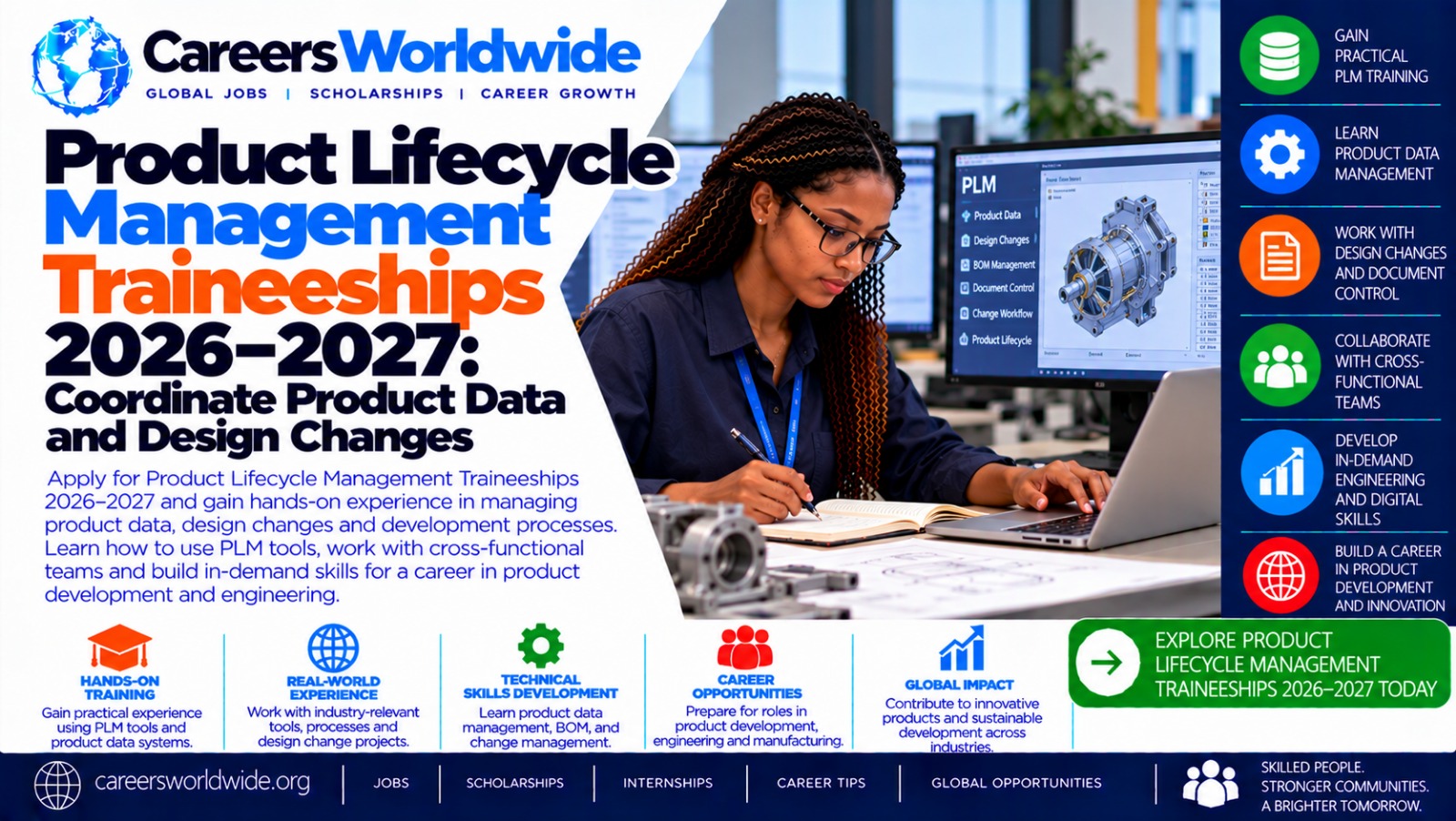

Excerpt: Product Lifecycle Management (PLM) Traineeships for 2026–2027 offer aspiring professionals an opportunity to explore how organisations manage product information, engineering documentation, design revisions, and product development processes. These traineeships can help candidates build practical skills in product data management, change coordination, digital collaboration, and quality documentation. This guide explains the typical responsibilities, eligibility considerations, useful skills, application process, and official resources to consult when searching for relevant trainee opportunities.
Introduction: Understanding Product Lifecycle Management Traineeships
Product Lifecycle Management (PLM) is the process of managing information, decisions, and activities associated with a product from its initial concept and design through manufacturing, distribution, maintenance, and eventual retirement.
Companies in manufacturing, engineering, automotive, aerospace, electronics, consumer goods, medical technology, and industrial equipment rely on accurate product information to coordinate complex operations. A change to a single component can affect technical drawings, material lists, supplier requirements, production instructions, quality checks, and delivery schedules.
Product Lifecycle Management traineeships provide an entry point for people interested in understanding and supporting these processes. Depending on the employer, a trainee may work with product data, engineering documentation, change requests, product records, or digital systems used to share information across departments.
The phrase “Product Lifecycle Management Traineeships 2026–2027” should be treated as a search topic rather than the name of one confirmed recruitment programme. Opportunities, eligibility criteria, application deadlines, and programme structures vary between employers and countries. Applicants should verify every vacancy through the relevant organisation’s official careers portal.
For candidates interested in engineering support, digital operations, technical administration, or product development, PLM training can provide a useful foundation for a career in modern industry.
What Does a Product Lifecycle Management Trainee Do?
A PLM trainee typically supports experienced professionals who manage product information and coordinate changes across departments. The precise duties depend on the employer’s products, internal procedures, software platforms, and level of technical complexity.
1. Coordinate Product Data
Product data includes the information required to identify, describe, manufacture, inspect, and maintain a product or component.
Examples include:
- Product identification numbers and component codes.
- Product descriptions and technical specifications.
- Engineering drawings and supporting documents.
- Bills of materials (BOMs).
- Approved suppliers and component information.
- Document revision numbers and approval statuses.
- Product configurations and associated records.
A trainee may help review entries, update approved information, identify missing fields, and check whether documents are stored in the correct locations.
Accuracy is essential. An incorrect component number or outdated specification can cause confusion, production delays, purchasing errors, or quality problems.
2. Support Design Change Coordination
Products evolve as engineers improve performance, respond to customer requirements, address quality issues, or replace unavailable components.
A design change may begin with a request from engineering, manufacturing, procurement, quality assurance, or a customer-facing team. The request must be documented, assessed, reviewed, approved, implemented, and recorded according to company procedures.
A trainee may assist by tracking change requests, checking supporting documentation, recording status updates, preparing meeting materials, and reminding relevant teams about outstanding actions.
Trainees do not normally have independent authority to approve safety-critical engineering changes. Their role is generally to support the established review and approval process.
3. Maintain Document Control
Document control helps ensure that employees use current, approved information rather than outdated drawings or specifications.
Typical responsibilities include checking revision identifiers, maintaining document registers, confirming approval status, organising files, and helping archive superseded records according to internal procedures.
Document control is particularly important in regulated industries, where traceability and evidence of approval may be required during audits.
4. Collaborate Across Departments
PLM activities often involve engineers, designers, production planners, quality specialists, procurement staff, suppliers, and project managers.
A trainee may help communicate change status, prepare action lists, follow up on missing information, and ensure that the right stakeholders receive the correct documentation.
Clear communication matters because a technically correct change can still create problems if the people responsible for implementing it are not informed at the right time.
5. Learn Digital PLM Tools
Employers may use enterprise PLM platforms, product data management (PDM) systems, enterprise resource planning (ERP) software, spreadsheet tools, and document management applications.
Depending on the organisation, relevant platforms may include Siemens Teamcenter, PTC Windchill, Dassault Systèmes ENOVIA, or SAP-related product and engineering workflows.
Prior experience with a particular system may be helpful but is not always necessary for a trainee position. Some employers provide structured training, while others expect applicants to demonstrate familiarity with digital documentation and data management.
Why Consider a PLM Traineeship in 2026–2027?
A PLM traineeship can be valuable for candidates who want to enter an industrial or technical environment without immediately specialising in product design or engineering development.
First, it introduces trainees to the relationship between product information and business performance. They learn why controlled documentation, accurate records, and timely communication are essential to manufacturing and product quality.
Second, it develops transferable skills. Data accuracy, version control, workflow coordination, technical communication, and problem-solving are useful across many industries.
Third, it can create a pathway into related roles, including:
- Product Data Management Assistant.
- PLM Support Analyst.
- Engineering Documentation Assistant.
- Change Management Coordinator.
- Configuration Management Assistant.
- Technical Project Support Officer.
- Junior PDM or PLM Administrator.
- Engineering Operations Assistant.
These are potential career directions, not guaranteed outcomes. Progression depends on an individual’s performance, qualifications, experience, and the employer’s available opportunities.
Finally, traineeships may allow participants to combine workplace experience with formal learning. Some are paid employment programmes, some are apprenticeships, and others are internships or graduate development placements. Applicants should confirm the exact arrangement before accepting an offer.
Eligibility Requirements: Who Can Apply?
There is no single eligibility standard for all PLM traineeships. Requirements are set by each employer and may differ considerably between entry-level, apprenticeship, internship, and graduate positions.
Educational Background
Relevant qualifications may include:
- Mechanical, industrial, electrical, or manufacturing engineering.
- Product design or industrial design.
- Information technology or information systems.
- Supply chain management or operations.
- Quality management or manufacturing technology.
- Technical administration or a related vocational qualification.
Some positions accept school-leavers with suitable mathematics, science, computer, or technical subjects. Others require a diploma, degree, apprenticeship qualification, or recent graduation.
Applicants should follow the minimum requirements stated in the specific vacancy rather than assuming that a particular qualification is universally required.
Technical Skills
Useful foundational skills include:
- Microsoft Excel or equivalent spreadsheet software.
- Document management and organised digital filing.
- Understanding tables, identifiers, and structured data.
- Basic technical drawing interpretation.
- Familiarity with revision numbers and approval records.
- General knowledge of engineering or manufacturing processes.
Computer-aided design (CAD) knowledge can be an advantage in roles involving drawings, but not every PLM trainee needs to design products.
Personal Attributes
Employers may look for candidates who demonstrate attention to detail, organisation, reliability, curiosity, teamwork, and a willingness to learn.
Because PLM work often involves controlled procedures, candidates should be comfortable following instructions, checking their work, asking questions when information is unclear, and escalating discrepancies rather than making unauthorised changes.
Work Authorisation and Availability
Some employers require applicants to have the legal right to work in the advertised country. Others may offer relocation assistance or sponsorship, but this should never be assumed.
Check the work location, start date, duration, working hours, language requirements, and any restrictions related to student or graduate status.
Practical Guidance: How to Prepare for a PLM Traineeship
Preparation can improve an application even when the candidate has never worked with a dedicated PLM platform.
Build a Foundation in Product Data
Learn how organisations identify products, components, drawings, and documents. Understand why unique identifiers and consistent naming conventions matter.
Practise organising a small sample dataset in a spreadsheet. Include columns for item number, description, revision, status, owner, and last-updated date.
Use fictional information only. Do not create or alter real engineering records without permission.
Understand Engineering Change Control
Familiarise yourself with the basic stages of an engineering change process:
- A change request is raised.
- The request is reviewed for completeness.
- Relevant teams assess the technical and operational impact.
- Authorised reviewers approve or reject the proposal.
- Approved changes are implemented according to a controlled plan.
- Documentation and records are updated.
- Implementation is verified and the change is closed.
Actual workflows differ by organisation. Some use formal engineering change requests (ECRs), engineering change orders (ECOs), or engineering change notices (ECNs), while others use different terminology.
Improve Your Spreadsheet Skills
Practise sorting and filtering records, using data validation, identifying duplicate entries, applying lookup functions, and creating simple status reports.
Learn how to distinguish missing information from incorrect information. Avoid overwriting source data without keeping an appropriate record of the changes.
Develop Technical Communication Skills
Practise writing concise, factual updates such as:
“The drawing revision is awaiting engineering approval. The manufacturing impact assessment remains outstanding. No implementation date has been confirmed.”
This approach is more useful than guessing at a deadline or stating that a change is complete when approval is still pending.
Prepare Evidence of Your Skills
A small portfolio can demonstrate your approach to data quality and organisation. Consider creating a fictional product register, a sample change-request tracker, and a short explanation of how you would identify an outdated document.
Clearly label these examples as training exercises. Do not include confidential employer information, copyrighted technical documents, or sensitive product designs.
Understanding Product Data and Design Change Coordination
Product data coordination and design change coordination are related but distinct activities.
Product data coordination focuses on keeping product information complete, accurate, identifiable, and accessible to authorised users.
Design change coordination focuses on managing the process through which product information or engineering requirements are reviewed and changed.
For example, an engineer might propose replacing a component because the existing part is no longer available. The change may require a technical assessment, an updated bill of materials, a revised drawing, procurement checks, a quality review, and approval before production can use the replacement.
A PLM trainee might track the request, verify that supporting records are attached, identify missing approvals, update the status register, and confirm that the approved revision is recorded after the authorised change is implemented.
The trainee helps maintain process visibility and traceability. The responsible engineers and designated approvers retain their decision-making authority.
Summary Table: Product Lifecycle Management Traineeships 2026–2027
| Category | What applicants should know |
|---|---|
| Opportunity type | Employer-specific traineeship, apprenticeship, internship, or graduate placement |
| Main focus | Product data, technical documentation, and design change coordination |
| Typical industries | Manufacturing, automotive, aerospace, electronics, industrial equipment, and engineering services |
| Possible duties | Data checks, document control, change tracking, record updates, and reporting |
| Educational background | Technical, engineering, IT, operations, or other qualifications specified by the employer |
| Useful software skills | Spreadsheets, document management, and familiarity with relevant PLM or PDM systems |
| Essential soft skills | Attention to detail, communication, organisation, teamwork, and willingness to learn |
| Experience level | Entry-level opportunities may accept candidates without previous PLM employment |
| Application documents | CV or résumé, cover letter when requested, qualifications, and other specified evidence |
| Location | Depends on the individual vacancy |
| Compensation | Must be verified in the employer’s official advertisement |
| Deadline | Varies by employer; confirm the closing date and time zone |
| Career possibilities | Product data support, configuration management, documentation, and PLM administration |
How to Apply for Product Lifecycle Management Traineeships 2026–2027
Because this title does not identify one verified employer or a single official recruitment scheme, the safest approach is to search for matching vacancies and apply through the organisation responsible for the advertised role.
Step 1: Find a Relevant Vacancy
Search employer career portals using terms such as:
- Product Lifecycle Management Trainee.
- PLM Trainee 2026.
- Product Data Management Intern.
- Engineering Change Coordinator Trainee.
- Configuration Management Apprentice.
- Product Data Assistant.
- Junior PLM Support.
- Engineering Documentation Trainee.
Also search for related opportunities in manufacturing, engineering operations, product data management, and technical documentation.
Use location filters to identify roles that match your work authorisation, relocation plans, and preferred working arrangement.
Step 2: Read the Advertisement Carefully
Confirm the job title, employer, location, contract type, eligibility requirements, required qualifications, application deadline, and anticipated start date.
Check whether the position is genuinely a traineeship or an experienced role with “trainee” mentioned in its description.
Identify the responsibilities that appear most frequently. These will help you tailor your CV and prepare for interviews.
Step 3: Prepare Your CV
Keep your CV clear, accurate, and relevant to the vacancy.
Highlight examples of:
- Maintaining accurate records.
- Working with spreadsheets or databases.
- Organising technical or administrative documents.
- Completing coursework or projects requiring careful data management.
- Communicating with different people to resolve missing information.
- Following documented processes and meeting deadlines.
Where possible, demonstrate results. For example, describe a class project in which you organised a dataset, checked entries for inconsistencies, or prepared a structured report.
Do not claim PLM software proficiency unless you have actually used the relevant system.
Step 4: Write a Targeted Cover Letter
Explain why product data and engineering change coordination interest you. Connect your qualifications and practical examples to the employer’s stated requirements.
Emphasise your willingness to learn, your understanding of document accuracy, and your ability to communicate clearly.
Avoid generic claims unsupported by evidence. A specific example from a coursework project, internship, volunteer activity, or previous job can make your application more convincing.
Step 5: Submit Through the Official Channel
Follow the instructions in the employer’s advertisement. Complete every required field, attach documents in the requested format, and check that contact information is correct.
Save a copy of the submission confirmation, vacancy reference number, and deadline. If the employer provides an application portal, use it rather than sending sensitive documents to an unverified intermediary.
Step 6: Prepare for an Interview or Assessment
Potential interview topics include document revision control, spreadsheet accuracy, prioritising tasks, handling conflicting information, and communicating with stakeholders.
You may be asked what you would do if two drawings showed different revisions. A sound answer would be to verify document identifiers and approval status, consult the authorised system or responsible person, and avoid using or distributing an unverified version.
Other assessments may test numerical reasoning, attention to detail, written communication, or basic technical understanding.
Step 7: Verify the Offer Before Accepting
Confirm the employer’s identity, employment terms, training arrangements, compensation, work location, reporting structure, and any conditions attached to the offer.
Legitimate recruitment processes should not require you to pay an unexplained recruitment fee to secure a job. Be cautious of requests for money, passwords, banking credentials, or identity documents before you have verified the organisation and the purpose of the request.
Official Application Resources
The following are established official resources for learning about PLM systems and finding relevant employers. They are useful starting points, not confirmation that a specific 2026–2027 traineeship is currently open.
1. Siemens Careers and Teamcenter
Siemens develops Teamcenter, a product lifecycle management platform used to manage product information and engineering processes.
- Careers: https://www.siemens.com/global/en/company/jobs.html
- Teamcenter product information: https://plm.sw.siemens.com/en-US/teamcenter/
Search the careers portal for PLM, product data, engineering support, configuration management, and graduate opportunities.
2. PTC Careers and Windchill
PTC provides Windchill, a product lifecycle management and product data management solution.
- Careers: https://www.ptc.com/en/careers
- Windchill information: https://www.ptc.com/en/products/windchill
These resources can help applicants understand the software ecosystem and look for relevant employment opportunities within the company.
3. Dassault Systèmes Careers and ENOVIA
Dassault Systèmes develops ENOVIA and other applications used in product design, collaboration, and lifecycle management.
- Careers: https://www.3ds.com/careers
- ENOVIA product information: https://www.3ds.com/products/enovia
Candidates can use these pages to research product lifecycle technologies and identify any relevant roles advertised by the company.
4. SAP Careers and Enterprise Product Processes
SAP provides enterprise software used across business operations, including processes connected to manufacturing, supply chains, and product information.
- Careers: https://www.sap.com/about/careers.html
- SAP product information: https://www.sap.com/products.html
Not every SAP role involves PLM. Search the job description for specific product data, engineering, manufacturing, or change management responsibilities.
5. Employer and Public Employment Portals
Applicants should also check official careers pages for automotive manufacturers, aerospace companies, engineering consultancies, electronics producers, industrial equipment manufacturers, and local manufacturing businesses.
Depending on the country, national employment services, public apprenticeship portals, university career centres, and recognised technical training institutions may advertise relevant entry-level opportunities.
For candidates in Zimbabwe or elsewhere in southern Africa, location-specific eligibility and employer requirements should be checked directly. An international company’s presence in a country does not automatically mean it offers local PLM traineeships or relocation support.
Important: These resources are official company or product pages, but they do not establish that a vacancy under the exact title “Product Lifecycle Management Traineeships 2026–2027: Coordinate Product Data and Design Changes” exists. Confirm the live vacancy, application dates, and eligibility rules on the employer’s actual recruitment page.
Frequently Asked Questions (FAQ)
1. What is a Product Lifecycle Management traineeship?
It is an entry-level learning or employment opportunity focused on understanding how product information, technical documentation, and engineering changes are managed throughout a product’s lifecycle. Duties depend on the employer.
2. Are Product Lifecycle Management Traineeships 2026–2027 open now?
Availability varies by employer and location. The 2026–2027 period does not guarantee that a particular programme is recruiting. Applicants should check current vacancies and published deadlines on official employer websites.
3. Do I need an engineering degree to apply?
Not necessarily. Some employers accept school-leavers, vocational graduates, diploma holders, or candidates with IT, operations, administration, or related backgrounds. Other roles require an engineering degree or a specific technical qualification.
4. Is previous PLM software experience compulsory?
Some vacancies require it, but entry-level training positions may accept candidates with general computer literacy and a willingness to learn. Check the required and preferred qualifications separately.
5. What software should I learn before applying?
Begin with spreadsheet skills, document management, and an understanding of product identifiers, revision control, and bills of materials. If relevant to your target employers, explore introductory materials for Teamcenter, Windchill, ENOVIA, or associated enterprise systems.
6. What does coordinating design changes involve?
It involves helping track requests, organise supporting documentation, follow review and approval progress, communicate outstanding actions, and maintain records of authorised changes. The trainee generally supports rather than independently approves engineering decisions.
7. Are these traineeships paid?
Payment depends on the employer, country, programme type, and contract. Review the vacancy and offer carefully to establish salary or stipend arrangements, benefits, training costs, and any other conditions.
8. Can international applicants apply?
Some employers accept international applicants, while others require existing work authorisation or restrict recruitment to particular countries. Visa sponsorship and relocation assistance must be explicitly confirmed.
9. What documents are usually required?
Common requirements include a CV or résumé, a cover letter when requested, education certificates or transcripts, and proof of relevant training. Some employers may require references, a portfolio, identity documentation, or additional forms.
10. How can I improve my chances of selection?
Tailor your CV to the advertised responsibilities, demonstrate accurate recordkeeping and spreadsheet skills, learn the fundamentals of product data and change control, and prepare specific examples of your problem-solving and communication abilities.
11. What career opportunities can follow a traineeship?
Depending on experience and available roles, candidates may progress into product data management, PLM support, configuration management, technical documentation, engineering coordination, or related operations positions. Employment or promotion is not guaranteed.
12. Where should I submit my application?
Apply through the employer’s verified careers website or the official application portal identified in the advertisement. Avoid relying solely on reposted vacancies, social media messages, or third-party websites that cannot verify the opportunity.
How to Make Your Application Stand Out
A strong application shows that you understand why product information must remain accurate throughout engineering and manufacturing activities.
Rather than simply listing “attention to detail” as a personal quality, provide evidence. Explain how you checked records, identified inconsistencies, organised project files, or followed a documented process.
Demonstrate that you understand the difference between making a change and authorising a change. In PLM environments, records often need to pass through formal review and approval steps before they can be implemented.
You should also communicate honestly about your technical experience. If you have not used a commercial PLM platform, state that you are developing your understanding of product data management and explain which relevant skills you already possess.
Before submitting an application, proofread your CV, confirm that attachments open correctly, remove unsupported claims, and ensure that your examples match the position’s actual requirements.
Final Thoughts
Product Lifecycle Management traineeships for 2026–2027 are a useful career area to explore if you are interested in engineering support, digital product information, technical documentation, manufacturing operations, or controlled design changes.
The most relevant opportunities may not always use the exact phrase “PLM Trainee.” Searching related job titles can reveal positions that provide similar experience in product data, configuration management, document control, and engineering change coordination.
Focus on building practical skills, understanding controlled workflows, preparing a targeted application, and verifying opportunities through official employer resources. With a clear understanding of the responsibilities and a careful approach to recruitment, you can make better-informed decisions about the next step in your technical career.
Disclaimer
This article is provided for general informational and career-guidance purposes only. It is not an official recruitment notice, job offer, guarantee of employment, or confirmation that a specific Product Lifecycle Management traineeship is available for 2026–2027.
Programme names, eligibility criteria, application deadlines, compensation, work authorisation requirements, and recruitment procedures may change. Applicants must independently verify all details with the relevant employer or authorised training provider before submitting an application or making financial or relocation decisions.
The company and product links above are intended as official research resources. Their inclusion does not imply endorsement of this article, a current vacancy, or a guaranteed application outcome. Never pay an unverified intermediary to secure employment, and do not provide sensitive personal information through an unverified recruitment channel.
SEO Keywords
Product Lifecycle Management Traineeships 2026–2027,
PLM traineeships 2026,
Product Lifecycle Management trainee jobs,
PLM trainee vacancies,
Product data management traineeships,
Design change coordination trainee,
Engineering change management traineeships,
Product data coordinator entry-level jobs,
PLM internship opportunities,
PLM apprenticeship programmes,
Product lifecycle management careers,
Engineering documentation trainee jobs,
Configuration management traineeships,
Product data management jobs for beginners,
Engineering change coordinator jobs,
PLM graduate opportunities 2026,
Product lifecycle management training,
Teamcenter trainee opportunities,
Windchill PLM trainee jobs,
ENOVIA trainee opportunities,
Manufacturing traineeships 2026–2027,
Technical documentation trainee vacancies,
Product data management skills,
Engineering operations traineeships,
How to apply for PLM traineeships,
PLM traineeship eligibility requirements,
Entry-level engineering support jobs,
Product lifecycle management application guide,
Product data and design change management,
PLM careers for graduates,
ALSO CHECK: Beit Trust Postgraduate Scholarships 2027: Study Opportunities for Eligible Southern African StudentsOctober 17, 2026
DAAD In-Country/In-Region Scholarships 2027: Postgraduate Funding for Sub-Saharan African StudentsOctober 17, 2026
University of British Columbia International Scholars Program 2027: Scholarships for International StudentsOctober 17, 2026