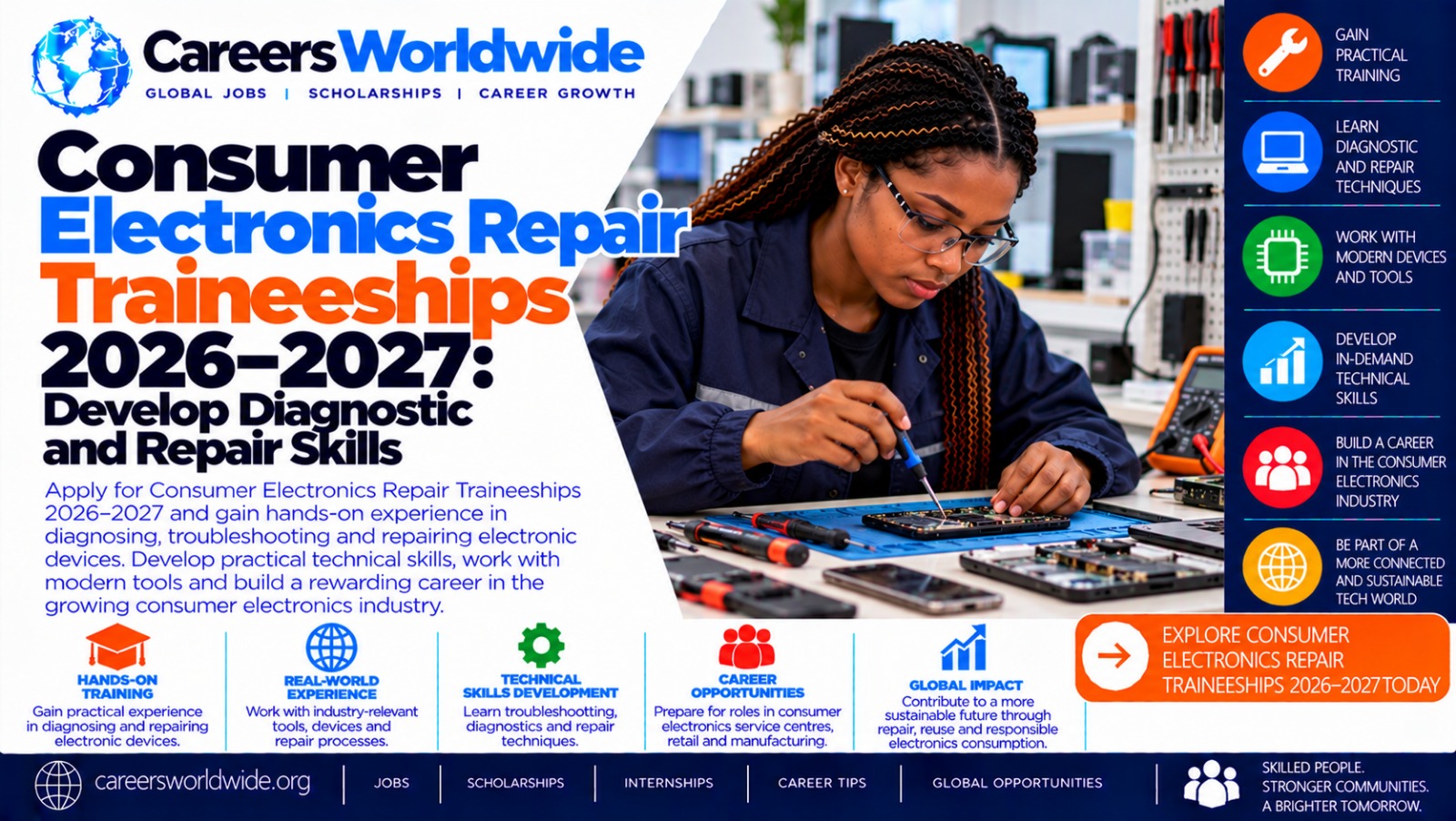

Excerpt: Consumer Electronics Repair Traineeships 2026–2027 offer aspiring technicians an opportunity to develop practical skills in diagnosing, maintaining, and repairing electronic devices. From televisions and radios to smartphones, audio systems, and household electronics, these training pathways can help beginners build technical confidence, gain workplace experience, and prepare for employment or self-employment. Discover the skills you may learn, common entry requirements, documents to prepare, how to find legitimate training opportunities, and the steps to take when applying for an electronics repair traineeship.
Introduction
Consumer electronics play an essential role in modern life. Smartphones support communication, televisions provide entertainment, computers help people study and work, and electronic appliances make everyday activities more convenient. When these devices malfunction, skilled repair technicians help identify faults, restore functionality, and extend product life.
As a result, consumer electronics repair can be an attractive career path for people interested in technology, practical problem-solving, and hands-on work. For school leavers, vocational training applicants, career changers, and aspiring entrepreneurs, a traineeship can provide a structured route into the repair industry.
Consumer Electronics Repair Traineeships 2026–2027 are a useful search focus for anyone hoping to enter this field during the upcoming training cycle. However, applicants should understand that the term does not necessarily refer to one national programme or a single application campaign. Opportunities may be offered by vocational training institutions, private electronics workshops, technical colleges, equipment service companies, and apprenticeship providers.
The availability of places, application dates, fees, qualifications, and funding arrangements depends on the country and individual provider. Applicants should therefore verify each opportunity through an official source before submitting personal information or paying any fees.
This guide explains how to prepare for electronics repair training, what practical skills to develop, where to look for legitimate opportunities, and how to improve an application for the 2026–2027 training period.
1. What Are Consumer Electronics Repair Traineeships?
A consumer electronics repair traineeship is a practical learning arrangement designed to introduce trainees to the maintenance, testing, fault diagnosis, and repair of electronic devices used by households and individual consumers.
Depending on the provider, the programme may combine classroom instruction, workshop demonstrations, supervised repairs, workplace experience, and assessments. Some opportunities are formal apprenticeships, while others are vocational courses, internships, or entry-level workshop placements.
These categories are not interchangeable. A formal apprenticeship may have a registered training plan and recognised assessment requirements, whereas a private workshop placement may provide experience without a nationally recognised qualification.
Before applying, candidates should establish exactly what the provider offers and whether the programme leads to a certificate, apprenticeship completion record, industry qualification, or practical experience only.
Areas of training
A consumer electronics repair programme may cover several areas:
- Television repair: Understanding power supplies, display systems, connectors, and common faults in supported television models.
- Smartphone and tablet servicing: Learning device inspection, battery replacement procedures, connector diagnosis, and basic component-level troubleshooting.
- Audio equipment repair: Examining speakers, amplifiers, radios, and sound systems.
- Computer and peripheral maintenance: Diagnosing selected hardware problems, power issues, ports, and peripheral faults.
- Electronic circuit fundamentals: Understanding resistors, capacitors, diodes, transistors, integrated circuits, and circuit diagrams.
- Testing and quality control: Using appropriate instruments and checking whether a repair has resolved the original problem.
- Customer service: Recording faults, explaining repair options, preparing estimates, and communicating professionally.
Not every traineeship covers all these specialisations. Some providers concentrate on mobile phones, while others focus on televisions, household electronics, or general electronics servicing.
Applicants should compare the practical workshop content with their intended career goals.
2. Why Consider an Electronics Repair Traineeship in 2026–2027?
Electronics repair offers a combination of technical learning, practical work, and opportunities to serve individuals and businesses.
Develop practical, employable skills
A traineeship can help learners move beyond theory and understand how electronic devices behave under real working conditions. Trainees may learn to inspect damaged equipment, follow diagnostic procedures, identify faulty components, and document repair work under supervision.
These skills can be useful when applying for junior technician roles, service-centre positions, equipment maintenance opportunities, or further technical training.
Build experience before seeking independent work
Employers often want more than theoretical knowledge. They may also value reliability, careful tool handling, accurate fault reports, customer communication, and the ability to follow safety procedures.
A well-structured traineeship can provide opportunities to demonstrate these qualities. Applicants should ask whether the programme includes supervised workshop hours, practical assessments, or a placement with an employer.
Explore self-employment
Some experienced repair technicians establish small workshops or provide mobile repair services. A traineeship can introduce the technical and administrative foundations needed for this path.
However, completing training does not automatically guarantee customers, profits, or business success. Independent technicians must also understand pricing, parts sourcing, warranties, customer records, local business regulations, and the costs of tools and workspace.
Contribute to longer product life
Repairing suitable devices can reduce unnecessary replacement and help consumers get more value from their purchases. Responsible repair also involves identifying when a device is unsafe, uneconomical to fix, or unsuitable for further use.
Technicians should follow manufacturer guidance, use compatible components, and explain repair limitations honestly.
3. Who Can Apply?
Eligibility varies by institution, employer, country, and qualification level. There is no single set of requirements that applies to every consumer electronics repair traineeship for 2026–2027.
Nevertheless, applicants can use the following general guidance when assessing opportunities.
School leavers
School leavers may be eligible for introductory vocational programmes that teach basic electronics, electrical principles, workshop safety, and diagnostic methods.
Some providers require secondary-school completion, while others accept applicants who meet a specified minimum educational level.
Applicants with a technical background
Candidates who have studied mathematics, physics, electrical installation, information technology, or electronics may find certain technical topics easier to understand.
Previous technical study can be an advantage, but it should not be assumed to be compulsory unless the official advertisement states that it is.
Career changers
People moving from retail, customer service, computer support, or another practical occupation may bring useful communication, organisation, and problem-solving skills.
Applicants should be prepared to demonstrate a genuine interest in electronics and a willingness to learn from the beginning.
Candidates without experience
Entry-level programmes may accept beginners. In these cases, motivation, attention to detail, punctuality, and willingness to follow instructions can be particularly important.
Never assume that a traineeship is open to everyone. Check the stated age limits, educational requirements, residency rules, and any prerequisites before applying.
4. Skills You Can Develop During Training
The most valuable electronics repair training combines foundational knowledge with supervised practical experience.
Electrical and electronic fundamentals
Trainees may learn about voltage, current, resistance, power, continuity, and basic circuit behaviour. These principles help explain why devices fail and how technicians can test circuits systematically.
Understanding circuit symbols and reading simple schematics can also make fault-finding more efficient.
Use of diagnostic equipment
Depending on the programme, learners may receive supervised instruction in using a digital multimeter, soldering station, suitable test leads, magnification equipment, and other workshop instruments.
More advanced training may introduce oscilloscopes, bench power supplies, electronic component testers, and specialised diagnostic equipment.
The purpose is not simply to use tools but to understand which tool is appropriate for a particular test and how to interpret the results safely.
Fault diagnosis
Good repair work begins with a structured diagnostic process.
Trainees should learn to confirm the reported problem, inspect the device, identify possible causes, carry out appropriate tests, and record findings before deciding on a repair.
Replacing parts without establishing the cause of a fault can waste money and may introduce additional problems.
Soldering and component handling
Some programmes teach soldering, desoldering, connector replacement, and printed circuit board handling.
These activities require practice and suitable equipment. Beginners should work under supervision and learn techniques that minimise heat damage, electrostatic discharge, and accidental short circuits.
Technical documentation
A professional technician records the device model, reported symptoms, test results, parts used, work completed, and any remaining limitations.
Documentation supports quality control, warranty decisions, customer communication, and future troubleshooting.
Workplace and customer skills
Technical ability must be matched with honesty, patience, teamwork, and respect for customer property.
Trainees may learn how to explain repair costs, obtain approval before proceeding, protect customer data, and return devices with clear information about the work performed.
5. Practical Guidance Before Applying
Applicants can improve their preparation by taking several straightforward steps before submitting an application.
First, identify the right specialisation. Decide whether you are most interested in mobile devices, televisions, audio systems, computers, or general electronics. A focused goal makes it easier to compare programmes.
Second, check the training format. Determine whether the opportunity is a full-time course, part-time programme, registered apprenticeship, paid traineeship, or unpaid workplace placement. Ask about the balance between theory and practical work.
Third, confirm the qualification outcome. Find out whether successful trainees receive an accredited certificate, a provider-issued certificate, an apprenticeship record, or a reference confirming experience. Where recognition matters, check the relevant national authority.
Fourth, assess the financial commitment. Ask whether tuition, registration, tools, protective equipment, transport, accommodation, and examination fees apply. A programme described as a traineeship is not automatically free or paid.
Fifth, investigate the provider. Verify the institution’s legal identity, contact details, workshop facilities, trainers, safety procedures, and assessment arrangements.
Sixth, prepare a clear application. Use accurate information, organise the required documents, and explain why you want to learn electronics repair.
Applicants should be especially cautious of advertisements promising guaranteed employment, unusually high earnings, or immediate certification without practical training.
6. Documents to Prepare
The official advertisement should always determine which documents are required. Depending on the provider, applicants may need some of the following:
- A completed application form.
- A current curriculum vitae or résumé.
- A copy of the required school-leaving certificate or academic results.
- Copies of relevant technical certificates, if applicable.
- A national identification document or other accepted proof of identity.
- Proof of residence, if requested.
- A brief motivation letter.
- Contact details for referees, where required.
- Certified copies of documents, if expressly requested.
Do not send every available personal document simply because an advertisement mentions an application. Submit only what the verified provider requires through its authorised channel.
Keep copies of submitted materials and save any application reference number or confirmation message.
7. How to Build Relevant Experience Before Training
Applicants who have little or no electronics experience can still prepare for entry-level opportunities.
Begin by learning basic electrical concepts through reputable educational materials, technical manuals, and introductory electronics lessons. Focus on understanding how circuits work rather than memorising component names.
Practise identifying common electronic components using unpowered training boards or educational kits. If you have access to a suitable multimeter, learn its functions using low-voltage training circuits and follow the instrument manufacturer’s instructions.
You can also practise documenting a device’s symptoms, recording observations, and explaining possible causes without claiming certainty where you have not completed the necessary tests.
If a reputable workshop offers supervised observation or an introductory practical course, consider asking whether beginners can attend.
Avoid opening mains-powered equipment, microwave ovens, televisions, power supplies, or damaged battery packs without appropriate training and supervision. Some devices can retain dangerous voltages even after disconnection. Lithium-ion batteries can also ignite if punctured, crushed, or incorrectly handled.
A strong beginner demonstrates curiosity while respecting safety limits.
8. Career Opportunities After Training
Career outcomes depend on the training provider, the trainee’s performance, the local job market, and any additional qualifications required.
Possible progression routes include:
- Junior consumer electronics repair technician.
- Mobile phone service technician.
- Television and audio equipment technician.
- Electronics workshop assistant.
- Electronics service-centre trainee.
- Warranty and repair support assistant.
- Technical sales or after-sales service assistant.
- Further study in electronics, electrical engineering technology, or a related vocational field.
- Self-employment after developing sufficient competence and meeting local requirements.
Some technicians eventually specialise in board-level repairs, diagnostic testing, equipment refurbishment, or particular product categories.
However, advanced specialisations may require additional equipment, substantial experience, manufacturer-specific training, or formal qualifications.
Applicants should treat a traineeship as a starting point for professional development rather than a guarantee of a particular job title or salary.
9. Summary Table: Consumer Electronics Repair Traineeships 2026–2027
The following table provides a quick overview of what prospective applicants should investigate. The details are general guidance, not confirmation of a single nationwide recruitment exercise.
| Category | What applicants should know |
|---|---|
| Programme focus | Consumer electronics diagnosis, servicing, and repair |
| Training period | 2026–2027, depending on the provider’s intake |
| Target applicants | School leavers, beginners, and eligible career changers |
| Educational requirements | Vary by institution and course level |
| Previous experience | May not be required for entry-level programmes |
| Training format | Vocational classes, supervised workshop practice, or apprenticeship |
| Potential equipment | Multimeter, soldering station, test equipment, and repair tools |
| Documents | Application form, academic results, identification, and other requested records |
| Training costs | May be free, subsidised, employer-funded, or fee-paying |
| Stipend or salary | Only available where the provider expressly offers it |
| Qualification | Depends on accreditation, assessment, and programme design |
| Application method | Official institutional portal, verified email, or designated admissions office |
| Closing date | Check the current official intake notice |
| Career possibilities | Repair workshops, service centres, technical support, or future self-employment |
Important: Do not interpret this table as an announcement that applications are open for a particular electronics repair traineeship. Confirm the programme title, intake, available places, and deadlines directly with the provider.
10. How to Apply for Consumer Electronics Repair Traineeships 2026–2027
The application process generally follows several stages, although the precise procedure depends on whether you are applying to a technical college, an employer, or a registered apprenticeship programme.
Step 1: Find a suitable training provider
Search for technical colleges, vocational training centres, electronics service companies, and established repair workshops that provide structured training.
Use search terms such as:
- Consumer electronics repair training 2027.
- Electronics technician traineeship 2026.
- Electronic equipment servicing course.
- Television and audio repair training.
- Mobile phone repair vocational course.
- Electronics apprenticeship opportunities.
If you are in Zimbabwe, begin with recognised technical and vocational education resources and contact relevant institutions to establish whether they offer an electronics servicing course or a closely related qualification.
Step 2: Confirm the course and eligibility
Read the official advertisement or course description carefully. Check the minimum educational qualifications, age restrictions, training location, course duration, fees, and practical training requirements.
If the programme is advertised as an apprenticeship, ask whether it is formally registered and what arrangements apply to workplace supervision and assessment.
If you cannot find a course explicitly called Consumer Electronics Repair, ask whether the provider offers electronics, electronic engineering, electronic equipment servicing, or another relevant technical programme. Similar names do not necessarily mean identical training.
Step 3: Prepare your documents
Prepare your résumé, academic records, identification, and motivation letter if required. Check that your contact details are accurate and that any certified copies meet the provider’s instructions.
Do not alter examination results or claim technical experience that you do not have. Beginners can explain their interest in the field honestly.
Step 4: Complete the official application
Use the application portal or submission method named in the verified notice.
Complete every required field, select the correct programme and intake, and review the form before submitting it. If a payment is required, confirm the official fee and payment instructions independently.
Save your application reference, receipt, or confirmation email.
Step 5: Prepare for assessment or an interview
Some providers may interview candidates, review academic results, or conduct aptitude assessments. Others may select applicants through a different procedure.
Be prepared to explain why you want to learn electronics repair, how you approach troubleshooting, and why safety matters in a workshop.
You may also be asked about your availability, educational background, career goals, and willingness to undertake practical training.
Step 6: Verify your admission or placement
A submitted application is not an offer of admission or employment. Wait for official communication confirming the outcome.
Before accepting a place, understand the training schedule, any contractual obligations, the expected qualification, fees or remuneration, and the conditions for completing the programme.
11. Official Application Resources
For applicants in Zimbabwe, the following resources are useful starting points for investigating recognised technical training and related application pathways. They do not, by themselves, confirm that a dedicated Consumer Electronics Repair Traineeship 2026–2027 is available.
1. HEXCO programme and course finder
The Higher Education Examinations Council provides information about technical and vocational programmes and qualification pathways. Explore the available courses and ask an accredited training centre whether it offers a suitable electronics-related programme.
Official website: https://hexco.zchpc.ac.zw/programmes
2. HEXCO official website
Visit the official HEXCO website for information about vocational education, examinations, apprenticeship training, industrial training, and related services.
Official website: https://hexco.zchpc.ac.zw/
3. HEXCO application portal
The following portal provides an online application interface for institutional programmes. Before applying, confirm that your chosen institution and course are listed, that the portal is authorised for that intake, and that the course matches your training goals.
Application portal: https://hexcones.ac.zw/ApplyForAdmission.aspx
4. Ministry of Higher and Tertiary Education resources
Zimbabwe’s responsible ministry provides information about technical and vocational education, quality assurance, trade testing, and qualification recognition. Use official ministry channels to clarify whether a proposed course or apprenticeship meets the relevant requirements.
Ministry website: https://mhtestd.gov.zw/
5. Industrial Training and Trade Testing contacts
For questions about registered apprenticeships, industrial attachment, trade testing, or relevant vocational pathways in Zimbabwe, consult the official HEXCO website’s contact information and request the appropriate office.
Contact page: https://hexco.zchpc.ac.zw/contact
Applicants in other countries should use their own national vocational education authority, apprenticeship registry, accredited technical colleges, and official employer recruitment pages.
Always verify contact details, fees, and deadlines before sharing documents or making payments. Where a website or advertisement cannot be independently verified, contact the institution using details published on its established official website.
12. Frequently Asked Questions (FAQ)
1. Are Consumer Electronics Repair Traineeships 2026–2027 officially open?
The title is a useful way to search for relevant training opportunities, but it does not identify one verified nationwide programme. Application availability depends on the institution or employer. Check current official notices and confirm the opening and closing dates before applying.
2. Do I need previous electronics repair experience?
Not necessarily. Some introductory courses and traineeships are designed for beginners. More advanced programmes may require previous technical training, relevant qualifications, or practical experience. Check the entry requirements for each opportunity.
3. What qualifications are required?
Requirements vary. A provider may request school-leaving qualifications, passes in mathematics or science, a technical certificate, or other prerequisites. Some programmes may have additional age or residency requirements. Only the official advertisement can confirm which qualifications are necessary.
4. Can I apply without a technical certificate?
You may be eligible for a foundation-level or introductory programme that accepts applicants without previous electronics training. Ask the institution whether it offers a beginner course or a preparatory qualification.
5. Will trainees receive a salary or stipend?
Not automatically. Some employer-sponsored apprenticeships provide remuneration, while vocational courses and private workshop placements may be unpaid or require fees. Confirm the financial arrangements in writing before accepting an offer.
6. How long does electronics repair training take?
Duration depends on the course level, specialisation, and training format. A short introductory course may take considerably less time than a formal vocational qualification or apprenticeship. Ask for the programme’s full schedule, including practical training and assessments.
7. Can I specialise in mobile phone repair?
Yes, if the training provider offers a suitable specialisation. Mobile phone servicing can involve battery and charging faults, connectors, screens, diagnostic procedures, and other repairs. Advanced work may require specialised equipment and additional training.
8. Will I receive a recognised certificate?
That depends on the institution, qualification, and assessment process. Before enrolling, confirm the awarding body and whether the qualification is recognised by the relevant national authority or industry.
In Zimbabwe, applicants can begin by checking HEXCO’s programme information and asking the relevant training institution about accreditation and examination arrangements.
Higher Education Examinations Council
+2
9. What documents should I submit?
Commonly requested documents include an application form, academic results, identification, a résumé, and a motivation letter. Some programmes require additional documents or certified copies. Follow the precise instructions in the official advertisement.
10. Where can I find legitimate application opportunities?
Start with recognised technical colleges, official vocational education authorities, registered apprenticeship providers, and established electronics service companies. For Zimbabwe, the HEXCO programme finder and official ministry resources are useful starting points.
Higher Education Examinations Council
+1
11. Can this training lead to self-employment?
Potentially. With sufficient practical competence, appropriate tools, business planning, and compliance with local requirements, experienced technicians may establish repair services. Training alone does not guarantee customers or income.
12. What should I do if I cannot find the exact course title?
Search for related programmes such as electronics servicing, electronic equipment maintenance, electronic engineering technology, or mobile device repair. Contact the provider to establish whether the course includes the practical diagnostic and repair skills you want to acquire.
13. How to Apply Successfully: Final Applicant Checklist
Before submitting an application for the 2026–2027 training period, use this checklist to make sure you are prepared.
Application readiness
0 of 8 completedI have identified a legitimate training provider.I have confirmed the course name and intake period.I meet the stated educational and other entry requirements.I have checked the application deadline.I have prepared all required documents.I understand the fees, funding, or stipend arrangements.I have verified the official application channel.I have saved a copy of my application and supporting documents.
Copy checklist
A careful application can help demonstrate your organisation and commitment. However, selection decisions are made by the relevant institution or employer, and applicants should not assume that meeting minimum requirements guarantees a place.
14. Final Thoughts
Consumer electronics repair can provide a practical starting point for a career in technical services. By learning electrical fundamentals, diagnostic procedures, equipment handling, safe repair methods, and customer communication, trainees can build a foundation for further study and professional experience.
For 2026–2027, the most effective approach is to identify a suitable training provider, verify its entry requirements, prepare the necessary documents, and follow the official application process.
Applicants should remain flexible when searching for opportunities. A course in electronics servicing or a related vocational discipline may provide relevant preparation even when a provider does not advertise a programme under the exact title used in this article.
Most importantly, prioritise hands-on training, qualified supervision, recognised assessment where applicable, and safe workshop practices. These factors can help distinguish a worthwhile training opportunity from an unstructured placement.
Start by checking the official vocational training resources in your country, contacting relevant institutions, and confirming the details of any available intake before applying.
Disclaimer
This article is provided for general informational and educational purposes. The title Consumer Electronics Repair Traineeships 2026–2027 does not represent confirmation of a specific national recruitment programme, a guaranteed vacancy, or an official application announcement.
Eligibility criteria, course availability, application deadlines, fees, stipends, qualifications, and selection procedures may change and vary by institution and country. Official resources listed for Zimbabwe are intended as starting points for investigating relevant vocational training pathways; they do not establish that a dedicated consumer electronics repair traineeship is currently recruiting.
Applicants should verify all information directly with the responsible institution or employer before submitting personal documents or making payments. No employment, admission, certification, or financial outcome is guaranteed.
SEO Keywords
Consumer Electronics Repair Traineeships 2026–2027, Consumer Electronics Repair Training, Electronics Repair Traineeship 2027, Electronics Technician Training, Electronics Repair Apprenticeships, Consumer Electronics Servicing Course, Electronic Equipment Repair Training, Television Repair Training, Mobile Phone Repair Training, Audio Equipment Repair Course, Electronics Diagnostic Skills, Electronics Repair Vocational Training, Electronics Trainee Application, Technical Training Opportunities 2026, Technical Training Opportunities 2027, Electronics Repair Career Opportunities, Electronics Workshop Training, Practical Electronics Skills, Electronics Repair Entry Requirements, Electronics Traineeship Application Process, Vocational Training Zimbabwe, HEXCO Programmes Zimbabwe, Zimbabwe Electronics Training Courses, Electronic Engineering Technology Training, Consumer Electronics Technician Career, Electronics Repair Skills Development, Electronics Apprenticeship Requirements, Electronics Repair Course Qualifications, Electronics Servicing Training Opportunities, How to Apply for Electronics Training,
ALSO CHECK: Beit Trust Postgraduate Scholarships 2027: Study Opportunities for Eligible Southern African StudentsOctober 17, 2026
DAAD In-Country/In-Region Scholarships 2027: Postgraduate Funding for Sub-Saharan African StudentsOctober 17, 2026
University of British Columbia International Scholars Program 2027: Scholarships for International StudentsOctober 17, 2026