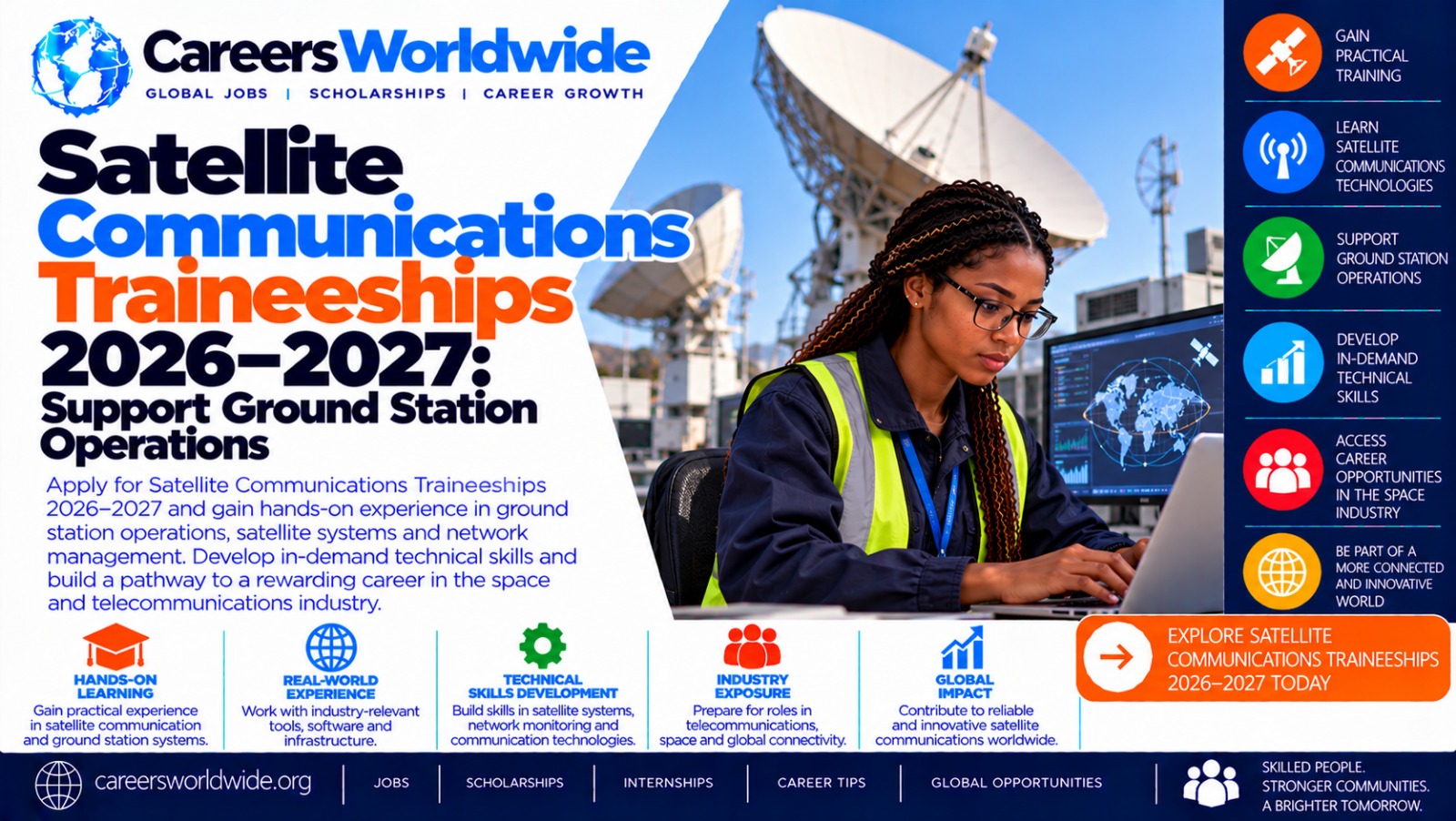

Excerpt: Satellite Communications Traineeships 2026–2027 offer aspiring engineers, IT graduates, telecommunications students, and technically minded job seekers a pathway into the growing space communications industry. Discover the skills needed to support ground station operations, potential trainee responsibilities, eligibility considerations, application preparation tips, and official resources for finding legitimate internships and entry-level opportunities with space agencies and satellite communications organisations.
Introduction: Build a Career in Satellite Communications
Satellite communications play an essential role in connecting people, organisations, and technologies across the world. From broadcasting and broadband internet to weather monitoring, navigation, disaster response, and scientific research, satellite systems help deliver information across vast distances.
Behind every successful satellite communication link is a network of ground-based facilities responsible for transmitting commands, receiving signals, processing data, and monitoring system performance. These facilities are known as ground stations, and they depend on skilled technical professionals to operate reliably.
For students, recent graduates, and aspiring telecommunications professionals, Satellite Communications Traineeships 2026–2027: Support Ground Station Operations is a useful career pathway to explore.
However, there is an important distinction: this title describes a career opportunity category rather than one confirmed, universal traineeship programme. Vacancies, funding, eligibility requirements, and application deadlines depend on the employer and country. Applicants should therefore search official recruitment portals for relevant internships, graduate trainee positions, apprenticeships, and junior ground systems roles.
Organisations such as the European Space Agency (ESA) and the National Aeronautics and Space Administration (NASA) publish training and early-career opportunities. ESA identifies ground segment systems and operations among its internship disciplines, while NASA provides internships through its Office of STEM Engagement and Pathways programmes.
The following guide explains how to prepare for opportunities in this specialist field during the 2026–2027 recruitment period.
What Are Satellite Communications Traineeships?
Satellite communications traineeships are structured learning or early-career opportunities designed to help participants develop practical knowledge of satellite systems, telecommunications infrastructure, network operations, and related engineering processes.
Depending on the employer, a placement may involve classroom instruction, supervised technical assignments, laboratory exercises, simulation activities, operational support, or a combination of these experiences.
Ground station operations focus on the equipment and systems used to communicate with satellites. A typical facility may contain antennas, radio-frequency equipment, modems, tracking systems, computers, network infrastructure, monitoring software, and data-processing systems.
Trainees may learn how these components work together to maintain a reliable communication link between a satellite and a ground-based facility.
The precise duties depend on the organisation and the trainee’s experience. Entry-level participants generally work under supervision rather than independently controlling operational satellite infrastructure.
Why Ground Station Operations Matter
Satellites cannot provide many of their services without effective communication with ground infrastructure. Ground stations help operators exchange commands and telemetry with spacecraft, receive scientific observations, and transfer information to users or processing facilities.
Ground systems also support mission planning, scheduling, monitoring, and troubleshooting.
A communications interruption, equipment fault, network failure, or antenna-tracking problem can affect the availability or quality of a service. Trained personnel help identify problems, document incidents, follow established procedures, and escalate technical issues to experienced engineers.
For trainees, this creates opportunities to understand how theoretical engineering knowledge is applied in real operational environments.
Who Should Apply for Satellite Communications Traineeships 2026–2027?
These opportunities may suit people interested in telecommunications, electronics, networking, computing, radio-frequency engineering, and space technology.
Relevant educational backgrounds may include:
- Telecommunications engineering.
- Electrical and electronic engineering.
- Computer engineering and computer science.
- Information technology and network administration.
- Radio-frequency and microwave engineering.
- Aerospace engineering.
- Systems engineering.
- Physics and applied mathematics.
- Data communications and signal processing.
Some programmes may accept applicants with technical diplomas, vocational qualifications, or relevant practical experience. Others require current university enrolment or a completed bachelor’s or master’s degree.
Applicants should not assume that all opportunities require a university degree. Equally, they should not assume that every traineeship accepts school leavers or candidates without previous technical training.
The published vacancy announcement is the final authority on eligibility.
Candidates from countries outside the employer’s home country should pay particular attention to nationality restrictions, work authorisation, visa requirements, and any rules governing access to sensitive technical facilities.
For example, NASA’s standard OSTEM and Pathways internship programmes have US citizenship requirements. ESA student internships have their own citizenship and student-status conditions. These restrictions do not automatically apply to every satellite operator or private telecommunications company.
What Do Ground Station Operations Trainees Do?
A ground station trainee’s responsibilities depend on the facility, mission, and level of training. Typical learning areas include the following.
1. Ground Station Equipment Monitoring
Trainees may learn to observe equipment status, review system alerts, record operating conditions, and understand the purpose of different hardware components.
These components may include antennas, tracking mechanisms, receivers, transmitters, modems, signal-processing equipment, and monitoring systems.
Participants may also become familiar with equipment checklists and routine inspection procedures.
Operational work must follow the employer’s authorisation and safety requirements. Trainees should never change live system settings or transmit signals without explicit permission and appropriate supervision.
2. Signal Reception and Transmission Fundamentals
Satellite communications involve radio signals travelling between a satellite and a ground station.
Trainees may study frequency bands, modulation, bandwidth, signal strength, noise, link budgets, and signal quality.
They may also learn the differences between uplink and downlink communications. An uplink carries signals from a ground station towards a satellite, while a downlink carries signals from a satellite towards a receiving station.
Practical learning may involve simulations, laboratory equipment, recorded measurements, or supervised demonstrations.
3. Network and Data Communications
Modern ground stations depend on networks that move information between equipment, control systems, processing facilities, and authorised users.
Trainees may gain exposure to IP networking, routing, switching, network monitoring, data transfer, and basic cybersecurity principles.
Useful foundational knowledge includes IP addressing, TCP/IP, DNS, network troubleshooting, and secure account management.
Depending on the employer, candidates may also encounter Linux systems, scripting, virtualisation, or automated monitoring tools.
4. Telemetry, Tracking, and Command Concepts
Telemetry provides information about a spacecraft’s condition and performance. Tracking helps determine or maintain knowledge of a satellite’s position relative to the ground station, while command systems enable authorised instructions to be sent to a spacecraft.
Trainees may learn how these functions are coordinated, how operational schedules are prepared, and why communication windows must be carefully managed.
Access to command systems is mission-sensitive and controlled. Trainees may study these processes without receiving permission to execute commands.
5. Troubleshooting and Incident Reporting
Technical problems may arise from equipment faults, software errors, network interruptions, interference, configuration issues, or environmental conditions.
A trainee may assist with collecting diagnostic information, checking approved procedures, documenting symptoms, and reporting findings to a supervisor.
Accurate incident records are particularly important in environments where multiple teams share responsibility for operational reliability.
6. Documentation and Team Communication
Ground station operations require clear communication between technicians, engineers, network administrators, mission planners, and other stakeholders.
Trainees may help maintain equipment logs, prepare shift handovers, update technical documentation, and summarise completed tasks.
Strong written communication and attention to detail are valuable even for highly technical positions.
Essential Skills and Qualifications
Candidates can improve their readiness by developing a combination of technical knowledge and professional skills.
Technical foundations
- Basic electronics and electrical principles.
- Telecommunications and radio-frequency fundamentals.
- Computer networking and IP communications.
- Operating systems and command-line basics.
- Signal processing and data communications concepts.
- Familiarity with troubleshooting methods.
- Understanding of cybersecurity and operational safety.
Practical and professional skills
- Analytical thinking and problem-solving.
- Accurate record-keeping.
- Clear written and verbal communication.
- Teamwork and willingness to learn.
- Following technical instructions.
- Time management and reliability.
- Awareness of safety and access-control requirements.
Not every applicant needs advanced expertise in all these areas. A beginner-friendly traineeship may focus on foundational learning, while an engineering placement may expect more specialised knowledge.
How to Strengthen Your Application
Candidates can demonstrate interest by completing a small, well-documented technical project.
Examples include building a simulated network-monitoring dashboard, analysing sample signal measurements, creating a basic telecommunications link-budget calculator, or documenting a laboratory exercise involving antennas or radio-frequency equipment.
A project should clearly explain its purpose, tools, methods, results, and limitations. Applicants should never claim to have operated professional satellite infrastructure when their experience was limited to simulations or classroom exercises.
Relevant online courses, university projects, laboratory work, technical clubs, and volunteer experience can also help demonstrate motivation.
Summary Table: Satellite Communications Traineeships 2026–2027
| Category | What applicants should know |
|---|---|
| Career area | Satellite communications and ground station operations |
| Opportunity types | Internships, graduate traineeships, apprenticeships, and junior technical roles |
| Relevant fields | Telecommunications, electronics, IT, networking, aerospace, and computer engineering |
| Typical learning areas | Signal monitoring, ground systems, networking, documentation, and troubleshooting |
| Experience level | Varies by programme; some opportunities are designed for students |
| Essential skills | Technical problem-solving, communication, teamwork, and attention to detail |
| Qualifications | Determined by each vacancy |
| Duration | Depends on the employer and programme |
| Financial support | Salary, stipend, allowance, unpaid placement, or other arrangements, depending on the offer |
| Application period | Check individual announcements for 2026–2027 deadlines |
| Application method | Official employer recruitment portal or authorised application system |
| Career progression | Potential pathways into telecommunications, ground systems, network operations, and satellite engineering |
This table provides general career guidance. It does not represent a single confirmed traineeship with uniform eligibility, benefits, or deadlines.
Practical Guidance: How to Prepare for the 2026–2027 Recruitment Period
Preparing early can help applicants avoid rushed submissions and identify suitable openings.
Step 1: Identify Your Preferred Technical Area
Satellite communications covers several specialisations. Some roles focus on antennas and radio-frequency equipment, while others concentrate on networking, software, data processing, mission operations, or systems engineering.
Review your education and experience to identify where you are strongest.
If you have an IT background, ground networks and monitoring systems may be a good starting point. If you have studied electronics or telecommunications, signal transmission and receiver systems may be more relevant.
Step 2: Research the Employer
Search for space agencies, satellite operators, telecommunications providers, research institutions, ground station service providers, and companies that supply satellite infrastructure.
Look for official vacancies containing terms such as:
- Ground Segment Engineering.
- Ground Station Operations.
- Satellite Communications.
- Telecommunications Engineering.
- RF Engineering.
- Mission Operations.
- Network Operations.
- Space Systems Engineering.
- Graduate Engineer.
- Technical Internship.
Do not rely solely on the phrase “Satellite Communications Traineeships 2026–2027.” Employers may advertise relevant roles under different titles.
Step 3: Check Eligibility Before Applying
Read the vacancy announcement carefully. Confirm the required qualification, academic level, citizenship, work authorisation, language proficiency, location, and availability dates.
Also check whether the programme requires university enrolment throughout the placement or accepts recent graduates.
Where a role requires experience with specialist equipment, distinguish between mandatory requirements and desirable skills.
Step 4: Prepare Your Documents
Most professional applications require a CV or résumé and may request a motivation letter, academic transcript, references, or other supporting information.
Prepare a concise CV that highlights relevant education, practical projects, technical tools, certifications, and teamwork.
Describe achievements clearly. For example, instead of writing “knowledge of computer networks,” explain a project in which you configured a test network, identified connectivity issues, or documented a troubleshooting procedure.
Follow the employer’s specific document and file-format instructions.
Step 5: Submit Through the Official Portal
Create an account on the employer’s authorised recruitment platform if required.
Complete each field accurately, attach the requested documents, and submit before the stated deadline. Save the confirmation message and retain a copy of your application.
If a vacancy provides an official contact for recruitment questions, use it to clarify genuine uncertainties rather than relying on unofficial social media posts.
Step 6: Prepare for Interviews or Technical Assessments
Depending on the role, selection may involve a competency-based interview, technical questions, a practical assessment, or a discussion of academic projects.
Revise telecommunications fundamentals, networking, basic electronics, troubleshooting, and the projects listed on your CV.
Prepare examples demonstrating how you solved a problem, worked with others, followed instructions, or learned an unfamiliar technical concept.
Interviewers may value a candidate’s reasoning and willingness to learn as much as their existing technical knowledge.
Official Application Resources for 2026–2027
The following resources provide legitimate starting points for finding relevant opportunities. They do not guarantee that a specific satellite communications traineeship is currently available.
1. European Space Agency (ESA) Student Internships
Official page: https://www.esa.int/About_Us/Careers_at_ESA/Student_Internships2
ESA offers student internships in several technical disciplines, including telecommunications, electrical engineering, software engineering, and ground segment systems and operations.
Its general internship information describes placements lasting three to six months and outlines student-status and citizenship requirements. Opportunities are published through ESA’s recruitment system.
Applicants should review the current conditions and search for positions matching their academic background.
2. ESA Official Recruitment Portal
Official portal: https://jobs.esa.int/
Use the recruitment portal to search for vacancies and filter opportunities by keywords, location, and appointment type.
Search terms such as “ground systems,” “telecommunications,” “ground segment,” and “operations” may help identify relevant positions.
Review each vacancy for its closing date, qualifications, location, and nationality requirements.
3. NASA Internship Programmes
Official page: https://www.nasa.gov/learning-resources/internship-programs/
NASA offers Office of STEM Engagement (OSTEM) internships and Pathways internships.
OSTEM provides short-term, project-based experiences for eligible students. Pathways offers a more structured internship route connected to potential federal employment after graduation.
NASA’s published programme information includes eligibility conditions and application schedules. Applicants should confirm the latest requirements before applying, particularly because standard OSTEM and Pathways eligibility includes US citizenship.
NASA internship projects vary by session and centre. Interested applicants should search the official system for technical projects that match their skills rather than assuming a dedicated satellite ground station traineeship is available.
4. NASA Careers and Pathways Information
Official page: https://www.nasa.gov/careers/
NASA’s careers resources explain employment routes, including Pathways opportunities and positions supporting its facilities and missions.
For civil service roles, applicants should check the vacancy announcement and the official application route. Some contractors and partner organisations recruit separately and maintain their own eligibility rules.
5. National Space Agencies and Satellite Operators
Applicants outside ESA’s and NASA’s standard eligibility groups should investigate opportunities closer to home or through international employers that accept applications from their country.
Useful sources include:
- National space agency career pages.
- Telecommunications regulatory authorities and public-sector technical agencies.
- Satellite broadband and broadcasting operators.
- University aerospace and telecommunications research laboratories.
- Ground station service providers.
- Satellite equipment manufacturers and telecommunications infrastructure companies.
- Accredited engineering apprenticeship and graduate development programmes.
Search each organisation’s official website for early-career vacancies. A local telecommunications internship involving transmission systems, networking, monitoring, or radio-frequency equipment may provide relevant experience for a future satellite communications career.
How to Apply: A Step-by-Step Checklist
Use this checklist when preparing an application.
- Identify at least three legitimate employers or recruitment portals.
- Search for ground station, ground segment, telecommunications, and satellite operations vacancies.
- Confirm the closing date and expected start date.
- Check academic, nationality, age, language, and work-authorisation requirements.
- Prepare an updated CV or résumé.
- Collect academic transcripts and any requested certificates.
- Draft a targeted motivation letter where required.
- Highlight technical projects and transferable skills.
- Complete the official application form accurately.
- Submit all requested documents before the deadline.
- Save the confirmation and monitor your application account.
- Prepare for technical interviews and competency questions.
Important: Do not pay an unofficial recruiter to guarantee selection. Verify any recruitment fee, training charge, or relocation offer directly with the employer before proceeding.
Frequently Asked Questions (FAQ)
1. What are Satellite Communications Traineeships 2026–2027?
The phrase describes early-career opportunities for people interested in satellite communications and ground station operations during the 2026–2027 period. Relevant openings may be advertised as internships, graduate trainee positions, apprenticeships, or junior engineering roles. Availability depends on the employer.
2. Are applications currently open?
Application status varies by organisation and vacancy. Check the official ESA and NASA recruitment resources listed above, along with national space agencies and satellite operators. Do not assume that an opportunity is open merely because a third-party website mentions 2026–2027.
3. Who is eligible to apply?
Eligibility depends on the specific programme. Employers may consider telecommunications, electrical engineering, computer science, IT, aerospace engineering, physics, and related qualifications. Some accept current students, while others recruit recent graduates or vocational trainees.
4. Do I need previous satellite communications experience?
Not necessarily. Entry-level opportunities may accept candidates with relevant academic knowledge and transferable technical skills. However, some specialist positions require experience in radio-frequency systems, networking, electronics, or software development.
5. Are satellite communications traineeships paid?
Payment arrangements differ. Some programmes offer salaries, stipends, or allowances; others are unpaid internships with separate conditions. Always check the official vacancy for compensation, travel support, accommodation, insurance, and other expenses.
6. Can international applicants apply?
Some employers recruit internationally, but others impose nationality or work-authorisation restrictions. ESA and NASA have specific eligibility conditions for their standard student internship programmes. Applicants should verify the rules for each vacancy and investigate local or international alternatives where necessary.
7. What qualifications are most useful?
Telecommunications engineering, electrical and electronic engineering, computer science, networking, aerospace engineering, and related technical fields are useful foundations. The most appropriate qualification depends on whether the role focuses on hardware, networks, software, or mission operations.
8. What skills should I learn before applying?
Start with basic electronics, networking, telecommunications principles, troubleshooting, and technical documentation. Depending on your chosen specialisation, consider learning Linux, scripting, signal processing, radio-frequency fundamentals, or network monitoring.
9. Where can I find official application forms?
Use the employer’s official recruitment portal. ESA opportunities are listed through its careers website, while NASA internships use the relevant NASA internship or federal recruitment systems. Other employers publish their own application instructions.
10. Does completing a traineeship guarantee employment?
No. A traineeship can strengthen your practical experience and professional network, but permanent employment depends on available vacancies, performance, qualifications, and the employer’s recruitment process.
11. Can an IT graduate work in ground station operations?
Potentially, yes. IT graduates may be suited to networking, systems administration, monitoring, software, cybersecurity, and data communications roles supporting ground infrastructure. The applicant must still meet the vacancy’s technical and educational requirements.
12. How can I avoid fake satellite recruitment advertisements?
Verify the vacancy on the organisation’s official website, check the recruitment contact details, and confirm that the application process matches the published instructions. Be cautious of guaranteed jobs, requests for payment to secure interviews, unofficial email addresses, and pressure to send sensitive documents immediately.
Career Prospects After a Traineeship
Ground station experience can provide a foundation for several technical career paths.
Depending on training, qualifications, and subsequent experience, participants may progress towards positions such as ground systems technician, satellite communications engineer, network operations engineer, telecommunications specialist, RF technician, systems support engineer, or mission operations support professional.
Some may pursue further study in communications engineering, signal processing, satellite systems, or aerospace technology.
Career progression is not automatic. Employers may require professional certifications, additional academic qualifications, security clearances, or practical experience before appointing candidates to advanced responsibilities.
The most valuable outcome of a traineeship is often the combination of technical understanding, disciplined operational practice, and evidence of the ability to learn within a professional engineering environment.
Final Summary
Satellite communications traineeships are worth exploring for students, graduates, and aspiring technicians interested in supporting the infrastructure that connects satellites with Earth.
The 2026–2027 recruitment period is an opportunity to investigate internships, graduate programmes, apprenticeships, and junior roles across space agencies, telecommunications companies, and satellite service providers.
Start by identifying your technical strengths, researching verified employers, checking eligibility, and preparing a focused application. Use official recruitment portals to confirm deadlines, financial arrangements, and application requirements.
Most importantly, treat the title “Satellite Communications Traineeships 2026–2027” as a search topic rather than a guarantee that one universal programme exists. A careful, well-prepared application to a legitimate, relevant vacancy is a stronger starting point for a career in ground station operations.
Disclaimer
This article is intended for general career information and educational purposes only. It does not announce or represent an official recruitment programme, guarantee that vacancies are available, or promise employment, payment, selection, or admission.
Eligibility criteria, application dates, compensation, duties, and selection procedures vary by organisation and may change. Applicants must consult the official employer website and the relevant vacancy announcement before applying. Any named organisation is referenced for informational purposes; inclusion does not imply endorsement of this article.
Applicants should independently verify recruitment communications and avoid sending money or sensitive personal information to unverified individuals or websites.
SEO Keywords
satellite communications traineeships 2026–2027,
satellite communications trainee jobs,
ground station operations traineeships,
satellite ground station internships,
satellite communications careers,
ground segment engineering internships,
space agency traineeships 2026,
space agency internships 2027,
telecommunications graduate traineeships,
satellite operations training programmes,
satellite communications engineering jobs,
ground station technician training,
satellite network operations careers,
telecommunications internships for graduates,
ESA student internships 2026–2027,
NASA internships for engineering students,
space technology career opportunities,
radio frequency engineering internships,
ground systems engineering careers,
satellite communications application requirements,
satellite communications qualifications,
entry-level space industry jobs,
satellite communications job application tips,
satellite ground systems training,
space communications career pathways,
international satellite communications opportunities,
graduate engineering traineeships 2027,
satellite operations jobs for graduates,
telecommunications engineering career development,
official space agency recruitment portals,
ALSO CHECK: Beit Trust Postgraduate Scholarships 2027: Study Opportunities for Eligible Southern African StudentsOctober 17, 2026
DAAD In-Country/In-Region Scholarships 2027: Postgraduate Funding for Sub-Saharan African StudentsOctober 17, 2026
University of British Columbia International Scholars Program 2027: Scholarships for International StudentsOctober 17, 2026