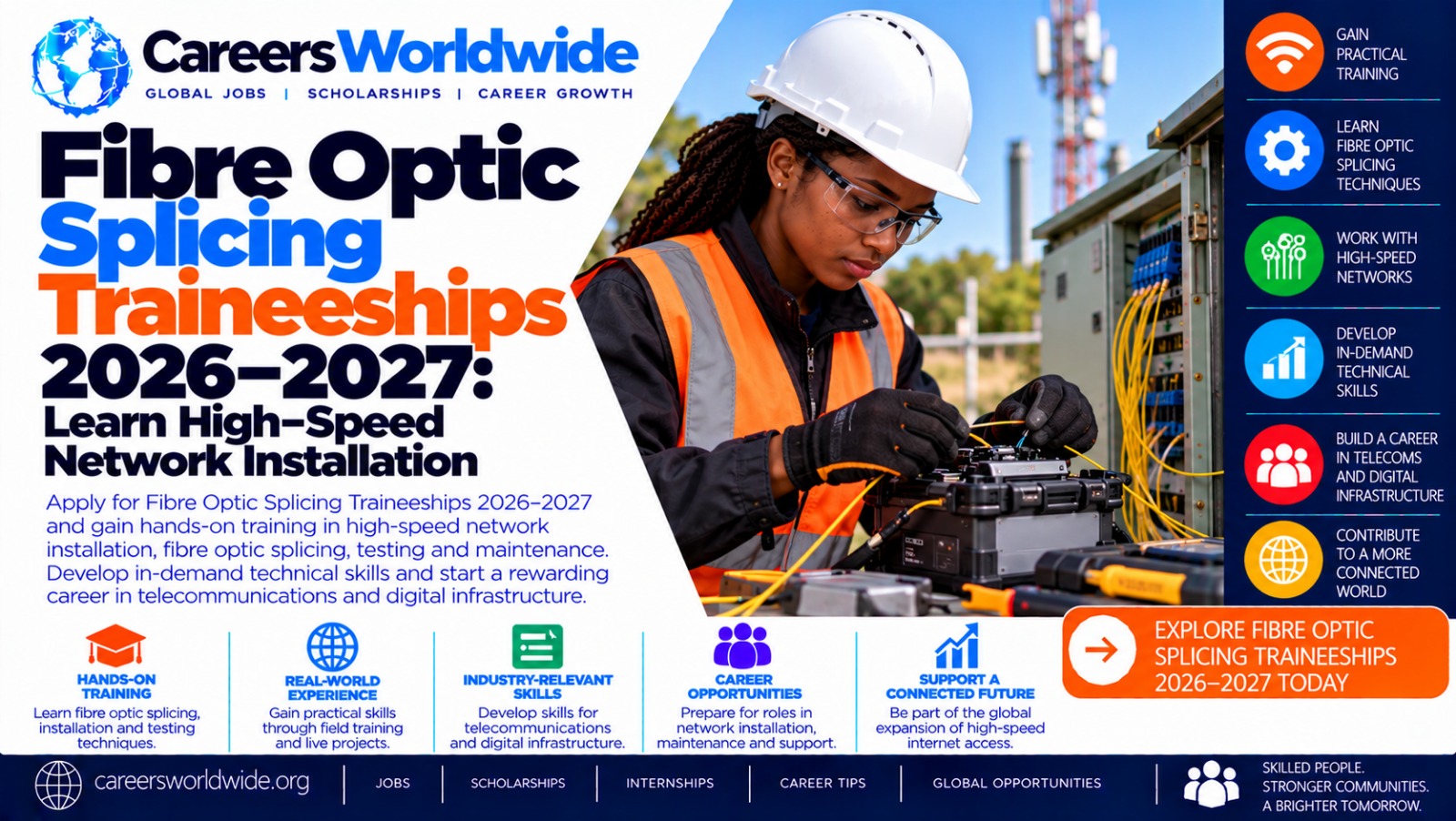

Excerpt: Fibre optic splicing traineeships for 2026–2027 offer an exciting career pathway for aspiring telecommunications technicians, school leavers and technical graduates who want to develop practical skills in high-speed network installation. As businesses, homes and institutions depend on reliable internet connectivity, trained fibre optic technicians play an important role in installing, maintaining and repairing modern communication networks. This comprehensive guide explains the skills trainees can learn, possible entry requirements, career opportunities, application preparation, and official resources to check for training and apprenticeship opportunities, particularly in Zimbabwe. It also explains how to identify legitimate programmes and prepare a competitive application without relying on unverified recruitment advertisements.
Fibre Optic Splicing Traineeships 2026–2027: An Opportunity to Build Technical Skills
Reliable internet connectivity has become essential for education, business, communication, healthcare and many other services. Behind the high-speed connections used every day are telecommunications networks that depend on properly installed and maintained fibre optic cables.
Fibre optic splicing traineeships can help aspiring technicians learn the practical skills required to work with these networks. Depending on the training provider, a programme may combine classroom instruction, workshop demonstrations, supervised fieldwork and experience with telecommunications equipment.
For the 2026–2027 period, applicants should understand an important distinction: a general fibre optic training opportunity is not automatically an advertised traineeship vacancy. Applicants should confirm whether a particular employer or institution has opened applications, what qualifications are required, and whether the programme includes paid employment, an apprenticeship, an industrial attachment or classroom-based training.
In Zimbabwe, prospective applicants can begin by exploring established apprenticeship and technical education resources, telecommunications-related courses, and opportunities announced by network operators and infrastructure companies.
The goal is to find a programme that offers structured learning, practical experience and credible evidence of the skills acquired.
What Is Fibre Optic Splicing?
Fibre optic splicing is the process of joining two optical fibres so that light signals can pass between them with minimal signal loss. These fibres are extremely thin strands of glass or other suitable optical material used to transmit information over long distances.
Technicians splice fibres when installing new network sections, repairing damaged cables, extending existing infrastructure or connecting customers to fibre-based broadband services.
Two common splicing methods are used in the industry.
Fusion splicing: This method uses specialised equipment to align and join fibre ends using heat. When correctly performed, it can produce a low-loss connection suitable for many telecommunications applications.
Mechanical splicing: This method uses a specialised alignment device to hold fibre ends together. It can be useful in particular installation and repair situations, depending on the network design and equipment requirements.
A trainee may also learn fibre preparation, cable handling, connectorisation, testing, fault identification and documentation. The precise curriculum depends on the provider and the type of network being installed.
Fibre optic technicians may work on fibre-to-the-home (FTTH) connections, business broadband installations, metropolitan networks, data centre links, telecommunications backbones and other optical communication systems.
What Do Fibre Optic Splicing Traineeships 2026–2027 Involve?
A traineeship is intended to help a learner move from theoretical knowledge towards practical competence. The structure varies by employer, training institution and qualification.
A well-designed programme may cover the following areas.
1. Fibre Optic Fundamentals
Trainees learn how optical signals travel through fibre cables and why fibre is used for high-capacity communications. Lessons may introduce single-mode and multimode fibre, attenuation, signal loss, connectors, cable types and basic network architecture.
Understanding these concepts helps technicians recognise the differences between installation environments and select appropriate methods under supervision.
2. Cable Preparation and Handling
Before a fibre can be spliced, technicians must prepare it correctly. Training may cover cable identification, safe handling, stripping protective layers, cleaning fibre ends and using suitable tools.
Precision is essential. Contamination, careless handling or incorrect preparation can affect the quality of a connection.
3. Fusion Splicing Equipment
A practical course may introduce fusion splicing machines, fibre cleavers, inspection tools and related accessories.
Trainees learn the importance of correct alignment, clean fibre ends, suitable equipment settings and quality checks. Beginners should practise under supervision rather than attempting work on live networks independently.
4. Fibre Testing and Fault Finding
Installation is not complete simply because cables have been connected. Technicians must verify that a link performs within the applicable requirements.
Training may introduce optical power meters, light sources, visual fault locators and optical time-domain reflectometers (OTDRs). Learners may practise identifying excessive loss, damaged sections, poor connections and other common problems.
5. Network Installation
Depending on the programme, learners may observe or assist with cable routing, duct installation, pole-mounted infrastructure, distribution points, customer premises equipment and fibre termination.
Fieldwork should follow the employer’s safety procedures, approved network plans and relevant local requirements.
6. Documentation and Customer Service
Technicians may need to record splice locations, test results, cable identifiers, network changes and installation completion details.
For customer-facing roles, clear communication, punctuality, respectful conduct and the ability to explain basic technical issues are also valuable skills.
Who Can Apply?
There is no single entry requirement for every fibre optic splicing traineeship. Employers and training institutions set their own criteria, so applicants should read the relevant advert or course information carefully.
Potential candidates may include:
- School leavers interested in practical technical careers.
- Holders of secondary-school qualifications, especially where mathematics, English and science are required.
- Students pursuing telecommunications, electrical engineering, electronics or information and communications technology.
- Graduates seeking industrial attachment or entry-level technical experience.
- Junior technicians who want to specialise in fibre optic installation and maintenance.
- Career changers with suitable technical aptitude who meet the provider’s admission requirements.
Some programmes may accept beginners, while others require a certificate, diploma, relevant work experience or previous technical training.
For example, Zimbabwe’s Higher Education Examinations Council (HEXCO) publishes information about apprenticeship training and technical trades, including telecommunications-related pathways. Its general apprenticeship entry information includes academic requirements, but applicants must confirm the requirements for the specific trade and intake.
A telecommunications diploma is another possible route. Trust Academy in Zimbabwe describes a telecommunications programme that includes networking, communication systems and fibre optic technology. Prospective students should contact the institution to verify the current course offering, fees, admission conditions and available intake dates.
Applicants should not assume that every telecommunications course is a dedicated fibre optic splicing traineeship or that enrolment guarantees employment.
Skills That Can Help You Stand Out
Technical knowledge is important, but employers also look for dependable trainees who can learn safely and work effectively with others.
Attention to detail: Fibre preparation, splice quality and test measurements require care and accuracy.
Problem-solving: Technicians need to investigate faults systematically rather than replace components without identifying the cause.
Basic mathematics: Measurements, distances, loss calculations and technical specifications often involve numerical reasoning.
Digital literacy: Technicians may use digital work orders, mapping systems, test-reporting software and electronic documentation.
Communication: Field teams coordinate with supervisors, engineers, customers and other installation workers.
Physical readiness: Some jobs involve outdoor work, ladders, confined work areas or travel between installation sites. Employers should explain the physical and safety requirements of the role.
Safety awareness: Fibre fragments can injure the eyes or skin, and installation sites may present electrical, traffic, working-at-height and underground utility hazards. Trainees must follow appropriate procedures and use required protective equipment.
Previous experience is helpful but is not always essential for entry-level training. Demonstrating a willingness to learn, following instructions and showing an interest in telecommunications can strengthen an application.
Career Opportunities After Training
Completing a suitable course or traineeship may support applications for several technical roles, depending on the qualification achieved and the employer’s requirements.
Possible pathways include:
- Fibre optic installation assistant.
- Junior fibre optic splicing technician.
- FTTH installation technician.
- Telecommunications field technician.
- Fibre testing and maintenance assistant.
- Network cabling technician.
- Broadband installation and support technician.
- Telecommunications maintenance technician.
With further training and relevant experience, some technicians progress into specialist testing, network maintenance, team supervision, project coordination or network planning.
Employment may be available through telecommunications operators, internet service providers, fibre infrastructure companies, contractors, engineering firms and organisations maintaining private communication networks.
However, completing a traineeship does not guarantee a job, a particular salary or immediate professional certification. Opportunities depend on local demand, technical competence, employer recruitment requirements and the recognition of the qualification.
Practical Guidance Before You Apply
Before committing money or time to a training programme, use the following checklist.
Confirm the programme type. Establish whether the opportunity is an apprenticeship, paid traineeship, unpaid industrial attachment, short course or full qualification.
Check the curriculum. Look for hands-on fibre preparation, splicing, testing, fault diagnosis, installation and safety training. A course that only discusses fibre optics theoretically may not provide enough practical experience for field work.
Ask about equipment access. Practical exposure to splicing machines, cleavers, test instruments and relevant tools can be valuable. Ask whether equipment is provided and whether practical sessions are included in the advertised fee.
Verify recognition. Ask which institution awards the qualification and whether the course or assessment is recognised by the relevant authority or employer. Do not confuse attendance certificates with occupational qualifications.
Understand the costs. Request written information about tuition, registration, tools, transport, accommodation, examination fees and protective equipment.
Check fieldwork arrangements. Find out whether learners receive supervised field experience, how placements are arranged and whether transport or other costs are covered.
Review the application deadline. For a 2026–2027 opportunity, use the closing date stated in the current official advert. Do not assume an older advertisement remains open.
Avoid unsupported promises. Be cautious of recruiters who promise guaranteed employment, ask for unexplained payments or refuse to identify the training provider or employer.
These checks help applicants compare programmes on their actual training value rather than relying on promotional claims alone.
Summary Table: Fibre Optic Splicing Traineeships 2026–2027
| Category | What applicants should know |
|---|---|
| Training focus | Fibre preparation, splicing, testing, installation and maintenance |
| Typical candidates | School leavers, technical students, graduates and aspiring technicians |
| Entry requirements | Vary by employer, institution and programme |
| Practical equipment | May include splicing machines, cleavers, power meters and OTDRs |
| Learning format | Classroom lessons, workshop practice, supervised fieldwork or a combination |
| Possible career paths | Fibre installer, junior splicer, FTTH technician and telecommunications field technician |
| Application documents | Commonly a CV, academic results, identification and relevant certificates |
| Fees and stipends | Must be confirmed with the provider or employer |
| Application period | Check the specific 2026 or 2027 intake announcement |
| Official starting points | HEXCO, relevant technical institutions and verified telecommunications employers |
| Employment guarantee | No guarantee unless the written programme terms explicitly provide one |
The information above is general career guidance, not confirmation of a single nationwide fibre optic splicing intake. Each vacancy and training provider must be checked independently.
How to Apply for Fibre Optic Splicing Traineeships 2026–2027
Applicants can follow these steps to identify suitable opportunities and prepare a professional application.
Step 1: Identify Suitable Training Providers and Employers
Begin with official technical education resources, telecommunications training institutions, internet service providers and fibre network contractors.
In Zimbabwe, HEXCO is a useful starting point for apprenticeship information and technical trade pathways. Training institutions offering telecommunications or networking courses may provide another route into the industry.
Check the official careers pages of employers operating in your area. Search for titles such as fibre optic trainee, telecommunications apprentice, FTTH installation assistant, network technician intern and junior splicing technician.
These are search terms, not confirmed vacancies.
Step 2: Read the Full Advertisement
Check the eligibility criteria, required qualifications, age restrictions where applicable, location, application method and deadline.
Confirm whether the organisation is recruiting trainees or selling a training course. A job advert and a course advertisement are not interchangeable.
If a notice is circulated through social media or a recruitment website, look for the same announcement on the employer’s official website or contact the organisation using independently verified contact details.
Step 3: Prepare Your Documents
A typical application package may include:
- An updated curriculum vitae (CV).
- Copies of relevant school certificates or examination results.
- Technical certificates or diplomas, where applicable.
- A copy of an identity document if requested.
- A concise application letter.
- Evidence of relevant projects, attachments or work experience, if available.
Follow the specific advert. Do not submit sensitive personal documents that have not been requested or send original certificates unless the official process specifically requires them.
Step 4: Write a Targeted Application Letter
Explain why you are interested in fibre optic installation, what qualifications you have and which skills you hope to develop.
If you are a beginner, highlight relevant mathematics, science, electrical, electronics, computer or networking studies. Mention practical projects, teamwork, punctuality and willingness to follow safety procedures.
Do not claim to have operated specialist equipment or completed field installations unless you genuinely have that experience.
Step 5: Submit Through the Official Channel
Use the application portal, verified email address or physical submission method specified by the organisation.
Check that attachments open correctly, your contact details are accurate and your documents match the stated requirements. Keep a copy of your application and any acknowledgement received.
Never pay an individual to guarantee selection or an interview. If a legitimate training programme charges fees, verify the amount directly with the institution and obtain official payment documentation.
Step 6: Prepare for an Interview or Assessment
Applicants may be asked about basic networking, electrical or optical concepts, their interest in telecommunications and how they would respond to a safety concern.
Review fibre optic fundamentals, cable handling, testing principles and the purpose of common installation tools. Practise explaining a technical concept clearly and honestly.
For a practical assessment, follow instructions carefully. Safety, methodical thinking and willingness to ask for help are more valuable than pretending to know a procedure you have never performed.
Step 7: Confirm the Offer Before Accepting
Before enrolling or starting work, request written confirmation of the programme duration, training location, supervision arrangements, fees or stipend, assessment method and qualification awarded.
If the opportunity includes employment, clarify the contract terms and whether completion leads to a separate recruitment process.
An authentic opportunity should provide enough information for you to understand what you are agreeing to.
Official Application Resources
The following resources are useful starting points for applicants, particularly those seeking opportunities in Zimbabwe. They are not all dedicated fibre optic traineeship vacancy pages, and their inclusion does not mean that a specific 2026–2027 position is currently open.
1. HEXCO — Apprenticeship Training
Website: https://hexco.zchpc.ac.zw/services/apprenticeship
HEXCO provides information about apprenticeship training, entry requirements and technical trades. Explore the relevant telecommunications or electrical pathways and contact the appropriate office to establish which trades are available for the intake you want.
2. HEXCO — Industrial Training and Trade Testing
Website: https://hexco.zchpc.ac.zw/committees/industrial-training
This resource explains aspects of trade testing and the documentation associated with occupational assessments. Check the applicable requirements before assuming that a short fibre optic course qualifies you for a particular trade test.
3. Trust Academy Zimbabwe — Telecommunications Diploma
Website: https://trustacademy.ac.zw/
Trust Academy describes telecommunications training covering communication systems, networking and fibre optic technology. Contact the institution through its current official channels to verify course availability, fees, practical components, admission requirements and industrial attachment arrangements.
A diploma programme may be a longer educational pathway rather than a short traineeship.
4. ICTZ — Learn ICT
Website: https://ictz.org.zw/learn/
ICTZ provides information about ICT learning resources, courses, workshops and training activities. Check whether any current offerings are relevant to networking or telecommunications skills.
5. ICT Association of Zimbabwe — School of Digital Technologies
Website: https://www.ictaz.org.zw/ieictsr
This organisation describes technology skills development and training initiatives. Contact it to ask about relevant current programmes or professional development opportunities.
6. Zimbabwe Youth Applications Portal
Website: https://youth.gov.zw/apply
The portal provides information about youth development, skills training and vocational training resources. It may help applicants explore broader technical education options, although a dedicated fibre optic vacancy must be confirmed separately.
7. Official Telecommunications Employer Careers Pages
Applicants can also check the official websites of telecommunications operators, internet service providers and fibre infrastructure contractors working in their region. Look for a careers or vacancies section and confirm any advertised position directly with the employer.
When using third-party recruitment sites, treat them as discovery tools rather than final proof that a vacancy is genuine. Verify the advert with the organisation responsible for the programme before submitting documents or making payments.
Frequently Asked Questions (FAQ)
1. Are fibre optic splicing traineeships open for 2026–2027?
Availability depends on the employer or training institution. The resources listed above provide places to begin searching, but they do not establish that a specific nationwide fibre optic splicing intake is open. Confirm the latest advert, closing date and eligibility requirements directly with the organisation.
2. Do I need previous experience to become a fibre optic splicing trainee?
Not necessarily. Some entry-level programmes are designed for beginners, while others require a technical qualification or relevant experience. Applicants should check the individual programme requirements and demonstrate their interest in practical telecommunications work.
3. What qualifications are usually useful?
Secondary-school qualifications, particularly mathematics, English and science where required, can provide a foundation. Certificates or diplomas in telecommunications, electronics, electrical engineering, networking or related technical subjects may be advantageous. The exact requirements vary.
4. How long does fibre optic training take?
There is no universal duration. A short course may cover selected skills over a limited period, while a structured apprenticeship or diploma may take considerably longer. Ask for the official programme schedule and distinguish classroom hours from supervised field experience.
5. Will trainees receive a salary or stipend?
Payment arrangements depend on the programme. Some employer-sponsored traineeships may offer compensation, while academic courses or industrial attachments may have different arrangements. Do not assume that a programme is paid unless the official advertisement or written offer confirms it.
6. Can I apply with only secondary-school qualifications?
You may qualify for some beginner-level opportunities, depending on their entry criteria. Other programmes may require a technical certificate, diploma or previous experience. If you do not yet meet the requirements for a specialist course, consider an introductory networking or telecommunications programme.
7. What equipment do fibre optic splicing technicians use?
Common equipment includes fusion splicers, fibre cleavers, stripping tools, cleaning supplies, optical power meters, light sources and OTDRs. The tools required depend on the task and network type. Trainees should learn their correct use under appropriate supervision.
8. Is fibre optic splicing a good career choice?
It can be a worthwhile technical career for people who enjoy practical problem-solving, careful work and telecommunications technology. Prospects depend on local infrastructure investment, employer demand, experience, qualifications and the ability to meet workplace safety and quality requirements.
9. Can I apply if I live outside Harare?
Potentially. Opportunities may be available in other towns and regions, but the location depends on the employer or institution. Check whether applications are accepted nationally, whether fieldwork is location-specific and whether relocation or transport costs are covered.
10. How can I avoid fake traineeship advertisements?
Verify vacancies on official employer or institutional websites, check that contact details are authentic, read the full conditions and be cautious of guaranteed-job claims. Do not pay unofficial recruiters to secure a position. If a training fee is required, confirm it directly with the provider and obtain an official receipt.
11. Does completing a short course make me a certified fibre optic technician?
Not automatically. A certificate may show course attendance or successful completion, but recognition depends on the awarding institution, assessment and applicable industry requirements. Ask what qualification is awarded and whether employers recognise it.
12. What should I do if I cannot find an open traineeship?
Build your foundation through relevant technical study, basic networking training and supervised practical experience. Monitor verified employer careers pages and official apprenticeship announcements. You can also prepare your CV in advance so you are ready when an appropriate vacancy becomes available.
How to Prepare Now for the 2026–2027 Intake
Applicants do not need to wait for a vacancy announcement before preparing.
Start by gathering your academic documents, updating your CV and identifying technical subjects or projects that demonstrate your interest in telecommunications. If possible, learn basic network concepts and familiarise yourself with fibre optic terminology through reputable educational resources.
Next, create a shortlist of training institutions and employers. Record each organisation’s official website, contact details, course or vacancy requirements and application deadlines. Check those sources regularly rather than relying exclusively on forwarded social media messages.
If you have limited technical experience, consider whether a recognised telecommunications, electronics, electrical or networking course would improve your eligibility. Compare course costs, duration and practical training before enrolling.
Above all, prioritise programmes that combine sound technical instruction with supervised practice, safety awareness and credible assessment. These features are more useful for long-term career development than an unsupported promise of a quick job.
Final Summary
Fibre optic splicing traineeships can provide a route into telecommunications for people interested in high-speed network installation, fibre testing and network maintenance. The 2026–2027 period is an opportunity to explore relevant training pathways, prepare application documents and monitor verified recruitment announcements.
In Zimbabwe, HEXCO, telecommunications training institutions, ICT development organisations and official employer careers pages are useful starting points. However, applicants must confirm whether a specific traineeship is open and whether it offers paid work, an attachment, formal training or an occupational qualification.
A strong applicant prepares carefully, checks programme legitimacy, develops relevant technical knowledge and understands the importance of precision and safety. With appropriate training and experience, fibre optic skills may support progression into a range of telecommunications and network infrastructure roles.
Disclaimer
This article is for general educational and career-information purposes only. It does not announce or guarantee an official Fibre Optic Splicing Traineeship 2026–2027 vacancy, employment offer, stipend, scholarship or admission place. Training availability, entry requirements, fees, deadlines and qualification recognition may change. Verify all information directly with the relevant employer, training institution or official authority before applying or making a payment. The inclusion of an organisation or website does not constitute an endorsement or guarantee of recruitment.
SEO Keywords
Fibre Optic Splicing Traineeships 2026–2027,
Fibre Optic Traineeships Zimbabwe,
Fibre Optic Splicing Training,
Fibre Optic Technician Jobs Zimbabwe,
Telecommunications Apprenticeships 2026,
Telecommunications Traineeships 2027,
Learn Fibre Optic Splicing,
High-Speed Network Installation Training,
Fibre Optic Technician Requirements,
Fibre Optic Installer Training,
FTTH Installation Training,
Fibre Optic Fusion Splicing Course,
Telecommunications Technical Training Zimbabwe,
Fibre Optic Apprenticeship Application,
Fibre Optic Splicing Career Opportunities,
HEXCO Apprenticeship Training Zimbabwe,
Telecommunications Diploma Zimbabwe,
Fibre Optic Network Installation,
Junior Fibre Optic Technician Vacancies,
Fibre Optic Testing and Maintenance,
Telecommunications Skills Development,
Fibre Optic Trainee Application Requirements,
Fibre Optic Training Institutions Zimbabwe,
How to Become a Fibre Optic Technician,
High-Speed Internet Infrastructure Careers,
ALSO CHECK: Beit Trust Postgraduate Scholarships 2027: Study Opportunities for Eligible Southern African StudentsOctober 17, 2026
DAAD In-Country/In-Region Scholarships 2027: Postgraduate Funding for Sub-Saharan African StudentsOctober 17, 2026
University of British Columbia International Scholars Program 2027: Scholarships for International StudentsOctober 17, 2026