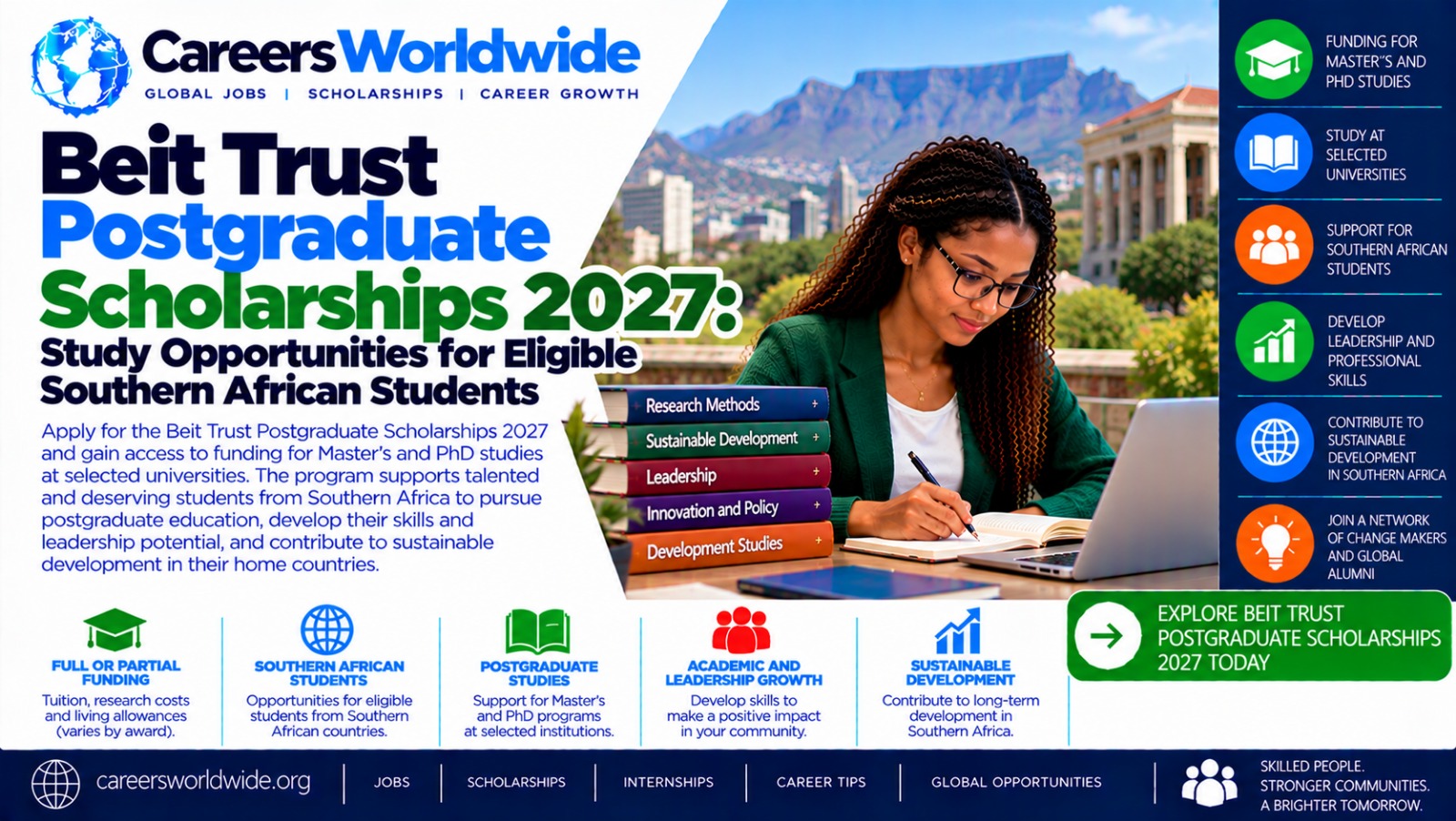

Excerpt: The Beit Trust Postgraduate Scholarships 2027 offer eligible graduates from Zimbabwe, Zambia and Malawi an opportunity to pursue postgraduate studies at selected universities in the United Kingdom and South Africa. The programme primarily supports Master’s-level education in development-focused disciplines and provides substantial financial assistance, including tuition fees, living allowances, return flights and eligible study-related expenses. Applications for the next scholarship round open on 1 December 2026 and close on 12 February 2027. Find out who qualifies, what the scholarship covers, which courses may be supported, how to apply and how to prepare a competitive application.
Beit Trust Postgraduate Scholarships 2027: Overview
The Beit Trust Postgraduate Scholarships are an opportunity for qualified Southern African graduates seeking advanced education and professional development. Through partnerships with selected universities in the United Kingdom and South Africa, the Trust supports postgraduate training intended to strengthen skills, leadership and development outcomes in eligible African countries.
According to the Trust’s official scholarship information, the next application round will support studies beginning in September 2027 at UK partner universities and January 2028 at South African partner universities. The application window opens on 1 December 2026 and closes on 12 February 2027. Applicants should submit their applications before the stated deadline because late applications cannot be processed.
The programme is particularly relevant to graduates who want to apply advanced knowledge to challenges affecting healthcare, engineering, education, agriculture, conservation and economic development.
Key scholarship details:
- Scholarship provider: The Beit Trust.
- Eligible countries: Zimbabwe, Zambia and Malawi.
- Study destinations: Selected universities in the United Kingdom and South Africa.
- Study level: Primarily postgraduate Master’s programmes.
- Application opening date: 1 December 2026.
- Application deadline: 12 February 2027.
- UK study commencement: September 2027.
- South African study commencement: January 2028.
- Application method: Online application through the official Beit Trust scholarship process.
- Funding: Tuition and academic fees, living allowance, eligible travel and visa-related expenses, and additional allowances, subject to the programme’s terms.
Applicants should consult the official Beit Trust scholarship page for the current list of partner universities, detailed eligibility criteria and application instructions.
1. About the Beit Trust Postgraduate Scholarship Programme
The Beit Trust is a charitable organisation that supports development through education and other initiatives in its countries of focus. Its postgraduate scholarship programme enables selected graduates to undertake advanced study at partner universities and develop expertise that can contribute to their home countries.
Unlike scholarships open to applicants from every country, the Beit Trust programme has a specific geographical focus. Eligibility is restricted to nationals of Zimbabwe, Zambia and Malawi who meet the Trust’s residency and return-home requirements.
The programme primarily supports taught Master’s degrees. It does not fund undergraduate degrees and does not ordinarily support applicants beginning PhD research. Extensions to doctoral study may be considered only in exceptional circumstances for outstanding existing Beit Scholars.
The Trust works with university partners to share the cost of educating scholars. This arrangement helps provide financial support for selected programmes while maintaining an emphasis on academic achievement, relevant experience, leadership and the potential to contribute to national development.
The scholarship is therefore not simply an opportunity to earn an international qualification. Candidates should demonstrate how their proposed education will help address practical challenges in their countries and how they intend to use their skills after graduation.
2. Who Is Eligible to Apply for the 2027 Scholarships?
Applicants must satisfy the Trust’s nationality, residency, academic and programme requirements. Meeting the minimum eligibility criteria does not guarantee an award, because the selection process is competitive.
Nationality and residency
The Trust accepts applications from eligible nationals of:
- Zimbabwe
- Zambia
- Malawi
Applicants must also meet the Trust’s permanent-residency requirements for one of these countries. They must live in, or intend to return to, their home country after completing their studies.
Applicants from other Southern African countries should not assume that regional residence alone makes them eligible. For example, a graduate who is a South African national does not qualify solely because they live in the region.
Academic qualifications
The programme is intended for graduates who can demonstrate that they are prepared for demanding postgraduate study.
The Trust gives preference to applicants holding a Distinction or Merit, generally equivalent to an upper-second-class undergraduate Honours degree. Applicants with lower classifications are not automatically excluded, but they may face stronger competition.
Applicants should check the admission requirements of their intended university and ensure that their qualifications meet the relevant academic standards.
Previous postgraduate qualifications
Candidates who already hold a postgraduate degree are generally not considered, except in exceptional circumstances. The programme aims to support people who have not yet had the opportunity to undertake postgraduate study.
Professional experience
Relevant professional experience is highly valued. As a guideline, at least three years of experience after completing an undergraduate degree, supported by a positive employer reference, can strengthen an application.
Three years is a guideline rather than an absolute rule. Applicants with less experience may still be considered, depending on their academic record and the overall strength of their application.
Professional experience is particularly useful when it demonstrates that the candidate understands the practical challenges in their field and can explain how further education would improve their contribution.
Leadership and community involvement
Applicants should provide evidence of leadership potential. This may include responsibilities at work, contributions to professional projects, academic leadership, community initiatives or sustained voluntary service.
Voluntary work can strengthen an application, but it does not automatically replace relevant professional experience.
Commitment to return home
A clear intention to return to the applicant’s home country and apply the acquired skills is an important consideration. Candidates should explain how their proposed qualification could support national development, improve professional practice or strengthen institutions and services.
Applicants who have already started the course for which they are seeking funding cannot be considered.
3. Which Courses and Fields of Study Are Supported?
The Beit Trust prioritises postgraduate education in fields with the potential to contribute to social and economic development.
Relevant disciplines include:
- Medicine and health: Clinical practice, healthcare delivery, public health and related areas, where supported by an eligible partner programme.
- Engineering: Engineering disciplines that address infrastructure, industry, technology and essential services.
- Education: Specialist training that can strengthen educational practice, systems and institutions.
- Economic growth: Fields that support productivity, development planning and economic capacity.
- Agriculture: Advanced knowledge that can improve agricultural production, food security and rural livelihoods.
- Conservation: Expertise that supports biodiversity, natural-resource management and environmental protection.
These examples are not an exhaustive list of every eligible course. Applicants must confirm that their proposed degree is offered by an approved partner university and meets the Trust’s requirements.
The programme generally supports a one-year taught MSc in the UK, a two-year taught MSc in South Africa, and certain four-year Master of Medicine programmes in South Africa. The Trust indicates that MMed awards are limited, making this route particularly competitive.
All supported programmes include a research component, and applicants should check the detailed course specifications before applying.
Important restrictions: The Trust does not fund MBA programmes. It also does not generally provide funding for undergraduate qualifications or applicants starting PhD research.
Some university partnerships have subject-specific restrictions. For example, the Trust’s official guidance identifies computer science at the University of St Andrews and engineering disciplines at the University of Strathclyde as restricted to those respective fields. Always check the latest partner-university list before choosing a course.
4. What Does the Beit Trust Scholarship Cover?
The scholarship provides substantial financial support for successful candidates undertaking approved postgraduate study.
According to the Trust’s official guidance, the package includes:
- Tuition and academic fees: Eligible fees are paid directly to the university.
- Living allowance: Financial assistance towards living costs during the supported period.
- Return air travel: Economy-class flights to and from the study destination.
- UK visa-related expenses: Eligible visa costs and the UK Immigration Health Surcharge.
- Medical and administrative costs: Eligible tuberculosis testing and biometric expenses associated with the UK route.
- Additional allowances: Approved arrival, laptop and departure allowances.
The precise arrangements depend on the scholarship terms and the study destination. Applicants should review the official conditions rather than assume that every personal expense will be reimbursed.
The Trust does not provide support for spouses or dependants. Candidates who plan to relocate with family members should therefore prepare a realistic budget for expenses outside the scholarship package.
Although the award is commonly described as fully funded, applicants should understand what is included, what is subject to approval and what they would need to pay themselves.
5. Summary Table: Beit Trust Scholarships 2027
| Feature | Details |
|---|---|
| Scholarship provider | The Beit Trust |
| Eligible nationalities | Zimbabwean, Zambian and Malawian |
| Required residency | Must meet the Trust’s permanent-residency conditions |
| Study destinations | Selected UK and South African partner universities |
| Main qualification | Master’s degree |
| Supported UK programmes | Generally one-year taught MSc |
| Supported South African programmes | Generally two-year taught MSc; certain four-year MMed programmes |
| Fields | Health, engineering, education, economic growth, agriculture, conservation and other eligible development disciplines |
| Applications open | 1 December 2026 |
| Applications close | 12 February 2027 |
| UK academic intake | September 2027 |
| South African academic intake | January 2028 |
| Main funding components | Tuition, living allowance, eligible travel, visa-related costs and additional allowances |
| UK university offer | Required before submitting the Beit Trust application |
| South African university offer | May not be required at the initial scholarship application stage |
| MBA programmes | Not supported |
| Undergraduate degrees | Not supported |
| Initial PhD research | Not ordinarily supported |
| Official application route | Beit Trust Scholarships |
Dates, course availability and award conditions should be verified against the official scholarship information before an application is submitted.
6. How to Prepare a Competitive Scholarship Application
Because the programme is competitive, applicants should prepare more than the minimum documentation. A strong application connects academic ability, professional experience, leadership and a credible plan for contributing to the applicant’s country.
Choose a relevant course
Start by identifying the development challenge you want to address. This could involve improving healthcare services, strengthening infrastructure, developing agricultural systems, improving education or advancing conservation.
Then identify a Master’s programme that provides the specialist knowledge needed to tackle that challenge.
Avoid choosing a course solely because the university is prestigious. Explain why its curriculum, research component and practical training are appropriate for your professional objectives.
Build a clear professional case
Applicants should be able to explain how their previous education and work experience have prepared them for postgraduate study.
Use specific examples of responsibilities, projects, achievements and problems you have helped solve. Where possible, explain the results of your work rather than listing duties alone.
If your academic classification is below the preferred level, relevant experience, strong references and a convincing professional record may help provide a fuller picture of your potential. They do not, however, guarantee selection.
Demonstrate leadership potential
Leadership is not limited to senior management positions. It may be demonstrated through mentoring colleagues, coordinating projects, improving a process, contributing to community programmes or taking responsibility for a challenging assignment.
Describe what you did, why it mattered and what changed as a result.
Prepare a focused personal statement
The Beit Trust requests a personal statement of no more than 300 words explaining how the proposed studies will benefit the applicant’s country.
Keep the statement concise and focused on development impact. Explain why the discipline matters, what knowledge you expect to gain and how you intend to apply it after graduation.
A useful structure is:
- Identify a specific professional or national development challenge.
- Explain how the proposed degree will equip you to address it.
- Describe how you intend to use the acquired skills in your home country.
Avoid vague promises such as wanting to make a difference without explaining how. A credible, specific plan is more persuasive than unsupported claims about future impact.
Select appropriate referees
The application requires academic and character references, as well as an employer reference where applicable.
Choose people who know your work or character sufficiently well to provide concrete examples of your abilities, reliability, achievements and leadership potential. Give them adequate notice and explain the programme and your proposed course.
Check every document
Before submission, confirm that names, dates, degree titles and course details match across your documents. Use clear scans and ensure that files are readable.
The official process requires applicants to upload all documents in one sitting. The application form cannot be saved and completed later, so preparation is especially important.
7. How to Apply for the Beit Trust Postgraduate Scholarships 2027
The application process differs slightly depending on whether you intend to study at a UK partner university or a South African partner university. Applicants should follow the official instructions for their preferred study destination.
Step 1: Review the official scholarship requirements
Visit the Beit Trust Scholarships page and read the eligibility criteria, selection priorities, partner-university list and application instructions.
Confirm that your nationality, residency, academic background and intended course meet the requirements before spending time on the application.
Step 2: Identify suitable partner universities
Choose one or more universities from the Trust’s approved list. Confirm that the proposed degree is eligible and that you satisfy the university’s admission requirements.
Applicants may include up to four degree courses at UK and/or South African partner universities in a single Beit Trust application.
Applying to multiple suitable partner universities may improve your opportunities, although it does not guarantee an award.
Step 3: Apply to UK universities where relevant
Applicants seeking UK study must apply directly to their selected partner universities and obtain an offer before submitting the Beit Trust scholarship application.
Inform the university that you are also seeking Beit Trust funding. Conditional offers are acceptable under the Trust’s guidance.
The university application and the scholarship application are separate processes. Admission to a university does not automatically result in scholarship funding.
Step 4: Follow the South African application route
Applicants proposing study at South African partner universities may submit their scholarship applications before receiving a confirmed university offer because the university application cycles open later.
At the scholarship application stage, provide a PDF list of the South African universities and courses you intend to apply to in the section where university offers would otherwise be requested.
If you receive a scholarship, you must subsequently apply to the relevant South African university. If you do not secure university admission, the scholarship will be withdrawn.
Step 5: Complete the online scholarship form
Use the official application link provided on the Beit Trust website when applications open on 1 December 2026.
Submit one scholarship application. If you are applying to both UK and South African partner universities, the Trust instructs applicants to wait until they have received their UK offer or offers before adding their South African options and submitting the combined application.
Follow the form’s instructions carefully and check that every required field is completed correctly.
Step 6: Upload all required documents
Prepare the documents in advance. The Trust lists the following supporting materials:
- Offer letter or letters from UK partner universities, and/or a PDF list of intended South African university courses, as applicable.
- Degree certificates and academic transcripts.
- Additional academic certificates, awards, prizes or evidence of achievement.
- An up-to-date curriculum vitae.
- A personal statement of no more than 300 words.
- A clear, recent photograph that is not a passport photograph.
- A copy of a valid passport showing the issue and expiry dates and sufficient blank pages.
- Details and arrangements for three references: academic, character and employer, where applicable.
Check the live application form for any updated instructions or additional requirements.
Step 7: Arrange references
After submitting your application, you will receive a reference link that you can send to your referees.
If a referee cannot use the link, the Trust provides downloadable reference forms. Completed forms should be emailed directly to scholarships@beittrust.org.uk.
Contact your referees early and allow enough time for them to prepare their submissions. Follow the Trust’s latest guidance regarding reference deadlines.
Step 8: Submit before the deadline
The scholarship application window closes on 12 February 2027. The Trust states that applications received after the deadline cannot be processed.
Do not leave document uploads until the final day. Because the application cannot be saved and resumed later, complete your preparation first, review your files and allow time to address technical difficulties.
Keep a record of your submission and monitor the email address used in your application for any correspondence from the Trust.
8. Important Dates and What Applicants Should Do Now
Applicants can use the period before applications open to strengthen their academic and professional profiles and prepare their documents.
October–November 2026: Preparation period
- Review the official eligibility criteria and partner-university list.
- Identify suitable courses and confirm their admission requirements.
- Prepare academic transcripts, degree certificates, passport documentation and a CV.
- Contact potential referees.
- Draft and refine the 300-word personal statement.
- Begin university applications where required.
1 December 2026: Applications open
Access the official online application and follow the instructions for your chosen study destination.
December 2026–January 2027: Application preparation and submission
Confirm that all supporting documents are ready, follow the appropriate university-offer procedure and coordinate with your referees.
12 February 2027: Application deadline
Submit the completed scholarship application before the closing date. Do not assume that a partially completed form or an application submitted after the deadline will be accepted.
April 2027: Expected interview period
The Trust states that interviews usually take place in April. Shortlisted candidates are generally invited approximately two weeks before the scheduled interview.
Interviews are essential and are held in person in Lusaka, Harare and Blantyre. Being interviewed does not guarantee that a scholarship will be awarded.
September 2027 and January 2028: Expected study commencement
The relevant academic year is expected to begin in September 2027 for UK partner universities and January 2028 for South African partner universities.
Applicants should verify all dates against the Trust’s official information and any correspondence they receive.
9. Frequently Asked Questions (FAQs)
1. Are the Beit Trust Postgraduate Scholarships 2027 fully funded?
The scholarship provides substantial financial assistance, including tuition and academic fees, a living allowance, economy-class return flights and eligible additional expenses. UK visa-related costs, the Immigration Health Surcharge, tuberculosis testing and biometric costs are also included under the Trust’s stated provisions. Applicants should review the official terms for details and exclusions.
2. Which countries are eligible?
The programme is restricted to eligible nationals of Zimbabwe, Zambia and Malawi who meet the Trust’s residency requirements. Applicants must also live in, or intend to return to, their home country after their studies.
3. Can I apply if I have a lower-second-class degree?
Applicants with a lower-second-class degree or a credit/pass qualification are not automatically excluded. However, competition is strong, and the Trust generally prefers applicants with a Distinction or Merit, equivalent to an upper-second-class Honours degree. Relevant professional experience, references and the overall strength of the application can also be important.
4. Is three years of work experience compulsory?
No. The Trust describes at least three years of relevant professional experience as a guideline rather than an absolute requirement. The amount and relevance of experience considered appropriate will depend on the merits of the application. Strong academic performance is particularly important for candidates with limited professional experience.
5. Can I apply without a university offer?
The requirements differ by destination. Applicants to UK partner universities must obtain an offer before submitting their Beit Trust application. Applicants for South African partner universities may apply without a confirmed offer, provided they submit the required list of intended universities and courses. They must subsequently obtain university admission if awarded funding.
6. Can I apply for a PhD?
The Trust does not ordinarily fund applicants beginning PhD research. Its primary focus is on Master’s-level study. Extensions to doctoral level may be considered only in exceptional cases for existing Beit Scholars of outstanding merit.
7. Are MBA programmes eligible?
No. The Trust states that it does not support MBA programmes. Applicants should identify an eligible alternative that aligns with the approved partner-university and course requirements.
8. Can I apply to more than one university?
Yes. Applicants may include up to four degree courses at approved UK and/or South African partner universities in one application. The Trust recommends applying to more than one partner university where appropriate, as this may improve the chances of finding a suitable placement.
9. Can I apply if I have already started my Master’s degree?
No. The Trust cannot consider applicants who have already begun the course for which they seek funding. Applicants should plan their university and scholarship applications accordingly.
10. Are spouses and dependants covered?
No. The Trust does not provide financial support for spouses or dependants. Applicants relocating with family should make independent arrangements for any additional expenses.
11. When will interviews take place?
Interviews usually take place in April, with shortlisted applicants generally receiving invitations around two weeks beforehand. Interviews are held in person in Lusaka, Harare and Blantyre. Applicants should monitor their email for official communication.
12. Where can I find the application form?
The official scholarship information and application link are available through the Beit Trust Scholarships website. The application window opens on 1 December 2026 and closes on 12 February 2027.
10. Official Application Resources and Contact Details
Applicants should rely on official sources when confirming eligibility, funding conditions, university partnerships and application deadlines.
1. Beit Trust official scholarship page
This is the main source for eligibility requirements, selection criteria, approved universities, application instructions, required documents and the online application link.
Website: https://beittrust.org.uk/beit-trust-scholarships/
2. Beit Trust contact page
Use the official contact page to verify contact information or direct general enquiries to the appropriate office.
Website: https://beittrust.org.uk/contact-beit-trust/
3. Scholarship enquiries
Email: scholarships@beittrust.org.uk
Applicants can contact the Trust for clarification about eligibility, course selection, references or application procedures. Include enough information in your enquiry to explain your question, but do not send sensitive personal documents unless requested through an appropriate official process.
4. University partner websites
After identifying an eligible partner university, visit its official website to confirm course availability, entry requirements, admission deadlines and any programme-specific conditions.
For UK applicants, university admission must be secured before submitting the Beit Trust scholarship application. For South African applicants, follow the alternative procedure explained in the Trust’s official guidance.
Application reminder: The next scholarship application window opens on 1 December 2026 and closes on 12 February 2027. Applicants should verify that they are using the official Beit Trust application link rather than an unofficial website requesting payment or personal information.
11. Practical Final Checklist for Applicants
Before submitting your application, work through the following checklist:
- Confirm that you are an eligible national and permanent resident of Zimbabwe, Zambia or Malawi.
- Check that you have not already started the course for which you are seeking funding.
- Verify that your intended programme and university are eligible.
- Confirm the university-offer requirements for your study destination.
- Prepare your degree certificates and transcripts.
- Update your CV with relevant employment, achievements and leadership responsibilities.
- Write a focused personal statement of no more than 300 words.
- Arrange your academic, character and employer references, where applicable.
- Prepare a clear recent photograph and a valid passport copy.
- Check that all documents are legible and correctly labelled.
- Complete the online application in one sitting.
- Submit before 12 February 2027 and monitor your email for updates.
12. Conclusion: An Opportunity to Develop Skills and Serve Southern Africa
The Beit Trust Postgraduate Scholarships 2027 offer an important opportunity for eligible graduates from Zimbabwe, Zambia and Malawi to pursue advanced education at selected universities in the United Kingdom and South Africa.
The programme’s emphasis on academic ability, professional experience, leadership and national development makes it especially relevant to candidates who can demonstrate how their proposed qualifications will contribute to their home countries.
Successful applicants may receive support for tuition, living costs, return travel and other eligible expenses, subject to the Trust’s conditions. However, eligibility alone does not guarantee selection, and applicants should take time to prepare a complete, well-supported application.
With the application window opening on 1 December 2026 and closing on 12 February 2027, prospective candidates should begin reviewing partner universities, preparing their documents and contacting referees well in advance.
For the most accurate information and the official application link, visit The Beit Trust’s scholarship website and follow the current instructions.
Disclaimer
This article is intended for general informational and educational purposes. Scholarship requirements, eligible courses, partner universities, funding arrangements and application dates may change. The Beit Trust is the authoritative source for all official scholarship information and application decisions.
Applicants are responsible for checking the latest eligibility criteria, university admission requirements, required documents and deadlines before applying. Publication of this article does not imply endorsement by the Beit Trust or guarantee admission, an interview or a scholarship award.
SEO Keywords
Beit Trust Postgraduate Scholarships 2027,
Beit Trust Scholarship 2027,
Beit Trust scholarships application,
Beit Trust scholarship eligibility,
fully funded scholarships for Zimbabweans 2027,
fully funded scholarships for Zambians 2027,
fully funded scholarships for Malawians 2027,
Southern African postgraduate scholarships,
Master’s scholarships in the UK for African students,
South Africa postgraduate scholarships for Southern Africans,
Beit Trust scholarship deadline 2027,
Beit Trust scholarship application process,
Beit Trust scholarship requirements,
Beit Trust scholarship official website,
postgraduate scholarships for African graduates,
international Master’s scholarships 2027,
fully funded Master’s scholarships Africa,
scholarships for Zimbabwean graduates,
scholarships for Zambian graduates,
scholarships for Malawian graduates,
Beit Trust UK university scholarships,
Beit Trust South Africa university scholarships,
development-focused postgraduate scholarships,
scholarships for engineering students in Africa,
scholarships for medical graduates in Southern Africa,
agriculture scholarships for African students,
conservation scholarships for African students,
education scholarships for Southern African students,
Beit Trust personal statement tips,
how to apply for Beit Trust scholarships,
Beit Trust scholarship 12 February 2027 deadline,
ALSO CHECK: Remote Audiobook Production Coordinator Jobs 2026–2027: Manage Recording and Publishing WorkflowsOctober 16, 2026
Remote Video Content Quality Reviewer Jobs 2026–2027: Check Digital Media StandardsOctober 16, 2026
Remote Digital Rights Coordinator Jobs 2026–2027: Track Content Permissions and UsageOctober 16, 2026