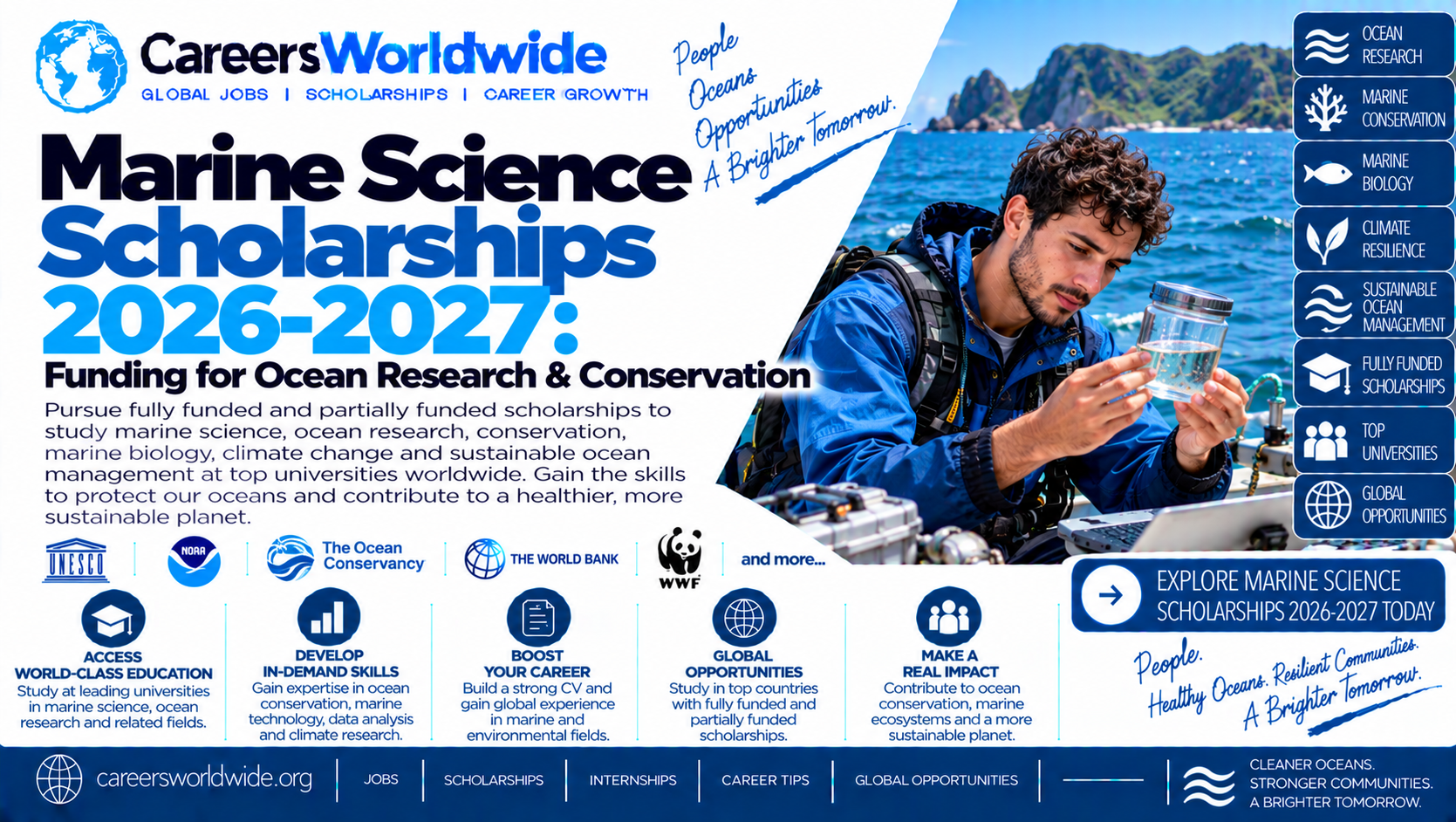

Excerpt: Marine Science Scholarships 2026–2027 can help students study marine biology, oceanography, fisheries science, marine conservation, coastal management and Antarctic research. This guide highlights current and upcoming scholarships, international funding routes and practical strategies for students preparing for careers in ocean research and conservation.
The world’s oceans cover more than two-thirds of the planet and support biodiversity, food systems, coastal communities, transportation, climate regulation and economic activity.
At the same time, marine ecosystems face increasing pressure from climate change, pollution, overfishing, habitat degradation, biodiversity loss and rising ocean temperatures.
These challenges have created demand for scientists and professionals with expertise in marine biology, oceanography, fisheries, marine conservation, coastal management and climate science.
For students interested in these fields, scholarships can make advanced education more accessible.
Marine Science Scholarships 2026–2027 are available through universities, government agencies, international programmes, research organizations and conservation institutions. Some opportunities are specifically designed for marine science, while others support related disciplines such as fisheries, environmental science, oceanography and natural-resource management.
This guide explains where students can look for funding, which current opportunities are worth monitoring, what scholarships may cover and how to prepare a competitive application.
Why Study Marine Science in 2026–2027?
Marine science is a multidisciplinary field.
Depending on the programme, students may study:
- Marine biology
- Oceanography
- Fisheries science
- Marine ecology
- Conservation biology
- Coastal management
- Climate science
- Aquaculture
- Marine chemistry
- Marine geology
- Ocean modelling
- Remote sensing
- Marine policy
- Environmental economics
- Antarctic science
Modern marine research increasingly combines traditional fieldwork with sophisticated technologies.
Scientists may use satellite observations, autonomous underwater vehicles, geographic information systems, genetic analysis, statistical modelling and artificial intelligence to understand marine ecosystems.
Marine science is also closely connected with climate resilience.
Students can work on questions such as:
- How are warming oceans affecting marine species?
- How can fisheries become more sustainable?
- How can coral reefs and coastal ecosystems be protected?
- How can plastic and other pollution be reduced?
- How can marine biodiversity be monitored?
- How can coastal communities adapt to climate change?
The European Commission’s Study in Europe portal identifies marine and water systems programmes as preparation for careers in environmental research, coastal engineering and climate adaptation.
Marine Science Scholarships 2026–2027: Summary Table
| Scholarship / Funding Route | Field | Funding | Eligibility | Status / Deadline |
|---|---|---|---|---|
| Clough Scholarship for Excellence in Marine Science | Marine science & conservation | $35,000 one-off | International & domestic PhD students in Australia | Closes Oct. 9, 2026 |
| IMAS Environmental Excellence AMSA Scholarship | Marine & Antarctic Science | $10,000 | Students entering/continuing relevant master’s study | Closes Jan. 8, 2027 |
| IMAS Honours & Masters Scholarship | Marine & Antarctic Science | $2,000 | Eligible 2027 Honours/Masters research students | Closes Feb. 26, 2027 |
| Fisheries New Zealand Masters Scholarship | Quantitative fisheries science | NZ$20,000/year up to 2 years | New Zealand citizens/residents | 2027 cycle |
| Fisheries New Zealand Undergraduate Scholarship | Quantitative marine biology | NZ$5,000 | Eligible NZ students | 2027 cycle |
| DFFE Oceans & Coasts Bursary | Marine biology, oceanography & coastal fields | Government bursary | Eligible South African students | 2027 opportunities advertised |
| Erasmus Mundus Marine & Water Programmes | Marine systems & environmental science | Full scholarships on selected programmes | Students worldwide | Many calls Oct.–Jan. |
| Marine Stewardship Council Student Research Grants | Fisheries research | Grant funding varies | Postgraduate students | 2026/27 round open |
Funding values, eligibility and deadlines can change. Applicants should confirm the latest requirements on the official provider’s website.
1. Clough Scholarship for Excellence in Marine Science
One of the most relevant current opportunities is the Clough Scholarship for Excellence in Marine Science at Edith Cowan University in Australia.
The scholarship supports outstanding PhD researchers working in marine science and marine conservation.
For 2026, the scholarship is open to domestic and international postgraduate research students and provides a one-off payment of $35,000. The application deadline is October 9, 2026.
Applicants must:
- Be enrolled full-time in a PhD at an Australian university
- Have passed confirmation of candidature
- Hold existing base PhD funding, such as an RTP scholarship or equivalent
- Be conducting research aligned with the scholarship’s priority themes
The scholarship focuses on two broad research areas:
Marine Conservation & Biodiversity
Research may involve:
- Habitat restoration
- Biodiversity protection
- Iconic species
- Ecosystem resilience
Marine Science Research
This includes:
- Scientific discovery
- Knowledge development
- Emerging tools
- New marine research technologies
An important point is that the Clough Scholarship is supplementary funding.
It does not replace the student’s existing PhD funding.
For international students already enrolled in an Australian PhD, this can therefore be a significant additional source of research support.
2. University of Tasmania IMAS Environmental Excellence AMSA Scholarship
The University of Tasmania’s Institute for Marine and Antarctic Studies offers several opportunities for students interested in marine and Antarctic science.
The IMAS Environmental Excellence AMSA Scholarship is available to students commencing the first or second year of the Master of Marine and Antarctic Science in Semester 1, 2027.
The scholarship is valued at A$10,000 for one year.
The current application period opened August 28, 2026, and closes January 8, 2027.
The scholarship is supported by the Australian Maritime Safety Authority and is connected with themes such as:
- Marine environmental protection
- Climate change
- Marine stewardship
- Seafood production
- Maritime safety
Selection considers academic merit and the applicant’s career aspirations, particularly where those aspirations align with the organization’s mission.
The scholarship can therefore be relevant to students who want to combine marine science with practical environmental and maritime applications.
3. University of Tasmania Marine & Antarctic Science Honours and Masters Scholarship
Another current University of Tasmania opportunity is the Marine and Antarctic Studies Honours & Masters Scholarship.
The award is designed for students commencing a one-year Honours programme or undertaking the research year of the Master of Marine and Antarctic Science in 2027.
The scholarship provides A$2,000 for one year.
The current application window opened August 28, 2026, with a closing date of February 26, 2027.
Applicants can come from academic backgrounds such as:
- Fisheries science
- Aquaculture
- Marine science
- Marine environment
- Marine biology
- Governance
- Related disciplines
Students must meet the academic requirements specified by the university.
The scholarship is particularly relevant for students who want research training in marine and Antarctic science rather than a purely coursework-based degree.
4. Fisheries New Zealand Masters Scholarships
Marine science students interested in fisheries modelling and quantitative research should also investigate the Fisheries New Zealand Scholarships.
The 2027 master’s scholarship provides NZ$20,000 per year for up to two years.
The programme is aimed at students undertaking quantitative marine science, particularly:
- Stock assessment modelling
- Ecosystem modelling
- Quantitative fisheries science
Applicants are encouraged to have backgrounds in:
- Mathematics
- Statistics
- Computing
- Biology
- Marine biology
The official programme states that applicants with strong quantitative or programming skills combined with marine biology are particularly relevant.
However, there is an important eligibility restriction.
Applicants must be New Zealand citizens or permanent residents and must undertake full-time study in New Zealand.
The 2027 application period is listed as September 15 to October 31, 2026.
This scholarship demonstrates how marine science is increasingly connected with quantitative data skills.
5. Fisheries New Zealand Undergraduate Scholarships
Fisheries New Zealand also offers undergraduate scholarships in quantitative marine biology.
The 2027 award is worth NZ$5,000 for the final year of undergraduate study.
The scholarship is aimed at students interested in combining marine biology with:
- Mathematics
- Computing
- Statistics
Applicants need to satisfy specific coursework requirements involving mathematics, statistics or computer programming and marine biology.
Again, this opportunity is restricted to New Zealand citizens or permanent residents.
For students eligible to apply, however, it demonstrates the value of combining marine biology with quantitative disciplines.
6. South Africa DFFE Oceans and Coasts Bursaries
Students in Africa should not overlook national government funding.
South Africa’s Department of Forestry, Fisheries and the Environment (DFFE) lists fields under its Oceans and Coasts programme that cover a wide range of marine and coastal disciplines.
The listed fields include:
- Marine biology
- Conservation biology
- Environmental science
- Oceanography
- Aquaculture
- Fisheries
- Coastal engineering
- Coastal dynamics
- Climate change
- Marine and coastal policy
- Natural-resource economics
- Marine spatial planning
- Environmental management
- Marine ecology
- Chemistry related to marine pollution
The department also lists research areas ranging from physical and chemical oceanography to biodiversity, fisheries and coastal adaptation.
DFFE stated in August 2026 that bursaries for the 2027 academic year were expected to be advertised between September and October 2026.
This makes the DFFE bursary page particularly important for South African students searching for 2027 marine science funding.
Applicants should check the official advertisement carefully because eligibility can be tied to South African citizenship, academic level and specific fields.
7. Erasmus Mundus Marine Science Programmes
International students should also explore Erasmus Mundus Joint Masters.
Erasmus Mundus is not one single marine scholarship.
Instead, it is a framework supporting joint master’s programmes across participating institutions.
The official Erasmus+ website states that students from around the world can apply to Erasmus Mundus Joint Masters and that selected programmes offer full scholarships to highly ranked students.
Scholarships can contribute toward:
- Participation costs
- Travel
- Visa costs
- Living expenses
The European Commission specifically highlights several marine and water-system programmes, including:
- IMBRSea — International Master in Marine Biological Resources
- MER 2030 — European MSc in Marine Environment and Resources
- COASTHazar — Coastal hazards and climate adaptation
- GroundwatCH
- Flood Risk Management
The European Education Area notes that marine and water programmes can provide training involving oceanographic infrastructure, multidisciplinary environmental analysis, fieldwork and research networks.
Erasmus Mundus applications commonly take place between October and January for programmes beginning the following academic year, although individual master’s programmes set their own deadlines.
For students targeting 2027 entry, autumn 2026 is therefore an important time to research programmes.
8. IMBRSea — International Master in Marine Biological Resources
IMBRSea is particularly relevant to students interested in marine biological resources.
The programme brings together multiple European universities and provides multidisciplinary training in marine biological resources.
Potential areas include:
- Marine biodiversity
- Fisheries
- Marine ecosystems
- Conservation
- Marine resource management
- Aquaculture
- Environmental assessment
However, applicants should carefully check the funding status for each intake.
The programme’s current funding information states that Erasmus Mundus scholarships are not available for the 2026–2027 academic year.
This is an important example of why applicants should not assume that a programme’s historical scholarship availability continues every year.
Students interested in IMBRSea should monitor the official programme website for future scholarship calls.
9. MER 2030 — European MSc in Marine Environment and Resources
Another marine-focused international master’s is MER 2030.
The programme provides multidisciplinary education in marine environment and resources and involves study across participating European universities.
However, the 2026–2028 intake was available only to self-funded students.
The official application page states that Erasmus Mundus student scholarships were not available for that intake because the programme’s new funding decision had not been secured in time for the 2026 start.
Students should therefore distinguish between:
Marine master’s programme
and
Marine master’s programme with an active Erasmus Mundus scholarship call.
They are not necessarily the same thing.
For future cycles, applicants should monitor the official MER Consortium website for updated scholarship announcements.
10. Marine Stewardship Council Student Research Grants
Marine science funding does not always come in the form of university tuition scholarships.
The Marine Stewardship Council (MSC) offers Student Research Grants supporting postgraduate research connected with fisheries working toward or engaged with the MSC Fisheries Standard.
The organization states that its 2026/27 grant round is open.
Previous grants have supported research in countries including:
- South Africa
- Mexico
- Suriname
Past research projects have covered topics such as:
- Marine mammal interactions
- Fish population research
- Species identification
- Fisheries impacts
- Sustainable fisheries management
This type of grant can be especially useful for postgraduate students who already have university funding but need additional support for a research project.
Students should review the current eligibility requirements and available funding categories before applying.
What Do Marine Science Scholarships Cover?
Scholarship funding varies significantly.
Some awards cover tuition.
Others provide research funding, living support or a one-time payment.
Possible benefits include:
Tuition fees
Some university or government scholarships cover part or all of tuition.
Living allowance
International scholarships may provide regular financial support.
Research expenses
Research grants can support:
- Fieldwork
- Laboratory work
- Equipment
- Data collection
- Travel
Travel
Some international scholarships provide travel allowances.
Accommodation
Certain scholarships provide accommodation or an allowance.
Research project support
Specialized marine research grants may support a specific thesis or field project.
Students should always check whether a scholarship is:
- Fully funded
- Partially funded
- Tuition-only
- Research-only
- Supplementary to existing funding
The Clough Scholarship, for example, is explicitly supplementary to existing PhD funding rather than a replacement for the student’s primary funding.
Who Can Apply for Marine Science Scholarships?
Requirements differ between programmes.
Potential applicants include:
- Undergraduate students
- Honours students
- Master’s students
- PhD students
- Early-career researchers
- Marine conservation professionals
- Fisheries researchers
- Environmental science graduates
Relevant academic backgrounds can include:
- Marine biology
- Biology
- Oceanography
- Environmental science
- Fisheries science
- Aquaculture
- Ecology
- Chemistry
- Geography
- Statistics
- Mathematics
- Computer science
- Environmental engineering
Students should not assume they need a degree specifically titled “Marine Science.”
Many programmes accept applicants from related disciplines.
Skills That Can Strengthen a Marine Science Scholarship Application
Marine science is becoming increasingly data-driven.
Students can strengthen their applications by developing skills in:
1. GIS
Geographic Information Systems are useful for mapping marine habitats, coastal environments and species distributions.
2. Statistics
Statistical analysis is important for ecological and fisheries research.
3. Programming
Python and R can be useful for modelling, data analysis and visualization.
4. Remote Sensing
Satellite data can support ocean monitoring and coastal research.
5. Field Research
Experience collecting and analysing environmental data can strengthen research applications.
6. Scientific Writing
Scholarship committees often look for applicants who can communicate research clearly.
7. Climate Science
Understanding ocean warming, sea-level rise and climate impacts can be valuable.
8. Conservation
Knowledge of biodiversity protection and ecosystem management is relevant to many marine programmes.
How to Write a Strong Marine Science Scholarship Motivation Letter
A good motivation letter should be specific.
Instead of writing:
“I want to save the oceans.”
Explain which marine problem you want to understand or help solve.
For example, you might focus on:
- Coral reef conservation
- Fisheries sustainability
- Marine pollution
- Coastal climate adaptation
- Ocean warming
- Marine biodiversity
- Sustainable aquaculture
- Plastic pollution
- Marine protected areas
- Fisheries modelling
Then connect your interest to your academic experience.
A strong structure is:
Paragraph 1: Background
Explain your academic and professional journey.
Paragraph 2: Marine science interest
Describe the specific area of marine science that interests you.
Paragraph 3: Relevant experience
Mention research, fieldwork, internships, volunteering or technical skills.
Paragraph 4: Programme fit
Explain why the specific university or research group is relevant.
Paragraph 5: Future impact
Explain how you plan to use your training after graduation.
How to Apply for Marine Science Scholarships
Step 1: Choose your marine specialization
Decide whether your interests are primarily:
- Marine biology
- Oceanography
- Fisheries
- Marine conservation
- Coastal management
- Aquaculture
- Marine chemistry
- Antarctic science
- Climate science
- Marine policy
Step 2: Find suitable programmes
Search universities and scholarship databases.
Use terms such as:
“Marine Biology MSc scholarship”
“Oceanography PhD scholarship”
“Marine Conservation scholarship”
“Fisheries Science scholarship”
“Coastal Management scholarship”
Step 3: Check funding status
Do not assume every programme currently offers a scholarship.
Check whether the opportunity is:
- Open
- Upcoming
- Closed
- Self-funded
- Scholarship-funded
Step 4: Check eligibility
Review:
- Citizenship
- Academic qualifications
- GPA
- English requirements
- Research experience
- Work experience
- Programme prerequisites
Step 5: Prepare your documents
Typical documents include:
- CV
- Academic transcripts
- Degree certificate
- Motivation letter
- Research proposal
- Recommendation letters
- Passport
- English-language test results
Step 6: Identify a research supervisor
For research master’s and PhD programmes, identifying a potential supervisor early can strengthen your preparation.
Step 7: Submit before the deadline
Keep a record of each submission and confirmation email.
30-Day Marine Scholarship Preparation Plan
| Week | Action |
|---|---|
| Week 1 | Research 5–10 marine science programmes |
| Week 2 | Compare eligibility and funding |
| Week 3 | Prepare CV, personal statement and research proposal |
| Week 4 | Contact referees, finalize documents and submit applications |
Create a scholarship tracker with:
- University
- Programme
- Country
- Degree
- Scholarship
- Funding amount
- Deadline
- Eligibility
- Supervisor
- Application link
- Application status
This can make managing multiple applications much easier.
Marine Science Career Opportunities
Marine science graduates can work in:
- Marine research
- Fisheries management
- Marine conservation
- Oceanographic research
- Environmental consulting
- Aquaculture
- Coastal management
- Marine policy
- Climate research
- Biodiversity monitoring
- Environmental education
- Data science
- Research institutions
- Government agencies
- Conservation organizations
Potential job titles include:
- Marine Biologist
- Marine Scientist
- Oceanographer
- Fisheries Scientist
- Marine Conservation Officer
- Marine Ecologist
- Coastal Scientist
- Fisheries Analyst
- Aquaculture Scientist
- Marine Policy Specialist
- Ocean Data Analyst
- Conservation Scientist
- Environmental Consultant
- Research Scientist
- Coastal Management Specialist
The strongest career opportunities may increasingly sit at the intersection of marine science and technology.
FAQ: Marine Science Scholarships 2026–2027
Are there fully funded marine science scholarships?
Yes. Some Erasmus Mundus Joint Masters offer full scholarships to selected students, with support that can include participation costs, travel, visa expenses and living allowances.
However, not every marine science programme offers an active scholarship in every academic year.
Can international students apply for marine science scholarships?
Yes. Some programmes are specifically open to international students.
For example, the Clough Scholarship at Edith Cowan University is open to domestic and international PhD students enrolled at Australian universities.
Other scholarships have nationality restrictions.
Are there marine science scholarships for African students?
Yes, although eligibility varies.
African students can investigate international programmes such as Erasmus Mundus, national government funding and scholarships offered by universities.
South Africa’s DFFE also lists extensive Oceans and Coasts study areas, including marine biology, oceanography, fisheries, coastal engineering and marine conservation.
Can I apply for marine science scholarships with a biology degree?
Often, yes.
Marine science programmes commonly accept applicants from biology and related environmental disciplines, although specific prerequisites vary.
Can environmental science students study marine conservation?
Yes. Environmental science can provide a relevant academic foundation for marine conservation, coastal management and related programmes.
Are there scholarships for marine biology master’s degrees?
Yes. University scholarships, Erasmus Mundus programmes and government funding can support master’s-level marine biology or related study.
Are there scholarships for marine science PhD students?
Yes.
The Clough Scholarship, for example, supports full-time PhD students conducting marine science and marine conservation research at Australian universities.
When should I apply for 2027 marine scholarships?
Many international master’s programmes open applications during late 2026.
Erasmus Mundus states that most applications are submitted between October and January for programmes beginning the following academic year.
Some university-specific scholarships already have 2027 deadlines. The University of Tasmania’s AMSA scholarship closes January 8, 2027, while its Marine and Antarctic Studies Honours & Masters Scholarship closes February 26, 2027.
Can I study oceanography through a marine science scholarship?
Yes.
Oceanography may be offered as a dedicated degree or as a specialization within marine science, environmental science or Earth science programmes.
Are marine research grants different from scholarships?
Yes.
A scholarship normally supports a student’s education, while a research grant may fund a particular research project.
The Marine Stewardship Council’s Student Research Grants, for example, support postgraduate research connected with fisheries.
Official Application Resources
Applicants should always verify requirements and deadlines through official sources.
Erasmus Mundus Joint Masters:
Erasmus Mundus official student opportunities
European Education Area — Marine and Water Systems:
Study marine and water systems in Europe
Edith Cowan University — Clough Scholarship for Excellence in Marine Science:
Clough Marine Science Scholarship
University of Tasmania — IMAS Environmental Excellence AMSA Scholarship:
IMAS Environmental Excellence AMSA Scholarship
University of Tasmania — Marine & Antarctic Studies Scholarship:
IMAS Honours & Masters Scholarship
Fisheries New Zealand Scholarships:
Fisheries New Zealand Scholarships
South Africa Department of Forestry, Fisheries and the Environment:
DFFE Bursaries and Oceans & Coasts Opportunities
Marine Stewardship Council Student Research Grants:
MSC Student Research Grants
Final Takeaway
Marine science offers students the opportunity to work at the intersection of ocean research, biodiversity conservation, climate change, fisheries, technology and sustainable development.
For students planning their 2026–2027 or 2027 academic pathway, the most effective approach is to search beyond scholarships carrying the exact words “marine science.”
Also consider:
- Marine biology scholarships
- Oceanography scholarships
- Fisheries scholarships
- Marine conservation scholarships
- Coastal management scholarships
- Aquaculture scholarships
- Antarctic science scholarships
- Environmental science scholarships
- Climate science scholarships
- Marine research grants
Several opportunities are particularly relevant for students planning ahead.
The Clough Scholarship for Excellence in Marine Science currently offers a $35,000 one-off award for eligible PhD researchers in Australia, with applications closing October 9, 2026.
The University of Tasmania’s IMAS Environmental Excellence AMSA Scholarship offers A$10,000 for eligible 2027 Master of Marine and Antarctic Science students and closes January 8, 2027.
The university’s Marine and Antarctic Studies Honours & Masters Scholarship offers A$2,000 and has a February 26, 2027 closing date.
Meanwhile, Erasmus Mundus provides a broader international route, with selected master’s programmes offering full scholarships and applications commonly taking place between October and January.
Students in South Africa should also monitor DFFE’s Oceans and Coasts funding opportunities, which cover marine biology, oceanography, fisheries, conservation, coastal engineering and other related disciplines.
The key is to begin early.
Research programmes, compare funding, identify supervisors where necessary, prepare your academic documents and develop a focused application explaining the marine problem you want to study and the contribution you hope to make.
Always verify the latest scholarship information directly with the official university, government agency or scholarship provider before applying.
Disclaimer
This article is for informational purposes only and does not constitute academic, financial, immigration or scholarship advice. Scholarship values, eligibility requirements, application deadlines and programme availability can change. Some opportunities described are scholarships, while others are research grants or broader environmental funding routes. Some programmes have nationality or residency restrictions. Applicants should verify all information through the official provider before submitting an application. CareersWorldwide does not guarantee admission, funding or scholarship selection and does not charge applicants for access to scholarship information.
SEO Information
SEO Title: Marine Science Scholarships 2026–2027: Ocean Research & Conservation
Meta Description: Explore Marine Science Scholarships 2026–2027 for marine biology, oceanography, fisheries, conservation, coastal management and ocean research.
Focus Keyword: Marine Science Scholarships 2026–2027
URL Slug: marine-science-scholarships-2026-2027
Excerpt: Discover Marine Science Scholarships 2026–2027 for students pursuing marine biology, oceanography, fisheries science, conservation, coastal management and ocean research.
SEO Keywords:
- Marine Science Scholarships 2026,
- Marine Science Scholarships 2027,
- Marine Science Scholarships 2026–2027,
- Marine Biology Scholarships,
- Oceanography Scholarships,
- Marine Conservation Scholarships,
- Marine Science Scholarships for International Students,
- Marine Science Scholarships for African Students,
- Fully Funded Marine Science Scholarships,
- Marine Biology Masters Scholarships,
- Marine Science PhD Scholarships,
- Ocean Research Scholarships,
- Fisheries Science Scholarships,
- Fisheries Scholarships 2026,
- Fisheries Scholarships 2027,
- Marine Conservation Masters,
- Oceanography Masters Scholarships,
- Marine Biology PhD Scholarships,
- Coastal Management Scholarships,
- Marine Ecology Scholarships,
- Marine Environmental Scholarships,
- Marine Research Grants,
- Ocean Science Scholarships,
- Antarctic Science Scholarships,
- Marine Science Scholarships Australia,
- Marine Science Scholarships Europe,
- Marine Science Scholarships UK,
- Erasmus Mundus Marine Science,
- Marine Biology Scholarships for African Students,
- Marine Conservation Scholarships for International Students,
- Ocean Research Funding 2026,
- Marine Biology Funding 2027,
- Marine Science Graduate Scholarships,
- Marine Science Research Scholarships,
- Marine Fisheries Scholarships,
- Marine Environmental Science Scholarships,
ALSO CHECK: DevSecOps Engineer Jobs 2026: Combine Software Development, Cloud & CybersecuritySeptember 25, 2026
Digital Transformation Consultant Jobs 2026: Lead Technology & Process ModernizationSeptember 25, 2026
ERP Implementation Consultant Jobs 2026: Help Organizations Modernize Enterprise SoftwareSeptember 25, 2026