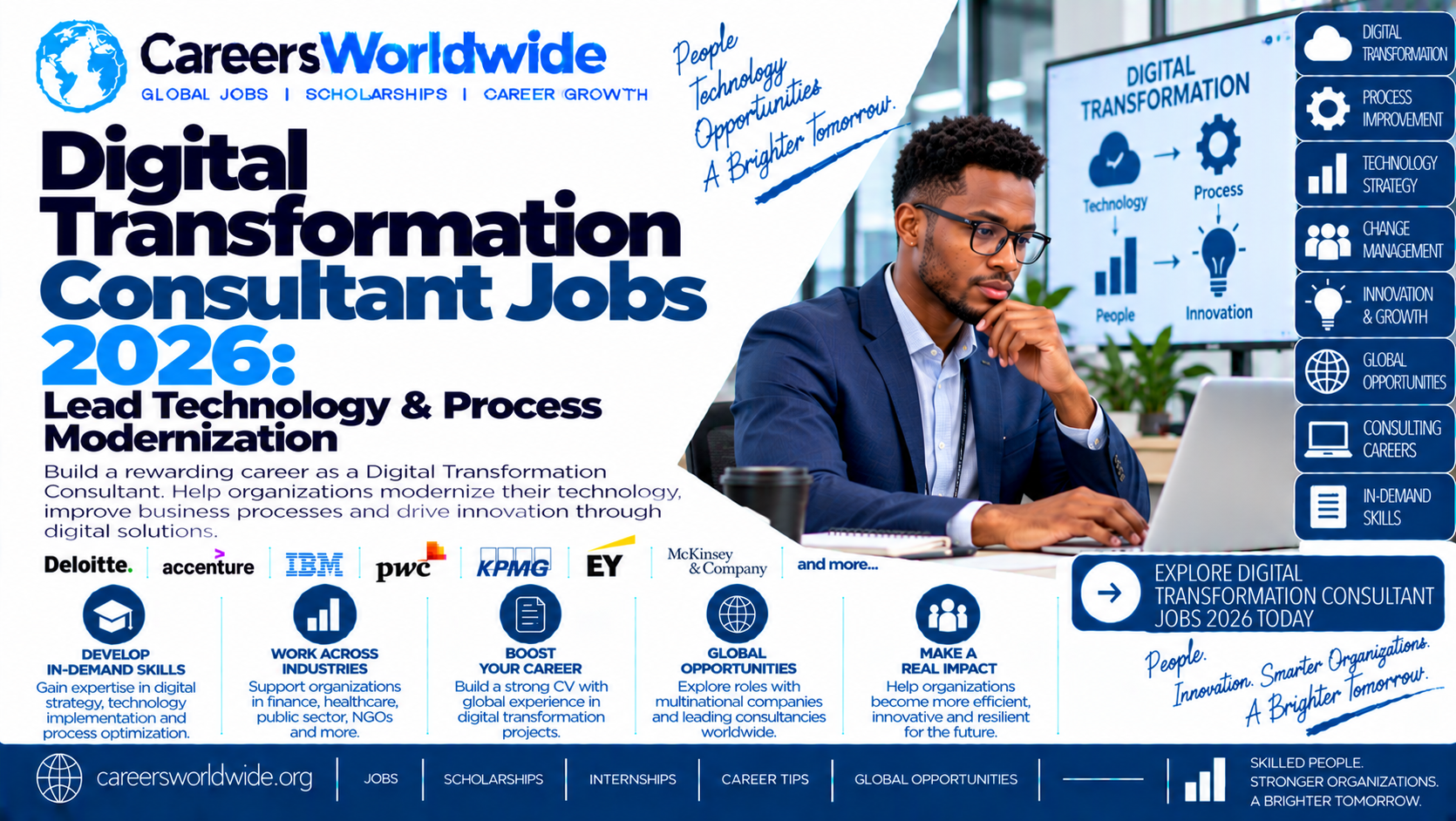

Excerpt: Digital Transformation Consultant Jobs 2026 are attracting professionals who can connect business strategy with technology, process improvement, data, AI, cloud platforms, and organizational change. This guide explains the skills, responsibilities, qualifications, job titles, application strategies, and career paths to help candidates pursue digital transformation consulting opportunities.
Digital Transformation Consultant Jobs 2026
Organizations across industries are modernizing the way they operate. Businesses are moving from manual workflows to digital platforms, adopting cloud technologies, improving data systems, automating repetitive processes, and exploring artificial intelligence.
This transformation creates demand for professionals who understand both business operations and technology.
Digital Transformation Consultants help organizations identify where technology can improve business performance and then support the journey from strategy to implementation. Their work may involve process redesign, technology assessment, cloud migration, data analytics, automation, customer experience, enterprise applications, cybersecurity, artificial intelligence, and change management.
IBM describes digital transformation as incorporating digital technology across organizational areas while modernizing processes, operations, products, and technology infrastructure. It also emphasizes that transformation involves business change and organizational alignment rather than simply replacing old IT systems.
For professionals interested in technology, consulting, business analysis, project management, and innovation, Digital Transformation Consultant Jobs 2026 can provide a broad career path.
What Does a Digital Transformation Consultant Do?
A Digital Transformation Consultant helps an organization determine how technology and redesigned processes can support its strategic objectives.
The role is usually broader than traditional IT support.
Instead of simply asking whether a company should purchase a particular software platform, a consultant may examine the organization’s entire operating model.
Typical questions include:
- Which business processes are inefficient?
- Where are employees spending too much time on manual work?
- Can automation improve productivity?
- Is the current technology infrastructure scalable?
- How can cloud platforms improve operations?
- Can data be used more effectively?
- Where could artificial intelligence create measurable value?
- How should employees transition to new systems?
- What risks could prevent a transformation project from succeeding?
The consultant then helps develop recommendations and, depending on the role, may participate in implementation.
IBM’s consulting career information describes consultants as professionals who analyze client situations, identify opportunities, recommend improvements, and collaborate with clients to implement solutions.
Why Digital Transformation Careers Are Growing in 2026
Digital transformation has become a major business priority because technology is increasingly integrated into everyday operations.
Companies are investing in areas such as:
- Artificial intelligence
- Cloud computing
- Data analytics
- Enterprise software
- Cybersecurity
- Automation
- Customer experience platforms
- Digital payments
- Mobile applications
- Business intelligence
- Process management
- Digital supply chains
- Modern collaboration systems
The transformation is not limited to technology companies.
Banks, hospitals, governments, manufacturers, retailers, universities, logistics companies, NGOs, telecommunications companies, and professional-services organizations all have processes that can potentially be improved through technology.
IBM’s technology consulting practice, for example, describes work involving application modernization, analytics, data science, automation, technology strategy, and embedding emerging technologies into business processes.
This creates opportunities for professionals with different backgrounds.
A person with an IT degree may enter through technology consulting.
Someone with a business background may enter through business transformation or process consulting.
A project manager may transition into transformation delivery.
A data analyst may specialize in analytics transformation.
Digital Transformation Consultant Jobs 2026: Summary Table
| Category | Details |
|---|---|
| Job field | Digital transformation and technology consulting |
| Main focus | Technology, business processes, data and organizational modernization |
| Typical employers | Consulting firms, technology companies, banks, corporations, government and NGOs |
| Common technologies | Cloud, AI, ERP, CRM, analytics, automation and enterprise platforms |
| Key skills | Business analysis, technology awareness, communication and project management |
| Education | Business, IT, computer science, engineering or related disciplines |
| Entry-level titles | Associate Consultant, Business Analyst, Technology Analyst |
| Mid-level titles | Digital Transformation Consultant, Technology Consultant |
| Senior titles | Senior Consultant, Transformation Manager, Principal Consultant |
| Work environment | Office, hybrid, remote and client-site depending on employer |
| Major deliverables | Transformation roadmaps, process designs, business cases and implementation plans |
| Important soft skills | Communication, collaboration, problem-solving and adaptability |
Key Responsibilities of a Digital Transformation Consultant
Although responsibilities vary by employer, several activities appear frequently across transformation consulting roles.
1. Assess Business Processes
Consultants begin by understanding how an organization currently works.
They may interview employees, review documentation, analyze workflows and identify bottlenecks.
For example, a company may still use spreadsheets to manage a process that could be automated through an enterprise platform.
The consultant documents the current state and identifies potential improvements.
2. Develop Transformation Strategies
After analyzing the current situation, consultants help develop a roadmap.
The roadmap may identify:
- Business priorities
- Technology requirements
- Implementation stages
- Required resources
- Risks
- Performance indicators
- Estimated timelines
- Change-management activities
A good transformation strategy connects technology investment to measurable business objectives.
3. Map and Redesign Processes
Process mapping is one of the most useful skills for aspiring transformation consultants.
You may be asked to document an existing process and then design a more efficient future-state process.
Common tools include:
- Flowcharts
- BPMN diagrams
- Process maps
- SIPOC diagrams
- Value-stream maps
- Workflow documentation
4. Evaluate Technology Solutions
Consultants may compare technology platforms and recommend solutions based on organizational requirements.
Depending on the project, this could involve:
- ERP systems
- CRM platforms
- Cloud services
- Data platforms
- Automation tools
- AI solutions
- Collaboration software
- Cybersecurity systems
The objective is not simply to select the newest technology.
The technology must address a genuine business requirement.
5. Support Implementation
Some transformation consultants remain involved after strategy development.
They may help with:
- Requirements gathering
- System configuration
- Testing
- Data migration
- Training
- User adoption
- Deployment
- Performance monitoring
This is why transformation consulting often overlaps with implementation consulting.
Technology Areas to Learn for Digital Transformation Consulting
You do not need to become an expert in every technology.
However, understanding the major technology categories can make your profile stronger.
Cloud Computing
Learn the fundamentals of:
- Infrastructure as a Service
- Platform as a Service
- Software as a Service
- Cloud migration
- Cloud security
- Cloud architecture concepts
Major cloud ecosystems include AWS, Microsoft Azure and Google Cloud.
Artificial Intelligence
AI is becoming increasingly relevant to transformation projects.
Candidates should understand concepts such as:
- Generative AI
- Machine learning
- AI automation
- Large language models
- AI governance
- Data requirements
- Responsible AI
- AI use-case evaluation
IBM reported in 2026 that AI is changing how consulting projects and organizational work are delivered, with enterprises increasingly reconsidering operating models and productivity.
Data and Analytics
Transformation depends heavily on data.
Useful skills include:
- Excel
- SQL
- Data visualization
- Business intelligence
- Dashboard design
- Data quality
- Data governance
- KPI development
Tools such as Power BI, Tableau and similar analytics platforms can be valuable.
Enterprise Applications
Learn the purpose of platforms such as:
- SAP
- Oracle
- Microsoft Dynamics 365
- Salesforce
- ServiceNow
You do not necessarily need advanced technical expertise in all of them.
Understanding what each category does and how it supports business processes can be useful.
Deloitte’s Technology & Transformation practice, for example, highlights work involving SAP, ServiceNow, supply chain and IT operations alongside strategy, process design and technology enablement.
Skills Employers Look For
Digital transformation consulting combines technical and business skills.
Business Analysis
You should be able to identify business problems and translate them into requirements.
Important capabilities include:
- Requirements gathering
- Stakeholder interviews
- Process analysis
- Gap analysis
- Business-case development
- Functional requirements
- User stories
Communication
Consultants regularly communicate with technical and non-technical stakeholders.
You may need to explain a complex technology concept to an executive or translate a business requirement for a technical team.
Strong writing and presentation skills therefore matter.
Project Management
Transformation initiatives often involve multiple teams.
Knowledge of:
- Agile
- Scrum
- Waterfall
- Project planning
- Risk management
- Stakeholder management
- Change management
can strengthen your profile.
IBM specifically highlights project management, Agile/Scrum, communication, problem-solving, decision-making and collaboration among useful consulting skills.
Problem-Solving
A consultant must understand the underlying problem before recommending a solution.
Employers may test this during interviews through case studies.
Digital Transformation Consultant Job Titles to Search
Do not search for only one job title.
Organizations use different terminology for similar work.
Consider searching for:
- Digital Transformation Consultant
- Digital Transformation Analyst
- Technology Transformation Consultant
- Business Transformation Consultant
- Technology Consultant
- Digital Strategy Consultant
- Business Analyst
- Technology Business Analyst
- IT Transformation Consultant
- Transformation Manager
- Enterprise Transformation Consultant
- Digital Advisory Consultant
- Technology Strategy Consultant
- Process Transformation Consultant
- Business Process Consultant
- IT Strategy Consultant
- Cloud Transformation Consultant
- Digital Operations Consultant
- AI Transformation Consultant
- Enterprise Applications Consultant
IBM’s consulting career portal currently identifies roles including Business Transformation Consultant, SAP Consultant, Salesforce Consultant, Oracle Consultant, Strategy Consultant and Industry Consultant.
Qualifications for Digital Transformation Consultant Jobs
There is no single degree required for every position.
Common educational backgrounds include:
- Computer Science
- Information Technology
- Software Engineering
- Information Systems
- Business Administration
- Management
- Engineering
- Economics
- Finance
- Data Science
- Operations Management
An MBA or master’s degree can be useful for some strategy-focused positions, while technical degrees may be more relevant to technology-heavy consulting roles.
However, practical experience can be equally important.
A candidate who can demonstrate successful projects may be competitive even without an advanced degree.
How to Build Experience Without a Consulting Job
One of the biggest challenges for entry-level candidates is obtaining consulting experience.
You can begin by creating transformation projects yourself.
Project 1: Digital Transformation Assessment
Choose a hypothetical company.
Document:
- Current business processes
- Technology problems
- Employee pain points
- Customer challenges
- Recommended technologies
- Implementation roadmap
- KPIs
Turn the analysis into a professional PDF presentation.
Project 2: Process Automation Case Study
Take a manual process such as employee leave requests.
Design:
Current process → Problem → Digital solution → Future process → Expected KPI
This demonstrates process-thinking.
Project 3: Business Intelligence Dashboard
Create a Power BI or Tableau dashboard using a public dataset.
Explain:
- Business problem
- Data source
- KPIs
- Dashboard
- Business recommendations
Project 4: AI Transformation Proposal
Choose a business function such as customer service.
Develop a proposal showing:
- Current challenge
- AI use case
- Expected benefits
- Risks
- Governance requirements
- Implementation stages
- KPIs
These projects can become portfolio evidence during applications and interviews.
Where to Find Digital Transformation Consultant Jobs in 2026
Candidates should search across several categories of employers.
Global Consulting Firms
Large consulting organizations regularly recruit professionals for technology, transformation, strategy and advisory practices.
Examples include:
- Deloitte
- IBM Consulting
- Accenture
- PwC
- EY
- KPMG
Deloitte describes its Technology & Transformation practice as helping organizations navigate technology-enabled business transformation, including innovation, efficiency, cybersecurity and sustainable growth.
Technology Companies
Technology companies also employ consultants who help customers adopt their platforms.
Look for roles connected with:
- Cloud
- AI
- ERP
- CRM
- Data
- Enterprise software
- Cybersecurity
Large Corporations
Banks, telecommunications companies, manufacturers, retailers and healthcare organizations increasingly maintain internal transformation teams.
Search for titles such as:
Transformation Analyst, Digital Strategy Analyst, Technology Transformation Manager, or Business Process Analyst.
How to Apply for Digital Transformation Consultant Jobs
Step 1: Choose Your Specialization
Avoid presenting yourself as an expert in everything.
Instead, select an area such as:
- AI transformation
- Cloud transformation
- ERP transformation
- Data transformation
- Customer experience
- Process automation
- Digital operations
Step 2: Customize Your Resume
Your resume should emphasize measurable achievements.
Instead of:
“Worked on business processes.”
Use:
“Mapped 15 operational workflows and identified opportunities for automation that reduced manual processing requirements.”
Where possible, quantify your impact.
Step 3: Demonstrate Technology Knowledge
Mention relevant technologies, tools and methodologies.
For example:
Skills: Business Analysis, Process Mapping, SQL, Power BI, Agile, Cloud Fundamentals, AI Strategy, Stakeholder Management.
Step 4: Build a Portfolio
A transformation portfolio can distinguish candidates from applicants who only list qualifications.
Include two or three strong projects rather than ten incomplete projects.
How to Prepare for the Interview
Transformation consulting interviews may combine behavioral questions, technical questions and business cases.
Prepare for questions such as:
“How would you transform a manual business process?”
A strong answer should cover:
- Understand the current process
- Identify pain points
- Gather stakeholder requirements
- Define the future-state process
- Evaluate technology options
- Assess costs and risks
- Create an implementation plan
- Define KPIs
“How would you convince employees to adopt a new system?”
Discuss:
- Early stakeholder involvement
- Communication
- Training
- Pilot programs
- Feedback
- Change champions
- Support after implementation
- Measuring adoption
“What would you do if stakeholders disagreed?”
Explain how you would identify the underlying concerns, establish common objectives, analyze evidence and facilitate a decision.
30-Day Preparation Plan
Week 1: Business Transformation
Study:
- Business processes
- Digital transformation
- Process mapping
- Business analysis
- KPIs
Week 2: Technology
Learn the fundamentals of:
- Cloud
- AI
- Data analytics
- ERP
- CRM
- Automation
Week 3: Consulting
Practice:
- Case interviews
- Presentation skills
- Problem-solving
- Executive summaries
- Business cases
Week 4: Applications
Complete:
- Resume
- LinkedIn profile
- Portfolio
- Cover letter
- Target employer list
- Interview preparation
Then begin applying consistently.
Certifications That May Help
Certifications are not mandatory for every consulting role, but relevant credentials can demonstrate structured learning.
Potential areas include:
- Project management
- Agile/Scrum
- Cloud fundamentals
- Business analysis
- Power BI
- IT service management
- Enterprise architecture
- Change management
Examples include certifications or training associated with major technology and professional organizations.
Choose certifications based on the type of consulting role you want rather than collecting credentials without a clear career objective.
Career Progression
A typical consulting progression may look like:
Analyst → Associate Consultant → Consultant → Senior Consultant → Manager → Senior Manager → Director/Partner
The exact structure differs by organization.
IBM, for example, describes a consulting progression that includes Associate Consultant, Consultant, Senior Consultant, Managing Consultant, Senior Managing Consultant, Associate Partner and Partner.
Other organizations use different titles.
As professionals gain experience, they may move from supporting transformation projects to leading workstreams, managing client relationships and eventually overseeing major transformation programs.
Digital Transformation Consultant Jobs and Remote Work
Digital transformation consulting can involve a mixture of working arrangements.
Some projects can be delivered remotely through digital collaboration tools.
Other assignments require consultants to visit client offices, particularly during workshops, implementation stages or stakeholder meetings.
Candidates should carefully read the work-location requirements before applying.
IBM’s entry-level consulting guidance notes that client-site work and travel can vary significantly by project and region.
Therefore, candidates should not assume that every transformation consulting role is fully remote.
Practical Advice for International Applicants
Candidates applying internationally should pay attention to:
- Work authorization
- Visa requirements
- Time-zone expectations
- Travel requirements
- Local professional qualifications
- Language requirements
- Client-facing experience
- Remote-work eligibility
Some multinational consulting organizations recruit globally, but individual vacancies may be restricted to specific countries.
Always verify eligibility in the individual job advertisement.
Common Mistakes to Avoid
Applying With a Generic Resume
A generic technology resume may not demonstrate your consulting capabilities.
Tailor your resume to the transformation role.
Focusing Only on Technology
Digital transformation is not simply an IT upgrade.
Business processes, people, strategy, adoption and measurable outcomes are equally important.
Listing Tools Without Evidence
Writing “Power BI” on a resume is less convincing than showing a dashboard project.
Ignoring Change Management
A technically successful project can still struggle if employees do not adopt the new process or system.
Overusing Buzzwords
Avoid filling your resume with terms such as “AI,” “innovation,” “digital disruption” and “transformation” without explaining what you actually accomplished.
FAQ: Digital Transformation Consultant Jobs 2026
1. What does a Digital Transformation Consultant do?
A Digital Transformation Consultant helps organizations modernize technology, business processes, data practices and operating models. Responsibilities can include assessment, strategy, process redesign, technology selection, implementation and change management.
2. What degree is needed?
Common degrees include IT, computer science, information systems, business, engineering, economics and management. Requirements vary by employer.
3. Can graduates become Digital Transformation Consultants?
Yes. Graduates can search for Associate Consultant, Analyst, Technology Analyst and Business Analyst positions that provide pathways into consulting.
4. Do I need programming skills?
Not necessarily. Some roles are highly technical, while others focus on strategy, business analysis, process improvement and implementation. Basic technical understanding is nevertheless valuable.
5. Is AI knowledge important?
AI knowledge is increasingly relevant because organizations are exploring AI for automation, decision-making, customer experience and productivity. IBM’s 2026 consulting commentary specifically describes AI as reshaping how organizations and consulting teams approach work.
6. Which tools should I learn?
Consider learning Excel, SQL, Power BI or Tableau, project-management tools, process-mapping tools and fundamentals of cloud, ERP, CRM and AI platforms.
7. Can I work remotely?
Some transformation roles support hybrid or remote arrangements, but others involve client-site work and travel. Always check the individual vacancy.
8. Is consulting experience required?
Not always. Entry-level positions can provide a pathway into consulting. Relevant internships, business analysis projects, technology projects and portfolio work can strengthen an application.
9. What is the difference between digital transformation and IT consulting?
IT consulting can focus heavily on technology systems and infrastructure. Digital transformation is broader and can combine technology with strategy, processes, people, data, customer experience and organizational change.
10. How can I stand out?
Build evidence. A strong portfolio containing a process-mapping project, transformation roadmap, analytics dashboard and technology business case can demonstrate practical capability.
11. What industries hire transformation professionals?
Potential employers span banking, healthcare, manufacturing, retail, telecommunications, government, logistics, professional services, technology and nonprofit organizations.
12. Where should I apply?
Start with official career portals of consulting firms, technology companies and organizations with internal transformation teams. Avoid relying exclusively on third-party job aggregators.
Official Application Resources
Candidates should verify current vacancies directly through official employer career websites.
IBM Consulting Careers: IBM’s consulting careers portal lists business transformation, SAP, Salesforce, Oracle, strategy and industry consulting roles.
Deloitte Careers: Deloitte provides consulting and technology career opportunities across different markets, including Technology & Transformation positions.
Microsoft Careers: Search Microsoft’s official careers platform for roles involving cloud, business applications, technology consulting and digital transformation.
Accenture Careers: Search the official Accenture careers platform for consulting, technology, cloud, AI and transformation positions.
PwC Careers: Explore official PwC career opportunities in consulting, technology and transformation.
EY Careers: Search official EY vacancies for consulting, technology, digital transformation and business advisory roles.
KPMG Careers: Review KPMG’s official career opportunities for technology consulting, digital transformation and advisory positions.
Always verify the exact vacancy, location, eligibility requirements, application deadline and work authorization conditions before submitting an application.
Final Takeaway
Digital Transformation Consultant Jobs 2026 sit at the intersection of business strategy, technology, data, process improvement and organizational change.
The strongest preparation is not simply learning a long list of technology tools. Candidates should learn how to identify business problems, analyze processes, evaluate technology options, communicate recommendations and support organizations through implementation.
Start with the fundamentals of business analysis and process mapping. Add practical knowledge of cloud, data analytics, AI, automation and enterprise platforms. Then create projects that demonstrate how you would solve real business problems.
For entry-level candidates, roles such as Business Analyst, Technology Analyst and Associate Consultant can provide useful entry points. Experienced professionals may target Digital Transformation Consultant, Technology Consultant, Transformation Manager or Digital Strategy roles.
The field continues to evolve as organizations adopt AI, cloud technologies, automation and data-driven operating models. That makes continuous learning particularly important for anyone pursuing a long-term consulting career.
Disclaimer
Job availability, salaries, eligibility requirements, locations, application deadlines and work arrangements can change at any time. The information in this article is intended for general career and educational guidance and should not be treated as confirmation that a particular position is currently open. Always check the official employer career page and the specific vacancy announcement before applying. Never pay a recruiter or third party to obtain a legitimate job application.
SEO Information
SEO Title: Digital Transformation Consultant Jobs 2026: Technology & Process Careers
Meta Description: Explore Digital Transformation Consultant Jobs 2026, including responsibilities, skills, qualifications, job titles, career paths, application tips and official resources.
Focus Keyword: Digital Transformation Consultant Jobs 2026
URL Slug: digital-transformation-consultant-jobs-2026
SEO Excerpt: Discover Digital Transformation Consultant Jobs 2026 and learn the skills, qualifications, technologies, career paths and application strategies needed to help organizations modernize technology and business processes.
SEO Keywords:
- Digital Transformation Consultant Jobs 2026,
- Digital Transformation Jobs 2026,
- Technology Consultant Jobs 2026,
- Business Transformation Consultant Jobs,
- Digital Strategy Jobs 2026,
- Technology Transformation Jobs,
- IT Transformation Consultant Jobs,
- Digital Transformation Careers,
- Business Transformation Jobs,
- Technology Consulting Jobs 2026,
- Digital Strategy Consultant Jobs,
- Transformation Manager Jobs,
- Business Analyst Jobs 2026,
- AI Transformation Jobs,
- Cloud Transformation Jobs,
- Digital Operations Jobs,
- Enterprise Transformation Consultant,
- Technology Strategy Consultant,
- Process Transformation Jobs,
- Digital Consulting Careers,
ALSO CHECK: ERP Implementation Consultant Jobs 2026: Help Organizations Modernize Enterprise SoftwareSeptember 25, 2026
Aerospace Engineering Scholarships 2026–2027: Funding for Aviation & Space ResearchSeptember 25, 2026
Forestry Scholarships 2026–2027: Study Forest Management, Conservation & Climate ResilienceSeptember 25, 2026