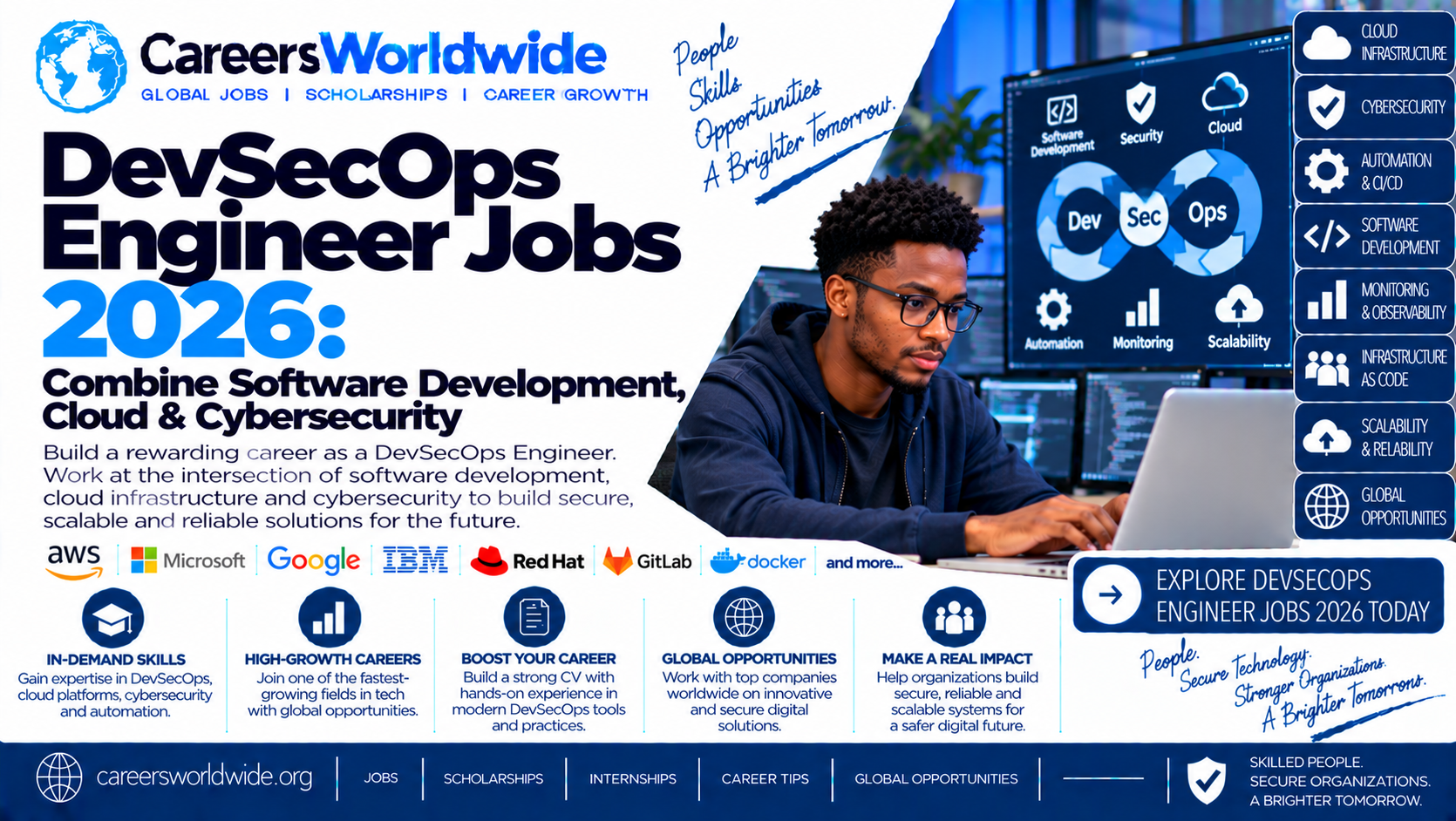

Excerpt: DevSecOps Engineer Jobs 2026 are opening opportunities for professionals who can combine software development, cloud infrastructure, automation and cybersecurity. This guide explains what DevSecOps engineers do, the skills employers look for, technologies to learn, career paths, portfolio projects, interview preparation, how to apply, and official resources for building a career in secure software delivery.
DevSecOps Engineer Jobs 2026
Modern software teams are expected to deliver applications quickly while keeping systems, data and infrastructure secure.
That combination has created growing interest in DevSecOps — an approach that integrates security throughout the software development and operations lifecycle rather than treating security as a final checkpoint.
Microsoft describes DevSecOps as integrating security throughout the application lifecycle and emphasizes practices such as automated security testing, secure coding, threat modeling, monitoring and incident response.
For professionals interested in software engineering, cloud computing and cybersecurity, DevSecOps offers a career path that brings these disciplines together.
A DevSecOps Engineer may work on CI/CD pipelines, cloud infrastructure, infrastructure as code, container security, vulnerability scanning, secrets management, security automation, monitoring and incident response.
This makes the role particularly relevant to organizations building and operating modern cloud applications.
What Is DevSecOps?
DevSecOps stands for Development, Security and Operations.
Traditional software development sometimes treated security as a separate activity performed near the end of development.
DevSecOps changes that model.
Security considerations are incorporated into activities such as:
- Planning
- Requirements analysis
- Coding
- Code review
- Build
- Testing
- Deployment
- Monitoring
- Incident response
The goal is to identify and address security problems as early as practical while maintaining efficient software delivery.
Microsoft’s current DevSecOps guidance describes this as a shift toward integrating security into everyday engineering work and automated development and testing processes.
Why DevSecOps Engineer Jobs Matter in 2026
Cloud applications are increasingly built using interconnected technologies.
A modern application might involve:
- Cloud infrastructure
- Containers
- Kubernetes
- APIs
- Databases
- CI/CD pipelines
- Open-source dependencies
- Infrastructure-as-code
- Identity systems
- Monitoring platforms
- Third-party services
Each component introduces security considerations.
A DevSecOps Engineer helps organizations incorporate security controls into the engineering process.
Google Cloud’s software-delivery guidance emphasizes CI/CD practices, productivity, modernization and software supply-chain security for modern development teams.
Microsoft similarly identifies areas such as threat modeling, software supply-chain security, SAST, DAST, workload security and DevOps logging as important parts of DevOps security.
DevSecOps Engineer Jobs 2026: Summary Table
| Category | Details |
|---|---|
| Career field | DevSecOps, cloud engineering and cybersecurity |
| Main focus | Secure software delivery and cloud operations |
| Core technologies | Git, CI/CD, containers, Kubernetes, cloud platforms |
| Security areas | SAST, DAST, secrets, vulnerabilities, IAM and monitoring |
| Cloud platforms | AWS, Microsoft Azure and Google Cloud |
| Infrastructure | Cloud, containers, Kubernetes and infrastructure as code |
| Programming | Python, Bash, PowerShell and application languages |
| Key skills | Automation, security, cloud and software development |
| Common employers | Technology companies, banks, consulting firms, SaaS companies and government organizations |
| Entry-level titles | DevOps Engineer, Cloud Engineer, Security Engineer, Junior DevSecOps Engineer |
| Advanced titles | Senior DevSecOps Engineer, DevSecOps Lead, Cloud Security Engineer |
| Work environment | Remote, hybrid or onsite depending on employer |
| Major objective | Deliver software efficiently while integrating security throughout the lifecycle |
What Does a DevSecOps Engineer Do?
DevSecOps responsibilities vary considerably by organization.
However, several activities appear frequently.
1. Build Secure CI/CD Pipelines
DevSecOps engineers help automate the software delivery process.
A pipeline may include:
Code → Build → Test → Security Scan → Package → Deploy → Monitor
Security controls can be integrated into multiple stages.
For example, automated tools can scan code for vulnerabilities before deployment.
2. Automate Security Testing
Security testing should not always depend on manual reviews.
DevSecOps environments may use:
- Static Application Security Testing
- Dynamic Application Security Testing
- Software Composition Analysis
- Secret scanning
- Container scanning
- Infrastructure-as-code scanning
- Dependency scanning
Microsoft’s DevSecOps guidance specifically identifies automated SAST, software composition analysis and secret scanning as important security practices.
3. Manage Cloud Security
DevSecOps engineers often work directly with cloud infrastructure.
Responsibilities may include:
- Identity and access management
- Network security
- Encryption
- Security groups
- Cloud logging
- Security policies
- Vulnerability management
- Infrastructure configuration
4. Secure Containers
Containers have become a major component of modern application delivery.
DevSecOps professionals may secure:
- Docker images
- Container registries
- Kubernetes clusters
- Container workloads
- Kubernetes configurations
- Admission controls
Microsoft’s current AKS DevSecOps architecture guidance recommends integrating automated security controls into CI/CD and cluster operations and includes container scanning, policy enforcement, runtime monitoring and software supply-chain controls.
5. Manage Secrets and Credentials
Exposed passwords, API keys and tokens can create serious security risks.
DevSecOps engineers therefore work with secrets-management solutions and secure authentication practices.
Instead of placing credentials directly inside source code, teams can use dedicated secrets-management systems.
Candidates should understand concepts such as:
- Secrets rotation
- API keys
- Tokens
- Certificates
- Key management
- Identity federation
- Least privilege
Microsoft’s Azure DevOps security guidance emphasizes restricting access, managing service connections, protecting data and automating security scanning.
6. Monitor Applications and Infrastructure
Security does not stop when an application reaches production.
DevSecOps engineers help establish monitoring and detection capabilities.
This may include:
- Logs
- Metrics
- Alerts
- Security events
- Application telemetry
- Cloud monitoring
- SIEM integration
Microsoft’s current DevSecOps operations guidance describes monitoring and detection as core capabilities for identifying threats and supporting incident response.
7. Support Incident Response
When security incidents occur, DevSecOps professionals may help investigate and remediate them.
They may contribute to:
- Incident analysis
- Containment
- System recovery
- Vulnerability remediation
- Pipeline investigation
- Credential rotation
- Post-incident reviews
Microsoft’s DevSecOps guidance recommends preparing teams to detect, respond to and recover from security incidents rather than assuming security ends after deployment.
Skills Needed for DevSecOps Engineer Jobs 2026
DevSecOps is a multidisciplinary field.
Candidates should develop skills across software engineering, operations, cloud and security.
Linux
Linux is an important foundation for many DevOps and cloud environments.
Learn:
- File permissions
- Processes
- Networking
- Shell commands
- Package management
- Logs
- Services
- SSH
Git
You should understand:
- Repositories
- Branches
- Pull requests
- Merging
- Tags
- Commit history
- Code reviews
Programming and Scripting
You do not necessarily need to become a full-time application developer.
However, scripting is extremely useful.
Consider learning:
- Python
- Bash
- PowerShell
Python can be particularly useful for security automation and infrastructure tasks.
Cloud Skills
Choose at least one major cloud platform and learn it systematically.
AWS
Learn fundamentals of:
- IAM
- EC2
- S3
- VPC
- CloudTrail
- CloudWatch
- Security services
Microsoft Azure
Study:
- Microsoft Entra ID
- Virtual Networks
- Azure Kubernetes Service
- Azure DevOps
- Key Vault
- Azure Monitor
- Microsoft Defender for Cloud
Google Cloud
Learn:
- IAM
- Compute Engine
- Cloud Storage
- VPC
- Kubernetes Engine
- Cloud Logging
- Security controls
You do not need advanced expertise in all three platforms at the beginning.
Choose one and build practical projects.
CI/CD Skills
CI/CD is central to DevSecOps.
Understand:
- Continuous integration
- Continuous delivery
- Pipeline configuration
- Build automation
- Automated testing
- Deployment strategies
- Rollbacks
- Environment separation
Tools worth exploring include:
- GitHub Actions
- GitLab CI/CD
- Jenkins
- Azure Pipelines
- AWS CodePipeline
The specific tool matters less than understanding the underlying concepts.
Containerization and Kubernetes
Learn Docker fundamentals first.
Understand:
- Images
- Containers
- Dockerfiles
- Registries
- Networks
- Volumes
Then progress to Kubernetes.
Study:
- Pods
- Deployments
- Services
- ConfigMaps
- Secrets
- Namespaces
- RBAC
- Ingress
- Network policies
Kubernetes security knowledge can be particularly valuable for cloud-native DevSecOps positions.
Infrastructure as Code
Infrastructure as Code allows teams to define infrastructure using configuration files.
Popular technologies include:
- Terraform
- AWS CloudFormation
- Azure Bicep
- Pulumi
Candidates should understand version control, reusable modules, state management and secure configuration.
Infrastructure-as-code security scanning is also relevant because insecure infrastructure configurations can introduce vulnerabilities before applications reach production.
Cybersecurity Skills
A DevSecOps Engineer should understand fundamental security concepts.
Important areas include:
Application Security
Learn about:
- OWASP Top 10
- Secure coding
- Authentication
- Authorization
- Input validation
- API security
- Encryption
Vulnerability Management
Understand:
- CVEs
- Vulnerability scanning
- Severity
- Remediation
- Patch management
- Dependency management
Identity and Access Management
Learn:
- Least privilege
- Role-based access control
- Multi-factor authentication
- Service identities
- Access policies
Threat Modeling
Threat modeling helps teams identify potential threats and determine appropriate controls.
Microsoft’s DevOps security benchmark specifically recommends threat modeling for applications, services and the CI/CD pipeline itself.
DevSecOps Tools to Learn
A practical DevSecOps toolkit may include:
| Area | Example Tools |
|---|---|
| Version control | Git, GitHub, GitLab |
| CI/CD | GitHub Actions, Jenkins, GitLab CI |
| Containers | Docker |
| Orchestration | Kubernetes |
| IaC | Terraform, Bicep |
| SAST | Semgrep, CodeQL |
| SCA | Dependabot and similar tools |
| Secrets | Vault, cloud key-management services |
| Cloud | AWS, Azure, Google Cloud |
| Monitoring | Prometheus, Grafana, cloud monitoring |
| SIEM | Microsoft Sentinel and similar platforms |
| Automation | Python, Bash, PowerShell |
Tools change over time, so candidates should focus on transferable concepts rather than memorizing product names.
DevSecOps Engineer Job Titles to Search
When searching for opportunities, use multiple titles.
Try:
- DevSecOps Engineer
- Junior DevSecOps Engineer
- DevOps Security Engineer
- Cloud Security Engineer
- DevOps Engineer
- Security Automation Engineer
- Cloud Engineer
- Application Security Engineer
- Platform Security Engineer
- Infrastructure Security Engineer
- Software Security Engineer
- DevSecOps Consultant
- DevSecOps Specialist
- Cloud DevSecOps Engineer
- Kubernetes Security Engineer
- CI/CD Security Engineer
- DevOps Security Analyst
- Security Engineering Analyst
Some employers may not use the term “DevSecOps” even though the role contains substantial DevSecOps responsibilities.
Qualifications for DevSecOps Engineer Jobs
Common educational backgrounds include:
- Computer Science
- Software Engineering
- Information Technology
- Cybersecurity
- Information Systems
- Computer Engineering
- Cloud Computing
- Network Engineering
A degree is not necessarily required for every role.
Practical skills, certifications, portfolio projects and professional experience can also be important.
For entry-level candidates, building strong fundamentals is usually more useful than immediately pursuing highly advanced certifications.
Certifications That May Help
Potential certification areas include:
Cloud
- AWS certifications
- Microsoft Azure certifications
- Google Cloud certifications
Security
- CompTIA Security+
- Cloud security certifications
- Vendor-specific security credentials
Kubernetes
- Kubernetes administration or security certifications
DevOps
- Vendor-specific DevOps certifications
- Infrastructure automation credentials
Certifications should support your career strategy rather than replace hands-on experience.
How to Build a DevSecOps Portfolio
A GitHub portfolio can be particularly useful for this career.
Project 1: Secure CI/CD Pipeline
Create a small application and build a pipeline that:
- Checks out code
- Runs tests
- Performs static security scanning
- Scans dependencies
- Checks for secrets
- Builds a container
- Scans the container
- Deploys to a test environment
Document every stage.
Project 2: Terraform Security Project
Create infrastructure using Terraform.
Then demonstrate:
- Secure IAM
- Network segmentation
- Encryption
- Logging
- Security scanning
- Least-privilege configuration
Project 3: Kubernetes Security Lab
Build a small Kubernetes environment.
Demonstrate:
- RBAC
- Namespaces
- Network policies
- Secure secrets handling
- Container image scanning
- Logging and monitoring
Project 4: Vulnerability Management Dashboard
Create a dashboard showing:
- Vulnerability count
- Severity
- Affected applications
- Remediation status
- Aging vulnerabilities
- Risk trends
This demonstrates that you understand both technology and security reporting.
How to Apply for DevSecOps Engineer Jobs
Step 1: Choose Your Technical Foundation
Start with:
Linux + Git + Python/Bash + Cloud + CI/CD
Then add:
Docker + Kubernetes + IaC + Security Automation
Step 2: Build Practical Projects
Create two or three projects that demonstrate actual implementation.
Your GitHub profile should contain:
- Clear README files
- Architecture diagrams
- Pipeline configurations
- Security controls
- Screenshots
- Lessons learned
Step 3: Tailor Your Resume
Highlight measurable outcomes.
Instead of:
“Created CI/CD pipeline.”
Use:
“Built an automated CI/CD pipeline incorporating automated testing, dependency scanning and container security checks.”
Step 4: Apply Across Related Roles
Do not restrict your search to “DevSecOps Engineer.”
Apply where appropriate for:
- DevOps Engineer
- Cloud Engineer
- Cloud Security Engineer
- Security Automation Engineer
- Application Security Engineer
- Platform Engineer
These roles can provide experience relevant to future DevSecOps positions.
How to Prepare for a DevSecOps Interview
Expect questions covering several disciplines.
Technical Questions
You may be asked:
- What is CI/CD?
- What is DevSecOps?
- What is shift-left security?
- What is SAST?
- What is DAST?
- What is software composition analysis?
- How do you secure a Docker image?
- How would you protect Kubernetes?
- How do you manage secrets?
- What is Infrastructure as Code?
- How would you secure a CI/CD pipeline?
Scenario Questions
You might receive a scenario such as:
“A production deployment contains a critical vulnerability. What would you do?”
A structured response could include:
- Confirm the vulnerability
- Assess severity and exposure
- Determine affected components
- Contain the risk where appropriate
- Notify relevant stakeholders
- Remediate or roll back
- Verify the fix
- Document the incident
- Improve pipeline controls to reduce recurrence
30-Day DevSecOps Learning Plan
Week 1: Foundations
Study:
- Linux
- Networking
- Git
- Python or Bash
- Basic cybersecurity
Week 2: DevOps
Learn:
- CI/CD
- Docker
- Infrastructure as Code
- Cloud fundamentals
Build a basic automated deployment pipeline.
Week 3: Security
Learn:
- OWASP
- SAST
- DAST
- SCA
- Secrets management
- IAM
- Vulnerability management
- Threat modeling
Integrate security tools into your pipeline.
Week 4: Cloud-Native Security
Study:
- Kubernetes
- Cloud security
- Monitoring
- Logging
- Incident response
Then publish a complete portfolio project.
Where to Find DevSecOps Engineer Jobs in 2026
Look at official career portals for:
- Cloud providers
- Software companies
- Cybersecurity companies
- Banks
- Telecommunications companies
- Technology consultancies
- SaaS businesses
- Government technology organizations
- Healthcare technology companies
- Financial technology companies
Search using combinations such as:
“DevSecOps Engineer” + remote
“Cloud Security Engineer” + 2026
“DevOps Security Engineer”
“Application Security Engineer” + cloud
“Platform Security Engineer”
“Kubernetes Security Engineer”
Always verify the vacancy directly on the employer’s official career site.
Remote DevSecOps Jobs
DevSecOps can be compatible with remote work because much of the work involves cloud platforms, code repositories, automated pipelines and online collaboration.
However, remote eligibility varies by employer and country.
Some positions may require:
- Specific country residency
- Time-zone availability
- Security clearance
- Occasional office attendance
- Client travel
- Authorization to work in a particular jurisdiction
International applicants should carefully check each vacancy.
Common Mistakes DevSecOps Candidates Should Avoid
Trying to Learn Everything
You do not need to master every cloud platform, programming language and security tool.
Develop a strong core and specialize gradually.
Ignoring Software Development
DevSecOps is not simply cybersecurity with a new title.
Understanding how software is built and deployed is essential.
Ignoring Security
Likewise, DevOps knowledge alone does not make someone a DevSecOps professional.
Security should be visible in your projects.
Putting Secrets on GitHub
Never publish real credentials, API keys or private certificates in public repositories.
Use fake credentials and demonstrate secure secrets-management practices.
Focusing Only on Certifications
A certificate can demonstrate knowledge, but practical projects provide evidence of implementation skills.
Not Understanding the Business Context
Security controls should support business objectives while managing risk.
FAQ: DevSecOps Engineer Jobs 2026
1. What is a DevSecOps Engineer?
A DevSecOps Engineer combines software development, DevOps automation, cloud engineering and cybersecurity to help organizations deliver software securely and efficiently.
2. Is DevSecOps a good career for software developers?
It can be a natural specialization for developers interested in cloud infrastructure, automation and security.
3. Do DevSecOps Engineers need cybersecurity knowledge?
Yes. Security is a central part of the role. Useful areas include application security, vulnerability management, IAM, secrets management and threat modeling.
4. Do I need programming skills?
Programming or scripting skills are highly useful. Python, Bash and PowerShell are common choices for automation.
5. Which cloud should I learn first?
Choose one major platform and build practical skills before attempting to master multiple clouds.
6. Is Kubernetes required?
Not for every DevSecOps role, but Kubernetes knowledge can be valuable for organizations running containerized workloads.
7. What is shift-left security?
Shift-left security means incorporating security earlier in the software development lifecycle instead of waiting until the final stages. Microsoft identifies this as a central DevSecOps practice.
8. What security tools should I learn?
Start with concepts behind SAST, DAST, software composition analysis, secret scanning, container scanning and infrastructure-as-code security.
9. Can beginners get DevSecOps jobs?
Some entry-level roles exist, although candidates may also enter through DevOps, cloud, software engineering or security positions before specializing.
10. Can DevSecOps Engineers work remotely?
Some positions are remote or hybrid, but requirements vary by employer, location and security considerations.
11. What should I put in my DevSecOps portfolio?
Show secure CI/CD pipelines, cloud infrastructure, container security, Infrastructure as Code, vulnerability scanning, monitoring and automation.
12. What should I study first?
A practical sequence is:
Linux → Git → Python/Bash → Cloud → CI/CD → Docker → Kubernetes → IaC → Security Automation
Official Application and Learning Resources
Candidates should use official career and learning platforms when researching DevSecOps opportunities.
Microsoft Learn
Microsoft provides extensive DevSecOps learning and technical documentation covering secure development, CI/CD, cloud security, containers, Kubernetes, monitoring and security automation.
Google Cloud
Google Cloud provides software-delivery resources covering CI/CD, modernization and software supply-chain security.
AWS Careers and Training
AWS provides official career opportunities and training resources covering cloud infrastructure, security and DevOps.
GitHub Careers and Security Resources
GitHub is relevant for both employment research and practical learning because modern DevSecOps workflows frequently involve source control, automation and security scanning.
Major Technology and Consulting Employers
Candidates can also review official career portals for companies such as:
- Microsoft
- Amazon
- IBM
- Accenture
- Deloitte
- Oracle
- Red Hat
- Cisco
- Cloudflare
Search each organization’s official careers page for current vacancies rather than relying solely on third-party listings.
Final Takeaway
DevSecOps Engineer Jobs 2026 bring together three major areas of technology:
Software development + cloud operations + cybersecurity.
The field requires more than knowing security tools.
A strong DevSecOps professional understands how software is developed, how applications are deployed, how cloud infrastructure operates and how security can be integrated into each stage.
For beginners, start with Linux, Git, scripting, cloud fundamentals and CI/CD. Then move into Docker, Kubernetes, Infrastructure as Code and security automation.
Build practical projects that demonstrate your skills rather than simply listing technologies on a resume.
A portfolio showing a secure CI/CD pipeline, infrastructure-as-code project, container security controls and cloud monitoring can give employers concrete evidence of your capabilities.
DevSecOps is also a field that requires continuous learning. Cloud services, development practices, security threats and automation technologies continue to evolve, so professionals should regularly update their technical knowledge.
Disclaimer
Job availability, salaries, eligibility requirements, locations, application deadlines, remote-work arrangements and employer requirements can change at any time. This article provides general career information and does not confirm that a particular DevSecOps vacancy is currently open. Candidates should verify every position through the employer’s official career website before applying. Never pay a recruiter or third party to obtain a legitimate job.
SEO Information
SEO Title: DevSecOps Engineer Jobs 2026: Software, Cloud & Cybersecurity
Meta Description: Explore DevSecOps Engineer Jobs 2026 and learn the software development, cloud, CI/CD, cybersecurity and automation skills needed for modern DevSecOps careers.
Focus Keyword: DevSecOps Engineer Jobs 2026
URL Slug: devsecops-engineer-jobs-2026
SEO Excerpt: Discover DevSecOps Engineer Jobs 2026, including required skills, cloud technologies, cybersecurity tools, certifications, portfolio projects, interview preparation and application resources.
SEO Keywords:
- DevSecOps Engineer Jobs 2026,
- DevSecOps Jobs 2026,
- DevSecOps Careers,
- DevOps Security Engineer Jobs,
- Cloud Security Engineer Jobs 2026,
- Cybersecurity DevOps Jobs,
- DevSecOps Engineer Careers,
- Junior DevSecOps Engineer Jobs,
- Remote DevSecOps Jobs,
- Cloud DevSecOps Jobs,
- DevOps Engineer Jobs 2026,
- Security Automation Engineer Jobs,
- Application Security Engineer Jobs,
- Kubernetes Security Jobs,
- CI/CD Security Jobs,
- Cloud Cybersecurity Jobs,
- DevSecOps Skills,
- DevSecOps Certifications,
- Secure Software Development Jobs,
- Infrastructure Security Engineer Jobs,
ALSO CHECK: Digital Transformation Consultant Jobs 2026: Lead Technology & Process ModernizationSeptember 25, 2026
ERP Implementation Consultant Jobs 2026: Help Organizations Modernize Enterprise SoftwareSeptember 25, 2026
Aerospace Engineering Scholarships 2026–2027: Funding for Aviation & Space ResearchSeptember 25, 2026