
Scholarships, bursaries, fellowships and training opportunities for aspiring science communicators
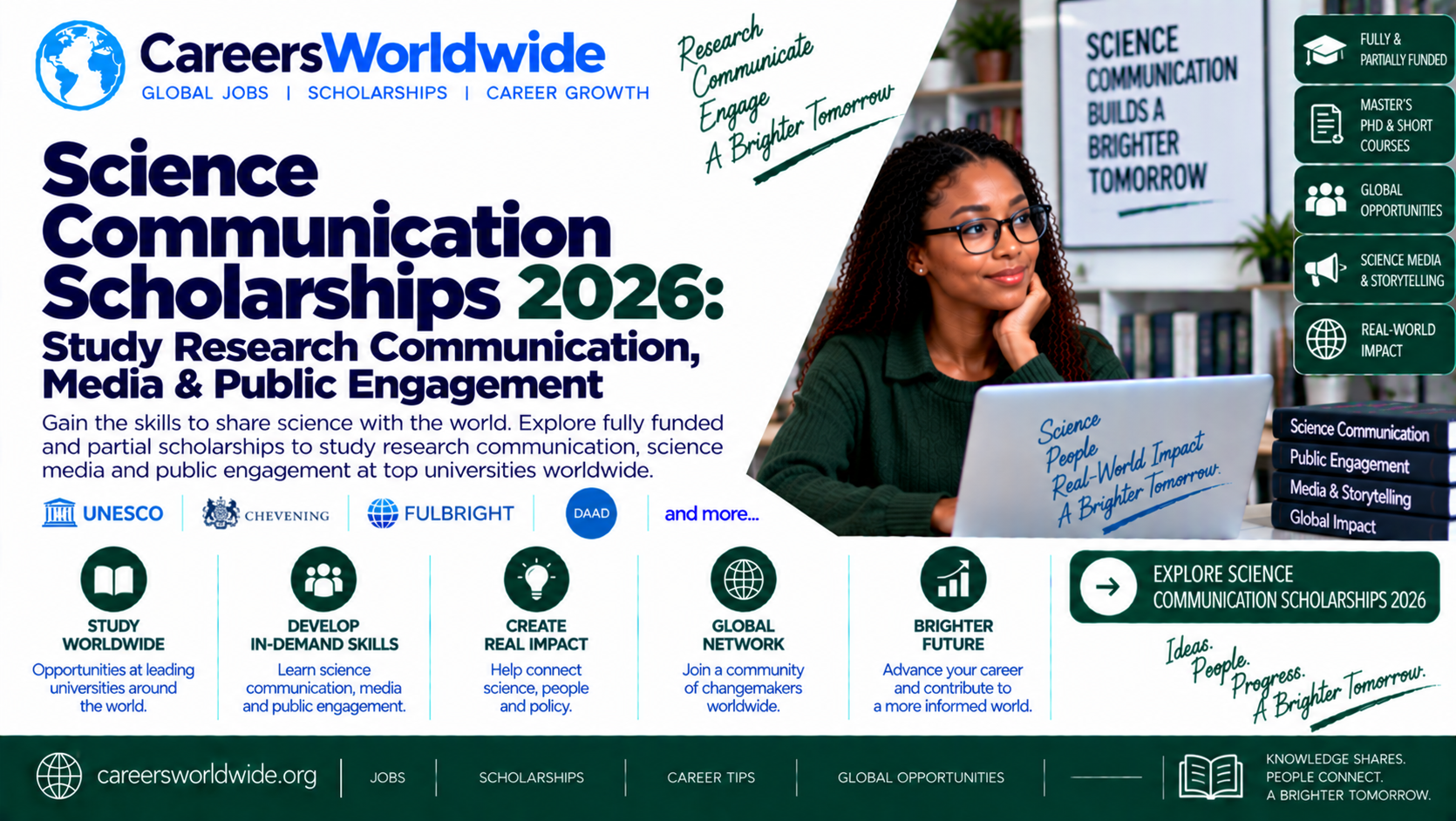
Excerpt: Explore science communication scholarships and fellowships for 2026, including opportunities to study research communication, science journalism, public engagement and health communication. This guide explains funding options, eligibility, application documents and practical steps for finding support—especially for international applicants planning future study.
Introduction: Funding a Career at the Intersection of Science and Communication
Science communication helps people understand scientific research and how it affects their lives. It connects researchers with communities, journalists with evidence, and institutions with the public.
As scientific topics such as climate change, public health, artificial intelligence and biotechnology become part of everyday discussion, communication skills are valuable across universities, research organizations, media outlets, museums, NGOs and government institutions.
For students and early-career professionals, studying science communication can open pathways into science journalism, research communications, public engagement, digital content production and science policy outreach. However, postgraduate tuition and professional training can be expensive—particularly for applicants travelling internationally.
Science communication scholarships and related funding can help cover tuition, research or project costs, training, and sometimes living expenses. The important detail is that these opportunities are not all the same: some fund a degree, some support a reporting project, and others recognize work already published.
This guide explains how to distinguish these options, where to find official application information, and how to prepare a competitive application. Because many 2026 deadlines fall earlier in the year, check each provider’s current status and look ahead to the next application cycle where necessary.
1. What Is Science Communication?
Science communication is the practice of explaining scientific ideas, evidence and research to audiences beyond specialist scientific communities. It can involve translating complex findings into accessible language without losing accuracy or context.
The field includes several connected areas:
- Science journalism: Reporting on discoveries, research debates, scientific institutions and the effects of science on society.
- Research communication: Helping universities, laboratories and research organizations communicate their work to wider audiences.
- Public engagement: Creating opportunities for communities to discuss, question and participate in science.
- Health communication: Explaining medical research, public health information and health-related evidence.
- Digital science media: Producing podcasts, videos, newsletters, explainers, websites and social media content about science.
- Science policy communication: Connecting scientific evidence with policymakers, public institutions and civic audiences.
A scholarship may focus on only one of these areas. Applicants should read the eligibility rules carefully rather than assuming every science-related award supports every communication discipline.
2. Types of Science Communication Funding
Before applying, identify what kind of support you need.
Degree scholarships and tuition bursaries
These support formal study, such as a master’s degree or postgraduate diploma. Funding may be a fixed contribution toward tuition rather than a full scholarship.
Journalism and reporting fellowships
These may fund a specific science journalism project, provide mentorship or support professional development. They are not necessarily intended to pay university tuition.
Awards for published communication
Some awards recognize science communication work that has already been produced or published. They may provide prize money or professional recognition, rather than funding a future course.
Short-course and workshop support
International schools, training programmes and professional workshops may offer fellowships or partial support for attendance. Check whether travel and accommodation are included; meals or course access alone do not mean all costs are covered.
Research and university-specific funding
Universities and research centres may offer departmental bursaries, assistantships or project-linked support. These can have separate application processes from admission to the academic programme.
3. Science Communication Scholarships and Related Opportunities to Explore
The following programmes illustrate different forms of funding. They are not all open for applications today, and not all are degree scholarships. Always confirm the next intake, funding conditions and eligibility on the official provider’s website.
1. NRF-SAASTA / University of Limpopo: Science Communication Postgraduate Diploma Support
South Africa · Postgraduate diploma
The National Research Foundation’s South African Agency for Science and Technology Advancement (NRF-SAASTA) has advertised financial support connected with the University of Limpopo’s Postgraduate Diploma in Science Communication.
The 2027 support call specifies South African citizenship or permanent residency, an appropriate NQF Level 7 qualification, and application to or admission into the relevant University of Limpopo programme. The application requirements include a form, CV, certified academic documents, proof of admission and a motivation letter. The published deadline is November 13, 2026. Check the official call for the complete conditions and any updates.
SAASTA
This is particularly relevant to applicants already based in South Africa who want structured postgraduate training in communicating science. International applicants should not assume they qualify: the citizenship and residency requirements are important.
Official application resource: NRF-SAASTA 2027 Science Communication Financial Support Call
2. University of Manchester: MSc Science and Health Communication Bursaries
United Kingdom · Master’s
The University of Manchester’s MSc Science and Health Communication combines science communication with health-related communication. Its funding page has listed bursaries of £1,000 for home students and £2,000 for overseas students for the 2026 intake.
The published 2026 deadlines were June 29 for home applicants and June 1 for overseas applicants. Those dates have passed as of September 2026, so prospective students should consult the university for any later funding rounds or information for the next academic year.
The University of Manchester
This type of bursary can reduce tuition costs, but applicants should calculate the remaining fees and living expenses independently.
Official funding resource: University of Manchester – MSc Funding
3. University of the West of England (UWE Bristol): Professor Frank Burnet MBE Bursary
United Kingdom · MSc
UWE Bristol has advertised the Professor Frank Burnet MBE Science Communication Part Bursary, associated with its science communication master’s programme. The published award was £1,500 for the September 2026 intake, with a June 19, 2026 application deadline.
That deadline has passed. Applicants considering a later intake should check whether the bursary is offered again, whether the award amount changes, and whether a separate course application is required.
UWE Bristol
Official bursary resource: UWE Bristol – Science Communication Part Bursary
4. UCL: MSc Science Communication
United Kingdom · Master’s
University College London offers an MSc in Science Communication. The programme is a formal academic route for students interested in communicating scientific knowledge to public audiences.
For 2026/27, UCL listed overseas tuition at £35,400 for full-time study and £17,700 for part-time study. These are tuition figures, not scholarship awards. The 2026 application cycle has closed, so applicants should use the official course page to check the next intake, fees and any available funding.
www2.fundsforngos.org
When assessing a high-cost programme, compare tuition support with total expenses, including accommodation, visa-related costs, travel and insurance.
Official course resource: UCL – MSc Science Communication
5. University of Sheffield: MSc Science Communication
United Kingdom · Master’s
The University of Sheffield offers an MSc Science Communication. Its course information states that the 2026 application window closed on September 4, while applications for 2027 entry opened on September 15, 2026.
That makes the official course page especially useful for applicants preparing for the next cycle. Review the academic entry requirements, fees, application documents and any funding opportunities directly with the university.
Postgraduate
Official course resource: University of Sheffield – MSc Science Communication
6. Council for the Advancement of Science Writing: Taylor/Blakeslee Graduate Fellowships
United States · Journalism fellowship
The Council for the Advancement of Science Writing (CASW) has announced Taylor/Blakeslee Graduate Fellowships, with awards of $6,000 each and seven fellowships described in its 2026 announcement.
These fellowships are connected with science writing and graduate-level development. Applicants should read the current official announcement to confirm the target audience, eligible programmes, submission materials and whether a new application round is available. The 2026 announcement is a useful starting point, but it should not be treated as proof that applications remain open.
CASW
Official fellowship resource: CASW – 2026 Prizes and Fellowships
7. Erice International School of Science Communication
Italy · Short-course fellowship
The Erice International School of Science Communication provides a training opportunity for people working or studying in science communication and journalism.
Its 2026 application period ran from April 13 to May 17, with the school scheduled for October 11–13, 2026. The application information describes eligibility for journalists, communicators and student graduates, and notes that meals are included. Applicants should verify exactly which other costs are covered, including travel and accommodation. The published 2026 application period has ended.
Advance Africa
Official application resource: Erice International School – Applications
8. European Geosciences Union: Science Journalism Fellowship
Europe · Journalism project funding
The European Geosciences Union (EGU) Science Journalism Fellowship supports journalism projects related to geosciences. The 2026 fellowship offered up to €5,000 for eligible project expenses, with a June 17, 2026 deadline.
This is not a general scholarship for any degree in science communication. It is intended for eligible journalism projects within the fellowship’s scope. The 2026 deadline has passed; check the EGU website for future calls and current rules.
European Geosciences Union (EGU)
Official fellowship resource: EGU – Science Journalism Fellowship
9. National Academies: Eric and Wendy Schmidt Awards for Excellence in Science Communications
United States · Professional awards
The National Academies’ Eric and Wendy Schmidt Awards for Excellence in Science Communications recognize science communication work. The 2026 programme described awards of $20,000 and $40,000, with 24 awards and a total of $640,000. Applications ran from March 2 to April 3, 2026, and the call focused on work released or published in 2025.
This is an award programme, not a conventional scholarship for future tuition. It may be relevant to science communicators who have already produced eligible work. Confirm the next cycle’s categories, publication dates and nomination or application rules.
ScholarshipTab
+1
Official programme resource: National Academies – Science Communication Awards
10. UC Santa Cruz: Science Communication Fellowship Information
United States · Graduate programme
The University of California, Santa Cruz, provides fellowship information for students in its Science Communication Program. Its published page reports average fellowship funding of $44,500 per student for the 2024–25 period.
That figure is historical programme information—not a guaranteed award for a new applicant or a promise of the same amount in 2026 or 2027. Prospective students should verify current funding availability, eligibility, renewal conditions and whether support is tied to admission.
Science Communication Program
Official funding resource: UC Santa Cruz – Science Communication Fellowships
4. How to Choose a Programme That Fits Your Goals
Start with the work you want to do after training. A future science journalist may need a different course or fellowship from someone aiming to lead communications at a university or research institute.
Consider these questions:
- Do I need a degree or practical training? A master’s programme provides structured academic study; a short course or fellowship may offer targeted skills and professional contacts.
- Is the funding for tuition or project expenses? A journalism fellowship may not pay university fees.
- Can I apply from my country? Some awards restrict applications by citizenship, residency, institution or region.
- Does the funding cover the full cost? Check the award amount against tuition, accommodation, travel and other expenses.
- Does the programme match my background? Some courses welcome applicants from science, journalism, communications or related fields; others may specify a particular degree or experience level.
A useful comparison is to calculate the unfunded cost:
Total expected study or participation costs − confirmed funding = amount you still need to finance.
Do not treat a scholarship listing as confirmed funding until you have read the provider’s official terms.
5. Practical Guidance for Applicants
Build a small science communication portfolio
A portfolio can demonstrate your ability to make complex topics understandable. It does not always need to be extensive. Consider including:
- A plain-language explanation of a scientific study.
- A short article or news report based on credible sources.
- A public-facing infographic or short video script.
- A podcast outline or interview feature.
- A sample outreach activity for a school or community group.
If the work was created for a class, internship or volunteer project, label it accurately. Do not imply that unpublished work was commissioned or published by an organization.
Demonstrate accuracy and audience awareness
Science communication is not simply simplifying technical language. It requires careful handling of evidence, uncertainty and context.
A strong sample should identify the main finding, explain why it matters, distinguish evidence from speculation, and avoid overstating what a study proves. Explain any technical terms that the intended audience may not know.
Write a specific motivation letter
Avoid relying only on broad statements such as “I am passionate about science.” Instead, explain:
- Which scientific topics you want to communicate.
- Which audiences you hope to serve.
- What experience has prepared you.
- Why the particular programme or fellowship fits your goals.
- How you plan to use the skills after completing it.
Where possible, connect your plans to a real communication need—for example, making local environmental research accessible, improving public understanding of health evidence, or helping communities engage with scientific institutions.
Ask referees early
If recommendations are required, contact referees well before the deadline. Share the programme details, your CV, relevant work samples and the submission date. Ask whether they can provide a specific reference rather than a generic endorsement.
Check funding conditions closely
Before accepting an award, confirm:
- Whether it is paid to you or directly to the institution.
- Whether it is a one-time contribution or renewable.
- Whether academic progress is required to retain it.
- Whether the award can be combined with other funding.
- Whether there are reporting, attendance or project-completion obligations.
6. How to Apply for Science Communication Scholarships
Use this step-by-step process to organize applications for 2027 entry or future funding rounds.
Application checklist
0 of 10 completedResetChoose a degree, fellowship or project award that matches your goalConfirm the next deadline on the official provider websiteCheck citizenship, residency and academic eligibilityReview tuition, award value and expenses not coveredPrepare CV and academic recordsCreate or update science communication work samplesDraft a tailored motivation letter or project proposalRequest references and supporting documentsCheck language-test and document-certification requirementsSubmit through the official portal and save confirmation
Step 1: Find the official programme page
Use university department pages, scholarship-provider websites and official fellowship announcements. Third-party opportunity websites can help you discover a call, but verify the details at the source before submitting personal documents or paying any fee.
Step 2: Confirm that the call is current
Look for the intake year, opening date, closing date and time zone. Some pages remain online after a deadline has passed. If a 2026 call is closed, check whether a 2027 round has been announced rather than assuming the same award will automatically return.
Step 3: Apply for admission and funding in the correct order
Some awards require an offer of admission; others require you to apply for funding separately or submit both applications within a particular period. Follow the institution’s stated sequence.
Step 4: Submit a complete application
Check file formats, page limits, reference requirements, translations and certification rules. Keep a copy of the application and confirmation email. If the provider allows updates, ask before replacing documents after submission.
Step 5: Prepare for follow-up
Monitor the email account used in the application, including spam or junk folders. Respond to requests for clarification within the stated timeframe. Do not assume that silence means acceptance or rejection unless the provider says so.
7. Application Documents You May Need
Requirements vary, but many postgraduate scholarships and fellowships request some combination of the following:
| Document | What to prepare |
|---|---|
| Academic CV | Education, relevant work, communication projects, skills and achievements |
| Academic records | Transcripts and certificates, with certified copies or translations if requested |
| Motivation letter | Your goals, fit with the programme and intended impact |
| Portfolio | Published or sample work that demonstrates communication ability |
| References | Contact details or letters from appropriate referees |
| Project proposal | For journalism or research communication awards that fund a defined project |
| Proof of admission | Required by some institution-linked bursaries |
| Language evidence | Test results or other proof, where specified |
| Budget | Estimated costs and how you would use project funding, if required |
Important: Never submit false qualifications, fabricated publication credits or misleading recommendation letters. If you have limited professional experience, use honest samples, coursework, volunteering or personal projects to demonstrate your skills.
8. Opportunities for International and African Applicants
Applicants from Africa and other regions should check eligibility before investing time in a lengthy application.
For example, the NRF-SAASTA financial support call described above has specific South African citizenship or permanent-residency conditions. It should not be presented as universally available to international applicants.
SAASTA
For international study, investigate:
- University scholarships open to overseas students.
- Country-specific government scholarships.
- Departmental bursaries linked to the chosen course.
- Fellowships supporting journalism or public engagement projects.
- Local research institutions and science organizations that may offer training or professional development.
Applicants based in Zimbabwe or elsewhere outside the country hosting a programme should also budget for visa-related expenses, travel, accommodation, insurance and any required proof of funds. These costs may not be included in a tuition bursary or short-course fellowship.
9. Career Paths After Science Communication Training
Science communication skills can support work across several sectors. The actual roles available depend on your experience, portfolio, qualifications and the employer.

Science journalist or reporter
Research and report on scientific developments, interview experts, verify claims and produce stories for print, broadcast or digital outlets.

Research communications officer
Translate research into accessible articles, institutional news, media materials and public-facing content.

Public engagement coordinator
Design events, workshops, exhibitions and activities that help people engage with scientific ideas.

Health or environmental communicator
Help explain evidence and programmes related to health, climate, conservation or environmental research.
Other possible paths include digital content production, science podcasting, museum education, communications for NGOs, and outreach roles in research projects. A qualification alone does not guarantee employment; practical work, subject knowledge, writing ability and professional relationships can also matter.
10. How to Make Your Application More Distinctive
A well-prepared application makes it easy for a reviewer to understand what you want to learn and how you will use it.
Show evidence, not just enthusiasm. Include one or two examples of your work and explain your role, intended audience and what you learned.
Connect the programme to a real goal. Name the skills you need—such as interviewing researchers, writing for general audiences, producing multimedia or evaluating public engagement—and explain why the course or fellowship fits.
Keep your proposal realistic. If applying for project funding, identify the audience, format, timeline, budget and expected outputs. Avoid promising impact you cannot measure.
Respect the audience. Explain how you would communicate responsibly with people who have different levels of scientific knowledge, languages or access to media.
Proofread carefully. Check names, dates, award titles, word limits and attachments. A clear, specific application is easier to assess than one filled with broad claims.
11. Science Communication Funding Summary Table
| Programme | Opportunity type | Funding / key detail | 2026 status |
|---|---|---|---|
| NRF-SAASTA / University of Limpopo | Postgraduate diploma support | 2027 financial support call; South African eligibility rules | Published deadline Nov. 13, 2026 |
| University of Manchester | MSc bursaries | £1,000 home / £2,000 overseas | 2026 deadlines passed |
| UWE Bristol | MSc bursary | £1,500 listed for September 2026 | Deadline passed |
| UCL | MSc programme | Overseas tuition listed at £35,400 full-time for 2026/27 | 2026 cycle closed |
| University of Sheffield | MSc programme | 2027 applications opened Sept. 15, 2026 | Check next intake details |
| CASW | Graduate journalism fellowships | $6,000 each; seven fellowships in 2026 announcement | Check official call |
| Erice International School | Short-course fellowship | 2026 school dates Oct. 11–13; meals included | Application period closed |
| EGU | Science journalism fellowship | Up to €5,000 for eligible project expenses | Deadline passed |
| National Academies | Science communication awards | $20,000 and $40,000 awards in 2026 programme | 2026 application period closed |
| UC Santa Cruz | Graduate fellowship information | 2024–25 average funding reported as $44,500 per student | Verify current availability |
Funding amounts, eligibility and dates are drawn from the programme information cited in the relevant sections. Historical figures should not be interpreted as guaranteed future awards.
12. Frequently Asked Questions
Are science communication scholarships available in 2026?
Yes, some institutions and organizations advertised science communication-related funding during 2026. However, many application deadlines have already passed by September 2026. Some 2027-related opportunities are also being announced, so applicants should check current official pages.
Can international students apply?
Some opportunities accept international applicants, while others are restricted by citizenship, residency or institution. Always check the eligibility section. For instance, the NRF-SAASTA support call described above specifies South African citizenship or permanent residency.
SAASTA
Do I need a science degree to study science communication?
Not necessarily. Entry requirements differ by programme. Some may accept applicants from journalism, media, communications, humanities or related disciplines, while others may require a relevant academic background or experience. Check the course’s official admissions requirements.
Are these opportunities fully funded?
Not all of them. A bursary may cover only part of tuition, while a fellowship may cover project costs or participation in a short course. Confirm exactly what is included and plan for any remaining expenses.
Can I apply if I have no professional journalism experience?
Potentially, depending on the programme. Some graduate courses are designed for students developing their skills. You can strengthen your application with relevant coursework, volunteering, personal projects and accurate writing samples.
What should I include in a science communication portfolio?
Include work that shows you can explain scientific information clearly and responsibly. Examples may include an article, infographic, video script, podcast outline or public engagement activity. Identify whether each sample was published, submitted as coursework or created independently.
When should I start preparing for 2027 scholarships?
Start as soon as you identify a suitable programme. Gather academic records, prepare work samples, contact referees and estimate costs before applications open. Some scholarships have deadlines well ahead of the academic intake.
Where can I verify scholarship information?
Use the official university, funding body or fellowship website. Third-party opportunity listings are useful for discovery, but the provider’s own call should determine eligibility, deadlines, award value and application procedure.
13. Official Application Resources
Use these links to verify programme details and look for future application rounds.
NRF-SAASTA / University of Limpopo
Science Communication PGDip financial support callView official call
University of Manchester
Science and Health Communication fundingView funding information
UWE Bristol
Professor Frank Burnet MBE bursaryView bursary details
University College London
MSc Science CommunicationView course page
University of Sheffield
MSc Science CommunicationView course page
Council for the Advancement of Science Writing
Graduate fellowships and science writing awardsView announcement
Erice International School
Science communication training applicationsView application page
European Geosciences Union
Science Journalism FellowshipView fellowship announcement
National Academies
Awards for Excellence in Science CommunicationsView programme
UC Santa Cruz
Science Communication Program fellowshipsView fellowship information
Final Thoughts
Science communication offers a way to connect research with public understanding, journalism, education and community engagement. Scholarships, bursaries and fellowships can help applicants develop the skills needed for this work—but each opportunity has its own purpose and conditions.
For 2026 applicants, the first task is to distinguish open calls from deadlines that have passed. For those planning ahead, the next steps are to shortlist relevant programmes, confirm eligibility, prepare a portfolio and begin collecting application documents well before the deadline.
Always verify the latest details with the official provider before applying. Funding availability, award values and admission requirements can change from one year to another.
Disclaimer
This article is for informational and educational purposes only. It is not an official announcement from any university, scholarship provider or fellowship organization. Deadlines, eligibility requirements, award amounts and programme availability may change. Applicants should confirm all details through the official application resources linked above. No scholarship or admission outcome is guaranteed.
SEO Keywords
Science Communication Scholarships 2026, science communication funding, science journalism fellowships 2026, science communication master’s scholarships, MSc Science Communication, research communication scholarships, public engagement science training, science writing fellowships, health communication scholarships, science communication postgraduate diploma, international science communication opportunities, science communication scholarships for African students, science journalism funding, science communication bursaries 2027, study science communication abroad
ALSO CHECK: Remote Pharmacovigilance Jobs 2026: Careers in Drug Safety & Healthcare ResearchSeptember 16, 2026
Remote Disaster Risk Jobs 2026: International Careers in Humanitarian & Climate ResilienceSeptember 16, 2026
Remote Carbon Analyst Jobs 2026: Emerging Careers in Carbon Markets & Climate FinanceSeptember 16, 2026