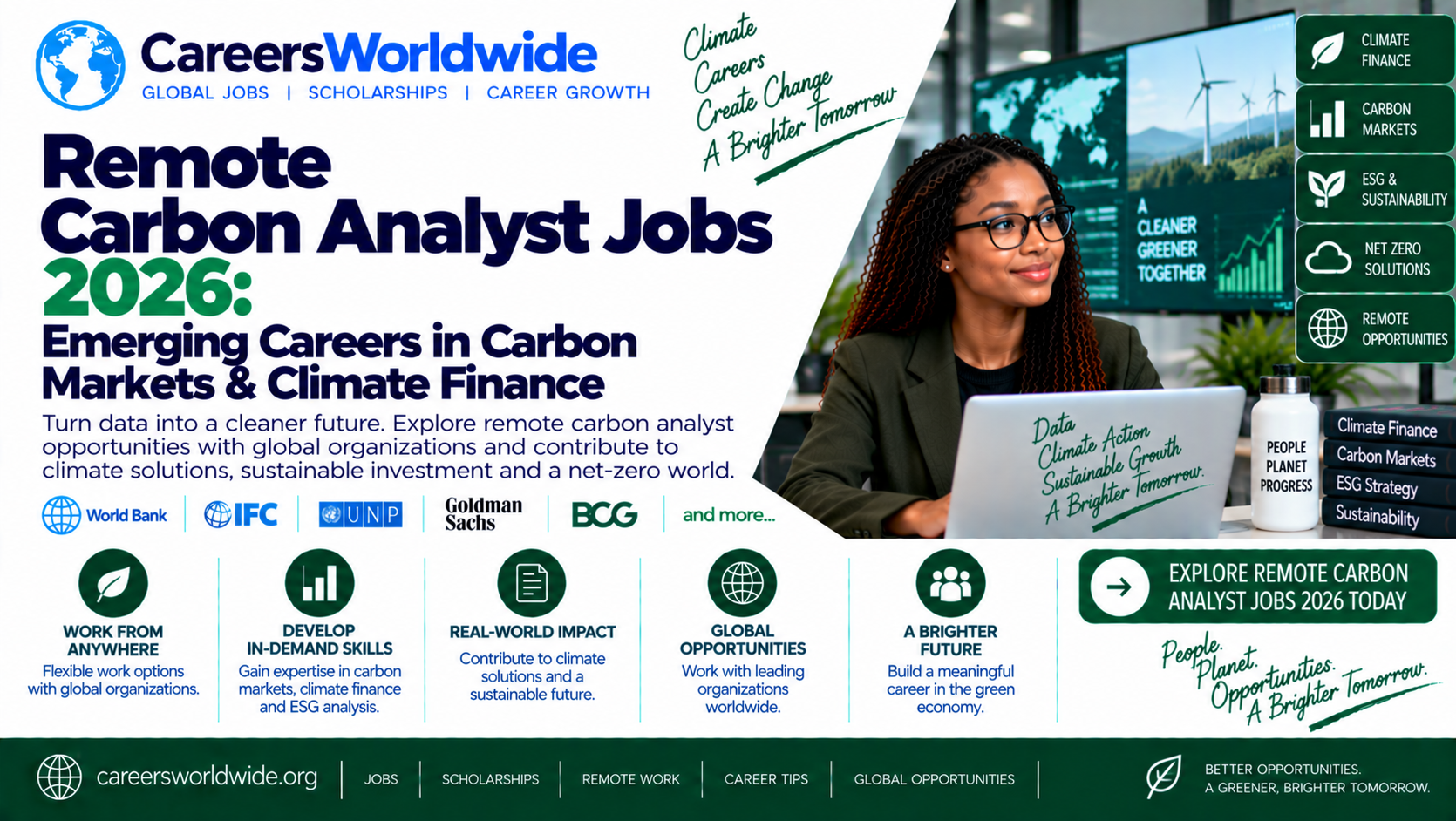

Excerpt: Remote Carbon Analyst jobs in 2026 are emerging at the intersection of climate policy, carbon markets, environmental data, investment, and sustainable finance. As governments and companies expand carbon-pricing systems, emissions trading, carbon-crediting programs, and climate-finance initiatives, professionals with analytical, financial, environmental, and data skills can explore a growing range of career paths. This guide explains carbon analyst roles, essential skills, career pathways, remote-work opportunities, portfolio ideas, application strategies, official resources, and SEO-focused job-search terms.
Remote Carbon Analyst Jobs 2026: A New Career Path in Climate Finance
The global carbon market is becoming increasingly sophisticated.
Governments are developing carbon-pricing systems, businesses are managing emissions exposure, investors are examining climate-related risks, and organizations are purchasing or developing carbon credits.
According to the World Bank’s State and Trends of Carbon Pricing 2026, direct carbon pricing now covers nearly 30% of global greenhouse-gas emissions through 87 implemented policies. Carbon-pricing mechanisms generated more than $107 billion in public revenue during 2025.
These developments are creating demand for professionals who can understand emissions data, market mechanisms, environmental regulations, financial models, and carbon projects.
One emerging career area is the Carbon Analyst.
Carbon analysts can work across several parts of the climate economy. Depending on the employer, the role may involve analyzing carbon markets, evaluating carbon-credit projects, calculating emissions, monitoring regulatory developments, researching climate investments, or supporting corporate decarbonization strategies.
The career can therefore appeal to people with backgrounds in:
- Finance
- Economics
- Environmental science
- Engineering
- Statistics
- Data analytics
- Sustainability
- Energy
- Accounting
- Public policy
- Climate science
Remote positions can also provide opportunities to work with international climate organizations, financial institutions, consultancies, technology companies, carbon-market platforms, and environmental businesses.
However, “remote” does not necessarily mean worldwide. Many employers limit remote positions to specific countries or regions.
What Does a Carbon Analyst Do?
A Carbon Analyst analyzes information related to greenhouse-gas emissions, carbon markets, carbon credits, climate policies, or climate-related financial activity.
The exact job description depends on the employer.
A carbon-market analyst could monitor:
- Carbon-credit prices
- Market supply and demand
- Emissions trading systems
- Carbon taxes
- Carbon-credit standards
- Project methodologies
- Market regulations
- Corporate demand
- Climate policies
A corporate carbon analyst may instead focus on:
- Scope 1 emissions
- Scope 2 emissions
- Scope 3 emissions
- Corporate inventories
- Emissions reductions
- Climate targets
- Sustainability reporting
A climate-finance analyst might analyze:
- Green investments
- Carbon-related financial risks
- Climate projects
- Sustainable finance
- Transition finance
- Investment opportunities
This variety means that the title Carbon Analyst can describe several different career paths.
Why Carbon Markets Matter in 2026
Carbon pricing has become an important component of climate and economic policy in many jurisdictions.
The World Bank’s 2026 Carbon Pricing Dashboard tracks carbon taxes, emissions trading systems, and carbon-crediting mechanisms around the world.
The World Bank reports that direct carbon pricing covered approximately 29% of global greenhouse-gas emissions in 2026. It also reported that carbon-credit issuance increased by 8% from 2024 to 2025, while carbon-credit prices declined slightly overall during 2025, with some project categories continuing to command premiums.
For analysts, this means the market involves much more than simply tracking a single “carbon price.”
Professionals may need to understand:
- Compliance carbon markets
- Voluntary carbon markets
- Carbon taxes
- Emissions trading systems
- Carbon credits
- Carbon removals
- Article 6 mechanisms
- Measurement, reporting and verification
- Climate finance
- Corporate emissions accounting
Carbon Markets vs. Carbon Credits
Understanding the difference is essential for anyone entering the industry.
Carbon Pricing
Carbon pricing places a financial value on greenhouse-gas emissions.
Two major direct approaches include:
Carbon taxes: A government establishes a price or tax associated with emissions.
Emissions trading systems: A market-based system allows regulated entities to trade emissions allowances within a defined framework.
The World Bank’s 2026 report tracks both carbon taxes and emissions trading systems as direct carbon-pricing instruments.
Carbon Credits
A carbon credit generally represents a quantified amount of greenhouse-gas reduction or removal under a particular methodology or program.
Carbon-credit markets involve additional questions around:
- Project quality
- Additionality
- Permanence
- Leakage
- Verification
- Monitoring
- Methodology
- Registry systems
That creates analytical work for professionals who evaluate carbon projects and credits.
Types of Remote Carbon Analyst Jobs in 2026
1. Carbon Market Analyst
A Carbon Market Analyst monitors market developments.
Responsibilities may include:
- Tracking carbon prices
- Monitoring market regulations
- Analyzing trading activity
- Preparing market reports
- Researching supply and demand
- Following emissions trading systems
This role can be suitable for candidates with finance, economics, energy, or environmental backgrounds.
2. Carbon Credit Analyst
Carbon Credit Analysts research individual projects or portfolios of credits.
They may assess:
- Project methodology
- Verification status
- Issuance history
- Retirement activity
- Project location
- Credit characteristics
- Market pricing
Strong research and data-analysis skills are important.
3. Carbon Accounting Analyst
Carbon accounting professionals help organizations measure greenhouse-gas emissions.
They may work with:
- Scope 1
- Scope 2
- Scope 3
- Activity data
- Emission factors
- Corporate inventories
- Sustainability reporting
This career can overlap with ESG and sustainability reporting.
4. Climate Finance Analyst
Climate Finance Analysts examine investments and financial mechanisms connected to climate objectives.
They may work on:
- Climate investments
- Green bonds
- Sustainable finance
- Transition finance
- Climate-risk analysis
- Carbon projects
- Renewable-energy investments
This pathway may appeal particularly to finance graduates.
5. Carbon Project Analyst
Carbon Project Analysts support projects intended to generate carbon credits.
Projects can involve areas such as:
- Reforestation
- Forest conservation
- Methane reduction
- Renewable energy
- Energy efficiency
- Carbon removal
- Waste management
Analysts may assist with project research, financial analysis, monitoring, documentation, and market assessments.
6. Climate Data Analyst
Climate Data Analysts work with environmental datasets.
Their work can involve:
- Emissions data
- Energy consumption
- Climate indicators
- Geographic information
- Corporate sustainability data
- Carbon inventories
Programming and data-visualization skills can be especially useful.
Industries Hiring Carbon Analysts
Carbon-market careers are not limited to environmental organizations.
Financial Services
Banks, investment firms, asset managers, and financial institutions may need professionals who understand climate risks and carbon markets.
Energy
Energy companies increasingly analyze emissions, carbon prices, renewable investments, and transition risks.
Consulting
Environmental and management consultancies can employ analysts to support corporate climate strategies, carbon accounting, and sustainability projects.
Technology
Climate-tech companies develop software and data platforms for emissions tracking, carbon accounting, carbon markets, and environmental reporting.
Carbon-Market Companies
Specialized carbon-market businesses may employ researchers, analysts, traders, project specialists, and data professionals.
International Organizations
Development organizations and multilateral institutions work on carbon pricing, climate finance, emissions reductions, and sustainable-development programs.
The World Bank, for example, publishes extensive carbon-pricing and carbon-market research and provides technical assistance related to carbon pricing and international carbon-credit markets.
Skills Employers Look for in Carbon Analysts
A successful Carbon Analyst may need a combination of technical, environmental, financial, and communication skills.
1. Carbon Market Knowledge
Learn the fundamentals of:
- Carbon taxes
- Emissions trading systems
- Carbon allowances
- Carbon credits
- Voluntary carbon markets
- Compliance markets
- Carbon removals
- Article 6
The World Bank Carbon Pricing Dashboard is a useful resource for understanding how different carbon-pricing instruments operate across jurisdictions.
2. Excel and Financial Modeling
Excel remains useful for analytical roles.
Learn:
- Pivot tables
- XLOOKUP
- INDEX/MATCH
- Conditional formulas
- Data validation
- Charts
- Scenario analysis
- Sensitivity analysis
For climate-finance positions, develop basic financial-modeling skills as well.
3. Data Analysis
Learn how to work with large datasets.
Useful technologies include:
- Excel
- SQL
- Python
- R
- Power BI
- Tableau
You do not need to master every tool.
Start with Excel and one programming or visualization environment.
4. Emissions Accounting
Understanding greenhouse-gas accounting can strengthen your profile.
Learn the basics of:
- Scope 1 emissions
- Scope 2 emissions
- Scope 3 emissions
- Emission factors
- Activity data
- Organizational boundaries
- Carbon inventories
This knowledge can help candidates explore corporate sustainability and carbon-accounting positions in addition to carbon-market roles.
5. Research Skills
Carbon markets change quickly.
Analysts may need to monitor:
- New regulations
- Market announcements
- Policy changes
- Carbon-credit methodologies
- Corporate climate commitments
- New trading systems
Strong research skills are therefore valuable.
Why MRV Skills Matter
One of the important technical areas in carbon markets is Measurement, Reporting and Verification, commonly abbreviated as MRV.
MRV helps establish whether emissions reductions or removals have been measured and documented according to applicable requirements.
The World Bank identifies MRV as an important component of carbon-credit markets and has published specific guidance on measuring, reporting, and verifying carbon credits.
A candidate interested in carbon-credit analysis should understand concepts such as:
- Baselines
- Monitoring plans
- Verification
- Data quality
- Emission factors
- Quantification
- Uncertainty
- Audit trails
These skills can be particularly relevant to carbon-project and carbon-accounting careers.
Carbon Analyst Jobs for Graduates
A specialized Carbon Analyst role may require previous climate or analytical experience, but graduates can build relevant experience through adjacent positions.
Potential entry points include:
- Sustainability Analyst
- ESG Analyst
- Climate Research Assistant
- Environmental Data Analyst
- Energy Analyst
- Research Analyst
- Carbon Accounting Assistant
- Climate Finance Intern
- Sustainability Intern
- Junior Data Analyst
A finance graduate could emphasize financial analysis and climate markets.
An environmental-science graduate could emphasize emissions, sustainability, and climate research.
A technology graduate could focus on environmental data, analytics, automation, and climate technology.
How to Build a Carbon Analyst Portfolio
A practical portfolio can demonstrate your abilities even before you have professional experience.
Project 1: Carbon Pricing Dashboard
Create a dashboard comparing carbon-pricing instruments across countries.
Include:
- Instrument type
- Coverage
- Carbon price
- Sector
- Implementation status
- Recent changes
The World Bank Carbon Pricing Dashboard provides public information that can be used to understand global carbon-pricing systems.
Project 2: Corporate Carbon Footprint
Use a hypothetical company and calculate:
- Scope 1
- Scope 2
- Selected Scope 3 categories
Explain your assumptions and emission factors.
Project 3: Carbon Credit Analysis
Select publicly available information about a carbon project.
Analyze:
- Project type
- Location
- Methodology
- Verification
- Issuance
- Retirement
- Potential risks
Do not present your analysis as an independent certification of the project’s quality.
Project 4: Climate Finance Model
Build a simplified investment model for a hypothetical climate project.
Analyze:
- Initial investment
- Operating costs
- Expected revenues
- Carbon-related revenue
- Energy savings
- Sensitivity scenarios
This can demonstrate both finance and climate knowledge.
Remote Work Skills for Carbon Analysts
Remote climate careers require strong digital collaboration.
Develop familiarity with:
- Microsoft Excel
- Google Sheets
- Microsoft Teams
- Slack
- Zoom
- Power BI
- Tableau
- GitHub
- Cloud-based document systems
More importantly, learn how to communicate analytical findings clearly.
A remote analyst may need to explain a complex carbon-market development through a short written briefing rather than a long meeting.
Carbon Markets and Climate Finance
Carbon markets increasingly intersect with climate finance.
The World Bank’s 2026 guidance discusses how domestic carbon pricing and international carbon-credit markets can be integrated into national climate planning and financing approaches.
This intersection creates career opportunities for people who understand both environmental policy and finance.
Potential work can involve:
- Climate investment analysis
- Carbon-market research
- Project finance
- Carbon revenue modeling
- Sustainable finance
- Transition finance
- Climate-risk analysis
Professionals with financial modeling skills may therefore explore carbon-market careers without coming exclusively from an environmental-science background.
A Practical 90-Day Carbon Analyst Career Plan
Days 1–30: Learn the Market
Study:
- Carbon pricing
- Carbon taxes
- Emissions trading systems
- Carbon credits
- Voluntary carbon markets
- Compliance markets
- MRV
- Article 6
Use authoritative resources such as the World Bank Carbon Pricing Dashboard and UNFCCC materials.
Days 31–60: Build Technical Skills
Focus on:
- Excel
- Data visualization
- Basic financial modeling
- Carbon accounting
- SQL or Python
- Research methods
Build your first portfolio project.
Days 61–90: Specialize
Choose a pathway:
Carbon Markets
or
Carbon Accounting
or
Climate Finance
or
Climate Data
Then update your CV and portfolio accordingly.
Start applying for relevant positions while continuing to learn.
Remote Carbon Analyst Jobs 2026: Summary Table
| Career Area | Main Focus | Useful Skills |
|---|---|---|
| Carbon Market Analyst | Carbon prices and market trends | Economics, Excel, research |
| Carbon Credit Analyst | Carbon-credit research | MRV, project analysis |
| Carbon Accounting Analyst | Corporate emissions | GHG accounting, Excel |
| Climate Finance Analyst | Climate investments | Finance, modeling |
| Carbon Project Analyst | Carbon projects | MRV, research, finance |
| Climate Data Analyst | Environmental datasets | Python, SQL, Power BI |
| ESG Analyst | Sustainability data | ESG, reporting, analytics |
| Energy Analyst | Energy and emissions | Energy markets, data |
| Sustainability Analyst | Corporate climate strategy | Research, reporting |
| Carbon Consultant | Client climate projects | Analysis, communication |
How to Find Remote Carbon Analyst Jobs in 2026
Do not search only for “Carbon Analyst.”
Use multiple search terms.
Try:
- Remote Carbon Analyst
- Carbon Market Analyst Remote
- Carbon Credit Analyst Remote
- Climate Finance Analyst Remote
- Carbon Accounting Analyst Remote
- Carbon Project Analyst
- Climate Data Analyst Remote
- ESG Analyst Remote
- Sustainability Analyst Remote
- Carbon Consultant Remote
- Climate Risk Analyst Remote
- Environmental Data Analyst Remote
- Carbon Markets Jobs 2026
- Climate Finance Jobs 2026
This approach can uncover related positions that may have different titles.
How to Make Your CV Stand Out
A carbon-focused CV should demonstrate analytical ability and climate knowledge.
Instead of listing only:
“Microsoft Excel”
show what you actually did.
For example:
“Built an Excel-based emissions analysis model to estimate Scope 1 and Scope 2 emissions across multiple operational scenarios.”
If you have analyzed carbon markets, explain the project.
For example:
“Developed a comparative analysis of carbon-pricing systems across selected jurisdictions using publicly available market data.”
Only include genuine experience and projects.
Carbon Analyst Interview Preparation
Prepare for questions such as:
“What is the difference between a carbon tax and an emissions trading system?”
Explain how each mechanism prices emissions and how their structures differ.
“What is a carbon credit?”
Explain the concept carefully and distinguish credits from compliance allowances.
“What is MRV?”
Explain measurement, reporting, and verification and why credible data matters.
“What are Scope 1, 2 and 3 emissions?”
Know the basic categories and examples.
“How would you analyze a carbon-credit project?”
Discuss methodology, baseline assumptions, monitoring, verification, issuance, retirement, project risks, and available evidence.
“How would you build a carbon-market dashboard?”
Explain the data sources, variables, cleaning process, calculations, visualizations, and update process.
Official Application and Career Resources
Because vacancies change frequently, applicants should verify current positions through official employer and institutional career portals.
World Bank
The World Bank is also a major source of carbon-pricing and carbon-market research. Its 2026 report tracks global carbon-pricing developments and carbon-credit markets.
International Finance Corporation
IFC careers can be relevant for professionals interested in sustainable finance, private-sector development, climate investment, and related fields.
United Nations Climate Change
UNFCCC Careers and Opportunities
UNFCCC resources cover international climate policy, carbon-market mechanisms, climate finance, and implementation of the Paris Agreement. Its official website continues to publish 2026 carbon-pricing and climate-finance materials.
World Bank Carbon Pricing Dashboard
This is particularly useful for candidates building carbon-market knowledge and portfolio projects. It provides jurisdiction-level information about carbon taxes, emissions trading systems, and crediting mechanisms.
UNFCCC Documents
UNFCCC Documents and Resources
The UNFCCC document library contains guidance, reports, technical materials, and other resources covering carbon markets and climate finance.
FAQ: Remote Carbon Analyst Jobs 2026
What does a Carbon Analyst do?
A Carbon Analyst evaluates information related to greenhouse-gas emissions, carbon markets, carbon credits, climate policy, carbon accounting, or climate finance.
Is Carbon Analyst a finance job?
It can be. Some Carbon Analyst roles are strongly connected to finance, while others focus on environmental data, emissions accounting, carbon projects, or policy.
Do I need a climate-science degree?
Not necessarily. Relevant backgrounds can include finance, economics, environmental science, engineering, statistics, data analytics, energy, sustainability, and public policy.
Can finance graduates work in carbon markets?
Yes. Financial modeling, economics, market research, investment analysis, and quantitative skills can be relevant to carbon-market and climate-finance roles.
Can environmental-science graduates become Carbon Analysts?
Yes. Environmental knowledge can be particularly relevant to carbon accounting, carbon projects, sustainability, emissions analysis, and environmental research.
Is Python necessary?
Not for every role. Excel and strong analytical skills may be sufficient for some positions, while Python, SQL, R, or other tools can be valuable for data-heavy jobs.
What is MRV in carbon markets?
MRV stands for Measurement, Reporting and Verification. It refers to processes used to measure and document emissions or reductions and verify relevant information according to applicable standards or requirements.
Are Carbon Analyst jobs remote?
Some positions are remote or home-based, but location restrictions are common. Applicants should check the exact geographic eligibility of each vacancy.
Can graduates get remote Carbon Analyst jobs?
Some entry-level and related positions may be available, but candidates may also benefit from searching for sustainability, ESG, climate-data, research, or analyst positions as entry points.
What certifications can help?
Relevant education or training in areas such as carbon accounting, ESG, climate finance, sustainability, GHG accounting, data analysis, or carbon markets can strengthen a profile. Candidates should evaluate each certification based on the actual requirements of the jobs they want.
How can I gain carbon-market experience?
Use public datasets and institutional resources to build research projects. Analyze carbon-pricing systems, create emissions dashboards, study publicly available carbon projects, or develop climate-finance models.
Where should I look for jobs?
Search official career pages of international organizations, financial institutions, consulting companies, climate-tech businesses, energy companies, carbon-market organizations, and sustainability-focused employers.
Final Thoughts
Remote Carbon Analyst Jobs 2026 represent a developing career area connecting climate policy, environmental data, carbon markets, sustainable finance, and business strategy.
The opportunity is broader than a single job title.
Professionals can enter through carbon-market analysis, carbon accounting, climate finance, ESG, sustainability, energy analysis, environmental data, or carbon-project development.
The global carbon-pricing landscape is also becoming more complex. The World Bank’s 2026 analysis reports 87 implemented direct carbon-pricing policies covering nearly 30% of global greenhouse-gas emissions, demonstrating the scale of the market environment analysts increasingly need to understand.
For people entering the field, a combination of Excel, data analysis, carbon accounting, financial modeling, market research, and climate-policy knowledge can provide a practical foundation.
Candidates interested in more technical positions can add Python, SQL, Power BI, R, or other data tools.
Those interested in climate finance should develop financial modeling and investment-analysis capabilities.
Those interested in carbon projects should learn about MRV, methodologies, verification, project documentation, and carbon-credit markets.
Most importantly, build evidence of your skills.
A portfolio containing a carbon-pricing dashboard, corporate emissions model, carbon-project analysis, or climate-finance model can show employers how you apply your knowledge to real-world questions.
Remote work adds another consideration: a job marked “remote” may still be restricted to a particular country, region, time zone, or employment jurisdiction. Always verify the requirements on the employer’s official careers page before applying.
Disclaimer
This article is provided for general career, educational, and informational purposes. Job availability, salaries, qualifications, geographic eligibility, application deadlines, remote-work arrangements, and employer requirements can change without notice. CareersWorldwide does not guarantee employment, interviews, or selection for any position. Applicants should verify all vacancy information through the relevant employer’s official career website before applying. Never pay a recruiter or employer to obtain a legitimate job, and do not submit sensitive financial or personal information through unofficial recruitment channels.
SEO Keywords
Primary keyword: Remote Carbon Analyst Jobs 2026
Secondary keywords: Remote Carbon Analyst Jobs, Carbon Analyst jobs 2026, remote carbon market jobs, carbon markets careers 2026, carbon credit analyst jobs, remote carbon credit jobs, climate finance jobs 2026, remote climate finance jobs, carbon accounting jobs 2026, remote carbon accounting jobs, carbon project analyst jobs, remote carbon project jobs, climate data analyst jobs, remote climate jobs 2026, ESG analyst jobs 2026, remote ESG analyst jobs, sustainability analyst jobs, remote sustainability jobs, carbon trading jobs, carbon market analyst jobs, carbon finance careers, climate finance careers, carbon credits jobs, carbon pricing jobs, emissions trading jobs, environmental data analyst jobs, climate risk analyst jobs, sustainable finance jobs, green finance jobs 2026, carbon markets careers for graduates, climate finance careers for graduates, remote environmental jobs, work from home climate jobs, global carbon market careers, carbon accounting careers, climate technology jobs, climate-tech careers 2026.
ALSO CHECK: Remote Biostatistics Jobs 2026: Global Careers in Health Data & Medical ResearchSeptember 16, 2026
Remote Customer Success Jobs 2026: Global SaaS Careers With Flexible Work OptionsSeptember 16, 2026
Remote QA Engineer Jobs 2026: Global Software Testing & Quality Assurance CareersSeptember 16, 2026