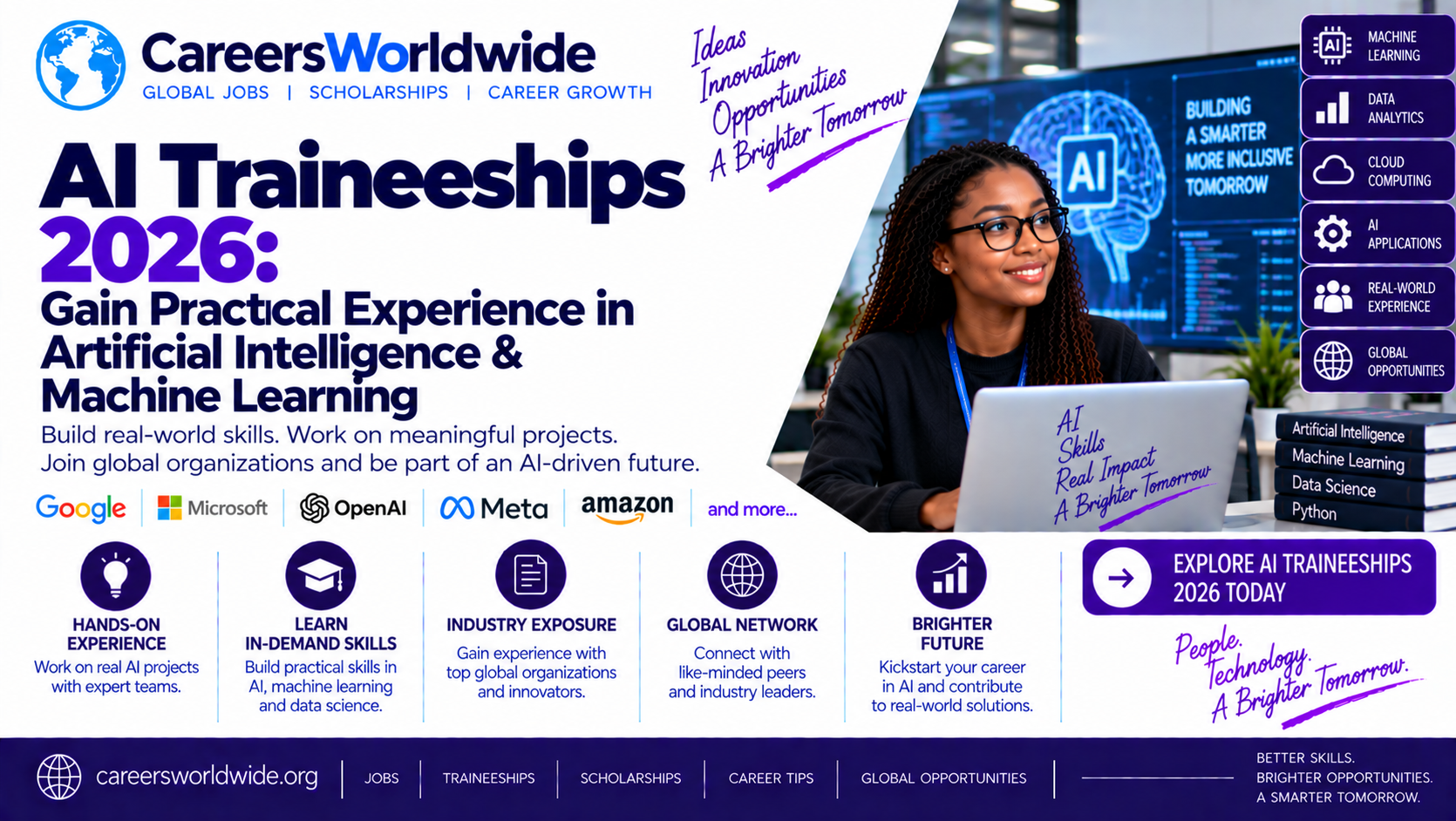

Excerpt: AI traineeships in 2026 offer students, graduates and career changers a practical pathway into artificial intelligence, machine learning, data science, automation and software development. Explore AI traineeship pathways, technical skills, portfolio projects, application strategies, interview preparation and official resources for building a career in artificial intelligence and machine learning.
Artificial intelligence has moved from a specialized research field into one of the most influential areas of modern technology.
Organizations are using AI for customer service, cybersecurity, healthcare, financial analysis, software development, logistics, marketing, scientific research and business automation.
At the same time, advances in machine learning and generative AI have created demand for professionals who can develop, deploy, evaluate and responsibly manage AI systems.
For students and recent graduates, this creates an opportunity to enter the field through AI traineeships in 2026.
A traineeship can provide structured learning combined with practical work experience. Depending on the program, participants may work with machine learning models, data pipelines, AI applications, cloud platforms, automation tools or software engineering teams.
Importantly, AI traineeships are not necessarily limited to people with advanced mathematics or doctoral degrees.
Many entry-level pathways emphasize programming, analytical thinking, problem-solving and the ability to learn new technologies.
What Are AI Traineeships?
AI traineeships are structured early-career programs designed to help participants develop practical skills in artificial intelligence and related technologies.
They may combine:
- Classroom learning
- Technical training
- Mentorship
- Project work
- Team collaboration
- Workplace experience
- Professional development
Depending on the employer, a trainee could work on:
- Machine learning
- Data analysis
- Natural language processing
- Computer vision
- Generative AI
- AI automation
- Model evaluation
- Data engineering
- Software engineering
- AI infrastructure
- Responsible AI
The title may not always say “AI Trainee.”
Search for related titles such as:
- AI Trainee
- Machine Learning Trainee
- Artificial Intelligence Apprentice
- AI Graduate Program
- Machine Learning Graduate
- Data Science Trainee
- AI Engineer Trainee
- Junior Machine Learning Engineer
- AI Research Assistant
- Data Analyst Trainee
- Software Engineering Graduate
- AI Technology Associate
Why AI Traineeships Matter in 2026
AI is increasingly being integrated into existing business and technology systems.
This means the future AI workforce will include more than research scientists.
Organizations need people who can:
- Prepare data
- Build models
- Test AI systems
- Deploy applications
- Monitor performance
- Manage infrastructure
- Evaluate outputs
- Identify risks
- Communicate results
This creates multiple career entry points.
Someone with strong programming skills might pursue machine learning engineering.
A statistics graduate could move into data science.
A software developer could specialize in AI applications.
A business graduate could work in AI product management or AI governance.
Major AI Traineeship Pathways
1. Machine Learning
Machine learning focuses on systems that learn patterns from data.
Trainees may work with:
- Regression
- Classification
- Clustering
- Model evaluation
- Feature engineering
- Data preprocessing
2. Generative AI
Generative AI systems can produce text, images, code and other content.
Entry-level opportunities may involve:
- AI application development
- Prompt engineering
- Model evaluation
- Retrieval-augmented generation
- AI agents
- AI testing
- Data preparation
3. Data Science
Data science combines statistics, programming and analytical thinking.
Trainees may work on:
- Data cleaning
- Exploratory analysis
- Predictive modeling
- Visualization
- Statistical analysis
4. AI Engineering
AI engineers build applications that use machine learning and AI models.
Skills can include:
- Python
- APIs
- Cloud platforms
- Databases
- Software engineering
- Machine learning
5. Computer Vision
Computer vision focuses on systems that process images and video.
Applications include:
- Medical imaging
- Manufacturing
- Autonomous systems
- Security
- Retail
6. Natural Language Processing
NLP focuses on systems that process human language.
Applications include:
- Search
- Chatbots
- Text classification
- Translation
- Summarization
- Document analysis
7. Responsible AI
As AI adoption expands, organizations need professionals who understand issues involving:
- Bias
- Fairness
- Privacy
- Transparency
- Security
- Governance
- Model evaluation
This can create opportunities for candidates with backgrounds in law, policy, ethics, social science and technology.
AI Traineeships at a Glance
| Pathway | Main Focus | Useful Skills |
|---|---|---|
| AI Trainee | General AI applications | Python, data |
| Machine Learning | Predictive models | Python, statistics |
| Data Science | Data analysis | SQL, Python |
| AI Engineering | AI applications | Python, APIs |
| Generative AI | AI-powered applications | APIs, Python |
| NLP | Language systems | Python, ML |
| Computer Vision | Image analysis | Python, computer vision |
| AI Infrastructure | Model deployment | Cloud, Docker |
| Responsible AI | Governance and evaluation | Research, ethics |
| AI Product | AI-powered products | Product, analytics |
Skills to Learn Before Applying
You do not need to master every AI technology before applying.
Build a strong foundation.
Python
Python is one of the most useful programming languages for AI and machine learning.
Learn:
- Variables
- Functions
- Loops
- Data structures
- Object-oriented programming
- File handling
- APIs
- Basic testing
Then progress to libraries such as:
- NumPy
- pandas
- scikit-learn
Mathematics
You do not need advanced mathematics for every entry-level AI role.
However, understand:
- Algebra
- Probability
- Statistics
- Basic calculus
- Linear algebra
For machine learning, statistics and probability are especially important.
SQL
AI systems depend on data.
Learn how to:
- Query databases
- Filter records
- Join tables
- Aggregate data
- Clean datasets
SQL can also open doors to data analyst and data engineering roles.
Git
Learn:
- Repositories
- Commits
- Branches
- Pull requests
- Merging
Use GitHub or another appropriate platform to document your projects.
Machine Learning Fundamentals
Before attempting complicated AI systems, learn the fundamentals.
Understand:
Supervised Learning
Models learn from labeled examples.
Examples include:
- Classification
- Regression
Unsupervised Learning
Models identify patterns in data without predefined labels.
Examples include:
- Clustering
- Dimensionality reduction
Model Evaluation
Learn why models should not simply be judged by whether they work on training data.
Understand:
- Training data
- Validation data
- Test data
- Overfitting
- Underfitting
- Accuracy
- Precision
- Recall
- F1 score
The appropriate evaluation metric depends on the problem.
Build AI Projects Before Applying
One of the strongest ways to demonstrate AI interest is to build practical projects.
Project 1: Customer Churn Prediction
Use a public or synthetic dataset to predict whether customers are likely to leave a service.
Document:
- Dataset
- Features
- Model
- Evaluation
- Limitations
Project 2: Sentiment Analysis
Build a simple NLP model that classifies text sentiment.
Explain:
- Data preprocessing
- Model selection
- Results
- Limitations
Project 3: Image Classification
Train a simple model to classify images using an appropriate public dataset.
Document the entire process.
Project 4: AI-Powered Document Search
Build a small application that allows users to search a collection of documents using semantic retrieval.
This can introduce you to modern AI application concepts.
Project 5: AI Business Assistant
Create a prototype AI application that helps a fictional business answer questions about its internal documents.
Focus on:
- Retrieval
- Prompt design
- Evaluation
- Security
- Hallucination risks
Do not upload confidential information.
How to Build a Strong AI Portfolio
A portfolio should explain what you built rather than simply display a model.
For every project, include:
Problem
What were you trying to solve?
Data
Where did the data come from?
Method
What approach did you use?
Results
How well did the system perform?
Limitations
Where could it fail?
Future Improvements
What would you change?
This demonstrates engineering and analytical thinking.
AI Traineeships Without Professional Experience
Many beginners worry that AI employers expect years of experience.
For a traineeship, your ability to learn can be as important as previous employment.
You can demonstrate this through:
- University projects
- Coding projects
- Kaggle-style competitions
- Open-source contributions
- Research
- Technical certifications
- Personal projects
A strong project portfolio can show that you can move from theory to implementation.
AI and Cloud Computing
AI applications increasingly depend on cloud infrastructure.
Learn the basics of at least one major cloud platform:
- AWS
- Microsoft Azure
- Google Cloud
Understand:
- Compute
- Storage
- Databases
- Networking
- Identity
- APIs
- Monitoring
Later, explore how machine learning models can be deployed using cloud services.
AI and Data Engineering
AI systems depend on reliable data pipelines.
Data engineering skills can therefore complement AI knowledge.
Explore:
- SQL
- Data warehouses
- ETL/ELT
- APIs
- Databases
- Data pipelines
- Cloud storage
This combination can lead to roles involving machine learning infrastructure and data platforms.
How to Find AI Traineeships in 2026
Search Technology Companies
Look for:
- AI graduate programs
- Machine learning internships
- AI engineering traineeships
- Software engineering graduate roles
- Data science programs
Search Banks
Banks increasingly use AI for:
- Fraud detection
- Risk analysis
- Customer service
- Document processing
- Financial forecasting
Technology and AI graduate programs can therefore provide relevant experience.
Search Healthcare Organizations
AI is used in areas such as:
- Medical research
- Health analytics
- Imaging
- Patient-risk modeling
- Healthcare administration
Search Consulting Firms
Consulting companies increasingly advise organizations on AI adoption and digital transformation.
Search for:
- AI consulting
- Data analytics
- Digital transformation
- Technology consulting
- Machine learning
Official AI Career and Training Resources
Applicants should use official career and education portals whenever possible.
Google Careers — Search AI, machine learning, software engineering, data and early-career opportunities.
Google also provides technical learning resources through Google Cloud Skills Boost, which includes training related to cloud, data and AI.
Microsoft
Microsoft Careers — Explore AI, software engineering, cloud and early-career opportunities.
Microsoft also provides AI learning resources through Microsoft Learn.
IBM
IBM Careers — Search AI, data, software, consulting and technology roles.
IBM also provides learning resources through IBM SkillsBuild.
Amazon
Amazon Jobs — Explore machine learning, AI, software engineering, data and cloud positions.
NVIDIA
NVIDIA Careers — Explore opportunities in AI, accelerated computing, software, research and engineering.
Applicants should verify the specific requirements of each vacancy before applying.
How to Apply for AI Traineeships in 2026
A strong application requires more than submitting a generic CV.
Step 1: Choose a Target Path
Decide whether your strongest direction is:
AI + Software Engineering
AI + Data Science
AI + Machine Learning
AI + Cloud
AI + Research
AI + Responsible AI
This helps you select appropriate vacancies.
Step 2: Read the Entire Job Description
Identify:
- Required qualifications
- Preferred skills
- Programming languages
- Degree requirements
- Experience requirements
- Location
- Work authorization
- Application deadline
Separate mandatory requirements from preferred qualifications.
Step 3: Customize Your CV
Put your most relevant skills and projects near the top.
If the role emphasizes Python, SQL and machine learning, those should be easy for the recruiter to find.
Step 4: Link Your Projects
Include a portfolio, GitHub repository or appropriate project page where relevant.
Make sure the repository is organized and contains a useful README.
Step 5: Prepare for Assessments
Some technology employers use coding tests, technical assessments or structured interviews.
IBM, for example, says its recruitment process may include coding assessments, video assessments and other role-dependent evaluations.
Prepare by practicing:
- Python
- Algorithms
- Data structures
- SQL
- Machine-learning fundamentals
- Problem-solving
Step 6: Apply Through the Official Portal
Use the employer’s official career website whenever possible.
This also reduces the risk of fraudulent recruitment advertisements.
NVIDIA specifically warns candidates about recruitment scams and says legitimate open positions are posted through its official careers system, with applicants encouraged to use the online portal.
How to Prepare Your AI Traineeship CV
Your CV should demonstrate both technical ability and learning potential.
Education
Include:
- Degree
- University
- Graduation date
- Relevant coursework
Technical Skills
Potential examples include:
- Python
- SQL
- Git
- pandas
- NumPy
- scikit-learn
- TensorFlow
- PyTorch
- Cloud platforms
Only list technologies you can discuss confidently.
Projects
Include your strongest two or three AI projects.
Research
Research experience can be particularly valuable for machine learning and AI roles.
Include:
- Research topic
- Methodology
- Tools
- Results
How to Make an AI CV Stand Out
Avoid simply writing:
“Passionate about artificial intelligence.”
Show evidence.
For example:
“Developed and evaluated a Python machine-learning model using a public dataset, achieving an F1 score of X and documenting model limitations.”
Specific evidence is more persuasive.
AI Traineeship Interview Preparation
AI interviews can cover several areas.
Programming
Prepare for:
- Python
- Algorithms
- Data structures
- Debugging
Machine Learning
Review:
- Regression
- Classification
- Overfitting
- Feature engineering
- Model evaluation
Statistics
Understand:
- Probability
- Distributions
- Correlation
- Regression
- Hypothesis testing
Data
Be comfortable with:
- SQL
- Data cleaning
- Data visualization
AI Concepts
Understand:
- Neural networks
- Embeddings
- Large language models
- Generative AI
- Model evaluation
Behavioral Questions
Prepare examples showing:
- Problem-solving
- Teamwork
- Curiosity
- Learning quickly
- Handling failure
- Communicating technical concepts
AI Traineeships for International Applicants
International candidates should carefully review eligibility.
Programs may be restricted based on:
- Citizenship
- Residence
- Work authorization
- University enrollment
- Graduation date
- Security requirements
Some government or defense-related AI programs may have particularly strict eligibility conditions.
Do not assume that an international technology company accepts candidates globally for every traineeship.
A Practical 90-Day AI Preparation Plan
Days 1–30: Programming and Data
Learn:
- Python
- SQL
- Git
- Statistics
Complete small coding exercises.
Days 31–60: Machine Learning
Study:
- Data preprocessing
- Regression
- Classification
- Model evaluation
- Overfitting
Build one machine-learning project.
Days 61–90: AI Application Development
Build a second project involving:
- Generative AI
- NLP
- Computer vision
- AI APIs
Then prepare your CV and start applying.
Common Mistakes AI Trainees Should Avoid
Trying to Learn Everything
AI is enormous.
Choose a specialization.
Focusing Only on Prompt Engineering
Prompting can be useful, but broader AI careers require understanding data, software, evaluation and system design.
Ignoring Mathematics
You do not need a PhD-level mathematical background, but basic statistics and probability are important.
Building Projects Without Documentation
Explain your methodology and limitations.
Copying Tutorials Without Understanding Them
Be prepared to explain your project during an interview.
Ignoring AI Ethics
Understand issues involving privacy, bias, security, misinformation and responsible deployment.
AI Traineeships 2026: Quick Summary
| Career Path | Main Focus | Key Skills |
|---|---|---|
| AI Trainee | General AI | Python, data |
| Machine Learning Trainee | Predictive models | Statistics, Python |
| Data Science Trainee | Data analysis | SQL, Python |
| AI Engineer Trainee | AI applications | Python, APIs |
| Generative AI Trainee | AI applications | LLMs, APIs |
| NLP Trainee | Language technology | Python, ML |
| Computer Vision Trainee | Image AI | Python, ML |
| AI Cloud Trainee | Deployment | Cloud, Docker |
| AI Research Trainee | Research | Math, statistics |
| Responsible AI Trainee | Governance | Research, ethics |
Frequently Asked Questions
What are AI traineeships?
AI traineeships are structured early-career programs combining training and practical experience in artificial intelligence, machine learning, data science or related technologies.
Can beginners apply for AI traineeships?
Yes. Requirements vary, but traineeship and graduate pathways can provide structured entry into the field.
Do I need a computer science degree?
Not necessarily. Computer science is useful, but mathematics, statistics, engineering, data science and other quantitative backgrounds can also be relevant.
Do I need advanced mathematics?
Not for every AI role. However, statistics, probability and basic linear algebra can provide a valuable foundation.
Is Python necessary for AI?
Python is one of the most useful languages for AI and machine learning, although other languages are used in production systems.
Should I learn machine learning before generative AI?
Understanding basic machine-learning and data concepts first can make it easier to understand modern AI systems.
Can I get an AI traineeship without experience?
Yes. Personal projects, academic research, coding portfolios and technical training can demonstrate practical ability.
Are AI traineeships paid?
Some employer-sponsored traineeships and graduate programs are paid, while compensation varies by organization, country and program. Always verify the official vacancy.
Can international students apply?
Some programs accept international candidates, while others have citizenship, residence or work-authorization requirements.
What projects should I build for an AI traineeship?
Build projects that demonstrate data preparation, model development, evaluation and practical application. Customer churn prediction, NLP, image classification and AI-powered applications are useful examples.
Final Thoughts
Artificial intelligence is creating new career opportunities across technology, finance, healthcare, government, research and business.
For students and graduates, the challenge is deciding where to start.
You do not need to master every AI framework.
Begin with Python, statistics, SQL and data analysis.
Then learn machine-learning fundamentals and build practical projects.
Once you have a foundation, explore more specialized areas such as generative AI, natural language processing, computer vision, AI engineering, cloud deployment or responsible AI.
The most valuable evidence you can provide to a prospective employer is not simply a list of AI buzzwords. It is evidence that you can take a problem, work with data, build a solution, evaluate the result and explain what you discovered.
A useful progression for 2026 is:
Python → Data → Statistics → Machine Learning → AI Applications → Cloud/Deployment → Portfolio → Traineeship Applications
AI traineeships can provide a valuable bridge between academic learning and professional technology work. Whether your long-term goal is to become a machine learning engineer, data scientist, AI engineer, AI researcher, AI product specialist or responsible-AI professional, building strong fundamentals will give you a better starting point.
Start with manageable projects, document your learning and apply strategically to programs whose eligibility requirements you meet.
Important Application Disclaimer
CareersWorldwide is a third-party careers and opportunities information website and is not the employer, training provider or recruiting authority for the programs and organizations mentioned in this article. Traineeship availability, eligibility, deadlines, locations, compensation and program conditions can change. Applicants should verify all information through the official employer or training provider before applying or submitting personal information. Never pay an unofficial individual or intermediary simply to obtain a traineeship or job.
SEO Keywords
AI traineeships 2026, artificial intelligence traineeships 2026, AI trainee jobs, AI apprenticeship 2026, artificial intelligence apprenticeship, machine learning traineeships, machine learning trainee jobs, AI graduate programs 2026, artificial intelligence graduate programs, AI training programs, machine learning training programs, AI careers 2026, artificial intelligence careers, entry-level AI jobs, AI jobs for graduates, machine learning jobs for beginners, AI traineeships for international students, AI traineeships for graduates, paid AI traineeships, data science traineeships 2026, AI engineering traineeships, generative AI traineeships, artificial intelligence internships 2026, machine learning internships 2026, AI technology careers
ALSO CHECK: Cybersecurity Traineeships 2026: Launch Your Career in Digital Security & ITSeptember 15, 2026
Health Informatics Scholarships 2026: Study Healthcare, Data & Digital Health TechnologySeptember 15, 2026
Accounting Internships 2026: Build Practical Experience in Finance & BusinessSeptember 15, 2026