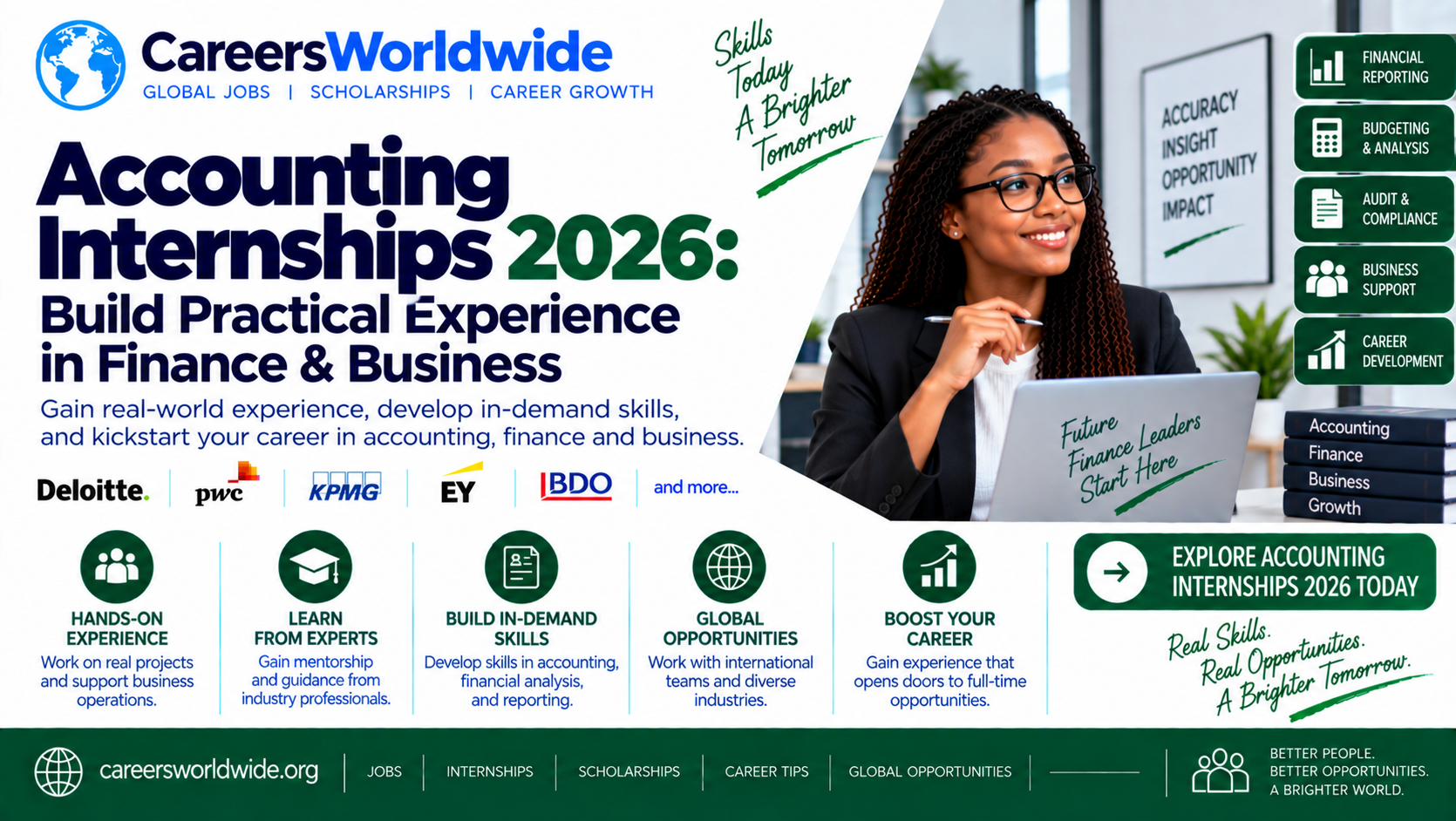

Excerpt: Accounting internships in 2026 can help students and recent graduates turn classroom knowledge into practical experience in financial reporting, auditing, tax, bookkeeping, budgeting and business analysis. Explore accounting career paths, essential skills, portfolio ideas, application strategies and official resources for finding accounting internships with companies, banks, professional firms and organizations.
Accounting is one of the most established career paths in business, but the profession continues to evolve rapidly.
Modern accountants increasingly work with financial technology, cloud accounting platforms, data analytics, automation, enterprise software and digital reporting systems. As businesses become more data-driven, accounting professionals are expected to understand more than debits and credits.
For students and recent graduates, an accounting internship in 2026 can provide an important bridge between academic study and the professional workplace.
An intern may assist with financial records, reconciliations, accounts payable, accounts receivable, budgeting, audit preparation, tax research, financial reporting or data analysis. Depending on the organization, interns can also gain experience with accounting software and enterprise resource planning systems.
Accounting internships can be found in public accounting firms, banks, corporations, consulting companies, nonprofit organizations, government institutions and international organizations.
The field is also broader than the traditional title of “Accounting Intern.” Students should consider related opportunities such as Audit Intern, Finance Intern, Tax Intern, Financial Analyst Intern, Internal Audit Intern and Accounting Advisory Intern.
What Are Accounting Internships?
Accounting internships are temporary professional-learning opportunities that allow students or recent graduates to gain practical experience in accounting and financial operations.
The exact responsibilities depend on the employer and the level of the internship.
Typical responsibilities may include:
- Preparing financial schedules
- Assisting with account reconciliations
- Entering financial information
- Supporting accounts payable
- Supporting accounts receivable
- Reviewing invoices
- Assisting with month-end close
- Preparing audit documentation
- Conducting financial research
- Supporting budgeting
- Analyzing financial data
- Maintaining accounting records
- Preparing management reports
- Assisting tax teams
- Improving financial processes
Some internships are highly technical, while others combine accounting with business operations or financial analysis.
Why Accounting Internships Matter in 2026
Accounting remains central to how organizations measure performance, manage resources and make financial decisions.
At the same time, technology is changing how accounting work is performed.
Cloud-based accounting, automation, artificial intelligence and data analytics are increasingly being incorporated into finance functions.
This means students entering the profession can benefit from developing both accounting fundamentals and digital skills.
A strong accounting intern should understand the basics of financial reporting while also being comfortable working with spreadsheets, databases and business software.
Types of Accounting Internships to Explore
1. Public Accounting Internships
Public accounting firms provide services to multiple clients.
Interns may gain experience in:
- External audit
- Tax
- Accounting advisory
- Assurance
- Consulting
This can be a strong pathway for students interested in professional accounting careers.
2. Corporate Accounting Internships
Corporate accounting teams manage the financial activities of individual organizations.
Interns may work on:
- General ledger accounting
- Month-end close
- Financial reporting
- Accounts payable
- Accounts receivable
- Expense reporting
- Internal controls
3. Audit Internships
Audit internships can provide exposure to financial statements, internal controls and evidence-based financial review.
Interns may assist with:
- Audit testing
- Documentation
- Financial statement analysis
- Account confirmations
- Reconciliations
- Control reviews
4. Tax Internships
Tax interns may assist with:
- Tax research
- Tax returns
- Compliance
- Financial documentation
- Tax calculations
- Client information gathering
Tax can be a particularly useful specialization for students interested in professional accounting.
5. Internal Audit Internships
Internal audit focuses on evaluating organizational processes, controls and risks.
Interns may examine:
- Internal controls
- Business processes
- Risk management
- Compliance
- Financial procedures
6. Accounting Advisory Internships
Accounting advisory combines accounting knowledge with consulting.
Interns may support projects involving:
- Financial reporting
- Accounting standards
- Transactions
- Process improvement
- Business transformation
7. Government and Nonprofit Accounting
Government agencies and nonprofit organizations also require accounting professionals.
Interns may gain experience with:
- Budget management
- Grant accounting
- Financial reporting
- Compliance
- Fund accounting
- Procurement
Accounting Internship Opportunities at a Glance
| Internship Area | Typical Responsibilities | Useful Skills |
|---|---|---|
| General Accounting | Ledgers, reconciliations | Accounting fundamentals |
| Audit | Testing, documentation | Analysis, attention to detail |
| Tax | Research, compliance | Tax knowledge |
| Corporate Finance | Reporting, planning | Excel, financial analysis |
| Accounts Payable | Invoices, payments | Accuracy, organization |
| Accounts Receivable | Billing, collections | Accounting, communication |
| Internal Audit | Controls, risk | Analysis, risk awareness |
| Accounting Advisory | Reporting, consulting | Accounting + problem-solving |
| Financial Analysis | Forecasting, reporting | Excel, statistics |
| Government Accounting | Budgets, compliance | Accounting, public finance |
Essential Accounting Skills for Interns
You do not need to know everything before applying.
However, mastering the fundamentals can give you a stronger foundation.
Financial Accounting
Understand:
- Assets
- Liabilities
- Equity
- Revenue
- Expenses
- Profit
- Cash flow
You should also understand how these elements appear in financial statements.
Financial Statements
Become comfortable reading:
Income statements
Balance sheets
Cash-flow statements
Understand how the statements relate to one another.
Journal Entries
Practice basic journal entries involving:
- Revenue
- Expenses
- Cash
- Accounts receivable
- Accounts payable
- Depreciation
- Accruals
- Prepayments
Bank Reconciliation
Understand how accounting records can be compared with bank statements to identify discrepancies.
Accounts Payable and Receivable
Learn the basic processes behind:
- Vendor invoices
- Customer invoices
- Payments
- Collections
- Aging reports
These are common areas of practical accounting work.
Excel Skills for Accounting Internships
Excel remains an important tool for many accounting and finance teams.
At minimum, learn:
- SUM
- SUMIF/SUMIFS
- COUNTIF/COUNTIFS
- IF
- XLOOKUP
- INDEX/MATCH
- Pivot tables
- Charts
- Conditional formatting
- Data validation
- Basic data cleaning
More advanced candidates can explore:
- Power Query
- Power Pivot
- Financial modeling
- Macros
- Automation
You do not need to become an Excel expert before applying, but being comfortable with spreadsheets can be valuable.
Accounting Software and Digital Skills
Modern accounting teams may use specialized platforms and enterprise systems.
Depending on the organization, students may encounter:
- QuickBooks
- Xero
- SAP
- Oracle
- Microsoft Dynamics
- NetSuite
- Workday
You do not need experience with every platform.
Instead, understand accounting workflows and learn how financial information moves through digital systems.
Data Analytics and Accounting
Accounting is becoming increasingly data-driven.
Data analytics can help finance teams identify:
- Unusual transactions
- Trends
- Errors
- Financial risks
- Expense patterns
- Revenue changes
- Operational inefficiencies
Students can strengthen their profiles by learning:
- Excel
- SQL
- Power BI
- Tableau
- Python
For an accounting student, even basic data-analysis skills can provide a useful advantage.
Accounting and Artificial Intelligence
AI and automation are increasingly relevant to accounting workflows.
Technology can potentially assist with:
- Invoice processing
- Transaction classification
- Document extraction
- Reconciliation
- Financial analysis
- Anomaly detection
- Reporting
This does not eliminate the need for accounting knowledge.
Instead, it makes it increasingly valuable for accountants to understand how technology can improve financial processes while maintaining appropriate controls and human oversight.
Students interested in the future of accounting can therefore combine:
Accounting + Data
or
Accounting + Technology
or
Accounting + Finance
How to Build an Accounting Portfolio
Accounting students sometimes overlook the value of projects because accounting can seem less portfolio-oriented than programming.
However, practical projects can demonstrate analytical ability.
Project 1: Financial Statement Analysis
Choose a publicly available annual report and analyze:
- Revenue
- Expenses
- Profitability
- Assets
- Liabilities
- Cash flow
Create a short report explaining the major trends.
Project 2: Budgeting Model
Build a simple annual budget for a hypothetical business.
Include:
- Revenue assumptions
- Operating expenses
- Payroll
- Capital expenditure
- Cash flow
- Budget variance
Project 3: Accounts Receivable Dashboard
Create a fictional accounts-receivable dataset.
Analyze:
- Outstanding invoices
- Aging
- Customer balances
- Collection trends
Build an Excel or Power BI dashboard.
Project 4: Bank Reconciliation
Create a sample bank statement and accounting ledger.
Identify:
- Outstanding checks
- Deposits in transit
- Bank charges
- Recording errors
Then prepare a reconciliation.
Project 5: Financial Data Dashboard
Use public company financial information to create a dashboard showing:
- Revenue growth
- Profit margins
- Cash flow
- Debt
- Key financial ratios
Document the methodology clearly.
Accounting Internships for Different Academic Backgrounds
Accounting Students
Emphasize:
- Financial accounting
- Auditing
- Tax
- Financial reporting
- Excel
Finance Students
Highlight:
- Financial analysis
- Financial modeling
- Excel
- Economics
- Investments
Business Students
Emphasize:
- Business analysis
- Accounting coursework
- Excel
- Operations
- Communication
Economics Students
Highlight:
- Quantitative analysis
- Statistics
- Economics
- Research
- Data analysis
Information Technology Students
Consider accounting technology, financial systems, ERP and data-analysis internships.
The important point is to connect your academic background with the requirements of the position.
How to Find Accounting Internships in 2026
Use several search channels rather than relying on one website.
Search Accounting Firms
Major professional-services firms frequently recruit students into audit, tax, advisory and consulting pathways.
Search for:
- Accounting internships
- Audit internships
- Tax internships
- Assurance internships
- Advisory internships
Search Banks
Banks recruit interns for accounting, finance, risk, operations and technology functions.
Look beyond traditional accounting titles.
Search Corporations
Large companies maintain internal finance and accounting departments.
Search industries such as:
- Technology
- Manufacturing
- Healthcare
- Energy
- Retail
- Telecommunications
- Consumer goods
- Logistics
Search Government and Nonprofit Organizations
Government agencies and nonprofit organizations can provide experience in budgeting, grants, financial reporting and public-sector accounting.
How to Prepare Your Accounting Internship CV
Keep your CV focused and easy to scan.
Include:
Education
List your degree, university and expected graduation date.
Accounting Coursework
Relevant subjects may include:
- Financial accounting
- Management accounting
- Auditing
- Taxation
- Corporate finance
- Economics
- Statistics
Technical Skills
Include relevant tools such as:
- Excel
- Power BI
- SQL
- QuickBooks
- SAP
- Xero
Only list software you can genuinely discuss.
Projects
Include two or three relevant academic or independent projects.
Experience
Part-time jobs, volunteer roles and student leadership can also demonstrate transferable skills.
How to Make Your CV More Competitive
Avoid simply listing responsibilities.
Show what you accomplished.
Instead of:
“Created Excel spreadsheets.”
Use:
“Built an Excel dashboard analyzing monthly expenses across five categories and identified budget variances.”
Instead of:
“Studied accounting.”
Use:
“Applied financial accounting principles to prepare journal entries, reconciliations and financial statements for simulated business cases.”
Specific evidence is more persuasive than generic claims.
How to Prepare for Accounting Internship Interviews
Expect a mixture of technical and behavioral questions.
Technical Questions
You may be asked:
- What are the three main financial statements?
- What is a journal entry?
- What is depreciation?
- What is an accrual?
- What is working capital?
- What is a bank reconciliation?
- What is the difference between accounts payable and accounts receivable?
- What is the purpose of an audit?
- How does a debit differ from a credit?
Excel Questions
You may also be asked about:
- Pivot tables
- XLOOKUP
- SUMIFS
- Data cleaning
- Charts
- Basic financial analysis
Behavioral Questions
Prepare examples showing:
- Attention to detail
- Problem-solving
- Teamwork
- Communication
- Organization
- Meeting deadlines
Use real examples from university projects, volunteering or previous work where possible.
Accounting Internships for International Students
International candidates should carefully review eligibility requirements.
Some internships are open to international applicants, while others require:
- Local university enrollment
- Local work authorization
- Specific citizenship
- Residence in a particular country
- Specific graduation dates
Always check the official posting before applying.
A multinational company’s global presence does not automatically mean every internship is open internationally.
Paid Accounting Internships
Many corporate and professional-services internships are paid, but compensation varies by:
- Employer
- Country
- Location
- Program
- Internship duration
- Student status
Do not rely on salary information from third-party websites unless it is confirmed by the official employer.
If compensation is not listed, applicants should avoid assuming a particular amount.
A 90-Day Accounting Internship Preparation Plan
Days 1–30: Master the Basics
Review:
- Financial accounting
- Financial statements
- Journal entries
- Reconciliations
- Accounts payable
- Accounts receivable
Improve your Excel skills.
Days 31–60: Build Practical Evidence
Complete two projects.
For example:
Financial Statement Analysis
and
Budget Dashboard
Document your methodology and results.
Days 61–90: Apply Strategically
Prepare:
- Accounting CV
- LinkedIn profile
- Cover letter
- Portfolio
- Interview answers
Create an application tracker and monitor official career pages.
Common Mistakes Accounting Internship Applicants Make
Applying Only to Accounting Firms
Corporate finance departments, banks, nonprofits and government agencies also offer relevant opportunities.
Ignoring Technology
Accounting is increasingly digital.
Excel, data analysis and accounting software can strengthen your profile.
Listing Software You Cannot Use
Do not list advanced accounting systems simply because you watched a tutorial.
Recruiters may ask you to demonstrate your knowledge.
Forgetting Soft Skills
Accounting requires accuracy, communication and teamwork.
Demonstrate these abilities through examples.
Submitting a Generic CV
Tailor your CV to the internship.
An audit application should emphasize different skills from a financial-analysis internship.
Accounting Internships 2026: Quick Summary
| Internship Type | Main Focus | Recommended Skills |
|---|---|---|
| Accounting Intern | General accounting | Financial accounting, Excel |
| Audit Intern | Financial assurance | Analysis, accounting |
| Tax Intern | Tax compliance and research | Tax, research |
| Finance Intern | Financial planning | Excel, analysis |
| Internal Audit Intern | Controls and risk | Risk, accounting |
| Accounting Advisory Intern | Accounting consulting | Accounting, problem-solving |
| AP Intern | Vendor payments | Excel, accuracy |
| AR Intern | Customer accounts | Accounting, organization |
| Financial Analyst Intern | Financial analysis | Excel, modeling |
| Accounting Technology Intern | Financial systems | ERP, data analysis |
Frequently Asked Questions
What are accounting internships?
Accounting internships provide students and recent graduates with practical experience in financial reporting, bookkeeping, auditing, tax, budgeting, reconciliations and related business functions.
Who can apply for accounting internships?
Requirements vary, but many internships target students studying accounting, finance, business, economics or related disciplines.
Do I need an accounting degree?
Not necessarily. Some finance, economics and business students may qualify for accounting or finance internships depending on the employer’s requirements.
What skills should an accounting intern have?
Important skills include financial accounting, Excel, attention to detail, analytical thinking, communication and organization.
Is Excel important for accounting internships?
Yes. Excel remains a useful tool for financial analysis, reconciliations, reporting and budgeting.
Should accounting students learn SQL?
SQL is not mandatory for every accounting role, but it can be useful for students interested in financial data analytics, audit analytics and accounting technology.
Can accounting internships lead to full-time employment?
An internship can provide valuable professional experience and may lead to graduate or full-time opportunities depending on the employer. However, employment after an internship is not guaranteed.
Are accounting internships paid?
Many employers offer paid internships, but compensation varies by employer and location. Verify the official vacancy for current details.
Can international students apply?
Some internships accept international applicants, while others require local work authorization or enrollment. Always check the individual vacancy.
What should I put on my accounting internship CV?
Include your education, accounting coursework, technical skills, projects, previous experience and relevant achievements. Quantify results wherever possible.
Where to Apply for Accounting Internships
Applicants should prioritize official employer career portals when searching for 2026 opportunities.
- Deloitte Careers — Explore student opportunities across audit, tax, consulting and related business areas.
- PwC Careers — Search student and graduate opportunities across assurance, tax, consulting and business services.
- EY Careers — Explore student, graduate and professional opportunities.
- KPMG Careers — Search student and early-career opportunities in audit, tax and advisory.
- JPMorganChase Careers — Explore finance, accounting, banking and technology opportunities.
- Goldman Sachs Careers — Search student and early-career opportunities across financial services.
- Microsoft Careers — Explore finance, business and technology internships.
- IBM Careers — Search finance, business and technology opportunities.
- United Nations Careers — Explore opportunities across the UN system, including finance and administrative functions.
When using third-party job boards, use them primarily for discovery and then verify the vacancy on the organization’s official website.
Final Thoughts
Accounting internships can provide much more than a first line on a CV.
A good internship can expose students to real financial processes, professional software, reporting deadlines, internal controls, teamwork and business decision-making.
The strongest candidates in 2026 will increasingly combine accounting fundamentals with digital and analytical skills.
If you are studying accounting, start by mastering financial statements, journal entries, reconciliations and Excel.
Then add practical capabilities such as Power BI, SQL, financial modeling or accounting software depending on your career direction.
Most importantly, create evidence of your abilities.
Build a financial analysis project. Create a budget model. Prepare a reconciliation exercise. Analyze a company’s annual report. Build a financial dashboard.
These projects can help demonstrate that you understand how accounting concepts work in practice.
Whether your long-term goal is to become an accountant, auditor, financial analyst, tax professional, finance manager or accounting technology specialist, an internship can provide a valuable starting point.
For 2026 applicants, the winning combination is straightforward:
Accounting knowledge + digital skills + practical projects + a targeted application strategy.
Start preparing early, monitor official career portals and apply only when you meet the stated eligibility requirements.
Important Application Disclaimer
CareersWorldwide is a third-party careers information website and is not the employer, recruiter or hiring authority for the organizations mentioned in this article. Internship availability, eligibility, deadlines, locations and compensation can change. Applicants should verify all information through the official employer’s career portal before applying or providing personal information. Never pay a recruitment fee simply to obtain an internship or job.
SEO Keywords
accounting internships 2026, accounting internships, accounting internship opportunities, finance internships 2026, accounting internships for students, accounting internships for graduates, accounting internships for international students, paid accounting internships, audit internships 2026, tax internships 2026, corporate accounting internships, public accounting internships, financial analyst internships, internal audit internships, accounting advisory internships, bookkeeping internships, finance and accounting internships, accounting jobs for students, accounting careers 2026, graduate accounting internships, entry-level accounting internships, accounting internship opportunities 2026, accounting firms internships, accounting technology internships, accounting and finance internships
ALSO CHECK: Fintech Internships 2026: Explore Careers in Digital Banking, Payments & Financial TechnologySeptember 15, 2026
Climate & Sustainability Internships 2026: Build a Career in ESG & Environmental DevelopmentSeptember 15, 2026
Cloud Computing Internships 2026: Gain Experience in Cloud Technology & InfrastructureSeptember 15, 2026