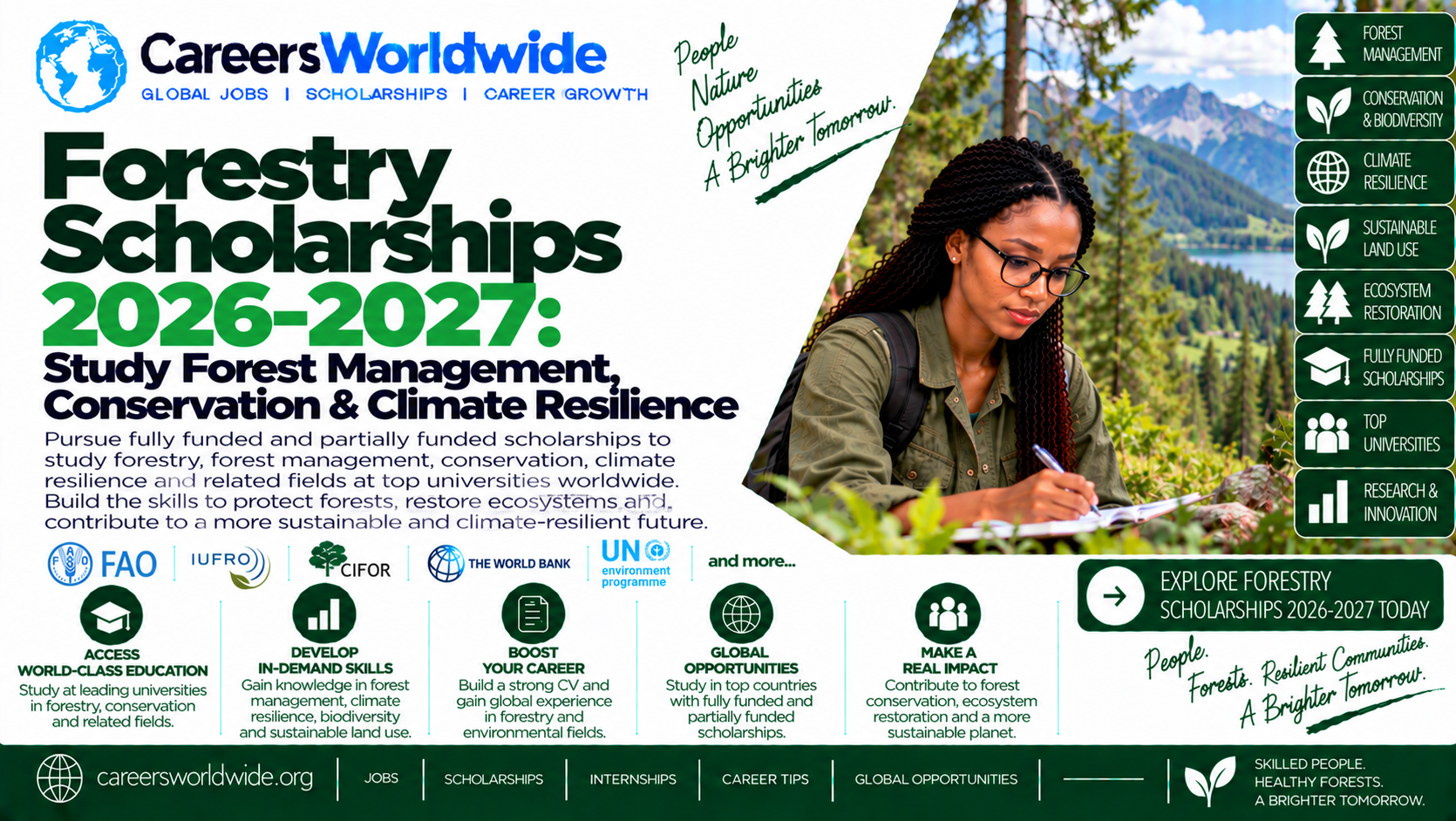

Excerpt: Forestry scholarships for 2026–2027 can help students build careers in forest management, conservation, biodiversity, climate adaptation, sustainable land use and natural-resource governance. This guide highlights international forestry master’s programmes, Erasmus Mundus opportunities, European forestry degrees, environmental scholarships and funding routes worth monitoring for upcoming application cycles.
Forests are becoming increasingly important to global environmental policy, climate resilience, biodiversity conservation and sustainable development. As governments, research institutions, conservation organizations and communities respond to deforestation, ecosystem degradation and climate change, graduates with specialist knowledge of forestry and natural-resource management can work across a wide range of sectors.
For students interested in this field, Forestry Scholarships 2026–2027 can provide opportunities to study subjects such as forest management, forest ecology, conservation science, climate adaptation, biodiversity, sustainable forestry, natural-resource economics and environmental governance.
Some scholarships are specifically designed for forestry, while others support broader environmental or natural-resource programmes that can lead to careers in forestry and conservation.
This guide explains where to look, which programmes to consider, how scholarship applications work and how prospective applicants can prepare strong applications.
Why Study Forestry in 2026–2027?
Forestry is no longer limited to traditional forest management.
Modern forestry increasingly combines:
- Climate science
- Conservation biology
- Geographic information systems
- Remote sensing
- Sustainable agriculture
- Environmental economics
- Carbon management
- Biodiversity protection
- Community development
- Forest policy
- Landscape restoration
- Data analysis
- Climate adaptation
This means forestry graduates can pursue careers beyond conventional forestry agencies.
Possible employers include government departments, conservation organizations, development agencies, research institutions, environmental consultancies, international organizations and private companies working in sustainable land use.
The importance of these skills is also reflected in international forest investment programmes. For example, the African Development Bank reported in 2026 on forest and climate investments in Burkina Faso, Côte d’Ivoire and Ghana involving landscape restoration, climate resilience and livelihood improvement.
For students interested in Africa’s environmental and climate-development challenges, this intersection between forestry, conservation and climate resilience can be particularly relevant.
Summary Table: Forestry Scholarships and Study Opportunities
| Opportunity / Programme | Study Area | Funding / Support | Target Group | 2026–2027 Status |
|---|---|---|---|---|
| MSc European Forestry | Forest sciences & management | Erasmus Mundus scholarships available competitively | International students | Next call Dec. 2, 2026–Jan. 13, 2027 |
| SUFONAMA | Sustainable forest & nature management | Erasmus Mundus route in relevant cycles | International graduates | 2026 cycle closed; monitor future calls |
| MEDfOR | Mediterranean forestry & natural resources | Programme-specific funding varies | International applicants | 2026 scholarship cycle closed |
| MSc Forest Sciences, University of Freiburg | Forest management, ecology & future forests | External scholarships including DAAD routes | International students | Programme admissions vary by intake |
| DAAD-EPOS Environmental Governance | Environmental governance & natural resources | Competitive DAAD scholarship | Eligible developing-country professionals | Applications for 2027/28 due Oct. 15, 2026 |
| Erasmus Mundus Joint Masters | Multiple environmental/forest-related fields | Full scholarships available on selected programmes | Students worldwide | Many applications expected Oct. 2026–Jan. 2027 |
| South Africa DFFE Bursary | Forestry management & related fields | Up to R80,000 | Eligible South African students | 2027 applications close Oct. 2, 2026 |
Funding, eligibility and deadlines vary by programme. Always confirm details on the official programme website before applying.
1. MSc European Forestry
One of the most directly relevant opportunities for prospective forestry students is the Master of Science in European Forestry, an Erasmus Mundus Joint Master programme delivered by a consortium of European universities.
The programme focuses specifically on forest sciences and forest management and provides an international study experience.
The official programme website states that the next application period is scheduled for December 2, 2026 to January 13, 2027, for students starting the programme in August 2027. Competitive Erasmus Mundus scholarships will be available.
This makes the programme particularly relevant for students searching for forestry scholarships for the 2027 academic year.
Students can expect exposure to topics related to forests and forest management across multiple European countries.
The programme can be suitable for applicants interested in:
- Sustainable forest management
- Forest ecology
- Forest conservation
- Forest policy
- Climate-related forest challenges
- International forestry
- Natural-resource management
The programme’s scholarship information states that Erasmus Mundus scholarships can cover participation costs, insurance and a monthly subsistence allowance of €1,400 for up to 24 months.
Because scholarship selection is competitive, applicants should prepare their academic and motivation materials well before the application period.
2. Erasmus Mundus Joint Masters
Students should not restrict their search to programmes with “forestry” in the title.
The broader Erasmus Mundus Joint Master system can provide opportunities in environmental sciences, biodiversity, ecosystems, natural-resource management and related disciplines.
The official Erasmus+ website states that students from around the world can apply to Erasmus Mundus Joint Masters. Selected programmes may offer full scholarships to highly ranked students.
These scholarships can contribute toward:
- Participation costs
- Travel
- Visa expenses
- Living expenses
Erasmus Mundus programmes normally involve study at multiple universities in different countries.
The official guidance indicates that applicants typically apply directly to the institution or consortium operating the master’s programme and that most applications are submitted between October and January for programmes beginning the following academic year.
This makes autumn 2026 an important period for students targeting 2027 entry.
The European Commission also announced in July 2026 that 37 new Erasmus Mundus Joint Masters had been selected, with student applications expected to open in autumn 2026.
Therefore, prospective forestry students should regularly check the Erasmus Mundus catalogue for newly available environmental and natural-resource programmes.
3. SUFONAMA: Sustainable Forest and Nature Management
The Sustainable Forest and Nature Management (SUFONAMA) master’s programme is another programme to know if your interests extend beyond traditional forestry.
SUFONAMA is an Erasmus Mundus Joint Master focused on sustainable management of forests and nature areas within an integrated landscape context.
The programme can be relevant to students interested in:
- Forest conservation
- Sustainable forest management
- Nature management
- Landscape management
- Environmental protection
- Biodiversity
- Natural-resource governance
The 2026 application cycle listed deadlines of January 15, 2026 for non-EU/EEA/Swiss applicants and March 1, 2026 for EU/EEA/Swiss applicants. Those deadlines have passed, so applicants targeting a future intake should monitor the official programme website for the next call.
This is an important distinction: a programme can be an excellent scholarship target without its current application window being open.
Applicants should therefore avoid relying on old deadline information found on scholarship blogs or social media.
4. MEDfOR – Mediterranean Forestry and Natural Resources Management
Another specialized programme is MEDfOR, the Mediterranean Forestry and Natural Resources Management master’s programme.
It provides training in forestry and natural-resource management and accepts candidates from around the world subject to programme requirements.
The 2026 programme page states that applicants needed at least a bachelor’s degree and English proficiency at B1 level.
However, the 2026 edition’s scholarship availability differed from previous cycles. The programme explicitly stated that its 2026 self-funded application round did not offer Erasmus Mundus scholarships.
This is a useful reminder that scholarship availability can change from one academic year to another.
Students should always verify whether a particular programme is offering:
- Full scholarships
- Partial scholarships
- Tuition waivers
- University-funded awards
- External scholarships
- Self-funded admission only
5. University of Freiburg MSc Forest Sciences
Germany is another important destination for forestry students.
The University of Freiburg offers an MSc Forest Sciences programme covering forest ecosystems, forest management, biodiversity, conservation, wood utilization and broader economic and policy dimensions of forestry.
The programme structure includes majors such as:
- Forestry
- Forest Ecology Research
- Future Forests
Students also undertake electives, internships and a master’s thesis. The programme comprises 120 ECTS.
The programme can be particularly attractive for students interested in combining traditional forestry with emerging issues such as global environmental change and future forest systems.
For the October 2026 intake, the programme listed an application period from March 1 to May 15, 2026. That cycle has therefore passed.
Students interested in a later intake should check the university’s official admissions information for the next application period.
The university also provides information about external scholarship providers, including DAAD opportunities.
6. DAAD Scholarships for Environmental and Natural-Resource Studies
Not every forestry scholarship is labeled a forestry scholarship.
One important route is the DAAD EPOS scholarship system for development-related postgraduate programmes.
For example, the University of Freiburg’s MSc Environmental Governance programme offers a limited number of DAAD-EPOS scholarships for eligible young professionals from developing countries.
The programme focuses on environmental governance rather than forestry alone, but it can be highly relevant for students interested in:
- Forest policy
- Environmental governance
- Climate policy
- Sustainable development
- Natural-resource management
- Conservation policy
For the 2027/28 intake, the programme states that DAAD scholarship applications are due October 15, 2026.
Applicants generally need:
- An academic degree
- At least two years of relevant professional experience
- Strong academic performance
- Eligibility under DAAD’s developing-country requirements
The programme states that internships and voluntary work are not counted toward the required two years of professional experience for this scholarship route.
This route is therefore more suitable for qualified professionals than recent graduates without relevant work experience.
7. South Africa DFFE Forestry Bursary
Students interested in forestry within Africa should also look at national government scholarship and bursary programmes.
South Africa’s Department of Forestry, Fisheries and the Environment currently lists its 2027 Full-Time Bursary Programme, with a closing date of October 2, 2026.
The programme specifically lists Forestry Management and includes fields such as:
- Diploma in Forestry
- Advanced Diploma in Forestry
- Bachelor of Science
- Honours in Natural Resource Management
- BSc in Forestry and Wood Sciences
The department states that the maximum bursary amount is R80,000.
Eligibility is specific to the programme and South African requirements, so international students should not assume they qualify.
However, the programme illustrates an important strategy for forestry students: check government departments responsible for forests, environment, climate, agriculture and natural resources in your own country.
Government-funded opportunities can sometimes be overlooked because students focus exclusively on large international scholarship programmes.
What Do Forestry Scholarships Usually Cover?
Funding differs considerably.
A scholarship may cover all or only part of your educational expenses.
Possible benefits include:
Tuition fees
Some scholarships pay tuition directly to the university.
Living allowance
Certain international scholarships provide monthly living support.
For example, Erasmus Mundus scholarship rules provide a contribution toward travel, visa, installation and subsistence costs, with programme-specific scholarship structures.
Travel
International programmes may provide travel support.
Insurance
Some scholarships include health or other insurance coverage.
Accommodation
University or government scholarships may provide accommodation or an accommodation allowance.
Research support
Some funding schemes can assist with fieldwork, research or thesis-related expenses.
Always read the official funding conditions carefully.
A scholarship described online as “fully funded” may have exclusions such as visa costs, flights, deposits or personal expenses.
Who Can Apply for Forestry Scholarships?
Requirements vary, but common applicant profiles include:
- Undergraduate students
- Final-year bachelor’s students
- Recent graduates
- Master’s applicants
- Environmental professionals
- Forestry professionals
- Conservation practitioners
- Researchers
- Development-sector professionals
Typical academic backgrounds include:
- Forestry
- Forest sciences
- Environmental science
- Natural-resource management
- Biology
- Ecology
- Geography
- Agriculture
- Environmental engineering
- Climate science
- Sustainable development
Some programmes are much more specialized.
Before applying, compare your academic background with the programme’s formal entry requirements.
Skills That Can Strengthen a Forestry Scholarship Application
A strong forestry application should show more than an interest in trees.
Consider developing skills in:
GIS and remote sensing
Geospatial technology is increasingly important for forest monitoring, land-use mapping and environmental assessment.
Data analysis
Statistics and data interpretation can support forest research and monitoring.
Climate science
Understanding climate change can strengthen applications focused on forest resilience and adaptation.
Biodiversity
Knowledge of ecosystems, species conservation and habitat management can be valuable.
Research methods
Strong research skills are particularly important for master’s and research-oriented programmes.
Communication
Forestry projects often involve governments, communities, scientists, businesses and conservation organizations.
Community engagement
Sustainable forest management frequently requires collaboration with local communities and stakeholders.
How to Write a Strong Forestry Scholarship Motivation Letter
Your motivation letter should explain why forestry matters to your academic and professional goals.
A useful structure is:
1. Start with your background
Briefly explain your education and experience.
2. Explain your forestry interest
Describe the environmental or development issue that interests you.
3. Connect the programme to your goals
Mention specific subjects, research areas or training opportunities relevant to your objectives.
4. Explain your intended impact
Describe how you plan to apply your knowledge after graduation.
5. Demonstrate preparation
Mention relevant research, internships, fieldwork, volunteering, GIS projects or professional experience.
Avoid generic statements such as “I love nature.”
Instead, demonstrate how your academic and professional experience connects with a specific forestry challenge.
How to Apply for Forestry Scholarships 2026–2027
Follow these steps.
Step 1: Identify your specialization
Decide whether your main interest is:
- Forest management
- Conservation
- Forest ecology
- Climate resilience
- Biodiversity
- Forest economics
- Forest policy
- Landscape restoration
- GIS and remote sensing
Step 2: Search official programme websites
Start with university and scholarship-provider websites.
Do not rely exclusively on social-media posts or third-party scholarship websites.
Step 3: Check eligibility
Review:
- Nationality
- Degree requirements
- Academic grades
- English-language requirements
- Professional experience
- Age requirements, if applicable
- Work experience
- Programme-specific prerequisites
Step 4: Prepare documents
Common documents include:
- Academic transcripts
- Degree certificates
- CV
- Motivation letter
- Passport
- References
- English-language test results
- Research proposal, where required
- Proof of employment, where required
Step 5: Apply for admission
Some scholarships require you to first obtain admission to the university.
Others combine admission and scholarship applications.
Step 6: Submit before the deadline
Do not wait until the final day.
International scholarship applications can involve document certification, references and language tests.
Step 7: Save evidence of submission
Keep copies of:
- Application forms
- Uploaded documents
- Confirmation emails
- Application numbers
- Scholarship correspondence
30-Day Forestry Scholarship Plan
If you are preparing for the next scholarship cycle, use a simple four-week plan.
| Week | Action |
|---|---|
| Week 1 | Identify 5–10 forestry or environmental programmes |
| Week 2 | Check eligibility and scholarship availability |
| Week 3 | Prepare CV, transcripts and motivation letter |
| Week 4 | Obtain references, finalize documents and track deadlines |
You can then maintain a scholarship spreadsheet containing:
- Programme
- University
- Country
- Degree
- Scholarship
- Eligibility
- Opening date
- Deadline
- Required documents
- Application link
- Status
This can prevent missed deadlines.
Forestry Career Opportunities After Graduation
A forestry degree can lead to careers in several sectors.
Potential roles include:
- Forest Management Specialist
- Forestry Officer
- Conservation Scientist
- Forest Ecologist
- Natural Resources Specialist
- Climate Adaptation Specialist
- Biodiversity Officer
- Environmental Consultant
- GIS Analyst
- Remote Sensing Specialist
- Restoration Specialist
- Forest Policy Analyst
- Sustainable Land Management Specialist
- Carbon and Nature Analyst
- Researcher
- Environmental Programme Officer
Graduates may work for government agencies, universities, research institutions, environmental consultancies, conservation organizations and international development programmes.
The field is also increasingly connected with carbon markets, ecosystem restoration, biodiversity monitoring and climate finance.
FAQ: Forestry Scholarships 2026–2027
Are there fully funded forestry scholarships for international students?
Yes. Some Erasmus Mundus forestry-related programmes offer competitive scholarships that can cover participation costs and provide living support. However, not every forestry master’s programme is fully funded, so applicants must check the specific scholarship terms.
Can international students apply for forestry scholarships in Europe?
Yes. Several European forestry master’s programmes accept international applicants. For example, the MSc European Forestry programme is designed for an international student cohort and offers competitive Erasmus Mundus scholarships.
When should I apply for forestry scholarships for 2027?
Many Erasmus Mundus programmes open applications toward the end of 2026. The MSc European Forestry programme, for example, lists December 2, 2026 to January 13, 2027 for its next call.
Can environmental science graduates apply for forestry programmes?
Often, yes, depending on the programme. Forestry programmes can accept applicants from related disciplines such as environmental science, ecology, biology, geography and natural-resource management. Always check the specific programme’s academic requirements.
Can African students apply for forestry scholarships?
Many international programmes accept students worldwide, although eligibility differs by scholarship. Erasmus Mundus Joint Masters are open to students from around the world, while other programmes may have nationality or regional restrictions.
Are there forestry scholarships specifically for African students?
There are country- and region-specific funding opportunities, as well as international scholarships open to African applicants. Students should check government forestry departments, development agencies, universities and international scholarship programmes.
Do I need work experience?
Not always. Some master’s programmes accept recent bachelor’s graduates. Other scholarships, particularly development-oriented awards such as certain DAAD-EPOS routes, require professional experience. The Freiburg MEG DAAD route, for example, requires at least two years of relevant post-bachelor professional experience.
Can I study forest conservation instead of traditional forestry?
Yes. Programmes can focus on forest ecology, biodiversity, nature management, conservation science and environmental governance rather than conventional forestry alone.
What should I study if I want to work in forest climate resilience?
Useful fields include forestry, forest ecology, climate science, environmental governance, conservation, natural-resource management, GIS and landscape restoration.
Are forestry scholarships competitive?
Many international scholarships are competitive. Academic preparation, relevant experience, a focused motivation letter, strong references and a clear career plan can strengthen an application.
Official Application Resources
Applicants should use official sources whenever possible.
Erasmus Mundus Joint Masters:
Erasmus Mundus official student opportunities
MSc European Forestry:
MSc European Forestry official programme website
MSc European Forestry scholarships:
European Forestry scholarships and fees
SUFONAMA:
Sustainable Forest and Nature Management official website
MEDfOR:
Mediterranean Forestry and Natural Resources Management
University of Freiburg Forest Sciences:
University of Freiburg Forest Sciences programme
DAAD:
DAAD official scholarship information
South Africa DFFE Bursaries:
Department of Forestry, Fisheries and the Environment bursaries
World Bank Scholarships:
World Bank Scholarships Program
Final Takeaway
Forestry is evolving into a multidisciplinary field connecting forest management, biodiversity, climate resilience, conservation, technology and sustainable development.
For students planning to study in 2026–2027 or prepare for 2027 entry, the strongest strategy is to look beyond scholarships carrying the exact word “forestry.”
Programmes in environmental governance, forest ecology, biodiversity, sustainable natural-resource management and climate adaptation can also lead to forestry-related careers.
The MSc European Forestry programme is particularly important to monitor because its next application window is scheduled for December 2, 2026 through January 13, 2027, with competitive Erasmus Mundus scholarships available.
At the same time, the wider Erasmus Mundus system is expected to open applications for newly selected master’s programmes during autumn 2026.
Applicants should begin preparing now by researching programmes, checking eligibility, collecting transcripts and references, improving their CVs and developing focused motivation letters.
Most importantly, verify every deadline and funding condition directly with the university or scholarship provider before submitting an application.
Disclaimer
This article is for informational purposes only and does not constitute scholarship, academic or immigration advice. Scholarship availability, eligibility requirements, application dates, funding amounts and programme structures can change. Some opportunities mentioned above have already closed for the 2026 intake and are included because they are relevant programmes to monitor for future cycles. Always verify current information through the official university, government or scholarship-provider website before applying. CareersWorldwide does not charge applicants for access to scholarship information and does not guarantee admission or scholarship selection.
SEO Information
SEO Title: Forestry Scholarships 2026–2027: Forest Management & Conservation
Meta Description: Explore Forestry Scholarships 2026–2027 for forest management, conservation, biodiversity, climate resilience and sustainable natural-resource careers.
Focus Keyword: Forestry Scholarships 2026–2027
URL Slug: forestry-scholarships-2026-2027
Excerpt: Discover Forestry Scholarships 2026–2027 for students interested in forest management, conservation, biodiversity, climate resilience and sustainable natural-resource management.
SEO Keywords:
- Forestry Scholarships 2026,
- Forestry Scholarships 2027,
- Forestry Scholarships 2026–2027,
- Fully Funded Forestry Scholarships,
- Forest Management Scholarships,
- Forest Conservation Scholarships,
- Forestry Masters Scholarships,
- Forest Science Scholarships,
- Sustainable Forestry Scholarships,
- Forestry Scholarships for International Students,
- Forestry Scholarships for African Students,
- Forest Ecology Scholarships,
- Natural Resource Management Scholarships,
- Climate Resilience Scholarships,
- Environmental Scholarships 2026,
- Forest Management Masters,
- Forestry MSc Scholarships,
- Erasmus Mundus Forestry,
- European Forestry Scholarships,
- Forest Conservation Masters,
- Sustainable Forest Management Scholarships,
- Biodiversity Scholarships,
- Climate Change and Forestry Scholarships,
- Forestry Study Abroad Scholarships,
- Forestry Graduate Scholarships,
ALSO CHECK: Science Communication Scholarships 2026–2027: Build Skills in Research Communication & Public EngagementSeptember 25, 2026
Water Resources Scholarships 2026–2027: Study Water Management & Environmental SustainabilitySeptember 24, 2026
Environmental Engineering Scholarships 2026–2027: Study Sustainable Infrastructure & TechnologySeptember 24, 2026