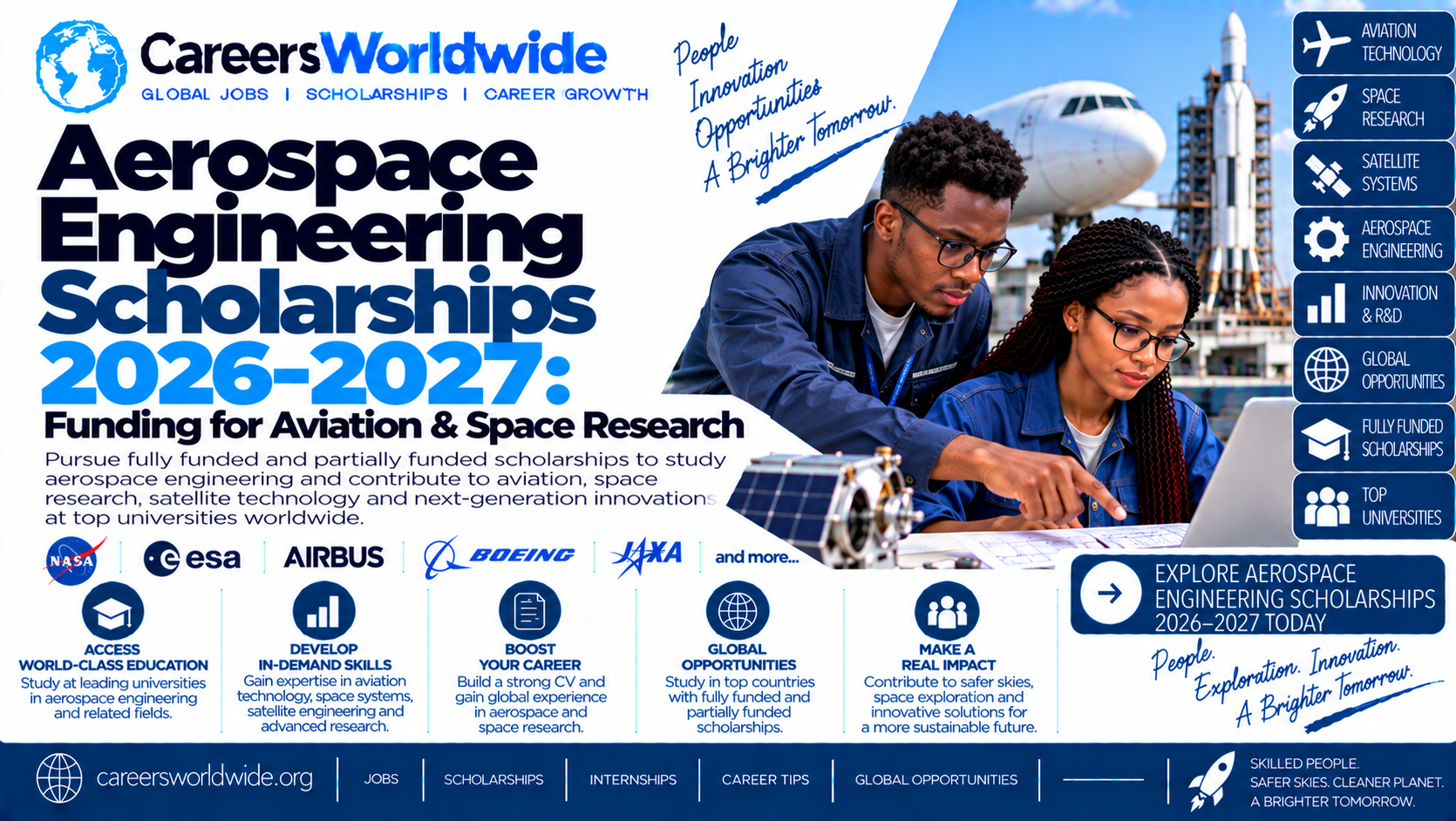

Excerpt: Aerospace Engineering Scholarships 2026–2027 can help students pursue advanced study in aeronautics, aircraft design, propulsion, spacecraft systems, computational engineering and space research. This guide highlights scholarship opportunities, university funding, aviation scholarships and international routes for students preparing for careers in aerospace and space technology.
Aerospace engineering is one of the most technology-intensive areas of engineering, combining mechanical engineering, mathematics, physics, materials science, computer science and advanced manufacturing.
The field covers two closely connected areas: aeronautics, which focuses on aircraft and atmospheric flight, and astronautics, which focuses on spacecraft and space systems.
For students interested in aircraft design, satellite technology, propulsion, autonomous systems, space missions or aviation research, an aerospace engineering degree can provide a pathway into a wide range of technical careers.
However, the cost of studying aerospace engineering—particularly at postgraduate level and internationally—can be significant.
That is why students should investigate scholarships, university awards, government funding, aviation-industry scholarships and broader engineering funding opportunities before applying.
This guide explores Aerospace Engineering Scholarships 2026–2027, including opportunities for master’s students, international applicants, aviation students and students interested in space research.
Why Study Aerospace Engineering in 2026–2027?
The aerospace sector is increasingly connected with areas such as:
- Satellite technology
- Space exploration
- Autonomous aircraft
- Unmanned aerial systems
- Artificial intelligence
- Sustainable aviation
- Advanced propulsion
- Computational fluid dynamics
- Robotics
- Composite materials
- Earth observation
- Space communications
- Mission design
Modern aerospace engineering is therefore much broader than traditional aircraft design.
Aerospace engineers can work on aircraft structures, propulsion systems, spacecraft, satellites, flight-control systems, simulation software, robotics and advanced materials.
Universities are also increasingly incorporating sustainability and digital technologies into aerospace programmes.
For example, Imperial College London’s Advanced Aeronautical Engineering MSc includes multidisciplinary training related to aircraft technologies and reducing environmental impact. The programme is scheduled to open applications for October 2027 entry on September 30, 2026.
This makes aerospace engineering particularly relevant for students interested in combining engineering with climate-conscious aviation, advanced computation and emerging space technologies.
Aerospace Engineering Scholarships 2026–2027: Summary Table
| Scholarship / Funding Route | Study Area | Potential Support | Target Applicants | Key Timing |
|---|---|---|---|---|
| Imperial Department of Aeronautics MSc Scholarship | Aeronautical Engineering | Full tuition fees | Home & overseas MSc applicants | Deadline: March 1, 2027 |
| Imperial Inspires Scholarships | Engineering & selected postgraduate programmes | £15,000 per year | International students | Applications for 2027 entry open from Sept. 2026 |
| University of Strathclyde Engineering Scholarships | Aerospace & engineering | Up to £12,000 | Eligible international master’s applicants | 2026 awards; check next cycle |
| Beit Strathclyde Scholarship | Faculty of Engineering | Full tuition & living costs | Residents of Zimbabwe, Zambia or Malawi | Opens Dec. 1, 2026 |
| ISTAT Foundation Scholarships | Aviation & aerospace-related fields | Scholarship funding varies | Selected university-nominated students | 2027 nominations open Nov. 2026 |
| Erasmus Mundus Joint Masters | Selected engineering/science fields | Full scholarships on selected programmes | Students worldwide | Most applications Oct.–Jan. |
| NASA student programmes | Aerospace & space-related STEM development | Programme-dependent | Eligibility varies | Deadlines vary |
Funding, eligibility and deadlines can change. Applicants should verify current requirements directly with the official provider before applying.
1. Imperial College London Department of Aeronautics MSc Scholarship
One of the most directly relevant scholarships for postgraduate aerospace applicants is the Department of Aeronautics MSc Scholarship at Imperial College London.
For the 2027/28 academic year, Imperial lists two scholarships covering full tuition fees, with both home and overseas students eligible.
The scholarship is available to applicants to eligible MSc programmes in the Department of Aeronautics.
Eligible programmes include:
- MSc Advanced Aeronautical Engineering
- MSc Advanced Computational Methods for Aeronautics, Flow Management and Fluid-Structure Interaction
- MSc Composites: The Science, Technology and Engineering Application of Advanced Composites
The listed scholarship deadline is March 1, 2027.
Importantly, there is no separate scholarship application.
Eligible students who submit a complete MSc application by the deadline are automatically considered.
This means applicants should treat the university application itself as the foundation of their scholarship application.
A strong academic record, relevant engineering preparation and a carefully prepared postgraduate application can therefore be important.
2. Imperial Advanced Aeronautical Engineering MSc
Students interested in aircraft technology can also consider Imperial’s Advanced Aeronautical Engineering MSc.
The programme is scheduled to begin in October 2027 and applications open on September 30, 2026.
The programme is designed for students with an aerospace or mechanical engineering background and includes areas associated with aircraft technologies and reducing environmental impact.
Imperial lists a minimum academic requirement of a 2:1, preferably First-Class Honours, in Aerospace or Mechanical Engineering, with some experience in fluid and structural dynamics.
The university uses several application rounds.
For 2027 entry, listed rounds include:
- January 6, 2027
- March 10, 2027
- April 28, 2027
Applicants should check the latest programme page because places may not remain available in later rounds.
For international applicants, the programme may also require an ATAS certificate depending on nationality and circumstances.
3. Imperial Inspires Scholarships
Another important funding route for international students is the Imperial Inspires Scholarship.
For students applying for autumn 2027 entry, Imperial says it will offer at least 300 Imperial Inspires scholarships across its faculties, including Engineering.
The scholarship provides:
£15,000 per year for each year of the course.
It is available to eligible international students paying the overseas tuition rate and applying to participating full-time undergraduate or selected postgraduate taught programmes.
For eligible applicants, the process begins with an Imperial application.
The university states that applicants should submit their undergraduate or postgraduate application after applications open in September 2026.
Eligible applicants will then be invited to complete an additional essay question where the scholarship is available for their course.
Aerospace applicants should therefore check whether their particular aeronautics programme participates in the scholarship scheme.
4. University of Strathclyde Aerospace Engineering Scholarships
The University of Strathclyde is another university worth monitoring for aerospace funding.
Its MSc Aerospace Engineering programme covers advanced aerospace topics including:
- Spacecraft design
- Space mission analysis
- Propulsion systems
- Artificial intelligence
- Sustainability in space engineering
- Engineering management
The university describes Glasgow as an important location for small satellite manufacturing and highlights links with aerospace and engineering employers.
For September 2026 entry, Strathclyde listed several Faculty of Engineering scholarships.
The Faculty of Engineering International Scholarship for Masters Study was worth £6,000, while Dean’s International Excellence Awards were listed at between £9,000 and £12,000 for eligible postgraduate applicants.
Students targeting the 2027 academic year should check the university’s funding pages for the next scholarship cycle rather than assuming that the same award values or deadlines will continue.
5. Beit Strathclyde Scholarship for Zimbabwe, Zambia and Malawi
A particularly relevant opportunity for eligible southern African applicants is the Beit Strathclyde Scholarship.
The University of Strathclyde states that the scholarship fully funds one student from Malawi, Zimbabwe or Zambia to undertake a master’s degree in the Faculty of Engineering during the 2027/28 academic year.
The scholarship provides:
- Tuition fees
- Living costs
- Full-length course support
The official page lists:
Opening date: December 1, 2026
Deadline: February 12, 2027
Applicants must be resident in Malawi, Zimbabwe or Zambia when applying and must hold an offer for an eligible one-year master’s degree in the Faculty of Engineering.
Aerospace applicants should check the complete list of eligible engineering departments and confirm that their intended programme qualifies before relying on this scholarship.
This is an example of why students should search for faculty-level engineering scholarships, rather than limiting their search to awards explicitly titled “aerospace scholarship.”
6. ISTAT Foundation Aviation Scholarships
The aerospace sector overlaps significantly with aviation, creating another scholarship route for students.
The ISTAT Foundation Scholarship Program provides financial support to academically qualified students pursuing aviation-related education.
The foundation states that its scholarship programme supports students preparing for careers in aviation and that 2027 nominations are expected to open in November 2026.
However, students should understand an important requirement.
The ISTAT Foundation scholarship is by invitation and nomination.
Students must obtain a nomination from an eligible university, and the programme is available through a selected group of universities.
The foundation also lists named scholarships for particular student groups.
One named scholarship is designed for an African student at an African university, or a female student from South America at an eligible university worldwide, pursuing a degree in aerospace engineering or aviation management.
Another listed award supports students pursuing undergraduate or graduate degrees in aerospace engineering or related fields, with preference for students interested in aviation technical careers.
Students should therefore ask their university’s financial-aid or engineering office whether it participates in the relevant ISTAT scholarship process.
7. Erasmus Mundus Scholarships
Aerospace applicants should also investigate the broader Erasmus Mundus Joint Master system.
Not every Erasmus Mundus programme is aerospace-focused, but the programme catalogue changes as new master’s degrees are selected.
The official Erasmus+ guidance says students from around the world can apply to Erasmus Mundus Joint Masters and that full scholarships are available for the best-ranked students on participating programmes.
Scholarships can contribute toward:
- Participation costs
- Travel
- Visa costs
- Living allowance
Erasmus Mundus master’s programmes normally involve study at multiple universities in different countries.
The official guidance states that applications are generally submitted between October and January for programmes starting the following academic year, although each programme establishes its own requirements and deadline.
Students interested in aerospace should search the catalogue using related disciplines such as:
- Space science
- Space engineering
- Robotics
- Computational engineering
- Mechanical engineering
- Materials science
- Artificial intelligence
- Satellite technology
This broader strategy can reveal funding opportunities that a search for “aerospace scholarship” alone might miss.
8. NASA Opportunities for Aerospace Students
NASA-related programmes can also provide valuable academic and professional development opportunities.
However, applicants should distinguish between scholarships, internships, challenges, academies and career-development programmes.
NASA’s current college and university opportunities page lists programmes such as NASA Community College Aerospace Scholars and the NASA EarthRISE Developers Academy.
The EarthRISE Developers Academy, for example, involves projects using NASA data to address real-world challenges and provides professional development and technical skills relevant to science and technology careers.
NASA has also operated specific scholarship programmes. The 2026 NASA-JSC Scholarship, for example, had an April 30, 2026 application deadline and provided financial assistance to selected students.
Because individual NASA opportunities have different eligibility rules, students should always check the current programme announcement rather than assuming that a NASA scholarship is open to all international students.
What Can Aerospace Engineering Scholarships Cover?
Funding differs considerably between scholarships.
Potential forms of support include:
Full tuition
Some awards cover the complete tuition cost.
Imperial’s Department of Aeronautics MSc Scholarship for 2027/28, for example, is listed as covering full tuition fees for both home and overseas students.
Partial tuition
Many university awards reduce tuition without covering the full cost.
Living expenses
Some scholarships provide annual or monthly allowances.
Travel
International scholarship programmes may provide travel contributions.
Visa expenses
Some international awards contribute toward visa-related costs.
Research support
Certain programmes may provide funding connected with research or project work.
Students should never assume that “scholarship” means fully funded.
Read the official funding conditions carefully before accepting an offer.
Who Can Apply for Aerospace Scholarships?
Eligibility depends on the scholarship.
Typical applicants include:
- High-school graduates
- Undergraduate engineering students
- Final-year students
- Recent engineering graduates
- Master’s applicants
- PhD candidates
- Aviation students
- Space-technology researchers
Common academic backgrounds include:
- Aerospace engineering
- Aeronautical engineering
- Mechanical engineering
- Electrical engineering
- Mechatronics
- Computer engineering
- Physics
- Mathematics
- Materials science
- Robotics
For postgraduate aerospace programmes, universities may require specific engineering or mathematical preparation.
For example, Imperial’s Advanced Aeronautical Engineering MSc expects applicants to have an aerospace or mechanical engineering background and experience in relevant fluid and structural dynamics.
Skills That Can Strengthen an Aerospace Scholarship Application
Aerospace engineering is highly technical, so applicants can strengthen their profile through practical technical skills.
1. Computer-Aided Design
Experience with CAD software can demonstrate familiarity with engineering design.
2. Programming
Python, MATLAB, C++ and other programming languages can be useful for simulation, analysis and automation.
3. Computational Fluid Dynamics
CFD is relevant to aircraft aerodynamics and propulsion research.
4. Robotics
Robotics and autonomous systems increasingly overlap with aerospace engineering.
5. Data Analysis
Data skills are useful for flight testing, simulations, satellite systems and research.
6. Artificial Intelligence
AI applications include autonomous systems, predictive maintenance, image analysis and mission planning.
7. Research Experience
Research projects can demonstrate your ability to investigate complex engineering problems.
8. Engineering Design
A portfolio of engineering projects can help demonstrate practical problem-solving.
How to Write an Aerospace Engineering Scholarship Motivation Letter
A strong motivation letter should connect your background with a clearly defined engineering objective.
Start with your academic background
Explain what you have studied and the technical foundation you have developed.
Identify your aerospace interest
Instead of simply saying you want to work in aerospace, identify the specific area that interests you.
For example:
- Aircraft propulsion
- Spacecraft systems
- Satellite technology
- Aerodynamics
- Sustainable aviation
- Autonomous flight
- Space robotics
- Composite materials
Explain why the programme fits
Mention relevant modules, laboratories, research areas or technical opportunities.
Describe your career objective
Explain what you hope to contribute after graduation.
Demonstrate preparation
Mention engineering projects, internships, research, competitions, programming or technical work.
A focused application is generally more persuasive than a generic statement about loving aviation.
How to Apply for Aerospace Engineering Scholarships
Follow this process.
Step 1: Choose your specialization
Decide whether your goal is:
- Aeronautical engineering
- Aerospace engineering
- Space engineering
- Propulsion
- Aircraft structures
- Avionics
- Robotics
- Computational engineering
- Satellite technology
Step 2: Identify universities
Build a list of universities offering relevant programmes.
Step 3: Search funding separately
Look at:
- University scholarships
- Faculty scholarships
- Government funding
- Industry scholarships
- Aviation organizations
- International scholarships
- Research funding
Step 4: Check eligibility
Review:
- Academic qualifications
- Nationality
- Residency
- English requirements
- Work experience
- Programme prerequisites
- Scholarship-specific conditions
Step 5: Prepare documents
You may need:
- Academic transcripts
- Degree certificates
- CV
- Personal statement
- Motivation letter
- Recommendation letters
- Passport
- English test results
- Research proposal
- Portfolio
Step 6: Submit the university application
Many university scholarships automatically consider students who submit their programme application by the relevant deadline.
Imperial’s Department of Aeronautics MSc Scholarship is an example: eligible applicants are automatically considered when they submit a complete MSc application by the scholarship deadline.
Step 7: Track your application
Save:
- Confirmation emails
- Application numbers
- Scholarship deadlines
- Supporting documents
- Admissions correspondence
30-Day Aerospace Scholarship Preparation Plan
| Week | What to Do |
|---|---|
| Week 1 | Identify 5–10 aerospace and engineering programmes |
| Week 2 | Compare scholarships and eligibility requirements |
| Week 3 | Prepare CV, academic documents and personal statement |
| Week 4 | Finalize references, submit applications and record deadlines |
Create a spreadsheet containing:
- University
- Programme
- Country
- Tuition
- Scholarship
- Funding amount
- Eligibility
- Deadline
- Application link
- Status
This makes it easier to manage multiple applications.
Aerospace Engineering Career Paths
An aerospace engineering qualification can lead to careers in:
- Aerospace Engineering
- Aeronautical Engineering
- Space Systems Engineering
- Propulsion Engineering
- Structural Engineering
- Avionics
- Flight Dynamics
- Guidance and Control
- Aircraft Design
- Satellite Engineering
- Systems Engineering
- Computational Engineering
- Robotics
- Autonomous Systems
- Research and Development
- Aviation Technology
Aerospace engineers can work in aviation companies, space organizations, defense-related industries, research institutions, universities, technology companies and engineering consultancies, depending on their nationality and the relevant employment and security requirements.
FAQ: Aerospace Engineering Scholarships 2026–2027
Are there fully funded aerospace engineering scholarships?
Yes. Some scholarships cover full tuition, while others may additionally provide living or travel support. Imperial’s Department of Aeronautics MSc Scholarship for 2027/28 is one example of a scholarship that covers full tuition fees.
Can international students get aerospace engineering scholarships?
Yes. Some university scholarships are explicitly open to overseas applicants. Imperial’s Department of Aeronautics MSc Scholarship lists both home and overseas tuition categories as eligible.
Can African students apply for aerospace scholarships?
Yes, depending on the programme. Some opportunities are international, while others are targeted to particular countries or universities. The ISTAT Foundation also lists an award supporting an African student at an African university pursuing aerospace engineering or aviation management.
Are there scholarships for aerospace master’s degrees?
Yes. Several university scholarships specifically support postgraduate aerospace or aeronautical engineering programmes.
What bachelor’s degree do I need for aerospace engineering?
Requirements vary. Aerospace, aeronautical and mechanical engineering are common backgrounds, although some programmes accept related engineering, mathematics or physics degrees.
Can mechanical engineers study aerospace engineering?
Yes. Some aerospace master’s programmes specifically accept mechanical engineering graduates. Imperial’s Advanced Aeronautical Engineering MSc, for example, lists Aerospace or Mechanical Engineering as the preferred academic background.
Does an aerospace scholarship cover living expenses?
Not necessarily. Some awards cover tuition only, while others include living allowances. Always read the official scholarship terms.
When should I apply for aerospace scholarships for 2027?
Many 2027 scholarship applications are already opening or will open during late 2026 and early 2027. Imperial’s Aeronautics MSc Scholarship has a March 1, 2027 deadline, while Beit Strathclyde opens December 1, 2026 and closes February 12, 2027.
Are there aerospace scholarships for undergraduate students?
Yes. Aviation and aerospace-related scholarships can be available through universities and industry organizations. The ISTAT Foundation, for example, supports college-level aviation students through its scholarship programme.
Can I study space engineering with an aerospace engineering degree?
Yes. Aerospace engineering commonly provides a foundation for spacecraft systems, propulsion, orbital systems, satellite technology and space research, although programme content varies.
Official Application Resources
Applicants should verify eligibility, deadlines and funding directly through official sources.
Imperial College London — Department of Aeronautics Scholarships:
Imperial Aeronautics Scholarships
Imperial College London — Department of Aeronautics MSc Scholarship:
Imperial MSc Scholarship Details
Imperial College London — Advanced Aeronautical Engineering MSc:
Advanced Aeronautical Engineering MSc
Imperial Inspires Scholarships:
Imperial Inspires Scholarships
University of Strathclyde — MSc Aerospace Engineering:
Strathclyde MSc Aerospace Engineering
University of Strathclyde — Beit Strathclyde Scholarships:
Beit Strathclyde Scholarships
Erasmus Mundus Joint Masters:
Erasmus Mundus Joint Masters
ISTAT Foundation Scholarship Programme:
ISTAT Foundation Scholarships
NASA College and University Opportunities:
NASA College and University Opportunities
Final Takeaway
Aerospace engineering combines some of the world’s most advanced engineering disciplines, from aircraft design and propulsion to satellites, spacecraft, robotics and autonomous systems.
For students planning to study during the 2026–2027 and 2027–2028 academic cycles, funding should be approached broadly.
Do not search only for scholarships titled “Aerospace Engineering Scholarship.”
Also investigate:
- Aeronautical engineering scholarships
- Faculty of Engineering scholarships
- Mechanical engineering scholarships
- Space engineering funding
- Aviation scholarships
- Erasmus Mundus programmes
- Government scholarships
- Industry-funded awards
- University excellence scholarships
For students targeting 2027 postgraduate entry, several important deadlines are already identifiable.
Imperial’s Department of Aeronautics MSc Scholarship offers two full-tuition awards for eligible applicants, with a March 1, 2027 deadline.
Imperial’s Advanced Aeronautical Engineering MSc opens applications on September 30, 2026, while its 2027 entry process includes multiple application rounds.
For eligible students from Zimbabwe, Zambia and Malawi, the Beit Strathclyde Scholarship is scheduled to open on December 1, 2026, with a February 12, 2027 deadline and full tuition and living-cost support for one qualifying engineering master’s student.
The ISTAT Foundation also states that its 2027 scholarship nominations will open in November 2026, although students must be nominated through participating universities.
Students should begin preparing well before deadlines by identifying suitable programmes, checking entry requirements, improving their academic CV, obtaining strong references and developing a focused statement explaining their aerospace ambitions.
Most importantly, verify every scholarship’s current requirements directly with the official provider before applying.
Disclaimer
This article is provided for informational purposes only and does not constitute academic, financial, immigration or scholarship advice. Scholarship amounts, eligibility requirements, programme availability and deadlines can change. Some opportunities discussed are university scholarships, aviation scholarships or broader engineering funding rather than scholarships exclusively dedicated to aerospace engineering. Applicants should confirm all information with the official university, scholarship provider, government agency or organization before submitting an application. CareersWorldwide does not guarantee admission, funding or scholarship selection and does not charge applicants for access to scholarship information.
SEO Information
SEO Title: Aerospace Engineering Scholarships 2026–2027: Aviation & Space Funding
Meta Description: Explore Aerospace Engineering Scholarships 2026–2027 for aviation, aircraft design, space research, propulsion, satellites and aerospace engineering.
Focus Keyword: Aerospace Engineering Scholarships 2026–2027
URL Slug: aerospace-engineering-scholarships-2026-2027
Excerpt: Discover Aerospace Engineering Scholarships 2026–2027 for students pursuing aviation, aircraft design, space research, propulsion, satellites and advanced aerospace technology.
SEO Keywords:
- Aerospace Engineering Scholarships 2026,
- Aerospace Engineering Scholarships 2027,
- Aerospace Engineering Scholarships 2026–2027,
- Aerospace Scholarships for International Students,
- Aerospace Scholarships for African Students,
- Fully Funded Aerospace Engineering Scholarships,
- Aerospace Engineering Masters Scholarships,
- Aeronautical Engineering Scholarships,
- Aviation Scholarships 2026,
- Aviation Scholarships 2027,
- Space Engineering Scholarships,
- Space Research Scholarships,
- Aerospace Masters Scholarships,
- Aeronautical Engineering Masters,
- Aircraft Engineering Scholarships,
- Aerospace Engineering Funding,
- Space Technology Scholarships,
- Aerospace Scholarships UK,
- Aerospace Engineering Scholarships Europe,
- Engineering Scholarships for International Students,
- Aviation Engineering Scholarships,
- Aerospace Research Scholarships,
- Satellite Engineering Scholarships,
- Propulsion Engineering Scholarships,
- Aerospace Engineering MSc Scholarships,
- Erasmus Mundus Engineering Scholarships,
- Imperial Aerospace Scholarships,
- Aerospace Scholarships for African Students 2026,
- Aerospace Scholarships for Zimbabwean Students,
- Aerospace Scholarships for International Students 2027,
ALSO CHECK: Forestry Scholarships 2026–2027: Study Forest Management, Conservation & Climate ResilienceSeptember 25, 2026
Science Communication Scholarships 2026–2027: Build Skills in Research Communication & Public EngagementSeptember 25, 2026
Water Resources Scholarships 2026–2027: Study Water Management & Environmental SustainabilitySeptember 24, 2026