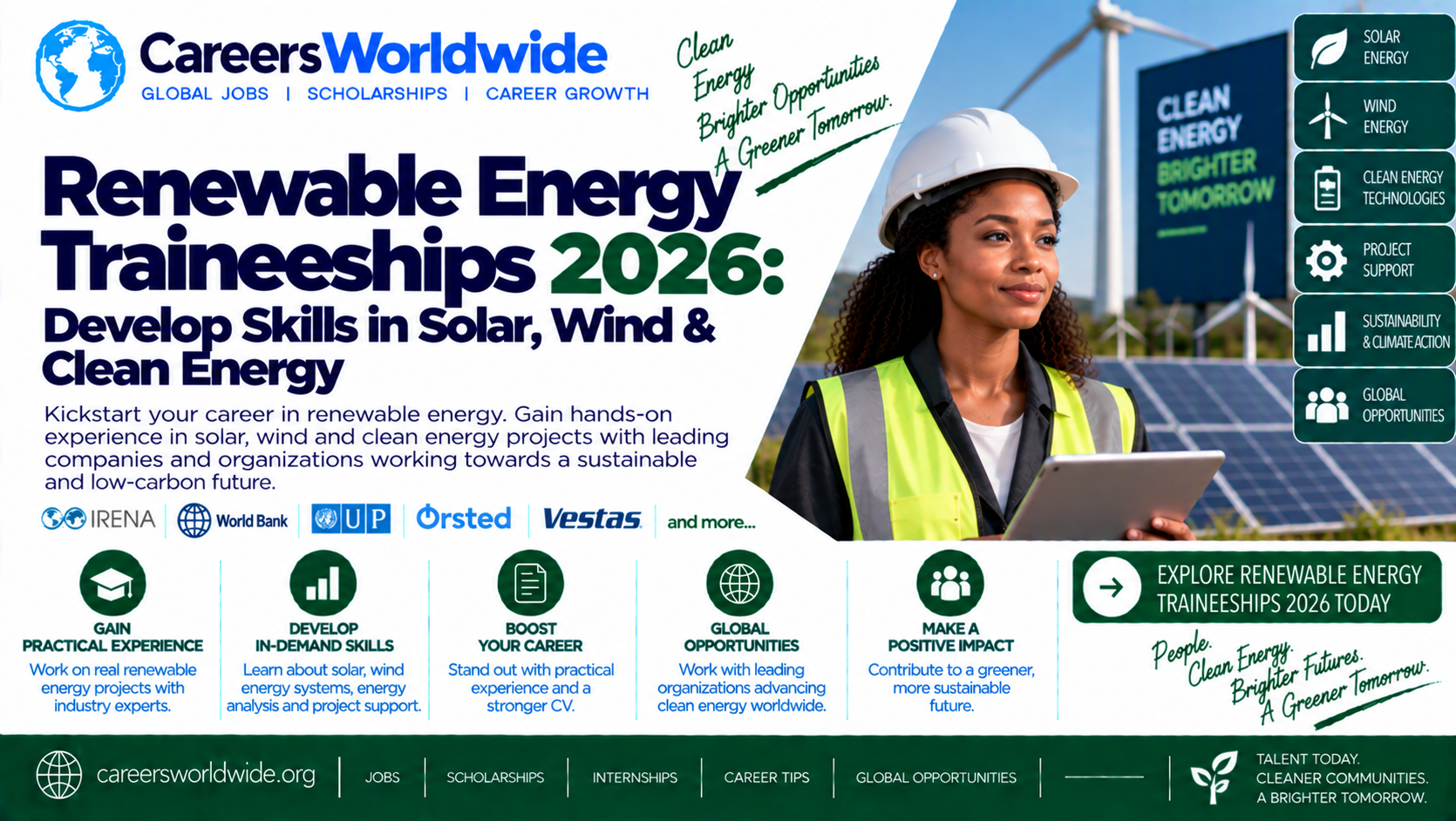

Excerpt: Interested in building a career in clean energy? Renewable energy traineeships in 2026 can offer practical exposure to solar power, wind energy, energy efficiency and sustainable infrastructure. Explore common trainee roles, qualifications, technical skills, portfolio projects, application tips and official learning resources to help you prepare for opportunities in the growing clean energy sector.
Renewable Energy Traineeships 2026: A Career Guide for Graduates
Renewable energy is transforming how electricity is generated, distributed and used. Solar photovoltaic (PV) systems, wind farms, battery storage and energy-efficiency projects require people with technical, operational, analytical and project-support skills.
Renewable energy traineeships can help graduates and early-career applicants explore these fields through supervised work, structured learning or practical assignments. Depending on the employer, trainees may assist with solar installation support, wind farm operations, electrical maintenance, energy data analysis, project coordination or environmental reporting.
There is no single renewable energy traineeship pathway. Some roles are hands-on engineering positions requiring electrical or mechanical training. Others focus on business development, project administration, research, monitoring or sustainability.
This guide explains how to identify suitable opportunities, prepare for applications and develop practical skills for clean energy careers in 2026.
1. What Is a Renewable Energy Traineeship?
A renewable energy traineeship is an early-career learning opportunity connected to clean energy technologies, projects or services. It may be offered by an energy company, engineering contractor, utility, development organization, research institution or equipment provider.
Programmes may combine classroom learning, workplace training, supervised assignments and practical experience.
Possible activities include:
- Supporting solar PV installation or inspection teams.
- Assisting with maintenance records and equipment checks.
- Collecting and organizing energy generation data.
- Helping prepare project reports and technical documentation.
- Supporting procurement, logistics or project coordination.
- Learning about battery storage and energy management.
- Assisting with environmental, health and safety procedures.
- Observing commissioning, troubleshooting or performance monitoring under supervision.
The role’s level of responsibility depends on the employer, training plan and the trainee’s qualifications. Electrical work, work at height and access to industrial equipment require appropriate training, authorization and supervision.
2. Why Explore Renewable Energy Careers in 2026?
Renewable energy projects involve more than generating electricity. They require planning, financing, engineering, installation, operations, maintenance, supply chains and monitoring.
For early-career applicants, exploring the sector can build transferable skills in:
Technical problem-solving: Understanding how equipment and systems operate, recognizing faults and following troubleshooting procedures.
Data and analysis: Reading performance figures, checking records and identifying patterns in energy output or equipment operation.
Project coordination: Tracking tasks, schedules, materials, suppliers and documentation.
Safety and compliance: Following site procedures, identifying hazards and respecting technical standards.
Sustainability awareness: Understanding how energy projects relate to emissions, energy access, land use and environmental considerations.
These skills can be useful in solar companies, utilities, engineering firms, manufacturers, NGOs, research organizations and energy-access programmes.
3. Main Renewable Energy Traineeship Pathways
Choose a pathway based on your education, practical interests and the kind of work environment you prefer.

Solar energy traineeships
May involve solar PV systems, site assessments, installation support, performance monitoring, maintenance documentation and customer energy solutions.
Search titles: Solar PV Trainee, Solar Technician Trainee, Graduate Solar Engineer.

Wind energy traineeships
Can introduce trainees to wind turbine systems, maintenance planning, operations data, mechanical or electrical systems and safety procedures.
Search titles: Wind Technician Trainee, Graduate Wind Engineer, Wind Farm Operations Trainee.

Energy storage and power systems
May cover batteries, inverters, monitoring systems, grid integration, energy management and electrical safety.
Search titles: Energy Storage Trainee, Junior Power Systems Engineer, Battery Systems Intern.

Energy data and performance analysis
Can involve collecting generation data, monitoring equipment performance, preparing dashboards and supporting technical or commercial reports.
Search titles: Renewable Energy Analyst Intern, Energy Data Trainee, Performance Monitoring Assistant.

Clean energy project support
May include project administration, procurement, logistics, stakeholder coordination, documentation and monitoring of project milestones.
Search titles: Renewable Energy Project Assistant, Energy Project Trainee, Sustainability Project Intern.
4. Solar Energy Traineeships: Skills and Responsibilities
Solar energy is a broad field that includes rooftop installations, commercial systems, utility-scale solar farms, off-grid systems and solar-powered services.
A trainee may support one or more parts of the project lifecycle.
Solar PV fundamentals
Learn the basic purpose of:
- Solar panels, which convert sunlight into electricity.
- Inverters, which convert direct current (DC) into alternating current (AC) in common PV systems.
- Mounting structures and cabling.
- Protection devices and disconnects.
- Batteries and charge controllers in applicable systems.
- Monitoring equipment and energy meters.
Understand the difference between grid-connected, off-grid and hybrid systems. Their components, operating conditions and safety requirements can differ.
Installation and maintenance support
Depending on the role and training, activities may include preparing documentation, checking equipment inventories, assisting with visual inspections, recording system readings or supporting maintenance teams.
Trainees should not perform live electrical work or work at height without the required training, equipment, authorization and supervision.
Solar performance monitoring
Solar systems are affected by factors such as sunlight, shading, temperature, equipment condition and system configuration. Trainees may learn to read generation data, compare actual output with expectations and document unusual readings for qualified staff to investigate.
A useful beginner exercise is to create a spreadsheet showing daily energy generation from fictional data and summarize the trend.
5. Wind Energy Traineeships: What to Learn
Wind energy roles may be based at wind farms, engineering offices, equipment manufacturers or maintenance service providers.
Wind turbine systems combine mechanical, electrical, control and monitoring technologies.
Common areas of exposure
- Turbine components and basic operating principles.
- Mechanical and electrical maintenance documentation.
- Operations and performance data.
- Fault reporting and maintenance scheduling.
- Environmental and site considerations.
- Workplace safety procedures.
Some wind technician positions require specialized safety training, medical or physical requirements, travel and work at height. Requirements differ by employer and jurisdiction.
Wind energy data
Trainees in analysis or engineering support roles may work with wind speed, energy output, downtime, maintenance records or equipment availability.
A beginner project could use a fictional dataset to create a chart of daily energy output, identify missing values and explain why a data pattern alone does not prove the cause of a technical issue.
6. Qualifications and Eligibility Requirements
Renewable energy traineeship requirements vary by specialization and employer.
Commonly relevant educational backgrounds
| Pathway | Relevant fields of study |
|---|---|
| Solar PV engineering | Electrical, electronic, energy or renewable energy engineering |
| Wind energy | Mechanical, electrical, mechatronics or energy engineering |
| Energy storage | Electrical engineering, power systems, energy technology |
| Energy data analysis | Engineering, computer science, statistics, data analytics |
| Project support | Business administration, project management, engineering or logistics |
| Environmental and sustainability work | Environmental science, sustainability, energy policy or related fields |
Some opportunities accept diplomas, technical certificates or vocational training. Others require a bachelor’s degree or a specific engineering qualification.
Can applicants from IT or software engineering apply?
Potentially, especially for roles involving energy data, monitoring dashboards, software systems, digital energy services, workflow automation or technical support.
However, an IT qualification does not automatically meet the requirements for electrical installation, power engineering or wind turbine maintenance. Check whether the role requires a particular engineering discipline, trade qualification or professional registration.
Experience requirements
Some traineeships are intended for recent graduates or applicants with limited experience. Others may request industrial attachment, internship experience, site exposure or familiarity with specific technologies.
Relevant experience could include:
- Engineering or technical attachment.
- Electrical or mechanical workshop training.
- Data analysis or dashboard projects.
- Energy research or university projects.
- Project coordination or logistics work.
- Environmental monitoring or fieldwork.
Use accurate descriptions and distinguish practical experience from theoretical study.
7. Essential Skills for Renewable Energy Trainees
You do not need to master every skill before applying. Prioritize those that match the target role.
Electrical and energy fundamentals
For technical roles, understand basic electricity, power, energy, voltage, current, AC/DC and the function of common system components.
Data handling
Practice spreadsheets, charts, data cleaning and basic performance calculations. Technical analysis roles may require Python, SQL or specialized engineering tools.
Documentation and reporting
Learn to keep accurate equipment records, write clear observations, maintain task trackers and follow reporting procedures.
Safety awareness
Understand the importance of risk assessments, PPE, electrical isolation, working-at-height controls and following authorized procedures.
Communication and teamwork
Practice sharing technical updates clearly, asking questions, recording issues and coordinating with engineers, technicians and project teams.
8. Digital Tools and Technical Knowledge
The right tools depend on the role. Employers may provide training in their own software and procedures, so applicants should focus on foundational concepts first.
Tools that may be useful
- Microsoft Excel or Google Sheets: Organizing equipment records, generation data, inventory and project trackers.
- Power BI or similar dashboard tools: Presenting performance data and project indicators.
- Python: Automating data cleaning, analysis or repetitive reporting tasks.
- CAD tools: Reading or preparing technical drawings where required.
- PV system design tools: Some solar roles use specialized software for system design and yield estimates.
- SCADA and monitoring systems: Used in some operational environments to observe equipment and system performance.
- Project management tools: Tracking activities, responsibilities, milestones and deadlines.
Do not claim proficiency in a tool after only watching a tutorial. Explain whether you have used it in a project, studied it or are still learning.
9. Practical Portfolio Projects for Applicants
A portfolio can demonstrate initiative, especially if you have limited professional experience. Use fictional or publicly available data and avoid publishing confidential project information.

Project 1: Solar generation dashboard
Create a spreadsheet using fictional daily solar output data. Include a line chart, monthly totals, missing-data checks and a short note explaining that generation varies with weather and system conditions.

Project 2: Wind output analysis
Use sample data to summarize energy output, downtime and missing records. Create a chart and identify questions an engineer would need to investigate before drawing conclusions.

Project 3: Renewable energy project tracker
Build a sample tracker for a small solar project, including tasks, owners, deadlines, material status and risks. Use fictional names and make clear that it is a learning exercise.

Project 4: Energy storage explainer
Prepare a short illustrated report explaining the role of batteries in a renewable energy system. Include a simple energy-flow diagram and describe the limits of your example.
For each project, include the objective, tools used, assumptions, method, sample results and limitations. A concise, well-explained project can be more useful than a large, unfinished one.
10. Where to Find Renewable Energy Traineeships in 2026
Opportunities may be advertised by energy developers, utilities, engineering contractors, equipment manufacturers, research institutions, government agencies and development organizations.
Solar companies and installers
Look for organizations that design, install, maintain or finance rooftop, commercial, utility-scale or off-grid solar systems. Relevant titles may include solar technician trainee, project assistant, junior design assistant or operations intern.
Utilities and power companies
Utilities may recruit graduates for engineering, operations, maintenance, planning, customer services, data and project support. Check whether a programme is specifically focused on renewable energy or offers broader power-sector exposure.
Wind developers and equipment providers
Wind-related opportunities may be found through project developers, turbine manufacturers, maintenance providers and engineering consultancies. Some roles require travel, site attendance or specialized safety training.
NGOs and energy-access programmes
Development organizations and social enterprises may work on rural electrification, mini-grids, clean cooking, energy access, climate projects and community energy initiatives.
Relevant titles may include energy project assistant, renewable energy programme intern, technical project trainee or monitoring and evaluation assistant.
Research and educational institutions
Universities, laboratories and research organizations may offer internships related to solar technologies, wind resources, energy storage, power systems, energy policy or sustainability analysis.
11. How to Apply for Renewable Energy Traineeships
Follow a consistent process to ensure your application matches the actual opportunity.
- Find and verify the vacancyStart with the employer’s official careers page or an authorized recruitment channel. Confirm the job title, location, closing date and application method.
- Check the eligibility criteriaReview the required qualification, graduation year, experience, technical knowledge, work authorization and any site or safety requirements.
- Tailor your CVHighlight relevant education, attachment, practical projects, technical skills, reporting experience and teamwork. Put the most relevant evidence near the top.
- Prepare a targeted application letterExplain why the specific renewable energy pathway interests you and connect your skills to the duties in the advert.
- Collect requested documentsThese may include certificates, transcripts, identification, references, a portfolio or professional credentials. Submit only what the employer requests through a verified channel.
- Submit as instructedFollow the required email subject, portal, file format and deadline. Keep a copy of the application and confirmation.
- Track your applicationsRecord the organization, role, source, date applied, closing date and follow-up details. Check your email and recruitment portal for updates.
CV tips for renewable energy applicants
A clear CV can help employers see how your background connects to the role.
Suggested sections:
- Name and professional contact details.
- Short professional profile.
- Education and relevant coursework.
- Technical skills and tools.
- Projects or practical experience.
- Internship, attachment or employment history.
- Training and certifications, if relevant.
- Portfolio link, if available.
Use specific examples instead of broad claims. For example:
- “Created an Excel dashboard using sample solar generation data.”
- “Assisted with maintaining equipment inventory records during industrial attachment.”
- “Prepared project documentation and tracked assigned tasks.”
- “Used Python to clean and summarize a sample energy dataset.”
Only include statements that accurately reflect your own experience.
Sample application email
12. Interview Preparation: Questions and Sample Approaches
Renewable energy interviews can combine technical fundamentals, safety awareness, practical problem-solving and questions about your motivation.
The questions depend on the role. A solar installation trainee may be assessed differently from an energy data analyst or project coordinator.
1. Why are you interested in renewable energy?
2. What is the difference between power and energy?
3. What does a solar inverter do?
4. What factors can affect solar generation?
5. What would you do if you noticed an unsafe condition at a site?
6. How would you approach unfamiliar monitoring software?
Practical scenario: Solar system output is lower than expected
Question: A monitoring dashboard shows that a solar PV system produced less energy than expected yesterday. What would you do?
A structured answer could be:
- Check that the data is complete and the reporting period is correct.
- Review available weather and sunlight information.
- Check for reported outages, alarms or maintenance activity.
- Compare the readings with relevant historical or expected data.
- Record the observation and avoid assuming a cause without evidence.
- Escalate to the responsible technical staff according to procedure.
- Follow approved safety requirements; do not open or repair equipment without authorization.
This approach demonstrates data awareness, documentation, safety and an understanding of the limits of a trainee’s responsibility.
13. Salary, Work Arrangements and Benefits
Renewable energy trainee compensation varies by employer, country, qualification, funding, contract type and technical specialization.
A trainee position may be a paid graduate job, internship, apprenticeship, fixed-term contract or another training arrangement. Do not assume all programmes provide the same benefits.
Before accepting an offer, confirm:
- Salary or stipend and the currency.
- Whether the amount is gross or net.
- Contract duration and probation terms.
- Work location and expected site travel.
- Working hours and any shift or on-call duties.
- Transport, accommodation or field allowances, if applicable.
- Safety equipment and required training.
- Mentoring, certification or study support.
- Whether a permanent role is possible, without assuming it is guaranteed.
Some roles are office-based, while others involve construction sites, solar farms, wind facilities, workshops or remote project locations. Read the work conditions carefully.
14. Safety and Professional Responsibility
Safety is central to renewable energy work. Solar and wind systems can involve electrical hazards, moving machinery, work at height, lifting operations, weather exposure and remote locations.
Trainees should:
- Complete required induction and safety training.
- Follow instructions from authorized supervisors.
- Use appropriate personal protective equipment (PPE).
- Never bypass guards, isolation procedures or safety controls.
- Avoid live electrical work unless properly qualified and authorized.
- Follow approved procedures for working at height and around machinery.
- Report hazards, near misses and equipment concerns.
- Stop and seek guidance when a task is outside their training or authorization.
A trainee is not expected to independently undertake high-risk technical work. Showing that you recognize your limits and follow safety procedures is an important part of professional readiness.
15. Official Renewable Energy Learning and Career Resources
These resources can help you build foundational knowledge and research the sector. They are learning or information resources—not confirmation that a particular traineeship is currently accepting applications.
International Renewable Energy Agency (IRENA)
Explore renewable energy technologies, publications, statistics and international sector information.
National Renewable Energy Laboratory (NREL)
Explore research and educational material related to renewable energy, energy systems and clean technology.
U.S. Department of Energy — Solar Energy Technologies Office
Learn about solar energy technology research, development and deployment.
U.S. Department of Energy — Wind Energy
Explore information about wind energy technologies and research.
International Energy Agency (IEA)
Find energy-sector analysis, data and reports that can support broader understanding of clean energy markets and systems.
How to use these resources effectively
- Choose a pathway such as solar, wind, storage, energy data or project support.
- Learn the basic terminology and technology relevant to that pathway.
- Review employer job descriptions to identify recurring requirements.
- Build a small project that demonstrates one or two relevant skills.
- Search the official career pages of energy companies, utilities, engineering firms and development organizations.
- Confirm the specific vacancy, eligibility and deadline before applying.
For applicants in Zimbabwe and elsewhere in Southern Africa, also investigate local utilities, solar installers, engineering contractors, energy-access organizations and relevant government or industry career channels. Check each employer’s official source for current opportunities.
16. A 30-Day Renewable Energy Preparation Plan
Use this checklist to organize your learning and job search. Choose one initial pathway and adapt the tasks to your current knowledge and available time.
Your preparation checklist
0/12 complete
Week 1 — Choose your pathwayChoose solar, wind, storage, energy data or project support as your initial focusReview basic concepts relevant to your chosen pathwayRead three job descriptions and list recurring qualifications and skills
Week 2 — Build foundationsComplete a beginner lesson using an official learning resourcePractice Excel, technical documentation or relevant softwareWrite a short note explaining a renewable energy system or process
Week 3 — Create a projectBuild a small portfolio project using fictional or public dataDocument your method, assumptions and limitationsPrepare a short explanation of what you learned
Week 4 — Prepare applicationsUpdate your CV and draft a targeted application letterPractice technical and safety-related interview questionsCheck official career pages and apply to suitable open roles
17. Renewable Energy Traineeships 2026: Summary Table
| Category | Key information |
|---|---|
| Opportunity type | Graduate traineeships, internships, apprenticeships and junior roles |
| Main pathways | Solar, wind, energy storage, power systems, data analysis and project support |
| Relevant qualifications | Engineering, energy technology, IT, data analysis, environmental science, business or related fields |
| Technical skills | Electrical fundamentals, energy data, spreadsheets, relevant software and documentation |
| Professional skills | Problem-solving, communication, teamwork, safety awareness and organization |
| Portfolio ideas | Solar generation dashboard, wind output analysis, project tracker or energy storage explainer |
| Potential employers | Energy developers, utilities, installers, manufacturers, engineering firms, NGOs and research institutions |
| Application documents | Tailored CV, application letter or email and requested supporting documents |
| Official resources | IRENA, NREL, U.S. Department of Energy and IEA |
| Important reminder | Verify the vacancy, eligibility, work conditions and closing date through the employer |
18. Frequently Asked Questions
1. What are renewable energy traineeships?
They are early-career learning opportunities that provide exposure to clean energy technologies, projects or services. Training may cover technical work, project support, data analysis, operations or maintenance.
2. Who can apply for renewable energy traineeships in 2026?
Eligibility depends on the programme. Employers may accept graduates or trainees with backgrounds in engineering, energy technology, IT, data analysis, environmental science, business or related disciplines.
3. Can I apply with a diploma?
Some programmes accept diplomas or technical qualifications, while others require a degree. Check the education requirements of the specific vacancy.
4. Can IT or software engineering graduates work in renewable energy?
Potentially. Relevant roles may involve energy data, monitoring systems, software, dashboards, digital services or project support. Electrical installation and certain engineering positions may require specialized qualifications.
5. Do I need previous experience?
Not always. Some graduate traineeships are designed for applicants with limited experience. Academic projects, industrial attachment, internships and relevant practical work may help demonstrate readiness.
6. What skills are useful for solar traineeships?
Depending on the role, useful skills include electrical fundamentals, solar PV concepts, documentation, data handling, safety awareness and familiarity with relevant monitoring or design tools.
7. What qualifications are needed for wind energy jobs?
Requirements vary. Technical roles may ask for electrical, mechanical, mechatronics or energy engineering backgrounds, while other positions may focus on data, project coordination or administration. Some roles require specialized safety training.
8. Are renewable energy traineeships paid?
Some are paid, but compensation depends on the employer, country, programme and contract type. Confirm the salary or stipend and benefits in the official vacancy or written offer.
9. Can renewable energy traineeships lead to permanent employment?
They may provide relevant experience for future roles, but permanent employment is not guaranteed. Progression depends on performance, qualifications, available positions and employer requirements.
10. Can renewable energy jobs be remote?
Some data, research, software and project-support roles may offer remote or hybrid arrangements. Installation, maintenance and many operational roles require site attendance. Always check the work location and conditions.
11. What should I include in my CV?
Include relevant education, technical skills, projects, internships, attachment experience and examples of problem-solving, documentation or data analysis. Tailor your CV to the specific job description.
12. Where can I find renewable energy traineeships?
Search official career pages of energy companies, utilities, solar installers, wind developers, engineering contractors, manufacturers, NGOs and research institutions. Confirm that the vacancy is genuine and still open before applying.
Conclusion
Renewable energy traineeships can help graduates and early-career applicants explore careers in solar, wind, energy storage, power systems, data analysis and clean energy project support.
The most useful starting point is to choose a pathway that matches your background, learn its technical fundamentals and build practical evidence of your skills. A small portfolio project, a clear CV and careful interview preparation can help you explain what you know and what you are ready to learn.
Renewable energy work can also involve significant safety responsibilities. Follow the training and authorization requirements for each task, and never attempt hazardous electrical or industrial work without proper supervision.
For CareersWorldwide readers, the practical next step is to review official employer career pages, compare eligibility requirements and apply only to opportunities that match your qualifications and circumstances.
Disclaimer
This article is for general career information and educational purposes. It is not an official recruitment notice and does not guarantee that vacancies are available, that applications will be successful, or that any particular salary, benefit or career outcome will be offered. Job requirements and deadlines may change. Verify all vacancy details through the relevant employer or authorized recruitment channel before applying. Follow applicable safety procedures and obtain appropriate training and authorization before undertaking technical work. CareersWorldwide is not responsible for employer recruitment decisions or losses arising from fraudulent recruitment messages.
SEO Keywords
Renewable Energy Traineeships 2026, Renewable Energy Jobs 2026, Solar Energy Traineeships, Solar Technician Trainee Jobs, Wind Energy Traineeships 2026, Wind Technician Trainee, Clean Energy Graduate Jobs, Renewable Energy Internships 2026, Graduate Renewable Energy Engineer, Solar PV Traineeships, Energy Storage Trainee Jobs, Battery Systems Internships, Renewable Energy Project Assistant, Energy Data Analyst Trainee, Renewable Energy Jobs for Graduates, Clean Energy Careers, Renewable Energy Jobs Zimbabwe, Solar Energy Jobs Zimbabwe, Wind Energy Careers, Renewable Energy Skills, Renewable Energy CV Tips, Renewable Energy Interview Questions, How to Apply for Renewable Energy Traineeships, CareersWorldwide.
ALSO CHECK: Junior Automation Engineer Jobs 2026: Build Workflow & Process Automation SolutionsSeptember 21, 2026
Procurement Traineeships 2026: Learn Purchasing, Supplier Management & Contract SupportSeptember 21, 2026
Data Analytics Traineeships 2026: Learn Business Intelligence & Data VisualisationSeptember 21, 2026