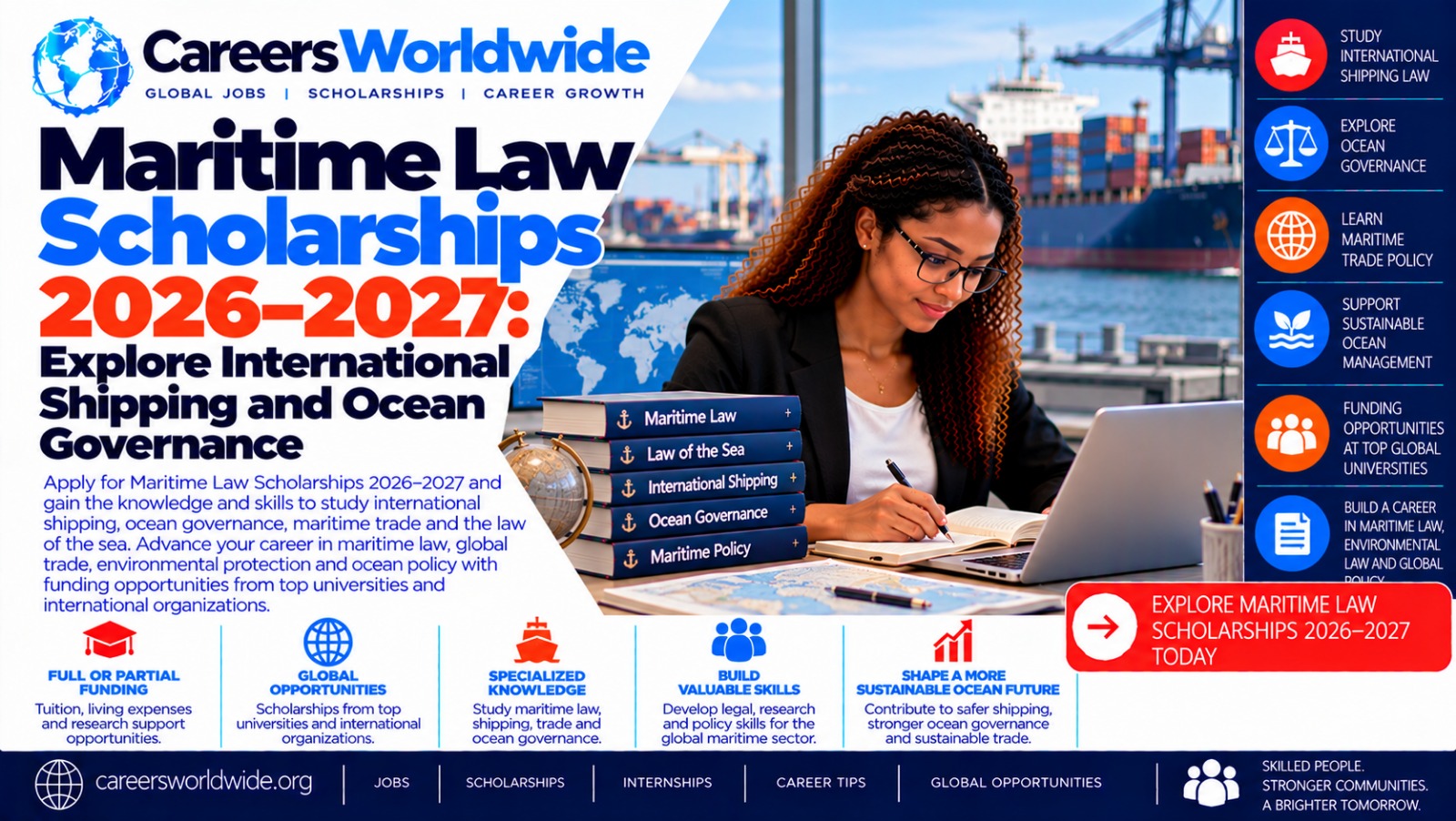

Excerpt: Maritime law scholarships for 2026–2027 can help aspiring lawyers, postgraduate students, researchers, and maritime professionals pursue advanced studies in international shipping, ocean governance, marine environmental protection, and the law of the sea. From specialist maritime law bursaries to international fellowships supported by maritime institutions and the United Nations, several funding pathways may be worth exploring. Discover potential opportunities, eligibility requirements, application steps, official resources, and practical tips for preparing a competitive scholarship application.
Introduction: Why Study Maritime Law in 2026–2027?
The world’s oceans are essential to international trade, food security, energy production, environmental sustainability, and global connectivity. As shipping networks expand and countries respond to marine pollution, maritime security concerns, climate change, and competing claims over ocean resources, the need for professionals with specialist maritime legal knowledge continues to grow.
Maritime law brings together several interconnected disciplines, including shipping contracts, admiralty law, marine insurance, maritime arbitration, port regulation, international trade, and the law of the sea. Ocean governance adds another important dimension, focusing on how governments and international institutions manage marine resources, protect biodiversity, resolve maritime disputes, and implement international legal agreements.
For students considering postgraduate education or professional development, the 2026–2027 academic cycle offers an opportunity to investigate specialist scholarships, university funding, research awards, and international fellowships.
However, maritime law funding is not always advertised under a single scholarship category. Some awards explicitly support maritime law, while others fund broader ocean affairs, marine environmental law, shipping regulation, or international legal research.
Applicants should therefore investigate several funding routes rather than limiting their search to awards with the words “maritime law” in their titles.
1. What Are Maritime Law Scholarships?
Maritime law scholarships are financial awards that help eligible students or researchers pay for education, specialist training, or research in legal fields connected with shipping and the oceans.
Depending on the funding provider, an award may cover tuition fees, research expenses, travel, accommodation, living costs, or a portion of the overall educational budget.
Common categories include:
- Postgraduate scholarships: Funding for master’s degrees, including Master of Laws (LLM) programmes.
- Research scholarships: Support for dissertations, postgraduate research, and projects investigating maritime legal issues.
- Professional fellowships: Opportunities for government officials, legal practitioners, lecturers, and maritime administrators to undertake advanced training.
- Marine and environmental law awards: Funding for research into marine conservation, offshore development, coastal communities, and environmental regulation.
- University bursaries: Financial assistance based on academic performance, financial need, or a combination of eligibility criteria.
- Short-course scholarships: Support for specialist programmes in the law of the sea, ocean policy, and international maritime governance.
Not every opportunity is a conventional scholarship. Some fellowships fund professional development or research placements, while others require government nomination or admission to a specific university programme.
Understanding these differences helps applicants identify funding that matches their qualifications, professional background, and intended career.
2. Maritime Law Scholarship Opportunities to Explore for 2026–2027
The following programmes and funding routes are useful starting points. Their eligibility rules, funding arrangements, and deadlines differ, so applicants should consult the official programme pages before making decisions.
A. Steven Wallace Maritime Trust — South Africa
The Steven Wallace Maritime Trust, established by the Maritime Law Association of South Africa, supports people studying, training, or conducting research in maritime law.
Its funding scope includes aspiring maritime legal practitioners, existing practitioners seeking further training, and researchers working in the field. This makes it particularly relevant to South African applicants pursuing maritime law qualifications or research.
The Trust’s published information states that applications for 2027 open on 1 September 2026 and close on 31 January 2027.
Applicants should prepare the documents specified by the Trust, including a motivation letter, curriculum vitae, academic results, evidence of university registration or a registration application, current academic results where applicable, and university invoices or account statements.
Who should investigate this opportunity?
South African students, postgraduate candidates, legal practitioners, and researchers whose studies or professional development directly relate to maritime law.
Official resource: https://www.mlasa.co.za/steven-wallace-maritime-trust/
B. Hamilton Shirley Amerasinghe Memorial Fellowship — United Nations
The Hamilton Shirley Amerasinghe Memorial Fellowship focuses on the law of the sea and international ocean affairs. It is particularly relevant to professionals who want to strengthen their understanding of the United Nations Convention on the Law of the Sea (UNCLOS).
The programme is intended primarily for government officials, research fellows, lecturers, and other eligible professionals involved in ocean law or maritime affairs.
According to the published 2027 call, the fellowship offers opportunities for specialised research and study at participating institutions, followed by an internship with the United Nations Division for Ocean Affairs and the Law of the Sea.
The published eligibility criteria include a relevant degree or technical qualification, citizenship of a developing state, at least five years of relevant work experience, research capability, and an age range of 25–40.
The deadline stated for the 2027 fellowship is 25 October 2026. Prospective applicants should check the official announcement immediately because the deadline is close.
Required materials include the online application form, the personal history and proposed research study programme form, and a copy of the passport biodata page. A nomination form may also be submitted where applicable. Incomplete applications are not considered.
Who should investigate this opportunity?
Eligible professionals in government, academia, and related institutions who work on maritime affairs, ocean policy, or the implementation of international law.
Official resource: https://www.un.org/oceancapacity/ar/HSA
C. IMO International Maritime Law Institute — LL.M. Programme
The International Maritime Law Institute (IMLI), established under the auspices of the International Maritime Organization, provides specialised postgraduate education in international maritime law.
Its LL.M. programme covers areas such as the law of the sea, shipping law, maritime security law, and marine environmental law. It also provides training in drafting maritime legislation and implementing international maritime instruments within national legal systems.
IMLI’s funding arrangements require careful attention. The Institute states that it does not itself offer fellowships, but it may approach external donors to sponsor a limited number of deserving, government-nominated candidates.
Applicants seeking this type of support generally need a government nomination that includes a request for financial assistance. A separate fellowship application and evidence of payment of the applicable fellowship application fee may also be required.
The published application information for the 2026–2027 programme lists a closing date of 27 February 2026. That date has passed, so prospective students should contact IMLI about subsequent admission cycles rather than assume applications remain open.
Who should investigate this opportunity?
Law graduates and relevant government or maritime-sector professionals seeking advanced education in international maritime legislation and regulation.
Official resource: https://imli.org/programmes-and-courses/ll-m-programme/
D. Institute of Marine & Environmental Law — University of Cape Town
The University of Cape Town’s Institute of Marine & Environmental Law offers a postgraduate funding route relevant to students whose interests overlap with maritime law, marine conservation, and environmental governance.
The Faculty of Law’s published postgraduate scholarship information describes an annual scholarship for eligible LLM, MPhil, or professional postgraduate study in marine and environmental law or environmental law.
The stated award value is approximately R100,000 toward tuition fees, subject to the applicable funding conditions and the current call.
This is a particularly relevant option for students researching marine pollution, coastal development, offshore energy, biodiversity protection, fisheries regulation, or environmental obligations under international and domestic law.
The published information refers to a 2026 scholarship call. Applicants targeting the 2027 academic year should confirm whether the next call has opened, which programmes qualify, and what dissertation or research requirements apply.
Who should investigate this opportunity?
Eligible postgraduate candidates interested in marine environmental law, coastal governance, and the regulation of ocean-related activities.
Official resource: https://law.uct.ac.za/undergrad-info-scholarship-funding/postgraduate-scholarships
E. University of Southampton — LLM Maritime Law
The University of Southampton offers an LLM in Maritime Law and provides information about funding opportunities for UK and international students.
Although admission to the programme does not automatically guarantee a scholarship, university-wide and external funding options may help eligible applicants meet their education costs.
The programme is relevant to students seeking advanced study in maritime legal issues and wishing to develop their understanding of the legal environment surrounding shipping and international commerce.
For the 2027 entry cycle, the university’s published course information gives application deadlines of 18 August 2027 for international applicants and 1 September 2027 for UK applicants. These are course application deadlines, not necessarily scholarship deadlines, and the university advises applying early.
Prospective students should check the programme’s current fees, entry requirements, funding arrangements, and any additional requirements applicable to international applicants.
Who should investigate this opportunity?
Law graduates seeking a specialist maritime law master’s degree and exploring university or external financial support.
Official resource: https://www.southampton.ac.uk/courses/maritime-law-masters-llm
F. International Foundation for the Law of the Sea — Summer Academy
The International Foundation for the Law of the Sea offers a Summer Academy focused on international law of the sea and related issues.
Its 2027 session is scheduled for 25 July to 20 August 2027. The published application information states that applications may be submitted until 31 March 2027, although applicants should confirm the exact session and application instructions on the official website.
The Foundation indicates that scholarships and travel grants may be available on a limited basis. Applicants should not assume that these awards cover every expense.
The application process may require identification, academic qualifications, English-language evidence, two reference letters, and a motivation statement addressing participation and, where relevant, scholarship or travel-grant support.
Who should investigate this opportunity?
Students, researchers, and professionals who want focused training in the law of the sea without necessarily undertaking a full master’s degree.
Official resource: https://iflos.org/summer-academy/application/
G. University and External Graduate Funding
A final route is to apply for a maritime law degree and investigate funding offered through the university’s wider postgraduate scholarship system.
Some institutions offer merit-based awards, means-tested bursaries, tuition reductions, or research funding for candidates whose interests align with marine policy, ocean governance, shipping regulation, or environmental law.
For example, Tulane Law School publishes graduate scholarship information covering tuition assistance for LLM students, including candidates in its Admiralty programme. Awards and eligibility vary by programme and applicant circumstances.
Applicants should distinguish between a confirmed maritime-specific award and a general scholarship for which a maritime law student may be eligible.
Official resource: https://law.tulane.edu/admissions/graduate-scholarships
3. Who Is Eligible for Maritime Law Scholarships?
Eligibility varies considerably between funding providers. Before preparing an application, check the following requirements.
Academic qualifications: Many postgraduate opportunities require a recognised bachelor’s degree in law or a related discipline. Research fellowships may accept qualifications in marine science, political science, ocean management, or another relevant field.
Nationality and residence: Certain awards are restricted to citizens of particular countries, residents of a specific region, or applicants from developing states.
Professional experience: Fellowships aimed at government officials or established professionals may require several years of relevant experience.
Academic performance: Some scholarships prioritise strong grades, research potential, or a record of academic achievement.
Financial need: Means-tested awards may require evidence of household income, financial hardship, or an inability to cover tuition independently.
Admission or registration: Some funders require an unconditional or conditional university offer, proof of registration, or evidence that an application for admission has been submitted.
Research alignment: Marine environmental law and ocean governance awards may require a research proposal connected to a specified topic, institution, or supervisory team.
Meeting the minimum criteria does not guarantee selection. Applicants should also demonstrate a clear reason for pursuing maritime law and explain how the qualification or research project will contribute to their professional or public-interest goals.
4. Practical Guidance for Finding the Right Funding
A successful funding search starts with a precise academic or professional objective.
If your main interest is shipping contracts, marine insurance, admiralty disputes, or port operations, prioritise maritime law departments, specialist legal trusts, and universities with shipping-related postgraduate programmes.
If your interests concern ocean boundaries, marine biodiversity, fisheries, or international environmental obligations, expand your search to law-of-the-sea fellowships, marine environmental law institutes, and ocean governance programmes.
Government employees should investigate fellowships requiring official nomination. These opportunities may provide a different route to specialist education than scholarships available through open university applications.
Applicants should also evaluate the full cost of study. A tuition-only scholarship may leave accommodation, travel, insurance, visa fees, research costs, and living expenses unfunded.
Before accepting an award, ask whether it can be combined with other financial assistance, whether it requires full-time enrolment, and whether recipients must return to a particular country or organisation after completion.
Finally, confirm all deadlines using the official funding provider’s current information. A programme may publish a course deadline separately from its scholarship deadline, and a previous year’s timetable should never be treated as a guarantee for the next intake.
5. Summary Table: Maritime Law Funding Opportunities
| Opportunity | Main focus | Funding route | Key timing or requirement |
|---|---|---|---|
| Steven Wallace Maritime Trust | Maritime law education and research | Scholarships and bursaries | 2027 applications close 31 January 2027 |
| Hamilton Shirley Amerasinghe Fellowship | Law of the sea and ocean affairs | International fellowship | Published 2027 deadline: 25 October 2026 |
| IMO International Maritime Law Institute | International maritime law | Potential external donor funding for nominated candidates | 2026–2027 deadline has passed |
| University of Cape Town | Marine and environmental law | Postgraduate scholarship | Confirm the next application call |
| University of Southampton | Maritime law LLM | University and external funding | Check course and separate funding deadlines |
| International Foundation for the Law of the Sea | Law-of-the-sea training | Limited scholarships and travel grants | Published 2027 application deadline: 31 March 2027 |
| Tulane Law School | Admiralty and graduate legal study | Scholarships and tuition assistance | Confirm programme-specific eligibility and timing |
The table is a starting point, not a guarantee of funding. Award values, application windows, eligibility criteria, and available places can change. Check the linked official resources before applying.
6. How to Apply for Maritime Law Scholarships
Step 1: Identify your target programme
Choose a qualification, fellowship, or research opportunity that matches your academic background and career plans. Decide whether you need a full degree, a short specialist course, or a research placement.
Step 2: Check eligibility and deadlines
Review nationality restrictions, academic requirements, work-experience criteria, funding coverage, and application dates. Contact the programme administrator if any requirement is unclear.
Step 3: Prepare your academic documents
Gather degree certificates, official transcripts, evidence of English proficiency where required, and any documentation requested to establish eligibility.
Ensure that names, dates, qualifications, and other information are consistent across your documents.
Step 4: Write a focused motivation letter
Explain why you want to specialise in maritime law, why the selected programme is appropriate, and how the training will support your intended career.
Use specific goals rather than broad claims. For example, you might plan to improve national shipping legislation, contribute to marine pollution regulation, support maritime dispute resolution, or research ocean governance challenges affecting coastal communities.
Step 5: Develop a research proposal where necessary
For research-based awards, define a manageable question, explain its importance, identify the relevant legal framework, and outline your proposed methodology.
Potential subjects include the implementation of UNCLOS, liability for marine pollution, regulation of offshore renewable energy, protection of marine biodiversity, or legal responses to maritime security threats.
Step 6: Secure references and nominations
Request recommendation letters well before the deadline. Choose referees who can discuss your academic ability, professional achievements, research potential, and suitability for the award.
If a government nomination is mandatory, begin the process early because internal approval can take considerable time.
Step 7: Submit the complete application
Follow the official submission procedure, use the required file formats, and check that all supporting documents have been attached.
Save the submission confirmation and retain copies of every document.
Step 8: Plan for the remaining costs
Prepare a realistic budget for tuition, accommodation, transport, meals, visa expenses, health insurance, books, and other essential costs.
If the award provides partial funding, identify credible additional sources before committing to the programme.
Step 9: Monitor correspondence
Check your email regularly and respond promptly to requests for clarification. Keep your contact details current and follow any instructions concerning interviews, offers, or acceptance deadlines.
7. How to Make Your Application More Competitive
A strong application connects academic preparation with a clearly defined maritime challenge.
First, demonstrate subject knowledge. Explain how your interests relate to shipping, marine environmental protection, international legal obligations, maritime commerce, or ocean governance.
Second, show practical relevance. Applicants with professional experience can describe legal research, shipping operations, regulatory work, coastal management, or policy projects that inform their goals. Students without professional experience can highlight relevant coursework, dissertations, volunteering, or research.
Third, explain the expected benefit. Funders may want to understand how the award will support the applicant’s development and, where relevant, benefit their home country, institution, or community.
Fourth, make your research proposal achievable. A narrowly defined question supported by a realistic methodology is often more persuasive than an overly broad project covering every aspect of international maritime law.
Finally, follow instructions precisely. Missing transcripts, incomplete forms, unsuitable references, or a late submission can undermine an otherwise strong application.
8. Official Application Resources
Use these official sources to verify the opportunities discussed in this article:
- Steven Wallace Maritime Trust: https://www.mlasa.co.za/steven-wallace-maritime-trust/
- Hamilton Shirley Amerasinghe Memorial Fellowship: https://www.un.org/oceancapacity/ar/HSA
- IMO International Maritime Law Institute LL.M.: https://imli.org/programmes-and-courses/ll-m-programme/
- University of Cape Town postgraduate scholarships: https://law.uct.ac.za/undergrad-info-scholarship-funding/postgraduate-scholarships
- University of Southampton LLM Maritime Law: https://www.southampton.ac.uk/courses/maritime-law-masters-llm
- International Foundation for the Law of the Sea Summer Academy: https://iflos.org/summer-academy/application/
- Tulane Law School graduate scholarships: https://law.tulane.edu/admissions/graduate-scholarships
For additional opportunities, search university postgraduate funding databases, national maritime authorities, maritime law associations, ocean research centres, and international organisations working on the law of the sea.
9. Frequently Asked Questions
Are maritime law scholarships available for 2026–2027?
Yes, relevant funding routes exist, including specialist maritime law bursaries, postgraduate scholarships, and international fellowships. However, availability depends on the individual provider and application cycle. Some 2026 deadlines have passed, while other 2027 opportunities have published application windows.
Can international students apply?
Some opportunities are open to eligible international applicants, while others are restricted by nationality, residence, institutional affiliation, or government nomination. Read the eligibility conditions carefully before preparing an application.
Do I need a law degree to study maritime law?
Many LLM programmes require a law degree or equivalent legal qualification. Certain fellowships and interdisciplinary programmes may accept candidates with relevant qualifications in marine science, political science, ocean management, or related disciplines. The rules depend on the programme.
Are fully funded maritime law scholarships available?
Some fellowships may cover substantial study-related expenses, and certain specialised awards may provide comprehensive support. Others offer partial tuition assistance or limited grants. Never assume that an award is fully funded unless the official terms explicitly confirm its coverage.
Can government officials apply for maritime law funding?
Yes. Some international programmes specifically target government officials responsible for maritime affairs, ocean policy, or the implementation of international legal instruments. These opportunities may require a formal nomination from the relevant authority.
What documents are commonly required?
Typical documents include academic transcripts, degree certificates, a CV, a motivation letter, references, proof of English proficiency where applicable, and evidence of admission or registration. Research fellowships may additionally require a proposed research programme, passport details, employment information, or a nomination form.
What is the difference between maritime law and the law of the sea?
Maritime law commonly addresses legal issues associated with shipping, maritime commerce, vessel operations, marine insurance, and related disputes. The law of the sea is a branch of international law concerned with maritime zones, navigation rights, ocean resources, jurisdiction, and states’ rights and obligations under international agreements. The fields overlap but are not identical.
When should I start preparing my application?
Begin as early as possible. Several months of preparation can help you obtain academic records, develop a research proposal, secure references, arrange a government nomination if needed, and organise your finances. Start by checking the earliest relevant deadline.
Are scholarships available for marine environmental law?
Yes. Some university awards and research funding schemes support marine environmental law, coastal governance, marine conservation, and environmental regulation. These may be suitable for applicants whose interests extend beyond commercial shipping.
How can I avoid scholarship scams?
Use official university, government, foundation, or international-organisation websites. Verify application fees and payment instructions directly with the institution, and be cautious of unsolicited messages promising guaranteed awards. Never provide sensitive financial information to an unverified intermediary.
10. Conclusion: Build Your Future in Maritime Law and Ocean Governance
Maritime law scholarships for 2026–2027 offer potential pathways into specialist legal education, international research, shipping regulation, and ocean governance. The most suitable option depends on your qualifications, nationality, professional experience, research interests, and financial needs.
Start by reviewing the Steven Wallace Maritime Trust, the Hamilton Shirley Amerasinghe Memorial Fellowship, the IMO International Maritime Law Institute, marine and environmental law funding at the University of Cape Town, and university or external graduate awards. Check current eligibility rules and deadlines before committing to an application.
Prepare your documents early, develop a focused statement of purpose, and explain how your studies will contribute to maritime legal practice, sound ocean governance, or the protection and sustainable use of marine resources.
A well-planned application can help turn a specialist academic interest into a practical career pathway in one of the world’s most internationally connected areas of law.
Disclaimer
This article is provided for general informational and educational purposes. It is not an official scholarship announcement, a guarantee of funding, or legal, immigration, or financial advice. Scholarship availability, eligibility requirements, award amounts, application procedures, and deadlines may change without notice. Some opportunities listed are fellowships or training programmes rather than conventional scholarships. Always verify current information directly with the official institution or funding provider before applying, paying fees, or making educational or travel commitments.
SEO Keywords
maritime law scholarships 2026,
maritime law scholarships 2027,
maritime law funding for international students,
international maritime law scholarships,
ocean governance scholarships,
law of the sea fellowships,
shipping law scholarships,
LLM maritime law funding,
maritime law bursaries South Africa,
Steven Wallace Maritime Trust scholarship,
Hamilton Shirley Amerasinghe Fellowship,
IMO International Maritime Law Institute scholarship,
marine environmental law scholarships,
ocean affairs fellowships 2027,
international shipping law postgraduate funding,
maritime law master’s scholarships,
UNCLOS fellowship opportunities,
marine conservation law scholarships,
postgraduate ocean governance funding,
maritime legal research grants,
ALSO CHECK: Remote Audiobook Production Coordinator Jobs 2026–2027: Manage Recording and Publishing WorkflowsOctober 16, 2026
Remote Video Content Quality Reviewer Jobs 2026–2027: Check Digital Media StandardsOctober 16, 2026
Remote Digital Rights Coordinator Jobs 2026–2027: Track Content Permissions and UsageOctober 16, 2026