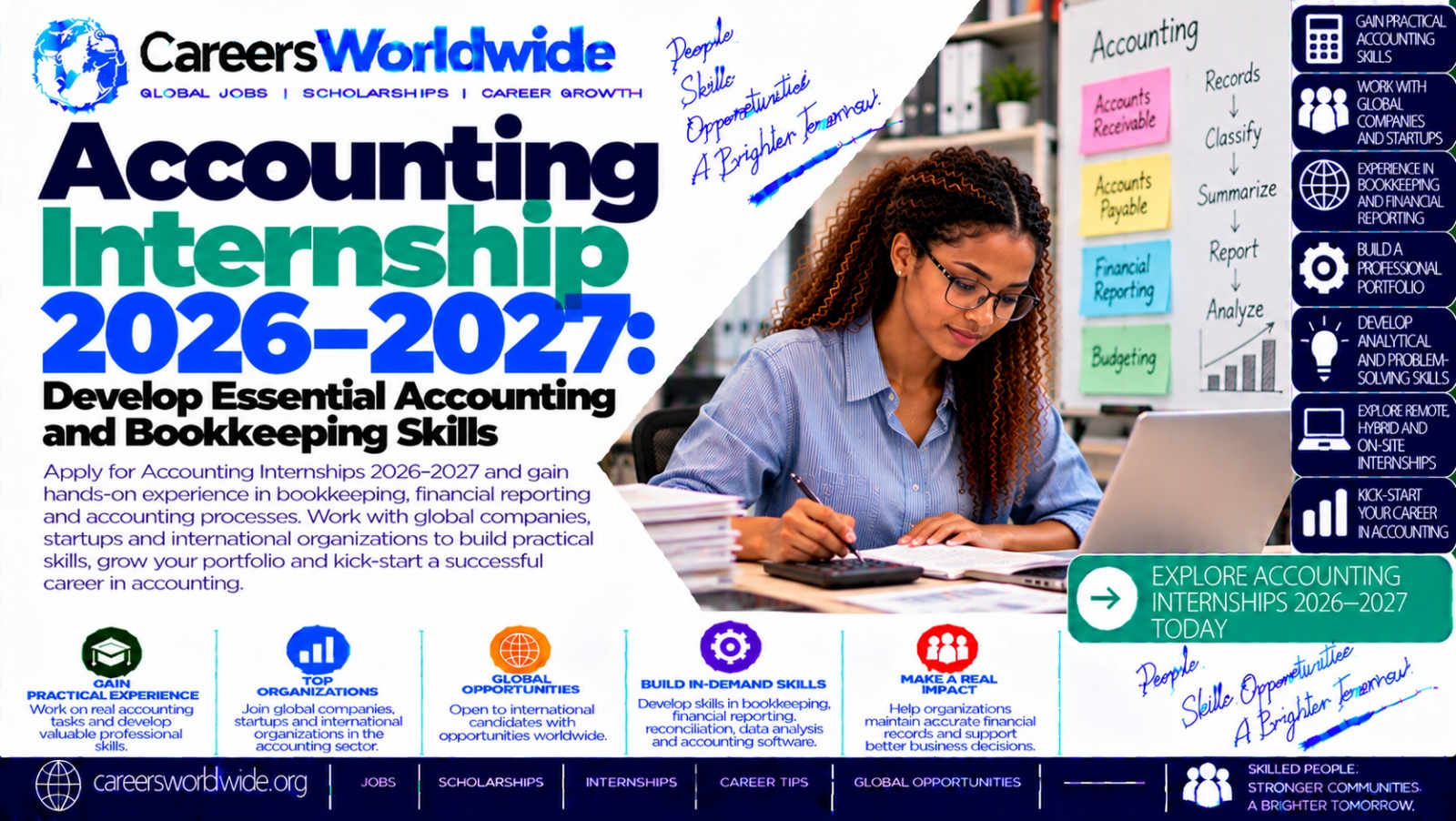

Excerpt: An Accounting Internship for 2026–2027 can help students, recent graduates, and aspiring finance professionals develop practical bookkeeping, financial reporting, reconciliation, and spreadsheet skills. Discover where to find opportunities, eligibility requirements, application tips, interview preparation, and trusted resources to help you take your first step toward an accounting career.
Introduction
An accounting internship is a valuable way to turn classroom knowledge into practical workplace experience. Whether you are studying accounting, finance, business administration, or a related subject, an internship can introduce you to the everyday responsibilities of accounting professionals and help you understand how organizations manage their finances.
For the 2026–2027 recruitment cycle, aspiring interns should prepare early, strengthen their technical skills, and learn how to present their qualifications clearly. Employers may look for candidates who understand basic accounting principles, can work accurately with financial information, communicate professionally, and demonstrate a willingness to learn.
Accounting internships are available across a range of organizations, including accounting firms, banks, retailers, manufacturing companies, nonprofit organizations, government departments, and small businesses. The responsibilities differ, but many placements provide exposure to bookkeeping, accounts payable and receivable, bank reconciliations, expense tracking, audit support, and financial reporting.
You do not necessarily need years of experience to become a strong applicant. A clear understanding of accounting fundamentals, reliable computer skills, attention to detail, and a well-prepared CV can help you demonstrate your potential.
This guide explains what to expect from an Accounting Internship 2026–2027, which skills to develop, how to find legitimate vacancies, and how to prepare an application that reflects your strengths.
1. What Is an Accounting Internship?
An accounting internship is a temporary work placement that allows students or early-career candidates to gain supervised experience in accounting and financial administration.
Depending on the employer, an intern may work with an accounting department, finance team, audit practice, tax department, or bookkeeping service. Some internships are designed for university students completing a required placement, while others are open to recent graduates seeking their first professional role.
Typical responsibilities include:
- Entering financial transactions into accounting software.
- Organizing invoices, receipts, purchase orders, and payment records.
- Assisting with accounts payable and accounts receivable.
- Comparing bank statements with internal financial records.
- Preparing spreadsheets and basic financial summaries.
- Supporting month-end reporting and document filing.
- Helping audit teams collect and organize evidence.
- Checking expense claims and identifying missing information.
Interns generally work under the supervision of experienced staff. They should not assume they will independently approve payments, alter official records, or make significant financial decisions. Those responsibilities depend on the employer’s policies, the intern’s authority, and applicable regulations.
The primary goal is to learn how accounting procedures operate in a real workplace while contributing to routine tasks accurately and responsibly.
2. Why Consider an Accounting Internship in 2026–2027?
Practical experience can help you understand what employers expect beyond academic qualifications.
Build job-ready skills. You can learn how financial records are maintained, how transactions move through an accounting system, and how teams investigate discrepancies.
Understand workplace accounting. Classroom exercises often use simplified examples. A real organization may have incomplete documents, approval procedures, multiple accounts, reporting deadlines, and software systems that require careful handling.
Explore different career paths. An internship can help you decide whether you are interested in financial accounting, management accounting, external audit, internal audit, taxation, payroll, accounts administration, or financial analysis.
Strengthen your CV. When you describe actual tasks and projects, employers can better understand how your knowledge applies to work.
Develop professional connections. Supervisors and colleagues may offer feedback, references, or advice about future opportunities. Any reference or recommendation will depend on your performance and the organization’s policies.
Improve confidence. Repeatedly working with spreadsheets, invoices, reconciliations, and reports can make accounting tasks feel more familiar and manageable.
Internships do not guarantee permanent employment. However, they can provide evidence of practical ability and help you make more informed career decisions.
3. Who Can Apply for Accounting Internships?
Eligibility requirements vary by employer, country, and program. Review each vacancy carefully rather than assuming every accounting internship follows the same rules.
Commonly eligible candidates include:
- Undergraduate students studying accounting, finance, commerce, economics, or business administration.
- Recent graduates looking for entry-level experience.
- Students who need an internship to satisfy academic or professional training requirements.
- Candidates pursuing recognized accounting qualifications.
- Applicants with bookkeeping or financial administration coursework.
- Career changers who can demonstrate relevant training and transferable skills, where the employer permits them.
Some employers require applicants to be enrolled at an accredited university. Others accept recent graduates or candidates with relevant certificates. Certain placements may require a minimum academic average, specific coursework, a valid work authorization, or availability during a defined period.
Documents you may need
Prepare the following before applications open:
- An up-to-date CV or résumé.
- A tailored cover letter, if requested.
- Academic transcripts or a current results statement.
- Proof of enrollment or graduation, where required.
- Certificates relevant to accounting, Excel, or bookkeeping.
- Contact details for appropriate referees.
- Identification or work-authorization documents at the stage specified by the employer.
Do not send sensitive documents to an unverified recruiter. Submit personal information through a legitimate employer portal or another verified application channel.
4. Essential Accounting and Bookkeeping Skills to Develop
Technical knowledge is important, but the ability to apply it carefully is what makes an intern useful to an accounting team.
A. Understand double-entry bookkeeping
Double-entry bookkeeping records each transaction using at least two accounts, with total debits equal to total credits.
For example, when a business purchases office supplies using cash, the transaction may increase office supplies expense and reduce cash. The exact accounts depend on the accounting policy and nature of the purchase.
Learn how to identify the accounts affected by a transaction, decide which accounts are debited or credited, and record the transaction in a journal before posting it to the ledger.
Practice with ordinary transactions such as sales, purchases, rent, payroll, customer receipts, supplier payments, and equipment purchases.
B. Learn the main financial statements
Interns should understand the purpose of the three core financial statements:
- Income statement: Summarizes revenue and expenses over a reporting period to show profit or loss.
- Balance sheet: Reports assets, liabilities, and equity at a particular date.
- Cash flow statement: Shows cash movements from operating, investing, and financing activities.
Learn how the statements relate to one another. For instance, profit is not necessarily the same as cash generated, because some revenue may remain unpaid and some expenses may be recorded before cash is paid.
You do not need to become an expert in complex reporting standards before applying for an internship. Start with the underlying concepts and practise interpreting simple examples.
C. Master bank reconciliation
Bank reconciliation compares an organization’s cash records with its bank statement to identify and explain differences.
Common reconciling items include outstanding payments, deposits in transit, bank charges, interest, and errors. Some differences require a timing explanation, while others may need a correction in the accounting records.
A good intern should be able to:
- Compare transactions in both records.
- Match deposits and payments.
- Identify unmatched entries.
- Investigate differences using supporting documents.
- Record authorized adjustments when appropriate.
- Escalate unexplained or suspicious discrepancies.
Accuracy matters more than speed. Never invent a transaction or adjust an entry simply to make two balances agree.
D. Improve Excel and spreadsheet skills
Spreadsheet proficiency is useful in many accounting departments. Start with these functions and features:
- SUM and AVERAGE for basic calculations.
- IF for simple logical checks.
- SUMIF or SUMIFS for conditional totals.
- COUNTIF or COUNTIFS for counting matching records.
- XLOOKUP or an equivalent lookup method for matching data.
- Sorting, filtering, tables, and data validation.
- PivotTables for summarizing transactions.
- Conditional formatting to highlight exceptions.
Practise with a sample transaction list. For example, summarize monthly expenses by category, identify duplicate invoice numbers, or compare a list of payments against a bank statement.
Use fictional or publicly available practice data rather than confidential financial information from a current or former employer.
E. Develop attention to detail
Small errors can affect reports, supplier payments, customer balances, and management decisions. Build a consistent checking routine.
Verify dates, amounts, account codes, invoice numbers, tax calculations, and supporting documentation. Check formulas before copying them across a spreadsheet. Recalculate important totals independently when appropriate.
If information is missing or inconsistent, document the issue and ask for clarification instead of guessing.
F. Learn accounting ethics and confidentiality
Accounting staff handle information that may include salaries, customer details, supplier agreements, banking data, and business results.
Interns should protect passwords, follow access restrictions, avoid sharing confidential documents, and use approved systems. They should not copy company records to personal devices or discuss sensitive financial information with unauthorized people.
Integrity is equally important. If you discover an error, report it through the proper process. Never alter records to conceal a mistake or misrepresent the accuracy of a report.
G. Strengthen communication and time management
Accounting work often involves deadlines and collaboration with colleagues outside the finance team. Practise explaining a discrepancy clearly, writing concise emails, asking focused questions, and keeping track of assigned tasks.
When several tasks compete for attention, confirm deadlines and priorities with your supervisor. A short progress update can prevent misunderstandings and help the team identify problems early.
5. Accounting Software and Digital Tools to Know
Many organizations use accounting software to record transactions, manage invoices, track expenses, and prepare reports. The software varies by employer, so focus on understanding the accounting process rather than memorizing one particular system.
Tools worth exploring include:
- Microsoft Excel or Google Sheets: For calculations, schedules, data checking, and reporting.
- QuickBooks: Commonly used by small businesses for bookkeeping, invoicing, and expense tracking.
- Xero: Cloud-based accounting software used by businesses and accounting professionals.
- Sage accounting products: Used by some organizations for bookkeeping, financial reporting, and related processes.
- ERP systems: Larger organizations may use integrated systems such as SAP or Oracle to connect accounting with purchasing, inventory, payroll, and other business operations.
You do not need to pay for several software subscriptions before applying. Begin with introductory tutorials, official learning materials, or free practice environments where available. Make sure you understand the difference between entering a transaction, approving it, and reviewing the resulting report.
Never claim to be proficient in software you have only watched someone else use. If you have completed a tutorial, describe that honestly as introductory training or practice experience.
6. Build Practical Experience Before Applying
You can demonstrate your skills even if you have never held an accounting job. The key is to practise using fictional transactions and produce work samples that show your understanding.
Here are four beginner-friendly projects.

Project 1: Create a bookkeeping ledger
Prepare a spreadsheet containing sample sales, purchases, rent, utilities, and supplier payments. Include transaction dates, descriptions, account names, debit and credit columns, and reference numbers. Check that total debits equal total credits.

Project 2: Complete a bank reconciliation
Create a fictional cashbook and bank statement. Match deposits and payments, list outstanding items, and explain any differences. Write a short note describing how you investigated the unmatched transactions.

Project 3: Prepare basic financial statements
Use a small set of sample transactions to prepare an income statement and a balance sheet. Explain what the figures suggest about revenue, expenses, assets, liabilities, and equity.

Project 4: Analyse monthly expenses
Organize fictional expenses into categories and use spreadsheet formulas or a PivotTable to calculate totals. Identify the largest expense category and summarize the results in a short, clearly labelled report.
Save your projects neatly and be prepared to explain your methods during an interview. You can mention them on your CV under a heading such as Accounting Projects or Practical Training. Make clear that they are practice projects rather than paid employment or client work.
7. A 30-Day Preparation Plan for Accounting Internship Applications
A simple schedule can help you build confidence without becoming overwhelmed. Adjust the pace to fit your studies, work, and other responsibilities.
Days 1–7
Review accounting fundamentals
Study the accounting equation, debits and credits, journal entries, ledger accounts, trial balances, and the purpose of financial statements. Complete short practice exercises and correct your mistakes.
Days 8–14
Practise spreadsheets and reconciliation
Build a sample cashbook, reconcile fictional bank transactions, and use spreadsheet formulas to summarize expenses. Check your calculations and label your files clearly.
Days 15–21
Prepare your application documents
Update your CV, draft a flexible cover letter, gather transcripts, and identify two or three examples that demonstrate accuracy, teamwork, problem-solving, or reliability.
Days 22–30
Research employers and practise interviews
Review official career pages, apply to suitable vacancies, practise accounting questions, and rehearse explaining your projects. Keep a record of submission dates and follow-up instructions.
By the end of the month, aim to have a tailored CV, a completed practice project, a shortlist of employers, and a consistent application routine. You can repeat the cycle to improve your skills and target additional opportunities.
8. Accounting Internship 2026–2027: Summary Table
Use this table as a quick reference while preparing your application.
| Category | What to know |
|---|---|
| Opportunity | Supervised practical experience in accounting, bookkeeping, audit, tax, or finance |
| Typical applicants | Eligible students, recent graduates, and candidates who meet each employer’s requirements |
| Core technical skills | Double-entry bookkeeping, ledger entries, reconciliations, financial statements |
| Digital skills | Excel or Sheets; familiarity with relevant accounting software |
| Professional skills | Accuracy, confidentiality, communication, teamwork, and time management |
| Common documents | CV, cover letter if requested, transcripts, certificates, and other specified evidence |
| Preparation strategy | Study fundamentals, complete sample projects, research employers, and practise interviews |
| Where to search | Official employer career pages, university career offices, and professional accounting bodies |
| Recruitment timing | Varies by country, employer, office, and internship intake |
| Main objective | Gain practical experience and build evidence of accounting ability |
9. How to Apply for an Accounting Internship in 2026–2027
A successful application starts with finding a suitable vacancy and following its instructions precisely. There is no single application portal for all accounting internships; different employers manage their own recruitment processes.
Step 1: Decide which accounting pathway interests you
Look at internships in financial accounting, audit and assurance, tax, management accounting, accounts payable, accounts receivable, payroll, or general finance. You can apply to different areas if you meet the requirements, but tailor each application to the work described.
Step 2: Search for legitimate vacancies
Start with official employer websites and university career services. Search for terms such as “accounting intern,” “finance intern,” “audit intern,” “bookkeeping intern,” “accounts assistant intern,” and “2027 internship.”
Check the location, eligibility criteria, expected start date, duration, closing date, and required documents. A listing for a particular office may not accept applications from candidates who cannot legally work in that country.
Step 3: Tailor your CV
Keep your CV clear, accurate, and easy to scan. Include:
- Your education, course, institution, and expected graduation date.
- Relevant accounting subjects and professional study.
- Spreadsheet and accounting software skills, with honest proficiency levels.
- Academic assignments or practice projects relevant to the vacancy.
- Part-time work, volunteering, leadership, or other transferable experience.
- Achievements that can be explained or verified.
Instead of writing “excellent attention to detail,” give evidence where possible. For example: “Checked and categorized 150 fictional transactions in an Excel practice project and investigated unmatched entries.” Only use figures that accurately describe work you actually completed.
Step 4: Write a focused cover letter
Address the employer or recruitment team as instructed. Explain why the internship interests you, what relevant skills you bring, and what you hope to learn. Refer to a responsibility or skill mentioned in the vacancy.
Avoid sending an identical letter to every employer. A short, specific application is often more persuasive than a long letter filled with generic claims.
Step 5: Submit the application correctly
Use the employer’s official application system where available. Check spelling, contact information, attachments, file names, and any questions in the online form before submitting.
Save the confirmation email or application reference. If the employer specifies a closing time or time zone, follow it rather than relying on your local clock.
Step 6: Prepare for the selection process
Some employers use online tests, recorded interviews, assessment centres, or several interview rounds. Others may conduct a straightforward interview with the finance team. Review the instructions provided for your specific vacancy.
Practise explaining basic accounting concepts and discussing how you would handle a discrepancy, missing document, deadline, or confidential record.
Step 7: Track applications professionally
Maintain a simple tracker containing the employer, role, location, application date, closing date, and current status. Follow up politely only when appropriate and consistent with the employer’s instructions.
Be alert to scams. Legitimate recruitment processes should not require you to pay a recruiter to secure a job offer. Verify unexpected messages through the employer’s official contact details before sharing personal information.
10. Official Accounting Internship Application Resources
The following resources can help you locate opportunities, understand employer requirements, and strengthen your accounting knowledge. Availability and eligibility differ by country, office, and intake, so always read the individual vacancy before applying.

Deloitte — Student and graduate opportunities
Explore internship, vacation programme, and graduate recruitment information through Deloitte’s regional career pages. In Southern Africa, opportunities and requirements differ between offices.
Official resource: Deloitte careers FAQs. The page explains recruitment routes and online application requirements.
Deloitte

KPMG — Student and graduate opportunities
Review student internships, vacation work, graduate programmes, and training contracts. KPMG’s Southern African careers page lists regional pathways and specific eligibility criteria.
Official resource: KPMG Southern Africa graduate opportunities. Check the page for current openings and deadlines.
KPMG

PwC — Early-career opportunities
Search for student internships and early-career roles in audit, tax, and related business services. Programmes and graduation-year requirements vary by country.
Official resource: PwC undergraduate summer internships. This page describes a UK programme; applicants elsewhere should use their local PwC careers site.
PwC UK Careers

ACCA — Financial accounting learning resources
Review introductory financial accounting concepts, double-entry techniques, financial statements, and study support. These resources can help you prepare for technical questions and improve your foundational knowledge.
Official resource: ACCA Financial Accounting resources.
ACCA Global

ACCA-X — Introduction to Bookkeeping
A useful starting point for learners who want to practise recording transactions, double-entry bookkeeping, ledger accounts, reconciliations, and trial balances.
Official resource: ACCA-X Introduction to Bookkeeping. The course page lists its current format, duration, and entry requirements.
ACCA-X
Important: These are official career or learning resources, not a guarantee that an Accounting Internship 2026–2027 vacancy is open in your location. Check the current vacancy list and application deadline before preparing a submission. For Zimbabwe-based applicants, also investigate local employers, accounting firms, banks, businesses, universities, and relevant professional accounting organizations.
11. Accounting Internship Interview Questions to Practise
Preparation can make it easier to explain what you know and how you approach unfamiliar tasks. Practise answering questions in your own words rather than memorizing definitions.
1. What is the difference between bookkeeping and accounting?
Bookkeeping focuses on recording and organizing financial transactions. Accounting uses those records to classify, reconcile, interpret, and report financial information. The responsibilities can overlap depending on the organization.
2. What is a bank reconciliation?
It is a comparison of the organization’s cash records with its bank statement. The aim is to identify timing differences, missing entries, bank charges, and possible errors so that differences are properly explained.
3. Why are debits and credits important?
They are the foundation of double-entry bookkeeping. Each transaction must be recorded so that total debits equal total credits, helping maintain the balance of the accounting records.
4. How would you handle a discrepancy in an invoice?
I would check the invoice against the purchase order, delivery record, and other relevant documentation. I would document the difference and raise it with the appropriate supervisor instead of changing the record without authorization.
5. What would you do if you made an accounting error?
I would notify the appropriate supervisor promptly, explain what happened, and follow the approved correction process. I would also identify what caused the error and consider how to avoid repeating it.
6. How comfortable are you with Excel?
Give an honest answer and mention the functions you have actually used. If your experience is limited, explain how you are practising formulas, filtering, reconciliation, and data summaries.
7. Why do you want this internship?
Connect your interest in accounting with the employer’s work and the skills you want to develop. Explain how your coursework, practice projects, or previous responsibilities have prepared you to learn and contribute.
A useful preparation technique is to give a specific example for each professional skill you mention. University projects, volunteering, part-time work, and group assignments can demonstrate reliability, teamwork, communication, and problem-solving even if they were not accounting jobs.
12. Frequently Asked Questions (FAQ)
When should I apply for an Accounting Internship 2026–2027?
Start checking employer websites and university career services early. Recruitment calendars vary, and some employers recruit months before the placement begins. Others advertise throughout the year or hire according to business needs.
Do I need previous accounting work experience?
Not always. Many internships are designed for students or early-career candidates. Relevant coursework, spreadsheet practice, bookkeeping projects, and transferable skills can help demonstrate readiness. Follow the specific vacancy’s requirements.
Can I apply if I am still studying?
Yes, if the employer accepts current students and you meet its other eligibility conditions. Some programmes target students in a particular year of study or graduating in a specified year.
Which accounting software should I learn first?
Begin with spreadsheet skills and fundamental bookkeeping principles. You can then explore introductory tutorials for QuickBooks, Xero, Sage, or other systems used in your target industry. Software requirements vary between employers.
Are accounting internships paid?
Some are paid, while others may be unpaid, academic placements, or structured training arrangements. The vacancy should explain compensation or relevant terms. Confirm the conditions before accepting an offer, and check applicable local employment rules.
Can an accounting internship lead to a permanent job?
It can provide experience that supports a future application, and some employers consider former interns for graduate or entry-level roles. However, permanent employment is not guaranteed and depends on vacancies, performance, eligibility, and recruitment policies.
What should I include in my CV if I have no experience?
Highlight education, relevant subjects, software skills, coursework, practice projects, volunteering, leadership, and other responsibilities that demonstrate accuracy and reliability. Be clear about the difference between academic practice and professional employment.
How can I find internships in my country?
Use official company career pages, local professional accounting bodies, university placement offices, and reputable job platforms. Filter by country and location, then confirm the opportunity on the employer’s own website before submitting personal documents.
Are online accounting internships available?
Some employers offer remote or hybrid placements, while others require office or client-site attendance. Check the location and work arrangement in the individual advertisement, and confirm whether you are eligible to work under the stated conditions.
Final Thoughts: Start Building Your Accounting Career
An Accounting Internship 2026–2027 can be an important first step toward a career in bookkeeping, financial accounting, auditing, taxation, or finance. The strongest preparation combines technical knowledge with practical examples of how you apply it.
Focus on understanding double-entry bookkeeping, financial statements, bank reconciliation, and spreadsheet analysis. Practise using fictional transactions, prepare a clear CV, and research employers through their official career websites. When applying, follow the eligibility rules, provide accurate information, and keep track of your submissions.
You do not need to master every accounting system before applying. You do need to demonstrate that you understand the fundamentals, take accuracy seriously, respect confidentiality, and are ready to learn from experienced professionals.
Start with one manageable project, strengthen one skill at a time, and apply consistently to suitable opportunities. These steps can help you approach the 2026–2027 internship cycle with greater confidence and a clearer professional direction.
Disclaimer
This article is intended for general career guidance and educational purposes. It does not represent a job offer or guarantee admission to any internship programme. Eligibility criteria, application dates, compensation, work authorization requirements, and availability vary by employer and country. Always confirm current information through the relevant employer’s official website. Never pay an unverified recruiter to secure an internship, and protect your personal information when applying.
SEO Keywords
Accounting Internship 2026–2027,
Accounting internships 2027,
Accounting internship application,
Bookkeeping internship,
Finance internship 2026–2027,
Accounting internship for students,
Accounting internship for graduates,
Entry-level accounting jobs,
Accounting skills for beginners,
Bookkeeping skills,
Financial accounting internship,
Audit internship 2027,
Accounting internship requirements,
How to apply for accounting internships,
Accounting internship CV tips,
Accounting interview questions,
Excel skills for accounting,
Bank reconciliation practice,
Double-entry bookkeeping,
Accounting career opportunities,
ACCA accounting resources,
Accounting internship application tips,
Finance and accounting career development,
Internship opportunities for accounting students,
Practical accounting experience,
ALSO CHECK: Finance Internship 2026–2027: Gain Experience in Financial Analysis and Business PlanningOctober 15, 2026
Graphic Design Internship 2026–2027: Build a Professional Creative PortfolioOctober 15, 2026
Business Intelligence Internship 2026–2027: Discover Data-Driven Business Decision-MakingOctober 15, 2026