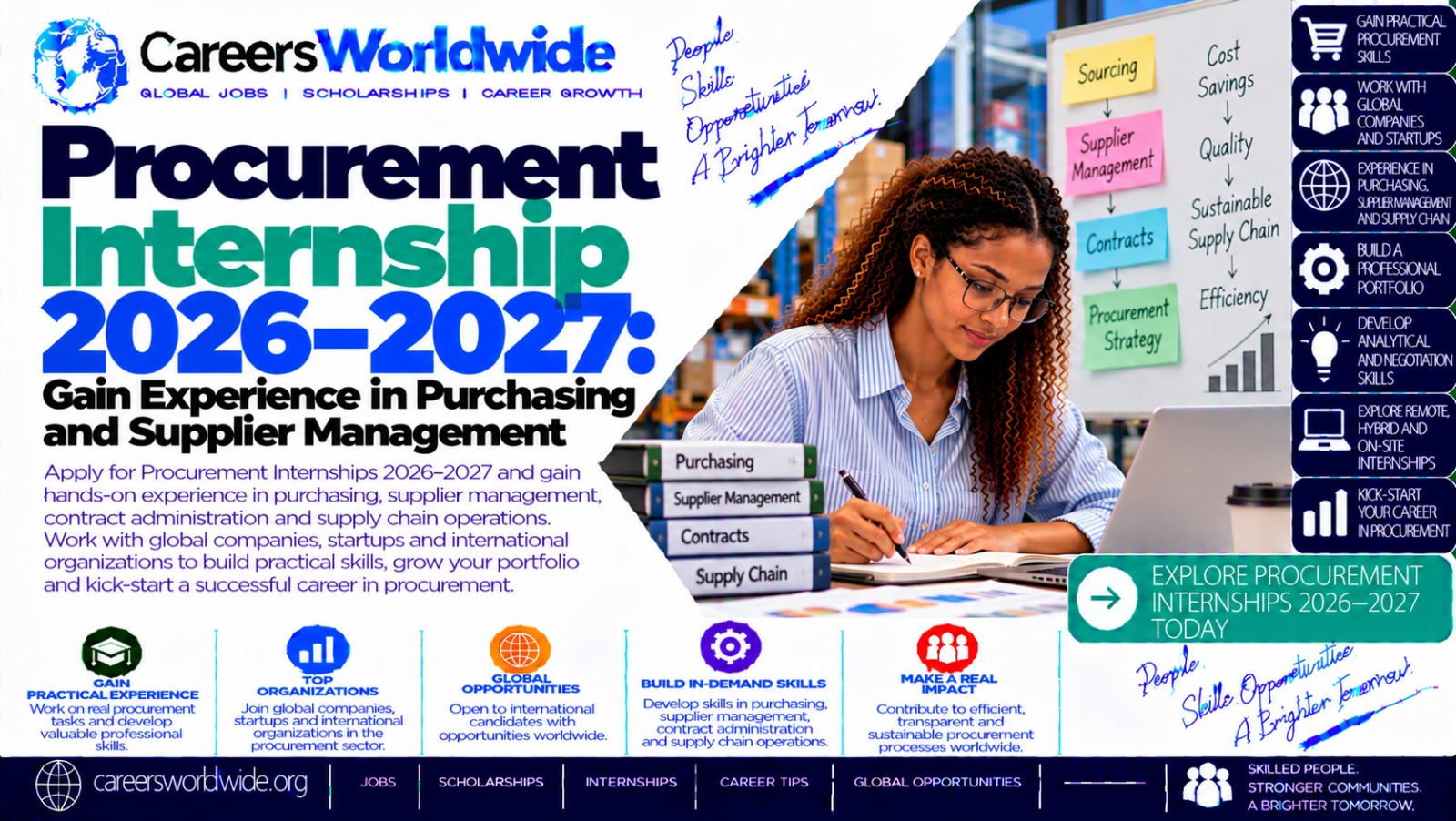

Excerpt: Looking for a procurement internship in 2026–2027? Discover how students and recent graduates can gain practical experience in purchasing, supplier evaluation, contract administration, inventory control, and supply chain management. Explore eligibility requirements, essential skills, application tips, research projects, and official career resources to help you prepare for procurement opportunities.
Introduction: Start Your Career in Procurement and Supply Chain Management
Every organization depends on purchasing the right goods and services at the right time, at the right price, and from reliable suppliers. Hospitals need medical supplies, construction companies need materials, retailers need stock, and international organizations need equipment and services to deliver their programmes. Procurement professionals help make these activities possible.
A Procurement Internship 2026–2027 can provide a valuable introduction to this essential business function. It allows students and early-career professionals to connect classroom knowledge with real purchasing processes, supplier communication, documentation, and contract management.
Rather than simply observing how an organization operates, interns may assist with preparing purchase orders, requesting quotations, comparing supplier offers, updating procurement databases, tracking deliveries, and organizing purchasing records. Under appropriate supervision, they can also learn how organizations assess supplier performance, manage risks, control costs, and follow procurement rules.
These skills are relevant across public institutions, private companies, banks, manufacturing businesses, universities, humanitarian organizations, and international development agencies.
The 2026–2027 period is a useful time to prepare for internships, industrial attachments, graduate programmes, and entry-level supply chain positions. However, opportunities have different recruitment schedules. There is no single application portal or universal internship programme covering every procurement employer.
The most effective strategy is to identify suitable organizations, monitor their official recruitment pages, prepare a strong CV, and demonstrate that you understand the importance of ethical, transparent, and efficient purchasing.
1. What Is a Procurement Internship?
A procurement internship is a temporary work and learning opportunity in which a student or recent graduate supports an organization’s purchasing and supplier management activities.
Procurement generally involves identifying business needs, finding suitable suppliers, obtaining and evaluating offers, arranging purchases, monitoring delivery, and maintaining records. Depending on the organization, the work may also involve tender administration, contract monitoring, inventory planning, invoice checks, and supplier performance reporting.
For example, the African Capacity Building Foundation (ACBF), headquartered in Harare, has advertised a procurement internship involving purchase orders, contract documentation, supplier follow-up, and procurement records. Its official vacancy page is a useful example of the type of practical responsibilities that procurement interns may encounter. Applicants should check the current status of the advertisement before applying.
The African Capacity Building Foundation
+1
Common types of procurement internships
- Purchasing and procurement: Assisting with requisitions, purchase orders, quotations, and purchasing documentation.
- Supplier management: Maintaining supplier information, communicating about delivery schedules, and organizing performance records.
- Strategic sourcing: Researching potential suppliers and comparing costs, quality, capacity, and delivery terms.
- Contract administration: Helping organize agreements, monitor deadlines, and maintain contract files.
- Inventory and materials management: Reviewing stock information, tracking orders, and helping identify replenishment needs.
- Public procurement: Learning how public institutions acquire goods and services under applicable laws and procurement regulations.
- Logistics and supply chain: Coordinating purchasing activities with warehousing, transport, operations, and distribution teams.
The precise responsibilities depend on the employer, the intern’s experience, and the level of supervision provided. Interns should not assume they will independently approve purchases, negotiate binding contracts, or make supplier awards.
2. Why Apply for a Procurement Internship in 2026–2027?
Procurement affects far more than the price shown on a supplier’s quotation. Poor purchasing decisions can cause delays, shortages, quality problems, and unexpected expenses. Effective procurement helps organizations secure suitable goods and services while managing cost, quality, risk, and accountability.
An internship provides an opportunity to understand these trade-offs in practice.
Gain hands-on purchasing experience
You may learn how a purchase request moves from an internal department to the procurement team, how quotations are collected, and how purchasing documentation is prepared.
You can also see why accuracy matters. A wrong quantity, incomplete specification, or missed delivery date can disrupt operations and create additional costs.
Develop supplier management skills
Organizations need suppliers that can meet agreed requirements consistently. Interns may assist with supplier communications, maintain contact details, track outstanding documents, or update delivery records.
This experience can help you understand how organizations evaluate reliability, service quality, responsiveness, pricing, and compliance.
Understand cost control and value for money
Procurement decisions should not automatically favour the lowest quoted price. Buyers may also need to consider quality, warranties, maintenance, delivery costs, supplier capacity, and the total cost of ownership.
An internship can show you how procurement teams compare offers systematically and document their decisions.
Learn about contracts and compliance
Procurement often operates under internal policies, legal requirements, delegated approval limits, and audit procedures. Interns can learn why purchase orders, contracts, quotations, approvals, and delivery records must be accurate and properly retained.
These practices are especially important in public procurement, humanitarian work, and organizations responsible for managing donor or taxpayer funds.
Build a foundation for career growth
Procurement experience can support future applications for purchasing officer, procurement analyst, sourcing specialist, inventory planner, logistics coordinator, contract administrator, or supply chain analyst roles.
An internship does not guarantee a permanent job, but it can help you demonstrate practical experience and understand which parts of supply chain management suit you best.
3. Who Can Apply for a Procurement Internship?
There is no universal eligibility rule for procurement internships. Employers set their own academic, experience, location, and documentation requirements.
Students studying procurement and supply chain management
Students pursuing a diploma or degree in procurement, purchasing and supply management, logistics, or supply chain management are natural candidates for many placements. Some universities require students to complete an industrial attachment as part of their qualification.
If your course includes a mandatory internship, obtain an official attachment letter from your institution and check whether the employer requires a specific placement duration.
Students in business and related disciplines
Some procurement internships accept applicants studying business administration, commerce, finance, economics, operations management, or other related subjects.
For instance, the ACBF procurement internship advertisement listed procurement and supply chain management alongside business administration, commerce, logistics, economics, finance, and related fields. Its requirements also emphasized analytical ability, organization, communication, confidentiality, and computer literacy.
The African Capacity Building Foundation
This illustrates why you should read the full vacancy rather than assume that only one degree qualifies.
Recent graduates
Some internships are intended for current students, while other opportunities accept graduates or emerging professionals. Entry-level procurement assistant, sourcing assistant, and supply chain trainee positions may also provide relevant experience.
Check whether the employer requires current enrolment, a recent graduation date, or a university endorsement.
International applicants
International applicants should confirm the work authorization, citizenship, residency, language, and educational requirements before applying. Some international organizations recruit from member countries only, while other employers use different eligibility rules.
Also establish whether the role is on-site, hybrid, or remote. A remote advertisement does not automatically mean that applicants can work from any country.
4. Essential Skills for Procurement Interns
You do not need to be an experienced buyer to apply for a student internship. However, showing that you are organized, analytical, reliable, and willing to learn can strengthen your application.
1. Microsoft Excel and office software
Practise sorting and filtering supplier data, creating comparison tables, using basic formulas, and preparing clear reports. Word processing and presentation skills are also useful for procurement documentation.
2. Research and supplier evaluation
Learn how to compare suppliers using relevant criteria such as price, specifications, delivery time, quality, warranties, and compliance documents.
3. Numerical and analytical ability
Procurement teams often compare quotations, calculate totals, check quantities, and track spending. Basic arithmetic and attention to units, taxes, discounts, and delivery charges can prevent costly mistakes.
4. Communication and teamwork
Procurement staff work with suppliers, finance teams, warehouse staff, project managers, and internal departments. Clear emails, accurate notes, and professional follow-up are essential.
5. Integrity and confidentiality
Procurement decisions may involve sensitive prices, competing bids, supplier records, and internal budgets. You should understand the importance of impartiality, confidentiality, proper approvals, and declaring conflicts of interest.
6. Organization and time management
You may need to track multiple purchase requests, delivery dates, supplier documents, and approvals. A well-maintained task list and consistent filing habits help ensure that nothing is overlooked.
What about procurement software?
Larger organizations may use enterprise resource planning (ERP) systems or specialized purchasing platforms. Some use tools such as SAP or other systems to process purchase requests, manage supplier records, and track orders.
You do not need to claim expertise in software you have never used. Instead, emphasize your willingness to learn and provide examples of other systems or spreadsheets you have used accurately.
5. Practical Project Ideas to Prepare Before Applying
If you have limited work experience, a small practice project can help you demonstrate relevant skills during an interview. Use fictional or publicly available information and label your work clearly as a learning exercise.
Project 1: Create a supplier comparison sheet
Imagine that an office needs 20 laptops. Create a spreadsheet with three fictional suppliers and compare the unit price, delivery charge, warranty, delivery time, and compliance with the required specification.
Calculate the total cost and explain which offer provides the best overall value based on the stated requirements. Do not automatically choose the lowest price if that supplier fails to meet a mandatory specification.
Project 2: Build a purchase order tracker
Create a simple spreadsheet with columns for requisition number, supplier, item, quantity, order date, expected delivery, actual delivery, status, and outstanding action.
Use fictional information to demonstrate how a procurement team could identify delayed orders and prioritize follow-up.
Project 3: Draft a supplier performance scorecard
Develop a sample scorecard with measures such as on-time delivery, quality, completeness of documentation, responsiveness, and compliance with agreed terms.
Explain how each measure would be scored and why the assessment should use consistent, evidence-based criteria.
Project 4: Map the procurement process
Create a simple process diagram showing how a request moves from an internal department through specification, approvals, supplier sourcing, evaluation, purchase order, delivery, receipt, invoice verification, and recordkeeping.
Actual workflows differ by organization and procurement rules, so present your diagram as an illustrative model rather than a universal procedure.
How to present your project
Save the finished work in a short PDF or spreadsheet portfolio. Include a brief introduction, your assumptions, the method used, and a note explaining that the information is fictional or publicly sourced.
A practical project is not a substitute for a required qualification or internship, but it can show initiative, attention to detail, and an understanding of procurement basics.
6. Procurement Internship 2026–2027: Summary Table
| Feature | What applicants should know |
|---|---|
| Opportunity type | Procurement internship, industrial attachment, purchasing trainee role, or supply chain placement |
| Main work areas | Purchasing, sourcing, supplier management, contracts, inventory, logistics, and procurement records |
| Typical applicants | Eligible students, recent graduates, and candidates in related business disciplines |
| Relevant qualifications | Procurement, purchasing and supply management, supply chain, logistics, business, commerce, finance, or related subjects |
| Essential skills | Excel, communication, numerical analysis, organization, research, integrity, and attention to detail |
| Common documents | CV, application or cover letter, academic transcript, certificates, and university attachment letter where required |
| Possible duties | Supplier research, quotation comparisons, purchase order tracking, filing, delivery follow-up, and reporting |
| Compensation | Varies; confirm whether the placement is paid, provides a stipend, or is unpaid |
| Work location | Depends on the employer; may be office-based, site-based, hybrid, or otherwise specified |
| Duration | Varies by programme and university attachment requirements |
| Application deadline | Employer-specific; use the date shown on the current official vacancy |
| Main application channel | Official employer careers portal or the application method stated in the vacancy |
This table provides a general overview. It does not mean that every organization offers all these duties, benefits, or eligibility options.
7. How to Apply for a Procurement Internship
A successful application should show that you understand the position and can contribute to routine procurement activities while learning from experienced professionals.
Step 1: Search for relevant vacancies
Use a variety of job titles because employers do not always use the word “internship.” Search for:
- Procurement Intern 2026
- Procurement Internship 2027
- Purchasing and Supply Management Attachment
- Supply Chain Intern
- Procurement Assistant Trainee
- Supplier Management Intern
- Logistics and Procurement Internship
- Sourcing Intern
- Contract Administration Intern
- Procurement Graduate Trainee
Include your preferred country or city when searching. For students, terms such as “industrial attachment” and “student attachment” can be especially useful in countries where work placements are part of a degree or diploma.
Step 2: Verify the vacancy
Open the employer’s official careers page and confirm the position title, location, qualifications, deadline, and application instructions.
Check whether the vacancy is still accepting applications. Recruitment advertisements can remain visible on search engines after the deadline has passed.
Do not rely solely on a social media post, a forwarded message, or an unfamiliar job listing site if an official employer notice is available.
Step 3: Prepare a clear CV
Your CV should be easy to scan and tailored to procurement. Include:
- Your name and appropriate contact details.
- Your current qualification and institution.
- Relevant coursework in procurement, logistics, inventory, business, or supply chain management.
- Computer skills, especially spreadsheets and document preparation.
- Academic projects or practical exercises related to purchasing.
- Work, volunteering, student leadership, or administrative experience.
- Languages and other skills relevant to the role.
If you have no formal procurement experience, focus on transferable skills. For example, maintaining records for a student organization, managing a project budget, comparing prices for an event, or coordinating deliveries may demonstrate relevant abilities—provided you describe your actual responsibilities accurately.
Step 4: Write a targeted cover letter
A good cover letter explains why you are interested in procurement, why the organization appeals to you, and what you can contribute.
Mention relevant coursework, your understanding of purchasing procedures, and your ability to work carefully with records or data. If you have completed a supplier comparison project, explain briefly what it taught you.
Avoid generic statements such as “I am applying because I need a job.” Instead, show that you understand the learning opportunity and are ready to support the procurement team.
Step 5: Gather the required documents
Depending on the vacancy, you may need:
- An updated CV or résumé.
- An application letter or cover letter.
- Academic transcripts or certificates.
- Proof of current enrolment.
- An official industrial attachment letter.
- References or recommendation letters, if requested.
- A copy of an identification document, if specifically required through a legitimate process.
Do not automatically send every personal document you possess. Follow the published instructions and submit sensitive information only through a verified, appropriate channel.
Step 6: Complete the application carefully
If the employer uses an online portal, complete each required field and upload documents in the specified format. If applications are accepted by email, use the subject line requested in the vacancy.
Before sending, check spelling, contact details, attachment names, and whether the documents open correctly. Submit before the deadline and retain a copy of your application.
Step 7: Prepare for an interview
Recruiters may ask why you chose procurement, how you would compare supplier quotations, what you would do if a delivery were late, or how you would handle confidential information.
Practise explaining how you would:
- Check whether a supplier quotation meets the specification.
- Compare total costs rather than unit prices alone.
- Keep purchase orders and supplier records organized.
- Follow up on a delayed order professionally.
- Handle an error in a purchasing document.
- Respond if a supplier offers you a personal gift.
- Escalate a problem rather than make an unauthorized decision.
For scenario questions, explain your reasoning. Strong answers generally show accuracy, fairness, compliance with procedures, clear communication, and a willingness to ask a supervisor when necessary.
8. Official Application Resources for 2026–2027
The following official resources are useful starting points for finding procurement-related opportunities. Some are general internship portals, while others are specific vacancy notices. A listed resource does not guarantee that a procurement internship is currently open. Always confirm the status and deadline before applying.

1. African Capacity Building Foundation (ACBF) — Procurement Intern
ACBF’s official vacancy notice describes an 11-month procurement internship in Harare, Zimbabwe, with exposure to purchase orders, contracts, supplier follow-up, procurement records, vendor databases, and reporting.
Deadline note: The published deadline was 30 September 2026, which has passed as of 15 October 2026. Check the page for any new notice or updated recruitment information rather than assuming the position remains open.
Official procurement internship notice · Official vacancies page
The African Capacity Building Foundation
+1

2. World Bank Group — WBG Pioneers
WBG Pioneers is the World Bank Group’s internship programme for eligible undergraduate and postgraduate students. Opportunities span different areas, and individual postings determine the actual duties and qualifications. Search the vacancy list for procurement, operations, corporate support, and supply chain-related roles.
The programme’s published cycle information shows recruitment periods that generally fall in January–February and July–August. Dates and openings can change, so check the current programme page.
Official WBG Pioneers programme · World Bank Group career programmes
World Bank Group
+1

3. Zimbabwe Parks and Wildlife Management Authority (ZimParks)
ZimParks has published procurement internship notices describing tasks such as sourcing suppliers, preparing purchasing documents, tracking orders, maintaining records, and compiling reports.
The specific regional vacancy linked below had an April 2026 deadline and is not presented here as an open position. Use the official jobs page to look for new recruitment notices.
Official procurement internship notice · ZimParks official website
Zimbabwe Parks And Wildlife Management Authority

4. United Nations Careers
The UN Careers portal is a useful starting point for searching internships and early-career roles across the UN Secretariat. Search relevant vacancies using procurement, supply chain, logistics, sourcing, and supply management terms. Eligibility and application procedures are defined by each vacancy.
Official UN Careers job search
United Nations Careers
How to find more opportunities in Zimbabwe and elsewhere
Alongside these resources, monitor the official careers pages of:
- Government ministries and public procurement authorities.
- Hospitals, universities, and public institutions.
- Manufacturing, retail, mining, construction, and distribution companies.
- Banks and insurance companies.
- Humanitarian and development organizations.
- Logistics providers, freight companies, and warehouse operators.
- International organizations with country offices.
For Zimbabwe-based applicants, searching for “procurement student attachment,” “purchasing and supply internship,” “supply chain intern,” and “procurement trainee” may reveal opportunities that do not use the exact title in this article.
If a vacancy is advertised on a third-party website, look for the same opportunity on the employer’s own website or verify the application contact using an official source. Never pay a recruiter for a guaranteed internship.
9. Frequently Asked Questions (FAQ)
1. What is the Procurement Internship 2026–2027?
It is a general term for procurement, purchasing, and supply chain internship opportunities available during the 2026–2027 period. Different organizations recruit independently, so applicants must check individual vacancies rather than expect one universal programme.
2. Who can apply for a procurement internship?
Many opportunities target students studying procurement, purchasing and supply management, logistics, supply chain management, business administration, commerce, or related disciplines. Some accept recent graduates. The employer’s published criteria determine eligibility.
3. Do I need previous work experience?
Not always. Student internships and industrial attachments may be designed for people with limited experience. Relevant coursework, computer skills, volunteering, and practical projects can help demonstrate your potential.
4. Are procurement internships paid?
Some internships provide a salary or stipend, while others are unpaid or form part of a university attachment. Compensation varies by organization and vacancy. Confirm the terms before accepting a placement.
5. What documents should I prepare?
Common documents include a CV, application letter, academic transcript, and proof of enrolment. Some employers require an official industrial attachment letter, certificates, references, or other supporting documents. Follow the specific instructions in the vacancy.
6. What software should I learn?
Start with Excel or Google Sheets, Word processing, and professional email. Basic spreadsheet formulas, sorting, filtering, and data organization are useful. Knowledge of an ERP or procurement system may be an advantage where relevant, but do not claim proficiency without practical experience.
7. Can I apply if I study business administration or finance?
Possibly. Some procurement vacancies accept candidates from related disciplines, including business, commerce, economics, and finance. Others require a specific procurement or supply chain qualification. Check the eligibility section carefully.
8. When should I apply for 2026–2027 internships?
Begin monitoring official career pages early and continue checking throughout the recruitment cycle. Some organizations recruit several months before the internship begins, while others advertise according to operational needs or university calendars. Do not assume all applications close at the end of the year.
9. How can I stand out without procurement experience?
Complete a practice supplier comparison, build a purchase order tracker, learn basic spreadsheet techniques, and tailor your CV to the vacancy. Be ready to explain how you would maintain accurate records, communicate professionally, and follow procurement procedures.
10. Can a procurement internship lead to a permanent job?
It may help you gain experience and professional references, but permanent employment is not guaranteed. Use the placement to learn, demonstrate reliability, ask for feedback, and understand the skills employers expect from entry-level procurement professionals.
11. What is the difference between procurement and supply chain management?
Procurement focuses on acquiring goods and services, including supplier selection, purchasing, and contract-related activities. Supply chain management is broader: it may include procurement, logistics, inventory, warehousing, transportation, production planning, and distribution. Many internships involve tasks that overlap both areas.
12. How do I avoid internship scams?
Verify the vacancy through the employer’s official website or independently confirmed contact details. Be cautious if someone promises guaranteed selection in exchange for payment, requests unusual fees, or pressures you to send sensitive documents through an unverified channel.
10. Your 30-Day Procurement Internship Preparation Plan
Use this practical plan to prepare your application and develop evidence of your skills.
Days 1–7
Explore the field
Research procurement roles, identify ten potential employers, and bookmark their official careers pages. Review vacancy requirements to identify the skills and documents you need.
Days 8–14
Practise the basics
Build a supplier comparison spreadsheet and a purchase order tracker. Practise calculating totals, checking delivery dates, and organizing fictional supplier records.
Days 15–21
Prepare your application
Update your CV, draft a tailored cover letter, gather your academic documents, and request an attachment letter if your institution requires one.
Days 22–30
Apply and practise interviews
Submit applications for suitable open positions, record deadlines, practise procurement scenarios, and continue checking official recruitment pages for new vacancies.
This plan is flexible. If a suitable opportunity closes soon, prioritize submitting a complete application rather than waiting for the end of the 30 days.
Conclusion: Take the First Step Toward a Career in Procurement
A Procurement Internship 2026–2027 can help you move from classroom learning to practical experience in purchasing, supplier management, and supply chain operations. By supporting procurement teams, interns can learn how organizations compare supplier offers, track orders, manage records, monitor deliveries, and follow purchasing procedures.
The strongest candidates combine relevant academic knowledge with accuracy, organization, communication, and professional integrity. You can begin developing these qualities before securing an internship by practising spreadsheet analysis, building a supplier comparison project, and learning the basics of purchasing documentation.
Start by checking official recruitment pages, identifying opportunities that match your qualifications, and preparing a focused application. Confirm deadlines and eligibility before submitting your documents, especially when using older vacancy notices.
Whether you hope to work in government, business, logistics, manufacturing, or international development, practical procurement experience can be a useful foundation for a long-term career in purchasing and supply chain management.
Disclaimer
This article is intended for general informational and career-planning purposes only. “Procurement Internship 2026–2027” refers to a category of opportunities, not one universal internship programme. Vacancies, eligibility requirements, compensation, locations, and application deadlines vary by organization and may change. Some linked advertisements have passed their stated deadlines and are included as examples of official recruitment resources, not as confirmation of current openings. Always verify vacancy status and application instructions directly with the employer. Never pay an unverified intermediary for guaranteed selection, and submit personal information only through legitimate application channels.
SEO Keywords
procurement internship 2026, procurement internship 2027, procurement internship 2026–2027, purchasing internship opportunities, supplier management internship, supply chain management internship, procurement student attachment, purchasing and supply management internship, procurement internship for students, procurement internship for graduates, procurement internship eligibility, procurement internship requirements, how to apply for procurement internship, procurement internship application process, procurement internship CV tips, procurement cover letter examples, procurement trainee opportunities, supply chain intern vacancies, logistics and procurement internship, supplier sourcing internship, contract management internship, public procurement internship, procurement assistant trainee, procurement skills for students, procurement interview questions, procurement internship in Zimbabwe, Harare procurement internship, African procurement internship opportunities, World Bank Group internship opportunities, ACBF procurement internship, ZimParks procurement internship, United Nations procurement careers, purchasing and supplier management careers, procurement career development, procurement spreadsheet practice, supplier comparison template, purchase order tracking, inventory and procurement management, procurement internship official application links, supply chain career opportunities,
ALSO CHECK: Business Development Internship 2026–2027: Discover Sales Strategy and Market ResearchOctober 15, 2026
Economics Research Internship 2026–2027: Explore Economic Policy and Market TrendsOctober 15, 2026
Renewable Energy Internship 2026–2027: Build Skills in Solar and Sustainable EnergyOctober 15, 2026