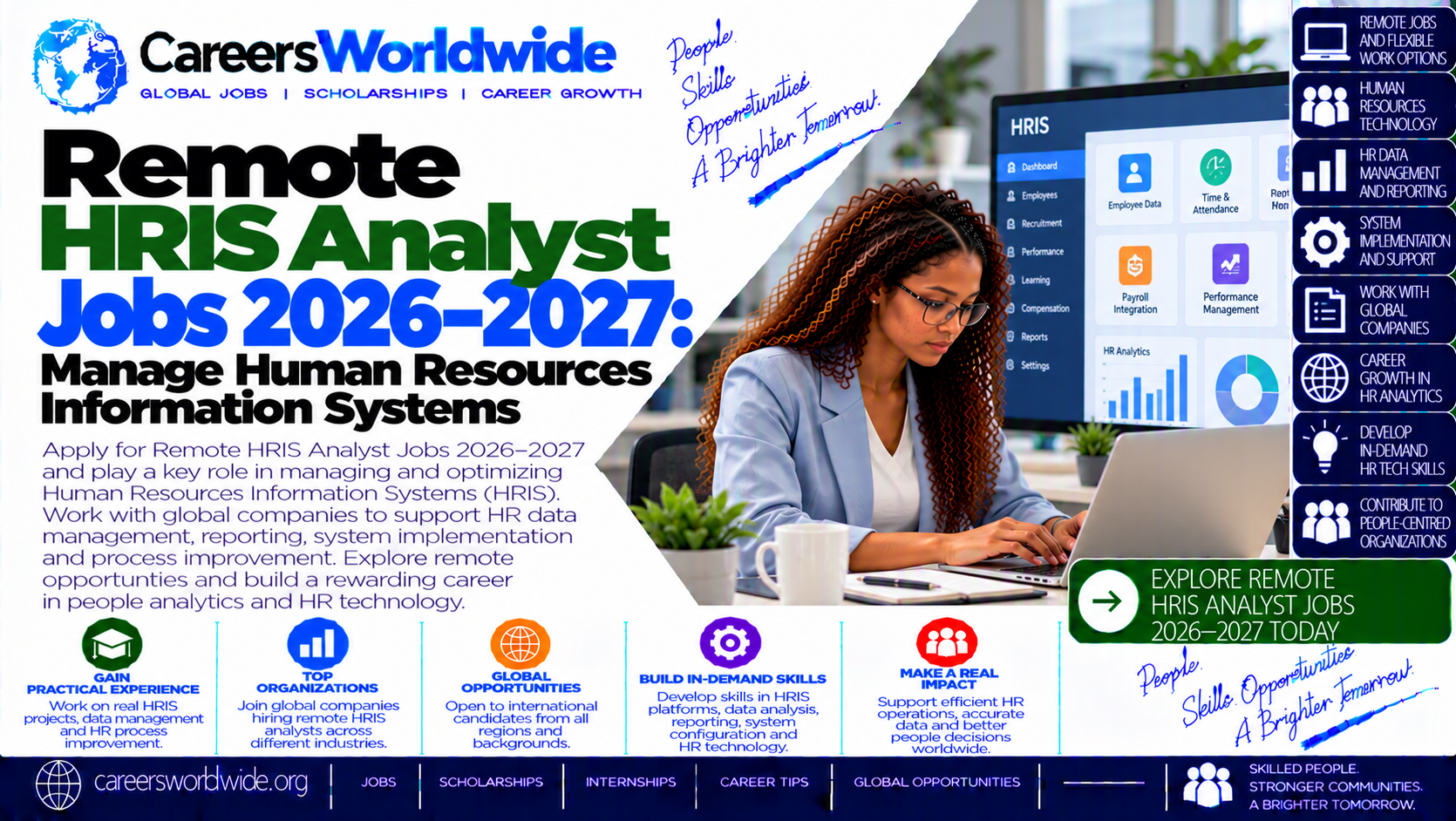

Excerpt: Discover remote HRIS analyst jobs for 2026–2027, explore the skills employers seek, learn about human resources information systems, and find practical ways to apply for remote opportunities with international companies. Build a career combining HR technology, data analysis, payroll systems, reporting, and business operations.
Remote HRIS Analyst Jobs 2026–2027 offer an opportunity for professionals interested in combining human resources, information technology, data management, and business analytics. As organizations increasingly rely on digital platforms to manage employee records, recruitment, compensation, benefits, performance management, and workforce planning, HR Information Systems (HRIS) professionals play an important role in keeping these systems accurate, secure, and useful.
For job seekers looking for remote work, HRIS analysis is a career path worth exploring. Opportunities may be available with multinational companies, technology businesses, consulting firms, healthcare organizations, financial institutions, nonprofit organizations, and companies with distributed workforces.
However, remote HRIS vacancies vary considerably. Some positions focus on reporting and data quality, while others require experience with enterprise platforms such as Workday, SAP SuccessFactors, Oracle HCM, UKG, or ADP. Employers may also distinguish between fully remote jobs, hybrid positions, and remote jobs restricted to particular countries.
This guide explains what remote HRIS analysts do, the qualifications employers may require, where to find legitimate opportunities, how to prepare a competitive application, and how international applicants can assess whether a position is accessible from their location.
Important: This is a career guide, not a list of verified live vacancies. Job titles, salaries, eligibility requirements, and remote-work arrangements depend on the employer and the individual recruitment announcement. Always confirm the details on the official careers website before applying.
1. What Are Remote HRIS Analyst Jobs?
Human Resources Information Systems analysts help organizations manage the technology and information used by their human resources departments. They work at the intersection of HR operations, software systems, reporting, data quality, and technical support.
A remote HRIS analyst performs these responsibilities from an approved remote location, communicating with HR teams, IT departments, payroll specialists, managers, and software vendors through digital tools.
The role can involve maintaining employee databases, configuring system settings, testing updates, troubleshooting problems, generating reports, and helping colleagues use HR platforms effectively.
For example, an organization operating across several countries may use an HRIS platform to manage employee onboarding, leave balances, job changes, payroll inputs, and performance reviews. An HRIS analyst helps ensure that the platform functions correctly and that the information it produces is reliable.
Why HRIS analysts matter
Accurate HR data helps organizations make informed decisions about staffing, recruitment costs, employee retention, compensation, and workforce planning.
Poorly maintained systems can produce inaccurate reports, duplicate records, payroll discrepancies, access-control problems, and delays in HR processes. HRIS analysts help reduce these risks by maintaining data standards, documenting processes, and investigating system issues.
As a result, the position can appeal to candidates with backgrounds in information technology, human resources, business administration, statistics, finance, or data analysis.
2. Why Consider Remote HRIS Analyst Careers in 2026–2027?
Organizations continue to digitize HR operations, integrate business applications, and standardize workforce reporting. These developments create potential opportunities for professionals who understand both business processes and the systems supporting them.
Several areas are particularly relevant to HRIS careers.
Cloud-based HR platforms: Employers use cloud software to centralize employee information and support HR operations across different offices.
People analytics: HR teams increasingly use dashboards and reports to understand turnover, recruitment performance, workforce composition, and other operational measures.
System integrations: HR platforms often exchange information with payroll, finance, identity-management, recruitment, and benefits systems. Analysts help investigate integration errors and reconcile inconsistent records.
Data governance and privacy: Employee information must be handled carefully, with appropriate access permissions, retention practices, and security controls.
Process automation: Organizations may automate onboarding workflows, approval processes, notifications, and routine reporting to reduce manual work.
These developments do not guarantee that remote HRIS vacancies will increase in every market. They do, however, provide useful areas of specialization for applicants preparing for 2026–2027 recruitment.
Remote HRIS roles can also be attractive because they may allow professionals to work with international teams without relocating. Nevertheless, an employer’s remote-work policy, payroll arrangements, tax requirements, and country restrictions determine whether an applicant can work from abroad.
3. Common Remote HRIS Analyst Job Titles
When searching for remote positions, do not limit your search to the exact phrase “HRIS Analyst.” Employers use different titles for similar responsibilities, and some relevant roles are listed under HR technology, people analytics, or business systems.
| Job title | Typical responsibilities |
|---|---|
| HRIS Analyst | Maintain HR systems, troubleshoot issues, and prepare reports |
| Workday HRIS Analyst | Support Workday configuration, reporting, and system administration |
| HR Systems Analyst | Analyze HR processes and maintain connected software applications |
| People Analytics Analyst | Analyze workforce data and prepare dashboards |
| HRIS Reporting Analyst | Build reports, validate data, and provide HR metrics |
| HR Technology Specialist | Support HR applications, integrations, and system improvements |
| HRIS Implementation Analyst | Assist with system configuration, testing, migration, and deployment |
| HR Data Analyst | Clean, analyze, and interpret employee and workforce data |
| HRIS Administrator | Manage user access, employee records, and routine system maintenance |
| HRIS Integration Analyst | Investigate data exchanges between HR, payroll, and other platforms |
These roles are related but not interchangeable. For example, a people analytics analyst may spend more time working with spreadsheets, SQL, and dashboards, while a Workday analyst may focus on business-process configuration, security, reporting, and system support.
Applicants should read the full job description rather than relying on the title alone.
4. Duties and Responsibilities of a Remote HRIS Analyst
The precise responsibilities depend on the organization, software platform, and seniority of the position. Common duties include the following.
HR system administration
HRIS analysts maintain the systems used to store and process employee information. Tasks may include updating system settings, supporting employee lifecycle transactions, maintaining organizational structures, and helping HR staff resolve technical problems.
Data quality and auditing
Employee records must be accurate, consistent, and appropriately maintained. Analysts may conduct regular audits, identify duplicate records, investigate discrepancies, and correct errors through approved procedures.
For example, an analyst may compare employee job titles and department codes across an HR platform and a payroll system to identify mismatches.
Reporting and analytics
HR leaders often need reliable information about employee headcount, turnover, recruitment, absenteeism, and workforce distribution. An HRIS analyst may build recurring reports, maintain dashboards, and explain discrepancies in the data.
Useful skills include advanced spreadsheet functions, pivot tables, lookup formulas, data visualization, and an understanding of how HR metrics are calculated.
System testing and upgrades
Organizations periodically introduce new features, modify workflows, and update software. Analysts help test these changes before they affect employees.
This can involve preparing test scenarios, documenting expected results, checking permissions, recording defects, and confirming that corrections work as intended.
User support and documentation
HR professionals and managers may need help understanding system workflows or resolving errors. Analysts investigate support tickets, explain procedures, prepare user guides, and escalate complex technical issues.
Integration and process improvement
HR platforms may exchange information with payroll, finance, recruitment, learning management, and identity-management systems. Analysts help identify integration failures and recommend ways to reduce repetitive manual work.
A strong candidate can explain not only how a system works but also how it supports business operations.
5. Qualifications and Skills Employers May Require
There is no single qualification requirement for every HRIS position. Entry-level roles may prioritize transferable technical skills, while senior positions often require several years of hands-on experience with a specific platform.
Educational qualifications
Relevant educational backgrounds may include:
- Information technology or computer science.
- Human resource management.
- Business information systems.
- Business administration.
- Data analytics or statistics.
- Accounting, finance, or a related analytical discipline.
Some employers accept equivalent professional experience in place of a specific degree. Others make a bachelor’s degree a formal requirement.
Applicants should use the advertised criteria as their guide rather than assuming that every employer follows the same standard.
Technical skills
The following capabilities can strengthen an application:
- Excel or Google Sheets: Formulas, pivot tables, lookups, data validation, and data cleaning.
- SQL: Querying structured databases and checking records.
- Reporting tools: Power BI, Tableau, or built-in HRIS reporting features.
- HR platforms: Workday, SAP SuccessFactors, Oracle HCM, UKG, or ADP.
- Testing: Creating test cases, recording defects, and validating system changes.
- Data governance: Understanding access permissions, confidentiality, data accuracy, and audit trails.
- Documentation: Writing clear process guides and recording technical procedures.
Not every vacancy requires all these skills. Workday experience, for instance, may be essential for a Workday-specific position but unnecessary for a role built around another platform.
Soft skills
Remote HRIS analysts also need strong communication, organization, analytical thinking, and problem-solving skills.
Because the role involves sensitive employee information, discretion and attention to detail are especially important. Remote workers must also communicate clearly across time zones, document their work, and manage competing priorities without constant supervision.
6. HRIS Platforms Worth Learning in 2026–2027

Workday HCM
Used for core HR data, organizational structures, talent management, reporting, and other workforce processes. Learn the fundamentals of business processes, reporting concepts, data security, and testing.

SAP SuccessFactors
A cloud HR platform covering areas such as employee central, performance, learning, and talent management. Understanding HR workflows and data structures can help you prepare for related roles.

Oracle HCM
Supports employee information, workforce management, talent processes, and HR reporting. Familiarity with enterprise applications and structured business processes is useful.

ADP and UKG
These platforms are relevant to payroll, timekeeping, workforce management, and HR administration. Their importance depends on the employer’s existing technology stack.
Official product and careers resources can help you understand the systems employers use. Begin with the Workday website at Workday, SAP SuccessFactors and HCM, Oracle HCM, and ADP.
Practical advice: Choose one platform to study first instead of trying to learn four systems simultaneously. Pair that learning with Excel, basic SQL, reporting, and data quality. These transferable skills can support applications across multiple HR technology environments.
Use official training resources to understand the software’s capabilities. Do not claim professional platform experience or certification on your CV unless you have actually earned it.
7. Expected Salaries for Remote HRIS Analyst Jobs
Compensation varies by country, employer, seniority, software expertise, employment classification, and responsibility level. A remote position with a US-based employer may have a different pay structure from a locally employed role or an international contractor agreement.
The following figures are illustrative planning ranges, not verified salary offers or current market averages.
| Experience level | Illustrative annual salary in the US |
|---|---|
| Entry-level or junior HRIS analyst | $50,000–$70,000 |
| Mid-level HRIS analyst | $70,000–$100,000 |
| Senior HRIS analyst | $95,000–$130,000+ |
| Specialized HRIS or implementation consultant | $100,000–$150,000+ |
Actual offers can fall outside these ranges. Specialized implementation work, complex integrations, advanced reporting, and extensive Workday or Oracle HCM experience may affect compensation, but no particular salary is guaranteed.
When evaluating an offer, consider:
- Whether the position is permanent, temporary, or contract-based.
- Whether salary is adjusted according to your country of residence.
- Whether benefits, paid leave, and retirement contributions are included.
- Whether the employer pays in US dollars or another currency.
- Whether you are responsible for your own taxes and insurance.
- Whether the role requires occasional travel or work outside standard hours.
International applicants should pay particular attention to location-based compensation. A company advertising a remote job in the United States may not employ candidates residing in Zimbabwe or other countries.
Check the job announcement for explicit international eligibility before investing substantial time in the application.
8. Where to Find Remote HRIS Analyst Jobs for 2026–2027
The best starting point is an employer’s official careers portal. Recruitment platforms can help you discover opportunities, but always verify the vacancy, location, and application instructions with the hiring organization.
Here are useful places to search.

1. Workday Careers
Explore opportunities with a major HR software provider. Search for HR systems, product support, consulting, customer experience, and related technical roles.

2. SAP Careers
Search for SuccessFactors, HR technology consulting, enterprise applications, business process consulting, and data-related positions.

3. Oracle Careers
Look for HCM-related consulting, application support, implementation, business analysis, and enterprise software opportunities.

4. Zebra Technologies Careers
Zebra has advertised Workday HRIS roles involving system administration, reporting, data integrity, and process improvements. Check its current listings and location requirements.

5. FHI 360 Careers
An international development organization worth checking for HR systems, data governance, HR operations, and related technology positions. Some previous vacancies have been restricted to US locations.
Other useful sources include:
- Indeed — search for remote HRIS analyst vacancies and compare advertised requirements.
- LinkedIn Jobs — search for HR technology roles and follow employers that recruit in your area.
- Oxford Global Resources jobs — explore specialist recruitment opportunities in technology and consulting.
Examples of roles to investigate
The following public listings illustrate the types of positions to look for. Their availability, closing dates, and eligibility can change, so check each employer’s application page before applying.
| Example role | What to check |
|---|---|
| Workday HRIS Analyst at Lee Company | View listing — remote options and occasional office requirements |
| HRIS & People Analytics Analyst at Ingenovis Health | View listing — Workday, ADP, and people analytics |
| HRIS Analyst at Vesta | View listing — remote work specifically based in Mexico |
| Workday HRIS Analyst at Zebra Technologies | View listing — Workday experience and remote/hybrid expectations |
These examples demonstrate why reading the full advertisement matters: a position marked remote may still require residence in a particular country or state.
9. How to Apply for Remote HRIS Analyst Jobs
A structured application strategy can help you target suitable vacancies instead of sending the same CV to every employer.
- Identify suitable job titles.Search for HRIS Analyst, Workday Analyst, HR Systems Analyst, HRIS Reporting Analyst, People Analytics Analyst, and HR Technology Specialist. Use variations of these titles when searching employer career pages.
- Check eligibility before applying.Confirm the accepted work locations, employment authorization requirements, experience level, degree requirements, salary range, and closing date. If you live outside the employer’s country, check whether international applicants are explicitly eligible.
- Prepare a targeted CV.Highlight relevant software, reporting, data validation, system support, documentation, and project experience. Include measurable achievements where you can substantiate them.
- Write a focused cover letter.Explain how your technical and analytical skills address the employer’s needs. Give a specific example of solving a data problem, improving a workflow, or supporting a business application.
- Submit the application through the official portal.Complete required fields, upload your documents, and answer screening questions accurately. Keep a copy of the vacancy description and confirmation of submission.
- Prepare for interviews.Practise explaining data-quality checks, troubleshooting workflows, reporting methods, system testing, confidentiality, and collaboration with HR and IT teams.
How to write a competitive HRIS analyst CV
Your CV should make your relevant skills easy to identify. A useful structure is:
- Professional summary.
- Technical skills and HRIS platforms.
- Employment history or relevant projects.
- Education and relevant training.
- Certifications, where applicable.
- Selected achievements.
A sample professional summary for someone with relevant experience could read:
HRIS and data analysis professional with experience supporting business systems, maintaining data quality, preparing operational reports, and improving administrative workflows. Skilled in spreadsheet analysis, documentation, problem-solving, and cross-functional collaboration. Interested in applying technical and analytical capabilities to HR systems administration, workforce reporting, and process improvement in a remote environment.
Adapt this example to your actual experience. If you have not worked with HRIS software, describe transferable technical skills and relevant projects honestly rather than claiming hands-on experience you do not have.
Build a small portfolio if you lack experience
You can demonstrate relevant skills without accessing real employee records.
Create a sample employee dataset using fictional names and information. Then develop:
- An Excel report showing headcount by department.
- A dashboard showing monthly recruitment or turnover trends.
- A data-validation exercise identifying duplicate records and missing fields.
- A short document describing an employee onboarding workflow.
- A sample system-testing checklist for a hypothetical HR platform.
These projects can demonstrate analytical thinking, reporting ability, and documentation skills. Make it clear that the data and scenarios are fictional.
10. A Practical Learning Plan for Aspiring HRIS Analysts
If you are starting from scratch, a focused learning plan can help you build relevant skills over several weeks.
Weeks 1–2
Learn HR fundamentals
Understand employee records, onboarding, job changes, payroll concepts, leave management, benefits, and organizational structures.
Weeks 3–4
Develop data skills
Practise Excel, pivot tables, lookup formulas, data cleaning, and basic reporting. Start learning SQL if relevant to your target vacancies.
Weeks 5–6
Explore an HRIS platform
Study official product documentation, demonstrations, and available learning resources for one system, such as Workday or SAP SuccessFactors.
Weeks 7–8
Build projects and apply
Finish a sample dashboard, practise troubleshooting scenarios, update your CV, and begin applying to roles that match your current level.
This is a suggested study schedule, not a guarantee of job readiness or employment. Candidates pursuing specialist implementation roles may need substantially more training and practical experience.
11. How International Applicants Can Find Remote HRIS Work
For candidates in Zimbabwe and other countries outside major hiring markets, international eligibility deserves special attention.
Start with listings that explicitly mention global remote work, international applicants, or remote work in your country. Search for employers with established international teams and review their employment arrangements.
There are several possibilities:
- International employment: The employer hires you in your country through an established local entity or employment partner.
- Independent contracting: You provide services under a contract, subject to applicable legal and tax requirements.
- Regional remote employment: The position is remote but limited to a specified country or region.
- Relocation-based employment: The position requires you to move to the employer’s country.
These arrangements have different legal, tax, benefits, and employment implications. Do not assume that a job advertised as “remote worldwide” permits work from every country; confirm the details with the employer.
If you are new to the field, also consider remote HR operations support, HR data reporting, HRIS support, and junior business systems positions. These can provide relevant experience for future analyst applications.
12. Tips for Avoiding Remote Job Scams
Remote technology jobs can attract fraudulent recruiters who use legitimate company names to obtain money or personal information.
Protect yourself by following these precautions:
- Verify that the vacancy appears on the employer’s official careers website.
- Check that recruiter communications use a credible company domain.
- Never pay a recruitment fee to secure a job.
- Do not buy equipment from a supposed recruiter as a condition of receiving an offer.
- Avoid sending banking details or identity documents before verifying the employer and the legitimate hiring process.
- Be cautious of unusually high salary promises with no meaningful interview or skills assessment.
Workday specifically warns applicants about recruitment scams and states that legitimate Workday hiring does not require personal payment or equipment purchases.
Workday US
If a message seems suspicious, contact the employer using the contact details published on its official website.
13. Frequently Asked Questions
1. Can I get a remote HRIS analyst job without experience?
Yes, it is possible to target junior HR systems, reporting, HR operations, and support roles, although opportunities vary. Build transferable skills in Excel, data quality, documentation, and business processes. Senior and specialist roles generally require relevant hands-on experience.
2. Do HRIS analysts need a degree?
Some employers require a bachelor’s degree in IT, HR, business, or a related discipline. Others accept equivalent professional experience. Always follow the specific vacancy’s stated requirements.
3. Which HRIS software should I learn first?
Choose based on the jobs you want to apply for. Workday, SAP SuccessFactors, Oracle HCM, UKG, and ADP are relevant platforms. Excel and reporting skills are useful starting points across many systems.
4. Are remote HRIS analyst jobs available internationally?
Some employers recruit internationally, but many remote roles are restricted to particular countries. Confirm whether your country of residence is eligible before applying.
5. Can I apply for HRIS jobs from Zimbabwe?
You can apply to vacancies that accept applicants based in Zimbabwe or explicitly support international contracting or employment. A US-remote or Mexico-remote listing should not be assumed to accept a Zimbabwe-based applicant.
6. How much can a remote HRIS analyst earn?
Compensation varies with location, experience, platform expertise, and employment arrangement. Use the advertised salary range where available and verify whether it applies to your country of residence.
7. Is Workday certification necessary?
Not every employer requires certification. Some prioritize practical experience, reporting, configuration, and troubleshooting. Review the requirements for your target roles before paying for training or certification.
8. Can someone with an IT background become an HRIS analyst?
Yes. IT professionals may have transferable skills in databases, troubleshooting, access control, system testing, and documentation. Learning HR processes can help bridge the gap.
9. What questions might appear in an HRIS analyst interview?
You may be asked how you would investigate duplicate employee records, troubleshoot a failed data integration, validate a report, test a system update, or protect confidential employee information. Platform-specific roles may also test configuration and reporting knowledge.
10. Where should I submit an application?
Use the employer’s official careers portal linked in the vacancy announcement. Confirm that the position is still open and follow its specific application instructions.
14. Official Application Resources
Use these official resources to begin your search for Remote HRIS Analyst Jobs 2026–2027.
| Resource | Application purpose |
|---|---|
| Workday Careers | Explore careers with an HR technology provider |
| SAP Careers | Search for HR technology and enterprise software roles |
| Oracle Careers | Explore HCM, consulting, and technical opportunities |
| Zebra Technologies Careers | Search for HRIS and business technology roles |
| FHI 360 Careers | Explore nonprofit HR systems and operations opportunities |
| LinkedIn Jobs | Discover HRIS vacancies and employer career pages |
| Indeed | Search for remote HRIS and related analyst roles |
These are starting points for job discovery, not a guarantee of open vacancies. Search each website for “HRIS Analyst,” “Workday Analyst,” “HR Systems Analyst,” and “People Analytics Analyst,” and verify current recruitment details before submitting your application.
15. Final Advice: Prepare for the Next Remote HRIS Opportunity
Remote HRIS analyst careers can suit people who enjoy technology, data, problem-solving, and improving business processes. The strongest applications connect practical skills to the employer’s needs rather than relying on a job title or software keyword alone.
For 2026–2027, focus on four priorities: develop strong reporting and data-quality skills, learn one relevant HR platform, build demonstrable projects, and target vacancies that genuinely accept applicants from your location.
If you already have IT or data analysis experience, highlight how those skills transfer to HR systems. If you are new to the field, consider junior support and reporting roles as a route toward more specialized HRIS work.
Above all, use official application resources, verify remote-work eligibility, and tailor each application to the advertised requirements. A focused, evidence-based job search is more useful than applying indiscriminately to every vacancy labelled remote.
Disclaimer
This article is for informational and career-planning purposes only. It does not represent a recruitment announcement, guarantee employment, or promise a particular salary. Job availability, eligibility, compensation, qualifications, and application deadlines may change without notice. Salary figures are illustrative estimates rather than verified offers. Always consult the employer’s official website for the latest vacancy details and application requirements. Never pay a recruiter to secure a job.
SEO Keywords
remote HRIS analyst jobs 2026, remote HRIS analyst jobs 2027, work from home HRIS analyst jobs, remote human resources information systems jobs, Workday HRIS analyst jobs, remote Workday analyst jobs, HR systems analyst vacancies, remote HR technology jobs, HRIS analyst salary, remote people analytics jobs, HRIS reporting analyst jobs, remote HR data analyst jobs, SAP SuccessFactors analyst jobs, Oracle HCM analyst jobs, entry level HRIS analyst jobs, international remote HRIS jobs, remote HRIS jobs for international applicants, HRIS analyst qualifications, HRIS analyst career opportunities, how to apply for remote HRIS analyst jobs, HR information systems careers, remote human resources technology careers, HRIS analyst jobs 2026–2027
ALSO CHECK: Robotics Field Service Engineer Jobs 2026–2027: Maintain Automated EquipmentOctober 13, 2026
Solar Project Engineer Jobs 2026–2027: Support Utility-Scale Solar DevelopmentsOctober 13, 2026
Veterinary Laboratory Technician Jobs 2026–2027: Support Animal Disease TestingOctober 13, 2026