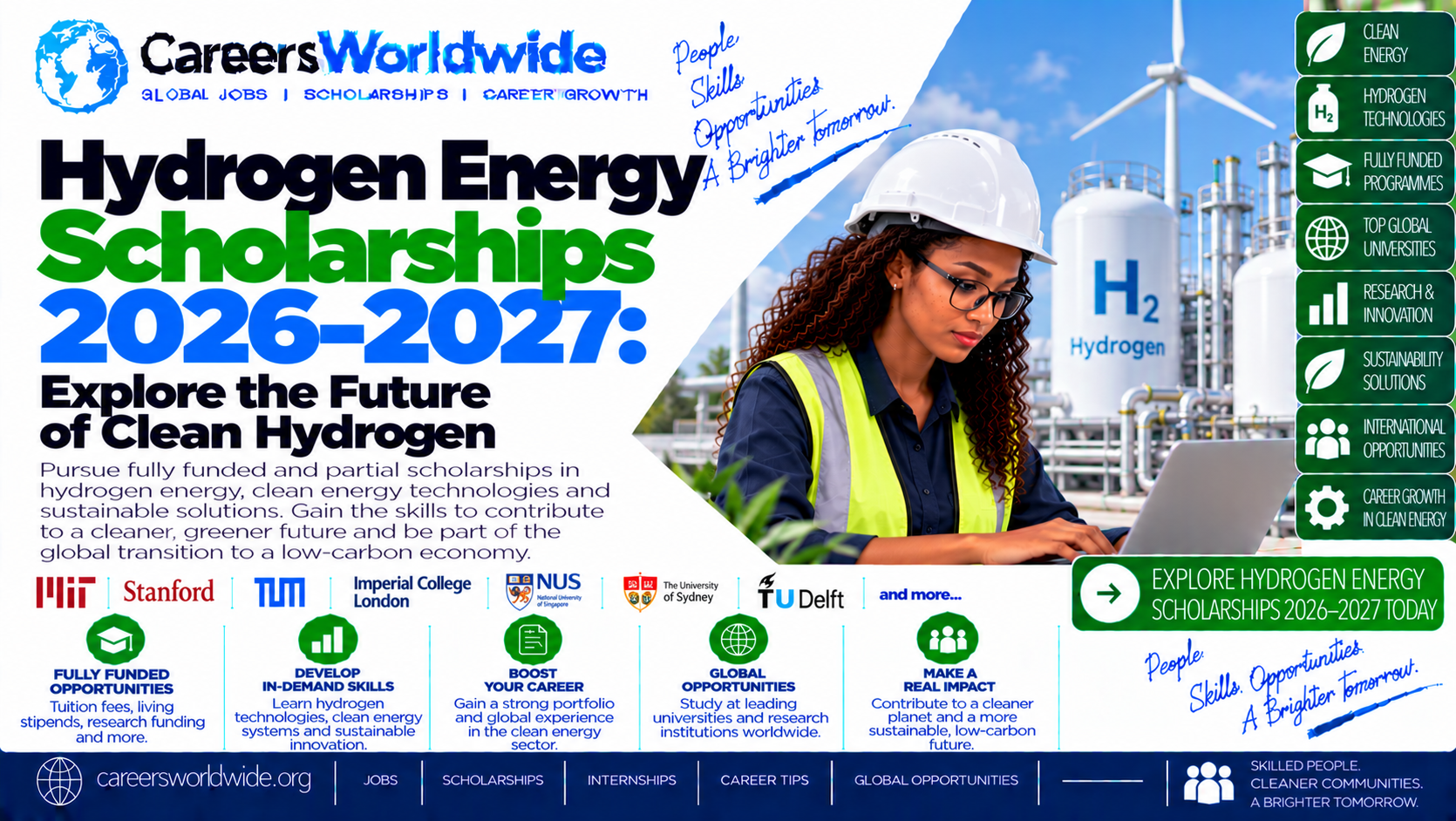

Excerpt: Hydrogen Energy Scholarships 2026–2027 can help students and early-career researchers pursue studies connected to clean hydrogen, fuel cells, renewable energy, electrolysis, energy storage, engineering, and sustainable energy systems. Explore scholarship pathways, eligible fields, practical application strategies, career opportunities, and official resources for building a future in the hydrogen economy.
Hydrogen Energy Scholarships Are Supporting the Next Generation of Clean-Energy Talent
The global energy system is undergoing a major transformation.
Governments, universities, research institutions, utilities, manufacturers, and technology companies are investing in technologies designed to reduce emissions while maintaining reliable energy supplies.
Among these technologies, clean hydrogen has become an important area of research and development.
The European Commission describes hydrogen as an energy carrier capable of transporting and storing large quantities of renewable energy and identifies renewable hydrogen as an important component of Europe’s clean-energy transition. Its hydrogen research agenda covers areas ranging from production and storage to distribution and end uses.
The U.S. Department of Energy similarly provides education resources for students interested in hydrogen and fuel-cell careers, including information about college programs, scholarships, internships, fellowships, and student opportunities.
This creates opportunities for students who want to specialize in areas such as:
- Hydrogen production
- Green hydrogen
- Renewable energy
- Electrolysis
- Fuel-cell technology
- Energy storage
- Chemical engineering
- Mechanical engineering
- Electrical engineering
- Materials science
- Energy economics
- Environmental engineering
- Sustainable energy systems
- Hydrogen infrastructure
- Energy policy
- Industrial decarbonization
However, students should understand that there is not necessarily one scholarship with the universal title “Hydrogen Energy Scholarship 2026–2027.”
Instead, funding can be found through university scholarships, engineering scholarships, clean-energy programs, research grants, government-funded education initiatives, international scholarships, fellowships, and specialized hydrogen training programs.
That makes strategic searching especially important.
What Are Hydrogen Energy Scholarships?
Hydrogen energy scholarships are educational funding opportunities that support students studying subjects relevant to hydrogen technologies and the broader clean-energy transition.
Depending on the scholarship, funding may support:
- Undergraduate degrees
- Master’s degrees
- PhD research
- Research placements
- Professional training
- Short courses
- Hydrogen-specific certifications
- Energy engineering programs
- Renewable-energy studies
- Fuel-cell research
- Clean-energy innovation
Some scholarships may directly mention hydrogen.
Others may use broader terminology such as:
Clean Energy Scholarship
Renewable Energy Scholarship
Energy Engineering Scholarship
Sustainable Energy Scholarship
Fuel Cell Research Scholarship
Green Hydrogen Scholarship
Climate Technology Scholarship
Energy Transition Scholarship
Decarbonization Scholarship
Students who search only for the phrase “hydrogen scholarship” could therefore miss relevant funding.
A broader search strategy can significantly increase the number of opportunities discovered.
Why Study Hydrogen Energy in 2026–2027?
Hydrogen is increasingly being considered for applications where direct electrification may be difficult or where hydrogen-derived fuels can provide another pathway for decarbonization.
The European Commission identifies hydrogen applications across industry and transport and highlights the development of hydrogen valleys, renewable hydrogen markets, electrolysers, and fuel-cell technologies.
The U.S. Department of Energy also supports clean-hydrogen activities involving production, storage, transportation, energy systems, and hard-to-decarbonize sectors.
This means students entering the field can potentially work across several parts of the energy value chain.
Potential areas include:
- Hydrogen production
- Electrolyser technology
- Fuel cells
- Hydrogen storage
- Hydrogen transportation
- Renewable electricity integration
- Industrial applications
- Energy systems modelling
- Hydrogen safety
- Materials research
- Hydrogen infrastructure
- Energy policy
- Environmental assessment
- Project development
- Energy economics
The field is therefore interdisciplinary.
A student does not necessarily need to study a degree literally called “Hydrogen Engineering.”
A degree in chemical engineering, mechanical engineering, electrical engineering, materials science, environmental engineering, energy systems, physics, chemistry, or economics may provide a route into hydrogen-related work.
Who Can Apply for Hydrogen Energy Scholarships?
Eligibility depends on the specific scholarship or academic program.
Potential applicants can include:
- High school graduates
- Undergraduate students
- Master’s students
- PhD candidates
- Engineering students
- Science students
- Energy researchers
- Environmental science students
- Renewable-energy students
- Technology students
- Professionals pursuing specialized training
Some opportunities may be restricted by nationality, country of residence, academic level, field of study, university admission, or professional background.
Applicants should never assume that a scholarship is globally available simply because the subject is international.
Always read the official eligibility requirements.
Degree Subjects That Can Lead to Hydrogen Careers
One of the most important decisions for students is selecting a degree that provides transferable technical skills.
1. Chemical Engineering
Chemical engineering is particularly relevant to hydrogen production, processing, industrial applications, and chemical systems.
Students can develop knowledge of:
- Chemical reactions
- Process engineering
- Thermodynamics
- Fluid mechanics
- Process design
- Catalysis
- Separation technologies
2. Mechanical Engineering
Mechanical engineers can contribute to hydrogen infrastructure, storage systems, equipment design, transportation systems, and energy conversion technologies.
Relevant subjects include:
- Thermodynamics
- Heat transfer
- Fluid mechanics
- Mechanical design
- Energy systems
- Manufacturing
- Computational modelling
3. Electrical Engineering
Hydrogen production increasingly intersects with renewable electricity and electrolysis.
Electrical engineers can work on:
- Power systems
- Renewable-energy integration
- Electrical controls
- Energy storage
- Power electronics
- Grid integration
- Electrolyser systems
4. Materials Science
Materials research is critical for improving hydrogen technologies.
Students may investigate:
- Hydrogen storage materials
- Catalysts
- Electrolyser materials
- Fuel-cell membranes
- Corrosion
- Advanced materials
- Nanotechnology
5. Environmental Engineering
Environmental engineers can examine hydrogen’s environmental impacts and help evaluate projects throughout their life cycles.
Potential research areas include:
- Life-cycle assessment
- Water use
- Emissions
- Environmental monitoring
- Industrial sustainability
- Waste management
- Clean-energy systems
6. Energy and Sustainability
Students studying energy policy, sustainability, or energy systems can work on the economic and policy dimensions of hydrogen.
Potential career areas include:
- Energy policy
- Hydrogen market development
- Energy economics
- Sustainability strategy
- Climate policy
- Energy consulting
- Project development
What Can Hydrogen Scholarships Cover?
Scholarship benefits vary widely.
Depending on the program, funding may contribute toward:
- Tuition fees
- Living expenses
- Research costs
- Laboratory expenses
- Books
- Academic materials
- Travel
- Conference participation
- Training fees
- Accommodation
- Stipends
However, applicants should not assume that every hydrogen-related scholarship is fully funded.
Some opportunities cover only tuition.
Others provide partial financial support.
Some specialized programs provide training rather than a university degree.
For example, the RENAC H2Uppp e-learning scholarship program has offered scholarship-supported hydrogen training for eligible applicants from ODA recipient countries. The program documentation describes a 12-week online learning format and scholarship places allocated through an application process.
Because programs change between application cycles, students should verify the latest funding details directly with the organization.
Practical Guidance: How to Become a Strong Hydrogen Scholarship Applicant
Winning competitive funding requires more than simply meeting the minimum academic requirements.
Applicants should demonstrate a clear connection between their education, research interests, and the energy transition.
1. Build a Strong Academic Foundation
Strong performance in relevant subjects can help.
Depending on your intended specialization, focus on areas such as:
- Mathematics
- Physics
- Chemistry
- Engineering
- Computer science
- Environmental science
- Economics
For postgraduate research, your previous academic work should ideally demonstrate preparation for the proposed research area.
2. Learn the Hydrogen Value Chain
You should understand more than the phrase “green hydrogen.”
Learn how hydrogen can be:
Produced → Conditioned → Stored → Transported → Distributed → Used
Study technologies such as:
- Electrolysis
- Fuel cells
- Hydrogen storage
- Hydrogen compression
- Hydrogen liquefaction
- Renewable electricity
- Hydrogen-derived fuels
The U.S. Department of Energy maintains educational resources covering hydrogen and fuel-cell technologies and careers.
3. Develop a Clear Research Interest
If applying for a master’s or PhD scholarship, identify a focused research question.
Possible themes include:
- Improving electrolyser efficiency
- Reducing hydrogen production costs
- Hydrogen storage materials
- Fuel-cell durability
- Renewable hydrogen integration
- Hydrogen safety
- Hydrogen infrastructure
- Water requirements for electrolysis
- Hydrogen transport
- Industrial decarbonization
- Hydrogen economics
- Hydrogen policy
A focused research interest can make your application more convincing.
4. Gain Research Experience
Students can strengthen applications by participating in:
- University research projects
- Engineering competitions
- Energy clubs
- Sustainability initiatives
- Laboratory projects
- Academic conferences
- Research assistantships
- Renewable-energy internships
Even a small undergraduate project can demonstrate genuine interest.
5. Build Technical Skills
Depending on your field, consider developing skills in:
- MATLAB
- Python
- Energy modelling
- Data analysis
- CAD
- Computational fluid dynamics
- Life-cycle assessment
- GIS
- Statistical analysis
- Process simulation
Technical skills can make your profile more competitive for research-focused opportunities.
How to Write a Strong Hydrogen Scholarship Personal Statement
Your personal statement should explain why hydrogen, why this program, and why you.
A useful structure is:
Paragraph 1: Motivation
Explain what attracted you to clean energy and hydrogen.
Paragraph 2: Academic preparation
Discuss your degree, relevant courses, projects, research, or technical experience.
Paragraph 3: Hydrogen interest
Explain the specific hydrogen challenge you want to study.
Paragraph 4: Career goals
Show how the scholarship fits your long-term plans.
Paragraph 5: Impact
Explain how you intend to use your knowledge after graduation.
Avoid generic statements such as:
“I want to save the planet.”
Instead, make the objective measurable and specific.
For example, an applicant might explain an interest in improving renewable-hydrogen production for industrial applications in emerging economies.
Hydrogen Scholarship Application Checklist
Before submitting an application, prepare:
- Updated CV
- Academic transcripts
- Degree certificates
- Proof of admission where required
- Personal statement
- Research proposal if required
- Letters of recommendation
- Passport or identification
- Proof of English proficiency where required
- Research portfolio where applicable
- Publications or academic projects if available
- Financial documents where required
Create a digital folder containing your documents so you can respond quickly when applications open.
Where to Find Hydrogen Energy Scholarships 2026–2027
Students should search across multiple categories.
Universities
University engineering and energy departments can offer:
- Research scholarships
- Graduate assistantships
- Tuition awards
- PhD positions
- Research fellowships
Look specifically at departments working on hydrogen, electrochemistry, renewable energy, fuel cells, energy systems, or industrial decarbonization.
Government Energy Agencies
Government energy agencies can provide education resources, research opportunities, internships, fellowships, and information about energy careers.
The U.S. Department of Energy’s hydrogen education resources specifically point students toward hydrogen-related education, scholarships, internships, fellowships, and career information.
International Scholarship Programs
International applicants should also investigate broader scholarships that allow study in engineering, energy, climate, sustainability, or environmental science.
A scholarship does not need to have “hydrogen” in its title to support hydrogen-related study.
Professional and Training Organizations
Specialized clean-energy training providers can also provide scholarships or subsidized education.
Students should carefully check whether an opportunity funds a university degree, short course, professional certificate, or research project.
These are different types of educational support.
Official Application Resources
The following sources are useful starting points for students researching hydrogen and clean-energy education opportunities.
U.S. Department of Energy — Hydrogen Education
The DOE provides educational resources for students and educators interested in hydrogen and fuel-cell technologies, including career, college, scholarship, internship, and fellowship information.
U.S. Department of Energy — Hydrogen Education Resources
DOE Hydrogen Program
The DOE Hydrogen Program provides information about hydrogen technology and funding opportunities involving areas such as hydrogen production, delivery, storage, and fuel-cell technologies.
DOE Hydrogen Program Funding Opportunities
European Commission — Hydrogen Research
The European Commission provides information about hydrogen research, innovation, skills initiatives, and the role of renewable hydrogen in the energy transition.
European Commission — Hydrogen Research and Innovation
RENAC / H2Uppp
Students and professionals interested in specialized hydrogen training can also investigate programs such as H2Uppp when scholarship calls are open. Previous program documentation describes scholarship-supported online hydrogen training.
Hydrogen Scholarship Opportunities: What to Search For
Rather than using one search phrase, try combinations such as:
“green hydrogen scholarship”
“hydrogen energy master’s scholarship”
“renewable energy scholarship 2027”
“clean energy engineering scholarship”
“fuel cell research scholarship”
“electrolysis research scholarship”
“hydrogen PhD funding”
“energy systems PhD scholarship”
“sustainable energy master’s funding”
“hydrogen technology fellowship”
This broader approach can uncover opportunities that would otherwise be missed.
Careers After Studying Hydrogen Energy
Hydrogen education can lead to careers across engineering, science, policy, consulting, research, and project development.
Potential roles include:
| Career | Typical Focus |
|---|---|
| Hydrogen Engineer | Hydrogen production and systems |
| Electrolysis Engineer | Electrolyser technologies |
| Fuel Cell Engineer | Fuel-cell systems |
| Energy Systems Engineer | Integrated energy technologies |
| Renewable Energy Engineer | Solar, wind and hydrogen integration |
| Chemical Engineer | Hydrogen production and processing |
| Materials Scientist | Catalysts and hydrogen materials |
| Hydrogen Project Analyst | Project development and analysis |
| Energy Policy Analyst | Regulation and energy policy |
| Sustainability Consultant | Decarbonization strategies |
| Energy Researcher | Technology and systems research |
| Hydrogen Safety Specialist | Risk and safety management |
| Energy Economist | Hydrogen markets and economics |
| Clean Energy Consultant | Energy-transition strategy |
The career landscape is interdisciplinary, which means students can enter the sector through multiple academic pathways.
Hydrogen Energy Scholarships 2026–2027: Summary Table
| Category | Details |
|---|---|
| Scholarship theme | Hydrogen, clean energy and energy transition |
| Academic levels | Undergraduate, Master’s, PhD and professional training |
| Relevant fields | Engineering, science, energy, sustainability and policy |
| Key technologies | Electrolysis, fuel cells, storage and renewable energy |
| Potential funding | Tuition, stipend, research or training support depending on program |
| International opportunities | Available through selected universities and scholarship schemes |
| Technical skills | Python, MATLAB, modelling, data analysis and engineering tools |
| Research areas | Production, storage, transport, materials and energy systems |
| Application documents | CV, transcripts, statement, references and proposal where required |
| Main advice | Verify eligibility and funding directly with the official provider |
How to Apply for Hydrogen Energy Scholarships
Step 1: Identify Your Academic Goal
Decide whether you want an undergraduate degree, master’s program, PhD, research placement, or professional training.
Step 2: Select Your Hydrogen Specialization
Choose a specific area such as electrolysis, fuel cells, storage, materials, policy, or energy systems.
Step 3: Search Official Sources
Start with universities, government energy agencies, research institutions, and recognized scholarship providers.
Step 4: Verify Eligibility
Check:
- Nationality
- Academic qualifications
- Degree level
- Field of study
- Admission requirements
- Language requirements
- Application deadline
Step 5: Prepare Your Documents
Make sure your CV, transcripts, references, statement, and research proposal are ready.
Step 6: Customize Your Application
Do not send the same personal statement to every program.
Explain why the particular university, research group, or scholarship matches your goals.
Step 7: Submit Through the Official Portal
Use the official university or scholarship website whenever possible.
Step 8: Monitor Your Application
Keep copies of your application and check your email for requests for additional documents or interview invitations.
How to Avoid Scholarship Scams
The growing popularity of clean-energy careers also creates opportunities for fraudulent scholarship advertisements.
Be cautious if an organization:
- Guarantees a scholarship
- Demands an unexplained application fee
- Requests payment through an individual
- Promises guaranteed admission
- Uses an unofficial email address
- Cannot identify the university or funding organization
- Requests sensitive financial information before verification
A legitimate scholarship should have identifiable sponsoring organizations, published eligibility requirements, and an official application process.
Always verify the opportunity independently.
FAQ: Hydrogen Energy Scholarships 2026–2027
Are there scholarships specifically for hydrogen energy?
Yes, hydrogen-focused education and training funding exists, although opportunities may be advertised under broader categories such as clean energy, renewable energy, engineering, fuel cells, or energy systems. The DOE maintains resources connecting students with hydrogen-related education and funding opportunities.
Can international students apply?
Some programs accept international students, while others are restricted to particular nationalities or institutions. Eligibility must be checked for each scholarship.
What degree should I study for a career in hydrogen?
Chemical, mechanical, electrical, environmental, and energy engineering are strong options. Materials science, chemistry, physics, economics, sustainability, and energy policy can also lead to hydrogen-related careers.
Can I study green hydrogen without an engineering degree?
Yes. Hydrogen is interdisciplinary. Students can contribute through policy, economics, environmental science, project management, sustainability, finance, communications, and other fields.
Are hydrogen scholarships fully funded?
Not always. Some may provide full funding, while others cover only tuition, research expenses, or specific training costs.
Can undergraduate students pursue hydrogen research?
Yes. Undergraduate students can look for university research projects, energy clubs, laboratory opportunities, competitions, internships, and research assistantships.
Is green hydrogen the same as clean hydrogen?
Not necessarily. “Green hydrogen” commonly refers to hydrogen produced through electrolysis powered by renewable electricity. “Clean hydrogen” can be used more broadly for hydrogen production pathways that meet particular emissions criteria.
What skills are useful for hydrogen careers?
Useful skills can include engineering fundamentals, data analysis, modelling, programming, energy systems knowledge, research, technical writing, project management, and understanding of sustainability and energy policy.
Where should I start searching?
Begin with university engineering and energy departments, government energy agencies, recognized scholarship providers, and established clean-energy education organizations.
Final Thoughts
Hydrogen energy is becoming an important area of research, engineering, policy, and investment as governments and organizations explore pathways toward lower-emission energy systems.
The European Commission’s hydrogen research initiatives span the hydrogen value chain and include education and skills initiatives designed to prepare people for emerging hydrogen-related careers.
For students, this creates an opportunity to develop expertise before the sector becomes even more competitive.
The most effective strategy is not simply to search for a scholarship with “hydrogen” in the title.
Instead, identify the part of the hydrogen economy you want to enter and then search for funding connected to that specialization.
An aspiring electrolyser researcher might look for chemical engineering, electrochemistry, materials science, or renewable-energy funding.
A future hydrogen policy analyst might pursue energy economics, environmental policy, sustainability, or public-policy scholarships.
An aspiring fuel-cell engineer could investigate mechanical engineering, chemical engineering, materials science, or energy systems programs.
The strongest applicants will combine academic preparation with a clear career direction, relevant technical skills, research experience, and a convincing explanation of how their education can contribute to the clean-energy transition.
For 2026–2027 applicants, the key is to start early, monitor official scholarship portals, prepare documents before deadlines, and verify every opportunity through the organization that actually provides the funding.
Disclaimer
Scholarship availability, eligibility requirements, funding amounts, deadlines, academic programs, and application procedures can change. This article is intended for general informational purposes and does not represent a guarantee of funding, admission, employment, or scholarship selection.
Applicants should always verify the latest information directly through the official university, government agency, scholarship provider, or training organization before submitting an application or paying any fees.
CareersWorldwide does not guarantee the accuracy of third-party scholarship advertisements and does not endorse unofficial agents claiming to guarantee scholarship awards.
SEO Keywords
hydrogen energy scholarships 2026,
hydrogen energy scholarships 2027,
hydrogen scholarships 2026,
hydrogen scholarships 2027,
hydrogen energy scholarship 2026 2027,
clean hydrogen scholarships,
green hydrogen scholarships,
green hydrogen scholarship 2026,
clean energy scholarships 2026,
renewable energy scholarships 2026,
renewable energy scholarships 2027,
hydrogen engineering scholarships,
hydrogen engineering scholarship 2026,
hydrogen technology scholarships,
hydrogen technology scholarship 2026,
hydrogen research scholarships,
hydrogen research funding,
hydrogen PhD scholarships,
hydrogen masters scholarships,
hydrogen energy masters scholarships,
hydrogen PhD funding 2026,
hydrogen fuel cell scholarships,
fuel cell research scholarships,
electrolysis scholarships,
electrolyser research scholarships,
green hydrogen masters scholarships,
green hydrogen PhD scholarships,
clean energy engineering scholarships,
energy engineering scholarships 2026,
sustainable energy scholarships 2026,
energy systems scholarships,
renewable hydrogen scholarships,
hydrogen research opportunities,
hydrogen education opportunities,
hydrogen technology education,
hydrogen careers 2026,
hydrogen energy careers,
clean hydrogen careers,
green hydrogen careers,
hydrogen engineer scholarships,
energy transition scholarships,
clean energy scholarships for international students,
hydrogen scholarships for international students,
hydrogen scholarships for African students,
hydrogen scholarships for Zimbabwean students,
fully funded hydrogen scholarships,
fully funded clean energy scholarships,
hydrogen sustainability scholarships,
hydrogen innovation scholarships,
hydrogen fuel cell scholarships 2026,
hydrogen energy funding opportunities,
hydrogen research funding opportunities,
renewable energy research scholarships,
clean energy research scholarships,
energy technology scholarships 2026,
hydrogen technology funding,
hydrogen university scholarships,
hydrogen graduate scholarships,
hydrogen undergraduate scholarships,
hydrogen energy PhD programs,
hydrogen energy master’s programs,
green hydrogen education,
clean hydrogen education,
future of hydrogen energy,
hydrogen economy scholarships,
hydrogen economy careers,
hydrogen energy research 2026,
hydrogen energy studies,
hydrogen energy degree programs,
hydrogen engineering degree scholarships,
renewable hydrogen research,
clean hydrogen research,
hydrogen fuel cell research,
hydrogen storage research scholarships,
hydrogen production research scholarships,
hydrogen energy scholarship opportunities,
hydrogen scholarship application,
hydrogen scholarship application 2026,
hydrogen scholarship application 2027,
hydrogen energy scholarships for students,
clean energy scholarships for students,
renewable energy scholarships for students,
energy transition scholarships 2026,
hydrogen innovation funding,
hydrogen technology scholarships for international students,
clean energy scholarships for international students 2026,
hydrogen research scholarships for international students,
green hydrogen research funding,
hydrogen energy study abroad scholarships,
hydrogen energy graduate funding,
hydrogen energy student funding,
hydrogen technology graduate scholarships,
hydrogen energy academic funding,
hydrogen clean energy education opportunities,
hydrogen careers and scholarships,
hydrogen energy scholarships 2026 2027,
ALSO CHECK: Semiconductor Engineering Scholarships 2026–2027: Funding Advanced Chip & Electronics ResearchOctober 5, 2026
Care Coordination Internships 2026: Support Patients & Healthcare TeamsOctober 4, 2026
Medical Affairs Internships 2026: Explore Scientific Communication & Healthcare StrategyOctober 4, 2026