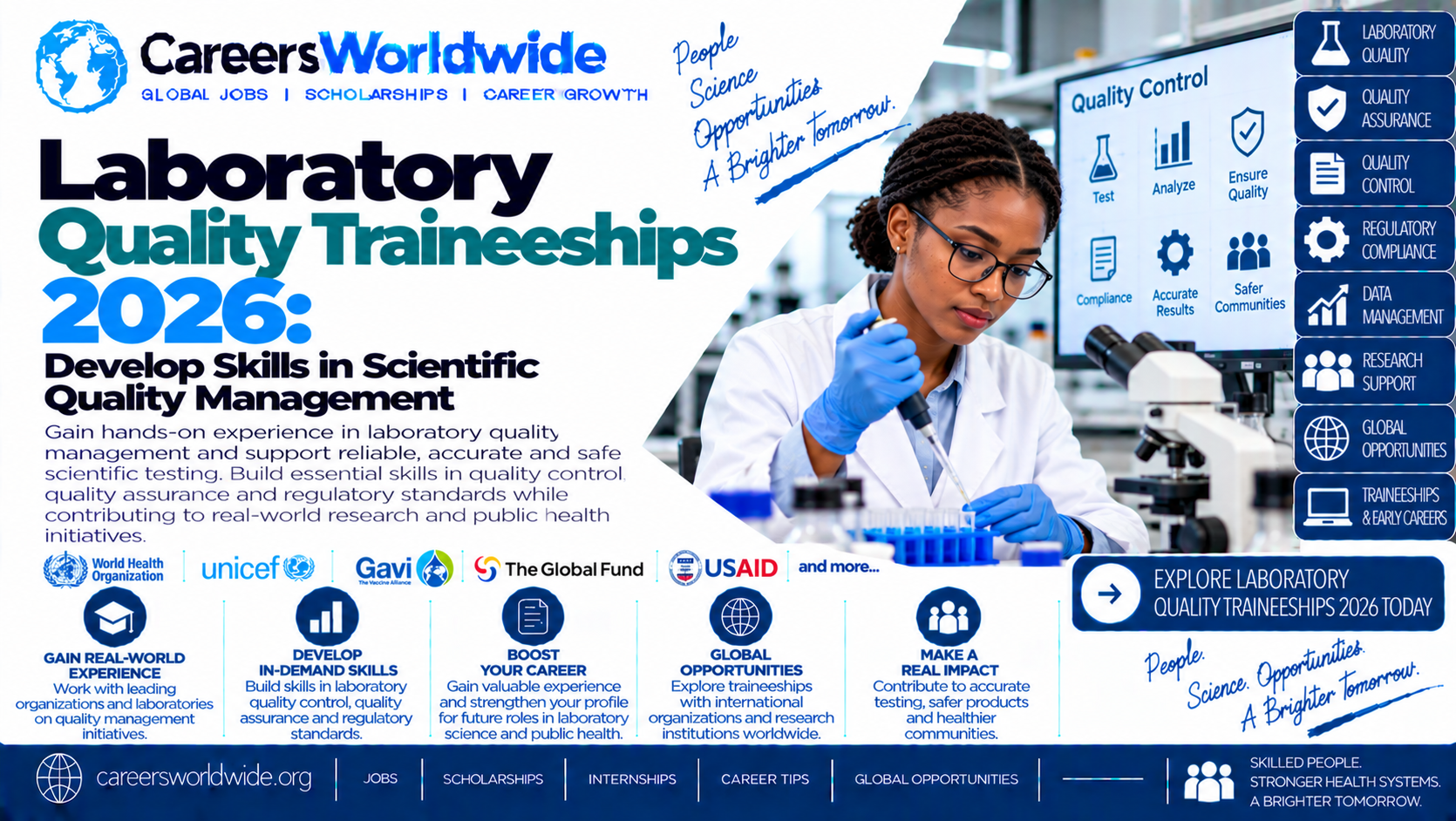

Excerpt: Laboratory Quality Traineeships 2026 can help students and early-career laboratory professionals develop practical skills in quality management systems, laboratory documentation, quality control, biosafety, audits, accreditation and scientific compliance. Explore the skills employers want, practical training opportunities, career pathways, application strategies and official laboratory-quality resources.
Introduction
Modern laboratories depend on more than scientific knowledge.
A laboratory can have sophisticated instruments and highly trained scientists, but reliable results also require effective quality systems, accurate documentation, competent personnel, appropriate procedures and continuous improvement.
That is why laboratory quality management has become an important area for clinical laboratories, public-health laboratories, research institutions, diagnostic facilities, environmental laboratories and other scientific organizations.
Laboratory Quality Traineeships 2026 can provide an entry point for people who want to develop practical experience in this area.
These opportunities may expose trainees to:
- Quality management systems,
- Standard operating procedures,
- Quality control,
- Quality assurance,
- Laboratory documentation,
- Internal audits,
- Corrective and preventive actions,
- Sample management,
- Biosafety,
- Equipment management,
- Data and records management,
- Accreditation preparation,
- Continuous improvement.
The World Health Organization emphasizes that accuracy, timeliness and reliability of laboratory results are major challenges for health laboratories and supports countries with quality-management guidance, training materials and practical implementation tools.
For aspiring laboratory scientists, quality officers and biomedical researchers, developing these skills can complement technical laboratory training and create additional career options.
What Is Laboratory Quality Management?
Laboratory Quality Management is the organized approach used to ensure that laboratory processes consistently produce reliable, accurate and timely results.
The concept covers much more than checking a test result.
It can include the entire laboratory workflow:
Pre-analytical → Analytical → Post-analytical
Pre-analytical
This can include:
- Patient or sample identification,
- Sample collection,
- Transportation,
- Sample reception,
- Storage,
- Sample preparation.
Analytical
This includes:
- Testing procedures,
- Equipment,
- Reagents,
- Calibration,
- Quality control,
- Method performance,
- Staff competency.
Post-analytical
This can include:
- Results verification,
- Reporting,
- Record management,
- Data protection,
- Communication of results,
- Corrective actions.
WHO’s Laboratory Quality Stepwise Implementation tool is designed to guide medical laboratories toward implementation of a quality management system aligned with ISO 15189.
Laboratory Quality Traineeships 2026: Summary
| Category | Details |
|---|---|
| Field | Laboratory quality management |
| Related fields | Quality assurance, quality control, laboratory science |
| Main standards | ISO 15189, ISO 17025 and related requirements |
| Core activities | Documentation, QC, audits, SOPs and quality improvement |
| Laboratory areas | Clinical, research, public health and environmental laboratories |
| Key skills | Accuracy, documentation, analysis and problem-solving |
| Scientific skills | Laboratory methods, testing procedures and data interpretation |
| Quality skills | QMS, IQC, EQA, audits and corrective actions |
| Safety | Biosafety, chemical safety and laboratory risk management |
| Common applicants | Laboratory science students and graduates |
| Career paths | Quality officer, laboratory scientist, QA specialist |
| Useful resources | WHO LQSI, WHO LQMS toolkit and GLLP |
What Does a Laboratory Quality Trainee Do?
The exact responsibilities depend on the laboratory and programme.
However, trainees may assist with several important quality-management activities.
1. Supporting Standard Operating Procedures
Laboratories rely on documented procedures to ensure that tasks are performed consistently.
A trainee may learn how to:
- Review SOPs,
- Organize documents,
- Identify outdated procedures,
- Track revisions,
- Maintain document-control records,
- Help staff access approved procedures.
Documentation is a fundamental component of a functioning laboratory quality system.
2. Quality Control
Quality control helps laboratories determine whether testing processes are operating within acceptable limits.
A trainee may be exposed to:
- Internal quality control,
- Control materials,
- QC charts,
- Trend analysis,
- Control limits,
- Error investigation,
- Corrective actions.
WHO’s laboratory quality-management training materials include process-control topics such as internal quality control, external quality control and proficiency-testing schemes.
3. External Quality Assessment
External Quality Assessment (EQA) and proficiency testing provide an additional mechanism for assessing laboratory performance.
Trainees may learn how laboratories:
- Participate in an EQA programme,
- Receive samples or assessment materials,
- Perform testing,
- Submit results,
- Receive performance feedback,
- Investigate problems,
- Implement corrective actions.
Understanding EQA can be particularly valuable for professionals interested in public-health and diagnostic laboratories.
4. Internal Audits
Quality systems need to be evaluated regularly.
Trainees may learn how to support internal audits by:
- Reviewing procedures,
- Checking records,
- Interviewing personnel,
- Identifying nonconformities,
- Documenting findings,
- Following corrective actions.
WHO’s Laboratory Quality Management System training toolkit includes assessment and audit training, including internal audits and the use of audit results for corrective action.
Why Laboratory Quality Skills Matter
Reliable laboratory results are important for:
- Patient diagnosis,
- Disease surveillance,
- Public-health response,
- Research,
- Drug development,
- Environmental monitoring,
- Food safety,
- Epidemiological investigations.
During infectious-disease outbreaks, for example, laboratory results can influence surveillance and response decisions.
WHO notes that sound laboratory quality management is important for producing test results that can be trusted, particularly in public-health emergencies.
This means laboratory quality professionals contribute to the reliability of the wider scientific and healthcare system.
ISO 15189 and Laboratory Quality
One of the most important standards to understand for medical laboratory quality is ISO 15189.
ISO 15189 specifies requirements for quality and competence in medical laboratories.
WHO’s Laboratory Quality Stepwise Implementation tool is specifically designed to help medical laboratories implement quality-management systems in compliance with ISO 15189.
Trainees interested in laboratory quality should become familiar with concepts such as:
- Quality management systems,
- Competence,
- Documentation,
- Risk management,
- Equipment,
- Personnel,
- Process control,
- Internal audits,
- Nonconformities,
- Corrective action,
- Continual improvement.
You do not necessarily need to become an ISO auditor at the beginning of your career.
However, understanding the principles can significantly strengthen your laboratory-quality profile.
ISO 17025 and Other Laboratory Environments
ISO 15189 is particularly relevant to medical laboratories.
Other laboratory environments may use different standards.
For example, ISO 17025 is relevant to testing and calibration laboratories.
This distinction matters because a laboratory-quality career can extend beyond clinical diagnostics.
Potential environments include:
- Medical laboratories,
- Research laboratories,
- Environmental laboratories,
- Food-testing laboratories,
- Pharmaceutical laboratories,
- Veterinary laboratories,
- Calibration laboratories.
Before applying for a traineeship, identify the type of laboratory and determine which quality standards are relevant.
Skills Employers Want in 2026
1. Attention to Detail
Laboratory quality work requires careful attention to:
- Dates,
- Sample identifiers,
- Records,
- Procedures,
- Equipment logs,
- QC results,
- Reports.
Small documentation errors can create larger quality problems.
2. Laboratory Science
A foundation in laboratory science is useful because quality professionals need to understand the processes they are evaluating.
Relevant backgrounds include:
- Medical Laboratory Science,
- Biomedical Science,
- Microbiology,
- Molecular Biology,
- Biochemistry,
- Biotechnology,
- Chemistry,
- Biology,
- Public Health.
3. Documentation
Learn how to maintain accurate:
- Laboratory records,
- SOPs,
- Forms,
- Checklists,
- Training records,
- Equipment records,
- Quality reports.
WHO’s LQSI guidance emphasizes documented personnel qualifications, training and competency information as part of laboratory quality management.
4. Data Analysis
Quality professionals frequently work with data.
You should become comfortable with:
- Excel,
- Basic statistics,
- Charts,
- Trend analysis,
- Quality indicators,
- Error rates,
- QC data.
Advanced data science is not always necessary.
The important skill is being able to identify patterns and understand what the data is telling you.
Laboratory Quality Traineeship Skills to Develop
A strong trainee can work toward the following skill set:
Laboratory
- Sample management,
- Laboratory testing,
- Biosafety,
- Equipment operation,
- Good laboratory practice.
Quality
- QMS,
- QA,
- QC,
- IQC,
- EQA,
- Auditing,
- CAPA.
Documentation
- SOP management,
- Record keeping,
- Document control,
- Quality manuals.
Management
- Risk assessment,
- Root-cause analysis,
- Corrective action,
- Continuous improvement.
Digital
- Laboratory Information Management Systems,
- Excel,
- Electronic records,
- Data analysis.
Understanding CAPA
One important concept for laboratory quality careers is Corrective and Preventive Action (CAPA).
Suppose a laboratory identifies repeated sample-labeling errors.
Simply telling employees to “be more careful” may not address the underlying problem.
A quality approach would investigate:
What happened?
Why did it happen?
How frequently does it occur?
What caused the problem?
What corrective action should be implemented?
How will the laboratory determine whether the action worked?
This is where root-cause analysis becomes important.
Laboratory Risk Management
Quality management is closely connected to risk management.
Potential risks include:
- Incorrect sample identification,
- Equipment failure,
- Reagent problems,
- Contamination,
- Incorrect results,
- Data-entry errors,
- Inadequate storage,
- Biosafety incidents,
- Poor documentation.
A trainee can learn to identify these risks and understand how laboratories reduce them.
Biosafety and Laboratory Quality
Quality and safety are closely related.
A laboratory needs procedures that protect:
- Staff,
- Patients,
- Research participants,
- Communities,
- The environment.
Important topics include:
- Personal protective equipment,
- Waste management,
- Biological hazards,
- Chemical hazards,
- Incident reporting,
- Exposure management,
- Decontamination.
WHO’s quality-management training materials include safety and laboratory process-control components alongside quality-system training.
Current 2026 Training and Traineeship Resources
Finding a programme specifically titled “Laboratory Quality Traineeship” can be more difficult than searching for broader laboratory-science traineeships.
Many quality-management experiences are embedded within laboratory scientist, research, public-health or scientific traineeships.
European Commission Joint Research Centre Scientific Traineeships
The European Commission’s Joint Research Centre offers a Scientific Traineeships Programme.
The JRC says its scientific traineeships are paid, multidisciplinary placements generally starting in March and October and running for five months. Its research environment includes scientific laboratories and research infrastructures.
Applicants interested in laboratory quality should review the scientific projects carefully and identify placements where laboratory operations, analytical methods, quality systems or scientific data are relevant.
This is an example of why candidates should search beyond the exact title “laboratory quality trainee.”
Laboratory Graduate Opportunities
Laboratory-science internships and graduate placements can also provide quality-management experience.
For example, a current 2026 Zimbabwe laboratory graduate internship listing at Zvitambo describes work involving research laboratory operations, specimen processing, laboratory testing, quality management, biosafety, sample management and research data systems.
The opportunity illustrates an important career strategy:
You do not always need a role titled “Quality Trainee” to develop laboratory-quality experience.
A laboratory scientist internship that includes QMS, quality control, documentation or biosafety can provide relevant preparation for later quality-focused positions.
Applicants should verify vacancies directly with the organization before applying.
WHO Laboratory Quality Training Resources
WHO provides some of the most useful freely available resources for people learning laboratory quality.
The WHO Laboratory Quality Management System Training Toolkit provides training materials covering the fundamentals of QMS and topics including sample management, process control, audits and organizational requirements.
The WHO LQSI tool provides a stepwise framework for laboratories working toward ISO 15189 compliance.
WHO also provides guidance emphasizing continuing education. Its LQSI guidance states that staff should receive appropriate training for their responsibilities and that refresher training should be part of a laboratory’s continuing education programme.
These resources can be particularly useful when preparing for interviews.
Global Laboratory Leadership Programme
The Global Laboratory Leadership Programme (GLLP) is another important resource.
WHO’s GLLP learning package was updated in July 2026. The updated materials include revised Quality Management System modules, laboratory information management systems content, monitoring and evaluation tools, implementation guidance and training-of-trainers resources.
The GLLP materials are available after registration and can help learners understand laboratory leadership and quality-management concepts.
This is useful for applicants who want to demonstrate knowledge beyond basic laboratory techniques.
How to Build a Laboratory Quality Portfolio
A portfolio can help you demonstrate quality-management knowledge even if you have limited professional experience.
Project 1: Create a Sample SOP
Choose a simple laboratory process.
Create:
- Purpose,
- Scope,
- Responsibilities,
- Materials,
- Procedure,
- Safety considerations,
- Quality controls,
- Documentation,
- References.
Clearly label the document as a training or fictional example.
Project 2: Create a Quality Checklist
Develop a checklist covering:
- Equipment,
- Personnel,
- Documentation,
- Safety,
- Sample management,
- QC,
- Records.
Use it as a learning exercise rather than presenting it as an official accreditation checklist.
Project 3: Analyze a Quality Problem
Create a fictional scenario.
For example:
A laboratory experiences repeated delays in sample processing.
Then conduct a simple root-cause analysis.
Consider:
- Staffing,
- Workflow,
- Equipment,
- Transport,
- Documentation,
- Sample reception.
Develop a proposed corrective action.
Project 4: Build a Quality Dashboard
Use Excel to track:
- Sample rejection rate,
- Turnaround time,
- QC failures,
- Equipment downtime,
- Corrective actions,
- Training completion.
A simple dashboard can demonstrate your ability to work with quality indicators.
Career Paths After a Laboratory Quality Traineeship
A laboratory-quality traineeship can support several career directions.
Possible roles include:
Laboratory Scientist
↓
Quality Assurance Assistant
↓
Laboratory Quality Officer
↓
Quality Assurance Specialist
↓
Laboratory Quality Manager
Other pathways include:
- Laboratory Accreditation Specialist,
- Quality Control Analyst,
- Clinical Laboratory Quality Specialist,
- Research Quality Specialist,
- Laboratory Auditor,
- Biosafety Officer,
- Regulatory Affairs Specialist,
- Quality Systems Manager.
The precise requirements depend on the country, laboratory type and profession.
How to Apply for Laboratory Quality Traineeships in 2026
Step 1: Search Broadly
Use several search terms:
- Laboratory Quality Trainee,
- Laboratory Quality Internship,
- Laboratory Quality Assurance Trainee,
- Laboratory Quality Management Internship,
- Laboratory Scientist Trainee,
- Laboratory Graduate Internship,
- Research Laboratory Internship,
- Clinical Laboratory Internship,
- Quality Control Laboratory Internship,
- Laboratory QA Internship,
- Biomedical Laboratory Traineeship,
- Scientific Traineeship Laboratory.
Step 2: Match Your Education
Review whether the vacancy accepts:
- Medical Laboratory Science,
- Biomedical Science,
- Biology,
- Chemistry,
- Microbiology,
- Biotechnology,
- Molecular Biology,
- Public Health.
Do not assume that all laboratory traineeships have identical academic requirements.
Step 3: Highlight Quality Experience
If you have completed:
- Laboratory quality training,
- ISO 15189 coursework,
- Biosafety training,
- Good Laboratory Practice training,
- Internal audit training,
place these prominently on your CV.
Step 4: Highlight Documentation Skills
Mention experience with:
- SOPs,
- Laboratory records,
- Sample logs,
- Equipment records,
- Quality forms,
- Data entry,
- Electronic laboratory systems.
Step 5: Demonstrate Accuracy
Use examples that demonstrate:
- Attention to detail,
- Consistency,
- Problem-solving,
- Confidentiality,
- Teamwork,
- Scientific integrity.
How to Prepare for a Laboratory Quality Interview
Expect questions such as:
“What is a quality management system?”
Explain that it is the organized framework of policies, processes, procedures, resources and responsibilities used to ensure consistent quality.
“What is the difference between QA and QC?”
A simple distinction is:
Quality Assurance: focuses on the system and processes designed to prevent quality problems.
Quality Control: focuses on operational checks used to detect problems and verify that processes or results meet requirements.
“What would you do if QC failed?”
A reasonable approach would include:
- Stop or assess affected testing as appropriate.
- Check the control and testing conditions.
- Review reagents and equipment.
- Investigate possible causes.
- Follow laboratory SOPs.
- Document the event.
- Take corrective action.
- Verify that the problem has been resolved.
The exact response should always follow the laboratory’s approved procedures.
“Why is documentation important?”
Documentation provides evidence of what happened, supports traceability, facilitates investigations and helps demonstrate that procedures were followed.
A 30-Day Laboratory Quality Preparation Plan
Week 1: Learn QMS Fundamentals
Study:
- ISO 15189,
- Quality assurance,
- Quality control,
- Quality indicators,
- Laboratory documentation.
Use WHO’s LQSI and LQMS resources.
Week 2: Study Laboratory Processes
Review:
- Sample management,
- Pre-analytical processes,
- Analytical processes,
- Post-analytical processes,
- Biosafety.
Week 3: Build a Portfolio
Create:
- Sample SOP,
- Quality checklist,
- CAPA case study,
- Excel quality dashboard.
Week 4: Apply
Search scientific traineeships, laboratory internships and quality-assurance placements.
Tailor your CV for every relevant position.
Frequently Asked Questions
What is a Laboratory Quality Traineeship?
It is a practical learning opportunity that helps trainees develop skills in laboratory quality systems, documentation, quality control, audits, safety and continuous improvement.
Do I need a laboratory science degree?
Many laboratory-based opportunities require a relevant science or laboratory qualification, but requirements vary by programme.
Is ISO 15189 important?
It is particularly important for medical laboratory quality. WHO’s LQSI tool is specifically designed to support implementation of laboratory quality systems aligned with ISO 15189.
What is ISO 17025?
ISO 17025 is relevant to testing and calibration laboratories. Applicants should determine which standard applies to their target laboratory.
Can students apply?
Some traineeships and internships are specifically designed for students or recent graduates. Others require professional experience.
Can I enter laboratory quality from laboratory science?
Yes. Laboratory-science training provides a useful technical foundation. Additional training in QMS, auditing, documentation and quality improvement can strengthen the profile.
What software should I learn?
Start with Excel and become familiar with laboratory information systems and electronic records. Advanced software requirements depend on the employer.
Is laboratory quality only about paperwork?
No. Documentation is important, but laboratory quality also covers people, processes, equipment, testing, safety, risk management, quality control and continuous improvement.
Where can I learn laboratory quality management?
WHO provides free laboratory quality-management resources, including the LQSI tool, LQMS training toolkit and GLLP learning materials.
Can laboratory quality experience lead to international careers?
Potentially. Quality systems and laboratory standards are relevant across many scientific and healthcare environments, although professional registration, local requirements and experience requirements differ between countries.
Official Application and Training Resources
WHO Laboratory Quality Management
WHO’s official laboratory-quality page explains the importance of laboratory quality management and provides links to training materials and practical tools.
WHO Laboratory Quality Management
WHO Laboratory Quality Stepwise Implementation Tool
The LQSI tool provides a structured approach for implementing a laboratory quality-management system aligned with ISO 15189.
WHO Laboratory Quality Stepwise Implementation Tool
WHO Laboratory Quality Management Training Toolkit
The training toolkit includes materials covering QMS fundamentals, sample management, process control, audits and organizational requirements.
WHO Laboratory Quality Management System Training Toolkit
WHO Global Laboratory Leadership Programme
The GLLP learning package was updated in 2026 and includes QMS, laboratory information systems, leadership, monitoring and evaluation and implementation resources.
WHO Global Laboratory Leadership Programme
European Commission Joint Research Centre
The JRC offers paid scientific traineeships twice a year, generally lasting five months, within a multidisciplinary scientific research environment. Applicants interested in laboratory quality should review individual scientific projects for relevant laboratory and quality-system experience.
European Commission Joint Research Centre — Work With Us
Medical Laboratory and Clinical Scientists Council of Zimbabwe
For applicants pursuing medical laboratory careers in Zimbabwe, the Medical Laboratory and Clinical Scientists Council provides information on registration for medical laboratory practitioners and students.
Medical Laboratory and Clinical Scientists Council of Zimbabwe
Final Takeaway
Laboratory Quality Traineeships 2026 can provide valuable preparation for a career at the intersection of laboratory science, quality assurance, compliance and scientific management.
The field involves much more than checking whether laboratory results look correct.
Quality professionals help establish reliable systems covering personnel, procedures, equipment, documentation, testing, safety, records and continual improvement.
For someone starting out, the most useful combination is:
Laboratory science + quality-management knowledge + documentation + data analysis + problem-solving.
Start by learning the fundamentals of laboratory quality management. Study ISO 15189 where relevant. Use WHO’s freely available LQSI and LQMS resources. Build practical projects demonstrating SOP writing, quality indicators, CAPA and audit concepts.
Then search broadly for laboratory-science internships, scientific traineeships, quality-assurance placements and research laboratory opportunities rather than limiting your search to positions with the exact title “Laboratory Quality Trainee.”
The European Commission JRC Scientific Traineeships Programme and laboratory graduate opportunities demonstrate that relevant experience can sometimes be gained through broader scientific placements.
With the right combination of scientific training and quality-management skills, an early-career laboratory professional can build toward roles in laboratory quality assurance, quality control, accreditation, laboratory management, research quality and regulatory environments.
Disclaimer
This article is provided for general career, education and professional-development information. Traineeship availability, eligibility criteria, deadlines, locations, compensation and application procedures can change without notice.
Readers should verify every opportunity through the official organization or employer before applying. A scientific traineeship is not necessarily a laboratory-quality traineeship, so applicants should review the actual duties and learning objectives before applying.
Professional registration requirements also vary by country and occupation. Applicants pursuing clinical or medical laboratory careers should verify applicable licensing and registration requirements with the relevant professional regulator.
CareersWorldwide does not guarantee employment, traineeship selection, interviews, visa sponsorship or recruitment outcomes.
Applicants should never pay an unofficial recruiter or individual to obtain a legitimate traineeship or job. Be cautious of requests for cryptocurrency, gift cards, recruitment fees, passwords or unnecessary financial information.
SEO Information
SEO Title: Laboratory Quality Traineeships 2026: Build Scientific QMS Skills
Meta Description: Explore Laboratory Quality Traineeships 2026 and learn about ISO 15189, quality assurance, quality control, laboratory audits, QMS skills and career opportunities.
Focus Keyword: Laboratory Quality Traineeships 2026
URL Slug: laboratory-quality-traineeships-2026
Excerpt: Discover Laboratory Quality Traineeships 2026 and learn how to develop practical skills in laboratory quality management, ISO 15189, quality assurance, quality control, audits and scientific compliance.
SEO Keywords:
Laboratory Quality Traineeships 2026,
Laboratory Quality Traineeships,
Laboratory Quality Internships 2026,
Laboratory Quality Jobs 2026,
Laboratory Quality Management Traineeships,
Laboratory Quality Management Internships,
Laboratory Quality Management Jobs,
Laboratory Quality Assurance Traineeships,
Laboratory Quality Assurance Internships,
Laboratory Quality Assurance Jobs 2026,
Laboratory Quality Control Traineeships,
Laboratory Quality Control Internships,
Laboratory Quality Control Jobs,
Laboratory QA Traineeships 2026,
Laboratory QA Internships 2026,
Laboratory QC Internships 2026,
Laboratory Scientist Traineeships 2026,
Laboratory Scientist Internships 2026,
Laboratory Graduate Internships 2026,
Biomedical Laboratory Traineeships,
Medical Laboratory Traineeships 2026,
Medical Laboratory Internships 2026,
Clinical Laboratory Internships 2026,
Research Laboratory Internships 2026,
Scientific Traineeships 2026,
Scientific Laboratory Traineeships,
Laboratory Quality Management System,
Laboratory QMS Jobs 2026,
Laboratory QMS Internships,
Laboratory QMS Traineeships,
Laboratory Quality Systems Careers,
Laboratory Quality Officer Jobs,
Laboratory Quality Assurance Officer Jobs,
Laboratory Quality Specialist Jobs,
Laboratory Quality Manager Jobs,
Laboratory Quality Coordinator Jobs,
Laboratory Accreditation Jobs 2026,
Laboratory Accreditation Traineeships,
Laboratory Accreditation Internships,
ISO 15189 Traineeships,
ISO 15189 Jobs 2026,
ISO 15189 Laboratory Quality,
ISO 15189 Training 2026,
ISO 17025 Laboratory Jobs,
ISO 17025 Training 2026,
Quality Assurance Laboratory Careers,
Quality Control Laboratory Careers,
Scientific Quality Management Careers,
Scientific Quality Assurance Jobs,
Laboratory Quality Skills,
Laboratory Quality Management Skills,
Laboratory QA Skills,
Laboratory QC Skills,
Laboratory Audit Skills,
Laboratory Quality Portfolio,
Laboratory Quality Management Portfolio,
Laboratory Quality Certification,
Laboratory Quality Training 2026,
Laboratory Quality Courses 2026,
Laboratory Quality Management Course,
Laboratory Quality Management Training,
WHO Laboratory Quality Training,
WHO Laboratory Quality Management,
WHO LQSI Training,
WHO Laboratory Quality Resources,
Global Laboratory Leadership Programme 2026,
GLLP Laboratory Quality Training,
Laboratory Quality Management WHO,
Laboratory Quality Internships Africa,
Laboratory Quality Jobs Africa,
Laboratory Quality Traineeships Africa,
Laboratory Quality Jobs Zimbabwe,
Laboratory Quality Internships Zimbabwe,
Medical Laboratory Internships Zimbabwe,
Laboratory Scientist Graduate Jobs Zimbabwe,
Laboratory Quality Careers Africa,
Laboratory Quality Jobs Worldwide,
Laboratory Quality Internships Worldwide,
Laboratory Quality Traineeships Worldwide,
How to Become a Laboratory Quality Officer,
How to Become a Laboratory Quality Specialist,
How to Get Laboratory Quality Jobs,
How to Get Laboratory Quality Internships,
Laboratory Quality Career Path,
Laboratory Quality Management Career,
Laboratory Quality Assurance Career,
Laboratory Quality Control Career,
Scientific Quality Management Jobs 2026,
Laboratory Compliance Jobs 2026,
Laboratory Regulatory Quality Jobs,
Laboratory Documentation Jobs,
Laboratory Audit Jobs 2026,
Laboratory CAPA Jobs,
Corrective Action Laboratory Jobs,
Laboratory Quality Improvement Jobs,
Laboratory Quality Systems Specialist,
Laboratory Quality and Accreditation Careers,
ALSO CHECK: Public Health Communications Traineeships 2026: Build Skills in Health Information & OutreachOctober 2, 2026
Digital Adoption Specialist Jobs 2026: Help Teams Adopt New Technology & AI ToolsOctober 1, 2026
Employer Branding Specialist Jobs 2026: Build Talent Attraction & Recruitment CampaignsOctober 1, 2026