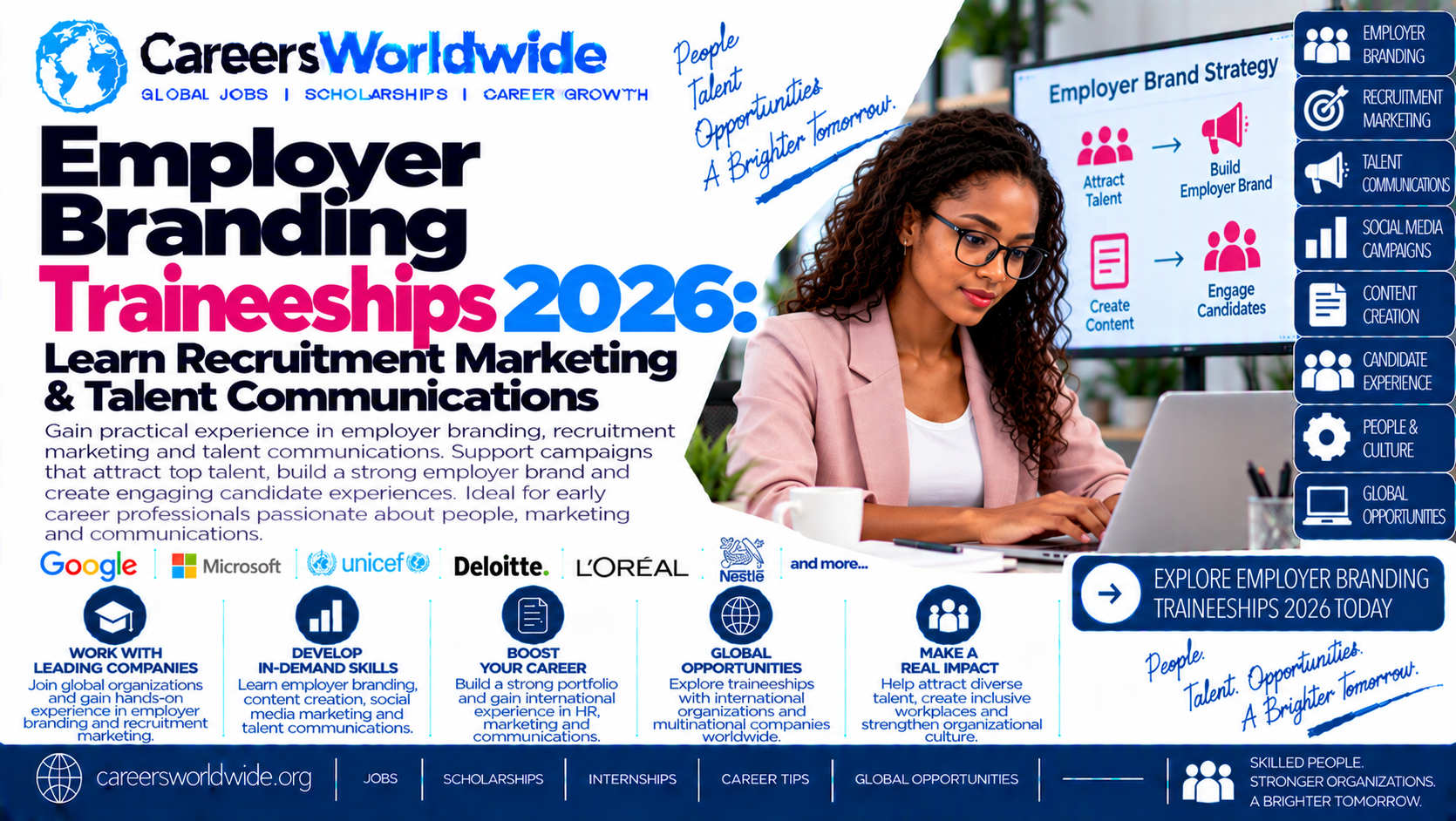

Excerpt: Employer Branding Traineeships 2026 can help students, graduates, and early-career professionals build practical skills in recruitment marketing, talent communications, employee engagement, social media, content creation, and employer reputation. This guide explains what employer branding traineeships involve, common requirements, where to find opportunities, how to prepare a strong application, and the skills that can help you stand out in 2026.
Employer branding has become an important part of modern recruitment. Organizations increasingly compete not only for customers but also for talented employees. As a result, companies, nonprofits, consulting firms, technology organizations, and international institutions need people who can communicate their workplace culture and employment opportunities effectively.
For students and recent graduates interested in marketing, human resources, communications, public relations, recruitment, digital media, or talent acquisition, an employer branding traineeship can provide a useful way to gain practical experience.
Unlike a traditional academic course, a traineeship typically combines structured learning with workplace exposure. Participants may assist with recruitment campaigns, create content for careers websites, analyze candidate engagement, support social media campaigns, coordinate employer events, and help HR teams communicate the organization’s employee value proposition.
This guide explores Employer Branding Traineeships 2026, including potential responsibilities, qualifications, application strategies, career pathways, and practical skills to develop.
What Are Employer Branding Traineeships?
Employer branding focuses on how an organization presents itself as a place to work.
An employer branding team may work closely with:
- Human resources
- Talent acquisition
- Recruitment marketing
- Communications
- Public relations
- Digital marketing
- Social media
- Employee engagement
- Corporate communications
A traineeship gives participants an opportunity to learn how these functions work together.
Typical projects could include helping create recruitment campaigns, preparing social media content, supporting careers events, researching candidate perceptions, or assisting with employer-branding reports.
The exact structure varies by employer. Some programs are highly focused on recruitment marketing, while others combine employer branding with HR communications or talent acquisition.
Why Employer Branding Matters in 2026
Recruitment has become increasingly digital.
Candidates can discover employers through LinkedIn, career websites, social media, employee reviews, online communities, virtual events, and professional networks.
This means organizations need consistent communication across multiple channels.
An employer branding professional might help answer questions such as:
- What makes this organization an attractive employer?
- How should career opportunities be communicated?
- What content do candidates respond to?
- How can employee stories be presented authentically?
- Which recruitment channels generate engagement?
- How can an organization improve its candidate experience?
- How should employer values be communicated to potential applicants?
Employer branding trainees can therefore gain exposure to both marketing and people-related functions.
What Do Employer Branding Trainees Do?
Responsibilities depend on the organization and level of the traineeship.
Common activities may include:
1. Recruitment Marketing
Trainees may assist with campaigns designed to attract applicants.
Tasks can include:
- Drafting recruitment campaign content
- Preparing job promotion materials
- Supporting digital campaigns
- Researching target audiences
- Monitoring campaign performance
- Creating candidate-facing communications
This can provide practical marketing experience while introducing participants to recruitment.
2. Social Media Content
Employer branding frequently uses professional and social media platforms.
A trainee could help develop:
- LinkedIn posts
- Employee stories
- Workplace videos
- Recruitment graphics
- Career-event announcements
- Internship campaigns
- Behind-the-scenes content
The objective is generally to communicate the organization’s workplace experience rather than simply advertise vacancies.
3. Employee Stories
Authentic employee experiences can be an important employer-branding tool.
Trainees may help interview employees and turn those conversations into:
- Blog articles
- Social media posts
- Videos
- Career-site stories
- Internal communications
- Recruitment materials
This requires strong interviewing, writing, editing, and storytelling skills.
4. Careers Website Content
Employer branding teams may contribute to careers pages.
Trainees could help update:
- Career descriptions
- Employee testimonials
- Benefits information
- Internship pages
- Recruitment campaigns
- Frequently asked questions
- Diversity and inclusion information
Attention to detail is especially important because candidates often use career websites when evaluating opportunities.
5. Employer Brand Research
Some traineeships involve research.
A trainee might analyze:
- Candidate feedback
- Recruitment trends
- Employee surveys
- Social media engagement
- Competitor employer-branding campaigns
- Careers-site performance
- Candidate demographics
Basic research and data-analysis skills can therefore be valuable.
Skills You Can Develop
An Employer Branding Traineeship 2026 can help develop a combination of creative, analytical, communication, and HR-related skills.
Communication
Strong written and verbal communication is useful for almost every employer-branding position.
You may write:
- Recruitment announcements
- Campaign copy
- Employee stories
- Website content
- Newsletters
- Internal communications
- Presentation materials
Digital Marketing
Understanding digital marketing can help you contribute to recruitment campaigns.
Useful areas include:
- Social media marketing
- Content marketing
- Search engine optimization
- Email marketing
- Audience research
- Campaign analytics
Recruitment Knowledge
You do not necessarily need extensive HR experience before starting a traineeship.
However, learning basic recruitment concepts can help.
These include:
- Candidate sourcing
- Applicant experience
- Talent acquisition
- Recruitment funnels
- Job advertising
- Candidate engagement
- Employee value proposition
Data Analysis
Employer branding increasingly involves measuring results.
Useful skills include:
- Microsoft Excel
- Google Sheets
- Basic dashboards
- Social media analytics
- Website analytics
- Survey analysis
- Data visualization
Graphic Design
Basic design skills can be useful when creating recruitment content.
Familiarity with tools such as Canva, Adobe Creative Cloud, Figma, or similar platforms may be advantageous depending on the employer.
Who Can Apply for Employer Branding Traineeships?
Eligibility varies considerably between organizations.
Potential applicants may include:
- University students
- Recent graduates
- Diploma holders
- Marketing graduates
- Human resources graduates
- Communications graduates
- Public relations students
- Business students
- Journalism graduates
- Digital marketing students
- Early-career professionals
Some traineeships may require applicants to be enrolled in an academic program, while others may be open to recent graduates.
Always read the specific eligibility requirements before submitting an application.
Common Academic Backgrounds
Employer branding is interdisciplinary, so there is no single degree that guarantees eligibility.
Relevant backgrounds can include:
| Field | Potential relevance |
|---|---|
| Marketing | Recruitment campaigns and audience engagement |
| Human Resources | Talent acquisition and employee experience |
| Communications | Internal and external communications |
| Public Relations | Reputation and stakeholder communications |
| Journalism | Interviewing and storytelling |
| Business | Organizational and commercial understanding |
| Digital Media | Social media and multimedia content |
| Psychology | Employee and candidate behavior |
| Graphic Design | Recruitment campaign materials |
| Information Technology | Digital recruitment platforms |
The strongest candidate is not necessarily the person with the most specialized degree. Demonstrable skills, relevant projects, communication ability, and enthusiasm for the field can also matter.
How to Build Experience Before Applying
You do not have to wait for a traineeship to begin developing employer-branding skills.
Create a Recruitment Campaign
Choose a fictional company and develop a small employer-branding campaign.
For example:
Campaign: Graduate Technology Careers 2027
Create:
- A LinkedIn recruitment post
- A careers-page introduction
- An employee story
- A recruitment graphic
- A short candidate FAQ
This gives you something tangible to discuss during an interview.
Build a Portfolio
A simple digital portfolio can include examples of:
- Recruitment copy
- Social media posts
- Employer-branding campaigns
- Blog articles
- Employee interviews
- Recruitment graphics
- Marketing analytics projects
A portfolio can demonstrate your skills even when you have limited professional experience.
Improve Your LinkedIn Profile
Your LinkedIn profile can function as a professional portfolio.
Consider highlighting:
- Relevant coursework
- Marketing projects
- HR projects
- Communications experience
- Volunteer work
- Freelance work
- Content projects
- Digital marketing skills
Use specific descriptions rather than simply listing generic skills.
Employer Branding Traineeships vs HR Traineeships
These opportunities can overlap, but they are not identical.
| Employer Branding | HR |
|---|---|
| Focuses heavily on employer reputation | Broader people-management function |
| Recruitment marketing | Recruitment and employee management |
| Careers content | HR administration |
| Employer communications | Policies and procedures |
| Social media campaigns | Employee relations |
| Candidate engagement | Workforce processes |
| Employee storytelling | Performance and development |
An employer branding traineeship may be particularly suitable for someone who enjoys both people and communications.
Employer Branding Traineeship Application Tips
Competition can be significant for attractive early-career programs.
Here are practical ways to improve an application.
1. Customize Your CV
Avoid sending exactly the same CV to every employer.
Highlight experience related to:
- Communications
- Marketing
- Recruitment
- Social media
- Writing
- Research
- Events
- Data analysis
2. Use Evidence
Instead of writing:
Good communication skills
Consider demonstrating the skill:
Created and published weekly social media content for a student organization, increasing engagement across its professional networking channels.
Specific evidence makes a CV more informative.
3. Write a Targeted Cover Letter
Explain:
- Why employer branding interests you.
- Why you are interested in the organization.
- What relevant experience you have.
- What you hope to learn.
- How you could contribute.
Avoid copying generic statements from online templates.
4. Research the Employer
Before an interview, examine:
- Careers website
- LinkedIn page
- Recruitment campaigns
- Employee stories
- Company values
- Recent initiatives
- Internship programs
Think about how the organization communicates with potential employees.
What to Expect During an Interview
Employer branding traineeship interviews may include competency questions, practical exercises, or portfolio discussions.
Possible questions include:
“Why are you interested in employer branding?”
Prepare a response connecting your interests in areas such as marketing, communications, HR, storytelling, and digital media.
“How would you promote a graduate recruitment campaign?”
Explain how you would identify the target audience, develop the message, select channels, create content, and measure performance.
“What makes an employer attractive to candidates?”
Consider factors such as:
- Career development
- Organizational culture
- Meaningful work
- Compensation and benefits
- Flexibility
- Learning opportunities
- Leadership
- Workplace experience
Avoid assuming that every candidate values the same things.
“How would you measure a recruitment campaign?”
Possible metrics include:
- Impressions
- Engagement
- Click-through rate
- Career-site visits
- Applications
- Qualified applications
- Conversion rate
Potential Career Paths After a Traineeship
An employer branding traineeship can provide experience relevant to several career directions.
Potential roles include:
- Employer Branding Specialist
- Employer Branding Coordinator
- Recruitment Marketing Specialist
- Talent Acquisition Coordinator
- Talent Communications Specialist
- Recruitment Communications Officer
- HR Communications Specialist
- Digital Recruitment Specialist
- Employee Communications Coordinator
- Social Media Specialist
- Talent Marketing Specialist
Career progression depends on experience, qualifications, performance, and the employer.
Where to Find Employer Branding Traineeships in 2026
Applicants should search across multiple sources rather than relying on one job board.
Useful sources include official employer career pages, professional networking platforms, graduate recruitment portals, university career services, and reputable job boards.
When you find an opportunity, verify it on the organization’s official careers website before applying.
Search terms to try include:
- Employer Branding Trainee
- Employer Branding Intern
- Recruitment Marketing Trainee
- Talent Communications Trainee
- Employer Brand Intern
- Talent Acquisition Trainee
- HR Communications Trainee
- Recruitment Communications Intern
- People & Culture Trainee
- Talent Marketing Intern
How to Apply for Employer Branding Traineeships 2026
The application process usually follows several stages.
Step 1: Identify Suitable Programs
Look for programs matching your:
- Education
- Location
- Work authorization
- Experience level
- Career interests
Step 2: Read the Requirements
Check whether the opportunity requires:
- A specific degree
- Current student status
- Graduation within a particular period
- Language skills
- Work authorization
- Specific technical skills
Step 3: Prepare Your CV
Keep your CV clear and focused on relevant achievements.
Step 4: Prepare Supporting Documents
Depending on the employer, you may need:
- Cover letter
- Academic transcript
- Portfolio
- References
- Writing sample
- Proof of enrollment
Step 5: Submit Through the Official Channel
Use the official application portal whenever possible.
Avoid paying anyone to submit an application on your behalf unless the organization explicitly identifies an authorized service and fee.
Step 6: Prepare for Selection
If shortlisted, research the employer and prepare examples demonstrating your communication, teamwork, creativity, organization, and analytical abilities.
Official Application Resources
Because traineeship vacancies can open and close throughout the year, applicants should check official career pages regularly rather than relying on outdated vacancy lists.
Useful official resources include:
- LinkedIn Jobs — search for employer branding, recruitment marketing, talent communications, and HR traineeships.
- Indeed — search for employer branding internships and recruitment marketing trainee positions.
- Glassdoor — useful for finding employer opportunities and researching organizations.
- Company career websites — the preferred source for confirming eligibility, deadlines, and application procedures.
- University career services — many institutions publish graduate and internship opportunities.
When applying to a specific organization, use its official careers portal to verify the vacancy and submission instructions.
Employer Branding Traineeships: What Should You Learn?
If your goal is to become competitive for employer branding opportunities, consider developing the following skill combination:
Communication + Marketing + HR + Digital Content + Analytics
A practical learning plan could look like this:
Month 1: Communication
Focus on:
- Professional writing
- Copywriting
- Storytelling
- Interview techniques
Month 2: Digital Marketing
Learn:
- Social media strategy
- Content marketing
- SEO fundamentals
- Audience research
Month 3: HR Fundamentals
Study:
- Recruitment
- Talent acquisition
- Candidate experience
- Employee engagement
Month 4: Analytics
Learn:
- Excel
- Basic data visualization
- Social media analytics
- Recruitment metrics
Month 5: Portfolio
Create several realistic employer-branding projects.
Month 6: Applications
Begin applying to suitable traineeships, internships, graduate programs, and entry-level positions.
Frequently Asked Questions
What is an employer branding traineeship?
It is a structured early-career learning opportunity focused on how organizations attract, engage, and communicate with potential and current employees.
Do I need an HR degree?
Not necessarily. Marketing, communications, journalism, business, psychology, digital media, and related backgrounds may also be relevant depending on the program.
Can graduates apply?
Many programs accept recent graduates, although eligibility varies. Always check the individual vacancy.
Is employer branding the same as recruitment?
No. Recruitment focuses on identifying and hiring candidates, while employer branding focuses more heavily on how an organization is perceived and communicated as an employer. The functions often work closely together.
Can marketing graduates work in employer branding?
Yes. Marketing skills such as content creation, audience research, campaign management, social media, and analytics can be highly relevant.
Do employer branding traineeships pay?
Some are paid and others may have different compensation structures. Never assume that a particular program is paid unless the official vacancy confirms the compensation.
Can international applicants apply?
That depends on the program. International applicants should check location, visa, work authorization, and eligibility requirements carefully.
What software should I learn?
Useful tools may include Microsoft Office, Google Workspace, Canva, Adobe tools, social media platforms, analytics platforms, and applicant-tracking or HR systems.
Is employer branding a good career for communications graduates?
It can be a relevant career direction because the field combines communications, marketing, storytelling, recruitment, and organizational culture. Individual career outcomes will depend on experience, skills, and available opportunities.
Final Thoughts
Employer Branding Traineeships 2026 offer an opportunity for students, graduates, and early-career professionals to explore the intersection of recruitment, marketing, communications, HR, and digital media.
The most useful preparation is practical. Build a portfolio, improve your writing, understand recruitment fundamentals, learn digital marketing, develop basic analytics skills, and follow organizations whose employer-branding work interests you.
When opportunities become available, carefully verify the eligibility criteria, deadline, location, compensation, and application procedure through the organization’s official recruitment channel.
A traineeship may be an entry point into employer branding, recruitment marketing, talent communications, HR communications, or broader talent-acquisition careers.
Quick Summary Table
| Category | Details |
|---|---|
| Opportunity | Employer Branding Traineeships 2026 |
| Main area | Recruitment marketing and talent communications |
| Suitable for | Students, graduates and early-career professionals |
| Relevant fields | Marketing, HR, communications, PR, business, journalism and digital media |
| Core skills | Writing, storytelling, social media, recruitment and analytics |
| Typical projects | Recruitment campaigns, employee stories, careers content and social media |
| Possible career paths | Employer Branding, Recruitment Marketing, Talent Communications and HR Communications |
| Application method | Usually through an employer’s official careers portal |
| Key preparation | CV, portfolio, communication skills and employer research |
| Important check | Eligibility, deadline, location, work authorization and compensation |
Disclaimer
This article is provided for general informational and educational purposes. Employer branding traineeship availability, eligibility criteria, deadlines, locations, compensation, and application procedures can change. Always verify the latest information through the official employer or program website before submitting an application or providing personal information. CareersWorldwide does not guarantee selection, employment, admission, or compensation for any opportunity mentioned in this guide.
SEO Keywords
Employer Branding Traineeships 2026,
Employer Branding Trainee Jobs 2026,
Employer Branding Internships 2026,
Recruitment Marketing Traineeships 2026,
Talent Communications Traineeships 2026,
Employer Brand Internships 2026,
HR Communications Traineeships 2026,
Recruitment Marketing Internships 2026,
Talent Acquisition Traineeships 2026,
People and Culture Traineeships 2026,
Employer Branding Jobs for Graduates 2026,
Employer Branding Careers 2026,
Employer Branding Graduate Programs 2026,
Marketing Traineeships 2026,
Human Resources Traineeships 2026,
Communications Traineeships 2026,
Talent Marketing Jobs 2026,
Recruitment Communications Jobs 2026,
Digital Recruitment Traineeships 2026,
Employer Branding Career Opportunities 2026
ALSO CHECK: Laboratory Quality Traineeships 2026: Develop Skills in Scientific Quality ManagementOctober 2, 2026
Public Health Communications Traineeships 2026: Build Skills in Health Information & OutreachOctober 2, 2026
Digital Adoption Specialist Jobs 2026: Help Teams Adopt New Technology & AI ToolsOctober 1, 2026