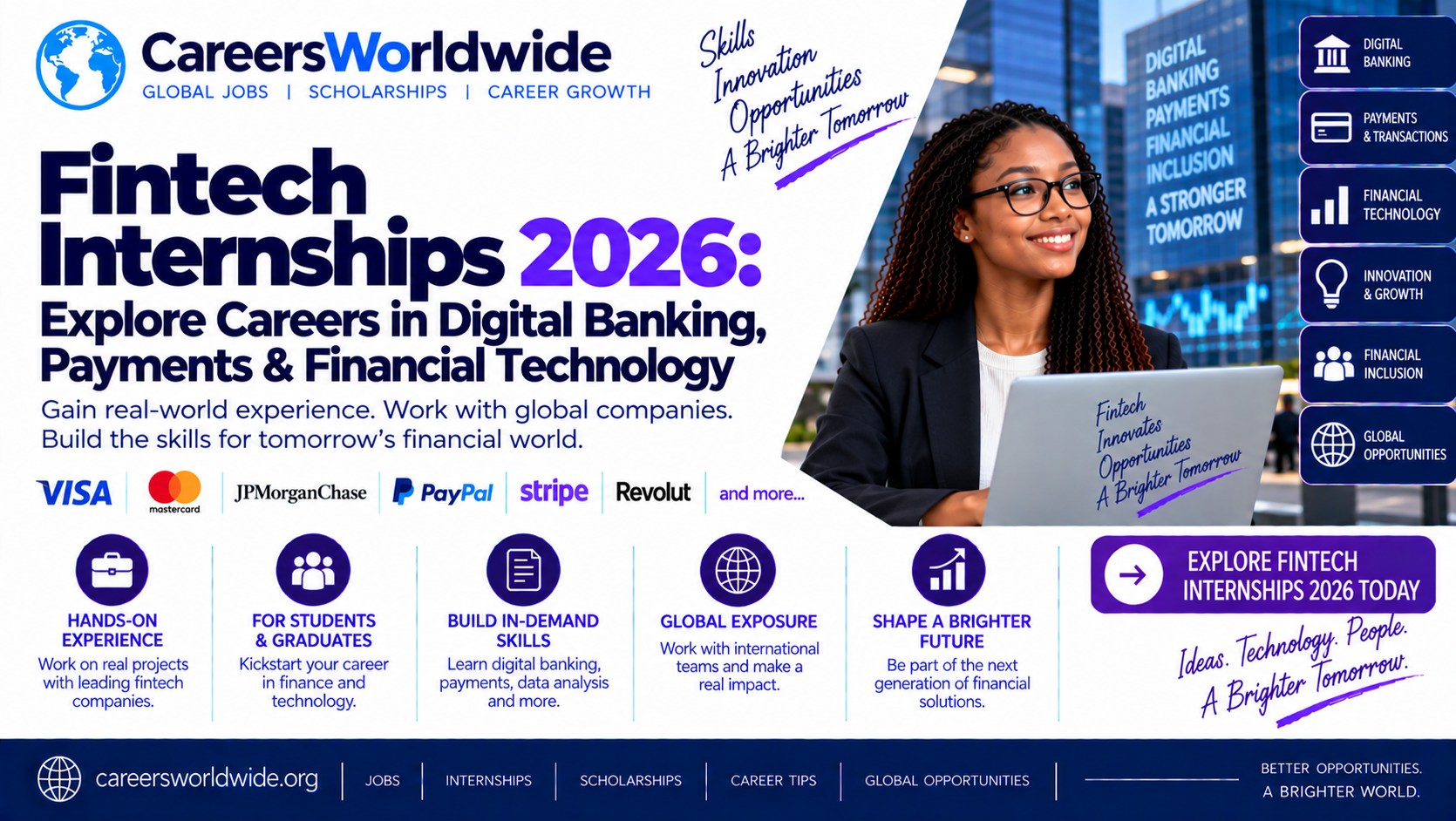

Excerpt: Fintech internships in 2026 offer students and recent graduates a practical route into digital banking, payment technology, financial software, cybersecurity, data analytics, blockchain, artificial intelligence and financial services innovation. Discover the skills employers seek, popular fintech internship pathways, portfolio projects, application strategies and official career resources for starting a career in financial technology.
Financial technology has transformed how people and businesses save, borrow, invest, transfer and manage money.
Mobile banking applications, digital wallets, instant payments, online lending platforms, automated investment services and fraud-detection systems are now part of everyday financial services. Behind these products are software engineers, data analysts, cybersecurity professionals, product managers, financial analysts and technology specialists.
For students and recent graduates, this creates opportunities to gain professional experience through fintech internships in 2026.
A fintech internship can provide exposure to both technology and financial services. Depending on the employer, an intern may work on payment systems, digital banking applications, financial data, risk management, fraud prevention, customer analytics, APIs, cloud infrastructure or product development.
The sector is also highly interdisciplinary. A computer science student can pursue fintech software engineering, while a finance student might work in digital banking or financial analytics. Students studying cybersecurity, mathematics, economics, statistics, business or data science can also find relevant pathways.
What Are Fintech Internships?
Fintech internships are structured early-career opportunities where students or recent graduates gain practical experience working on technology-driven financial products, services or operations.
The work can vary significantly between organizations.
A fintech intern might assist with:
- Digital banking products
- Payment platforms
- Financial data analysis
- Fraud detection
- Cybersecurity
- Risk analytics
- Software development
- API integration
- Customer analytics
- Financial modeling
- Product research
- Compliance technology
- Blockchain applications
- Artificial intelligence
- Cloud infrastructure
The title may not always contain the word “fintech.”
Students should therefore search for related positions such as:
- Fintech Intern
- Banking Technology Intern
- Software Engineering Intern
- Payments Intern
- Data Analyst Intern
- Risk Analyst Intern
- Product Management Intern
- Financial Technology Intern
- Cybersecurity Intern
- Digital Banking Intern
- Business Analyst Intern
- Quantitative Analyst Intern
- Technology Analyst Intern
A broader search can uncover significantly more relevant opportunities.
Why Fintech Is an Attractive Career Area in 2026
Financial services increasingly depend on technology.
Traditional banks have expanded digital channels, while fintech companies have introduced new approaches to payments, lending, investment and financial management.
At the same time, established technology companies increasingly provide infrastructure and services used by financial institutions.
This creates career opportunities at the intersection of:
Finance + Technology
Data + Finance
Cybersecurity + Banking
Software + Payments
AI + Financial Services
Cloud + Digital Banking
The result is a wide range of potential career paths for students with different academic backgrounds.
Types of Fintech Internships to Explore
1. Digital Banking Internships
Digital banking teams develop and improve online and mobile financial services.
Interns may contribute to:
- Digital account services
- Mobile applications
- Customer journeys
- Banking platforms
- Product research
- Digital onboarding
- User analytics
This pathway can be suitable for students studying finance, business, computer science or information technology.
2. Payments Internships
Payments are at the heart of fintech.
Payment-focused interns may learn about:
- Payment processing
- Digital wallets
- Card networks
- Merchant services
- Payment APIs
- Transaction monitoring
- Payment security
Students interested in software engineering, finance, cybersecurity or business can explore this area.
3. Fintech Software Engineering Internships
Software engineers build the technology behind financial products.
Interns may work with:
- Python
- Java
- JavaScript
- C++
- APIs
- Databases
- Cloud platforms
- Microservices
- Testing
- Version control
Software engineering internships are particularly useful for students pursuing computer science or software engineering.
4. Financial Data Internships
Financial institutions generate enormous quantities of data.
Data-focused interns may work with:
- SQL
- Python
- Excel
- Data visualization
- Statistics
- Machine learning
- Business intelligence
Projects can involve customer behavior, transactions, risk, fraud or financial performance.
5. Fraud and Financial Crime Internships
Digital transactions create opportunities for sophisticated fraud detection.
Interns may support teams working on:
- Transaction monitoring
- Fraud analytics
- Risk scoring
- Anomaly detection
- Financial crime research
- Customer verification
This area combines finance, data and cybersecurity.
6. Cybersecurity Internships
Financial institutions are attractive targets for cybercriminals, making cybersecurity a critical fintech function.
Interns may gain experience in:
- Security monitoring
- Identity management
- Vulnerability assessment
- Network security
- Incident response
- Application security
- Security testing
7. Product Management Internships
Fintech products need professionals who understand both technology and customer needs.
Product interns may help with:
- Market research
- Customer research
- Product requirements
- Competitor analysis
- Product analytics
- Feature development
- User experience
Fintech Internship Areas at a Glance
| Internship Area | Typical Focus | Useful Skills |
|---|---|---|
| Digital Banking | Online banking products | Finance, product knowledge |
| Payments | Transaction technology | APIs, finance, technology |
| Software Engineering | Financial applications | Programming, databases |
| Data Analytics | Financial data | SQL, Excel, Python |
| Cybersecurity | Financial security | Networking, security |
| Fraud Analytics | Transaction monitoring | Statistics, data |
| Risk | Financial and operational risk | Finance, analytics |
| Product Management | Digital financial products | Research, communication |
| Blockchain | Distributed financial technology | Programming, cryptography |
| AI & Machine Learning | Automation and prediction | Python, statistics |
| Cloud Technology | Financial infrastructure | Cloud, Linux, networking |
| Business Analysis | Financial technology processes | Analysis, communication |
Skills to Learn Before Applying
You do not need to become an expert in financial technology before applying for an internship.
However, a solid technical or financial foundation can make your application stronger.
Learn Financial Fundamentals
Technology candidates should understand basic financial concepts.
Learn about:
- Banks
- Loans
- Interest
- Payments
- Credit
- Investments
- Financial statements
- Risk
- Transactions
You do not need to become a professional accountant.
The objective is to understand the environment in which fintech products operate.
Learn Programming
Programming can open multiple fintech pathways.
Python is a particularly useful starting point because it can be applied to:
- Data analysis
- Automation
- Machine learning
- Financial modeling
- APIs
Depending on your target roles, also consider:
- Java
- JavaScript
- C++
- SQL
Learn SQL
SQL is one of the most practical skills for fintech data roles.
Practice:
- SELECT statements
- Filtering
- Sorting
- Joins
- Aggregation
- Subqueries
- Window functions
Create small financial datasets and practice answering business questions with SQL.
Learn Excel
Excel remains useful across finance and fintech.
Become comfortable with:
- Pivot tables
- XLOOKUP
- IF functions
- Charts
- Data cleaning
- Conditional formatting
- Basic financial modeling
Understand APIs
Modern fintech systems frequently communicate through APIs.
Learn basic concepts such as:
- REST APIs
- JSON
- Authentication
- Requests
- Responses
- API keys
- HTTP methods
You can practice by connecting a small application to a public financial or economic data API.
AI and Fintech Internships
Artificial intelligence is becoming increasingly relevant to financial technology.
Potential applications include:
- Fraud detection
- Customer support
- Credit risk
- Financial forecasting
- Document processing
- Personalization
- Algorithmic trading
- Compliance monitoring
Students interested in AI fintech roles should build foundations in:
- Python
- Statistics
- Machine learning
- Data analysis
- SQL
However, avoid treating AI as a replacement for financial knowledge.
The strongest candidates understand both the technology and the problem they are attempting to solve.
Cybersecurity and Fintech
Security should be considered a core part of fintech rather than a separate concern.
Financial applications handle highly sensitive information and transactions.
This makes cybersecurity knowledge valuable.
Students interested in fintech security should study:
- Authentication
- Authorization
- Encryption
- Network security
- Secure coding
- Identity and access management
- Threat modeling
- Incident response
A small security-focused project can demonstrate practical interest.
For example, create a demonstration web application and document how authentication, authorization and secure API access should be implemented.
Build a Fintech Portfolio
You can create fintech projects even before obtaining an internship.
Project 1: Personal Finance Dashboard
Create a dashboard that analyzes sample income and expense data.
Use:
- Excel
- Power BI
- Python
- SQL
Display:
- Monthly spending
- Savings rate
- Spending categories
- Trends
- Budget variance
Project 2: Payment API Demo
Build a simple application that demonstrates how a payment API could be integrated.
Do not use real financial credentials or sensitive information.
Focus on understanding:
- API requests
- Authentication
- Error handling
- Transaction status
- Webhooks
Project 3: Fraud Detection Model
Use a publicly available or synthetic dataset to build a basic fraud classification model.
Explain:
- Dataset
- Features
- Model
- Evaluation
- False positives
- False negatives
This can demonstrate both technical and financial reasoning.
Project 4: Banking App Prototype
Design a basic digital banking interface.
Focus on:
- User experience
- Account overview
- Transactions
- Transfers
- Security
- Accessibility
Project 5: Financial Data Analysis
Use publicly available market or economic data to answer a specific question.
For example:
How did selected economic indicators change over five years?
Present your methodology and findings clearly.
How to Find Fintech Internships in 2026
A targeted search strategy can save time.
Search Banks
Major banks frequently recruit students into technology, analytics, risk, operations and digital banking programs.
Search their official career sites for:
- Technology internships
- Digital banking internships
- Data internships
- Software engineering internships
- Cybersecurity internships
- Quantitative internships
Search Fintech Companies
Explore companies working in:
- Payments
- Digital banking
- Financial infrastructure
- Digital lending
- Investment technology
- Wealth management
- Financial APIs
Search Technology Companies
Technology companies can offer roles involving cloud platforms, software engineering, cybersecurity and data services that support financial institutions.
Search Consulting Firms
Consulting firms often work with banks and financial institutions on technology transformation.
Relevant internship titles may include:
- Technology Consulting Intern
- Financial Services Consulting Intern
- Data Analytics Intern
- Digital Transformation Intern
- Risk Consulting Intern
How to Prepare Your Fintech Internship CV
A strong CV should show the connection between your skills and financial technology.
If You Study Computer Science
Emphasize:
- Programming
- Databases
- APIs
- Cloud
- Cybersecurity
- Software projects
If You Study Finance
Emphasize:
- Financial analysis
- Excel
- Financial modeling
- Statistics
- Risk
- Investment analysis
If You Study Data Science
Emphasize:
- Python
- SQL
- Statistics
- Machine learning
- Data visualization
- Predictive modeling
If You Study Cybersecurity
Emphasize:
- Network security
- Secure coding
- Threat analysis
- Identity management
- Vulnerability assessment
The goal is to make your academic background relevant to the role.
How to Stand Out as a Fintech Internship Applicant
Recruiters are likely to see many applications containing similar technical keywords.
Projects can help differentiate you.
Instead of simply writing:
Python, SQL, Finance
show what you accomplished.
For example:
“Developed a Python model using synthetic transaction data to identify potentially fraudulent payment patterns.”
This provides evidence of application rather than merely listing a skill.
Preparing for Fintech Internship Interviews
Interview preparation should reflect the role.
Technical Candidates
Prepare for questions covering:
- Programming
- Data structures
- Databases
- APIs
- Cloud computing
- Cybersecurity
- Software design
Finance Candidates
Review:
- Financial statements
- Valuation basics
- Risk
- Banking
- Interest rates
- Markets
- Financial products
Data Candidates
Prepare for:
- SQL
- Statistics
- Python
- Data cleaning
- Data visualization
- Case studies
Product Candidates
Expect questions about:
- Customer needs
- Product design
- Market research
- Prioritization
- Metrics
- User experience
Fintech Internships for International Students
International applicants should carefully review eligibility requirements.
Some internships are restricted to students enrolled in local universities or candidates who have authorization to work in a specific country.
Before applying, verify:
- Country eligibility
- University enrollment requirements
- Graduation date
- Work authorization
- Internship location
- Program duration
- Language requirements
Do not assume that a global financial institution accepts applications from every country for every internship.
Requirements can differ even between programs within the same organization.
A 90-Day Fintech Internship Preparation Plan
Days 1–30: Choose Your Path
Select one primary direction:
Fintech + Software
Fintech + Data
Fintech + Finance
Fintech + Cybersecurity
Fintech + Product
Learn the fundamentals of your chosen area.
Days 31–60: Build a Project
Complete one substantial project.
Document:
- Problem
- Method
- Technology
- Results
- Limitations
- Future improvements
Publish the project through an appropriate portfolio or code repository.
Days 61–90: Apply
Prepare your:
- CV
- LinkedIn profile
- Portfolio
- Cover letter
- Interview preparation
Create an application tracker and monitor official career portals regularly.
Common Mistakes Fintech Applicants Should Avoid
Applying Only to Fintech Companies
Banks, payment networks, consulting firms and technology companies can all provide fintech-related experience.
Ignoring Finance
Technology alone does not explain how financial systems work.
Learn basic financial concepts.
Ignoring Technology
Finance students should not assume that financial knowledge is sufficient for every fintech position.
Build at least basic data and technology skills.
Listing Buzzwords Without Projects
If you list Python, SQL, AI and blockchain, be prepared to explain how you have actually used them.
Applying Without Checking Eligibility
Always review the official vacancy before applying.
Student status, location and work authorization can be decisive requirements.
Frequently Asked Questions
What are fintech internships?
Fintech internships provide students and recent graduates with practical experience in technology-driven financial services such as digital banking, payments, financial analytics, cybersecurity and financial software.
What degree is best for fintech?
There is no single required degree. Computer Science, Software Engineering, Finance, Economics, Data Science, Mathematics, Statistics, Cybersecurity and Business can all lead to fintech careers.
Can finance students work in fintech?
Yes. Finance students can pursue areas such as digital banking, financial analytics, risk, product management, payments and sustainable finance.
Can computer science students work in fintech?
Absolutely. Computer science students can pursue software engineering, cloud infrastructure, cybersecurity, data engineering, AI and payment technology.
Do fintech internships require previous experience?
Not always. Academic projects, personal projects, coursework and certifications can demonstrate relevant skills.
What programming language is best for fintech?
Python is a strong starting point because of its applications in data analysis, automation and machine learning. SQL is also highly valuable for data-related roles.
Is SQL important for fintech?
Yes. SQL is widely useful for analyzing structured financial and transaction data.
Are fintech internships paid?
Many corporate internships offer compensation, but payment varies by employer, country, program and location. Check the official vacancy for confirmed compensation.
Can international students apply for fintech internships?
Some programs accept international students, while others have local enrollment or work-authorization requirements. Always verify eligibility in the official posting.
Can a fintech internship lead to a full-time job?
An internship can provide professional experience and, depending on the employer and program, may serve as a pathway to graduate or full-time opportunities. However, conversion is never guaranteed.
Fintech Internships 2026: Quick Summary
| Career Path | Best For | Skills to Develop |
|---|---|---|
| Digital Banking | Finance + business students | Banking, analytics |
| Payments | Technology + finance | APIs, payments |
| Fintech Software | Computer science students | Programming, databases |
| Data Analytics | Data/finance students | SQL, Python, statistics |
| Fraud Analytics | Data + risk candidates | Statistics, ML |
| Cybersecurity | Security students | Networks, security |
| Risk Technology | Finance + analytics | Risk, data |
| Product Management | Business/product candidates | Research, analytics |
| AI in Finance | AI/data students | Python, ML |
| Cloud Fintech | IT/engineering students | Cloud, Linux, networking |
Where to Apply for Fintech Internships
Start with official career pages and student portals. Search by internship title, location and business area.
- JPMorganChase Careers — Explore technology, finance, data, risk and financial-services opportunities.
- Goldman Sachs Careers — Explore student and early-career opportunities across financial services and technology.
- Mastercard Careers — Explore opportunities connected to payments, technology, cybersecurity and data.
- Visa Careers — Monitor careers across digital payments, technology, data and financial services.
- PayPal Careers — Explore opportunities connected to digital payments and financial technology.
- Stripe Careers — Explore opportunities in payments infrastructure, engineering, product and operations.
- IBM Careers — Explore technology, cloud, data, AI and financial-services technology opportunities.
- Microsoft Careers — Search technology, cloud, data and student opportunities that can intersect with financial services.
Applicants should always verify the specific internship’s eligibility, location, application deadline and compensation on the official employer page before applying.
Final Thoughts
Fintech is one of the clearest examples of how technology and finance are becoming increasingly connected.
For students and recent graduates, this creates multiple entry points.
You do not have to become an expert in banking, programming, artificial intelligence and cybersecurity simultaneously.
Instead, choose a direction and build complementary skills.
A finance student might combine financial analysis + SQL + data visualization.
A computer science student might combine Python + APIs + databases + cloud computing.
A data science student might focus on Python + statistics + machine learning + financial datasets.
A cybersecurity student might develop network security + secure coding + identity management + financial systems knowledge.
Then demonstrate those skills through practical projects.
The strongest internship application is not necessarily the one containing the longest list of technologies. It is the application that clearly shows what you know, what you have built and how your skills can solve problems.
For 2026 applicants, the most effective strategy is to combine finance knowledge, technology skills, practical projects and targeted applications.
Start learning now, build a portfolio, monitor official career pages and apply when you meet the requirements.
Important Application Disclaimer
CareersWorldwide is a third-party careers information website and is not the employer, recruiter or hiring authority for the organizations mentioned in this article. Internship availability, eligibility, deadlines, locations and compensation can change. Applicants should verify all information through the official employer’s career portal before submitting an application or personal information. Never pay a recruitment fee simply to obtain an internship or job.
SEO Keywords
fintech internships 2026, fintech internships, financial technology internships, fintech internship opportunities, digital banking internships 2026, payments internships 2026, banking technology internships, fintech software engineering internships, fintech data analyst internships, fintech cybersecurity internships, financial technology careers, fintech jobs for students, fintech internships for graduates, fintech internships for international students, paid fintech internships, digital banking internships, payment technology internships, financial data internships, fintech analyst internships, fintech product management internships, AI fintech internships, blockchain internships 2026, fintech technology internships, banking internships 2026, financial services technology internships
ALSO CHECK: Climate & Sustainability Internships 2026: Build a Career in ESG & Environmental DevelopmentSeptember 15, 2026
Cloud Computing Internships 2026: Gain Experience in Cloud Technology & InfrastructureSeptember 15, 2026
Human Resources Internships 2026: Start Your Career in Recruitment, Talent & People ManagementSeptember 15, 2026