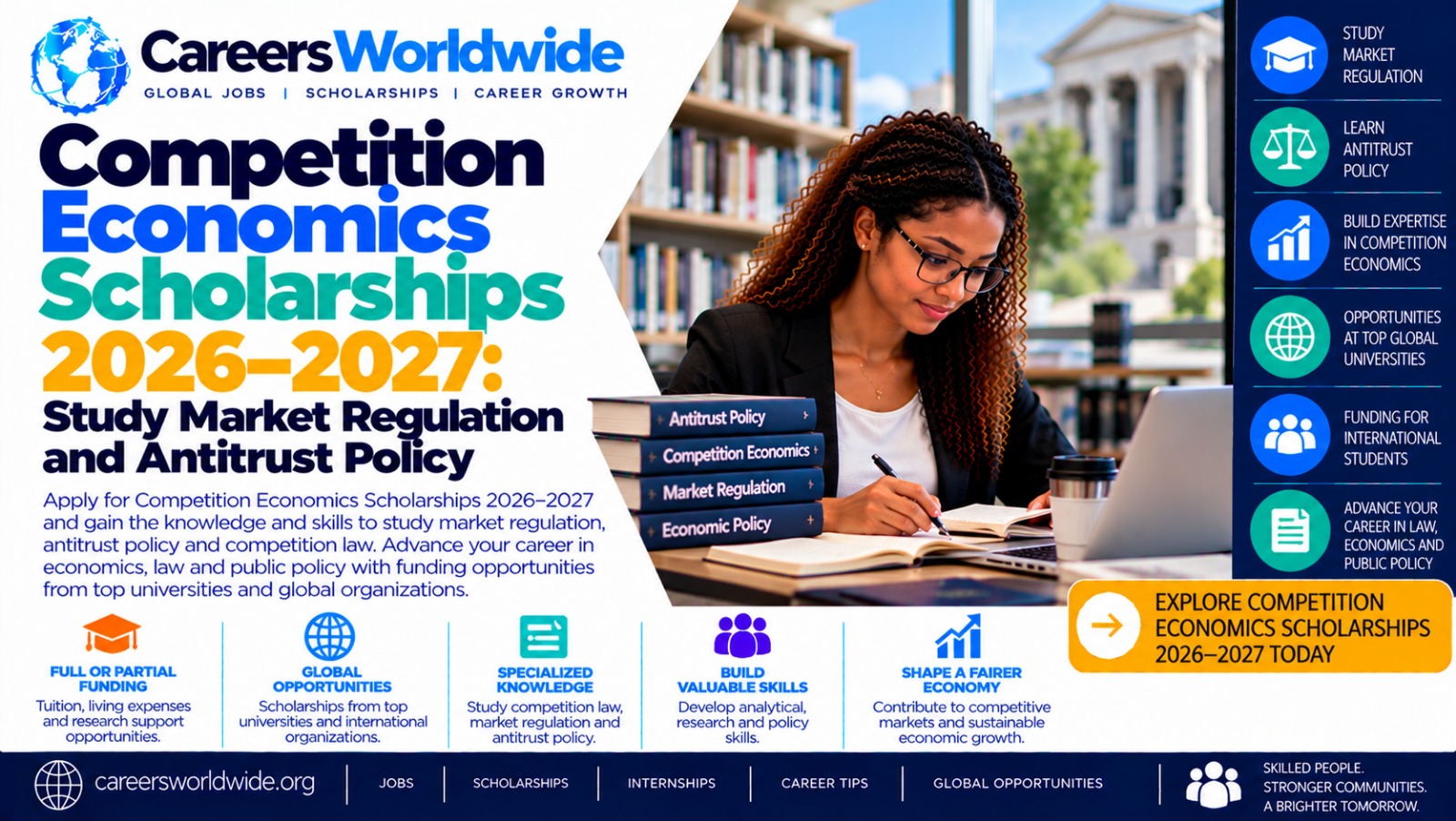

Excerpt: Discover how to pursue competition economics scholarships for the 2026–2027 academic year, explore postgraduate opportunities in antitrust policy and market regulation, identify university funding routes, and prepare a competitive application. This practical guide explains eligibility, essential documents, application strategies, official resources, and career pathways for students interested in competition economics, competition law, and economic policy.
Introduction: Why Study Competition Economics in 2026–2027?
Competition economics is an increasingly important field for understanding how businesses compete, how markets operate, and how governments can protect consumers from anti-competitive practices. It combines economic theory, quantitative analysis, regulatory policy, and legal principles to examine issues such as monopolies, cartels, mergers, market dominance, and digital-platform competition.
For students interested in economics, law, public policy, finance, or business regulation, postgraduate study in competition economics can provide valuable preparation for careers in competition authorities, regulatory institutions, economic consultancies, international organisations, universities, and private legal or advisory firms.
Competition economics scholarships for 2026–2027 are therefore worth investigating for students who want to develop specialist knowledge without relying entirely on personal or family funding. However, an important distinction must be made: there is no single universal scholarship that automatically funds every student studying antitrust policy. Funding opportunities depend on the university, programme, nationality, academic background, financial circumstances, and the conditions of each award.
Prospective applicants should investigate scholarships, research grants, university fee waivers, government sponsorships, and externally funded postgraduate programmes. Some opportunities support an entire degree, while others cover tuition fees, living expenses, research costs, or only part of the total study budget.
As of October 2026, applicants should also distinguish between funding for the 2026–2027 academic year and opportunities for programmes beginning in 2027. Some scholarship competitions for September 2026 entry have already closed, while applications for 2027 entry may open in the coming months.
This guide explains how to identify suitable opportunities, assess eligibility, prepare a strong application, and locate official application resources.
1. What Are Competition Economics Scholarships?
Competition economics scholarships are funding opportunities that support students pursuing education or research related to market competition, antitrust enforcement, industrial organisation, economic regulation, and competition policy.
The funding may be advertised under a broader subject rather than the exact phrase “competition economics scholarship.” Applicants should therefore search for programmes in economics, law, public policy, regulatory governance, industrial organisation, and economic research.
Relevant areas of study include:
- Antitrust economics: Examining monopolies, cartels, collusion, market power, and anti-competitive conduct.
- Competition law: Studying the legal rules governing business conduct, mergers, and market dominance.
- Industrial organisation: Analysing how firms behave, how markets are structured, and how competition affects prices and innovation.
- Merger regulation: Evaluating whether business acquisitions may substantially reduce competition.
- Digital market regulation: Investigating platform power, data advantages, network effects, and technology-sector competition.
- Economic regulation: Examining how governments oversee industries such as telecommunications, energy, transport, and financial services.
- Competition policy research: Assessing how enforcement decisions affect consumers, productivity, investment, and economic development.
Scholarships may be offered by universities, governments, foundations, research centres, international organisations, and private institutions. Some are restricted to particular nationalities or regions, while others are available to applicants from a wider range of countries.
Students should confirm whether the award explicitly supports their intended programme. A scholarship for a general economics degree may be suitable for someone researching industrial organisation, but it should not be described as a dedicated antitrust scholarship unless the provider says so.
2. Who Should Apply?
Competition economics scholarships may suit applicants at different stages of their academic or professional development.
Undergraduate students
Students completing undergraduate studies in economics, law, mathematics, statistics, finance, business, or public administration can begin preparing for postgraduate opportunities.
A strong academic record is helpful, particularly in economics, quantitative methods, research, and analytical writing. Applicants should also explore whether their preferred universities offer undergraduate-to-postgraduate funding pathways.
Master’s applicants
A master’s degree may be appropriate for graduates seeking specialised knowledge of competition law, economic regulation, public policy, or industrial organisation.
Applicants with economics backgrounds may prefer programmes emphasising econometrics, market structure, and quantitative analysis. Law graduates may favour programmes focusing on antitrust legislation, enforcement, and regulatory institutions.
Students should compare course modules carefully rather than choosing a programme solely because its title contains the word “competition.”
Doctoral candidates
Doctoral study is particularly relevant for applicants interested in academic research, competition-authority economics, policy evaluation, and advanced economic modelling.
A research proposal could examine merger effects, cartel detection, digital markets, market concentration, competition in developing economies, or the relationship between regulation and innovation.
Doctoral funding may be available through government sponsorships, university research scholarships, national funding authorities, or institution-specific fellowships.
Early-career professionals
Competition authorities, regulatory agencies, law firms, consultancies, and public-sector institutions employ professionals who understand market behaviour and regulatory frameworks.
Applicants with relevant work experience may be able to explain how postgraduate study would strengthen their professional skills and contribute to public policy or institutional development.
Professional experience can be useful, but it does not replace formal academic eligibility requirements.
3. Potential Funding Routes for 2026–2027
Because funding availability varies by institution and applicant profile, the most effective strategy is to investigate several routes rather than relying on a single advertised scholarship.
University scholarships and fee waivers
Universities may offer merit-based awards, need-based assistance, international student scholarships, faculty funding, or fee reductions.
Check the funding pages of universities offering relevant programmes. Search for both the exact programme name and broader funding categories such as postgraduate scholarships, international awards, and research studentships.
For example, King’s College London offers a Competition Law LLM pathway. Its official course information describes specialist teaching, competition-law events, and opportunities to engage with practitioners. Prospective students should investigate the university’s current funding listings separately rather than assuming that the pathway has a dedicated scholarship for every applicant.
Official programme information: https://www.kcl.ac.uk/study/postgraduate-taught/courses/competition-law-llm
Research-based economics programmes
Students interested in the quantitative foundations of competition policy should also consider economics research programmes.
The European University Institute (EUI) offers a Master in Economic Research and a doctoral programme in economics. These are broader economics programmes rather than dedicated competition-policy scholarships, but they may be relevant to applicants pursuing research in industrial organisation, market power, or regulation.
The EUI’s published information for its 2027–2028 Master in Economic Research identifies 15 January 2027 at 14:00 Central European Time as the application deadline, subject to confirmation when the next call opens. Applicants should check the official programme page for updated requirements, tuition arrangements, and funding eligibility.
Official resource: https://www.eui.eu/apply?id=master-of-research-in-economics
Doctoral applicants should review the funding arrangements applicable to their nationality and chosen funding category. Eligibility and financial support differ across funding authorities, and not every applicant automatically qualifies for a funded place.
Official doctoral resource: https://www.eui.eu/apply?id=doctoral-programme-in-economics
Government and national research funding
Government scholarships and national research grants may support postgraduate study in economics, law, public policy, or related disciplines.
Applicants should investigate funding offered by their home country’s education ministry, research council, public-service training programmes, and recognised scholarship agencies.
Some schemes require applicants to return home after graduation or work in a designated sector. Others require a university admission offer before funding can be confirmed.
Read these conditions before applying, particularly if you intend to study abroad.
Region-specific opportunities
Some postgraduate funding schemes target applicants from particular regions or countries.
For example, the University of Oxford’s Centre for the Study of African Economies publishes scholarship information for its economics graduate programmes. Its official page states that the 2026–2027 scholarship cycle is closed and that applications for the 2027–2028 academic year are expected to be invited in autumn.
Eligible African applicants interested in economics research should monitor this resource for the next cycle. However, the programme is not a dedicated competition economics scholarship, and applicants must meet the relevant economics-course requirements.
Official resource: https://www.csae.ox.ac.uk/scholarships
Research prizes and specialist awards
Research prizes can be relevant to advanced students and early-career scholars, although they should not be confused with tuition scholarships.
For example, University College London’s Faculty of Laws announced the Valentine Korah Memorial Prize for work addressing competition law and policy. The inaugural competition concerns eligible scholarship published in 2025, with a submission deadline of 28 October 2026 and a stated prize of £1,000.
This is a research prize, not a general degree-funding scheme. Applicants should read the official eligibility and submission requirements before treating it as a relevant opportunity.
Official announcement: https://www.ucl.ac.uk/laws/news/2026/oct/new-valentine-korah-memorial-prize-celebrates-excellence-competition-law-scholarship
4. Summary Table: Competition Economics Scholarships and Funding Routes
The following table summarises selected official resources and how they may fit your academic plans. These are examples of relevant funding routes and study opportunities, not a claim that every resource offers a dedicated competition economics scholarship.
| Opportunity or resource | Suitable applicants | Funding or study focus | Important consideration |
|---|---|---|---|
| King’s College London Competition Law LLM | Prospective postgraduate law students | Competition law and regulatory practice | Check scholarships separately |
| European University Institute Master in Economic Research | Applicants with suitable economics and quantitative preparation | Advanced economics research | Check the 2027–2028 application call |
| European University Institute Doctoral Programme in Economics | Prospective doctoral researchers | Economics research and eligible funding schemes | Funding depends on nationality and eligibility |
| Oxford Centre for the Study of African Economies | Eligible African applicants pursuing economics graduate study | Economics scholarships and research pathways | The 2026–2027 cycle is closed |
| University College London Valentine Korah Memorial Prize | Eligible scholars submitting qualifying competition-law research | Research recognition and a monetary prize | Not a general tuition scholarship |
| National research councils and government scholarship programmes | Eligible domestic or international students | Postgraduate education and research | Rules vary by funding authority |
Applicants should verify current application status, eligible degree programmes, award values, and deadlines directly with each provider. Scholarship information can change during the admissions cycle.
5. Eligibility Requirements: What Applicants Should Expect
There is no universal eligibility standard for competition economics funding. Nevertheless, several requirements appear frequently across postgraduate scholarship and university admissions processes.
Academic qualifications: Applicants generally need the appropriate previous qualification for their intended programme. Master’s programmes commonly require a relevant undergraduate degree, while doctoral programmes normally require substantial prior academic preparation and a suitable research profile.
Academic performance: Providers may consider grades, class rank, research achievements, or the quality of previous academic work. Some awards specify a minimum grade, while others assess candidates comparatively.
Subject preparation: Economics programmes may require knowledge of microeconomics, mathematics, statistics, and econometrics. Competition-law programmes may accept law graduates and, depending on their rules, candidates from other disciplines.
Language proficiency: International applicants may need to demonstrate English-language proficiency through an accepted test or evidence of prior study. Requirements differ between universities and programmes.
Nationality or residency: Government-funded awards and regional scholarships may be restricted to citizens or residents of particular countries.
Financial need: Need-based scholarships can require household-income information, financial statements, or evidence of personal circumstances.
Research potential: Research scholarships may evaluate the originality, feasibility, and policy relevance of a proposed project.
Professional experience: Relevant employment, internships, regulatory work, research assistance, or policy experience may strengthen an application when the provider considers these factors.
Before submitting an application, create a checklist of every mandatory condition. A strong personal statement cannot compensate for failure to meet an essential eligibility requirement.
6. Practical Guidance for Finding Suitable Scholarships
The first step is to define the subject you want to study. Competition economics can be approached through economics, law, public policy, or a combined interdisciplinary programme.
If you want to conduct quantitative research, look for courses covering industrial organisation, econometrics, applied microeconomics, and market design. If your goal is legal practice, prioritise competition law, merger control, antitrust enforcement, and regulatory procedure.
Next, prepare a shortlist of universities and funding sources. Review each institution’s official admissions pages, scholarship databases, and departmental research profiles.
Record the following information for every opportunity:
- Scholarship name and official provider.
- Eligible course and level of study.
- Nationality and residency restrictions.
- Tuition coverage and any living-cost allowance.
- Application deadline and time zone.
- Required admission offer or application reference.
- Supporting documents and reference requirements.
- Renewal conditions and restrictions on other funding.
Pay particular attention to the difference between a scholarship that pays tuition and one that also provides living expenses. A full tuition waiver may still leave accommodation, travel, insurance, visa fees, and everyday costs unfunded.
Applicants should also check whether scholarship consideration is automatic or requires a separate form. Missing a supplementary application can prevent an otherwise eligible student from being considered.
7. How to Prepare a Competitive Scholarship Application
A successful application connects your academic background, professional ambitions, and proposed area of study.
Write a focused personal statement
Explain why competition economics matters to your goals. Rather than saying only that you are interested in economics, identify a specific issue you want to understand.
For example, you might be interested in how merger regulation affects consumer prices, how dominant digital platforms influence smaller businesses, or how competition policy can improve productivity in emerging economies.
Explain what you have already done to explore the subject and how the selected programme would help you progress.
Demonstrate analytical ability
Competition economics frequently requires evidence-based reasoning. Highlight relevant coursework, research papers, quantitative projects, internships, or professional assignments.
If you have used statistical software, analysed market data, or completed an economic research project, explain your contribution accurately. Do not claim technical expertise you cannot demonstrate.
Develop a clear research interest
Research-oriented applicants should identify a manageable question.
Possible topics include:
- The effects of market concentration on consumer prices.
- Competition enforcement in digital markets.
- The economic consequences of mergers in telecommunications.
- Cartel detection and the role of economic evidence.
- Competition policy in developing economies.
- The relationship between market entry barriers and innovation.
A focused question is generally more persuasive than a proposal attempting to address every aspect of antitrust policy.
Obtain strong references
Choose referees who can discuss your academic performance, analytical skills, research ability, or professional achievements.
Provide them with your CV, programme details, draft research interests, and submission deadlines well in advance.
Proofread and submit early
Ensure that your name, academic history, dates, and supporting documents are consistent. Follow the provider’s instructions for file formats, word limits, translations, and certified documents.
Submit before the deadline rather than relying on last-minute uploads or email correspondence.
8. How to Apply: Step-by-Step Instructions
Although individual procedures differ, the following sequence provides a practical starting point for 2026–2027 applicants and students preparing for 2027 entry.
Step 1: Choose an appropriate programme. Identify a recognised course or research degree that matches your academic background and career objectives.
Step 2: Confirm admission requirements. Check qualifications, language requirements, transcripts, references, and any quantitative prerequisites.
Step 3: Search for relevant funding. Review university scholarships, research grants, government awards, and eligible external sponsorships.
Step 4: Check eligibility before investing time. Confirm nationality, residency, degree-level, financial-need, and programme restrictions.
Step 5: Prepare your documents. Assemble your CV, academic transcripts, certificates, personal statement, research proposal if required, references, and language-test results where applicable.
Step 6: Submit the programme application. Follow the university’s official application process and retain your application reference.
Step 7: Complete the scholarship application. Apply separately if the provider requires a dedicated scholarship form. If consideration is automatic, confirm how eligibility is assessed.
Step 8: Monitor your application. Check email, application portals, and requests for additional evidence. Respond before the stated deadlines.
Step 9: Review the funding offer. Confirm the award amount, payment schedule, duration, renewal rules, and any conditions attached to the scholarship.
Step 10: Plan your study budget. Calculate remaining tuition, accommodation, travel, insurance, visa costs, and personal expenses before accepting an offer.
An admission offer does not necessarily guarantee scholarship funding, and a scholarship application does not automatically secure admission.
9. Official Application Resources
Use official institutional sources as the starting point for applications and funding verification.
- King’s College London — Competition Law LLM: https://www.kcl.ac.uk/study/postgraduate-taught/courses/competition-law-llm
- King’s College London — Funding opportunities: https://www.kcl.ac.uk/study/funding
- European University Institute — Master in Economic Research: https://www.eui.eu/apply?id=master-of-research-in-economics
- European University Institute — Doctoral Programme in Economics: https://www.eui.eu/apply?id=doctoral-programme-in-economics
- University of Oxford Centre for the Study of African Economies — Scholarships: https://www.csae.ox.ac.uk/scholarships
- University College London Faculty of Laws — Competition-law research prize announcement: https://www.ucl.ac.uk/laws/news/2026/oct/new-valentine-korah-memorial-prize-celebrates-excellence-competition-law-scholarship
- European Commission — Competition policy: https://competition-policy.ec.europa.eu/index_en
- Organisation for Economic Co-operation and Development — Competition: https://www.oecd.org/en/topics/competition.html
The final two resources provide useful background on competition policy and regulatory developments. They are not, by themselves, scholarship application portals.
10. Frequently Asked Questions (FAQ)
Are competition economics scholarships available for 2026–2027?
Funding may be available through university scholarships, economics research grants, government sponsorships, and broader postgraduate awards. Availability depends on the institution and applicant’s eligibility. Some 2026–2027 application cycles have already closed, so check current listings and investigate 2027–2028 opportunities where appropriate.
Can international students apply?
Some scholarships accept international applicants, while others are limited to particular nationalities, countries of residence, or regional groups. Always consult the official eligibility requirements before applying.
Do I need a degree in economics?
Not necessarily. Economics programmes may require substantial quantitative preparation, while competition-law programmes may be more suitable for law graduates. Applicants from business, finance, mathematics, statistics, or public policy should assess each programme’s entry requirements individually.
Does a competition economics scholarship cover all expenses?
Not always. Some awards cover tuition fees only, while others may contribute towards living costs, research expenses, or travel. Check the funding amount and calculate any remaining expenses before accepting an offer.
Can I study competition law instead of competition economics?
Yes. Competition law focuses on legal rules, enforcement procedures, and regulatory institutions, while competition economics concentrates on market behaviour, economic evidence, and the effects of competition policy. Both disciplines overlap, and your choice should reflect your intended career.
Are there fully funded master’s programmes in antitrust policy?
Fully funded opportunities may exist through broader economics, law, public policy, or international scholarship schemes, but applicants should not assume that a particular competition-law or competition-economics course has full funding. Verify the award’s coverage, eligible programmes, and application requirements with the provider.
What documents are normally required?
Common documents include academic transcripts, degree certificates, a CV, a personal statement, references, and proof of language proficiency where applicable. Research programmes may additionally require a proposal, writing sample, or evidence of quantitative preparation.
When should I apply for 2027 entry?
Begin researching opportunities as early as possible. Some universities open applications months before the academic year starts, and funding deadlines may be earlier than course deadlines. The European University Institute’s published information identifies 15 January 2027 at 14:00 CET as the deadline for its 2027–2028 Master in Economic Research, subject to confirmation in the next call.
Can professional experience strengthen my application?
Yes, where relevant. Experience in regulatory agencies, economic consulting, legal research, government, or market analysis can demonstrate a clear motivation for specialist study. However, professional experience does not replace mandatory academic qualifications.
How can I avoid scholarship scams?
Use official university and government websites, verify application addresses, and read published eligibility conditions. Be cautious of unsolicited guarantees of scholarships, demands for unusual advance payments, or organisations claiming that admission or funding is assured. Contact the institution through its independently verified website if anything appears suspicious.
11. How to Apply Successfully: A Final Preparation Checklist
Before submitting your application, make sure you have completed the following tasks:
- Selected a suitable competition economics, competition law, or economics research programme.
- Confirmed that your qualifications meet the admission requirements.
- Identified scholarships for which you meet the eligibility conditions.
- Checked whether the funding cycle is open and recorded the correct deadline.
- Prepared your CV, transcripts, personal statement, and references.
- Explained your interest in market regulation and antitrust policy clearly.
- Confirmed whether a separate scholarship application is necessary.
- Reviewed tuition coverage, living expenses, and funding conditions.
- Submitted all required documents through the official application portal.
- Saved confirmation emails and copies of your application.
Keep a separate record of each scholarship application. This will help you track deadlines, interview dates, missing documents, and follow-up requests.
12. Career Opportunities After Studying Competition Economics
Specialist training in competition economics can support several career pathways, depending on your qualifications, practical experience, and the requirements of individual employers.
Competition authorities: Economists and legal professionals assess mergers, investigate potentially anti-competitive conduct, and contribute to enforcement decisions.
Economic consulting: Consultants analyse market definition, market power, damages, merger effects, and the economic evidence used in competition disputes.
Law firms and corporate legal departments: Competition-law specialists advise clients on compliance, transactions, investigations, and regulatory risk.
Government and public policy: Graduates can contribute to regulatory reform, market oversight, consumer protection, and assessments of economic policy.
Research and academia: Advanced study may lead to research, university teaching, or policy analysis focused on market structure and regulatory effectiveness.
International organisations and development institutions: Competition-policy expertise can contribute to research on productivity, market access, economic development, and institutional capacity.
Career outcomes are not guaranteed by receiving a scholarship or completing a degree. They depend on the student’s qualifications, relevant experience, professional development, and the employment market.
Conclusion
Competition Economics Scholarships 2026–2027 offer a useful starting point for students seeking advanced knowledge of market regulation, antitrust policy, industrial organisation, and competition law. The most effective approach is to identify an appropriate programme first and then find funding that matches its requirements.
Investigate university scholarships, national research funding, government sponsorships, and relevant regional opportunities. Consider broader economics research programmes if your goal is to analyse market power, merger effects, or regulatory policy quantitatively. If your interests are more legal, investigate specialist competition-law degrees and the funding available to their students.
Above all, verify information directly with official providers. Scholarship amounts, eligibility criteria, deadlines, and programme availability can change, and a relevant academic programme should not be mistaken for a dedicated scholarship.
Start preparing your documents early, develop a clear academic or research objective, and compare the full cost of each study option. A well-planned application can help you pursue specialist education in a field that connects economic analysis with practical decisions about markets, consumers, and public policy.
Disclaimer
This article is provided for general educational and informational purposes. It is not an official scholarship announcement, a guarantee of funding, or a substitute for guidance from the relevant university or scholarship provider.
The opportunities discussed include academic programmes, broader funding routes, and a research prize; they do not all represent dedicated competition economics scholarships. Application deadlines, eligibility requirements, funding amounts, and availability may change. Applicants must verify the latest information through official institutional websites before submitting an application or making financial commitments.
No scholarship award, admission decision, visa approval, or employment outcome is guaranteed.
SEO Keywords
Competition Economics Scholarships 2026–2027,
Competition Economics Scholarships,
Antitrust Policy Scholarships,
Market Regulation Scholarships,
Competition Law Scholarships 2026,
Economics Scholarships for International Students,
Fully Funded Economics Scholarships,
Postgraduate Economics Funding,
Industrial Organisation Scholarships,
Competition Policy Master’s Programmes,
Antitrust Economics Graduate Programmes,
Competition Law LLM Scholarships,
Economic Regulation Postgraduate Study,
International Student Scholarships 2027,
Economics Research Scholarships 2027,
Doctoral Scholarships in Economics,
Digital Markets Regulation Courses,
Merger Control and Competition Policy,
Government Scholarships for Economics Students,
University Scholarships for International Students,
Study Competition Economics Abroad,
Competition Authority Careers,
Economic Consulting Career Opportunities,
Scholarships for Economics Graduates,
Market Competition and Antitrust Research,
Competition Economics Application Guide,
Competition Economics Eligibility Requirements,
Competition Economics Scholarship Deadlines,
Competition Economics Official Application Resources,
Study Market Regulation and Antitrust Policy,
ALSO CHECK: Remote Audiobook Production Coordinator Jobs 2026–2027: Manage Recording and Publishing WorkflowsOctober 16, 2026
Remote Video Content Quality Reviewer Jobs 2026–2027: Check Digital Media StandardsOctober 16, 2026
Remote Digital Rights Coordinator Jobs 2026–2027: Track Content Permissions and UsageOctober 16, 2026