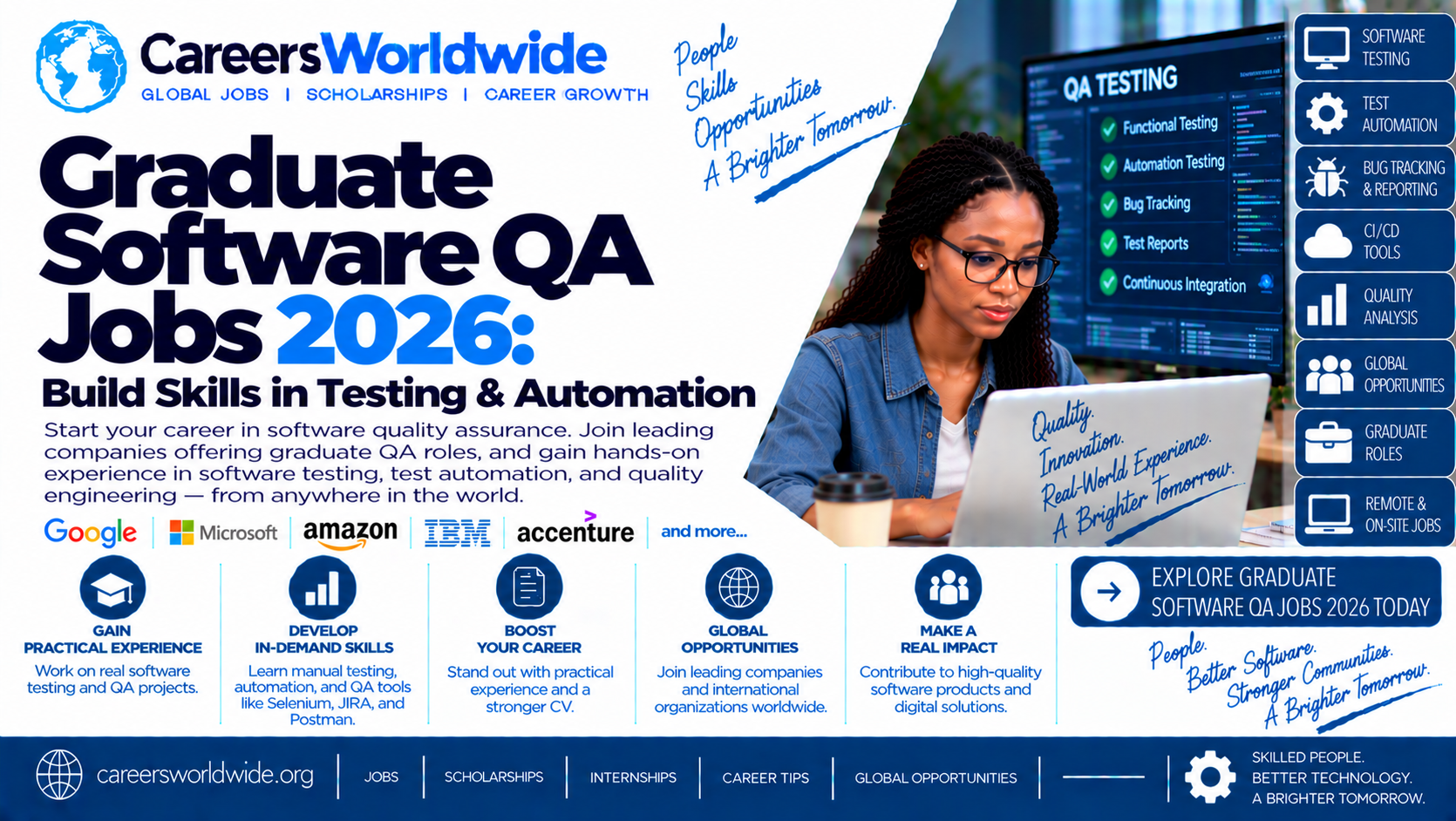

Excerpt: Graduate software QA jobs are opening pathways into software testing, quality assurance, automation and software engineering. Learn what graduate QA professionals do, which technical skills employers look for, how to build a testing portfolio, where to find opportunities in 2026, and how to prepare a competitive application.
Software applications are becoming more complex, connected and dependent on reliable digital experiences. From banking applications and e-commerce platforms to healthcare systems, cloud services and mobile apps, organizations need software that works consistently and securely.
That makes software quality assurance (QA) an important part of the software development lifecycle.
For graduates, QA can provide a practical entry point into technology without requiring years of professional software-development experience. Entry-level QA professionals can begin with manual testing, test-case design and defect reporting before progressing into automated testing, API testing, performance testing, DevOps and software development in test (SDET) roles.
The field is also becoming increasingly technical. Modern QA teams often use programming languages, version control, CI/CD pipelines, browser automation frameworks and cloud-based testing environments.
For graduates willing to combine testing fundamentals with programming and automation, software QA can become a versatile technology career.
What Are Graduate Software QA Jobs?
Graduate software QA jobs are entry-level positions designed for people beginning careers in software testing and quality engineering.
Common responsibilities may include:
- Creating test cases
- Executing manual tests
- Reporting software defects
- Performing regression testing
- Testing web and mobile applications
- Verifying bug fixes
- Supporting automated testing
- Testing APIs
- Maintaining test documentation
- Reviewing requirements
- Supporting continuous integration
- Analyzing test results
The exact responsibilities depend on the employer.
Some graduate positions are primarily manual-testing roles, while others may introduce automation from the beginning.
A graduate QA position may be advertised under titles such as:
- Graduate QA Engineer
- Junior QA Engineer
- Graduate Test Engineer
- Software Tester
- Junior Software Tester
- Quality Assurance Analyst
- Junior Test Analyst
- Automation Test Engineer
- Associate QA Engineer
- Software Quality Engineer
- Junior SDET
Understanding these variations is important when searching for opportunities.
Why Software QA Remains Important in 2026
Software development has become increasingly automated, but automation does not eliminate the need for testing.
Instead, modern engineering teams need testing to happen earlier and more frequently.
A typical software delivery process may involve:
Requirements → Development → Testing → CI/CD → Deployment → Monitoring
QA professionals help identify problems before software reaches users and provide feedback throughout this process.
Automated testing can also allow teams to repeatedly test critical functionality after changes are introduced.
Selenium’s official documentation describes WebDriver as a browser automation API and explains how it can be used to create browser-based regression automation suites and execute tests across environments.
Playwright similarly provides end-to-end testing capabilities across Chromium, Firefox and WebKit, with features including test isolation, auto-waiting, assertions, tracing and parallel execution.
This makes automation knowledge particularly useful for graduates who want to move beyond purely manual testing.
Graduate Software QA Jobs 2026: Summary Table
| Category | Details |
|---|---|
| Career field | Software testing and quality assurance |
| Experience | Graduate to approximately 0–2 years |
| Common titles | Graduate QA Engineer, Junior QA Engineer, Test Analyst |
| Core responsibilities | Testing, defect reporting, regression and quality checks |
| Automation tools | Selenium, Playwright and other frameworks |
| Programming | Java, Python, JavaScript or TypeScript can be useful |
| Other skills | Git, SQL, APIs and CI/CD |
| Testing types | Functional, regression, integration, API and end-to-end |
| Academic backgrounds | Computer science, software engineering, IT and related disciplines |
| Portfolio | Automated tests, bug reports, test plans and CI workflows |
| Work arrangements | Office, hybrid or remote depending on employer |
| Career progression | Graduate QA → QA Engineer → Senior QA/SDET → QA Lead |
| Application strategy | Tailored CV + testing portfolio + technical preparation |
What Does a Graduate QA Engineer Do?
1. Understand Requirements
Testing begins before the application is finished.
QA professionals need to understand what the software is supposed to do.
A tester may review:
- User stories
- Functional requirements
- Acceptance criteria
- Technical specifications
- Design documents
The objective is to translate requirements into testable conditions.
2. Create Test Cases
A test case describes how a particular feature should be tested.
A basic test case can include:
- Test ID
- Feature
- Preconditions
- Test steps
- Expected result
- Actual result
- Status
For example, for a login page:
Test: Login with valid credentials.
Expected result: The user is successfully authenticated and redirected to the appropriate account page.
Good QA professionals also consider what happens when things go wrong.
3. Perform Functional Testing
Functional testing checks whether software behaves according to its requirements.
Examples include:
- Login
- Registration
- Search
- Checkout
- Payments
- Password reset
- File uploads
- Form validation
4. Perform Regression Testing
Regression testing checks whether existing functionality continues to work after changes are introduced.
For example, a developer may update a payment component.
The QA team may then test:
- Payment processing
- Cart functionality
- Order creation
- Customer notifications
- Refund functionality
The objective is to identify unintended consequences of software changes.
5. Report Defects
Finding a bug is only part of the job.
QA professionals must communicate it clearly.
A useful bug report normally contains:
- Clear title
- Environment
- Steps to reproduce
- Expected result
- Actual result
- Severity or priority
- Screenshots or logs where appropriate
Compare:
“Login doesn’t work.”
with:
“Login returns HTTP 500 after submitting valid credentials on Chrome when the account contains a newly verified email address.”
The second description gives developers substantially more information.
Manual Testing Is Still Useful
Graduates sometimes assume they should skip manual testing and immediately learn automation.
That can be a mistake.
Automation is more useful when you understand what should be tested and why.
Manual testing helps develop skills in:
- Exploratory testing
- Requirement analysis
- Edge-case identification
- User behavior analysis
- Test design
- Defect investigation
Once those foundations are strong, automation becomes much easier to understand.
Skills to Learn for Graduate QA Jobs
1. Testing Fundamentals
Start with:
- Test cases
- Test scenarios
- Test plans
- Functional testing
- Regression testing
- Smoke testing
- Sanity testing
- Integration testing
- System testing
- User acceptance testing
- Exploratory testing
You should understand what each means and when it might be appropriate.
2. Programming
You do not need to become a senior software engineer before applying for graduate QA jobs.
However, basic programming can dramatically expand your options.
Choose one language initially:
- Java
- Python
- JavaScript
- TypeScript
- C#
The best choice often depends on the tools used by employers in your target market.
3. Selenium
Selenium is a long-established browser automation ecosystem.
Its WebDriver technology allows tests to control browsers through browser automation APIs. Selenium also provides Selenium Grid for distributed execution across machines and environments.
Selenium official documentation
For beginners, learn:
- Locators
- WebDriver
- Browser navigation
- Element interaction
- Assertions
- Waits
- Test runners
- Page Object Model
- Test reporting
4. Playwright
Playwright is another important modern testing framework.
Its official documentation describes Playwright Test as a full-featured end-to-end test runner supporting Chromium, Firefox and WebKit, with browser isolation, auto-waiting, assertions and parallel execution.
Playwright official documentation
Playwright can be particularly useful for graduates who already know JavaScript or TypeScript.
Its official resources also support Python, Java and .NET.
5. API Testing
Modern software frequently depends on APIs.
Learn basic concepts such as:
- GET
- POST
- PUT
- PATCH
- DELETE
- HTTP status codes
- Headers
- Authentication
- JSON
- Request bodies
- Response validation
Tools such as Postman can be useful for practicing API testing.
6. SQL
Basic SQL can help QA professionals investigate application data.
Learn:
SELECT
WHERE
JOIN
GROUP BY
ORDER BY
COUNT
SUM
For example, after creating a user through an application, a tester may need to verify that the corresponding database record was created correctly.
7. Git
Learn:
- Repository basics
- Clone
- Commit
- Push
- Pull
- Branches
- Merge
- Pull requests
Automated tests are often stored alongside application code, so understanding version control is valuable.
8. CI/CD
Learn the basic purpose of continuous integration and continuous delivery.
A QA engineer may configure automated tests to run when:
- Code is committed
- A pull request is opened
- A branch is updated
- A deployment occurs
Playwright’s official best-practices documentation recommends running tests frequently in CI/CD and notes that Playwright can be configured with GitHub Actions.
Build a Graduate QA Portfolio
A portfolio can help compensate for limited professional experience.
Project 1: Manual Test Plan
Choose a publicly accessible web application or your own project.
Create:
- Test scenarios
- Test cases
- Expected results
- Actual results
- Defect reports
Document what you tested and why.
Project 2: Selenium Automation
Build a small Selenium project that tests:
- Login
- Search
- Navigation
- Form submission
Organize the code professionally.
Include:
- Page Object Model
- Reusable functions
- Assertions
- Test data
- Reports
Project 3: Playwright E2E Testing
Create an automated Playwright suite covering a fictional e-commerce application.
Test:
- Product search
- Product selection
- Cart
- Checkout
- Invalid input
- Successful order completion
Playwright’s official tooling includes code generation, tracing and a VS Code extension, which can help beginners learn test authoring and debugging.
Project 4: API Testing
Create an API-testing project covering:
- Successful requests
- Invalid requests
- Authentication
- Response validation
- Error handling
Project 5: CI Testing
Connect your automation project to GitHub Actions or another CI platform.
Configure the pipeline so tests execute automatically when changes are pushed.
This demonstrates that you understand more than simply writing individual scripts.
How to Make Your QA CV Stand Out
A graduate QA CV should emphasize evidence, not only software names.
Instead of:
Selenium, Java, Git, SQL, Postman
write:
Built a Selenium WebDriver regression suite in Java covering authentication, navigation and form validation, with reusable page objects and automated assertions.
Instead of:
Playwright
write:
Developed Playwright end-to-end tests for a sample e-commerce application covering product search, cart and checkout workflows.
This gives recruiters a clearer picture of what you can actually do.
Where to Search for Graduate QA Jobs
Search across:
- Technology companies
- Software vendors
- Banks
- Fintech companies
- Telecommunications companies
- E-commerce businesses
- Consulting firms
- Healthcare technology companies
- Government technology programs
- SaaS companies
- Digital agencies
- Startups
Do not limit searches to “QA Engineer.”
Use multiple keywords.
Useful Job Search Terms
Try:
- Graduate QA Engineer
- Graduate Test Engineer
- Junior QA Engineer
- Junior Test Analyst
- Graduate Software Tester
- Junior Software Tester
- QA Analyst Graduate
- Associate QA Engineer
- Automation Tester Junior
- Graduate Automation Tester
- Junior Automation Engineer
- Software Quality Engineer
- Test Automation Graduate
- SDET Graduate
- Quality Assurance Analyst
- Junior SDET
- Entry-Level Software Tester
How to Apply for Graduate Software QA Jobs
Step 1: Identify Your Target
Choose whether you want to focus primarily on:
Manual QA
or
Automation QA
or a combination of both.
For long-term technical development, learning automation alongside manual-testing fundamentals can give you broader options.
Step 2: Customize Your CV
Match your CV to the job description.
If the employer mentions:
- Selenium
- Java
- API testing
- SQL
- Git
make sure relevant experience appears prominently if you genuinely have it.
Do not claim skills you have not practiced.
Step 3: Build a GitHub Portfolio
A strong GitHub repository might contain:
qa-automation-project/
├── tests/
├── pages/
├── test-data/
├── reports/
├── README.md
└── configuration/
Your README should explain:
- Project purpose
- Tools
- Installation
- How to run tests
- Test coverage
- Example results
Step 4: Apply Through Official Career Pages
Use employer career portals whenever possible.
Avoid relying solely on social-media posts or unofficial recruiters.
Verify the vacancy on the employer’s official website before submitting sensitive information.
How to Prepare for QA Interviews
Question: What is software testing?
Explain that software testing involves evaluating software to identify defects, verify requirements and provide information about product quality.
Question: What is regression testing?
Explain that regression testing checks whether existing functionality continues to work after software changes.
Question: What is the difference between severity and priority?
Severity describes the impact of a defect.
Priority describes how urgently the defect should be addressed.
Question: What is automation testing?
Explain that automation testing uses software tools and scripts to execute tests and verify expected results.
Question: Why shouldn’t everything be automated?
Some tests may be difficult or inefficient to automate.
Exploratory testing, usability evaluation and frequently changing functionality may require human judgment.
Question: What is a flaky test?
A flaky test produces inconsistent results without a corresponding change in the software under test.
Possible causes include:
- Timing problems
- Unstable environments
- Poor test isolation
- External dependencies
- Weak selectors
Playwright’s documentation emphasizes test isolation and reliable web-first assertions as ways to make automated tests more resilient.
Question: What would you automate first?
A good answer might focus on:
- Stable functionality
- High-value workflows
- Repetitive regression tests
- Critical business processes
- Tests that run frequently
A Practical 30-Day Graduate QA Learning Plan
Week 1: Testing Fundamentals
Learn:
- SDLC
- STLC
- Test cases
- Defect lifecycle
- Functional testing
- Regression testing
- Exploratory testing
Create 20–30 test cases for a sample application.
Week 2: Programming and Automation
Choose one language.
Then learn:
- Variables
- Conditions
- Loops
- Functions
- Classes
- Error handling
Start writing simple browser tests.
Week 3: Build an Automation Project
Choose Selenium or Playwright.
Create a structured project containing:
- Login tests
- Search tests
- Form tests
- Negative tests
- Assertions
- Test reporting
Week 4: Git, API and CI
Add:
- GitHub
- API testing
- SQL
- CI workflow
Then update your CV and begin applying.
Career Progression
Graduate QA jobs can lead to several technology careers.
A traditional pathway may look like:
Graduate QA Engineer → QA Engineer → Senior QA Engineer → QA Lead
An automation-focused pathway may become:
Graduate QA → Automation QA Engineer → SDET → Senior SDET → Test Architect
Other possibilities include:
- DevOps
- Software engineering
- Test automation
- Performance engineering
- Security testing
- API testing
- Quality engineering
- Engineering management
The skills overlap with broader software-engineering practices, particularly programming, Git, CI/CD and debugging.
Frequently Asked Questions
Are graduate QA jobs suitable for computer science graduates?
Yes. Computer science, software engineering, information technology and related degrees can provide useful foundations for QA careers.
However, employers set their own educational and technical requirements.
Do I need experience before applying?
Not always. Graduate positions are designed for people at the beginning of their careers.
University projects, internships, personal projects and open-source contributions can help demonstrate practical ability.
Do I need to know Selenium?
Not every employer uses Selenium. However, understanding browser automation concepts and at least one established automation framework can be valuable.
Selenium’s official documentation provides learning resources for WebDriver, Selenium IDE and Grid.
Should I learn Playwright or Selenium?
Both can be useful.
Selenium has a mature browser-automation ecosystem, while Playwright provides modern end-to-end testing features including auto-waiting, tracing, browser isolation and cross-browser execution.
The best choice for a particular application depends on the employer’s technology stack.
Can QA engineers become software developers?
Yes. QA automation roles can provide exposure to programming, debugging, Git, APIs and CI/CD, all of which overlap with software-development skills.
Career progression varies by individual and employer.
Is manual testing still worth learning?
Yes. Manual testing helps develop test-design, exploratory-testing and defect-investigation skills.
These fundamentals can make automation work more effective.
Do I need a certification?
Not necessarily.
A certification may demonstrate structured learning, but practical projects, technical skills and evidence of testing ability can also be important.
Can graduate QA jobs be remote?
Some positions may be remote or hybrid, while others require employees to work from a particular office.
Always check the specific vacancy.
What programming language should I learn?
Start with the language that aligns with the automation ecosystem you want to use and the employers you are targeting.
Java, Python, JavaScript, TypeScript and C# are all used in software-testing environments.
What should a graduate QA portfolio contain?
Ideally include:
- Manual test cases
- Bug reports
- Automation tests
- API testing
- SQL examples
- Git repository
- CI workflow
- Clear README documentation
Official Learning and Application Resources
Selenium
Selenium provides official documentation for WebDriver, Selenium IDE and Grid. Its WebDriver resources include getting-started instructions and guidance for creating browser automation tests.
Selenium Official Documentation
Playwright
Playwright’s official website provides documentation for end-to-end testing, automation, assertions, tracing and test execution across major browser engines.
Playwright Official Documentation
Playwright GitHub
The official Microsoft Playwright repository provides source code, documentation links, examples and installation information.
Microsoft Playwright on GitHub
GitHub
GitHub can be used to build a public testing portfolio, maintain automation projects and demonstrate version-control skills.
Microsoft Careers
Microsoft’s official careers platform can be searched for software engineering, testing, engineering and early-career opportunities.
Amazon Jobs
Amazon’s official jobs platform includes technology and software-development opportunities across different locations.
Google Careers
Google’s official careers platform provides information about technology and early-career opportunities.
Final Takeaway
Graduate software QA jobs can provide an accessible starting point for a career in technology while developing skills that extend well beyond traditional software testing.
The strongest approach is to learn testing fundamentals first, then add programming and automation.
Understand how to write effective test cases. Learn how to report defects clearly. Practice exploratory testing. Then build automated tests with a framework such as Selenium or Playwright.
From there, add API testing, SQL, Git and CI/CD.
Your goal should be to demonstrate that you can do more than execute a checklist.
A strong graduate QA candidate can explain what should be tested, why it should be tested, how the test can be automated and what the results mean.
Build a portfolio that demonstrates those capabilities.
A GitHub repository containing organized automation tests, documented manual test cases, API testing and a CI workflow can give employers tangible evidence of your skills.
For 2026 applicants, searching broadly is also important. Look beyond “QA Engineer” and search for Graduate Test Engineer, Junior Test Analyst, Software Tester, Automation Tester, Quality Assurance Analyst and Junior SDET roles.
The path can begin with manual testing and gradually develop toward automation, quality engineering, SDET, DevOps or other software-technology careers.
Disclaimer
This article is provided for general career and educational information only. It does not guarantee employment, interviews, selection or eligibility for any particular position. Job titles, qualifications, compensation, locations, work arrangements and application requirements vary by employer and may change without notice. Always verify the vacancy and requirements through the employer’s official career website before applying. Never pay an unofficial recruiter or individual to secure employment.
SEO Information
SEO Title: Graduate Software QA Jobs 2026: Testing & Automation Careers
Meta Description: Explore graduate software QA jobs in 2026. Learn software testing, Selenium, Playwright, automation, SQL, Git, CI/CD, portfolio and application tips.
Focus Keyword: Graduate Software QA Jobs 2026
URL Slug: graduate-software-qa-jobs-2026
Suggested Excerpt: Graduate software QA jobs offer an entry point into software testing, quality assurance and automation. Learn the skills, tools, portfolio projects and official resources to start a QA career in 2026.
SEO Keywords:
- Graduate Software QA Jobs 2026,
- Graduate QA Engineer Jobs,
- Junior QA Engineer Jobs,
- Entry-Level QA Jobs 2026,
- Graduate Software Tester Jobs,
- Junior Software Tester Jobs,
- Graduate Test Engineer Jobs,
- Junior Test Analyst Jobs,
- Software Testing Jobs 2026,
- QA Automation Jobs,
- Graduate Automation Tester Jobs,
- Junior Automation Tester Jobs,
- Software Quality Assurance Jobs,
- Quality Assurance Analyst Jobs,
- Graduate SDET Jobs,
- Junior SDET Jobs,
- Selenium QA Jobs,
- Playwright QA Jobs,
- Test Automation Jobs 2026,
- Software Testing Graduate Jobs,
- Entry-Level Software Testing Jobs,
- Graduate Technology Jobs 2026,
- Junior Software QA Jobs,
- QA Engineer Careers,
- Software Testing Careers,
- Automation Testing Careers,
- Remote Graduate QA Jobs,
- Graduate IT Jobs 2026,
- Software Quality Engineer Jobs,
- Graduate Technology Careers,
ALSO CHECK: Entry-Level CRM Analyst Jobs 2026: Support Customer Data & Digital EngagementSeptember 24, 2026
Entry-Level Carbon Accounting Jobs 2026: Support Emissions Data & Sustainability ReportingSeptember 24, 2026
Food Security Internships 2026: Work on Agriculture, Nutrition & Sustainable DevelopmentSeptember 23, 2026