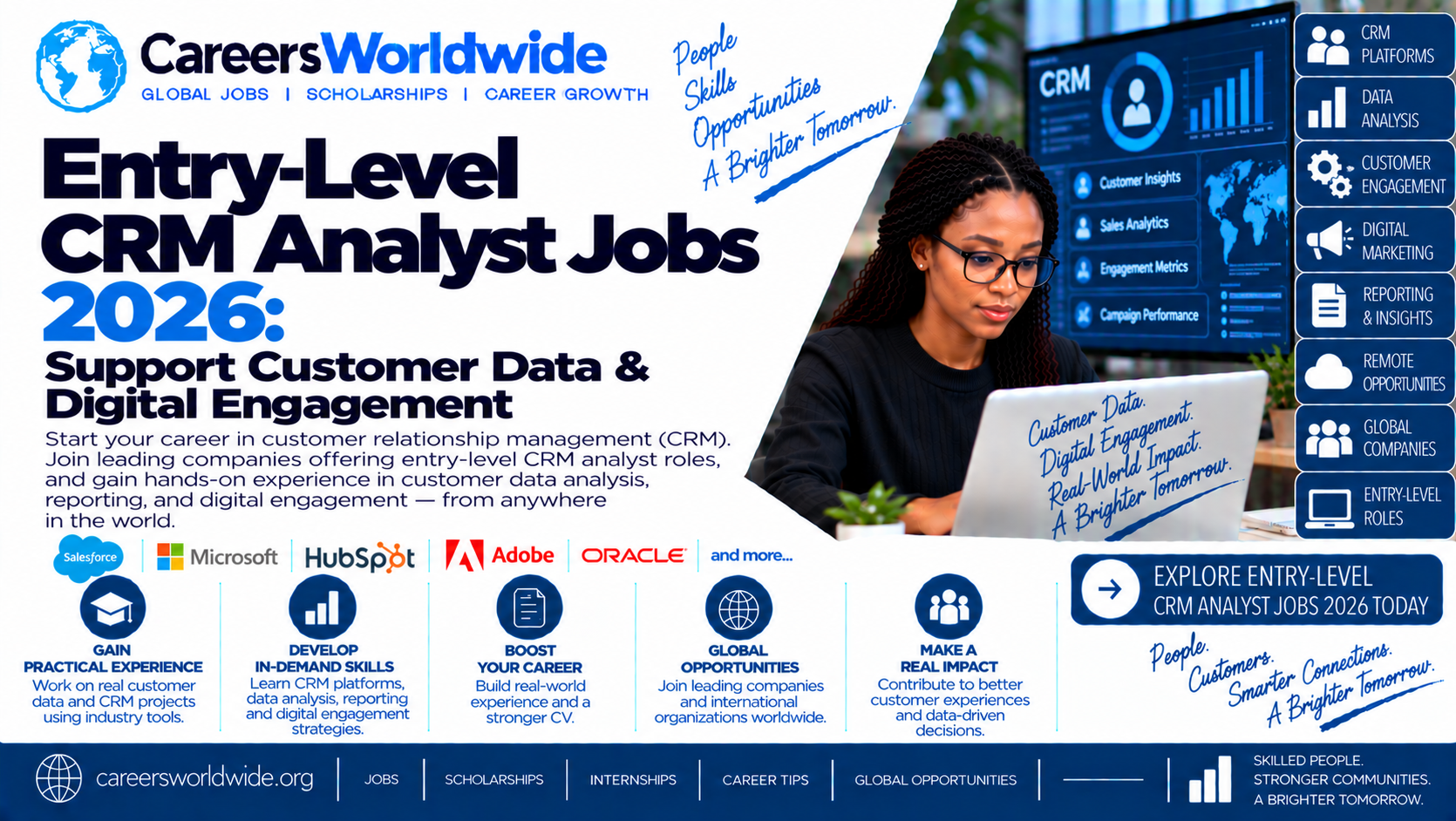

Excerpt: Entry-level CRM analyst jobs are attracting graduates and early-career professionals interested in customer data, business analytics, marketing technology and digital engagement. Learn what CRM analysts do, which skills employers seek, how to build practical experience, where to search for opportunities in 2026, and how to create a stronger application.
Customer relationships have become increasingly data-driven. Companies use customer relationship management systems to organize information about leads, prospects, customers, interactions, purchases, support requests and marketing activity.
But collecting customer information is only part of the process.
Organizations also need professionals who can turn CRM data into useful insights.
That is where CRM analysts come in.
Entry-level CRM analysts can support teams by maintaining customer datasets, analyzing customer behavior, creating reports and dashboards, monitoring data quality and helping sales, marketing and customer-success teams make more informed decisions.
For graduates with backgrounds in business, information technology, marketing, economics, statistics, computer science or data analytics, CRM analysis can provide an accessible pathway into the broader fields of business intelligence, customer analytics, marketing technology and digital transformation.
What Is a CRM Analyst?
A CRM analyst works with customer relationship management data and systems to help an organization better understand and manage its customer relationships.
CRM stands for Customer Relationship Management.
CRM platforms can contain information about:
- Leads
- Prospects
- Customers
- Sales opportunities
- Customer interactions
- Marketing campaigns
- Support cases
- Purchases
- Customer preferences
- Account activity
- Engagement history
A CRM analyst may analyze this information to answer questions such as:
- Which marketing campaigns generate the most qualified leads?
- How quickly are leads moving through the sales pipeline?
- Which customer segments generate the most revenue?
- Where are customers dropping out of the journey?
- Which accounts have declining engagement?
- How complete and accurate is the CRM database?
- Which sales representatives have the strongest pipeline conversion?
- How effective are customer-retention initiatives?
The role therefore sits between data, technology and business decision-making.
Salesforce’s official Trailhead resources describe CRM Analytics as a platform for exploring business data, creating visualizations and monitoring important metrics, while its training resources emphasize data management, analytics and data visualization skills.
Why CRM Analyst Jobs Matter in 2026
Modern organizations can have millions of customer records across multiple systems.
Without effective data management and analysis, important information can become difficult to use.
CRM analysts can help businesses:
- Improve customer-data quality
- Track sales performance
- Analyze customer engagement
- Measure marketing results
- Segment customers
- Identify trends
- Support customer-retention strategies
- Improve reporting
- Monitor sales pipelines
- Support data-driven decision-making
CRM analytics can also involve bringing information from multiple sources together.
Salesforce’s CRM Analytics documentation explains that CRM Analytics can combine Salesforce and external data, allowing teams to explore information and create dashboards for business decision-making.
This makes CRM analytics relevant across industries rather than only within technology companies.
Entry-Level CRM Analyst Jobs 2026: Summary Table
| Category | Details |
|---|---|
| Job field | CRM, customer analytics and business intelligence |
| Experience | Graduate to approximately 0–3 years |
| Common titles | CRM Analyst, Junior CRM Analyst, CRM Data Analyst |
| Main focus | Customer data, reporting, engagement and CRM systems |
| Common tools | Excel, CRM platforms, SQL, Power BI, Tableau |
| CRM platforms | Salesforce, HubSpot, Microsoft Dynamics and others |
| Important skills | Data analysis, reporting, data quality and communication |
| Academic backgrounds | Business, IT, marketing, economics, statistics, computer science and related fields |
| Typical teams | Sales, marketing, customer success, operations and analytics |
| Portfolio projects | Customer segmentation, sales funnel analysis and CRM dashboards |
| Work arrangements | Office, hybrid or remote depending on employer |
| Career progression | CRM Analyst → Senior Analyst → CRM Manager/Analytics Lead |
| Application strategy | Tailored CV + measurable data projects + relevant tools |
What Does an Entry-Level CRM Analyst Do?
Responsibilities vary between employers, but junior CRM analysts commonly support several areas.
1. CRM Data Management
One of the most important responsibilities is ensuring customer information is accurate and usable.
Tasks may include:
- Reviewing customer records
- Identifying duplicates
- Checking incomplete fields
- Standardizing information
- Updating records
- Validating data
- Monitoring data-quality issues
- Supporting CRM migrations
Good CRM analysis starts with good data.
If customer records are incomplete or inconsistent, even sophisticated dashboards can produce misleading conclusions.
2. Reporting and Dashboards
CRM analysts may create recurring reports for business teams.
Examples include:
- Lead-generation reports
- Sales pipeline reports
- Customer-retention reports
- Campaign-performance reports
- Conversion-rate reports
- Customer-engagement dashboards
- Revenue reports
- Account-activity reports
The goal is not simply to produce charts.
A good CRM analyst helps stakeholders understand what the data means and what action may be appropriate.
3. Customer Segmentation
Customer segmentation involves dividing customers into groups based on relevant characteristics.
Possible segmentation criteria include:
- Industry
- Location
- Customer type
- Purchase history
- Engagement
- Revenue
- Product usage
- Customer lifecycle stage
For example, a company could analyze whether highly engaged customers behave differently from customers who have not interacted with the business recently.
4. Sales Funnel Analysis
CRM analysts can also examine the customer or sales journey.
A simplified funnel might look like:
Lead → Qualified Lead → Opportunity → Customer
The analyst can calculate conversion rates between stages.
For example:
If 1,000 leads enter a funnel and 100 become customers, the overall lead-to-customer conversion rate is 10%.
A CRM analyst may then investigate why conversion differs between campaigns, customer segments or sales teams.
5. Marketing Campaign Analysis
CRM systems can contain information about marketing interactions.
A CRM analyst may help analyze:
- Email engagement
- Campaign responses
- Lead sources
- Conversion rates
- Customer acquisition
- Campaign revenue
- Segment performance
This makes CRM analytics particularly relevant to marketing teams.
Skills Needed for Entry-Level CRM Analyst Jobs
Excel
Excel remains an important skill for many analyst positions.
Learn:
- XLOOKUP
- SUMIFS
- COUNTIFS
- IF statements
- Pivot tables
- Data validation
- Conditional formatting
- Charts
- Data cleaning
- Basic statistical functions
A candidate who can confidently manipulate a customer dataset has a practical foundation for CRM analysis.
SQL
SQL can become particularly valuable when CRM data is stored in databases or data warehouses.
Start with:
- SELECT
- WHERE
- GROUP BY
- ORDER BY
- JOIN
- CASE
- COUNT
- SUM
- AVG
- Common table expressions
You do not necessarily need advanced SQL for every entry-level CRM position.
However, basic SQL can significantly expand the types of analyst roles you can target.
Data Visualization
CRM analysts need to communicate findings visually.
Useful tools include:
- Power BI
- Tableau
- Salesforce CRM Analytics
- Excel dashboards
Salesforce Trailhead offers foundational CRM Analytics training covering data visualization and analytics, while its more advanced training includes dashboard building, data integration and data management.
CRM Platforms
Understanding at least one major CRM platform can help.
Common platforms include:
- Salesforce
- HubSpot
- Microsoft Dynamics 365
- Zoho CRM
- SAP customer-management solutions
You do not need to master every platform.
A better strategy is to learn the fundamentals of one platform and understand concepts that transfer between systems.
Salesforce Skills Can Be Useful
Salesforce is particularly relevant to CRM careers because it combines CRM functionality with analytics, automation and reporting.
Salesforce’s Trailhead platform provides free learning resources covering CRM Analytics, data management, dashboards, data quality and business analytics.
For example, the Discover CRM Analytics trail is designed at a foundational level and covers data visualization and analytics concepts.
The Build and Administer CRM Analytics trail goes further into data integration, dashboards, data management and administration.
Explore Salesforce Trailhead CRM Analytics resources
Build a CRM Analyst Portfolio
You do not have to wait for your first job to demonstrate CRM analytics skills.
Create realistic projects using fictional or publicly available datasets.
Portfolio Project 1: Customer Segmentation Dashboard
Create a dataset containing:
- Customer ID
- Industry
- Location
- Revenue
- Purchase frequency
- Engagement score
- Customer status
Then build a dashboard showing customer segments.
Portfolio Project 2: Sales Funnel Analysis
Create a fictional CRM dataset and analyze:
- Number of leads
- Qualified leads
- Opportunities
- Closed deals
- Conversion rates
- Average deal size
- Sales-cycle duration
Present the results in a Power BI, Tableau or Excel dashboard.
Portfolio Project 3: Customer Churn Analysis
Create a simple customer dataset and analyze which characteristics are associated with customer churn.
Possible variables include:
- Customer tenure
- Product usage
- Support interactions
- Purchase frequency
- Customer segment
- Last interaction date
Clearly distinguish between correlation and causation when presenting your findings.
Portfolio Project 4: CRM Data Quality Audit
This can be particularly useful because data quality is central to CRM operations.
Create a dataset containing:
- Duplicate records
- Missing email addresses
- Inconsistent country names
- Incorrect dates
- Missing customer segments
Then document how you would identify and correct the problems.
Salesforce’s training materials specifically include data-quality and data-management learning paths, making these useful areas for aspiring CRM analysts to study.
CRM Analyst Job Titles to Search
Do not search for only one title.
Different organizations use different terminology.
Try:
- CRM Analyst
- Junior CRM Analyst
- CRM Data Analyst
- CRM Reporting Analyst
- Customer Data Analyst
- Customer Analytics Analyst
- Customer Insights Analyst
- Marketing Data Analyst
- Marketing Analytics Analyst
- Sales Operations Analyst
- Revenue Operations Analyst
- CRM Operations Analyst
- CRM Specialist
- CRM Coordinator
- Business Analyst – CRM
- Digital Analytics Analyst
- Customer Success Analyst
- Data Analyst – Customer Experience
- Customer Intelligence Analyst
- Marketing Operations Analyst
Some of these roles may have responsibilities that overlap with CRM analysis without using “CRM Analyst” in the title.
Who Hires CRM Analysts?
CRM skills are useful across many sectors.
Technology companies
Technology businesses often maintain large customer databases and use CRM systems to support sales, marketing and customer-success operations.
Salesforce itself maintains an official careers portal with opportunities across areas including technology, sales and customer-facing functions.
SaaS companies
Software-as-a-service businesses depend heavily on customer acquisition, engagement, retention and expansion data.
CRM analysts may support:
- Sales operations
- Revenue operations
- Customer success
- Marketing operations
- Business intelligence
Financial services
Banks, fintech companies and financial-services businesses use customer information to support relationship management, marketing and service operations.
Retail and e-commerce
Retail businesses can use CRM data to analyze purchasing behavior, customer segments, loyalty and marketing performance.
Telecommunications
Telecommunications companies generate large amounts of customer and usage information, creating opportunities for customer analytics professionals.
Consulting firms
Consulting organizations may recruit analysts to support CRM implementation, data migration, customer analytics and digital-transformation projects.
HubSpot as Another Useful CRM Ecosystem
HubSpot is another major CRM and customer-platform ecosystem worth understanding.
Its official careers page describes the company as focused on helping businesses grow and provides access to current job opportunities and its talent community.
For job seekers, learning how CRM platforms organize contacts, companies, deals, activities and customer interactions can provide useful transferable knowledge even when a particular employer uses a different platform.
How to Apply for Entry-Level CRM Analyst Jobs
Step 1: Tailor your CV
Do not submit a generic data-analyst CV to every CRM role.
Highlight:
- CRM experience
- Data analysis
- Excel
- SQL
- Reporting
- Dashboards
- Customer analytics
- Data quality
- Marketing analytics
- Business intelligence
If you completed a university project using customer data, include it.
Step 2: Use measurable achievements
Instead of:
Created reports using Excel.
Use:
Built an interactive Excel dashboard analyzing 5,000 customer records across acquisition source, engagement and conversion metrics.
Specific numbers make your experience easier to understand.
Step 3: Link your portfolio
A portfolio can contain:
- Dashboard screenshots
- SQL queries
- Data-cleaning examples
- CRM analysis reports
- Customer segmentation projects
- Written insights
Make sure any datasets are permitted for public use.
Step 4: Research the company
Before an interview, understand:
- What the company sells
- Who its customers are
- How it acquires customers
- What its customer journey looks like
- Which CRM platform it appears to use
- What metrics might matter
This helps you discuss CRM analytics in a business context.
alyst Interviews
Expect questions covering both technical and business concepts.
“What is CRM?”
Explain that CRM refers to the strategies, processes and technologies organizations use to manage customer relationships and customer information.
“What is data quality?”
Discuss concepts such as:
- Accuracy
- Completeness
- Consistency
- Validity
- Uniqueness
- Timeliness
“How would you identify duplicate customers?”
Explain a process involving appropriate matching fields, duplicate detection rules, validation and careful review before merging records.
“What metrics would you monitor?”
Depending on the business, examples include:
- Lead conversion
- Customer acquisition
- Customer retention
- Churn
- Sales-cycle length
- Pipeline value
- Customer lifetime value
- Campaign conversion
- Engagement
- Revenue per customer
“How would you explain a dashboard to a non-technical manager?”
Focus on business questions.
Do not simply describe every chart.
Explain:
- What changed?
- Why it may matter?
- What segment or process is affected?
- What additional information is needed?
- What action could be investigated?
A Practical 30-Day CRM Analyst Preparation Plan
Week 1: Learn CRM fundamentals
Study:
- CRM concepts
- Customer lifecycle
- Sales pipeline
- Lead management
- Customer segmentation
- Customer retention
- CRM data quality
Week 2: Improve technical skills
Practice:
- Excel
- SQL
- Power BI or Tableau
- Basic statistics
Also explore a CRM learning environment.
Salesforce Trailhead offers structured learning in CRM Analytics and data literacy, including data interpretation, data visualization and data management.
Build your data literacy with Salesforce Trailhead
Week 3: Build a portfolio
Create:
- Customer segmentation dashboard
- Sales funnel analysis
- CRM data-quality project
Publish the work in a professional portfolio.
Week 4: Apply and practice
Search multiple job titles and tailor each application.
Practice explaining your projects in simple business language.
Career Progression
An entry-level CRM analyst role can lead to several career directions.
One possible pathway is:
Junior CRM Analyst → CRM Analyst → Senior CRM Analyst → CRM Analytics Manager
Other possibilities include:
CRM Analyst → Marketing Analytics
CRM Analyst → Business Intelligence
CRM Analyst → Revenue Operations
CRM Analyst → Customer Insights
CRM Analyst → Data Analytics
CRM Analyst → CRM Administration
CRM Analyst → Digital Transformation
The exact progression depends on the organization and your developing skills.
Frequently Asked Questions
Are CRM analyst jobs suitable for recent graduates?
Yes. Entry-level CRM and customer-data positions can be suitable for graduates with relevant analytical, business or technology skills. Employers differ in their experience requirements, so always read the individual vacancy carefully.
Do I need a computer science degree?
No. CRM analyst roles can be relevant to graduates from business, marketing, economics, statistics, information systems, computer science and other analytical disciplines.
Is SQL required?
Not every position requires SQL, but learning SQL can make you eligible for a broader range of data-focused CRM roles.
Is Salesforce certification necessary?
Not necessarily. Certification can demonstrate structured learning, but practical projects and relevant experience can also strengthen an application.
Salesforce provides official Trailhead training that can help candidates build CRM Analytics and data-management knowledge.
Can marketing graduates become CRM analysts?
Yes. Marketing graduates can have relevant knowledge of customer journeys, campaigns, segmentation and engagement. Adding Excel, SQL and data visualization skills can strengthen their profile.
Can CRM analysts work remotely?
Some CRM, analytics and operations roles may be remote or hybrid, but this depends on the employer, location and responsibilities.
What is the difference between a CRM analyst and a data analyst?
A data analyst may work with many types of business data. A CRM analyst focuses more specifically on customer relationship data, CRM processes and customer-related business questions.
There can be substantial overlap between the two careers.
What should I put in a CRM analyst portfolio?
Include projects demonstrating:
- Data cleaning
- Customer segmentation
- Funnel analysis
- Dashboard creation
- SQL
- Data-quality analysis
- Business recommendations
What CRM platform should I learn first?
There is no universal requirement. Salesforce, HubSpot and Microsoft Dynamics are examples of major CRM ecosystems. Choose one and learn the underlying concepts thoroughly.
Official Application and Learning Resources
Salesforce
Salesforce provides an official careers portal for current employment opportunities. Its Trailhead platform also offers CRM Analytics, data literacy, data management and dashboard training.
HubSpot
HubSpot’s official careers page provides access to open positions and its talent community.
Salesforce CRM Analytics Training
The official CRM Analytics learning resources cover foundational analytics, data visualization and business intelligence.
Salesforce Data Literacy
Salesforce Trailhead’s data-literacy curriculum covers data interpretation, data structure, aggregation, visualization and communication.
Final Takeaway
Entry-level CRM analyst jobs can be an effective starting point for graduates interested in the intersection of customer data, analytics, technology and business strategy.
The career does not require you to become an expert in every CRM platform.
Instead, focus on transferable fundamentals.
Learn how customer data is structured. Understand data quality. Become comfortable with Excel. Add SQL and a visualization tool. Learn the basics of at least one CRM platform. Then create practical projects demonstrating that you can turn customer information into useful business insights.
Your first role might be called CRM Analyst, but it could also be listed as Customer Data Analyst, Marketing Analyst, Sales Operations Analyst, CRM Specialist, Customer Insights Analyst or Revenue Operations Analyst.
That is why broad job searching is important.
For 2026 applicants, one of the strongest ways to differentiate yourself is to show employers what you can actually do. A well-designed CRM dashboard, a documented SQL project or a customer-segmentation analysis can provide stronger evidence than a CV containing only a list of software names.
Build the skills, create the evidence and apply through verified employer career channels.
Disclaimer
This article is provided for general career and educational information only. It does not guarantee employment, interviews, selection or eligibility for any particular position. Job titles, qualifications, locations, compensation, work arrangements and application requirements vary by employer and may change without notice. Always review the official vacancy and employer career page before applying. Never pay an individual or unofficial recruiter to secure a legitimate job unless a clearly documented official process requires a fee.
SEO Information
SEO Title: Entry-Level CRM Analyst Jobs 2026: Customer Data & Digital Engagement
Meta Description: Explore entry-level CRM analyst jobs in 2026. Learn CRM skills, customer data analytics, SQL, dashboards, job titles, applications and official resources.
Focus Keyword: Entry-Level CRM Analyst Jobs 2026
URL Slug: entry-level-crm-analyst-jobs-2026
Suggested Excerpt: Entry-level CRM analyst jobs offer graduates a pathway into customer data, analytics and digital engagement. Learn the skills, tools, portfolio projects and official resources to start a CRM analytics career in 2026.
SEO Keywords:
- Entry-Level CRM Analyst Jobs 2026,
- CRM Analyst Jobs 2026,
- Junior CRM Analyst Jobs,
- CRM Data Analyst Jobs,
- Customer Data Analyst Jobs,
- Customer Analytics Jobs 2026,
- CRM Reporting Analyst Jobs,
- CRM Analytics Jobs,
- Customer Insights Analyst Jobs,
- Marketing Data Analyst Jobs,
- Marketing Analytics Jobs,
- Sales Operations Analyst Jobs,
- Revenue Operations Analyst Jobs,
- CRM Specialist Jobs,
- CRM Operations Jobs,
- Salesforce CRM Analyst Jobs,
- Salesforce Analytics Jobs,
- HubSpot CRM Jobs,
- Customer Relationship Management Jobs,
- Entry-Level Data Analyst Jobs,
- Graduate CRM Jobs,
- Digital Engagement Jobs,
- Customer Experience Analytics Jobs,
- CRM Data Jobs,
- Remote CRM Analyst Jobs,
- CRM Careers 2026,
- Customer Data Careers,
- Business Analytics Jobs 2026,
- CRM Reporting Jobs,
- Customer Intelligence Jobs,
- Entry-Level Analytics Jobs 2026,
ALSO CHECK: Entry-Level Carbon Accounting Jobs 2026: Support Emissions Data & Sustainability ReportingSeptember 24, 2026
Food Security Internships 2026: Work on Agriculture, Nutrition & Sustainable DevelopmentSeptember 23, 2026
Blockchain Development Internships 2026: Explore Distributed Applications & Digital SystemsSeptember 23, 2026