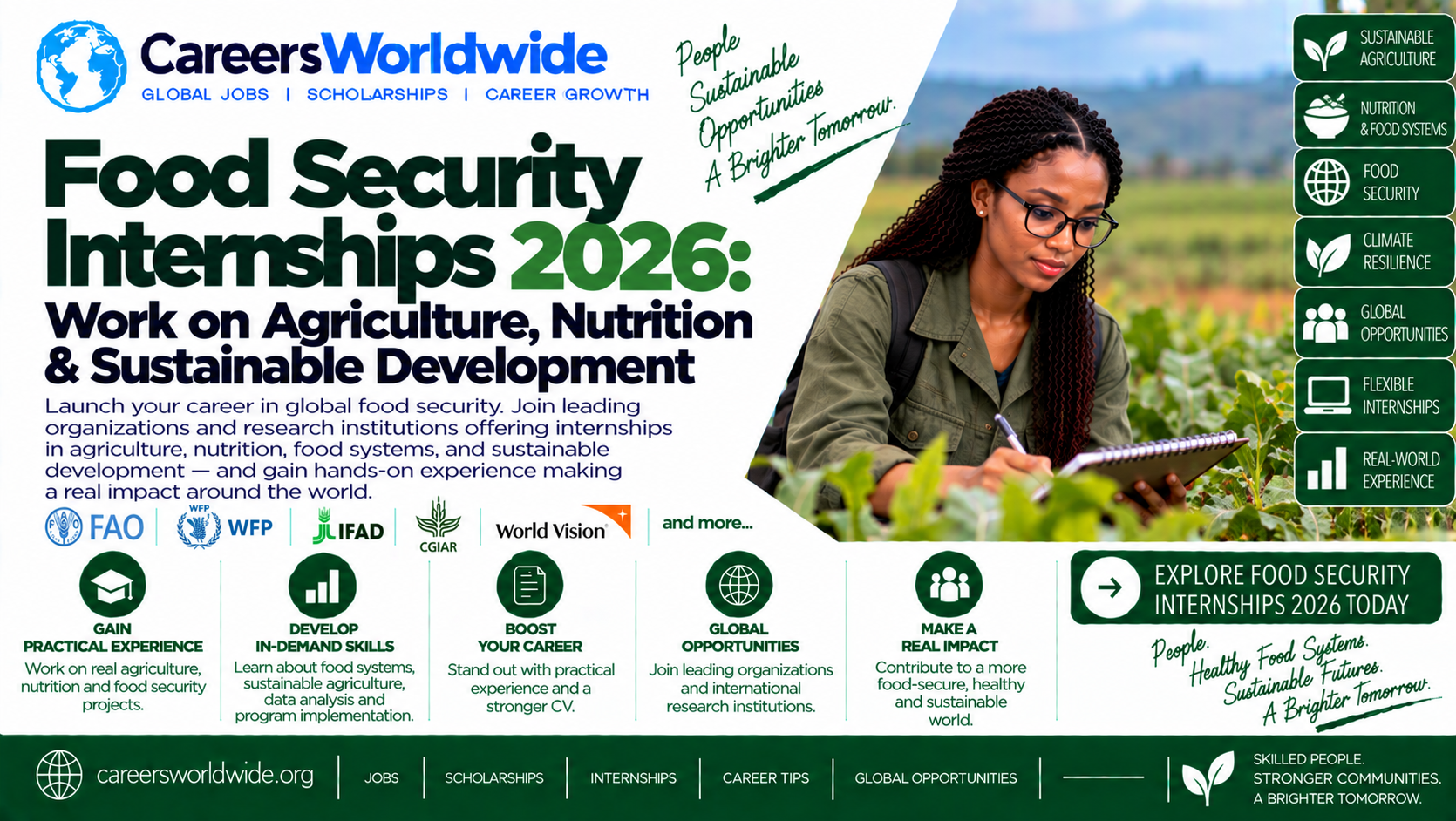

Excerpt: Food Security Internships 2026 offer students and recent graduates an opportunity to gain practical experience in agriculture, nutrition, food systems, rural development, humanitarian response and sustainable development. From analysing agricultural data and supporting nutrition programmes to researching climate-resilient food systems and helping communities respond to food insecurity, these internships can open pathways into careers with international organisations, governments, NGOs and research institutions.
Food Security Internships 2026: An Introduction
Food security is a multidisciplinary field connecting agriculture, nutrition, economics, environmental sustainability, humanitarian assistance and rural development.
The work extends far beyond producing food.
Food-security professionals may examine whether people have reliable access to sufficient and nutritious food, how agricultural systems respond to climate pressures, how markets affect food availability and affordability, and how humanitarian programmes can support communities experiencing food crises.
For students, this creates a broad range of potential internship opportunities.
A food-security intern could work on:
- Agricultural research
- Nutrition programmes
- Food-system analysis
- Rural development
- Climate-smart agriculture
- Food-market research
- Humanitarian response
- Monitoring and evaluation
- Agricultural data analysis
- Sustainable development
- Food policy
- Programme management
- Community development
The Food and Agriculture Organization of the United Nations (FAO), for example, describes its internship programme as an opportunity for students and recent graduates to gain practical experience in areas connected with its mandate and Strategic Framework. Its current internship information includes work related to sustainable agri-food systems, nutrition and food security.
This makes food security particularly relevant for students who want an international development career.
What Is a Food Security Internship?
A food security internship is a structured learning or work opportunity focused on improving food systems, nutrition outcomes, agricultural productivity, resilience or access to food.
Depending on the organisation, interns may contribute to:
- Food-security research
- Agricultural programmes
- Nutrition assessments
- Food-system projects
- Rural development
- Humanitarian operations
- Market analysis
- Agricultural policy
- Climate adaptation
- Monitoring and evaluation
- Data analysis
- Programme communications
The exact work varies considerably.
An agriculture student might support a crop-production project. A nutrition student could help analyse nutrition data. A data analyst could build dashboards tracking food-security indicators. A development-studies student might research agricultural policy.
That flexibility makes food security a useful career field for people from different academic backgrounds.
Why Food Security Matters in 2026
Food systems face interconnected economic, environmental and social pressures.
Agricultural production can be affected by:
- Climate variability
- Water availability
- Soil degradation
- Market conditions
- Conflict
- Displacement
- Infrastructure
- Agricultural inputs
- Food prices
- Supply-chain disruptions
Nutrition is also closely connected to food systems.
This means food-security work increasingly involves professionals who can combine technical knowledge with research, data, policy and programme-management skills.
The World Food Programme describes its internship programme as a professional learning opportunity where interns can contribute through research, data analysis, documents, presentations and other assignments supporting its mission to address hunger and malnutrition.
Types of Food Security Internships
1. Agriculture Internships
Agriculture-focused internships can involve:
- Crop production
- Agricultural research
- Soil management
- Irrigation
- Sustainable farming
- Agricultural extension
- Farm economics
- Climate-resilient agriculture
These opportunities can be suitable for students studying agriculture, agronomy, environmental science or agricultural economics.
2. Nutrition Internships
Nutrition internships may involve:
- Nutrition research
- Programme support
- Data analysis
- Nutrition education
- Maternal and child nutrition
- Community nutrition
- Nutrition monitoring
Students studying nutrition, public health, food science, dietetics or related fields may find these opportunities particularly relevant.
UNICEF maintains a dedicated internship programme for students and recent graduates and states that internships can provide hands-on experience in humanitarian and development work.
3. Food Systems Internships
Food-systems work looks at how food moves from production to consumption.
An intern might examine:
- Production
- Processing
- Distribution
- Markets
- Food access
- Consumer behaviour
- Sustainability
This can suit students studying economics, business, agriculture, environmental science or development studies.
4. Humanitarian Food Security Internships
Humanitarian organisations often work in contexts affected by food insecurity, displacement and emergencies.
Interns may support:
- Programme research
- Food-security assessments
- Data analysis
- Monitoring
- Reporting
- Logistics
- Communications
- Programme coordination
The World Food Programme’s internship programme specifically provides opportunities for students and recent graduates to gain practical experience supporting humanitarian work.
5. Sustainable Agriculture Internships
Sustainable agriculture internships focus on improving agricultural systems while considering environmental and economic sustainability.
Potential areas include:
- Climate-smart agriculture
- Soil health
- Water management
- Agroecology
- Sustainable inputs
- Agricultural biodiversity
- Resilient farming systems
6. Food Security Data Internships
Modern food-security programmes increasingly rely on data.
Interns may work with:
- Household surveys
- Agricultural datasets
- Food-price information
- Geographic data
- Nutrition indicators
- Programme-monitoring data
Useful technical skills include Excel, SQL, R, Python, Power BI and GIS.
7. Food Policy Internships
Policy-focused opportunities may involve researching:
- Agricultural policies
- Food prices
- Trade
- Nutrition policies
- Rural development
- Climate adaptation
- Food-system transformation
Strong writing and research skills can be particularly valuable.
Food Security Internships 2026 Summary Table
| Internship Area | Typical Responsibilities | Useful Background |
|---|---|---|
| Agriculture | Crop and farming research | Agriculture, agronomy |
| Nutrition | Nutrition programme support | Nutrition, public health |
| Food Systems | Food-chain research | Agriculture, economics |
| Humanitarian Food Security | Assessments and programme support | Development, humanitarian studies |
| Sustainable Agriculture | Climate and resource projects | Environmental science |
| Food Security Data | Surveys and data analysis | Statistics, data science |
| Food Policy | Research and policy analysis | Economics, public policy |
| Rural Development | Community and agricultural programmes | Development studies |
| Agricultural Economics | Markets and farm economics | Economics, agriculture |
| Monitoring & Evaluation | Programme indicators and reporting | Statistics, development |
Skills to Develop Before Applying
Agriculture Fundamentals
If you are targeting agriculture-related roles, understand:
- Crop production
- Soil health
- Water management
- Agricultural value chains
- Agricultural markets
- Food production systems
- Climate impacts on agriculture
You do not need to become an agricultural specialist overnight. Focus on understanding the concepts relevant to the internship.
Nutrition Fundamentals
For nutrition-oriented positions, learn about:
- Food groups
- Dietary diversity
- Malnutrition
- Micronutrients
- Maternal and child nutrition
- Nutrition indicators
- Food access
Students should distinguish between food security and nutrition while understanding how closely the two are connected.
Data Analysis
Data skills can be valuable across food-security careers.
Learn:
- Excel
- Data cleaning
- Pivot tables
- Basic statistics
- Charts
- Survey analysis
Then consider:
- R
- Python
- SQL
- Power BI
- Tableau
Being able to turn a large dataset into a clear finding can be valuable to programme teams.
Learn Monitoring and Evaluation
Many development and humanitarian organisations need to measure whether programmes are working.
Learn:
- Indicators
- Baselines
- Targets
- Outputs
- Outcomes
- Logical frameworks
- Data collection
- Monitoring
- Evaluation
For example, a food-security programme might track changes in agricultural production, household food access or programme participation.
Research and Writing Skills
Food-security internships can involve substantial research and documentation.
Practise:
- Literature reviews
- Policy briefs
- Research summaries
- Data interpretation
- Report writing
- Presentation design
Learn to communicate findings clearly to both technical and non-technical audiences.
GIS and Geospatial Skills
Location matters significantly in agriculture and food security.
GIS can help analyse:
- Crop distribution
- Rainfall
- Drought
- Flood exposure
- Food markets
- Roads
- Population
- Agricultural land
Students interested in food security can therefore benefit from learning QGIS, ArcGIS or basic geospatial Python tools.
Build a Food Security Portfolio
You can demonstrate your interest before obtaining your first internship.
Project 1: Food Price Analysis
Choose publicly available food-price data.
Analyse:
- Price changes
- Geographic differences
- Seasonal patterns
- Commodity trends
Create charts and a short report explaining the findings.
Project 2: Agricultural Production Dashboard
Build a dashboard showing agricultural indicators.
Possible variables include:
- Crop production
- Yield
- Agricultural area
- Rainfall
- Food prices
Use Excel, Power BI or another analytics platform.
Project 3: Food Security GIS Project
Create a map showing relationships between:
- Agricultural land
- Population
- Roads
- Markets
- Rainfall
Explain the methodology and limitations.
Project 4: Nutrition Research Brief
Choose a food or nutrition topic and write a five-page research brief.
Include:
- Problem
- Evidence
- Key findings
- Policy implications
- References
Project 5: Climate and Agriculture Analysis
Examine how a climate variable such as rainfall or temperature relates to agricultural production.
Use publicly available data and clearly distinguish correlation from causation.
How to Make Your Application Stand Out
Avoid writing only:
Passionate about ending hunger and improving food security.
Instead, demonstrate what you have actually done.
For example:
Analysed five years of agricultural production data to identify seasonal changes in crop yields and presented the findings through an interactive dashboard.
That statement gives an employer evidence of:
- Data analysis
- Agriculture knowledge
- Communication
- Initiative
Your CV should connect your academic background to practical work.
How to Find Food Security Internships in 2026
Search beyond the exact phrase “Food Security Intern.”
Useful searches include:
- Food Security Intern
- Food Systems Intern
- Agriculture Intern
- Nutrition Intern
- Sustainable Agriculture Intern
- Agricultural Research Intern
- Rural Development Intern
- Food Policy Intern
- Humanitarian Intern
- Nutrition Research Intern
- Agricultural Economics Intern
- Food Security Data Intern
- Monitoring and Evaluation Intern
- Climate-Smart Agriculture Intern
- Sustainable Development Intern
Also search directly through international organisations, research institutes, NGOs, universities and government agencies.
Official Application Resources
Food and Agriculture Organization of the United Nations
FAO is one of the most relevant organisations for students interested in agriculture, food security and sustainable food systems.
FAO’s Internship Programme is designed for enrolled undergraduate or graduate students and recent graduates. Its official criteria include nationality of an FAO member, relevant academic status, language requirements and age requirements. Internship assignments are listed as lasting between three and eleven months.
FAO states that internship opportunities are advertised through Calls for Expression of Interest on its career portal, and applicants should apply online through that portal.
FAO also states that only applications submitted through its official career portal will be considered.
For applicants interested specifically in Africa, FAO has also advertised a 2026 internship call for Africa connected to its work supporting sustainable and resilient agri-food systems.
World Food Programme
The World Food Programme (WFP) is another major organisation to investigate for food-security and humanitarian opportunities.
WFP’s internship programme is designed for students and recent graduates and can involve research, data analysis, presentations and programme support. Its official information states that internships can take place at country offices, regional bureaux and headquarters.
WFP currently states that its internships generally last between two and eight months and provide a stipend contribution toward basic subsistence costs, with the amount linked to the assignment location and capped at US$1,000 per month under the current programme information.
Eligibility requirements include being enrolled in an undergraduate or graduate programme or being a recent graduate within the specified period, with additional academic requirements.
Always check the individual vacancy for current requirements.
International Fund for Agricultural Development
The International Fund for Agricultural Development (IFAD) focuses on rural development, agriculture and reducing rural poverty and hunger.
Its internship programme provides six-month opportunities for recent graduates and current students working in areas relevant to IFAD’s mission.
IFAD states that applicants must be 30 or younger and meet specified university-enrolment or recent-graduate requirements. It also provides a monthly allowance, with enhanced support for eligible interns from developing countries who need to travel to their duty station.
IFAD’s employment information identifies nutrition and food security, rural and agricultural development, natural-resource management, environment and climate change, monitoring and evaluation, and research and development among its areas of work.
UNICEF
Nutrition is a major component of child health and development, making UNICEF relevant for students interested in nutrition, public health and humanitarian programmes.
UNICEF’s official Internship Programme is open to students and recent graduates from diverse academic backgrounds. Internships normally last six to twenty-six weeks, can be full-time or part-time, and UNICEF states that interns receive a monthly stipend.
UNICEF’s current vacancies can be filtered by internship and include a dedicated Nutrition category.
Applicants should check each vacancy because academic, language, location and other requirements vary.
How to Apply for Food Security Internships
Step 1: Choose Your Specialisation
Food security is broad.
Decide whether your strongest interest is:
- Agriculture
- Nutrition
- Data
- Food policy
- Rural development
- Humanitarian work
- Climate adaptation
- Monitoring and evaluation
This helps you target the right internships.
Step 2: Research the Organisation
Before applying, investigate:
- Its mission
- Programmes
- Geographic focus
- Food-security activities
- Internship responsibilities
- Eligibility criteria
For example, FAO, WFP, IFAD and UNICEF all work in related areas but have different mandates.
Step 3: Tailor Your CV
Highlight relevant coursework and projects.
Instead of:
Microsoft Office skills.
Consider:
Analysed agricultural survey data in Excel, cleaned datasets and developed charts summarising crop production trends.
Specific evidence is more useful.
Step 4: Write a Targeted Cover Letter
Your cover letter should answer:
- Why food security interests you
- Why this organisation interests you
- What relevant skills you have
- What practical project demonstrates those skills
- What you can contribute
Avoid sending the same generic letter to every organisation.
Step 5: Apply Through the Official Portal
FAO explicitly states that applications must be submitted through its official career portal.
IFAD likewise requires internship applications through its Careers Centre.
UNICEF directs applicants to current vacancies and requires candidates to follow the instructions associated with the individual vacancy.
Always use official recruitment websites rather than sending documents to unverified recruiters.
How to Prepare for a Food Security Interview
Potential questions include:
Food Security
- What does food security mean?
- What factors influence food access?
- How can climate change affect food systems?
- What is the relationship between food security and nutrition?
Agriculture
- What challenges affect agricultural productivity?
- What is climate-smart agriculture?
- How can farmers improve resilience?
- How can technology support agriculture?
Nutrition
- What factors contribute to malnutrition?
- Why is dietary diversity important?
- How can nutrition programmes be evaluated?
Data
- How would you analyse a food-price dataset?
- How would you clean survey data?
- Which indicators would you use to monitor a programme?
Development
- Why are rural livelihoods important?
- How can development programmes become more sustainable?
- Tell us about a research project you completed.
Prepare examples from university, volunteering, research projects or previous work.
Food Security Internships for International Applicants
International applicants should carefully check eligibility.
FAO requires internship candidates to be nationals of FAO members and also specifies education, language, age and residence or immigration requirements.
IFAD states that it recruits nationals of its Member States and has specific internship eligibility criteria.
WFP has its own academic and language requirements, while UNICEF’s internship programme requires candidates to meet specified age, education and language criteria.
Therefore, international applicants should check:
- Citizenship
- Residency
- Visa requirements
- Degree level
- University status
- Age
- Language
- Internship location
- Application deadline
Do not assume that an international organisation automatically accepts applicants from every country for every internship.
Careers After a Food Security Internship
A food-security internship can support several career paths.
Potential roles include:
- Food Security Analyst
- Agricultural Research Assistant
- Nutrition Programme Assistant
- Food Systems Analyst
- Agricultural Economist
- Sustainable Agriculture Specialist
- Rural Development Officer
- Monitoring and Evaluation Analyst
- Food Policy Analyst
- Humanitarian Programme Officer
- Agricultural Data Analyst
- Nutrition Research Assistant
- Climate-Smart Agriculture Specialist
- Development Programme Analyst
- Food Security Researcher
Combining food-security expertise with another technical discipline can broaden your options.
Agriculture + Data = Agricultural Data Analytics
Nutrition + Public Health = Nutrition Programme Management
Agriculture + GIS = Precision Agriculture
Economics + Food Security = Agricultural Economics
Climate Science + Agriculture = Climate-Resilient Food Systems
Data + Development = Monitoring and Evaluation
30-Day Food Security Internship Preparation Plan
Days 1–7: Learn the Fundamentals
Study:
- Food security
- Food systems
- Agriculture
- Nutrition
- Rural development
- Sustainable development
Days 8–14: Choose a Specialisation
Select one:
- Agriculture
- Nutrition
- Data
- Policy
- Humanitarian work
- Climate adaptation
- M&E
Days 15–21: Build a Project
Complete a practical project using:
- Agricultural data
- Food-price data
- Nutrition data
- GIS
- Survey information
Create a short report.
Days 22–25: Build Your Application
Update:
- CV
- Cover letter
- Portfolio
Days 26–27: Research Organisations
Review:
- FAO
- WFP
- IFAD
- UNICEF
- NGOs
- Research institutions
Days 28–30: Apply
Create an application tracker with:
- Organisation
- Internship
- Location
- Deadline
- Eligibility
- Application date
- Status
Frequently Asked Questions
What degree do I need for a food security internship?
Relevant degrees include agriculture, nutrition, food science, economics, environmental science, public health, development studies, statistics, data science and related disciplines.
Requirements vary by programme.
Can agriculture students apply?
Yes. Agriculture is one of the most directly relevant backgrounds for food-security internships.
Can nutrition students apply?
Yes. Nutrition students can pursue internships involving nutrition programmes, food systems, humanitarian assistance and public health.
Can data science students apply?
Yes. Data skills can be valuable for food-security research, monitoring and evaluation, agricultural analytics and programme management.
Are food security internships paid?
Some are paid or provide stipends, while compensation varies by organisation and programme.
WFP currently states that its internship programme provides a stipend contribution toward basic subsistence costs. UNICEF states that its interns receive a monthly stipend, while IFAD provides a monthly allowance.
Can international students apply?
Some programmes accept international applicants, but eligibility varies considerably.
Check the official programme rules before applying.
Can recent graduates apply?
Yes, several organisations accept recent graduates within specified time periods.
For example, FAO accepts eligible recent graduates, while UNICEF and WFP also have provisions for recent graduates under their respective internship requirements.
What should I put on my CV if I have no experience?
Include:
- Academic projects
- Research
- Coursework
- Volunteer work
- Data analysis
- Agricultural projects
- Nutrition projects
- Community work
- GIS projects
What is the difference between food security and nutrition?
Food security concerns people’s access to sufficient, safe and nutritious food, while nutrition focuses more specifically on how food and other factors affect nutritional status and health. The two areas are closely interconnected.
Where should I search for legitimate internships?
Start with official career portals operated by FAO, WFP, IFAD, UNICEF and other international organisations, universities, research institutes and established NGOs.
Final Takeaway
Food Security Internships 2026 can provide valuable practical experience for students and graduates interested in agriculture, nutrition, humanitarian assistance and sustainable development.
The field is broad.
You could work with farmers, analyse food-price data, support nutrition programmes, study agricultural markets, develop GIS maps, evaluate development projects or research climate-resilient food systems.
The strongest applicants combine subject knowledge with practical skills.
If you study agriculture, develop data-analysis skills. If you study nutrition, learn research and programme-monitoring methods. If you study data science, learn the fundamentals of agriculture and food systems. If you study economics, explore agricultural markets and food policy.
Then create a practical project that demonstrates what you can do.
Official organisations such as FAO, WFP, IFAD and UNICEF provide useful starting points. FAO’s internship programme covers fields connected with its mandate and sustainable agri-food systems, WFP offers humanitarian internships involving research and data analysis, IFAD provides internships related to rural development and its mission, and UNICEF offers internships across its global development and humanitarian work, including opportunities connected with nutrition.
Always verify current deadlines, eligibility, location and compensation through the official organisation before applying.
Disclaimer
This article is provided for informational and career-planning purposes only. Internship availability, deadlines, eligibility requirements, stipends, locations and application procedures can change. CareersWorldwide does not guarantee employment, internship placement or selection. Applicants should verify all opportunities through the organisation’s official website before submitting personal information or documents. Be cautious of fraudulent recruitment messages. FAO, WFP and IFAD all provide official warnings or guidance concerning recruitment scams and unofficial communications.
SEO Information
SEO Title: Food Security Internships 2026: Agriculture, Nutrition & Development
Meta Description: Explore Food Security Internships 2026 in agriculture, nutrition, humanitarian work, sustainable development, food systems and rural development.
Focus Keyword: Food Security Internships 2026
Suggested URL Slug: food-security-internships-2026
Suggested Excerpt: Explore Food Security Internships 2026 and discover opportunities in agriculture, nutrition, food systems, humanitarian assistance, rural development and sustainable agriculture.
SEO Keywords:
- Food Security Internships 2026,
- food security internships,
- agriculture internships 2026,
- nutrition internships 2026,
- food systems internships,
- sustainable agriculture internships,
- agricultural internships,
- humanitarian food security internships,
- food security jobs 2026,
- agriculture jobs 2026,
- nutrition jobs 2026,
- rural development internships,
- agricultural research internships,
- agricultural economics internships,
- food policy internships,
- sustainable development internships,
- climate-smart agriculture internships,
- food security research internships,
- agricultural data internships,
- nutrition research internships,
- humanitarian internships 2026,
- FAO internships 2026,
- WFP internships 2026,
- IFAD internships 2026,
- UNICEF nutrition internships,
- food security careers,
- agriculture careers 2026,
- nutrition careers,
- food systems careers,
- sustainable agriculture careers,
- international development internships,
- development internships 2026,
ALSO CHECK: Blockchain Development Internships 2026: Explore Distributed Applications & Digital SystemsSeptember 23, 2026
Geospatial Analytics Internships 2026: Explore GIS, Mapping & Location DataSeptember 23, 2026
Natural Language Processing Internships 2026: Work With Language & AI SystemsSeptember 23, 2026