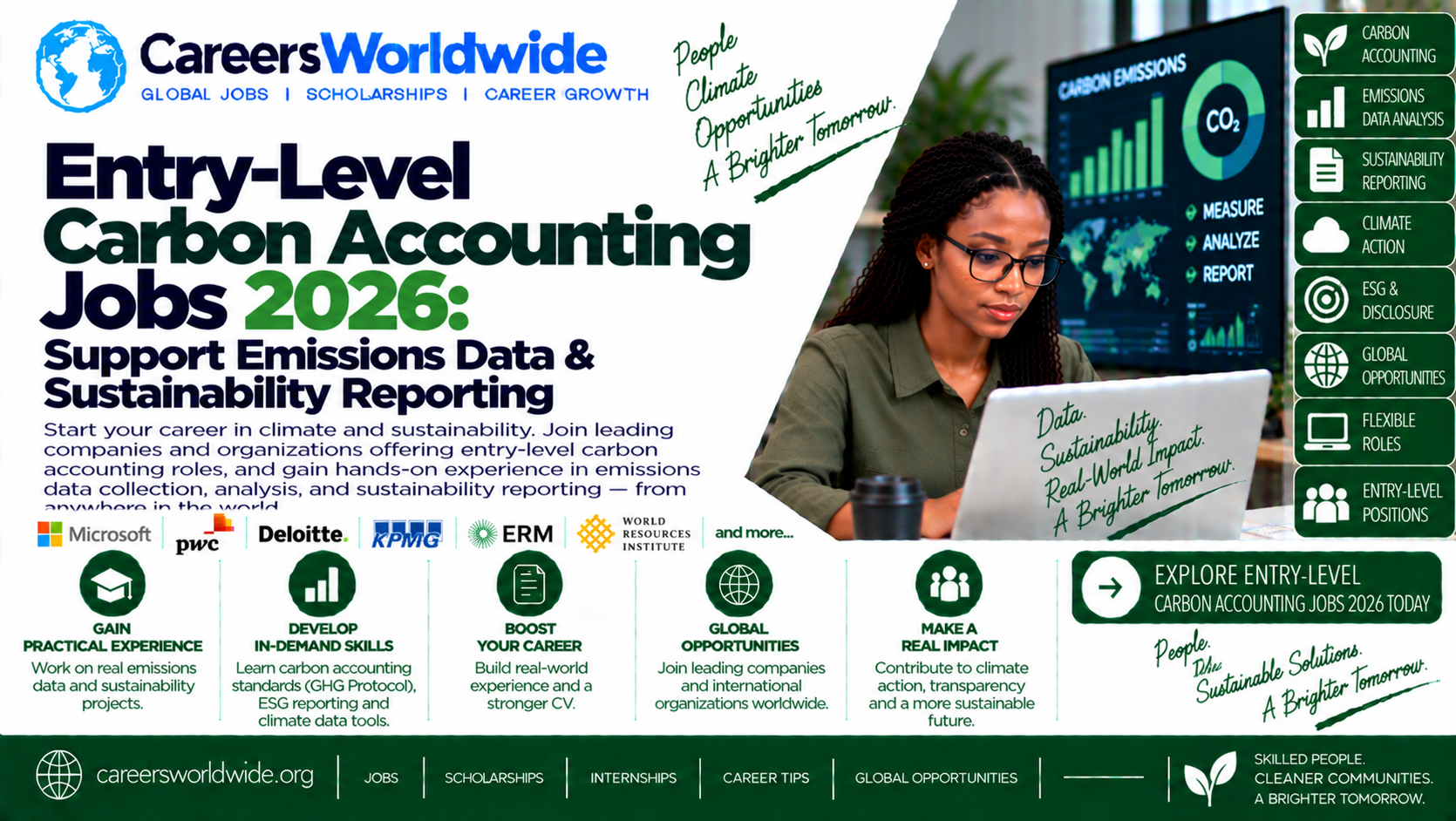

Excerpt: Entry-level carbon accounting jobs are creating opportunities for graduates and early-career professionals interested in climate data, sustainability reporting, environmental analysis and corporate emissions management. Learn what carbon accountants do, which skills employers look for, how to build practical experience, where to find opportunities in 2026, and how to prepare a strong application.
Businesses are under increasing pressure to understand, measure and communicate their greenhouse gas emissions. As companies collect environmental data, prepare sustainability disclosures and develop climate strategies, they need people who can organize emissions information, check calculations, maintain documentation and support reporting processes.
This has created a growing career area around carbon accounting, greenhouse gas accounting, sustainability data and climate reporting.
For graduates, entry-level carbon accounting jobs can provide a pathway into sustainability consulting, ESG reporting, climate analytics, environmental management, corporate sustainability and decarbonization.
The work is also becoming more connected to financial and corporate reporting. The IFRS Foundation’s IFRS S2 Climate-related Disclosures includes requirements relating to Scope 1, Scope 2 and Scope 3 greenhouse gas emissions, making emissions data an important component of climate-related disclosure for organizations applying the standard.
What Are Entry-Level Carbon Accounting Jobs?
Entry-level carbon accounting jobs involve supporting organizations in measuring, organizing, calculating, analyzing and reporting greenhouse gas emissions.
Despite the word “accounting,” these positions are not necessarily traditional accounting jobs. Carbon accounting combines elements of:
- Environmental science
- Data analysis
- Accounting and finance
- Sustainability
- Research
- Energy management
- Business reporting
- Compliance
- Climate strategy
A junior carbon accounting professional may work with electricity consumption, fuel use, business travel, purchased goods, logistics, waste, facilities and other operational information.
The information is then converted into emissions estimates, commonly expressed as carbon dioxide equivalent (CO2e).
The Greenhouse Gas Protocol provides widely used standards and guidance for organizations preparing greenhouse gas inventories. Its Corporate Standard covers corporate-level GHG inventories, while its Scope 3 Standard addresses value-chain emissions.
Why Carbon Accounting Matters in 2026
Carbon accounting is becoming increasingly relevant because organizations need reliable environmental information for multiple purposes.
Companies may use emissions data to:
- Understand their environmental footprint
- Identify major sources of emissions
- Track progress against reduction targets
- Prepare sustainability reports
- Respond to customer information requests
- Support investor disclosures
- Prepare climate-related reporting
- Develop decarbonization strategies
- Assess supply-chain emissions
- Support science-based climate targets
The reporting environment is also evolving.
For example, IFRS S2 requires relevant entities to disclose climate-related information and includes greenhouse gas emissions among its cross-industry metrics. The IFRS Foundation’s implementation resources specifically address GHG emissions disclosure requirements under IFRS S2.
At the same time, the GHG Protocol announced in July 2026 that it and ISO are working toward a consolidated corporate greenhouse-gas accounting standard, reflecting the continuing development of the global carbon-accounting landscape.
For job seekers, this means learning the fundamentals of emissions accounting can provide a foundation for several sustainability-related career paths.
Entry-Level Carbon Accounting Jobs 2026: Quick Summary
| Category | Typical Entry-Level Focus |
|---|---|
| Job field | Carbon accounting and sustainability |
| Experience | Graduate to approximately 0–3 years |
| Common titles | Carbon Analyst, Sustainability Analyst, ESG Analyst, GHG Accounting Analyst |
| Main data | Energy, fuel, travel, waste, procurement and operational data |
| Core framework | GHG Protocol |
| Common emissions categories | Scope 1, Scope 2 and Scope 3 |
| Important skills | Excel, data analysis, research and reporting |
| Useful knowledge | GHG inventories, emission factors and sustainability disclosures |
| Possible employers | Corporations, consultancies, financial institutions, NGOs and sustainability organizations |
| Academic backgrounds | Sustainability, environmental science, engineering, economics, finance, accounting, data analytics and related fields |
| Career progression | Carbon Analyst → Sustainability/ESG Analyst → Carbon Manager/Consultant → Sustainability or Climate Lead |
| Work style | Office, hybrid, remote or consulting depending on employer |
| Application strategy | Tailored CV + evidence of carbon-data skills + practical portfolio |
What Does a Junior Carbon Accountant Actually Do?
The exact responsibilities vary by organization, but entry-level employees often support more experienced sustainability, finance or climate professionals.
1. Collect emissions data
A junior analyst may request and organize information such as:
- Electricity consumption
- Natural gas usage
- Vehicle fuel
- Refrigerant information
- Business travel
- Employee commuting
- Freight and logistics
- Purchased materials
- Waste
- Supplier information
The challenge is often not simply finding numbers. It is determining whether the data is complete, comparable and suitable for emissions calculations.
2. Organize emissions inventories
Carbon accounting requires a structured inventory.
You may be asked to maintain spreadsheets or databases containing:
- Activity data
- Reporting periods
- Facilities
- Business units
- Emission sources
- Units of measurement
- Emission factors
- Calculated emissions
- Data sources
- Assumptions
- Quality checks
Attention to detail is therefore extremely important.
3. Support Scope 1, Scope 2 and Scope 3 calculations
Understanding the three major emissions categories is fundamental.
Scope 1 generally covers direct emissions from sources owned or controlled by an organization.
Examples can include fuel combustion in company-controlled equipment or certain industrial processes.
Scope 2 generally relates to indirect emissions associated with purchased or acquired electricity, steam, heating or cooling. The GHG Protocol has specific Scope 2 guidance for this area.
Scope 3 covers other indirect emissions throughout an organization’s value chain.
These can involve areas such as:
- Purchased goods and services
- Capital goods
- Transportation
- Business travel
- Employee commuting
- Use of sold products
- End-of-life treatment
Scope 3 can be particularly data-intensive because organizations often depend on information from suppliers, customers and other external sources.
4. Apply emission factors
Carbon accounting commonly involves converting activity data into estimated emissions.
For example, a company may have electricity consumption measured in kilowatt-hours. An appropriate emissions factor can then be applied to estimate associated greenhouse gas emissions.
A junior analyst needs to understand:
Activity data × Emission factor = Estimated emissions
Real-world calculations can be considerably more complicated because emission factors depend on geography, fuel type, methodology, reporting year and other factors.
5. Perform quality checks
Data quality is a major part of carbon accounting.
You may need to identify:
- Missing data
- Duplicate records
- Unusual changes
- Incorrect units
- Inconsistent reporting periods
- Unsupported assumptions
- Incorrect emission factors
- Calculation errors
Strong analytical habits can therefore be just as valuable as climate knowledge.
Skills Employers May Look For
Excel and spreadsheet skills
Excel remains highly useful for entry-level sustainability data work.
Learn:
- Pivot tables
- XLOOKUP
- SUMIFS
- IF statements
- Data validation
- Conditional formatting
- Basic charts
- Data cleaning
- Structured tables
You do not need to be an advanced programmer to begin building a carbon-accounting career.
Data analysis
Employers may value candidates who can work comfortably with structured datasets.
Useful skills include:
- Data cleaning
- Quality assurance
- Basic statistics
- Trend analysis
- Data visualization
- Documentation
- Spreadsheet modeling
Knowledge of SQL, Python or Power BI can provide an additional advantage for data-heavy positions.
GHG Protocol knowledge
The GHG Protocol should be high on the learning list for anyone targeting carbon-accounting roles.
Its Corporate Standard provides requirements and guidance for preparing corporate GHG inventories, while its Scope 3 Standard helps organizations assess value-chain emissions.
GHG Protocol official standards and guidance
Sustainability reporting
Learn how emissions data fits into broader corporate reporting.
You should understand concepts such as:
- Climate-related disclosures
- Sustainability reporting
- Materiality
- Climate risks
- Climate targets
- GHG inventories
- Data governance
- Assurance
- Reporting boundaries
IFRS S2 is particularly useful to understand at a foundational level because it connects climate-related disclosures with information relevant to users of general-purpose financial reports.
IFRS S2 Climate-related Disclosures
Do You Need an Accounting Degree?
Not necessarily.
The phrase “carbon accounting” can make the profession sound like a conventional financial-accounting career. In practice, organizations recruit people from several academic backgrounds.
Potentially relevant degrees include:
- Environmental science
- Environmental management
- Sustainability
- Climate science
- Engineering
- Energy studies
- Economics
- Finance
- Accounting
- Business
- Data analytics
- Statistics
- Geography
- Natural resources
Your academic background matters, but practical evidence can also be important.
For example, an environmental science graduate who has created a complete sample GHG inventory may demonstrate more directly relevant skills than a candidate who simply lists “interest in sustainability” on a CV.
Build a Carbon Accounting Portfolio
One of the best ways to demonstrate entry-level capability is to create practical projects.
Portfolio Project 1: Corporate GHG Inventory
Create a fictional company and calculate:
- Scope 1 emissions
- Scope 2 emissions
- Selected Scope 3 categories
- Total emissions
- Emissions by facility
- Emissions by source
Document your assumptions and sources.
Portfolio Project 2: Electricity Emissions Dashboard
Create a spreadsheet or Power BI dashboard showing:
- Monthly electricity consumption
- Emission factors
- Monthly CO2e
- Year-over-year changes
- Emissions intensity
- Highest-emitting facilities
Portfolio Project 3: Scope 3 Analysis
Select a fictional organization and analyze several Scope 3 categories.
Explain:
- What activity data is required.
- Where the data could come from.
- What assumptions are necessary.
- How the emissions could be estimated.
- What data-quality limitations exist.
Portfolio Project 4: Sustainability Reporting Brief
Create a five-page report explaining an organization’s climate performance.
Include:
- Organizational boundary
- Reporting period
- Scope 1
- Scope 2
- Scope 3
- Emissions intensity
- Reduction target
- Key limitations
- Recommendations for better data
This can become a strong interview discussion document.
Understanding ISO 14064 Can Also Help
Another useful framework to know is the ISO 14064 series.
ISO 14064-1:2018 specifies principles and requirements at the organizational level for quantifying and reporting greenhouse gas emissions and removals, including the design, development, management, reporting and verification of a GHG inventory. ISO states that this version remains current after review in 2024.
ISO 14064-1 official information
Job seekers do not necessarily need to purchase standards to begin learning the subject. Start by understanding the concepts, terminology and relationship between frameworks.
What Job Titles Should You Search For?
Do not search only for “Carbon Accountant.”
Organizations may use many different titles for similar entry-level work.
Try searching for:
- Junior Carbon Analyst
- Carbon Accounting Analyst
- GHG Analyst
- GHG Accounting Analyst
- Sustainability Analyst
- ESG Analyst
- Climate Data Analyst
- Environmental Data Analyst
- Carbon Data Analyst
- Sustainability Reporting Analyst
- ESG Reporting Analyst
- Climate Reporting Analyst
- Energy and Carbon Analyst
- Decarbonization Analyst
- Climate Consultant
- Sustainability Consultant
- Environmental Analyst
- Junior Sustainability Consultant
- ESG Data Analyst
- Carbon Footprint Analyst
Some roles may contain only a portion of carbon-accounting responsibilities.
Read the job description carefully rather than relying exclusively on the title.
Where Can You Find Entry-Level Carbon Accounting Jobs?
Sustainability consultancies
Consulting firms can be useful places to search because they may work with multiple clients across climate, energy, sustainability and reporting projects.
For example, ERM’s early-career program describes opportunities including climate and sustainability analysts, GIS and data specialists, and energy and carbon analysts. ERM states that its early-career opportunities are designed for recent graduates and early professionals with relevant backgrounds.
Corporate sustainability teams
Large companies increasingly have sustainability, ESG, climate or environmental teams.
Search company career portals for combinations such as:
“sustainability analyst” + company name
or:
“carbon” + “ESG” + careers
Environmental organizations
Environmental organizations and climate-focused institutions may advertise positions involving climate data, emissions, environmental reporting and research.
Financial institutions
Banks, asset managers and other financial organizations may employ sustainability and climate professionals because environmental information can affect investment analysis, risk management and reporting.
Reporting and disclosure organizations
CDP operates an environmental disclosure system and provides 2026 disclosure guidance and materials for organizations. Its career page also provides access to current vacancies.
How to Apply for Entry-Level Carbon Accounting Jobs
Step 1: Tailor your CV
Your CV should immediately communicate relevant skills.
Instead of writing:
Interested in sustainability and climate change.
Use evidence-based descriptions such as:
Built a sample corporate GHG inventory covering Scope 1, Scope 2 and selected Scope 3 categories using activity data, emission factors and documented assumptions.
The second statement gives the employer something concrete to evaluate.
Step 2: Highlight transferable skills
If you have limited professional experience, emphasize:
- Research projects
- University assignments
- Internships
- Data analysis
- Excel projects
- Environmental assessments
- Sustainability reports
- Academic research
- Volunteer projects
- Climate-related coursework
Step 3: Create a portfolio
A simple online portfolio can contain:
- GHG inventory
- Excel calculations
- Dashboard
- Methodology notes
- Sustainability reporting sample
- Data-quality checklist
Do not include confidential information from previous employers.
Step 4: Write a targeted cover letter
Explain why your background fits the role.
Focus on three things:
- Your technical foundation.
- Your evidence of practical work.
- Why the organization’s specific sustainability or climate work interests you.
Step 5: Apply through official channels
Use the employer’s official careers page whenever possible.
Avoid recruiters asking for payment to secure a job. Verify unusual job offers independently through the organization’s official website.
How to Prepare for Carbon Accounting Interviews
Interview questions may test both technical understanding and attention to detail.
Be prepared for questions such as:
What is carbon accounting?
Explain that it involves quantifying and reporting an organization’s greenhouse gas emissions using defined boundaries, activity data, emission factors and appropriate methodologies.
What is the difference between Scope 1, Scope 2 and Scope 3?
Give a simple definition and a practical example for each.
How would you handle missing emissions data?
Explain that you would first investigate the source, check whether alternative primary data exists, document the gap and apply an appropriate estimation methodology if required.
How would you check a carbon dataset?
Discuss unit checks, duplicate detection, unusual-value checks, source documentation, reporting-period consistency and calculation verification.
What is CO2e?
Explain that carbon dioxide equivalent provides a common way of expressing the climate impact of different greenhouse gases using their global-warming potential.
What is Scope 3?
Explain that it addresses indirect emissions across an organization’s value chain and that it can involve significant data-collection and estimation challenges.
A Practical 30-Day Preparation Plan
Week 1: Learn the fundamentals
Study:
- Greenhouse gases
- CO2e
- Scope 1
- Scope 2
- Scope 3
- Organizational boundaries
- Operational boundaries
- Emission factors
Use the official GHG Protocol resources as your foundation.
Week 2: Build technical skills
Practice:
- Excel
- Data cleaning
- Pivot tables
- Basic dashboards
- Simple emissions calculations
Week 3: Build a portfolio
Create a fictional company’s emissions inventory.
Document:
- Data sources
- Calculations
- Assumptions
- Emission factors
- Results
- Limitations
Week 4: Apply
Search for:
- Carbon Analyst
- Sustainability Analyst
- ESG Analyst
- Climate Analyst
- GHG Analyst
- Sustainability Reporting Analyst
- Energy and Carbon Analyst
- Junior Sustainability Consultant
Submit tailored applications rather than sending the same CV to every employer.
Career Progression After an Entry-Level Carbon Accounting Job
Carbon accounting can lead to several different career directions.
A possible progression is:
Junior Carbon Analyst → Carbon/Sustainability Analyst → Senior Sustainability Analyst → Carbon Manager or Climate Consultant → Sustainability/Climate Lead
Other pathways include:
- ESG reporting
- Sustainability assurance
- Climate risk
- Decarbonization
- Energy management
- Sustainable finance
- ESG data
- Environmental consulting
- Climate strategy
- Supply-chain sustainability
- Corporate sustainability
The career does not have to remain exclusively focused on calculations.
Frequently Asked Questions
Are carbon accounting jobs suitable for recent graduates?
Yes. Some employers specifically advertise early-career sustainability and environmental positions. ERM, for example, describes early-career opportunities for recent graduates and early professionals across sustainability-related technical and analytical areas.
However, requirements vary by employer, so always check the specific vacancy.
Do I need professional carbon-accounting certification?
Not necessarily for every entry-level role.
A certification can be useful, but practical knowledge of GHG accounting, data analysis and reporting can also strengthen your profile.
Is carbon accounting the same as financial accounting?
No. Carbon accounting focuses on measuring and reporting greenhouse gas emissions rather than primarily tracking financial transactions.
There can nevertheless be overlap between sustainability reporting, financial reporting, risk and corporate disclosure.
Can finance graduates work in carbon accounting?
Yes. Finance, economics and accounting graduates can potentially bring useful skills in data management, reporting, controls and quantitative analysis.
They should complement that background with GHG accounting and sustainability knowledge.
Can environmental science graduates enter this field?
Yes. Environmental science provides a relevant foundation, particularly when combined with data analysis and reporting skills.
Is Excel important?
Yes. Many entry-level sustainability-data tasks can involve spreadsheets, data cleaning, calculations and quality checks.
Advanced tools such as SQL, Python, Power BI or specialized ESG software can provide additional capabilities.
What is the most important framework to learn first?
For corporate greenhouse gas accounting, the GHG Protocol is an important starting point because its Corporate Standard and related guidance provide frameworks for measuring and reporting organizational emissions.
Can carbon accounting jobs be remote?
Some sustainability-data roles may offer remote or hybrid arrangements, but this varies considerably by employer, location, client requirements and the nature of the work.
Always check the individual vacancy.
Are there opportunities outside major climate organizations?
Yes. Carbon-accounting skills can be relevant across sectors including manufacturing, technology, financial services, logistics, energy, retail, agriculture, consulting and professional services.
Is Scope 3 important for entry-level candidates?
It can be. Scope 3 often requires extensive data collection, estimation and supplier engagement, making it useful knowledge for candidates interested in corporate emissions analysis. The GHG Protocol provides a dedicated Scope 3 Standard and calculation guidance.
Official Application and Learning Resources
Job seekers should prioritize official sources when researching employers, standards and vacancies.
GHG Protocol: Learn the Corporate Standard, Scope 2 Guidance and Scope 3 resources.
GHG Protocol Standards & Guidance
IFRS Foundation: Review IFRS S2 and its implementation resources for climate-related disclosures and greenhouse gas emissions.
ISO: Review the official information on ISO 14064-1 for organizational GHG quantification and reporting.
CDP: Explore disclosure guidance and current careers. CDP’s 2026 disclosure resources include guidance for corporate and other reporting organizations.
Science Based Targets initiative: Learn how corporate emissions targets connect with climate strategy and the Corporate Net-Zero Standard.
Science Based Targets initiative – Corporate Net-Zero Standard
ERM: Search early-career sustainability, climate, environmental and energy/carbon opportunities.
Final Takeaway
Entry-level carbon accounting jobs can provide a practical entry point into the expanding field of sustainability data and climate reporting.
The strongest candidates do not necessarily need years of experience. They need to demonstrate that they understand the fundamentals and can work carefully with data.
Start with the GHG Protocol. Learn Scope 1, Scope 2 and Scope 3. Improve your Excel and data-analysis skills. Understand the role of emissions information in sustainability and climate disclosures. Then build a small portfolio showing that you can transform raw activity data into a documented emissions analysis.
As reporting requirements, corporate climate strategies and emissions-management systems continue to evolve, the ability to produce organized, transparent and reliable emissions information can become a valuable foundation for a broader sustainability career.
For 2026 job seekers, the goal should not simply be to search for a vacancy titled “Carbon Accountant.” Search broadly across carbon analysis, sustainability data, ESG reporting, climate analytics, energy and carbon, environmental analysis and sustainability consulting.
The most important step is to turn your interest in climate into demonstrable skills and evidence of practical work.
Disclaimer
This article is provided for general career and educational information only. It does not guarantee employment, interviews, selection or eligibility for any particular position. Job titles, qualifications, locations, work arrangements and application requirements vary by employer and may change without notice. Always review the official vacancy and employer career page before applying. Do not pay a recruiter or third party to obtain a legitimate job unless an official employer process clearly requires a documented fee.
SEO Information
SEO Title: Entry-Level Carbon Accounting Jobs 2026: Emissions & Sustainability Careers
Meta Description: Explore entry-level carbon accounting jobs in 2026, including carbon analyst, ESG and sustainability reporting careers. Learn skills, applications and official resources.
Focus Keyword: Entry-Level Carbon Accounting Jobs 2026
URL Slug: entry-level-carbon-accounting-jobs-2026
Suggested Excerpt: Entry-level carbon accounting jobs offer graduates a pathway into emissions data, ESG reporting and corporate sustainability. Learn the skills, job titles, portfolio projects and official resources to start your career in 2026.
SEO Keywords:
- Entry-Level Carbon Accounting Jobs 2026,
- Carbon Accounting Jobs 2026,
- Junior Carbon Analyst Jobs,
- Carbon Analyst Jobs,
- GHG Accounting Jobs,
- Greenhouse Gas Accounting Jobs,
- Sustainability Analyst Jobs 2026,
- ESG Analyst Jobs 2026,
- Climate Data Analyst Jobs,
- Carbon Data Analyst Jobs,
- Sustainability Reporting Jobs,
- ESG Reporting Jobs,
- Scope 1 Scope 2 Scope 3 Jobs,
- GHG Analyst Jobs,
- Environmental Data Analyst Jobs,
- Energy and Carbon Analyst Jobs,
- Climate Reporting Jobs,
- Entry-Level Sustainability Jobs,
- Graduate Carbon Accounting Jobs,
- Graduate Sustainability Jobs 2026,
- ESG Data Jobs,
- Climate Analytics Jobs,
- Sustainability Consulting Jobs,
- Carbon Footprint Analyst Jobs,
- Remote Carbon Accounting Jobs,
- Carbon Accounting Careers,
- Sustainability Careers 2026,
ALSO CHECK: Food Security Internships 2026: Work on Agriculture, Nutrition & Sustainable DevelopmentSeptember 23, 2026
Blockchain Development Internships 2026: Explore Distributed Applications & Digital SystemsSeptember 23, 2026
Geospatial Analytics Internships 2026: Explore GIS, Mapping & Location DataSeptember 23, 2026