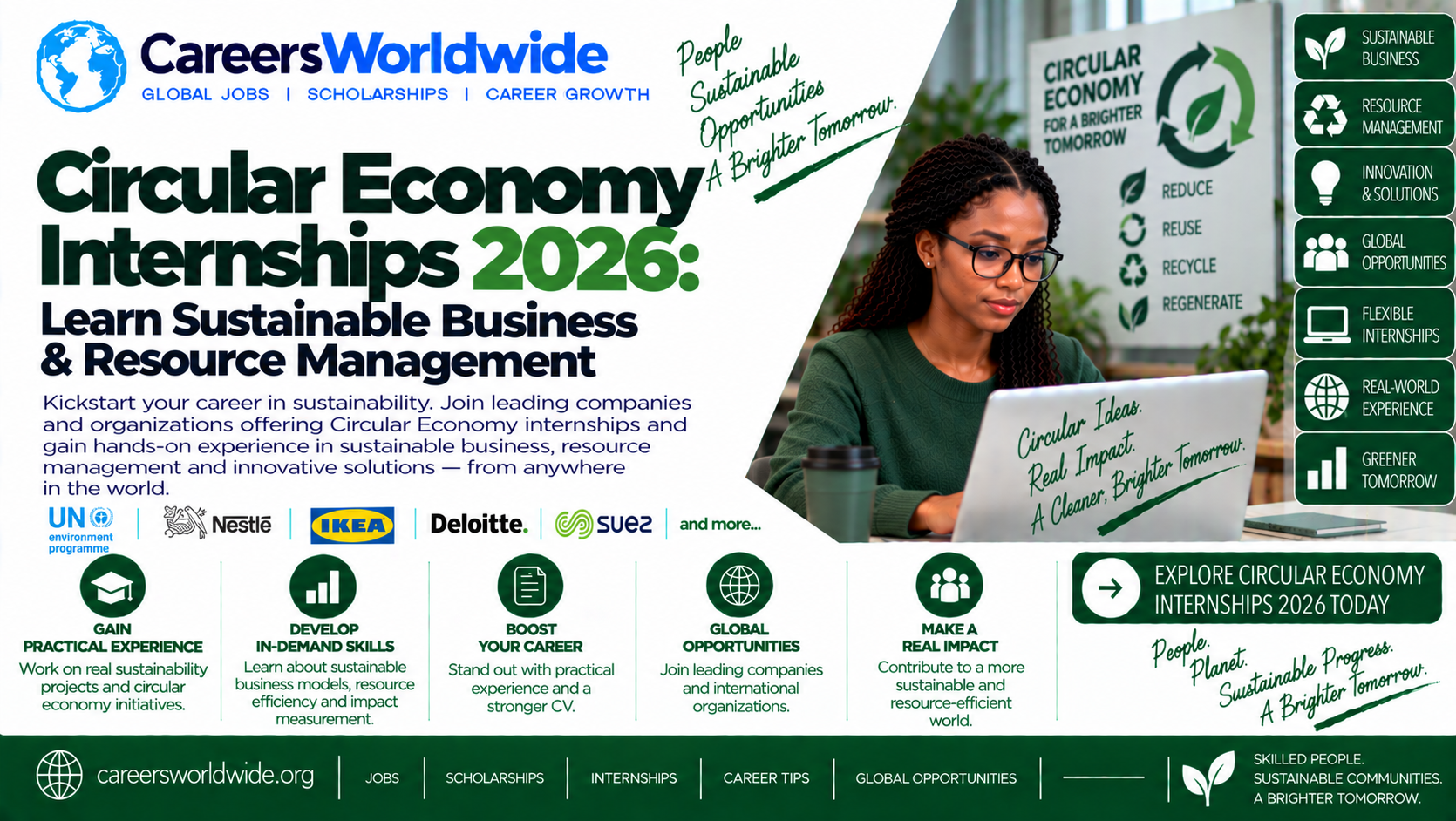

Excerpt: Circular Economy Internships 2026 can help students and early-career professionals build practical skills in sustainable business, resource efficiency, waste reduction, circular design, supply chains, recycling, ESG and responsible production. This guide explains what circular economy interns do, where to find opportunities, skills employers look for, how to prepare a strong application, and official resources to explore. Circular Economy Internships 2026: Learn Sustainable Business & Resource Management
Circular Economy Internships 2026: An Emerging Career Path
The circular economy is increasingly becoming part of discussions around business strategy, resource security, product development, supply chains, environmental management and sustainable consumption.
Unlike the traditional linear model of take, make and dispose, a circular economy aims to eliminate waste and pollution, keep products and materials in use and regenerate natural systems. These principles are central to the work of the Ellen MacArthur Foundation, one of the organisations focused specifically on accelerating the transition to a circular economy.
For students and recent graduates, this creates an interdisciplinary career path.
A circular-economy internship could involve analysing materials, researching markets, supporting sustainability projects, examining supply chains, developing business cases, studying waste streams, assisting with environmental reporting or researching policies.
Importantly, you do not necessarily need a degree titled Circular Economy.
Students studying business, economics, engineering, environmental science, finance, supply-chain management, data analytics, design, public policy, communications and related subjects can find relevant pathways.
What Is a Circular Economy Internship?
A circular economy internship is a structured learning and work experience focused on how organisations can use resources more efficiently and reduce waste while maintaining or creating economic value.
Depending on the organisation, interns may support projects involving:
- Sustainable business models
- Resource efficiency
- Recycling and recovery
- Product reuse
- Repair and refurbishment
- Sustainable procurement
- Circular supply chains
- Packaging
- Product design
- Environmental research
- ESG
- Sustainability reporting
- Waste management
- Materials management
- Sustainable finance
- Policy analysis
- Data analysis
The work can therefore look very different from one internship to another.
For example, an engineering intern might investigate how a product can be redesigned for repair. A business student could research whether a reusable packaging model is commercially viable. A data analyst intern could develop a dashboard showing waste or resource-use indicators.
The Ellen MacArthur Foundation’s education resources emphasise that circular-economy learning should help people apply circular thinking in their chosen careers.
Why Circular Economy Skills Matter in 2026
Circular economy is increasingly connected to major business and environmental questions.
Companies need to consider issues such as material availability, supply-chain resilience, packaging, waste, product longevity and changing sustainability expectations.
The Ellen MacArthur Foundation’s current work highlights plastics and packaging, critical minerals, and fashion and textiles among its mission areas.
This illustrates how broad the circular economy field has become.
A student who learns circular-economy concepts can potentially apply those skills across several professional areas.
Business
Circular business models can include:
- Product-as-a-service
- Rental
- Sharing
- Repair
- Resale
- Refurbishment
- Take-back programmes
Supply Chains
Circularity can influence:
- Procurement
- Materials sourcing
- Logistics
- Packaging
- Returns
- Supplier management
Engineering
Engineers may work on:
- Product durability
- Repairability
- Materials
- Design for disassembly
- Manufacturing efficiency
Finance
Circular-economy projects can require:
- Investment analysis
- Business cases
- Financial modelling
- Risk analysis
- Sustainable finance research
Data
Data professionals can analyse:
- Material flows
- Waste
- Resource consumption
- Recycling rates
- Environmental indicators
This makes circular economy a useful additional specialisation rather than necessarily a standalone career.
Types of Circular Economy Internships
1. Circular Business Internships
These positions focus on how companies can change the way they create and capture value.
An intern might research:
- Reusable products
- Repair services
- Rental models
- Resale platforms
- Product take-back
- Refurbishment
- Sharing models
Business, economics and management students may find these roles particularly relevant.
2. Sustainability Internships
Not every relevant opportunity will contain the words “circular economy.”
Search for sustainability internships involving:
- Environmental performance
- Resource efficiency
- ESG
- Waste reduction
- Sustainable operations
- Responsible sourcing
- Sustainability reporting
These roles can provide transferable experience for future circular-economy positions.
3. Circular Supply Chain Internships
Supply chains are an important part of resource management.
Interns may analyse:
- Supplier practices
- Packaging
- Material sourcing
- Transportation
- Inventory
- Product returns
- Procurement
- Waste
These positions can be useful for students studying logistics, procurement, operations or business.
4. Circular Design Internships
Circular design focuses on preventing waste through better product and system design.
Possible responsibilities include:
- Material research
- Product research
- Packaging design
- Repairability
- Recyclability
- Product longevity
- Design-for-disassembly
Students studying industrial design, engineering, architecture or product development may find this area particularly relevant.
5. Waste and Resource Management Internships
These internships can provide hands-on exposure to:
- Waste audits
- Recycling
- Materials recovery
- Waste prevention
- Electronic waste
- Organic waste
- Resource efficiency
Such experience can lead toward environmental management and resource-management careers.
6. Circular Economy Research Internships
Research roles may involve:
- Literature reviews
- Market research
- Policy research
- Data collection
- Report writing
- Industry analysis
- Circular-business research
Strong analytical and writing abilities are valuable here.
7. Sustainable Finance Internships
Circular businesses need financing.
An intern could potentially contribute to:
- Investment research
- Financial analysis
- Sustainability-linked finance
- Market research
- Business cases
- ESG analysis
This pathway can be particularly relevant for finance and economics students.
Circular Economy Internships 2026 Summary Table
| Internship Area | Potential Responsibilities | Useful Background |
|---|---|---|
| Circular Business | Business-model research | Business, economics |
| Sustainability | ESG and environmental projects | Sustainability, business |
| Resource Management | Materials and waste analysis | Environmental science |
| Circular Supply Chain | Sustainable sourcing | Supply chain, procurement |
| Circular Design | Product and packaging research | Design, engineering |
| Waste Management | Waste reduction and recovery | Environmental studies |
| Circular Finance | Financial and market research | Finance, economics |
| Policy | Circular-economy research | Public policy, economics |
| Data | Sustainability analytics | Data science, statistics |
| Communications | Sustainability content | Communications, marketing |
Skills to Develop Before Applying
You do not need every skill listed below. Instead, identify the requirements that appear most frequently in the internships you want.
Circular Economy Fundamentals
Learn the difference between:
- Linear economy
- Circular economy
- Recycling
- Reuse
- Repair
- Refurbishment
- Remanufacturing
- Resource efficiency
- Sustainable consumption
- Sustainable production
- Life-cycle thinking
Being able to explain these concepts clearly can help during interviews.
Research
Develop your ability to:
- Find reliable information
- Compare sources
- Analyse industry reports
- Summarise findings
- Write research briefs
- Present recommendations
Excel and Data Analysis
Excel remains useful for sustainability work.
Practice:
- Pivot tables
- Charts
- Formulas
- Data cleaning
- Basic analysis
- Dashboards
For more technical roles, consider learning:
- Power BI
- SQL
- Python
- Tableau
Business Analysis
Learn how to evaluate an idea from both environmental and commercial perspectives.
Ask:
- Does it reduce resource use?
- Does it reduce waste?
- What does it cost?
- Who is the customer?
- How does the organisation make money?
- What operational changes are necessary?
- What risks exist?
Communication
Circular-economy projects can involve technical, business and policy stakeholders.
Practice writing:
- Executive summaries
- Research briefs
- Presentations
- Project reports
- Recommendations
How to Build Experience Before Your First Internship
One of the biggest challenges for students is the requirement for “experience” in entry-level applications.
You can start building relevant evidence before receiving your first internship.
Create a Circular Economy Portfolio
A portfolio can demonstrate what you can actually do.
Project 1: Packaging Analysis
Choose a common product.
Analyse:
- Packaging materials
- Product lifespan
- Reuse potential
- Recycling potential
- Waste generated
- Alternative materials
- Improvement opportunities
Then create a short report.
Project 2: Waste Audit
Conduct a simple waste audit at a school, university, office or simulated workplace.
Categorise waste into areas such as:
- Paper
- Plastics
- Food
- Glass
- Metals
- Electronics
- Other materials
Then develop recommendations.
Project 3: Circular Business Model
Choose an industry such as:
- Fashion
- Electronics
- Furniture
- Food
- Packaging
Develop a circular business concept based on repair, reuse, rental, resale or refurbishment.
Explain:
- The problem
- The proposed solution
- The customer
- Revenue model
- Operational requirements
- Environmental benefits
- Risks
Project 4: Sustainability Dashboard
Use Excel or Power BI to create a dashboard showing indicators such as:
- Waste generated
- Recycling rate
- Material consumption
- Packaging volume
- Energy consumption
- Water consumption
This can demonstrate both sustainability and analytical skills.
How to Find Circular Economy Internships in 2026
Do not search for only one job title.
Use a broad search strategy.
Useful Search Terms
Try:
- Circular Economy Intern
- Circular Economy Internship
- Sustainability Intern
- ESG Intern
- Environmental Intern
- Resource Management Intern
- Sustainable Business Intern
- Circular Design Intern
- Sustainable Supply Chain Intern
- Waste Management Intern
- Environmental Research Intern
- Sustainability Analyst Intern
- Sustainable Finance Intern
- Responsible Sourcing Intern
- Climate Intern
- Resource Efficiency Intern
Search company career pages directly whenever possible.
The Ellen MacArthur Foundation confirms that it sometimes offers internships and entry-level positions and directs candidates to its current vacancies. It also states that it does not accept speculative applications.
Official Application Resources
Ellen MacArthur Foundation
The Ellen MacArthur Foundation is one of the most directly relevant organisations for circular-economy careers.
Its official careers page explains that the organisation works with businesses, governments and academic institutions to accelerate the transition to a circular economy.
Ellen MacArthur Foundation Careers
Its FAQ confirms that internships and entry-level positions may be available and that applicants should apply through advertised vacancies rather than speculative applications.
Ellen MacArthur Foundation Careers FAQ
European Commission Traineeships
The European Commission’s Blue Book programme is another official resource worth researching for applicants interested in European policy and sustainability-related work.
The programme is a five-month paid traineeship and provides practical experience in EU policymaking and administration.
European Commission Jobs and Traineeships
The official programme explains that applications open twice each year, with specific application periods for March and October traineeships.
Applicants should check eligibility carefully because some positions may have nationality or other restrictions.
Blue Book Traineeship Programme
EU Careers Traineeships
The official EU Careers portal provides information about traineeships across EU institutions, bodies and agencies.
This can be useful when searching for opportunities related to environmental policy, resource management, sustainability and related areas.
Circular Economy Learning Resources
Before applying, strengthen your knowledge through the Ellen MacArthur Foundation’s education resources.
Ellen MacArthur Foundation Education and Learning Resources
The Foundation explains that education has an important role in giving people the skills and knowledge to apply circular thinking in their careers.
How to Apply for Circular Economy Internships
Step 1: Choose Your Career Direction
Decide which area interests you most.
For example:
Business: circular business models
Engineering: circular product development
Finance: sustainable and circular finance
Data: sustainability analytics
Environment: resource and waste management
Supply Chain: sustainable procurement
This makes your applications more focused.
Step 2: Research the Organisation
Before applying, investigate:
- Its business model
- Sustainability priorities
- Products or services
- Circular initiatives
- Internship responsibilities
- Eligibility requirements
Do not submit the same generic application to every employer.
Step 3: Tailor Your CV
Your CV should demonstrate relevant evidence.
Instead of simply writing:
Passionate about sustainability.
Use measurable evidence where possible:
Analysed packaging materials and developed recommendations for reducing single-use packaging.
Or:
Created an Excel dashboard to analyse waste categories and recycling rates.
The second approach gives recruiters something concrete to evaluate.
Step 4: Prepare a Cover Letter
Your cover letter should explain:
- Why you are interested
- What you have already done
- What skills you bring
- Why the organisation interests you
- How the internship fits your career direction
Avoid making the entire letter about what you want to receive from the internship.
Explain what you can contribute as well.
Step 5: Prepare for the Interview
Potential questions include:
- What is a circular economy?
- How does it differ from a linear economy?
- Why should businesses adopt circular models?
- What is resource efficiency?
- How could a company reduce waste?
- What circular business model interests you?
- Tell us about a sustainability project.
- How would you conduct a waste audit?
- How would you communicate sustainability data to senior management?
Prepare examples from university, volunteering, personal projects or previous employment.
How to Stand Out From Other Applicants
Avoid relying only on generic sustainability language.
Build evidence.
For example, instead of saying:
I am passionate about circular economy.
Show it through:
- A circular-economy research project
- A waste audit
- A sustainability dashboard
- A business-model analysis
- An environmental research paper
- Relevant coursework
- Volunteer experience
- Sustainability-related student projects
You can also publish selected work through a professional portfolio or LinkedIn profile.
The goal is to make it easy for a recruiter to see the connection between your skills and the internship.
Circular Economy Internships for International Applicants
International applicants should carefully examine eligibility requirements.
An internship described as “remote” does not necessarily mean that candidates from every country can participate.
Possible restrictions include:
- Citizenship
- Residency
- Work authorisation
- University enrolment
- Time zone
- Location
- Language requirements
The European Commission, for example, explains that certain services or agencies may not recruit nationals from non-EU countries for particular traineeship positions.
Therefore, applicants should never assume eligibility from the word “international” or “remote.”
Read the official vacancy carefully.
Career Options After a Circular Economy Internship
A circular-economy internship can potentially support several career directions.
Examples include:
- Circular Economy Analyst
- Sustainability Analyst
- ESG Analyst
- Sustainability Consultant
- Environmental Consultant
- Resource Management Specialist
- Sustainable Supply Chain Analyst
- Sustainable Procurement Specialist
- Circular Business Strategist
- Circular Design Specialist
- Waste Management Specialist
- Sustainability Data Analyst
- Environmental Policy Analyst
- Sustainable Finance Analyst
- Climate and Resource Consultant
The most useful combination may be circular-economy knowledge plus another professional discipline.
For example:
Data + Circular Economy = Sustainability Data Analytics
Finance + Circular Economy = Sustainable Finance
Business + Circular Economy = Circular Business Strategy
Engineering + Circular Economy = Circular Product Development
Supply Chain + Circular Economy = Circular Supply Chain Management
30-Day Circular Economy Internship Preparation Plan
Days 1–7: Learn
Study:
- Circular economy
- Resource efficiency
- Waste hierarchy
- Reuse
- Repair
- Recycling
- Circular business models
- Sustainable consumption
Days 8–14: Specialise
Choose one area:
- Business
- Supply chain
- Finance
- Design
- Environment
- Data
- Policy
Days 15–21: Build
Complete one portfolio project.
Document:
- Problem
- Research
- Data
- Analysis
- Recommendations
Days 22–26: Prepare
Update:
- CV
- Cover letter
- Portfolio
- References
Days 27–30: Apply
Create an application tracker containing:
- Organisation
- Internship title
- Deadline
- Location
- Eligibility
- Application date
- Status
Apply through official career portals whenever possible.
Frequently Asked Questions
What degree is needed for a circular economy internship?
There is no universal degree requirement. Relevant backgrounds include environmental science, sustainability, business, economics, engineering, finance, supply chain, design, data science and public policy.
The vacancy determines the actual eligibility requirements.
Are Circular Economy Internships 2026 paid?
Some internships are paid, while others may be unpaid or structured as academic placements. Compensation varies by employer, country and programme.
Always verify compensation through the official vacancy.
Can business students apply?
Yes. Circular economy involves business models, operations, supply chains, procurement, markets and finance.
Can engineering students apply?
Yes. Engineering can be relevant to product design, materials, manufacturing, repairability and resource efficiency.
Can finance students apply?
Yes. Circular businesses may require investment analysis, financial modelling, market research and sustainable-finance expertise.
Can international students apply?
Some programmes accept international applicants, while others impose nationality, residency or work-authorisation requirements.
Check the official eligibility criteria before applying.
Are remote circular economy internships available?
Remote opportunities can exist, but availability and geographic eligibility vary. Remote does not automatically mean worldwide.
What if I have no professional experience?
Use academic projects, coursework, volunteering, research assignments and personal projects.
A well-documented circular-economy project can demonstrate initiative and relevant skills.
Is recycling the same as circular economy?
No. Recycling is only one part of circularity. Circular economy can also involve prevention, reuse, repair, refurbishment, remanufacturing and product-life extension.
Where can I learn circular economy?
The Ellen MacArthur Foundation provides education and learning resources designed to help learners understand and apply circular-economy concepts.
Final Takeaway
Circular Economy Internships 2026 can provide valuable practical experience at the intersection of sustainability, business and resource management.
The field is broader than recycling. It can involve product design, supply chains, procurement, finance, data, policy, waste management, environmental research and business strategy.
The best preparation is to combine knowledge with evidence.
Learn the fundamentals, choose a specialisation, build at least one practical project and tailor your CV to each opportunity.
When searching, use a broad range of titles rather than relying exclusively on “Circular Economy Intern.” Sustainability, ESG, resource management, environmental research, sustainable supply chain, circular design and sustainable-business internships can all provide relevant experience.
Use official employer and institutional websites to verify vacancies, eligibility, deadlines and application procedures. The Ellen MacArthur Foundation specifically advises applicants to use its advertised vacancies rather than submitting speculative applications.
Disclaimer
This article is for informational and career-planning purposes only. Internship availability, deadlines, eligibility requirements, compensation, locations and application procedures can change. CareersWorldwide does not guarantee employment, admission or selection. Applicants should verify every opportunity through the organisation’s official website before submitting personal information or documents. Be cautious of anyone requesting payment in exchange for an internship application or selection unless a legitimate programme clearly states an official fee.
SEO Information
SEO Title: Circular Economy Internships 2026: Sustainable Business & Resource Management
Meta Description: Explore Circular Economy Internships 2026 in sustainable business, resource management, circular design, ESG, supply chains and environmental sustainability.
Focus Keyword: Circular Economy Internships 2026
Suggested URL Slug: circular-economy-internships-2026
Suggested Excerpt: Discover Circular Economy Internships 2026 and learn how to build practical skills in sustainable business, resource management, circular design, ESG and sustainable supply chains.
SEO Keywords:
- Circular Economy Internships 2026,
- circular economy internships,
- sustainability internships 2026,
- sustainable business internships,
- resource management internships,
- circular economy jobs 2026,
- sustainability jobs 2026,
- ESG internships 2026,
- sustainable supply chain internships,
- environmental internships 2026,
- circular design internships,
- waste management internships,
- recycling internships,
- resource efficiency internships,
- green internships 2026,
- sustainable finance internships,
- environmental management internships,
- circular business internships,
- international sustainability internships,
- graduate sustainability internships,
- student sustainability internships,
- circular economy careers,
- sustainable business careers,
- environmental careers 2026,
ALSO CHECK: Remote LLM Application Developer Jobs 2026: Build AI-Powered SoftwareSeptember 22, 2026
Remote KYC Analyst Jobs 2026: Support Customer Due Diligence & ComplianceSeptember 22, 2026
Remote Technical Documentation Specialist Jobs 2026: Create Software Guides & Knowledge BasesSeptember 22, 2026