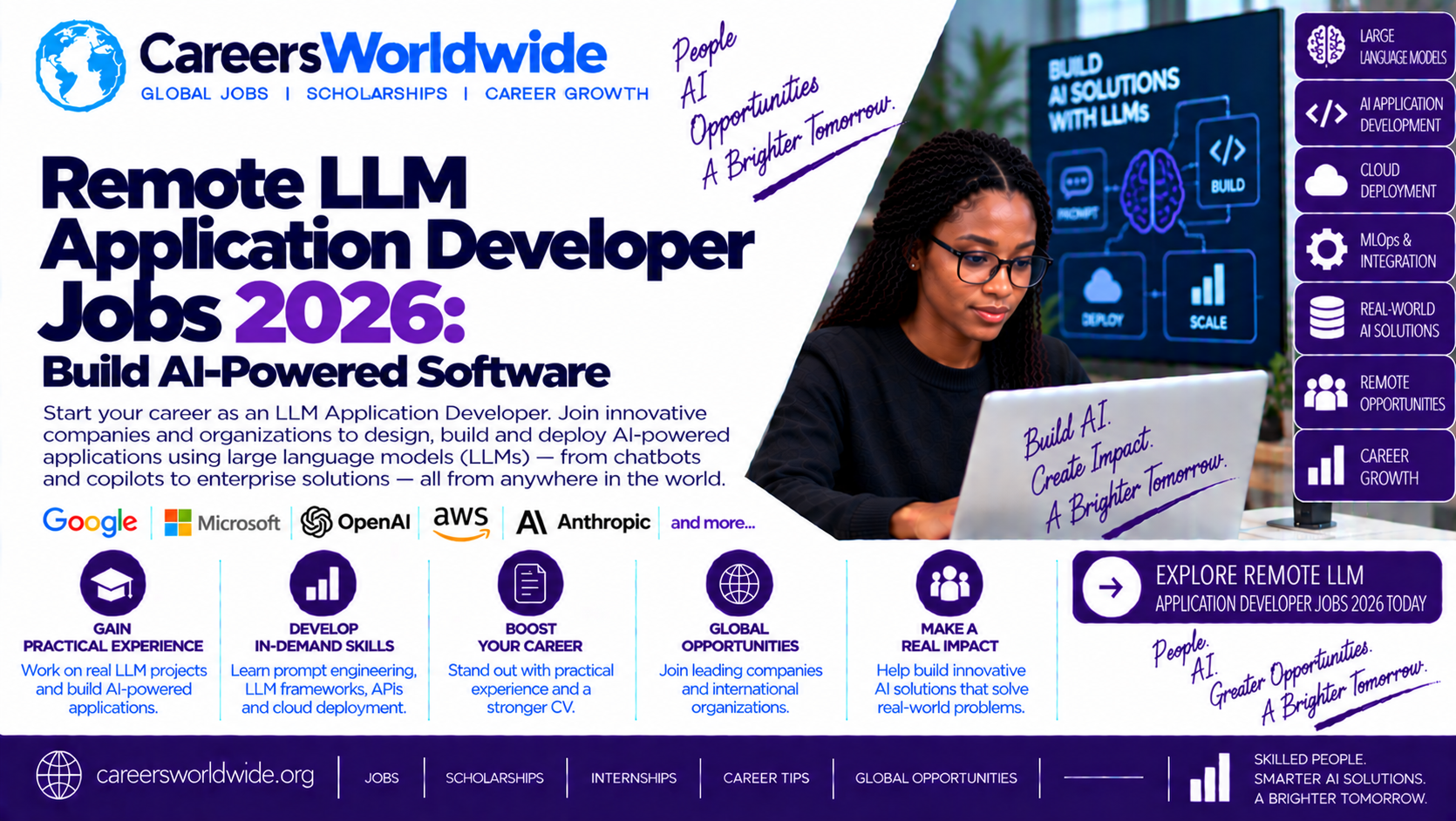

Excerpt: Discover remote Large Language Model (LLM) application developer careers in 2026. Explore key responsibilities, programming and AI skills, portfolio projects, job-search strategies, application tips, and official learning resources to help you prepare for AI-powered software development opportunities.
Large Language Model (LLM) applications are becoming part of software products used for search, document analysis, customer support, writing assistance, and business workflows. Developers who can connect language models to useful, secure, and maintainable applications may find opportunities across software companies, startups, consulting firms, and technology teams.
Remote LLM application developer jobs combine software engineering with applied AI. The work can include integrating model APIs, building retrieval-augmented generation (RAG) systems, designing user interfaces, evaluating outputs, and deploying applications.
This career path is not limited to training AI models from scratch. Many application developers focus on engineering the software around existing models—making it reliable, safe, useful, and suitable for real users.
Important: Remote does not necessarily mean worldwide. Employers may limit hiring to particular countries, regions, or time zones. Check each vacancy’s official eligibility requirements before applying.
1. What Are Remote LLM Application Developer Jobs?
LLM stands for Large Language Model. These models can process and generate text and, depending on the model, work with other kinds of information. Developers integrate them into software to support tasks such as answering questions, summarizing documents, extracting structured information, or assisting users with complex workflows.
An LLM application developer builds the software that makes these capabilities accessible to users.
A typical application may include:
- A web or mobile interface.
- A backend service that communicates with a model.
- Data retrieval or search functionality.
- Instructions and context supplied to the model.
- Authentication and access controls.
- Error handling and usage limits.
- Testing, evaluation, logging, and monitoring.
The role requires more than prompt writing. Developers need to understand how the model fits into the complete application, how to handle incorrect or incomplete responses, and how to maintain the system after deployment.
Common job titles
| Job title | Typical focus |
|---|---|
| LLM Application Developer | Building software powered by language models |
| Generative AI Engineer | Developing applications using generative AI |
| Applied AI Engineer | Applying AI techniques to practical product problems |
| AI Software Engineer | Integrating AI features into software products |
| LLM Engineer | May include application development, inference, or model integration |
| RAG Engineer | Building retrieval-augmented generation systems |
| AI Backend Engineer | Developing APIs and backend services for AI features |
| Conversational AI Developer | Creating chatbots and conversational interfaces |
| AI Agent Engineer | Developing systems that use models to select or request actions |
Job titles are not standardized. Read the responsibilities to determine whether a position focuses on application development, machine learning research, infrastructure, or a combination.
2. What Does an LLM Application Developer Do?
Responsibilities depend on the employer, product, and seniority of the role.
Integrate language models
Developers connect applications to models through APIs or approved deployment environments. They handle requests, responses, configuration, authentication, timeouts, and rate limits.
Build AI-powered features
Examples include:
- AI assistants that answer questions about a defined knowledge base.
- Tools that summarize documents or reports.
- Search applications that provide generated explanations.
- AI-assisted writing or coding features.
- Customer-support assistants.
- Text classification and information extraction tools.
- Internal productivity applications.
Develop retrieval-augmented generation systems
RAG combines information retrieval with model generation. An application retrieves relevant information from a source and supplies it as context to help the model answer a question.
Developers may work on document ingestion, chunking, embeddings, indexing, retrieval, reranking, context construction, and source references.
Evaluate output quality
LLM applications may generate inaccurate, incomplete, inconsistent, or unsupported responses. Developers need ways to assess whether a system performs well for its intended use.
This can involve test datasets, human review, automated checks, retrieval metrics, latency measurement, and monitoring of production failures.
Improve reliability and cost
Developers may optimize prompts, context size, model selection, caching, token usage, and request handling. The objective is to meet product requirements—not simply to use the largest or newest model.
Protect users and data
AI applications may process confidential documents, customer details, or business information. Developers must consider authorization, privacy, data retention, prompt injection, unsafe tool use, and the consequences of incorrect outputs.
3. Why Are LLM Application Development Skills Relevant?
Organizations exploring generative AI need more than access to a model. They need software that integrates with existing systems, supports real workflows, and can be tested and maintained.
That creates demand for a combination of skills:
Software engineering: Building maintainable services, APIs, interfaces, and tests.
AI integration: Understanding model APIs, prompt design, context windows, structured outputs, and model limitations.
Data handling: Preparing documents, retrieving relevant information, and controlling access.
Product thinking: Understanding the user’s problem and designing useful, appropriate features.
Security and reliability: Protecting information, monitoring failures, and limiting unsafe behavior.
For job seekers, demonstrating these skills through working projects can make their experience more concrete than listing AI-related keywords alone.
Hiring conditions and remote eligibility vary by employer and region. A growing technology area does not guarantee that every applicant will find a suitable remote role.
4. Essential Technical Skills to Develop
Programming
Python is commonly used in AI development, while JavaScript and TypeScript are widely used in web applications. Other languages may be relevant depending on the employer’s stack.
Focus on:
- Variables, functions, classes, and data structures.
- Error handling and debugging.
- Writing readable, maintainable code.
- Automated testing.
- APIs and JSON.
- Git and collaborative development.
- Basic data structures and algorithms.
Backend development
Many LLM applications require backend services to coordinate requests, model calls, retrieval, authentication, and business logic.
Useful skills include REST APIs, request validation, authentication, asynchronous programming, database integration, logging, and testing.
Frontend development
For developers building complete AI products, frontend knowledge helps create usable interfaces. Common technologies include HTML, CSS, JavaScript, TypeScript, and frameworks such as React.
AI interfaces may need streaming responses, loading states, conversation history, source references, feedback controls, and clear error messages.
Model APIs and structured outputs
Learn how to send model requests, configure parameters, handle responses, and validate results. When an application expects structured data, understand schemas and how to check whether generated content follows the expected format.
Do not assume a model will always return valid JSON or follow instructions perfectly. Build validation and recovery into the application.
Embeddings and semantic search
Embeddings represent information numerically and can support similarity-based retrieval. Learn the basics of:
- Text embeddings.
- Similarity search.
- Vector indexes.
- Metadata filtering.
- Retrieval quality.
- Document chunking and preparation.
Databases and deployment
Depending on the project, you may use relational databases, document storage, search engines, or vector databases. Understand why each component is needed instead of choosing tools only because they are popular.
Also learn environment configuration, secure secret management, testing, deployment, and log inspection.
5. Important LLM Concepts for Developers
You do not need to become a machine learning researcher to build useful LLM applications, but you should understand concepts that influence application behavior.
| Concept | Why it matters |
|---|---|
| Tokens and context windows | Limits how much content can be processed in one request |
| Prompt design | Shapes instructions and context supplied to the model |
| Sampling settings | Can affect variability in generated responses |
| Embeddings | Support semantic similarity and retrieval |
| RAG | Supplies retrieved information as context |
| Tool calling | Lets a model request actions through defined interfaces |
| Structured outputs | Helps applications handle responses in predictable formats |
| Evaluation | Measures performance against defined tasks and criteria |
| Hallucination | Describes generated content that is unsupported or incorrect |
| Prompt injection | A risk where untrusted input attempts to manipulate model behavior |
Understanding these concepts helps developers explain their design choices and limitations during technical interviews.
6. Tools and Technologies You May Encounter
The tools used in LLM development vary by company and product. These examples are learning options, not a mandatory checklist for every vacancy.

Python
Useful for backend services, AI integrations, data processing, prototypes, and evaluation scripts.
![黒いロゴデザインの有名企業&ブランド事例20選[2026年最新版] | ロゴデザイン制作をネットで依頼! ロゴオンライン(法人対応)](https://images.openai.com/static-rsc-4/sEsUUG6UghuFvpzbA7mvaEWtmEYEFVVbtdgDQF-y_3ABkBoKx2lWapcUBwqNnYgV7DM65X00XYDIKAWCLPNernN7brTjfs1WxLdnz30SSFEt4Z2KqE0ky_KEqkmtYQOSHtVWJmvSgWiKJiiRfeRkajl3eZJydtRlk_A2VjwLDpM?purpose=inline)
Model APIs
Provide access to language models. Developers need to understand authentication, request handling, usage limits, and model-specific capabilities.

React and TypeScript
Useful for building interactive interfaces for AI-powered web applications.

Docker
Can help package applications and make development and deployment environments more consistent.

Databases and search tools
Store application data and support retrieval. The appropriate choice depends on scale, data structure, and search requirements.
Other tools may include orchestration libraries, evaluation frameworks, cloud platforms, observability services, and vector-search systems. Learn the underlying concepts so you can adapt to different employer stacks.
7. How to Build a Portfolio for Remote LLM Developer Roles
A portfolio can help recruiters assess how you approach practical engineering problems. A few complete, well-documented projects can be more informative than many unfinished demos.
Use fictional, public, or properly licensed data. Never upload private employer information, API keys, or confidential documents to a public repository.
Project 1: Document question-answering assistant
Build an application that lets users ask questions about a small collection of documents.
Suggested features:
- Select or upload sample documents.
- Split documents into searchable passages.
- Retrieve relevant passages for each question.
- Generate an answer grounded in the retrieved material.
- Display source references.
- Provide a fallback when the information is unavailable.
Skills demonstrated: backend development, retrieval, prompt construction, interface design, and answer grounding.
Project 2: AI meeting-notes assistant
Create an application that processes a sample transcript and produces a structured summary.
Possible outputs include a meeting overview, discussion points, recorded decisions, and action items. Add validation so the application does not invent owners, deadlines, or decisions that were not in the transcript.
Project 3: Customer-support knowledge assistant
Use a fictional product FAQ or public documentation to build a support assistant.
Consider adding source references, a fallback for questions outside the knowledge base, user feedback, and tests for misleading or unsupported responses.
Project 4: Structured data extraction tool
Create a tool that converts fictional text into a defined data structure—for example, extracting product names, dates, and task descriptions.
Use schema validation and handle incomplete or invalid outputs. OpenAI’s documentation explains how structured outputs can constrain supported model responses to a developer-supplied JSON Schema.
OpenAI
What to include in each project
Portfolio checklist
Mark each item as you complete it.
0/9A clear problem statement and intended usersA short architecture diagram or explanationA working demo or screenshotsSetup instructions and environment requirementsAn explanation of model and retrieval choicesTests or evaluation examplesKnown limitations and failure casesSecurity and privacy considerationsA short list of possible improvements
A useful portfolio explains not only what worked, but also what failed and how you tested the system. This helps distinguish a polished demo from an application that has been evaluated for reliability.
8. LLM Evaluation: Show That Your Software Works
An AI application should be tested against its intended purpose. Developers need to know whether it produces useful outputs, handles edge cases, and behaves appropriately when information is missing.
OpenAI’s evaluation guidance describes defining a task, testing inputs, and analyzing results to improve application behavior.
OpenAI API
+1
Build a small evaluation set
For a document assistant, create representative questions and expected behavior. Include:
- Questions answered directly in the documents.
- Questions requiring multiple passages.
- Ambiguous questions.
- Questions not answered by the source material.
- Attempts to access information the user should not see.
- Inputs containing misleading or irrelevant text.
Evaluate more than whether an answer sounds fluent. Consider factual support, relevance, completeness, source use, latency, and cost.
Record limitations honestly
If your project sometimes retrieves irrelevant passages, state that. If it has not been tested at scale, do not claim production readiness. Clear limitations show that you understand the difference between a prototype and a dependable product.
9. AI Application Security and Responsible Development
Security matters because LLM applications handle user input, retrieved content, generated outputs, and sometimes tool calls.
OWASP’s GenAI Security Project provides guidance on risks relevant to LLM and generative AI applications.
OWASP Gen AI Security Project
+1
Prompt injection
Untrusted text may attempt to manipulate a model’s behavior. Do not assume instructions inside retrieved documents are trustworthy or that a prompt alone is a security boundary.
Sensitive information disclosure
Limit what information the model can retrieve and return. Access checks should be enforced in application logic and data systems—not merely in a prompt.
Insecure output handling
Treat model-generated content as untrusted input. Validate and safely handle outputs before using them in databases, interfaces, commands, or other systems.
Excessive tool permissions
If an application allows a model to call tools, restrict those tools to the minimum permissions needed. Require confirmation or human review for consequential actions when appropriate.
Unbounded consumption
Requests can be expensive or resource-intensive. Consider rate limits, token budgets, timeouts, monitoring, and controls that help manage usage and availability.
A portfolio project does not need enterprise-grade infrastructure, but it should show that you recognize these risks and have taken proportionate steps to address them.
10. Where to Find Remote LLM Application Developer Jobs in 2026
Search across both AI-specific and general software engineering job titles. Employers may advertise similar work as applied AI, generative AI, AI product engineering, or backend development with model integration.
Search phrases
Try these searches:
- Remote LLM Application Developer
- Remote Generative AI Engineer
- Remote Applied AI Engineer
- Remote AI Software Engineer
- Remote RAG Engineer
- Remote AI Backend Developer
- Remote Conversational AI Developer
- Remote AI Agent Engineer
- Remote LLM Integration Engineer
- Remote Software Engineer Generative AI
Add your target country or region to narrow results. Search for both “remote” and “distributed,” and check how each employer defines those terms.
Job-search platforms and official career pages
LinkedIn Jobs
Search AI engineering and software development roles, set remote filters, and verify promising listings on the employer’s own website.
Indeed
Search multiple job-title variations and compare requirements, location restrictions, and application instructions.
Wellfound Jobs
Explore startup opportunities and inspect each employer’s hiring location and remote-work terms.
Y Combinator Jobs
Search startup roles that may include AI product engineering. Confirm current openings and eligibility directly.
OpenAI Careers
Check the official careers page for available engineering positions and their stated qualifications and locations.
Anthropic Careers
Review official openings in engineering and related technical areas. Job titles and hiring locations may differ.
These are job-search resources, not confirmation that a particular vacancy is open today. Verify the live listing, closing date, and location requirements before applying.
11. Salary Expectations for Remote LLM Application Developers
There is no single global salary for remote LLM application developers. Compensation depends on experience, specialization, employer, hiring country, and whether the role is employment or contract work.
A software engineer integrating model APIs into an existing product may have a different compensation structure from a senior engineer responsible for AI infrastructure, evaluation systems, or production architecture.
When reviewing an advertised salary, check:
- Currency and pay period.
- Whether the amount is base salary, total compensation, or contract billing.
- Seniority and required experience.
- Whether the employer uses location-based pay bands.
- Whether equity, bonuses, or benefits are included.
- Whether the employer can hire in your country.
- Whether the amount is gross or net.
Be cautious about claims that all AI developers earn a particular amount. Compare current vacancies in your target market and at your experience level.
12. How to Apply for Remote LLM Application Developer Jobs
- Choose roles that match your skills.Compare the vacancy’s required languages, frameworks, AI experience, seniority, and location rules with your background.
- Tailor your CV.Highlight relevant APIs, backend or frontend engineering, databases, testing, deployments, model integrations, and AI projects.
- Link to relevant portfolio projects.Include a repository or demo that is safe to share. Explain your contribution, design choices, and how you evaluated the application.
- Write a focused cover letter.Connect your experience to the employer’s product or technical needs. Avoid generic claims such as “AI expert” unless your experience supports them.
- Apply through a verified channel.Prefer the employer’s official careers page or the application route linked from it.
- Prepare for technical assessments.Review coding fundamentals, API design, debugging, testing, data handling, and the AI concepts named in the job description.
- Track your applications.Record the role, employer, application date, source link, and follow-up instructions.
CV keywords to consider
Use these only when they accurately describe your skills or experience:
- Large Language Models (LLMs)
- Generative AI
- AI application development
- Python
- JavaScript or TypeScript
- REST APIs
- Retrieval-Augmented Generation (RAG)
- Embeddings and semantic search
- Prompt design
- Structured outputs
- Model evaluation
- Automated testing
- Backend development
- Cloud deployment
- Data privacy and application security
A concise CV with specific project outcomes is generally more useful than an unverified list of tools.
13. Sample CV Summary and Experience Bullets
Professional summary template
Software developer with experience in [your relevant languages, frameworks, or projects] and an interest in building reliable AI-powered applications. Familiar with [your actual LLM, API, retrieval, or data skills]. Interested in developing user-focused software with attention to testing, maintainability, privacy, and performance.
Adapt this to your actual experience. Do not imply professional AI work if your experience is limited to personal projects.
Example project bullets
For a portfolio project, you could write:
- Built a document question-answering prototype using a language model API and retrieval from a sample document collection.
- Implemented source references and fallback behavior for questions not supported by retrieved content.
- Created a test set to evaluate answer relevance, source support, and behavior on unanswerable questions.
- Added input validation, error handling, and environment-based configuration for application secrets.
Describe what you actually built. If it is a prototype, call it a prototype rather than claiming it is a production system.
14. Cover Letter Template
Personalize the letter for each employer and include specific examples that demonstrate your suitability.
15. Interview Preparation: Questions to Practice
What is RAG, and when might you use it?
Explain how retrieval supplies relevant external information to a model. Discuss when it may help, such as answering questions about a frequently updated document collection, and note that retrieval quality and access control still matter.
How would you reduce unsupported answers?
Describe a combination of approaches: retrieving relevant evidence, providing clear instructions, requiring source references where appropriate, using fallback behavior, and evaluating against representative test cases. Explain that no single prompt guarantees factual accuracy.
How would you test an LLM feature?
Discuss a defined evaluation set, expected behavior, edge cases, human review where needed, regression testing, and monitoring after deployment.
How would you protect private information?
Explain authentication, authorization, data minimization, secure secret management, approved data retention, and restrictions on what the model can retrieve or disclose.
What happens when the model API is unavailable?
Discuss timeouts, bounded retries, error handling, user-friendly fallback behavior, monitoring, and avoiding uncontrolled retry loops.
How would you control cost and latency?
Consider model selection, prompt and context size, caching where appropriate, request limits, streaming, and measuring performance against product requirements.
How would you handle a model-generated tool request?
Explain that the application should validate the requested action, check permissions, limit tool access, and require confirmation for consequential operations when appropriate. The model should not bypass application security.
16. Official Learning Resources
These resources can help you build technical knowledge and prepare for relevant roles. They are educational starting points, not guarantees of employment.
OpenAI for Developers
Explore API documentation and developer resources for building AI-powered applications. The API quickstart introduces making an initial request and handling API credentials securely.
OpenAI API
+1
Hugging Face LLM Course
Learn about LLMs and NLP through the Hugging Face ecosystem, including Transformers, Datasets, Tokenizers, and related tools.
Hugging Face
OWASP GenAI LLM Top 10
Review security risks relevant to LLM and generative AI applications.
OWASP Gen AI Security Project
+1
OpenAI: Structured Outputs
Understand how schema-constrained outputs can help applications handle structured model responses.
OpenAI
OpenAI Evaluation Guide
Learn how to define evaluation tasks, run tests, analyze results, and improve model behavior.
OpenAI API
+1
17. A Practical 30-Day Learning Plan
Use this flexible plan to prepare for applications. Adjust it to your current programming experience and the requirements of the roles you want to pursue.
30-day preparation checklist
0/12
Week 1
Strengthen development foundationsReview Python or JavaScript/TypeScript fundamentals.Practice Git, APIs, JSON, and error handling.Build a small backend endpoint and test it.
Week 2
Build an LLM-powered featureMake a simple model API integration.Create a small chat or text-processing interface.Add input validation and useful error messages.
Week 3
Add retrieval and evaluationBuild a small document retrieval workflow.Create representative test questions and expected behavior.Record limitations, failure cases, and improvement ideas.
Week 4
Polish and applyDocument the project and publish safe demo materials.Update your CV and portfolio links.Search verified vacancies and check remote eligibility.Practice technical and project-based interview questions.
18. Remote Work: What International Applicants Should Check
A remote vacancy may still have location-specific requirements. Before applying, check:
- Eligible countries: Does the employer explicitly hire in your country?
- Work authorization: Is local authorization required?
- Employment arrangement: Is the role direct employment, contract work, or through another hiring entity?
- Working hours: Does the team require overlap with a particular time zone?
- Equipment and connectivity: Are there minimum technical requirements?
- Data handling: Are there restrictions on accessing or processing data from certain countries?
- Compensation: Does the advertised range apply to your location?
If the vacancy does not clearly state whether international applicants are eligible, contact the employer through its official recruitment channel.
19. Remote LLM Application Developer Jobs 2026: Summary Table
| Category | Key details |
|---|---|
| Career field | AI software development and product engineering |
| Common job titles | LLM Application Developer, Applied AI Engineer, Generative AI Engineer |
| Main responsibilities | Model integration, application development, retrieval, evaluation, maintenance |
| Programming skills | Python, JavaScript/TypeScript, or languages specified by the employer |
| AI concepts | Prompt design, embeddings, RAG, structured outputs, evaluation |
| Engineering skills | APIs, databases, testing, deployment, error handling |
| Security priorities | Access control, data privacy, safe output handling, tool permissions |
| Portfolio projects | Document assistant, meeting-notes tool, support assistant, structured extraction |
| Salary | Varies by location, seniority, employer, and contract |
| Remote eligibility | Country, time-zone, and employment restrictions may apply |
| Application route | Verified employer career pages and established job platforms |
| Preparation strategy | Build demonstrable projects, test them, document limitations, tailor applications |
20. Frequently Asked Questions
1. What does an LLM application developer do?
An LLM application developer builds software that uses large language models. Typical work includes API integration, application logic, retrieval, user interfaces, testing, security, and maintenance.
2. Do I need to train an AI model from scratch?
Usually not for application-focused roles. Many developers use existing models through APIs or deployment platforms. Some positions may require fine-tuning, model serving, or deeper machine learning expertise, so check the job description.
3. Can beginners apply for remote LLM developer jobs?
Some junior or associate roles may be accessible to candidates with strong programming fundamentals and relevant projects. Other positions require professional software engineering or AI experience. Build a portfolio that demonstrates your actual skills and target vacancies that match your level.
4. Which programming language should I learn?
Python is useful for AI integrations and backend development. JavaScript or TypeScript is useful for web interfaces and application services. The right choice depends on the type of software you want to build and the employers you are targeting.
5. Is prompt engineering enough to become an LLM application developer?
Prompt design is useful, but application development usually requires broader engineering skills, including APIs, data handling, testing, debugging, security, and deployment.
6. What is RAG?
Retrieval-augmented generation combines retrieval of relevant external information with model-generated responses. It can help applications answer questions using a particular document collection or knowledge base, but performance depends on retrieval quality and other design choices.
7. Do I need a vector database?
Not necessarily. Some projects benefit from vector search, while others can use conventional search, relational databases, or other retrieval approaches. Choose technology based on the application’s needs.
8. How can I demonstrate experience without a professional AI job?
Build a working project, publish a clear technical explanation, provide safe demo materials, and describe how you tested the system. Be transparent about whether it is a personal project, prototype, or production application.
9. Are remote LLM jobs open to applicants worldwide?
Some are, but many have country, time-zone, or work-authorization restrictions. Verify the employer’s stated eligibility before applying.
10. What should I include in an LLM developer portfolio?
Include the problem statement, working demo or screenshots, architecture, setup instructions, relevant code, testing or evaluation examples, security considerations, and known limitations.
11. How do I prepare for an LLM developer interview?
Review programming fundamentals, APIs, debugging, databases, retrieval, model limitations, evaluation, security, and the technologies named in the vacancy. Practice explaining the design choices and trade-offs in your own projects.
12. Where can I find current remote LLM developer vacancies?
Search official employer career pages and established job platforms using multiple titles, such as “Applied AI Engineer,” “Generative AI Engineer,” and “LLM Application Developer.” Confirm that each listing is current and that your location is eligible.
Conclusion
Remote LLM Application Developer Jobs 2026 offer a path for software developers interested in building useful applications powered by generative AI. The work combines software engineering with model integration, retrieval, evaluation, data handling, and application security.
A practical way to prepare is to strengthen your programming foundations, build one or two complete AI-powered projects, test them against realistic examples, and document what they can and cannot do. Then tailor your CV to specific vacancies and verify the employer’s remote-work requirements before applying.
The most useful portfolio is not necessarily the one with the most AI features. It is one that clearly demonstrates the problem you solved, the engineering choices you made, and how you assessed the application’s reliability.
Disclaimer
This article is for general career information and educational purposes only. It does not guarantee that any vacancy is currently open, that an employer accepts applicants worldwide, or that any applicant will be hired. Job availability, salaries, technical requirements, and remote-work policies may change. Always confirm current details through the employer’s official careers website. Technology examples are illustrative and are not endorsements.
SEO Keywords and WordPress Details
SEO title Copy
Remote LLM Application Developer Jobs 2026: Build AI Software
Meta description Copy
Explore Remote LLM Application Developer Jobs 2026. Learn AI software skills, portfolio projects, salary factors, remote eligibility, and how to apply.
Focus keyword Copy
Remote LLM Application Developer Jobs 2026
Suggested URL slug Copy
remote-llm-application-developer-jobs-2026
WordPress excerpt Copy
Discover remote LLM Application Developer Jobs 2026, including AI software development skills, RAG and model integration, portfolio projects, application tips, and official learning resources.
Related SEO keywords
remote LLM application developer jobs 2026,
remote generative AI engineer jobs,
remote applied AI engineer jobs,
LLM developer careers,
remote AI software engineer jobs,
RAG engineer remote jobs,
AI application developer jobs,
remote AI backend developer,
LLM integration engineer jobs,
remote conversational AI developer,
AI agent engineer remote,
generative AI software development careers,
remote Python AI developer jobs,
AI application development portfolio,
entry-level LLM developer jobs,
ALSO CHECK: Remote KYC Analyst Jobs 2026: Support Customer Due Diligence & ComplianceSeptember 22, 2026
Remote Technical Documentation Specialist Jobs 2026: Create Software Guides & Knowledge BasesSeptember 22, 2026
Remote Vendor Risk Analyst Jobs 2026: Assess Third-Party Business RisksSeptember 22, 2026