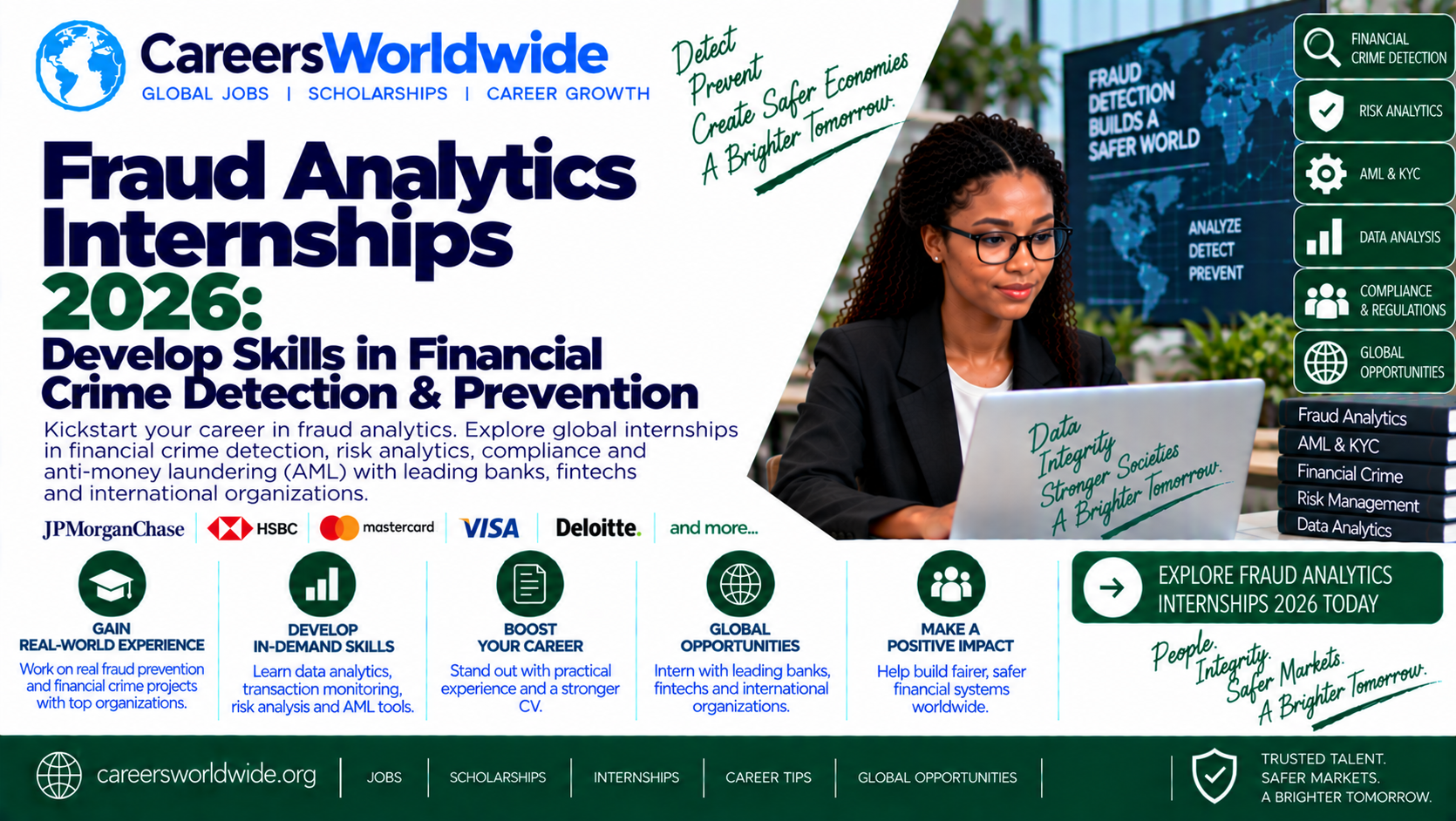

Excerpt: Discover how fraud analytics internships can help students and recent graduates build practical skills in financial crime detection, data analysis, risk monitoring, and fraud prevention. Explore the skills employers value, project ideas, application guidance, and official career resources for 2026 opportunities.
Fraud analytics is becoming an important area for organizations that need to identify suspicious activity, protect customers, and reduce financial losses. Banks, payment companies, fintech firms, insurance providers, and technology businesses use data-driven methods to investigate unusual transactions and strengthen their controls.
For students and early-career professionals interested in data, finance, cybersecurity, or financial crime prevention, a fraud analytics internship can offer exposure to real business problems and analytical techniques.
This guide explains what fraud analytics interns do, which skills to develop, where to look for opportunities in 2026, and how to prepare an application. It also includes official career resources and practical steps for building a relevant portfolio.

Fraud analytics combines data analysis, risk awareness, and investigation to help identify potentially suspicious activity.
1. What Are Fraud Analytics Internships?
Fraud analytics internships are entry-level learning opportunities that introduce participants to the use of data and analytical methods to detect, investigate, and help prevent fraud.
Depending on the employer, interns may work with transaction data, customer behavior patterns, case-management systems, risk indicators, or reporting dashboards. The work is typically supervised and may involve collaboration with fraud operations, compliance, data science, cybersecurity, or financial crime teams.
Fraud analytics is not limited to banking. Similar methods are used in:
- Digital payments and e-commerce
- Insurance claims
- Consumer lending and credit
- Identity verification
- Online marketplaces
- Telecommunications
- Public-sector benefit and payment programs
The precise duties, eligibility criteria, and level of technical work vary by organization and internship.
2. What Does a Fraud Analytics Intern Do?
Intern responsibilities depend on the team, the data available, and the employer’s regulatory and privacy requirements. Typical learning activities may include:
Transaction monitoring
Reviewing transaction patterns and learning how organizations identify activity that differs from expected customer or business behavior.
Data cleaning and analysis
Preparing datasets, checking for missing or inconsistent values, and using spreadsheets, SQL, or Python to explore trends.
Fraud trend reporting
Helping create reports or dashboards that summarize alerts, investigation outcomes, or changes in fraud patterns.
Alert and case support
Learning how analysts review alerts, document findings, and escalate cases according to internal procedures. Interns should not assume they will make independent decisions about customers or accounts.
Model and rule evaluation
Some placements may introduce interns to the evaluation of fraud detection rules or machine-learning models, including false positives, missed cases, and model performance.
Collaboration and documentation
Recording analysis clearly, sharing findings with teammates, and following confidentiality, data-protection, and information-security requirements.
3. Why Consider Fraud Analytics in 2026?
Fraud analytics sits at the intersection of several professional fields. It can be relevant to applicants who enjoy investigating patterns, solving problems, and working with data that has a practical business purpose.
Potential areas of exposure include:
- Data analytics: turning raw records into understandable findings.
- Financial services: learning how payment, lending, and account activity are monitored.
- Risk management: understanding how organizations identify and respond to potential losses.
- Technology: exploring automation, analytics platforms, and detection systems.
- Compliance and investigations: learning why evidence, documentation, and controlled processes matter.
An internship does not guarantee a permanent position. However, practical experience, a well-documented project, and strong analytical fundamentals can help applicants demonstrate relevant capabilities when pursuing future roles.
4. Types of Fraud Analytics Internships
Fraud analytics can be found under different job titles. Searching only for “fraud analytics internship” may miss relevant opportunities listed by other teams.

Payment Fraud Analytics
Focuses on card payments, digital wallets, transfers, chargebacks, and suspicious payment activity. Useful for applicants interested in fintech and banking.

Financial Crime Analytics
May cover fraud indicators alongside anti-money-laundering (AML) monitoring, customer due diligence, and investigative analytics. These functions overlap but are not identical.

Fraud Data Science
May involve statistical analysis, feature engineering, model evaluation, anomaly detection, and machine-learning experiments.

E-commerce and Identity Risk
Can include account takeover, fake accounts, promotional abuse, identity verification, and suspicious online orders.

Insurance and Claims Analytics
May help teams examine unusual claims patterns, review supporting data, and improve risk reporting.
5. Who Can Apply?
Eligibility depends on the employer and the specific role. Some internships are designed for current university students, while others accept recent graduates or candidates pursuing professional training.
Relevant academic backgrounds may include:
- Data science, statistics, mathematics, or computer science
- Finance, economics, accounting, or business analytics
- Information systems or software engineering
- Cybersecurity, criminology, or forensic accounting
- Risk management, compliance, or related disciplines
A degree specifically titled “fraud analytics” is not generally necessary. Applicants should focus on matching the requirements listed in each vacancy.
Common eligibility requirements
Employers may ask for some combination of:
- Current enrollment in a degree program or recent graduation
- Basic knowledge of statistics, databases, or financial services
- Strong analytical and written communication skills
- Authorization to work in the internship location
- Availability for the full internship period
- Ability to comply with background checks and confidentiality rules, where applicable
Important: An internship advertised by a global company is not automatically open to applicants worldwide. Check the location, work authorization, student-status requirements, and any restrictions before applying.
6. Skills to Develop Before Applying
Applicants do not need to master every tool before applying to an internship. A practical foundation in data analysis, problem-solving, and responsible handling of information is a useful starting point.
SQL and data querying
Learn to filter, join, group, and summarize records. Practice queries that count transactions, compare activity over time, and identify unusual patterns in a sample dataset.
Excel or spreadsheet analysis
Build confidence with pivot tables, lookups, conditional formulas, charts, and data-cleaning techniques.
Python
Learn basic programming and data manipulation with tools such as pandas. Practice calculating metrics and creating clear visualizations.
Statistics and analytical thinking
Understand averages, distributions, sampling, correlation, precision, recall, and why unusual does not necessarily mean fraudulent.
Risk and privacy awareness
Learn the importance of evidence, data minimization, access controls, secure handling, and fair review processes.
A practical learning sequence
If you are starting from scratch, consider this order:
- Learn spreadsheet fundamentals and descriptive statistics.
- Practice SQL using small, non-sensitive datasets.
- Use Python to clean data and automate repetitive analysis.
- Study fraud concepts such as false positives, chargebacks, account takeover, and suspicious transaction patterns.
- Build one portfolio project and explain its limitations.
You can develop these skills through coursework, practice datasets, and personal projects. Paid certifications are not a universal requirement; check the vacancy before spending money on training.
7. Practical Portfolio Projects for Beginners
A small, well-explained project can demonstrate how you approach analytical problems. Use synthetic or properly licensed public data—never upload confidential customer records or information from an employer.

Project 1: Transaction pattern analysis
Create or use a sample dataset with timestamps, transaction values, and anonymized account identifiers. Explore transaction frequency, amounts, and changes over time. Document patterns that merit further review without labeling individuals as criminals.

Project 2: Fraud monitoring dashboard
Build a dashboard that displays alert volumes, review outcomes, and trends by time period. Clearly distinguish simulated alerts from confirmed outcomes.

Project 3: Evaluate a simple detection model
Using a suitable public or synthetic dataset, compare a basic rule with a simple classification model. Discuss precision, recall, class imbalance, and the cost of false alerts.
What to include in your project write-up
- The question you wanted to investigate
- Dataset source and whether it is synthetic, public, or licensed
- Data-cleaning steps and assumptions
- Tools and methods used
- Key findings and visualizations
- Limitations and possible sources of bias
- How a human reviewer might use the results responsibly
Avoid claiming that a model “detects all fraud.” Fraud patterns change, datasets can be incomplete, and automated flags require appropriate review and governance.
8. Where to Find Fraud Analytics Internships in 2026
Fraud-related placements may be listed on company career websites under analytics, risk, compliance, financial crime, data science, or internship categories. Use the employer’s official career portal to confirm whether a position is actually open.
The following organizations are examples of places to investigate. Their inclusion is not confirmation of a current 2026 internship vacancy.

JPMorganChase
Search student and internship listings for analytics, risk, controls, operations, and financial crime-related roles.
Official careers portal: jpmorganchase.com/careers

Citi
Explore student opportunities and search for risk, data, compliance, operations, and fraud-related teams.
Official careers portal: citigroup.com/careers

Visa
Look for internships connected to payment analytics, risk, data science, and payment security.
Official careers portal: visa.com/careers

Mastercard
Search student programs and roles related to cyber and intelligence, data, risk, and payment security.
Official careers portal: careers.mastercard.com

PayPal
Explore internships in data analytics, risk, trust and safety, operations, and payment protection.
Official careers portal: paypal.com/us/webapps/mpp/jobs

American Express
Search for student opportunities related to risk management, analytics, fraud prevention, and financial services.
Official careers portal: americanexpress.com/en-us/careers
Other employers and sectors to search
Also explore banks, fintech companies, insurance providers, e-commerce platforms, consulting firms, and specialist risk-technology businesses operating in your target location.
Useful job-title variations include:
- Fraud Analytics Intern
- Fraud Data Analyst Intern
- Risk Analytics Intern
- Financial Crime Intern
- AML Analytics Intern
- Payments Risk Intern
- Trust and Safety Intern
- Data Science Intern — Risk
- Fraud Strategy Intern
- Transaction Monitoring Intern
Search broadly, but read the job description carefully. A role with “risk” in its title may focus on credit risk, operational risk, market risk, or another area rather than fraud.
9. How to Apply for Fraud Analytics Internships
A structured application process can help you avoid missing eligibility details and submit stronger materials.
Application checklist
0 of 8 completedResetIdentify relevant internship titles and employersCheck eligibility, location, work authorization, and deadlineTailor your CV to the listed requirementsPrepare a concise cover letter if requestedAdd a portfolio project or GitHub link if relevantPrepare examples of analytical problem-solvingSubmit through the employer’s official portalSave the vacancy details and track the application
Step 1: Search official career websites
Start with the companies and sectors relevant to your interests. Use several title variations rather than relying on a single keyword.
Step 2: Read the full vacancy description
Check the role’s responsibilities, required skills, application deadline, start date, duration, location, and eligibility. Make sure you understand whether the internship is paid, whether relocation support is offered, and whether the position is remote, hybrid, or onsite. Do not assume these details are the same across employers.
Step 3: Tailor your CV
Emphasize relevant coursework, projects, tools, and measurable outcomes. Use keywords from the vacancy where they accurately describe your experience.
Step 4: Submit requested documents
Some employers ask for a CV and application form; others may request transcripts, a cover letter, references, or work samples. Submit only what is requested and follow the employer’s file-format instructions.
Step 5: Track your applications
Record the role title, employer, date submitted, deadline, and any follow-up instructions. Use a spreadsheet or simple tracker so you can prepare for assessments and interviews.
10. How to Write a CV for Fraud Analytics Internships
A student or recent graduate CV can be concise and focused. If you have limited professional experience, include relevant academic projects, coursework, volunteer work, and practical exercises.
Suggested CV structure
- Contact information: name, professional email, phone number, and relevant portfolio link.
- Professional profile: two or three lines describing your analytical interests and relevant skills.
- Education: qualification, institution, dates, and relevant coursework.
- Technical skills: SQL, Excel, Python, visualization tools, and statistical methods you can actually use.
- Projects: describe the problem, methods, and results.
- Experience: internships, employment, research, volunteering, or other relevant responsibilities.
- Additional information: include only items requested or useful for the role.
Example profile statement
“Analytical graduate with a foundation in data analysis, statistics, and financial risk concepts. Experienced in using spreadsheets and SQL to explore datasets and communicate findings through clear reports. Interested in applying data-driven methods to fraud prevention and financial crime analytics.”
Adapt this example to your actual background. Do not claim experience with tools or responsibilities you have not used.
How to describe a project
Instead of writing “Worked on fraud data,” describe the work more specifically:
- “Analyzed a synthetic transaction dataset using SQL to summarize transaction frequency and value by time period.”
- “Created a dashboard to visualize sample alert volumes and review outcomes.”
- “Compared model evaluation metrics and documented the limitations of the sample dataset.”
Use real results where possible, but do not invent percentages, savings, or detection rates.
11. Preparing for Fraud Analytics Internship Interviews
The selection process varies. It may include a CV review, online assessment, technical exercise, behavioral interview, or discussion with a hiring team.
Technical topics to review
| Topic | What to practice |
|---|---|
| SQL | Filtering, joins, aggregation, grouping, and date-based analysis |
| Excel | Pivot tables, lookups, formulas, and data cleaning |
| Statistics | Distributions, sampling, precision, recall, and class imbalance |
| Python | DataFrames, basic analysis, and visualization |
| Fraud concepts | Transaction monitoring, account takeover, chargebacks, and false alerts |
| Communication | Explaining methods, assumptions, findings, and limitations |
Sample interview questions
1. How would you investigate a sudden increase in suspicious transactions?
Explain how you would validate the data, compare the change with a relevant baseline, segment the activity, examine possible causes, and document findings for review.
2. What is a false positive in fraud detection?
A false positive is an alert that is classified as suspicious even though the underlying activity is not fraudulent. Discuss why false positives can create unnecessary review work or customer friction.
3. Why might a fraud detection model miss suspicious activity?
Possible reasons include incomplete data, changing fraud patterns, limitations in the model, weak features, or a decision threshold that does not capture enough relevant cases.
4. How would you explain an analytical finding to a non-technical colleague?
Describe the question, the evidence, the main result, its limitations, and the practical next step in plain language.
5. How do you protect sensitive information while analyzing data?
Discuss using approved systems, accessing only the data needed, following organizational policies, avoiding unauthorized downloads or sharing, and reporting potential data-handling issues.
Behavioral interview preparation
Prepare examples that demonstrate:
- A time you solved a difficult analytical problem
- How you checked your work for errors
- How you handled feedback or changed your approach
- How you explained a technical idea clearly
- How you managed competing deadlines
- How you handled information responsibly
Use examples from university, personal projects, employment, or volunteering. Explain your own contribution accurately.
12. Opportunities for International Applicants
Applicants seeking internships outside their home country should verify eligibility before investing significant time in an application.
Important questions include:
- Does the employer accept applications from international students?
- Must applicants already have permission to work in the country?
- Does the employer provide visa sponsorship or other immigration support?
- Is the internship restricted to students enrolled at particular universities?
- Can the work be performed remotely from another country?
- Are there language, background-check, or residency requirements?
Remote does not necessarily mean worldwide. Some employers restrict remote internships to specific countries or jurisdictions because of employment, data-protection, and operational requirements.
If you are applying from Zimbabwe or another country outside the employer’s location, check the vacancy’s work-authorization terms directly and contact the official recruiting team if the requirements are unclear. Do not rely solely on third-party job summaries.
13. How to Avoid Internship Scams
Fraud prevention is also relevant to the job search itself. Fake internship advertisements may imitate well-known employers or use unofficial email addresses and application forms.
Take care to:
- Apply through the employer’s official career website whenever possible.
- Verify that the vacancy exists and that the recruiter’s identity is legitimate.
- Be cautious if someone demands payment to secure an interview, offer, or job placement.
- Avoid sending banking passwords, one-time passcodes, or unnecessary sensitive documents.
- Treat unusually urgent offers or requests to move immediately to private messaging with caution.
- Confirm the employer’s identity before sharing personal information.
A professional-looking logo or website is not proof that an opportunity is genuine. When uncertain, contact the organization through contact details published on its official website.
14. Fraud Analytics Career Paths After an Internship
Fraud analytics experience may be relevant to several early-career paths. The titles and requirements differ across organizations, and an internship alone does not guarantee entry into any particular role.
Fraud Analyst
Reviews alerts, examines patterns, and supports investigations or prevention processes.
Risk Analyst
Analyzes risk indicators and supports monitoring, reporting, and risk-control activities.
Financial Crime Analyst
May support fraud, AML, or related financial crime monitoring and case processes.
Data Analyst
Uses data preparation, querying, visualization, and reporting to support business decisions.
Fraud Data Scientist
May develop or evaluate statistical and machine-learning approaches to detection.
Fraud Strategy Analyst
Helps assess detection rules, operational outcomes, and prevention strategies.
15. Summary Table: Fraud Analytics Internships 2026
| Category | Key details |
|---|---|
| Opportunity type | Internship or student placement |
| Main focus | Fraud detection, prevention, risk analysis, and data reporting |
| Potential employers | Banks, payment networks, fintechs, insurers, e-commerce and technology companies |
| Relevant fields | Data science, statistics, finance, computer science, cybersecurity, accounting, and risk |
| Useful technical skills | SQL, Excel, Python, statistics, visualization |
| Other important skills | Critical thinking, documentation, communication, privacy awareness |
| Common tasks | Data analysis, monitoring support, reporting, case documentation, model evaluation |
| Application materials | CV and any documents specifically requested by the employer |
| Work arrangements | Vary by vacancy; verify location and remote-work eligibility |
| Deadline and pay | Vacancy-specific; confirm on the official listing |
| Official application route | Employer career portal or verified recruiting process |
16. Frequently Asked Questions (FAQ)
Are fraud analytics internships available in 2026?
Employers may advertise internships in fraud analytics, financial crime, risk, payments, and data science during 2026. Availability changes by employer and location, so check official career portals for current vacancies and deadlines.
Do I need a finance degree to apply?
Not necessarily. Relevant programs may include statistics, mathematics, computer science, data science, information systems, cybersecurity, accounting, economics, and finance. Always follow the specific vacancy’s eligibility requirements.
Can beginners apply?
Some internships are designed for students and early-career applicants. A beginner can strengthen an application by demonstrating basic analytical skills, completing a relevant project, and clearly explaining what they know and what they are learning.
Do I need to know Python?
Not every role requires Python. Some emphasize Excel and SQL, while more technical data science positions may require programming and statistical modeling. Use the job description to prioritize your preparation.
Are fraud analytics internships paid?
Compensation varies by employer, country, and program. Confirm the stipend or salary, benefits, and any relocation support in the official vacancy details. Do not assume that every internship is paid.
Can international students apply?
Some programs accept international applicants, while others have restrictions based on location, enrollment, or work authorization. Check the eligibility section and any visa or sponsorship information carefully.
Are remote fraud analytics internships available?
Remote arrangements depend on the employer and the nature of the work. Some roles require onsite attendance or restrict remote work to specific countries because of data-security and employment requirements.
What should I include in a fraud analytics portfolio?
A useful portfolio may include a clearly documented project using synthetic or appropriately licensed data, with data-cleaning steps, analysis, visualizations, evaluation metrics, and a discussion of limitations.
Is fraud analytics the same as anti-money laundering?
No. Fraud analytics focuses on identifying and preventing fraudulent activity. Anti-money laundering (AML) focuses on detecting and preventing the movement or concealment of illicit funds. The areas can overlap within financial crime teams, but they have distinct objectives and processes.
Can an internship lead to a full-time job?
It may provide relevant experience and professional connections, but conversion is not guaranteed. Full-time hiring depends on employer needs, performance, eligibility, and available positions.
17. Final Application Advice
Fraud analytics internships can be relevant for candidates who want to combine data analysis with financial services, technology, risk, and investigations.
Start by learning the fundamentals of SQL, spreadsheets, statistics, and responsible data handling. Build a small portfolio project, search using several related job titles, and tailor your CV to each position.
Most importantly, confirm every vacancy’s eligibility, deadline, compensation, location, and application instructions through the employer’s official recruitment channel. Treat the organization examples in this article as places to investigate—not as confirmation that a particular internship is currently accepting applications.
Disclaimer
This article is for general career information and educational purposes. It does not represent a guarantee of employment, internship availability, compensation, visa sponsorship, or selection. Internship requirements and application deadlines may change. Always verify current information through the official employer website and follow the instructions in the original vacancy announcement.
CareersWorldwide is not affiliated with the employers mentioned unless explicitly stated. Applicants should exercise caution with third-party recruitment messages and never pay an unverified party to obtain a job offer.
SEO Keywords
Focus keyword Copy
Fraud Analytics Internships 2026
Secondary keywords
Fraud analyst internships 2026, financial crime internships 2026, fraud detection internships, fraud prevention internships, risk analytics internships, fintech internships 2026, payment fraud analytics, financial crime analyst internship, data analytics internships 2026, fraud data science internships, AML analytics internships, transaction monitoring internships, fraud prevention careers, entry-level fraud analyst jobs.
ALSO CHECK: Quantitative Research Internships 2026: Gain Experience in Financial Modelling & Data AnalysisSeptember 20, 2026
RegTech Internships 2026: Explore Financial Compliance, Automation & Risk TechnologySeptember 20, 2026
Urban Planning Scholarships 2026: Funding for Smart Cities, Housing & Sustainable DevelopmentSeptember 17, 2026