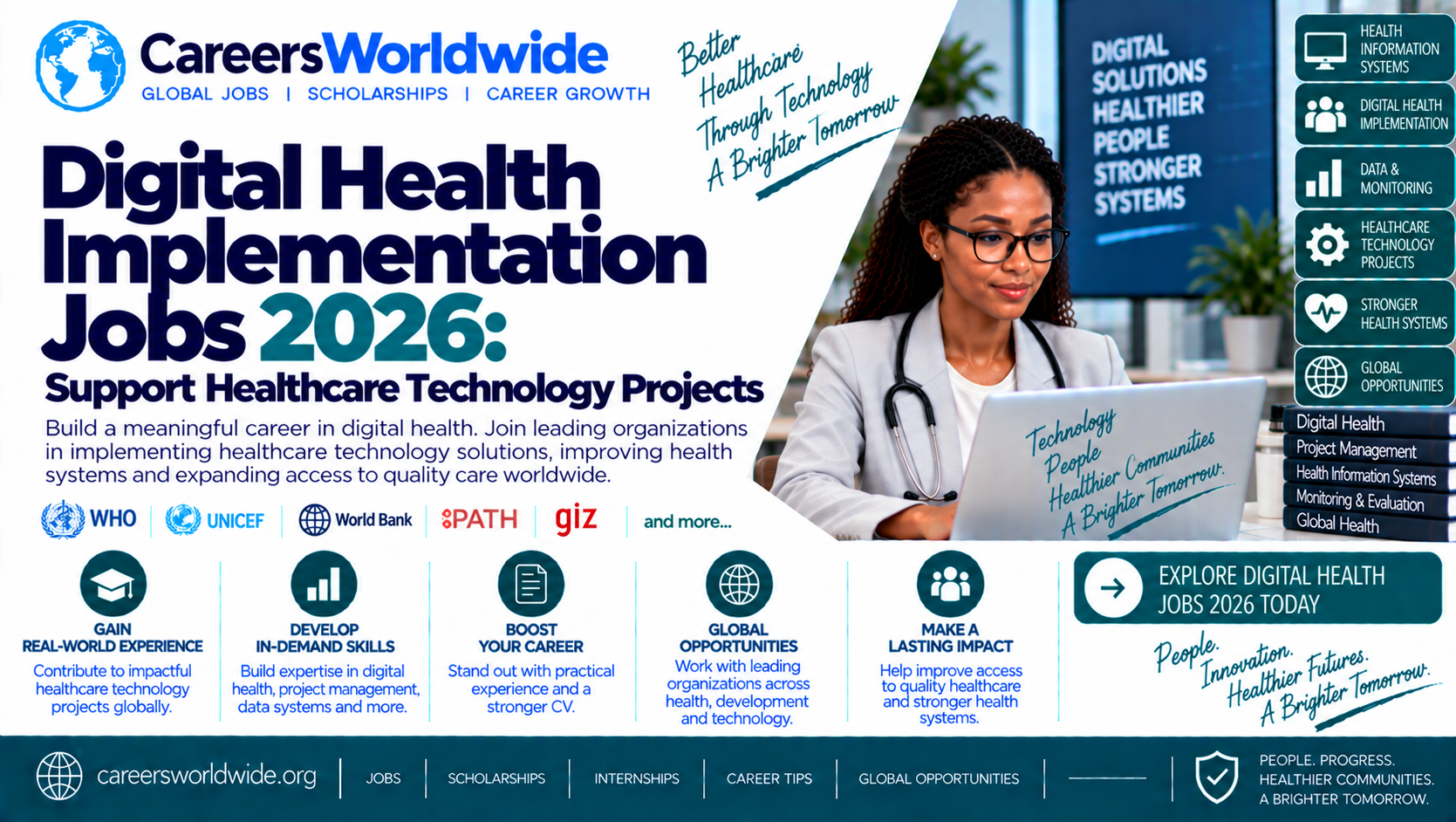

A practical career guide for professionals interested in digital health, healthcare technology, project coordination, and health information systems.
Excerpt: Digital health implementation jobs offer opportunities to help hospitals, public health organizations, NGOs, and technology providers introduce and improve digital tools used in healthcare. From electronic medical records and telehealth platforms to health information systems and digital reporting tools, these roles connect technology with frontline healthcare delivery. Explore common job titles, essential skills, qualifications, application strategies, and official career resources to help you pursue digital health implementation opportunities in 2026.
Introduction: Why Digital Health Implementation Matters
Healthcare organizations increasingly rely on digital systems to manage patient information, coordinate services, monitor health programs, and support clinical decisions. But technology does not improve healthcare simply because it has been purchased or installed. It must be configured, introduced, tested, adopted by users, and maintained within real healthcare settings.
This is where digital health implementation professionals play an important role.
They help turn healthcare technology plans into working projects. Depending on the employer and role, their responsibilities may include coordinating software rollouts, supporting health workers during training, documenting system requirements, monitoring project progress, troubleshooting implementation issues, and helping teams use data effectively.
Digital health implementation is a broad career area. Some positions are technical, while others focus on project management, health information systems, training, monitoring and evaluation, or stakeholder coordination. Employers may include hospitals, ministries of health, international organizations, NGOs, consulting firms, research institutions, and health technology companies.
This guide explains how to explore digital health implementation jobs in 2026, identify relevant opportunities, build practical skills, and prepare an application. It is a career guide—not a list of verified live vacancies. Always check the official employer’s recruitment page for current openings, deadlines, eligibility, and compensation.
1. What Are Digital Health Implementation Jobs?
Digital health implementation jobs involve supporting the introduction, adoption, operation, or improvement of technology used in healthcare and public health programs.
The work may involve a single facility, a network of hospitals, a regional health program, or a nationwide digital health initiative. Some projects focus on clinical systems, while others support health data collection, logistics, disease surveillance, patient engagement, or service delivery.
Examples of digital health technologies
- Electronic health records (EHRs) and electronic medical records (EMRs)
- Health management information systems (HMIS)
- Telemedicine and virtual care platforms
- Digital tools for community health workers
- Laboratory information management systems (LIMS)
- Pharmacy and supply-chain information systems
- Mobile health applications
- Disease surveillance and reporting platforms
- Digital appointment, referral, and patient communication systems
- Health data dashboards and reporting tools
Implementation work often brings together healthcare professionals, software developers, administrators, data specialists, government representatives, and technology vendors.
2. Common Digital Health Implementation Job Titles
Job titles vary between employers. A role that involves implementation may not include the words “digital health” in its title, so applicants should search across related job categories.
| Job title | Typical responsibilities |
|---|---|
| Digital Health Project Assistant | Supports schedules, meetings, documentation, and project coordination |
| Digital Health Implementation Officer | Coordinates rollout activities, user support, and implementation tracking |
| Health Information Systems Officer | Supports health information platforms, data processes, and system use |
| EHR/EMR Implementation Specialist | Helps configure, test, deploy, and support electronic health record systems |
| Digital Health Project Coordinator | Tracks deliverables, stakeholders, budgets, risks, and timelines |
| Health IT Support Officer | Troubleshoots devices, accounts, networks, and healthcare applications |
| Digital Health Training Officer | Develops materials and trains healthcare workers to use digital systems |
| Health Data Officer | Supports data quality, reporting, analysis, and system-based workflows |
| Implementation Research Assistant | Supports research into how health interventions or technologies are adopted |
| Digital Health Consultant | Provides specialist advice, implementation planning, or technical support |
Practical tip: Read the responsibilities rather than relying on the job title alone. A “Program Officer” position may involve digital health system rollout, while an “IT Support” position may be limited to general desktop support.
3. Where Digital Health Implementation Professionals Work
Digital health projects operate across different parts of the healthcare ecosystem. Understanding the employer type can help you identify the experience and qualifications a vacancy may require.
Hospitals and healthcare networks
Hospitals may introduce or upgrade electronic records, appointment systems, clinical workflows, laboratory platforms, and reporting tools. Implementation teams can work with clinicians, administrative staff, IT departments, and vendors.
Relevant search terms include:
- Hospital IT implementation
- EHR implementation specialist
- Clinical systems support
- Health information systems coordinator
- Digital transformation project assistant
Government and public health programs
Public health authorities may use digital systems to support disease surveillance, health facility reporting, patient referrals, immunization programs, or national health information systems.
Roles may involve coordinating with multiple facilities, supporting data quality, preparing training sessions, and tracking adoption across a program.
NGOs and international development organizations
NGOs and development partners may support digital health initiatives as part of projects in primary healthcare, maternal and child health, infectious disease programs, community health, or health-system strengthening.
Applicants should examine whether a vacancy focuses on technology implementation, program delivery, monitoring and evaluation, research, or a combination.
Health technology companies and consulting firms
Technology vendors and consulting firms may recruit implementation specialists, customer success professionals, technical project coordinators, trainers, and support analysts.
These roles can involve client onboarding, requirements gathering, software configuration, testing, training, and post-launch support.
Universities and research institutions
Research teams may study how digital health tools are introduced, whether health workers adopt them, how data quality changes, and what barriers affect implementation.
Research assistant and project coordinator roles may suit applicants with experience in public health, information systems, statistics, or research methods.
4. What Does a Digital Health Implementation Officer Do?
The day-to-day work depends on the organization, project size, and technology being introduced. An implementation officer may spend time in a healthcare facility, at a project office, working remotely with a technical team, or travelling between project locations.
Common responsibilities include the following.
Project planning and coordination
Implementation teams need clear plans for moving from an existing workflow to a new digital system. Staff may help prepare work plans, meeting agendas, deployment schedules, progress reports, and implementation trackers.
Typical tasks include:
- Coordinating project meetings and recording decisions.
- Tracking milestones, deliverables, and outstanding issues.
- Communicating with healthcare facilities and project partners.
- Supporting procurement, logistics, and deployment planning.
- Escalating delays, risks, and resource constraints.
Requirements gathering and workflow mapping
Before a system is deployed, the implementation team needs to understand how healthcare workers currently perform their tasks.
For example, a clinic may record patient visits on paper, maintain a separate pharmacy register, and submit monthly reports manually. An implementation project may examine how these processes could be supported by a digital system.
The implementation professional may help document user requirements, map workflows, identify pain points, and communicate findings to technical specialists.
System configuration, testing, and rollout
Some positions involve hands-on technical tasks. These can include preparing user accounts, testing system features, checking devices, documenting software issues, and assisting with pilot deployments.
Applicants should distinguish between implementation coordination and software development. Many implementation jobs do not require building an application from scratch, although technical roles may require programming, database, networking, or system administration experience.
Training and user support
A digital health system is useful only when its intended users can operate it appropriately. Implementation staff may organize training sessions, create user guides, demonstrate workflows, and provide support after launch.
They may also collect feedback from health workers and report recurring challenges to the project team.
Monitoring, reporting, and continuous improvement
Teams often monitor whether the system is being used as intended and whether implementation milestones are being achieved.
Possible indicators include:
- Number of facilities onboarded.
- Number of users trained.
- Percentage of intended users actively using the system.
- Completion of required data fields.
- Frequency of system errors or unresolved support tickets.
- Timeliness of reporting.
- User feedback and training needs.
These indicators should be interpreted in context. A high number of logins alone does not prove that a system improves care or reduces staff workload.
5. Qualifications and Educational Background
There is no single qualification required for every digital health implementation position. Employers set requirements according to the technical complexity, health-sector context, and seniority of the role.
Commonly relevant fields
- Health informatics or biomedical informatics
- Information technology or computer science
- Software engineering or information systems
- Public health or global health
- Health administration or health management
- Project management
- Statistics, data science, or monitoring and evaluation
- Nursing or another clinical discipline, particularly for clinical-system projects
Some positions accept a diploma or bachelor’s degree with relevant experience, while specialist, research, or senior advisory roles may require postgraduate qualifications.
For public health programme roles, employers may prioritize experience in health systems, programme delivery, monitoring and evaluation, or government and NGO coordination. For technical implementation roles, they may place greater emphasis on databases, software support, integration, and troubleshooting.
Always follow the vacancy’s stated minimum requirements. A general career guide cannot replace an employer’s eligibility criteria.
Experience that can strengthen an application
Relevant experience may come from:
- Supporting an IT help desk or service desk.
- Assisting with a hospital or clinic information system.
- Coordinating a software deployment or upgrade.
- Training staff to use a new digital tool.
- Maintaining databases or preparing routine reports.
- Supporting a public health or NGO project.
- Participating in health research or data collection.
- Documenting user requirements and testing software.
Applicants without formal digital health experience can demonstrate transferable skills through academic projects, supervised placements, volunteer work, or small portfolio projects. Be clear about the scope of your contribution and never present simulated work as a real-world deployment.
6. Essential Skills Employers May Look For
Digital health implementation sits at the intersection of technology, healthcare operations, and people. A strong applicant can explain technical concepts clearly while understanding that healthcare environments have practical constraints.
Technical literacy
Understand software workflows, user accounts, basic networking, databases, system testing, and troubleshooting. More technical roles may require SQL, APIs, interoperability standards, or system administration.
Project coordination
Track deadlines, maintain action logs, document risks, organize meetings, and follow up with multiple stakeholders.
Communication and training
Explain systems to users with different levels of technical experience, listen to feedback, and create clear training materials.
Data quality and reporting
Work carefully with spreadsheets, data validation, reporting dashboards, and documentation. Understand that data quality affects downstream decisions.
Privacy and security awareness
Handle health information responsibly, follow access controls, protect credentials, and escalate suspected privacy or security incidents.
Healthcare context is important
Digital health projects affect real workflows and may involve sensitive patient information. Applicants should understand the importance of confidentiality, appropriate access, informed consent where applicable, and the need to follow organizational policies and local laws.
Do not use real patient data in a portfolio or demonstration unless you have explicit authorization and appropriate safeguards. For learning projects, use synthetic or properly de-identified data.
7. Digital Health Systems and Concepts Worth Learning
You do not need to master every platform before applying. Start with the systems and concepts most relevant to the roles you want.
Electronic medical records and electronic health records
Learn the purpose of clinical records, patient registration, encounters, diagnoses, medication lists, and clinical documentation. Understand that terminology and workflows differ between systems and jurisdictions.
Health Management Information Systems
HMIS platforms support the collection, aggregation, and reporting of health-service data. Learn how indicators are defined, how reporting periods work, and why data validation matters.
Interoperability
Interoperability concerns the ability of different systems to exchange and meaningfully use information. Familiarity with health data standards such as HL7 FHIR may be helpful for technical and integration-focused roles.
Implementation and change management
A rollout requires more than technical installation. Learn about stakeholder mapping, readiness assessments, pilot testing, user training, feedback collection, and post-launch support.
Data protection and cybersecurity
Understand least-privilege access, secure passwords, multi-factor authentication, safe data handling, backups, incident reporting, and the importance of following approved procedures.
8. Practical Portfolio Projects for Beginners
A small, well-documented project can help demonstrate your ability to think through implementation challenges. It should show your process, not just a finished dashboard or application.

Project 1: Clinic appointment workflow prototype
Map a fictional clinic’s appointment process. Create a simple workflow diagram, identify bottlenecks, propose a digital workflow, and write a short implementation plan.
Demonstrates: workflow analysis, requirements gathering, documentation.

Project 2: Health data quality dashboard
Use synthetic monthly data to show missing values, reporting completeness, and trends. Document the checks used and explain the limits of the analysis.
Demonstrates: Excel, data validation, reporting, communication.

Project 3: Digital system training package
Create a fictional user guide, a short training agenda, a frequently asked questions sheet, and a feedback form for a clinic information system.
Demonstrates: user support, training design, clear communication.
For each project, include the problem, intended users, assumptions, proposed solution, testing or validation steps, limitations, and lessons learned. Clearly label it as a demonstration or academic project if it was not deployed in a real healthcare setting.
9. How to Find Digital Health Implementation Jobs in 2026
A practical search strategy combines exact job-title searches with broader terms used by health-sector employers.
Search by role and technology
Try combinations such as:
- “Digital health implementation” jobs
- “Health information systems” officer
- “EHR implementation” specialist
- “Digital health project coordinator”
- “Health IT” support officer
- “Health informatics” consultant
- “Digital health” programme assistant
- “Health systems strengthening” technology
- “HMIS” officer or consultant
- “Implementation research” digital health
Search across several contract types, including full-time positions, fixed-term appointments, consultancies, project-based roles, and internships. Check whether each position is national, international, remote, hybrid, or office-based.
Search by project language
Employers may describe digital health work using terms such as:
- Digital transformation
- Health information systems strengthening
- Digital public infrastructure
- Health data systems
- Digital health ecosystem
- Technology-enabled healthcare
- Health systems innovation
- Digital implementation support
These terms can reveal relevant roles that do not explicitly mention “implementation” in the title.
Use alerts and saved searches
Create saved searches on official recruitment portals where available. WHO, for example, uses its Stellis recruitment platform and provides instructions for setting job alerts.
World Health Organization
+1
Review alerts regularly and check the original vacancy page before applying. A job-board repost may be outdated or omit important eligibility details.
10. Official Application Resources
The following organizations and resources are relevant places to explore digital health work, related programmes, and recruitment opportunities. They are not a guarantee that a matching vacancy is open today.

World Health Organization (WHO)
Explore roles related to health systems, digital health, data, technical cooperation, and country programmes through the global employment portal.
WHO careers and application guidance
WHO uses Stellis for vacancies and candidate profiles.
World Health Organization
+1

UNICEF
Explore health, innovation, programme management, ICT, and consultancy opportunities. UNICEF describes work supporting digital health systems and data use with governments and partners.
UNICEF vacancies
UNICEF digital health and information systems
UNICEF Careers
+2

PATH
Review PATH’s digital health and data work, which includes supporting health-system digital transformation, standards, and sustainable digital ecosystems.
PATH digital health and data programme
PATH
Additional employers to investigate
Depending on your interests and location, also explore official career pages for:
- National ministries of health and public health agencies.
- Hospitals, health networks, and academic medical centres.
- Health technology companies and electronic health record vendors.
- NGOs implementing health programmes.
- Research institutions studying digital health adoption.
- Development partners supporting health information systems.
When searching these employers, use the organization’s own website to verify the vacancy, application address, contract type, and deadline.
11. How to Apply: A Step-by-Step Guide
A targeted application should connect your experience directly to the responsibilities in the vacancy announcement.
- Read the vacancy announcement carefullyIdentify the required education, years of experience, technical skills, language requirements, duty station, travel expectations, and application deadline. Note whether the employer requires a particular nationality or work authorization.
- Match your experience to the job descriptionMake a simple checklist of each essential requirement and the evidence you can provide. Do not claim a qualification, certification, or deployment experience you do not have.
- Prepare a targeted CV or résuméPlace relevant IT support, project coordination, health information systems, data, training, or research experience near the top. Use concise bullet points describing your actual contribution and results.
- Write a focused cover letterExplain why the role fits your experience, what relevant implementation or support work you have done, and how you could contribute to the stated project objectives.
- Prepare supporting documentsDepending on the vacancy, these may include education certificates, professional references, work samples, a portfolio, a technical proposal, or a financial proposal for a consultancy.
- Submit through the official channelFollow the application instructions exactly. Complete required online fields, upload requested documents, and submit before the stated deadline. Keep a copy of the submitted application and any confirmation.
- Prepare for assessments and interviewsBe ready to explain how you would plan a rollout, support users, document a technical issue, manage competing deadlines, protect sensitive information, and evaluate whether implementation is progressing.
WHO’s application guidance advises candidates to review vacancy requirements, provide accurate and complete information, and observe the closing date. Its selection process may include assessments and competency-based interviews.
World Health Organization
12. How to Write a Digital Health Implementation CV
A CV should make it easy for a recruiter to see the connection between your experience and the role.
Suggested CV structure
- Name and professional contact details
- Professional summary tailored to digital health implementation
- Relevant technical and project skills
- Work experience, placements, or relevant volunteering
- Education and relevant training
- Selected projects or portfolio
- Certifications, languages, and professional memberships, where relevant
- References, if requested
Example professional summary
Technology and project-support professional with experience in IT troubleshooting, user assistance, documentation, and data-related tasks. Interested in supporting digital health implementation through system rollout coordination, user training, implementation tracking, and reliable technical support. Committed to responsible handling of sensitive information and clear communication with technical and non-technical teams.
Adapt this example to your actual qualifications and experience. Remove any skill or responsibility you cannot substantiate.
Turn duties into evidence
Instead of writing “Responsible for IT support,” explain the work more specifically:
- “Resolved user-reported software and connectivity issues, documenting recurring problems for follow-up.”
- “Prepared training materials and supported staff during a new software rollout.”
- “Maintained project trackers and followed up on implementation actions.”
- “Used spreadsheet validation to identify incomplete records in a demonstration dataset.”
Include numbers only when you can verify them. Do not invent percentages, project sizes, or performance improvements.
13. Interview Preparation: Questions to Practise
Digital health implementation interviews may combine behavioural questions, project scenarios, and technical questions.
| Interview question | What your answer should demonstrate |
|---|---|
| How would you prepare a clinic for a new digital system? | Readiness assessment, workflow review, stakeholder engagement, training, and rollout planning |
| What would you do if users resisted a new system? | Listening, identifying barriers, practical support, feedback, and appropriate escalation |
| How would you investigate a system issue? | Reproducing the problem, gathering details, checking approved troubleshooting steps, documenting, and escalating |
| How would you protect patient information? | Confidentiality, access controls, secure handling, and following organizational policies |
| How would you track implementation progress? | Clear milestones, indicators, reporting frequency, risk tracking, and follow-up |
| What if a facility has unreliable connectivity? | Assessing the operational constraint, documenting requirements, and consulting the technical team about approved options |
Scenario practice
Imagine a clinic has begun using a digital patient registration system. Staff report that the system is slow, several users have forgotten their passwords, and some records appear incomplete.
A structured response could be:
- Clarify which users and workflows are affected.
- Determine whether the issue is widespread or limited to specific devices or accounts.
- Follow approved troubleshooting and account-recovery procedures.
- Document examples without exposing unnecessary patient information.
- Escalate system performance or data-quality issues to the responsible technical team.
- Communicate status and workarounds only if approved.
- Track resolution and identify whether additional training is needed.
This approach shows that implementation support is both technical and operational. It also avoids making unapproved changes to sensitive systems.
14. Salary, Contract Types, and Work Arrangements
There is no single salary range for digital health implementation jobs. Compensation varies by employer, country, funding source, seniority, contract type, technical specialization, and whether the position is locally or internationally recruited.
A project assistant, national officer, international specialist, and independent consultant may have very different compensation arrangements. Some consultancy announcements request a financial proposal, while staff vacancies may publish a salary scale or contractual benefits.
Do not assume that every digital health role is remote or highly paid. Some jobs require frequent travel to health facilities, training sessions, or project sites. Others may be office-based, hybrid, or remote with specific country restrictions.
Before applying, check:
- Gross salary, fee, or payment structure.
- Contract duration and renewal conditions.
- Duty station and travel requirements.
- Work authorization and nationality restrictions.
- Benefits, insurance, and leave provisions.
- Whether equipment, connectivity, or travel costs are covered.
- Whether the role is employee, consultant, temporary, or volunteer status.
If compensation is not listed, use the official recruitment contact or application process to seek clarification rather than relying on an unrelated salary estimate.
15. Career Progression in Digital Health
Digital health implementation can connect several career pathways. The direction you take may depend on whether you prefer technical work, healthcare operations, programme coordination, or research.
Example career pathway
Entry-level support
IT Support Assistant · Project Assistant · Data Assistant
Implementation experience
Implementation Officer · Health Information Systems Officer · Training Coordinator
Specialist or management roles
Digital Health Specialist · Project Manager · Health Informatics Consultant
Illustrative pathway only. Progression depends on qualifications, experience, available positions, and employer requirements.
Other possible directions include health data analytics, implementation research, clinical informatics, interoperability, digital health product management, and health systems strengthening.
16. Practical 30-Day Preparation Plan
If you are preparing to apply for digital health implementation jobs, use the following plan to organize your learning and application work.
Your preparation checklist
0/12
Week 1: Explore the fieldReview 10 relevant job descriptionsIdentify recurring qualifications and skillsChoose two job titles to target
Week 2: Build foundational skillsPractise spreadsheet data validationStudy basic health information system conceptsReview privacy and security fundamentals
Week 3: Create evidenceComplete one synthetic-data or workflow projectWrite a short implementation planPrepare a brief portfolio summary
Week 4: Prepare applicationsTailor your CV to a real vacancyDraft a role-specific cover letterSubmit suitable applications and track deadlinesReset checklist
17. Summary Table: Digital Health Implementation Jobs 2026
| Category | What to know |
|---|---|
| Main purpose | Help healthcare organizations introduce, adopt, and improve digital systems |
| Common job titles | Implementation Officer, Project Coordinator, Health IT Support Officer, Health Information Systems Officer |
| Potential employers | Hospitals, public health agencies, NGOs, international organizations, technology providers, research institutions |
| Relevant qualifications | IT, software engineering, health informatics, public health, information systems, project management, or related fields |
| Important skills | Troubleshooting, project coordination, training, data quality, communication, privacy awareness |
| Useful portfolio evidence | Workflow maps, synthetic-data dashboards, training materials, implementation plans |
| Contract types | Staff positions, consultancies, temporary roles, project appointments, and some internships |
| Application approach | Match the vacancy requirements, tailor your CV, prepare supporting evidence, and apply through official channels |
| Salary | Varies by employer, location, seniority, and contract; verify each announcement |
| Key caution | A general career guide does not confirm that a particular vacancy is currently open |
18. Frequently Asked Questions (FAQ)
1. What are digital health implementation jobs?
They are roles that help healthcare organizations plan, introduce, test, support, and improve digital systems. Work may include project coordination, user training, technical support, workflow analysis, system testing, and implementation monitoring.
2. Do I need a medical degree?
Not necessarily. Many technology, project coordination, data, and implementation support positions accept candidates from IT, software engineering, information systems, health informatics, or related fields. Some clinical or public health specialist positions require specific health qualifications.
3. Can IT graduates apply for digital health jobs?
Yes, when their qualifications and experience match the vacancy requirements. IT graduates may be relevant for health IT support, system implementation, technical coordination, data systems, and software-related roles.
4. Are digital health implementation jobs remote?
Some roles may allow remote or hybrid work, but others require office attendance, healthcare facility visits, training, or travel. Always check the duty station and work-arrangement details in the vacancy announcement.
5. What software should I learn?
Start with tools relevant to the roles you are targeting. Useful foundations can include spreadsheets, databases, reporting tools, system testing, and basic networking. Health informatics and technical implementation roles may also benefit from learning about interoperability standards and health information systems.
6. Can beginners apply?
Some assistant, internship, junior support, or project-based roles may be suitable for early-career applicants. Eligibility varies. Demonstrate transferable skills through relevant coursework, supervised experience, and clearly labelled portfolio projects.
7. How much do digital health implementation officers earn?
Compensation varies substantially by employer, country, seniority, and contract type. Check the official vacancy for a stated salary or fee, and review benefits, travel expectations, and contract conditions before applying.
8. Where can I find digital health vacancies?
Start with official recruitment portals such as WHO and UNICEF, then explore health NGOs, public health agencies, hospitals, technology companies, and research institutions. Search using related terms such as “health information systems,” “EHR implementation,” and “digital health project coordinator.”
9. What should I include in my CV?
Highlight relevant education, technical skills, project coordination, user support, training, data handling, and implementation-related experience. Include concrete examples of your contribution, and only use figures or outcomes you can verify.
10. Are specific 2026 vacancies confirmed in this article?
No. This article provides career guidance and official resources for searching. Vacancy availability, deadlines, eligibility, and compensation can change; verify all details on the employer’s official recruitment page.
Conclusion
Digital health implementation jobs bring together technology, healthcare operations, project delivery, and user support. They may suit applicants who enjoy solving practical problems, coordinating people, documenting processes, and helping organizations use digital systems effectively.
To prepare for opportunities in 2026, identify the job titles that match your background, build relevant technical and communication skills, create a small portfolio using synthetic or fictional data, and tailor each application to the official vacancy requirements.
For CareersWorldwide readers, the most useful next step is to explore current recruitment portals and verify the details of each opportunity before applying.
Official Application Resources
- WHO Careers — Apply for a Position
- WHO Global Employment Portal
- UNICEF Careers — Current Vacancies
- UNICEF — Digital Health and Information Systems
- PATH — Digital Health and Data
Disclaimer
This article is intended for general career information and educational purposes. It does not represent a recruitment announcement or guarantee employment, salary, selection, or eligibility. Job titles, requirements, deadlines, compensation, and work arrangements vary by employer and may change. Applicants should verify all information through the official employer’s website and follow the instructions in the specific vacancy notice. CareersWorldwide is not affiliated with the organizations mentioned unless expressly stated.
SEO Keywords
Digital Health Implementation Jobs 2026, Digital Health Jobs 2026, Healthcare Technology Jobs, Digital Health Officer Jobs, Health Information Systems Jobs, Health IT Jobs, EHR Implementation Jobs, EMR Implementation Specialist, Digital Health Project Coordinator, Health Informatics Careers, Digital Health Consultant Jobs, Digital Transformation Healthcare, NGO Digital Health Jobs, WHO Digital Health Careers, UNICEF Digital Health Jobs, Healthcare IT Implementation, Health Systems Strengthening Jobs, Digital Health Careers for Graduates, Health Technology Project Jobs, Digital Health Implementation Officer.
ALSO CHECK: Business Intelligence Internships 2026: Learn Data Visualisation, Reporting & Decision SupportSeptember 20, 2026
Investor Relations Internships 2026: Build Experience in Corporate Finance & CommunicationsSeptember 20, 2026
Fraud Analytics Internships 2026: Develop Skills in Financial Crime Detection & PreventionSeptember 20, 2026