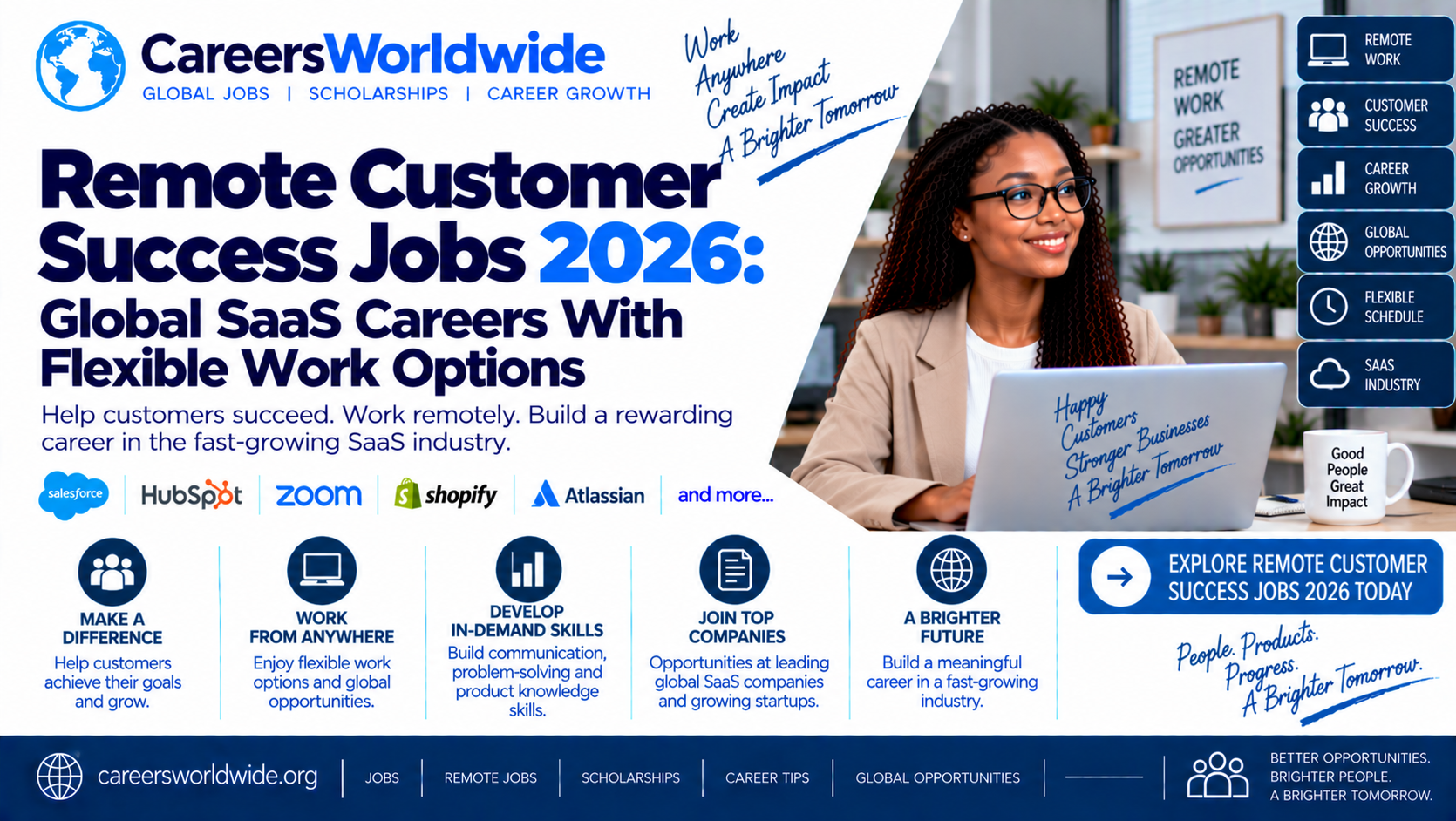

Excerpt: Remote Customer Success jobs in 2026 are creating opportunities for professionals who enjoy working with customers, solving problems, improving product adoption, and supporting long-term client relationships. Explore global SaaS career paths, in-demand skills, entry-level opportunities, salary considerations, remote-work strategies, practical application tips, and official resources for finding Customer Success careers.
Remote Customer Success Jobs 2026: Build a Career in Global SaaS
The software industry has changed how businesses interact with customers. Companies increasingly use cloud-based platforms, subscription software, artificial intelligence tools, financial technology, healthcare platforms, communication systems, and business applications to serve customers around the world.
As these products become more sophisticated, companies need professionals who can help customers understand and successfully use them.
That is where Customer Success comes in.
Remote Customer Success jobs combine communication, technology, problem-solving, account management, product knowledge, and data analysis. Unlike traditional customer service roles that may focus primarily on resolving individual issues, Customer Success teams often work proactively with customers to help them achieve their goals with a product or service.
For job seekers interested in technology but not necessarily software engineering, Customer Success can provide an alternative route into the SaaS industry.
Remote opportunities can also make the field attractive to professionals looking for flexible work arrangements and international career exposure.
What Is Customer Success?
Customer Success is a business function focused on helping customers obtain value from a company’s product or service.
A Customer Success professional may:
- Onboard new customers
- Explain product features
- Help customers achieve business goals
- Monitor customer engagement
- Identify potential problems
- Conduct product training
- Coordinate with technical support
- Communicate customer feedback internally
- Support renewals
- Identify expansion opportunities
- Analyze customer-health indicators
- Build long-term relationships
The exact responsibilities vary considerably between companies.
A Customer Success Manager at an enterprise SaaS company may manage a portfolio of large corporate clients, while a Customer Success Associate may support hundreds of smaller customers through email, chat, webinars, and digital resources.
Why SaaS Companies Need Customer Success Professionals
Software-as-a-Service companies operate differently from traditional businesses.
Instead of selling software once and ending the relationship, SaaS companies often depend on continuing subscriptions.
That means customers need to continue seeing value from the product.
If customers struggle with implementation, fail to adopt important features, or cannot achieve their desired outcomes, they may eventually stop using the platform.
Customer Success teams help address these challenges.
They can help customers understand the product, establish effective workflows, solve adoption problems, and communicate feedback to internal teams.
This makes Customer Success an important function across many SaaS organizations.
Types of Remote Customer Success Jobs in 2026
Customer Success is not one single career.
There are several roles that job seekers can explore.
1. Customer Success Associate
Customer Success Associate positions can be suitable for professionals beginning their careers.
Typical responsibilities may include:
- Supporting Customer Success Managers
- Responding to customer questions
- Preparing account information
- Tracking customer activity
- Coordinating onboarding
- Updating CRM records
- Creating customer resources
These roles can provide experience that later leads to Customer Success Manager positions.
2. Customer Success Manager
The Customer Success Manager, or CSM, is one of the most recognizable roles in the field.
CSMs may manage a portfolio of customers and help them achieve specific outcomes.
Responsibilities can include:
- Customer onboarding
- Account reviews
- Product adoption
- Success planning
- Customer training
- Relationship management
- Renewal support
- Escalation management
- Cross-functional collaboration
The position often requires strong communication and organizational skills.
3. Technical Customer Success Manager
Technical Customer Success Managers work with more technically complex products.
They may support customers using:
- APIs
- Cloud platforms
- Developer tools
- Cybersecurity software
- Data platforms
- Enterprise applications
- Infrastructure products
Technical knowledge can be particularly useful in these positions.
Understanding concepts such as APIs, databases, integrations, authentication, and cloud services can help candidates stand out.
4. Customer Onboarding Specialist
Onboarding specialists help new customers get started.
Their responsibilities may include:
- Account setup
- Training
- Implementation coordination
- Product demonstrations
- Documentation
- Configuration support
- Initial success planning
This can be a strong career option for people who enjoy teaching and guiding others.
5. Customer Success Operations
Customer Success Operations, often called CS Ops, focuses on the systems and processes supporting Customer Success teams.
Professionals in this area may work with:
- CRM systems
- Customer-health data
- Reporting
- Dashboards
- Automation
- Customer segmentation
- Process improvement
This career path is particularly relevant to candidates who enjoy data and technology.
6. Customer Education Specialist
Customer Education professionals develop resources that help customers learn a product.
They may create:
- Training courses
- Webinars
- Tutorials
- Knowledge-base articles
- Product guides
- Certification programs
Strong writing, presentation, and instructional skills can be valuable here.
Industries Hiring Customer Success Professionals
Customer Success careers exist across a wide range of industries.
Software and SaaS
SaaS companies are among the most visible employers of Customer Success professionals.
Products can include:
- Business software
- CRM systems
- Marketing platforms
- HR technology
- Project-management tools
- Data platforms
- Collaboration software
Fintech
Financial technology companies use Customer Success teams to help business customers understand and adopt digital financial products.
Healthcare Technology
Health-tech organizations may employ Customer Success professionals to support hospitals, clinics, healthcare providers, businesses, or other customers using digital platforms.
Cybersecurity
Cybersecurity companies often need Customer Success professionals who can help customers implement and effectively use security solutions.
Education Technology
EdTech companies may hire Customer Success professionals to support schools, universities, educators, students, and businesses.
AI and Data Technology
The growth of AI platforms has created new opportunities for customer-facing professionals who can explain technical products and help organizations integrate them into workflows.
Skills Employers Look for in Remote Customer Success Jobs
Successful Customer Success professionals generally combine interpersonal and technical abilities.
Communication
Communication is central to the profession.
You may need to:
- Explain complex concepts simply
- Conduct virtual meetings
- Write professional emails
- Prepare presentations
- Handle difficult conversations
- Listen carefully to customers
Strong written communication is particularly important for remote roles.
Problem-Solving
Customers may describe a business problem without knowing the technical cause.
Customer Success professionals need to understand the issue, investigate available information, and coordinate with the appropriate internal teams.
Product Knowledge
You need to understand the product you represent.
This may involve learning:
- Core features
- Workflows
- Integrations
- Limitations
- Pricing structures
- Common use cases
- Troubleshooting processes
CRM Skills
Customer Success teams frequently use CRM and customer-management platforms.
Examples include:
- Salesforce
- HubSpot
- Zendesk
- Gainsight
- Intercom
- Zoho
Learning the fundamentals of CRM systems can strengthen your CV.
Data Analysis
Customer Success is increasingly data-driven.
Teams may monitor:
- Customer engagement
- Product usage
- Renewal rates
- Customer health
- Support volume
- Adoption
- Customer satisfaction
Basic spreadsheet and data-analysis skills can therefore be useful.
Customer Success Metrics You Should Understand
Candidates interviewing for Customer Success positions should understand common performance indicators.
Customer Retention
Measures how effectively a company retains customers over time.
Churn
Represents customers or recurring revenue lost during a period.
Customer Lifetime Value
Estimates the value generated by a customer throughout the relationship.
Net Revenue Retention
Measures changes in recurring revenue from an existing customer base, including expansions, contractions, and churn.
Customer Satisfaction
Often measured through surveys and customer feedback.
Product Adoption
Measures how customers use key features or workflows.
Understanding these concepts can make interviews easier because Customer Success teams frequently use metrics to evaluate customer relationships.
Remote Customer Success Jobs for Beginners
You do not necessarily need years of SaaS experience to begin exploring Customer Success.
Relevant backgrounds can include:
- Customer service
- Sales
- Account management
- Technical support
- Business administration
- Marketing
- Communications
- IT
- Project coordination
- Education
For graduates, internships and associate-level positions can provide useful entry points.
If you lack direct Customer Success experience, focus your CV on transferable skills.
For example, if you previously worked in customer service, emphasize:
- Customer relationship management
- Problem resolution
- Communication
- Complaint handling
- Product knowledge
- Customer satisfaction
If you have an IT background, emphasize:
- Technical troubleshooting
- Software knowledge
- Documentation
- User support
- Systems knowledge
- Problem-solving
How to Build a Customer Success Portfolio
A portfolio is not mandatory for every Customer Success role, but it can demonstrate your practical thinking.
Create a hypothetical SaaS customer-success project.
For example, imagine that a company sells project-management software.
Develop a customer-success plan containing:
Customer Onboarding Plan
Create a 30-day onboarding roadmap.
Customer Health Dashboard
Define indicators such as:
- Login frequency
- Feature adoption
- Support requests
- Training attendance
- Customer satisfaction
Quarterly Business Review
Create a presentation showing how you would review customer performance.
Customer Communication
Write sample onboarding emails and follow-up messages.
Churn-Risk Strategy
Explain how you would identify and respond to customers showing signs of disengagement.
This type of project can demonstrate commercial awareness, communication skills, organization, and analytical thinking.
Remote Customer Success Jobs and Flexible Work
Remote Customer Success positions can offer flexible working arrangements, but applicants should read the job description carefully.
A company may describe a position as remote while still requiring:
- Residence in a particular country
- Work authorization
- Specific working hours
- Overlap with headquarters
- Occasional travel
- Availability for customer meetings
For international applicants, these details matter.
“Remote” should therefore not automatically be interpreted as “work from anywhere.”
How to Find Remote Customer Success Jobs
Use multiple search terms when exploring vacancies.
Try:
- Remote Customer Success Manager
- Remote Customer Success Associate
- Remote Customer Success Specialist
- Remote SaaS Customer Success
- Technical Customer Success Manager Remote
- Customer Onboarding Specialist Remote
- Customer Success Operations Remote
- Customer Education Specialist Remote
- Client Success Manager Remote
- Customer Experience Manager Remote
Searching several variations can reveal opportunities that would not appear under a single job title.
How to Make Your Customer Success CV Stand Out
A strong CV should connect your previous experience to customer outcomes.
Instead of writing:
“Answered customer emails.”
Consider a results-focused description such as:
“Resolved customer inquiries through email and live communication while maintaining accurate case records and escalating technical issues when required.”
Where you have genuine measurable results, include them.
For example:
- Number of customers supported
- Response-time improvements
- Customer satisfaction results
- Retention improvements
- Number of accounts managed
- Training sessions delivered
Never invent statistics.
How Technology Skills Can Help Your Customer Success Career
Customer Success is becoming more technical in many organizations.
A candidate who understands technology can potentially work with more complex products.
Consider learning:
CRM
Understand customer records, pipelines, tasks, and reporting.
Excel or Google Sheets
Learn:
- Filters
- Pivot tables
- Lookups
- Basic charts
- Data cleaning
SQL
Basic SQL can be helpful for Customer Success Operations and data-oriented roles.
APIs
Understanding basic API concepts can be valuable when supporting integrations.
Analytics
Learn how to interpret product usage and customer behavior data.
AI Tools
Understand how AI can assist with customer communication, knowledge management, support workflows, and product adoption.
90-Day Customer Success Career Plan
Days 1–30: Learn the Fundamentals
Study:
- Customer Success principles
- SaaS business models
- Customer lifecycle
- Onboarding
- Retention
- Churn
- Customer health
- CRM fundamentals
Create sample customer communication materials.
Days 31–60: Build Technical and Analytical Skills
Learn:
- CRM software
- Excel/Google Sheets
- Basic data analysis
- Product analytics concepts
- SaaS metrics
- Presentation skills
Create a sample customer-health dashboard.
Days 61–90: Apply and Practice
Update your CV.
Build your LinkedIn profile around customer-facing technology skills.
Prepare interview answers.
Begin applying to:
- Customer Success Associate
- Customer Success Specialist
- Customer Onboarding
- Technical Customer Success
- Customer Support
- Customer Success Operations
Continue developing your skills while applying.
Remote Customer Success Jobs 2026: Summary Table
| Role | Main Focus | Useful Skills |
|---|---|---|
| Customer Success Associate | Customer support and account assistance | Communication, CRM |
| Customer Success Manager | Customer relationships and outcomes | Communication, SaaS knowledge |
| Technical CSM | Technical product adoption | APIs, troubleshooting, cloud |
| Onboarding Specialist | New-customer implementation | Training, organization |
| Customer Success Operations | Processes and data | Analytics, CRM, spreadsheets |
| Customer Education Specialist | Customer training | Writing, presentations |
| Client Success Manager | Account relationships | Relationship management |
| Customer Experience Specialist | Overall customer journey | Communication, analytics |
How to Apply for Remote Customer Success Jobs in 2026
Step 1: Identify Suitable Roles
Search for positions matching your actual experience.
If you are new to the field, consider associate, specialist, onboarding, support, and junior positions.
Step 2: Research the Company
Visit the organization’s official website and confirm that the vacancy is genuine.
Step 3: Study the Job Description
Pay attention to:
- Location
- Required experience
- SaaS experience
- CRM requirements
- Time-zone requirements
- Travel expectations
- Employment type
- Application deadline
Step 4: Customize Your CV
Emphasize transferable experience relevant to the specific position.
Step 5: Prepare for Interviews
Practice questions such as:
“How would you handle an unhappy customer?”
“How would you identify a customer at risk of leaving?”
“How would you onboard a new customer?”
“What metrics would you use to measure customer success?”
“How would you explain a complicated software feature to a nontechnical customer?”
Use real examples from your experience whenever possible.
Step 6: Apply Through Official Channels
Submit applications through the employer’s official career portal whenever possible.
Avoid recruiters who demand payment or sensitive financial information as a condition of receiving a job.
Official Application Resources
Because job openings and eligibility requirements change, applicants should verify vacancies directly with employers.
Useful official career resources include:
- Salesforce Careers
- HubSpot Careers
- Microsoft Careers
- Atlassian Careers
- Adobe Careers
- Zendesk Careers
- Intercom Careers
When searching these career sites, try keywords such as Customer Success, Customer Success Manager, Customer Success Associate, Client Success, Customer Onboarding, Customer Experience, Customer Operations, and Technical Customer Success.
FAQ: Remote Customer Success Jobs 2026
What is a Customer Success Manager?
A Customer Success Manager helps customers achieve their intended outcomes with a company’s product or service. The role commonly involves onboarding, product adoption, relationship management, and coordination with internal teams.
Can I get a Customer Success job without SaaS experience?
Some employers accept transferable experience from customer service, sales, account management, technical support, education, or other customer-facing fields. Requirements vary between vacancies.
Is Customer Success a technology career?
Customer Success is a customer-facing business function, but many roles are within technology companies. Technical Customer Success and Customer Success Operations can involve substantial technology and data work.
Can Customer Success jobs be fully remote?
Some are, but remote arrangements vary. Certain employers restrict positions to particular countries or require specific working hours.
What CRM should I learn?
Salesforce, HubSpot, Zendesk, Intercom, Gainsight, and similar platforms can be useful. You do not need to master every CRM system.
Do Customer Success Managers need coding skills?
Most general Customer Success roles do not require advanced programming. Technical roles may benefit from knowledge of APIs, databases, integrations, cloud technology, or scripting.
What degree is required?
There is no single universal degree requirement. Employers may consider candidates from business, communications, technology, marketing, management, or other educational backgrounds.
How can graduates gain experience?
Consider internships, customer-support roles, SaaS internships, onboarding positions, volunteer projects, technology projects, and portfolio work demonstrating communication and customer problem-solving.
What should I include on my CV?
Highlight customer relationships, problem-solving, communication, account management, SaaS or technology experience, CRM knowledge, data skills, training experience, and measurable achievements.
What is the difference between Customer Success and Customer Support?
Customer Support often focuses on resolving specific customer issues or requests. Customer Success generally takes a broader, proactive approach to helping customers achieve desired outcomes. Some organizations combine or overlap these functions.
Final Thoughts
Remote Customer Success Jobs 2026 provide an interesting pathway for professionals who want to work in the global SaaS and technology industry while focusing on customers rather than software development alone.
The field includes several career directions, from Customer Success Associate and Onboarding Specialist to Technical Customer Success Manager and Customer Success Operations.
Candidates can strengthen their prospects by combining communication, SaaS knowledge, CRM skills, data analysis, customer relationship management, and technical understanding.
For graduates, customer support, internships, onboarding, and associate-level positions can provide relevant experience. For professionals with technology backgrounds, technical Customer Success and Customer Success Operations can provide opportunities to combine technical knowledge with customer-facing work.
Remote employment also requires careful attention to location and eligibility rules. A position described as remote may still have country, time-zone, work-authorization, or travel requirements.
The most reliable approach is to verify vacancies through official employer career pages, tailor every application to the specific role, and continue building practical skills while searching.
Disclaimer
This article is provided for general career and educational information. Job availability, salaries, eligibility requirements, application deadlines, remote-work policies, and geographic restrictions can change without notice. CareersWorldwide does not guarantee employment, interviews, or selection for any position. Applicants should verify all information through the relevant employer’s official recruitment website before applying or providing personal information. Legitimate employers generally do not require applicants to pay money to obtain a job.
SEO Keywords
Primary keyword: Remote Customer Success Jobs 2026
Secondary keywords: Remote Customer Success jobs, Customer Success Manager jobs 2026, remote SaaS jobs 2026, remote customer service jobs, Customer Success Associate jobs, remote Customer Success Manager, technical Customer Success jobs, remote SaaS careers, Customer Success careers 2026, remote client success jobs, customer onboarding jobs remote, Customer Success Operations jobs, remote technology jobs 2026, SaaS careers for graduates, entry-level Customer Success jobs, work from home Customer Success jobs, global SaaS jobs, remote account management jobs, Customer Experience jobs 2026, Customer Success jobs for graduates, remote tech careers, flexible remote jobs 2026.
ALSO CHECK: Remote QA Engineer Jobs 2026: Global Software Testing & Quality Assurance CareersSeptember 16, 2026
Business Analyst Jobs 2026: In-Demand Careers in Data, Strategy & Business OperationsSeptember 15, 2026
AI Traineeships 2026: Gain Practical Experience in Artificial Intelligence & Machine LearningSeptember 15, 2026