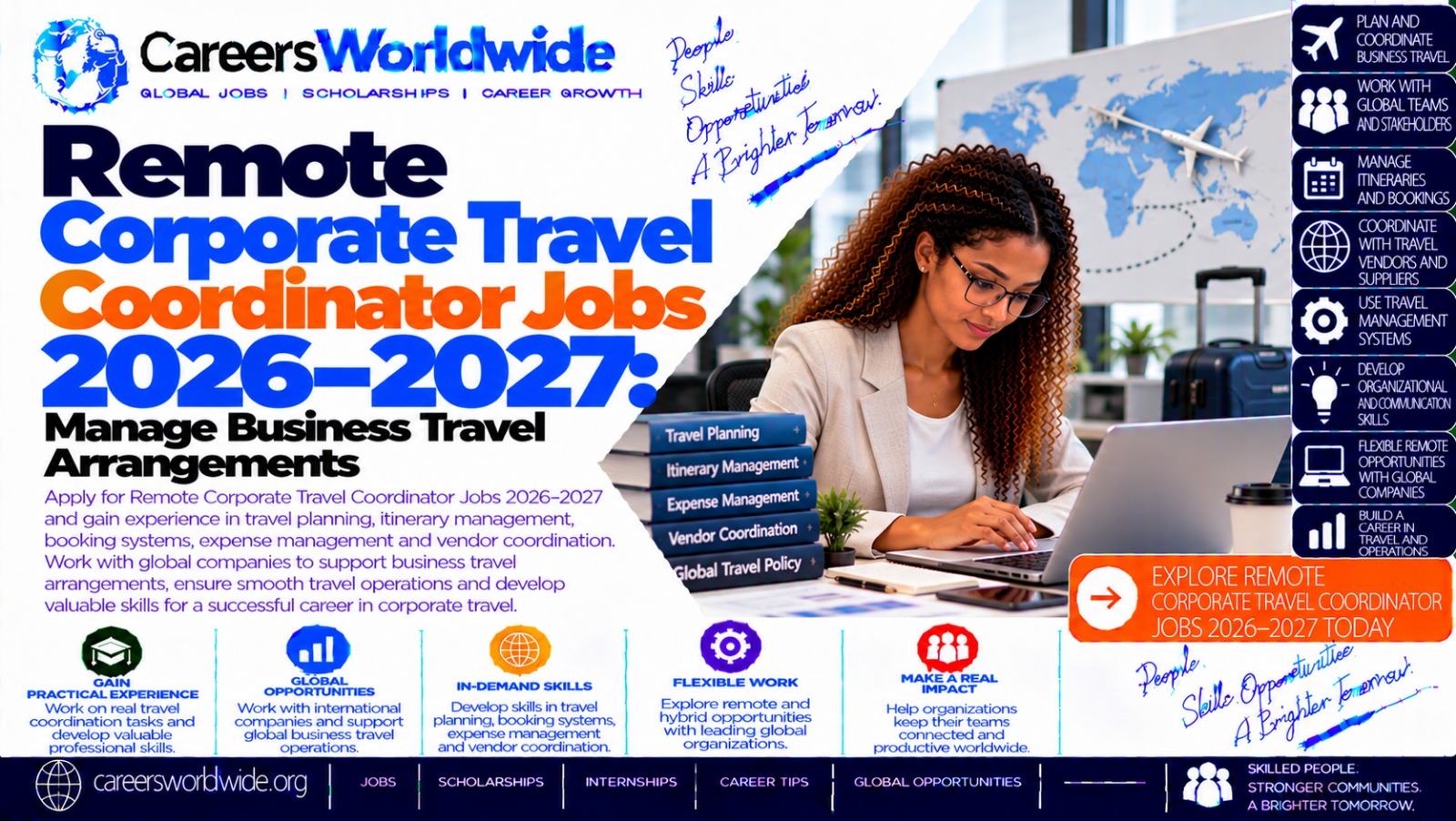

Excerpt: Remote corporate travel coordinator jobs in 2026–2027 offer opportunities for organized, customer-focused professionals to help businesses manage flights, hotels, ground transportation, travel schedules, and employee itineraries. These roles may be available through corporate travel management companies, multinational organizations, travel agencies, and business support providers. Discover the essential skills, qualifications, work-from-home requirements, application steps, salary research strategies, and official career resources you can use to pursue remote corporate travel coordination opportunities.
Introduction: Explore Remote Corporate Travel Coordinator Jobs in 2026–2027
Business travel plays an important role in corporate operations, from client meetings and conferences to training sessions, international negotiations, and company events. Organizations need reliable professionals who can coordinate these arrangements efficiently, manage changes, communicate with travelers, and help employees follow company travel policies.
Remote corporate travel coordinator jobs combine administrative organization, customer service, travel planning, and digital communication. Depending on the employer, a coordinator may work directly for a company, support a corporate travel management provider, or assist a distributed team responsible for employee travel across multiple locations.
The opportunity is not limited to experienced travel professionals. Applicants with backgrounds in administration, customer support, hospitality, reservations, event coordination, and operations may also have transferable skills that employers value.
However, remote positions differ considerably. Some employers recruit internationally, while others require applicants to live in a particular country, maintain specific working hours, or possess previous experience with corporate booking systems. A job advertised as remote does not automatically mean it is available worldwide.
For job seekers planning their next career move in 2026–2027, understanding these requirements is essential. This guide explains what corporate travel coordinators do, where to find legitimate opportunities, how to prepare an application, and how to identify positions that match your experience and location.
1. What Is a Remote Corporate Travel Coordinator?
A remote corporate travel coordinator organizes business travel arrangements for employees, managers, executives, clients, or other authorized travelers. Rather than working from a traditional corporate office, the coordinator performs some or all of these responsibilities through online booking platforms, email, telephone, messaging applications, and travel management systems.
The exact duties depend on the organization. In a small business, one coordinator might handle an entire trip from initial request to final itinerary. In a multinational company, responsibilities may be divided among booking specialists, travel managers, expense teams, and executive assistants.
Common responsibilities include:
- Booking domestic and international flights.
- Arranging hotel reservations and approved accommodations.
- Coordinating airport transfers, car rentals, trains, and other transportation.
- Preparing detailed itineraries and sharing confirmation documents.
- Updating bookings when meetings, flights, or travel dates change.
- Communicating with employees, managers, suppliers, and travel agencies.
- Checking requests against company travel policies and approved budgets.
- Recording booking information and assisting with travel expense documentation.
- Monitoring schedule disruptions and helping travelers understand available alternatives.
- Protecting confidential employee, payment, and business information.
Some positions focus primarily on reservations, while others emphasize administration, reporting, policy compliance, or executive travel support.
Practical tip: Read the responsibilities section of every job advertisement carefully. A corporate travel coordinator position may differ substantially from a general travel agent, personal assistant, or travel operations manager role, even when the job titles appear similar.
2. Why Consider This Career in 2026–2027?
Remote corporate travel coordination can appeal to people who enjoy organizing complex schedules, solving problems, and helping others navigate changing plans.
Businesses may need travel support for sales meetings, industry conferences, international projects, customer visits, and employee training. Travel management providers may also need personnel to assist corporate clients with reservations, service requests, and itinerary changes.
Digital booking platforms and online collaboration tools make it possible to perform many coordination tasks away from a traditional office. Nevertheless, not every employer offers fully remote work, and some positions combine home-based work with office attendance or occasional travel.
Several factors make this career worth exploring:
Flexible work arrangements: Some employers offer fully remote or hybrid schedules. Availability depends on the employer, position, and employment country.
Transferable administrative skills: Experience managing calendars, coordinating appointments, preparing documents, and communicating with customers can be relevant.
Multiple industry pathways: Opportunities may exist with travel management companies, technology businesses, consulting firms, financial institutions, international organizations, and large employers with frequent business travelers.
Potential career development: With experience, coordinators may pursue travel operations, executive travel support, corporate travel management, procurement, meetings and events, or related administrative positions.
International coordination: Some positions involve working across time zones and arranging trips involving multiple countries, suppliers, and transportation providers.
It is important to approach these opportunities realistically. Remote work is competitive, entry-level positions may require previous customer service experience, and employers can impose strict availability or location requirements. The strongest application demonstrates both organizational ability and a practical understanding of business travel operations.
3. Main Duties and Day-to-Day Responsibilities
A remote corporate travel coordinator’s working day often revolves around planning, communication, accuracy, and responding to changes.
Booking flights and transportation
Coordinators review travel requests, compare permitted flight options, check schedules, and book transportation according to company guidelines. They may coordinate airport transfers, rental cars, rail journeys, or connections between destinations.
Accuracy is essential. A booking with the wrong travel date, passenger name, departure airport, or arrival time can cause unnecessary expenses and missed meetings.
Arranging accommodation
Hotel coordination includes checking approved properties, availability, room requirements, location, cancellation conditions, and company spending limits. Coordinators may also communicate special requests and ensure the reservation covers the correct dates.
Preparing itineraries
A useful itinerary brings the essential information together in one accessible document. Depending on the trip, it may include flight numbers, departure times, confirmation codes, accommodation details, meeting addresses, ground transportation, and emergency contact information.
Handling schedule changes
Business travel plans can change unexpectedly because of flight cancellations, delayed connections, meeting rescheduling, or employee emergencies. Coordinators help identify alternatives, communicate updates, and follow the employer’s procedures for approving changes.
Supporting travel policies and expenses
Companies often establish rules concerning approved booking channels, airfare classes, hotel budgets, advance booking, and expense documentation. Coordinators help travelers follow those requirements and may assist finance teams with receipts, invoices, and booking records.
Communicating across departments
The role can involve regular interaction with employees, senior managers, finance departments, procurement teams, suppliers, and external travel consultants.
Professional communication matters because travelers may need clear answers quickly, particularly when a disruption affects an important business commitment.
4. Qualifications and Skills Employers May Require
Requirements vary by vacancy. Some corporate travel consultant roles require previous travel-booking experience, while administrative coordination positions may place greater emphasis on organization and customer service.
The following skills can strengthen an application.
| Skill or qualification | Why it matters |
|---|---|
| Written and verbal communication | Helps resolve booking questions and communicate itinerary changes. |
| Organization and time management | Supports several travelers, deadlines, and reservations simultaneously. |
| Computer proficiency | Enables efficient use of booking platforms, spreadsheets, email, and calendars. |
| Attention to detail | Reduces errors involving names, dates, destinations, and payment records. |
| Customer service | Helps maintain professional, helpful relationships with travelers. |
| Problem-solving | Supports alternative arrangements during disruptions. |
| Confidentiality | Protects employee information, travel documents, and company data. |
| Budget awareness | Helps identify options that meet corporate travel policies. |
| Adaptability | Makes it easier to respond to urgent changes and shifting priorities. |
| Travel technology knowledge | Supports accurate reservations and itinerary management. |
Is a university degree necessary?
Not always. Some employers accept a secondary-school qualification and relevant experience, while others prefer a diploma, degree, or industry-specific training.
The U.S. Bureau of Labor Statistics explains that travel agents typically need a high school diploma, strong communication and customer service skills, and computer proficiency. It also notes that employers may prefer relevant education or experience. These findings provide useful occupational context, but they do not establish the requirements for every corporate coordinator vacancy or country.
Read the specific advertisement before paying for a qualification. A degree is not automatically necessary for every position, and a certificate cannot guarantee employment.
Do applicants need travel industry experience?
Some positions require experience with reservations, ticketing, corporate travel policies, or global distribution systems (GDS). Other employers may consider applicants with transferable experience or provide structured training.
Relevant backgrounds include:
- Administrative assistant or office coordinator.
- Executive assistant or personal assistant.
- Customer service representative.
- Hotel reservations or hospitality staff.
- Airline customer support agent.
- Event planner or meeting coordinator.
- Travel consultant or booking agent.
- Operations or logistics assistant.
If you have never worked in travel, demonstrate how your previous responsibilities translate into the new role. For example, arranging appointments, resolving customer complaints, managing confidential records, and coordinating multiple deadlines can all provide relevant evidence.
5. Travel Software and Digital Tools to Understand
Remote coordinators rely on digital tools to communicate, organize bookings, and maintain accurate records. Employers usually specify their preferred systems during recruitment or training.
Global distribution systems: Tools such as Sabre and Amadeus support travel reservations and related transactions. Knowledge of a particular system can be valuable for travel consultant roles, although not every coordination job requires direct GDS access.
Online booking platforms: Corporate booking tools help employees or travel teams search for flights, hotels, and transportation while following approved company processes.
Email and calendars: Microsoft Outlook, Google Calendar, and related tools help coordinate meetings, deadlines, and itinerary updates.
Spreadsheets: Excel or Google Sheets may be used for booking trackers, cost comparisons, traveler lists, and expense reconciliation.
Collaboration platforms: Microsoft Teams, Zoom, and similar applications support remote communication, team meetings, and handovers.
Document management systems: Secure file-sharing tools help teams store itineraries, confirmations, invoices, and travel policies.
You do not need to master every platform before applying. Prioritize the tools named in the vacancy, and avoid claiming professional proficiency in software you have not used.
A practical way to build confidence is to create a sample itinerary using fictional traveler information. Include a schedule, transportation options, accommodation details, a simple budget comparison, and a contingency plan. Clearly label the exercise as a sample rather than presenting it as paid work experience.
6. Remote Work Requirements and International Eligibility
One of the most important steps in finding remote corporate travel coordinator jobs is confirming where the employer can legally hire you.
Remote vacancies may be advertised as:
- Remote within one country: Applicants must reside in an approved country, state, or region.
- Remote within a time zone: Employees may need to work specified hours even if they live elsewhere.
- Hybrid: Some office attendance is required.
- Work from anywhere: International work may be permitted, but the arrangement can still have limits.
- Remote contractor: The worker provides services under a contract rather than standard employee terms.
These arrangements are not interchangeable.
For example, a vacancy marked “US Remote” may require U.S. residence, employment authorization, or the ability to work a designated shift. It should not be interpreted as an invitation for applicants from every country.
Applicants living outside the employer’s hiring region should check eligibility before investing substantial time in an application. Ask whether the company accepts international employees, engages contractors in your country, or uses an employer-of-record arrangement where legally appropriate.
Setting up a productive home workspace
Employers may expect a quiet working area, dependable internet access, a suitable computer, secure access to company systems, and professional telephone communication.
Some provide equipment; others specify minimum technical requirements or require employees to supply certain items. Confirm the policy before accepting an offer or purchasing expensive equipment.
If you are applying from Zimbabwe or another country outside the advertised hiring region, also consider payment arrangements, local employment rules, time-zone differences, and whether the employer can lawfully engage you. International interest alone does not establish eligibility.
7. Remote Corporate Travel Coordinator Salary and Benefits
Compensation depends on the employer, job level, location, working hours, employment arrangement, and experience required. Because the title covers different responsibilities, there is no single salary that applies to all remote corporate travel coordinator jobs in 2026–2027.
As a reference point, the U.S. Bureau of Labor Statistics reported a median annual wage of $50,160 for travel agents in May 2025. This is an occupational benchmark, not a salary forecast or guaranteed pay rate for remote corporate travel coordinators. Corporate travel consultants, administrative coordinators, and experienced travel managers may receive different compensation.
For a practical comparison, review each vacancy for:
- Annual salary or hourly pay.
- Currency and payment frequency.
- Employee versus contractor status.
- Health insurance, pension, or other benefits, where applicable.
- Paid leave and public holiday arrangements.
- Training compensation and probation requirements.
- Evening, weekend, overnight, or holiday shift expectations.
- Overtime rules and any performance-based incentives.
- Equipment, internet, and home-office allowances.
Compare offers using the actual working hours and employment conditions rather than salary alone.
For example, a position with a higher advertised hourly rate may require overnight availability or independent contractor expenses. A lower-paying employee role may include paid training or benefits. Evaluate the complete package and applicable local costs.
Be cautious of advertisements promising unusually high earnings for simple booking tasks without explaining the employer, responsibilities, or employment terms. Never pay a recruiter to secure a job or provide sensitive financial information before verifying the hiring organization and offer.
8. Summary Table: Remote Corporate Travel Coordinator Jobs 2026–2027
Use this overview to identify the main requirements and determine which opportunities to investigate first.
| Category | What applicants should know |
|---|---|
| Job title | Corporate Travel Coordinator, Travel Consultant, Travel Operations Coordinator, Business Travel Agent, or Travel Administrator |
| Work arrangement | Fully remote, hybrid, or location-restricted remote |
| Typical duties | Flight and hotel bookings, itinerary preparation, travel support, policy compliance, and schedule changes |
| Education | Secondary education may be sufficient for some roles; others prefer additional qualifications |
| Experience | Requirements range from transferable administrative skills to several years of corporate travel experience |
| Software | Booking platforms, GDS tools, spreadsheets, email, calendars, and collaboration systems |
| Salary | Varies by country, seniority, employer, and employment arrangement |
| Work schedule | Standard business hours or shifts covering evenings, weekends, and urgent requests |
| Application documents | Tailored CV or résumé, relevant qualifications, and references when requested |
| Recruitment channel | Official employer career pages and verified recruitment systems |
| International eligibility | Must be confirmed for each employer and vacancy |
| Career progression | Senior travel consultant, travel operations specialist, travel manager, or meetings and events coordinator |
9. Where to Find Legitimate Remote Corporate Travel Jobs
Start with companies that specialize in business travel or operate large corporate travel programs. Use their official career portals to check current vacancies, eligibility conditions, and application procedures.
The following resources are useful starting points. They are not a guarantee that a particular coordinator vacancy is open or that applicants in every country are eligible.
BCD Travel
BCD Travel provides business travel management services and advertises career opportunities across travel consulting, customer service, operations, and other functions. Its official careers website describes remote and flexible working opportunities for many roles.
Explore: BCD Travel Careers
Search for titles such as Travel Consultant, Travel Consultant Trainee, Corporate Travel, and Travel Operations. Review the country, work arrangement, shift requirements, and experience criteria for each listing.
American Express Global Business Travel
American Express Global Business Travel (Amex GBT) operates in corporate travel and related services. Its career opportunities may include travel consulting, customer support, account management, and operations.
Explore: American Express Careers
Search for business travel-related terms and verify whether the vacancy belongs to the relevant travel business. Filter by location and workplace arrangement where those options are available.
CWT
CWT is another business travel management company worth investigating. Search for its official career website and current vacancies in travel consulting, traveler support, and corporate travel operations.
Start with the company’s official website: CWT
Follow its careers links to identify the official recruitment portal. Confirm that any advertised role remains active before applying.
Corporate employers and travel management providers
Companies in consulting, technology, finance, manufacturing, and professional services may employ internal travel coordinators or executive support staff. Travel management companies may use different titles for comparable work.
Try searching for these job titles:
- Remote Corporate Travel Coordinator.
- Remote Travel Consultant.
- Corporate Travel Specialist.
- Travel Operations Coordinator.
- Business Travel Agent.
- Travel and Expense Coordinator.
- Executive Travel Coordinator.
- Meetings and Events Coordinator.
- Travel Support Specialist.
- Corporate Travel Administrator.
Broader search terms can reveal relevant opportunities that do not use the exact phrase “corporate travel coordinator.”
General job boards
Established job boards can help identify openings and compare job requirements. Examples include LinkedIn Jobs, Indeed, and other reputable platforms operating in your region.
Use them to discover vacancies, but when possible, verify the position on the employer’s own career website before submitting an application or personal information.
10. How to Apply for Remote Corporate Travel Coordinator Jobs
A targeted application is generally more effective than sending the same résumé to every advertisement. Follow these steps to improve the relevance and clarity of your application.
Step 1: Identify suitable vacancies
Search using multiple job titles and filter for remote positions, experience level, and country eligibility.
Save advertisements that match your background. Record the employer, application deadline if provided, work location, required skills, salary information, and application link.
Step 2: Check the eligibility criteria
Before preparing your documents, confirm the following:
- Is the position open in your country or region?
- Is previous corporate travel experience compulsory?
- Does the employer require a particular booking system?
- Are the working hours compatible with your availability?
- Is the role permanent, temporary, or contract-based?
- Does the employer provide training?
- Are there specific language, education, or work authorization requirements?
If a critical requirement is unclear, consult the employer’s official recruitment team.
Step 3: Prepare a tailored résumé
Your résumé should show how your experience matches the responsibilities in the advertisement.
Highlight achievements involving scheduling, customer service, booking coordination, records management, expense documentation, problem-solving, and remote communication.
Whenever possible, provide measurable evidence. For example, if accurate, you might state that you coordinated appointments for several managers, resolved a defined number of customer inquiries, or maintained records for a large number of transactions.
Do not invent figures, qualifications, employers, or travel industry experience.
Step 4: Write a focused cover letter
Explain why the position interests you and connect your experience to the employer’s needs.
A strong cover letter might describe how you manage competing deadlines, communicate professionally with customers, protect confidential information, and respond calmly when plans change.
If you are transitioning from administration or hospitality, explain how your existing skills can transfer to corporate travel coordination.
Step 5: Submit your application through the official channel
Complete the application form, attach the requested documents, and review your details before submitting.
Use a professional email address and ensure your contact information is accurate. Keep a copy of the job description and confirmation of submission.
Step 6: Prepare for interviews and assessments
Employers may ask situational questions about missed flights, hotel cancellations, urgent itinerary changes, customer complaints, confidentiality, or conflicting priorities.
Practise explaining your decision-making process. Emphasize accuracy, calm communication, compliance with company policy, and timely escalation when approval is needed.
Step 7: Follow up professionally
If the employer provides a recruitment timeline, respect it. If no timeline is provided, a brief follow-up after a reasonable interval may be appropriate.
Avoid repeated messages, and continue applying to other suitable vacancies while waiting for a decision.
11. How to Apply Without Previous Corporate Travel Experience
If you are new to the industry, focus on entry-level vacancies, trainee programs, and roles that emphasize customer service or administrative support.
Start by identifying your transferable skills. A hotel receptionist may understand reservations and guest requests. An administrative assistant may already manage calendars and confidential documents. A customer service representative may be experienced in resolving urgent problems while maintaining a professional tone.
Next, develop foundational travel knowledge. Learn how flight itineraries are structured, why ticket conditions matter, how cancellation policies affect costs, and how company travel policies influence booking decisions.
You can also practise preparing sample itineraries and comparing fictional travel options. Use imaginary names and booking references rather than real passenger information.
If a vacancy specifically requires Sabre, Amadeus, or another GDS, determine whether introductory training is available and whether the employer accepts equivalent experience. Training may help demonstrate commitment, but avoid paying for a course simply because a recruiter claims it guarantees employment.
Finally, apply for adjacent roles such as travel support assistant, reservations agent, customer service representative, or administrative coordinator. These positions may provide relevant experience for future corporate travel opportunities.
12. How to Recognize and Avoid Recruitment Scams
Remote job seekers should verify vacancies carefully, especially when advertisements promise immediate hiring, unusually high earnings, or employment without a meaningful selection process.
Warning signs include:
- Requests for recruitment, registration, or job placement fees.
- Offers made without a credible interview or assessment.
- Email addresses that imitate a company but use unrelated domains.
- Requests for banking passwords, one-time passcodes, or unnecessary identity documents.
- Instructions to purchase equipment from a designated individual or transfer money for reimbursement.
- Pressure to accept an offer immediately without written employment terms.
- Advertisements that cannot be found on the employer’s official career website.
A legitimate employer may request identity, tax, payroll, or work authorization documentation at the appropriate stage of recruitment. The key is to verify the employer, understand why the information is required, and use a secure official process.
Never send money to obtain a job. If a listing appears suspicious, contact the organization using contact information independently obtained from its official website.
13. Frequently Asked Questions (FAQ)
1. Can I work remotely as a corporate travel coordinator in 2026–2027?
Yes, some employers advertise remote travel consulting and coordination positions. However, availability depends on current recruitment needs, job requirements, and the countries in which the employer can hire. Always confirm the location restrictions in the original advertisement.
2. Do I need a degree to become a corporate travel coordinator?
Not necessarily. Some employers accept secondary education and relevant customer service or administrative experience. Others prefer a diploma, degree, travel qualification, or previous experience using reservation systems. Follow the specific requirements in the job listing.
3. Can beginners apply for remote corporate travel jobs?
Yes, beginners can apply for vacancies that accept entry-level applicants or provide training. Search for trainee positions, reservations support, travel administration, and customer service roles. Experienced corporate travel consultant positions may have stricter requirements.
4. How much can a remote corporate travel coordinator earn?
Pay varies by country, employer, experience, and duties. The U.S. Bureau of Labor Statistics reported a median annual wage of $50,160 for travel agents in May 2025, but this figure is not a guaranteed salary for corporate travel coordinators. Check the advertised compensation and local employment conditions.
5. Which skills are most important for this role?
Organization, communication, attention to detail, customer service, computer proficiency, confidentiality, and problem-solving are particularly relevant. Knowledge of corporate travel policies and reservation systems can also be valuable.
6. Can I apply for international remote positions from Zimbabwe?
Potentially, but eligibility depends on the employer. Some companies hire only within the United States, the United Kingdom, or other designated markets. Others may support international employment or contractor arrangements. Check country eligibility, work authorization, payment arrangements, and time-zone requirements before applying.
7. Do I need to own a computer and have home internet?
Many remote employers require reliable internet and a suitable workspace. Equipment policies differ: some companies provide computers and accessories, while others specify what applicants must supply. Check the technical requirements before accepting a role.
8. What software should I learn before applying?
Start with spreadsheets, email, calendars, online meeting tools, and document management. If you want to pursue travel consultant positions, introductory knowledge of Sabre or Amadeus may be useful when those systems appear in job requirements.
9. Are corporate travel coordinator jobs the same as travel agent jobs?
No. The roles can overlap, but a corporate travel coordinator may focus on employee itineraries, company travel policies, internal approvals, and expense records. A travel consultant may concentrate more heavily on reservations, ticket changes, and advising travelers. The actual responsibilities matter more than the title alone.
10. How do I know whether a remote job advertisement is legitimate?
Look for the vacancy on the employer’s official careers website, verify the recruiter’s identity, and review the application process. Avoid offers that require payment to secure employment or request sensitive financial information through unverified channels.
11. Will employers provide training?
Some employers offer structured training, while others expect candidates to have previous experience with booking systems and corporate travel procedures. Read the vacancy carefully and ask the recruitment team about training when the information is unclear.
12. When should I start applying for 2027 opportunities?
Start whenever suitable vacancies appear rather than waiting for a particular month. Set up job alerts, check official career portals regularly, and prepare your résumé in advance. Recruitment schedules differ between employers, and no universal hiring season guarantees openings.
14. How to Apply: A Practical Checklist
Use the following checklist to organize your job search and improve your chances of finding a suitable remote corporate travel coordinator position in 2026–2027.
Application Preparation Checklist
- Identify at least three companies that offer corporate travel management services.
- Search for remote corporate travel coordinator, travel consultant, and travel operations jobs.
- Confirm that each employer accepts applicants from your country.
- Review the required qualifications, experience, software skills, and working hours.
- Prepare a professional résumé and a tailored cover letter.
- Practise creating travel itineraries and answering customer service interview questions.
- Submit applications through verified company career websites.
- Keep a record of application dates, job links, and follow-up deadlines.
- Verify every job offer before sharing sensitive personal information.
Helpful tip: Complete each step as you progress through your job search. Keeping a record of your applications will help you stay organized, avoid missing deadlines, and follow up with employers professionally.
15. Official Application Resources
The following websites are useful starting points for finding business travel employers and researching the occupation. Visit the sites directly, search for relevant vacancies, and read each listing’s eligibility requirements.
<box gap={3}> <row align=”start” gap={3}> <AsyncImage query=”BCD Travel corporate travel company logo” aspectRatio=”1:1″ maxWidth=”76px”/> <box flex=”1″ gap={1}> **BCD Travel Careers**
  Search for travel consultant, travel operations, and other business travel opportunities.

  <text><Link url="https://www.bcdtravel.com/jobs/" title="Visit the official BCD Travel careers page"/></text>
</box>
</row> <divider color=”subtle”/> <row align=”start” gap={3}> <AsyncImage query=”American Express corporate brand logo” aspectRatio=”1:1″ maxWidth=”76px”/> <box flex=”1″ gap={1}> **American Express Careers**
  Explore relevant corporate, customer service, and travel-related openings.

  <text><Link url="https://careers.americanexpress.com/" title="Visit the official American Express careers website"/></text>
</box>
</row> <divider color=”subtle”/> <row align=”start” gap={3}> <AsyncImage query=”CWT business travel management company logo” aspectRatio=”1:1″ maxWidth=”76px”/> <box flex=”1″ gap={1}> **CWT**
  Explore the company website and follow its careers links to locate official recruitment opportunities.

  <text><Link url="https://www.mycwt.com/" title="Visit the official CWT website"/></text>
</box>
</row> <divider color=”subtle”/> <row align=”start” gap={3}> <AsyncImage query=”United States Bureau of Labor Statistics official seal” aspectRatio=”1:1″ maxWidth=”76px”/> <box flex=”1″ gap={1}> **U.S. Bureau of Labor Statistics**
  Research travel agent duties, education, compensation benchmarks, and occupational outlook information.

  <text><Link url="https://www.bls.gov/ooh/sales/travel-agents.htm" title="Read the official travel agent occupational profile"/></text>
</box>
</row> </box>
These resources serve different purposes. Company websites are the primary place to confirm vacancies and submit applications; the occupational profile provides general career information. Neither guarantees a particular vacancy will remain open throughout 2026–2027.
16. Final Thoughts: Building a Career in Remote Corporate Travel Coordination
Remote corporate travel coordinator jobs can suit professionals who enjoy organization, customer service, digital communication, and solving practical problems. The work can involve coordinating complex itineraries, helping employees manage unexpected travel disruptions, and ensuring reservations follow company policies.
The most effective approach is to prepare before applying. Develop a relevant résumé, identify transferable skills, learn the basics of corporate travel arrangements, and investigate booking software where appropriate. Most importantly, target positions that match your qualifications, working hours, and country of residence.
For 2026–2027, use official employer career pages as your primary source of information. Treat salary figures as employer- and location-dependent, verify every vacancy, and avoid recruitment offers that demand payment.
Whether you are an experienced travel consultant or an administrative professional seeking a new direction, a structured job search can help you identify suitable opportunities and prepare stronger applications.
Disclaimer
This article is for general informational and career guidance purposes only. It does not constitute an employment offer, guarantee job placement, or promise a particular salary. Vacancies, qualifications, compensation, recruitment schedules, and remote-work policies may change without notice. Confirm all requirements directly with the relevant employer through its official website. International applicants are responsible for checking applicable work authorization, tax, employment, and contractual requirements. Company names and links are provided for informational purposes and do not imply endorsement or a guarantee of recruitment.
SEO Keywords
remote corporate travel coordinator jobs 2026,
remote corporate travel coordinator jobs 2027,
work from home travel coordinator jobs,
remote business travel jobs,
corporate travel coordinator careers,
remote travel consultant jobs,
business travel coordinator vacancies,
remote travel operations jobs,
corporate travel specialist jobs,
travel booking jobs from home,
remote travel administration jobs,
work from home corporate travel agent,
entry level remote travel jobs,
remote travel jobs with training,
international remote travel coordinator jobs,
corporate travel management careers,
remote flight and hotel booking jobs,
travel itinerary coordinator jobs,
remote travel support specialist jobs,
corporate travel jobs for beginners,
remote reservations agent jobs,
travel coordinator qualifications,
corporate travel coordinator salary,
remote travel jobs for international applicants,
official corporate travel job application websites,
how to apply for remote travel coordinator jobs,
business travel management careers 2027,
ALSO CHECK: Banking Internship 2026–2027: Start Your Career in Financial ServicesOctober 15, 2026
Human Resources Internship 2026–2027: Learn Recruitment and Talent ManagementOctober 15, 2026
Procurement Internship 2026–2027: Gain Experience in Purchasing and Supplier ManagementOctober 15, 2026