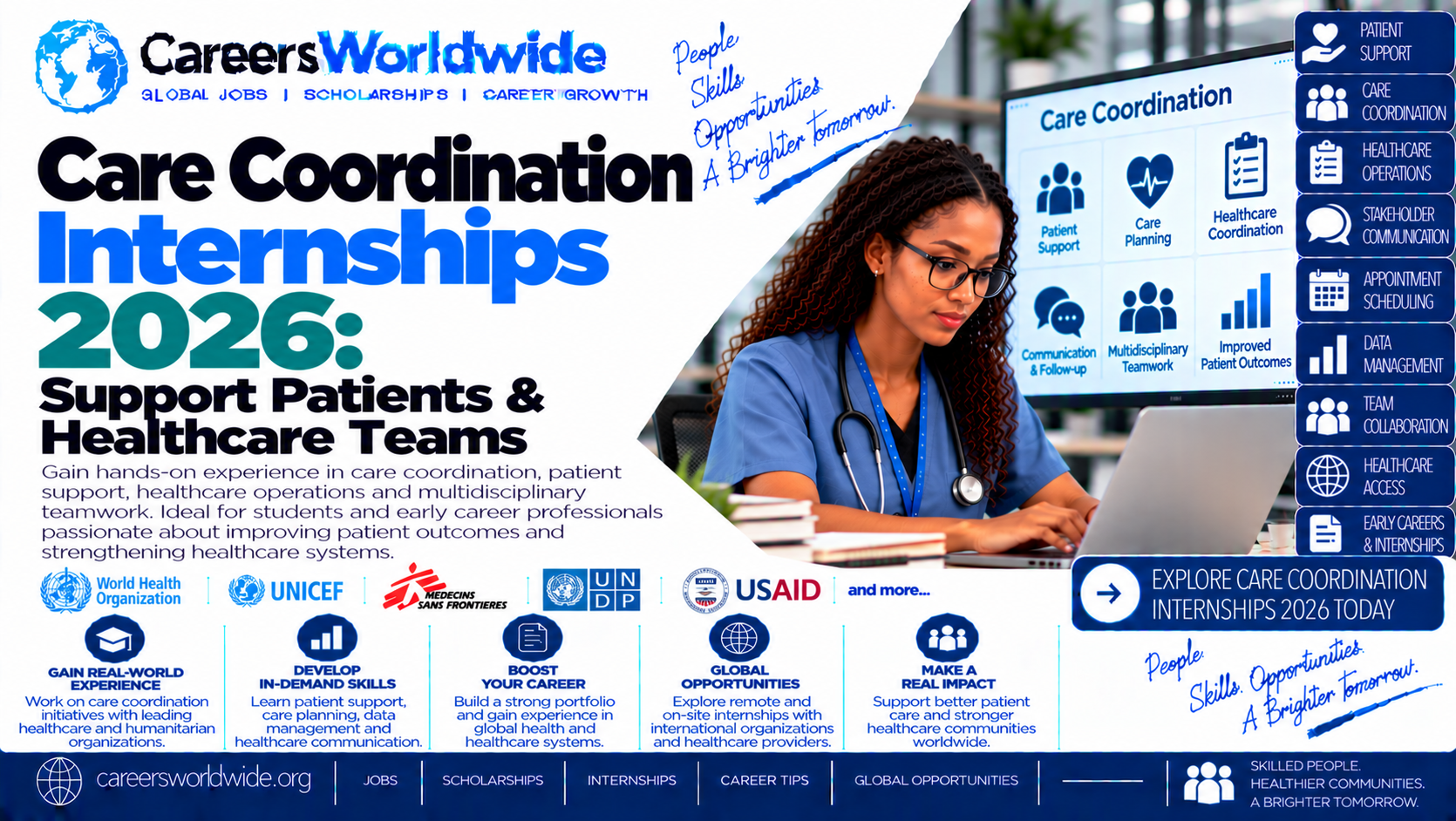

Excerpt: Care Coordination Internships 2026 offer students and recent graduates an opportunity to gain practical experience supporting patients, healthcare professionals, referrals, appointments, health records, discharge planning, and patient-centered services. These internships can be an excellent starting point for careers in healthcare administration, public health, health services, patient navigation, health informatics, social services, and clinical operations.
Healthcare is becoming increasingly team-based, technology-driven, and focused on delivering coordinated services around the needs of individual patients. As patients interact with primary-care providers, specialists, hospitals, pharmacies, insurers, rehabilitation services, and community organizations, keeping information and services connected has become increasingly important.
That is where care coordination comes in.
The Agency for Healthcare Research and Quality (AHRQ) describes care coordination as deliberately organizing patient-care activities and sharing information among everyone involved in a patient’s care so that care can be safer and more effective. Activities can include assessing patient needs, coordinating referrals, supporting transitions between care settings, monitoring follow-up, communicating information, and connecting patients with community resources.
For students and early-career professionals, Care Coordination Internships 2026 can provide exposure to these processes while working alongside healthcare teams.
What Are Care Coordination Internships?
Care coordination internships are structured learning opportunities in which interns assist healthcare organizations, clinics, hospitals, health plans, nonprofit organizations, research programs, or community-health initiatives with activities that help patients navigate healthcare services.
Depending on the organization, an intern may work with nurses, physicians, social workers, care managers, patient navigators, administrative teams, health-information professionals, or public-health specialists.
The exact responsibilities vary significantly.
Some internships may be primarily administrative, while others may involve patient outreach, data analysis, referral tracking, quality improvement, research, or healthcare navigation.
Common activities can include:
- Supporting appointment scheduling and follow-up.
- Tracking referrals and care transitions.
- Organizing patient information.
- Helping maintain care coordination records.
- Supporting patient outreach.
- Communicating with members of healthcare teams.
- Assisting with discharge-planning activities.
- Connecting patients with appropriate community resources.
- Preparing reports and spreadsheets.
- Supporting healthcare quality-improvement projects.
- Reviewing workflow processes.
- Helping identify gaps in follow-up care.
- Assisting with patient education materials.
- Supporting data collection for healthcare programs.
Interns generally work under supervision and should not assume responsibilities that require professional clinical licensure or independent clinical judgment.
Why Care Coordination Matters in Modern Healthcare
Healthcare can involve many professionals and organizations. A patient may see a primary-care provider, specialist, pharmacist, laboratory, hospital, rehabilitation provider, and community organization.
Without effective communication, important information can be delayed, duplicated, or missed.
AHRQ identifies activities such as teamwork, medication management, health information technology, care management, transitions of care, proactive care planning, monitoring and follow-up, and linking patients with community resources as important components of coordinated care.
This makes care coordination relevant to a wide range of healthcare careers.
An intern who learns how referrals move through a healthcare system, for example, can develop a better understanding of how administrative processes affect patient experiences.
Likewise, an intern helping with data or quality improvement can learn how healthcare organizations identify workflow problems and measure improvements.
What Do Care Coordination Interns Actually Do?
One of the biggest advantages of these internships is the variety of work available.
1. Patient Follow-Up
Interns may assist teams with non-clinical follow-up activities.
This could involve organizing outreach lists, documenting completed follow-up activities, or helping staff identify patients who need additional administrative support.
The goal is to help healthcare teams keep track of what needs to happen next.
2. Referral Coordination
Referrals can involve multiple steps.
A patient may need a referral from primary care, an appointment with a specialist, supporting medical information, and subsequent communication back to the referring provider.
Interns may help track administrative stages of the referral process under supervision.
3. Appointment Coordination
Interns may assist with appointment-related workflows, particularly in outpatient clinics and healthcare programs.
Tasks could include organizing appointment information, identifying scheduling gaps, preparing reminder lists, or helping administrative teams monitor attendance and follow-up.
4. Care Transitions
Transitions between healthcare settings are another important area.
For example, a patient might move from a hospital to home-based care, rehabilitation, or another healthcare facility.
AHRQ highlights transitions of care as an important component of effective coordination.
Interns may support teams by organizing information, tracking administrative tasks, or helping monitor whether transition-related activities have been completed.
5. Data and Reporting
Some care coordination internships are highly data-oriented.
Interns may use spreadsheets, databases, electronic health record systems, dashboards, or reporting tools to organize information.
Possible projects include:
- Tracking referral completion.
- Measuring appointment attendance.
- Monitoring patient outreach.
- Preparing weekly reports.
- Identifying workflow bottlenecks.
- Supporting quality-improvement projects.
- Cleaning non-clinical datasets.
- Creating charts and summaries.
These skills can be particularly useful for students interested in health informatics, healthcare analytics, or public health.
Who Can Apply for Care Coordination Internships?
Eligibility depends on the employer and program.
Potential applicants may include students studying:
- Public Health
- Health Administration
- Healthcare Management
- Nursing
- Social Work
- Psychology
- Sociology
- Health Informatics
- Biology
- Medicine
- Pharmacy
- Nutrition
- Data Science
- Statistics
- Business Administration
- Information Technology
- Health Sciences
Some employers may also consider recent graduates.
Not every care coordination internship requires a clinical degree.
Many positions focus on administration, communication, research, data, patient navigation, program support, or healthcare operations.
However, applicants should carefully read each official vacancy because some healthcare organizations may require specific academic backgrounds, enrollment status, location, or prior experience.
Skills Employers Look For
You do not necessarily need years of healthcare experience to become competitive.
Instead, demonstrate transferable skills.
Communication
Care coordination depends heavily on clear communication.
Your application should show that you can communicate professionally with different audiences.
Examples include:
- Writing professional emails.
- Preparing reports.
- Communicating with teams.
- Explaining information clearly.
- Listening carefully.
- Documenting information accurately.
Organization
Healthcare environments involve deadlines, appointments, records, referrals, and multiple stakeholders.
Employers value candidates who can manage several priorities without losing track of details.
Attention to Detail
Small administrative mistakes can create significant workflow problems.
Highlight experiences where you:
- Managed records.
- Checked information.
- Maintained spreadsheets.
- Followed procedures.
- Organized schedules.
- Verified data.
Teamwork
Care coordination is fundamentally collaborative.
AHRQ’s resources emphasize multidisciplinary teamwork and communication as important components of coordinated care.
Use examples from school projects, volunteer work, employment, research, or community activities.
Technology
Depending on the internship, useful skills can include:
- Microsoft Excel
- Google Sheets
- Microsoft Word
- Database systems
- Electronic health record concepts
- Data visualization
- Scheduling software
- Communication platforms
- Basic reporting tools
You do not need to know every healthcare system before applying.
Showing that you can learn technology quickly can be equally valuable.
Care Coordination Internships and Health Informatics
Care coordination increasingly intersects with technology.
Healthcare organizations use digital systems to share information, manage referrals, track appointments, communicate with teams, and monitor outcomes.
This creates opportunities for students interested in technology.
A student studying information technology or software engineering, for example, could pursue internships involving healthcare workflows, digital health platforms, patient portals, data quality, or healthcare analytics.
Health informatics students may be particularly well positioned because they can combine healthcare knowledge with data and technology skills.
Care Coordination and Patient Navigation
Care coordination and patient navigation are closely related but are not necessarily identical.
Patient navigators often help patients overcome barriers to accessing healthcare services.
These barriers may include difficulty understanding healthcare systems, transportation challenges, communication problems, financial concerns, or difficulty accessing community resources.
Care coordination can involve a broader organizational process connecting healthcare activities among multiple participants.
For interns, understanding this distinction can help when searching for opportunities.
Do not search only for the exact phrase “Care Coordination Internship.”
Also search for related titles.
Examples include:
- Care Management Intern
- Patient Navigator Intern
- Healthcare Operations Intern
- Clinical Operations Intern
- Patient Services Intern
- Population Health Intern
- Health Services Intern
- Healthcare Administration Intern
- Medical Operations Intern
- Community Health Intern
- Public Health Intern
- Patient Experience Intern
- Health Informatics Intern
- Quality Improvement Intern
- Clinical Research Operations Intern
This broader strategy can significantly increase the number of opportunities you discover.
Summary Table: Care Coordination Internships 2026
| Category | Details |
|---|---|
| Opportunity | Care Coordination Internships 2026 |
| Main focus | Patient support, healthcare coordination and team operations |
| Typical applicants | Students and recent graduates |
| Relevant fields | Public health, healthcare administration, nursing, health informatics, social work and related disciplines |
| Common tasks | Referrals, follow-up, scheduling, documentation, reporting and patient-support activities |
| Key skills | Communication, organization, teamwork, data management and attention to detail |
| Possible workplaces | Hospitals, clinics, health plans, nonprofits, research organizations and community-health programs |
| Experience level | Entry-level / internship |
| Work arrangements | On-site, hybrid or remote depending on employer |
| Potential career paths | Care coordinator, patient navigator, healthcare administrator, health services analyst and clinical operations roles |
| Application method | Usually through the organization’s official careers or internship portal |
| Important requirement | Always verify eligibility and deadlines on the official vacancy page |
How to Make Your CV Stand Out
A strong CV should make your relevant abilities immediately visible.
Instead of simply writing:
“Good communication skills.”
Give evidence.
For example:
“Coordinated a student research project involving five team members, maintaining project documentation and weekly progress reports.”
Instead of:
“Computer literate.”
Consider:
“Used Excel to organize and analyze project data, prepare summaries, and maintain accurate records.”
These examples demonstrate the skill rather than simply claiming it.
Recommended CV Sections
Your CV can include:
- Contact information
- Professional summary
- Education
- Relevant experience
- Volunteer experience
- Research or academic projects
- Technical skills
- Healthcare/public-health skills
- Certifications
- Leadership or extracurricular activities
If you have no healthcare employment history, do not assume you have nothing relevant to offer.
University projects, volunteering, customer-service work, administrative experience, community programs, research projects, and technology experience can all demonstrate transferable skills.
How to Write a Strong Care Coordination Internship Cover Letter
Your cover letter should answer three questions:
Why healthcare?
Explain your interest in healthcare, patient services, public health, or healthcare operations.
Why care coordination?
Show that you understand the importance of connecting patients, providers, services, and information.
Why you?
Connect your education, communication, organization, technology, research, or teamwork experience to the internship.
Avoid writing a generic letter that could be sent to any employer.
Mention the organization and explain why its work interests you.
Practical Application Strategy for 2026
Competition can be strong for healthcare internships, particularly at major hospitals and healthcare organizations.
A strategic approach can help.
Start Early
Do not wait until the deadline.
Some internship programs recruit months ahead of the start date.
Check official career pages regularly.
Apply to Multiple Related Roles
Do not restrict yourself to one job title.
Search for care coordination, patient navigation, healthcare operations, health services, population health, and clinical operations opportunities.
Customize Every Application
Match your CV to the requirements.
If the vacancy emphasizes:
- Data analysis
- Patient communication
- Excel
- Teamwork
- Research
make sure relevant experience is easy to find.
Prepare for Interviews
Expect questions such as:
Why are you interested in care coordination?
How would you handle multiple competing priorities?
Tell us about a time you worked as part of a team.
Describe a situation where you had to organize detailed information.
How would you handle confidential patient information?
What does patient-centered care mean to you?
For behavioral questions, use the STAR approach:
Situation → Task → Action → Result
How to Apply for Care Coordination Internships 2026
The safest application strategy is to apply directly through the official employer website.
Step 1: Identify Target Organizations
Look for:
- Hospitals
- Health systems
- Community health organizations
- Health insurance organizations
- Public-health agencies
- Research institutions
- Healthcare technology companies
- Nonprofit healthcare organizations
- Universities and medical centers
Step 2: Search the Official Careers Page
Use search terms such as:
“care coordination intern”
“patient navigator intern”
“healthcare operations intern”
“population health intern”
“health services intern”
“clinical operations intern”
Step 3: Read Eligibility Requirements
Check:
- Degree requirements
- Enrollment requirements
- Graduation date
- Location
- Work authorization
- Internship duration
- Start date
- Application deadline
- Required documents
Step 4: Prepare Your Documents
Typically, you may need:
- CV/resume
- Cover letter
- Academic transcript
- References
- Writing sample
- Portfolio or project examples
Not every organization requires all of these.
Step 5: Apply Through the Official Portal
Avoid relying on third-party websites when an official application page is available.
Job boards can help you discover vacancies, but always verify the opportunity on the employer’s own website.
Official Application Resources
Because individual internship vacancies open and close throughout the year, applicants should use official career and program pages rather than relying on a static list of vacancies.
A particularly useful resource for understanding care coordination is the Agency for Healthcare Research and Quality (AHRQ). Its care-coordination resources explain the principles, activities, measurement approaches, and implementation considerations associated with coordinated healthcare.
AHRQ Care Coordination Resources
AHRQ also provides training resources covering care-coordination processes, workflow assessment, referrals, multidisciplinary teams, and quality improvement.
AHRQ Care Coordination Training Resources
For applicants interested in AHRQ opportunities, the agency states that it has offered graduate-student internships connected with ongoing research projects, with internship announcements posted through its job opportunities resources.
AHRQ Careers and Employment Information
For actual 2026 internship vacancies, applicants should also check the official careers pages of hospitals, health systems, universities, public-health organizations, nonprofit healthcare organizations, and healthcare companies.
What Can You Do After a Care Coordination Internship?
A care coordination internship can provide a foundation for several career paths.
Care Coordinator
Care coordinators help organize services and communication around patients.
Patient Navigator
Patient navigators help people understand and access healthcare services.
Healthcare Administrator
Healthcare administrators support the operational side of healthcare organizations.
Clinical Operations Specialist
Clinical operations professionals help healthcare programs and services run efficiently.
Population Health Analyst
Population-health professionals use data and healthcare strategies to improve outcomes across groups of patients.
Health Services Researcher
Research-oriented graduates can study healthcare delivery, quality, access, costs, and patient outcomes.
Health Informatics Specialist
Those with technology and data skills can pursue roles connecting healthcare with information systems.
Public Health Professional
Care coordination experience can also complement careers in community health, health promotion, program management, and public-health administration.
Frequently Asked Questions
Are Care Coordination Internships only for nursing students?
No. Eligibility depends on the employer. Opportunities may be suitable for students studying public health, healthcare administration, social work, health informatics, psychology, health sciences, data analysis, business, and other related disciplines.
Do I need clinical experience?
Not necessarily.
Many internship responsibilities involve administration, data, communication, research, patient services, or healthcare operations rather than direct clinical care.
Always check the individual vacancy requirements.
Can international students apply?
Some programs accept international students, while others have citizenship, residency, enrollment, or work-authorization restrictions.
International applicants should carefully review the official eligibility criteria before applying.
Are Care Coordination Internships paid?
Some internships are paid, while others may be unpaid or structured as academic placements.
Never assume compensation. Check the official vacancy announcement.
Can these internships be remote?
Some healthcare operations, research, analytics, and administrative internships may offer remote or hybrid arrangements.
However, opportunities involving direct patient interaction or access to clinical facilities are more likely to require on-site participation.
What degree is best for care coordination?
There is no single required degree for every role.
Relevant programs include public health, health administration, health sciences, nursing, social work, health informatics, psychology, healthcare management, and related disciplines.
What should I put on my CV if I have no healthcare experience?
Focus on transferable skills.
Highlight communication, organization, research, data analysis, teamwork, customer service, administration, volunteering, leadership, and technology experience.
Is care coordination a good healthcare career starting point?
It can be.
The experience can expose students to healthcare workflows, multidisciplinary teamwork, patient services, healthcare administration, quality improvement, and health information processes.
How can I find Care Coordination Internships 2026?
Search official employer career portals using several related keywords rather than relying exclusively on the phrase “care coordination internship.”
Try terms such as patient navigator intern, care management intern, healthcare operations intern, clinical operations intern, population health intern, health services intern, and patient services intern.
Final Thoughts
Care Coordination Internships 2026 can be a valuable entry point for students and recent graduates who want to understand how modern healthcare teams work together.
The field sits at the intersection of patients, healthcare professionals, technology, administration, communication, data, and public health.
The experience can be particularly useful for people who enjoy solving organizational problems while contributing to better patient experiences.
Successful applicants do not necessarily need extensive professional experience. What matters is demonstrating that you can communicate clearly, organize information, work collaboratively, learn new systems, protect confidential information, and approach healthcare from a patient-centered perspective.
Care coordination itself is broader than scheduling appointments. Effective coordination involves organizing activities, sharing information, supporting transitions, monitoring follow-up, understanding patient needs, and connecting people with appropriate services.
For 2026 applicants, the best strategy is therefore to build a strong, targeted CV, search broadly across related healthcare internship titles, prepare carefully for interviews, and verify every opportunity through the organization’s official website.
Whether your long-term goal is public health, healthcare administration, health informatics, patient navigation, clinical operations, health services research, or population health, a care coordination internship can help you understand the systems behind patient care while developing practical workplace skills.
Disclaimer
This article is provided for informational and educational purposes only. Internship availability, eligibility requirements, application deadlines, compensation, locations, and work arrangements can change at any time. CareersWorldwide does not guarantee placement, selection, employment, compensation, or acceptance into any internship program. Applicants should independently verify all opportunity details on the official organization’s website before submitting an application or personal information. Never pay a fee to apply for an internship unless the official organization clearly confirms a legitimate charge.
SEO Keywords
care coordination internships 2026,
care coordination internship 2026,
healthcare internships 2026,
patient care internships 2026,
patient coordinator internships 2026,
care management internships 2026,
patient navigator internships 2026,
healthcare administration internships 2026,
health services internships 2026,
clinical operations internships 2026,
health informatics internships 2026,
public health internships 2026,
healthcare operations internships 2026,
patient services internships 2026,
population health internships 2026,
medical internships 2026,
healthcare internships for students 2026,
healthcare internships for recent graduates 2026,
care coordination jobs,
care coordinator career,
patient navigator jobs,
healthcare administration jobs 2026,
health services careers 2026,
clinical operations careers 2026,
health informatics careers 2026,
public health careers 2026,
healthcare management internships 2026,
care management intern,
patient navigation internship,
healthcare operations intern,
care coordination experience,
healthcare internship opportunities 2026,
best healthcare internships 2026,
healthcare internships for international students 2026,
remote healthcare internships 2026,
hybrid healthcare internships 2026,
paid healthcare internships 2026,
entry level healthcare internships 2026,
graduate healthcare internships 2026,
healthcare careers for graduates 2026,
patient-centered care internships,
healthcare quality improvement internships,
healthcare research internships 2026,
health services research internships 2026,
community health internships 2026,
clinical research operations internships 2026,
care coordination training,
care coordination students,
care coordination career path,
healthcare career opportunities 2026,
ALSO CHECK: Medical Affairs Internships 2026: Explore Scientific Communication & Healthcare StrategyOctober 4, 2026
Public Relations Internships 2026: Gain Experience in Media Relations & Brand VisibilityOctober 4, 2026
Localization Internships 2026: Adapt Digital Products for Global MarketsOctober 4, 2026