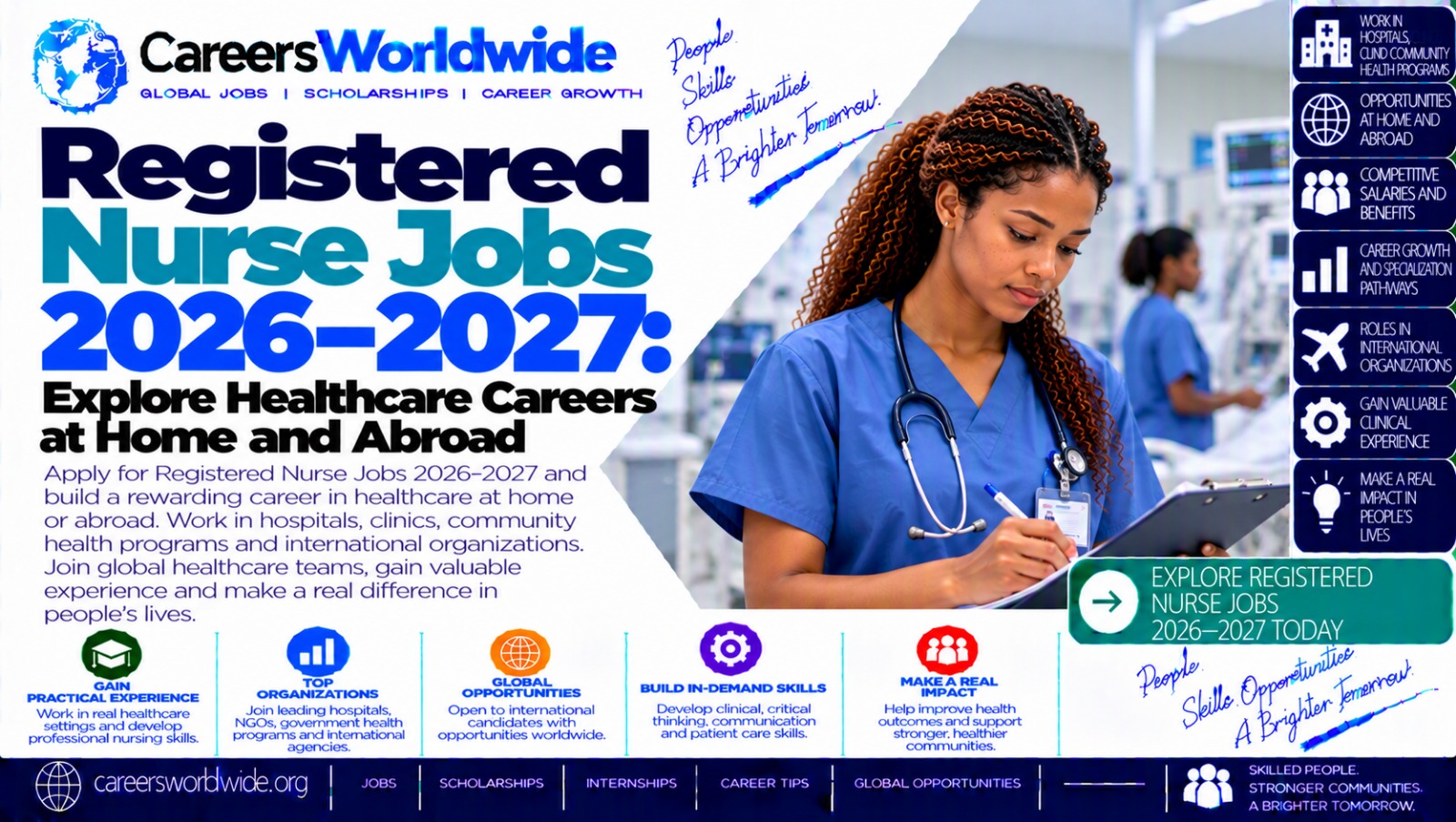

Excerpt: Registered Nurse Jobs 2026–2027 offer aspiring and experienced nurses an opportunity to explore healthcare careers in hospitals, clinics, community health centres, aged-care facilities, and other medical settings at home and abroad. Whether you are a newly qualified nurse, an experienced healthcare professional seeking career advancement, or an internationally trained nurse planning to work overseas, understanding the application process is essential. This comprehensive guide explains where to find nursing vacancies, the qualifications employers expect, how to prepare your application, international registration requirements, and official recruitment resources to help you take the next step in your nursing career.
Registered Nurse Jobs 2026–2027: An Overview
Registered nurses play an essential role in healthcare delivery. They assess patients, administer prescribed treatments, monitor recovery, provide health education, document clinical information, and collaborate with doctors and other healthcare professionals to improve patient outcomes.
As healthcare systems respond to changing population needs, nursing remains an important career to consider. Opportunities may arise in public hospitals, private medical facilities, primary healthcare centres, residential care homes, rehabilitation units, and community health programmes.
For 2026–2027, job seekers should look beyond traditional hospital positions. Depending on their qualifications, experience, and professional registration, nurses may also explore specialist clinical practice, nursing education, research, occupational health, case management, and certain telehealth roles.
However, vacancies, salary levels, recruitment priorities, and immigration policies differ by country and employer. This guide is designed to help candidates identify suitable opportunities and understand the steps required to apply. It does not represent a single international recruitment campaign or guarantee that particular vacancies are currently open.
1. Types of Registered Nurse Jobs Available
Registered nursing offers several career pathways. The most suitable option depends on your clinical interests, education, professional registration, and previous experience.
Hospital Registered Nurses
Hospital nurses work in medical and surgical wards, emergency departments, intensive care units, operating theatres, maternity services, and other clinical departments.
Their responsibilities may include monitoring vital signs, administering medication, assisting with procedures, maintaining patient records, identifying changes in clinical condition, and supporting patients and their families.
Some departments require additional qualifications or previous experience. For example, critical care, emergency nursing, and perioperative nursing positions may have specific competency requirements.
Community and Primary Healthcare Nurses
Community nurses support people outside major hospital settings. They may work in health centres, outpatient clinics, public health programmes, schools, or patients’ homes.
Typical responsibilities include health education, wound care, chronic disease monitoring, vaccination services where authorised, maternal and child health support, and follow-up care.
These positions may appeal to nurses interested in prevention, health promotion, and improving access to essential healthcare services.
Aged-Care and Long-Term Care Nurses
Aged-care facilities and long-term care providers employ nurses to support older adults and people with complex or continuing healthcare needs.
Duties may include medication management, monitoring chronic conditions, coordinating care plans, preventing pressure injuries, communicating with families, and working with multidisciplinary teams.
Candidates should check the registration and experience requirements applicable to each country and facility.
Specialist Nursing Careers
Nurses with relevant training and experience may pursue opportunities in areas such as:
- Emergency and trauma nursing.
- Intensive care and critical care.
- Oncology nursing.
- Renal and dialysis nursing.
- Mental health nursing.
- Paediatric nursing.
- Midwifery, where separately qualified and registered.
- Perioperative nursing.
- Infection prevention and control.
- Palliative care.
Specialist positions can require recognised postgraduate qualifications, additional competencies, or substantial clinical experience. A general nursing qualification does not automatically establish eligibility for every specialist role.
Nursing Education, Research, and Management
Experienced nurses may also consider clinical education, staff training, quality improvement, healthcare research, ward management, and nursing administration.
Some of these positions require a bachelor’s degree, postgraduate qualification, management experience, research training, or a current professional licence.
2. Registered Nurse Jobs at Home and Abroad
Nursing applicants should consider opportunities in their home country as well as international destinations. Working locally may offer valuable experience and professional development, while overseas employment may provide exposure to different healthcare systems.
Nursing Opportunities at Home
Start by checking government health ministry websites, public service recruitment portals, hospital career pages, private healthcare employers, and recognised nursing organisations in your country.
For applicants in Zimbabwe, relevant starting points include the Ministry of Health and Child Care, public service recruitment announcements, private hospital career pages, and the responsible nursing regulator. Verify the current registration requirements and whether a vacancy is advertised through an official channel before submitting documents.
Local employment can help candidates build clinical experience, strengthen references, develop specialist skills, and prepare for future career progression.
When reviewing domestic vacancies, check the work location, grade, salary scale if published, employment type, shift expectations, required experience, and closing date.
United Kingdom
The United Kingdom is one destination internationally trained nurses may consider. Opportunities can be found across NHS trusts, community services, private healthcare providers, and care-related organisations.
The official NHS Jobs website is a starting point for vacancies: https://www.jobs.nhs.uk/
Nurses trained outside the UK must investigate the registration process administered by the Nursing and Midwifery Council (NMC). Depending on their circumstances, applicants may need qualification and identity checks, evidence of English-language proficiency, and assessments of professional competence.
The NMC explains the process for internationally trained applicants at https://www.nmc.org.uk/registration/joining-the-register/register-nurse-midwife/trained-outside-uk/.
Registration and immigration permission are separate matters. Before accepting an offer, check the current visa rules, employer sponsorship arrangements, contract conditions, and any recruitment-related costs. UK immigration policies can change, so do not assume that every nursing vacancy offers overseas sponsorship. Official NMC guidance and UK government guidance for overseas applicants.
Canada
Canada offers nursing roles through hospitals, provincial and territorial health services, community organisations, and other healthcare employers.
The Government of Canada’s Job Bank is a useful resource for finding advertised positions: https://www.jobbank.gc.ca/
Nursing registration is managed by the relevant provincial or territorial regulatory authority. Internationally educated applicants may need an assessment of their education and registration history, language evidence, examinations, or additional education, depending on the jurisdiction and individual circumstances.
Candidates should identify the province where they intend to work and review its specific registration pathway before assuming they can practise.
Job Bank listings do not automatically establish eligibility to work in Canada. Applicants outside the country should also verify immigration and work-permit requirements.
Australia
Australia has nursing opportunities across public and private hospitals, aged care, community health, regional facilities, and other healthcare services.
Begin with official state or territory health department career portals and the Australian Government’s employment resources. For professional registration information, consult the Australian Health Practitioner Regulation Agency (Ahpra) and the Nursing and Midwifery Board of Australia.
Official resources include:
- Ahpra: https://www.ahpra.gov.au/
- Nursing and Midwifery Board of Australia: https://www.nursingmidwiferyboard.gov.au/
Internationally qualified nurses must follow the registration pathway that applies to their qualifications and circumstances. English-language standards, qualification assessment, and other registration requirements may apply.
Registration does not, by itself, provide permission to work in Australia. Confirm any relevant visa requirements separately.
New Zealand
New Zealand provides nursing opportunities through public health services, hospitals, community providers, and other healthcare organisations.
The official Ministry of Health careers information is available at https://www.health.govt.nz/about-us/careers/information-for-job-applicants.
Applicants should also consult the Nursing Council of New Zealand at https://www.nursingcouncil.org.nz/ for registration information.
Internationally educated nurses should establish whether their education and professional history meet the applicable registration requirements before making relocation plans.
Other International Destinations
Nurses may also investigate vacancies in Ireland, the United Arab Emirates, Saudi Arabia, and other countries where their qualifications and experience may be relevant.
Each destination has its own nursing regulator, licensing procedures, employment laws, language requirements, and immigration rules. Some employers recruit internationally for particular positions, while others require candidates to hold local registration before applying.
Research the destination carefully rather than relying on broad claims that a country is recruiting all nurses or offering guaranteed employment.
3. Qualifications and Requirements for Registered Nurse Jobs
Requirements vary by position, employer, and country. Nevertheless, most registered nurse vacancies require evidence of appropriate nursing education and eligibility to practise.
Common requirements include:
- A recognised nursing qualification, such as a diploma or degree accepted by the relevant regulator.
- Current registration or a professional licence, where required.
- Clinical placement experience or relevant employment history.
- Identity documents and verified educational records.
- References from suitable professional or academic referees.
- Evidence of English-language proficiency when required.
- Criminal record checks, health assessments, or other pre-employment checks where applicable.
- Additional training or experience for specialist positions.
Newly qualified nurses should search for graduate programmes, internship opportunities, supervised practice positions, or entry-level vacancies where available and appropriate to their registration status.
Experienced nurses should highlight clinical competencies, patient populations served, specialist training, leadership responsibilities, and relevant continuing professional development.
Important: Never describe yourself as a fully registered nurse in a jurisdiction where you have not obtained the required registration. Where an employer permits applications from candidates awaiting registration, disclose your status accurately and follow the employer’s instructions.
4. Documents to Prepare Before Applying
Preparing your documents in advance can make it easier to respond to suitable vacancies.
Curriculum Vitae
Create a clear, professional CV that includes your contact details, nursing qualifications, professional registration, clinical experience, skills, relevant training, and referees where requested.
List your employment history in reverse chronological order, beginning with your most recent position. Explain your responsibilities and achievements without exaggerating your experience.
For example, instead of writing only that you worked on a medical ward, explain the relevant duties you performed, the patient groups you supported, and the clinical procedures for which you were trained and authorised.
Cover Letter
A tailored cover letter should explain why you are applying, how your qualifications match the vacancy, and what relevant experience you would bring to the team.
Address the selection criteria in the job advertisement. Avoid sending the same generic letter to every employer.
Supporting Documents
Depending on the application, you may need:
- Nursing certificates and academic transcripts.
- Proof of current professional registration.
- Identity documents and passport, where relevant.
- Employment certificates and professional references.
- English-language test results, where required.
- Evidence of specialist training.
- Registration assessment documents.
- Police clearance or medical documents, when requested through legitimate procedures.
Follow the employer’s instructions for certified copies, translations, document formats, and submission methods. Do not send unnecessary sensitive information to unverified recruiters.
5. How to Find Legitimate Nursing Vacancies
A successful job search begins with reliable information.
First, identify the type of nursing position you want. Search using relevant job titles such as Registered Nurse, Staff Nurse, Clinical Nurse, Community Nurse, Emergency Nurse, or Graduate Nurse, while checking that the role matches your qualifications.
Second, use official recruitment portals and employer websites. Search for current vacancies, read the complete description, and confirm the closing date.
Third, compare the advertised requirements with your qualifications. Prioritise positions for which you meet the essential criteria rather than submitting applications indiscriminately.
Fourth, maintain a record of applications. Include the employer, vacancy title, closing date, documents submitted, contact details, and any interview dates.
Finally, prepare for interviews by reviewing patient safety, infection prevention, professional ethics, teamwork, communication, clinical judgement, and examples from your own practice.
Recruitment can take time. Keep applying for suitable opportunities while completing registration or documentation steps, provided you meet each vacancy’s stated eligibility requirements.
6. Salary, Benefits, and Career Development
Nursing salaries vary widely by country, employer, experience, qualifications, speciality, and working hours. Public-sector salary scales may differ from private-sector packages, and some employers offer additional payments for night shifts, weekends, overtime, or particular responsibilities.
Potential employment benefits may include paid annual leave, pension contributions, health coverage, professional development, relocation support, or assistance with registration. These benefits are not universal and should never be assumed.
When comparing offers, consider the full financial picture rather than the advertised salary alone.
Review:
- Basic salary and payment frequency.
- Contracted weekly hours and shift patterns.
- Overtime rates and allowances.
- Housing and transport costs.
- Tax and social security deductions.
- Professional registration and renewal fees.
- Relocation, examination, and visa costs.
- Accommodation or relocation repayment clauses.
- Leave entitlements and probation conditions.
Ask for written clarification about any unclear terms. A high advertised salary may not represent a better overall offer if housing costs, unpaid expenses, or contractual obligations are substantial.
Career development also matters. Continuing education, specialist certification, mentoring, and leadership experience can strengthen a nurse’s future applications, subject to employer and regulatory requirements.
7. Avoid Nursing Recruitment Scams
International recruitment can attract fraudulent advertisements and impersonation attempts. Job seekers should be especially cautious when a recruiter promises guaranteed employment, guaranteed registration, or a guaranteed visa in exchange for an upfront payment.
Warning signs include requests to transfer money to a personal account, offers without a proper interview, unofficial email addresses pretending to represent major hospitals, pressure to sign immediately, and requests for passport details before the organisation’s identity has been established.
Before proceeding, independently locate the employer’s official website and contact its recruitment department using published contact details. Check the recruiter’s authorisation where relevant and verify the professional regulator’s official requirements.
Read employment contracts carefully, including repayment clauses, recruitment fees, notice periods, accommodation deductions, and restrictions on leaving the job.
The UK government provides practical guidance for overseas healthcare applicants, including information about recruitment processes and potential scams: https://www.gov.uk/government/publications/applying-for-health-and-social-care-jobs-in-the-uk-from-abroad/part-1-applying-for-health-and-social-care-jobs-in-the-uk-from-abroad.
Never surrender original identity documents to an unverified agent or pay someone who claims they can bypass official licensing procedures.
8. Practical Guidance for a Strong Application
A competitive application should be accurate, relevant, and easy to review.
Match your CV to the vacancy. Highlight experience that directly relates to the advertised ward, patient group, or specialist service.
Demonstrate safe practice. Use specific examples showing how you communicate with patients, document care, escalate concerns, protect confidentiality, and collaborate with colleagues.
Explain employment gaps honestly. If requested, provide a concise and factual explanation.
Check every document. Confirm that your name, qualifications, registration details, employment dates, and contact information are consistent.
Prepare for competency-based interviews. Use real examples to explain the situation, your responsibilities, the actions you took, and the outcome. Protect patient confidentiality at all times.
Understand the contract. Confirm the salary, hours, duties, work location, probation period, and any relocation arrangements before accepting an offer.
Plan international applications early. Registration assessments, language testing, verification, and immigration processing may take considerable time. Timelines differ, so rely on the relevant authorities rather than assuming you can complete every step within a fixed period.
9. Summary Table: Registered Nurse Jobs 2026–2027
| Career pathway | Typical workplace | What to check before applying |
|---|---|---|
| Hospital nurse | Public or private hospital | Nursing registration, clinical competencies, shift requirements |
| Community nurse | Health centre or community service | Scope of practice, local registration, relevant experience |
| Aged-care nurse | Residential or long-term care facility | Employer requirements, care experience, professional licence |
| Specialist nurse | ICU, emergency, oncology, or other specialist unit | Specialist qualifications and clinical experience |
| Graduate nurse | Graduate programme or supervised practice setting | Eligibility criteria, graduation date, registration status |
| Nursing educator | Hospital, college, or training institution | Teaching experience and academic requirements |
| Nursing manager | Hospital or healthcare organisation | Leadership experience and management qualifications |
| International nurse | Healthcare employer abroad | Local registration, language standards, immigration permission |
This table provides a general overview, not a list of confirmed vacancies. Each employer’s current advertisement remains the controlling source for eligibility and application instructions.
10. Frequently Asked Questions (FAQ)
Are registered nurse jobs available for 2026–2027?
Healthcare employers advertise nursing positions throughout the year, but availability varies by country, employer, speciality, and location. Check official recruitment portals for vacancies that are open now and verify their closing dates.
Can newly qualified nurses apply?
Yes, where the employer offers graduate, entry-level, or supervised practice positions and the applicant meets the stated requirements. Some vacancies require previous post-registration experience, so read the job description carefully.
Can nurses apply for jobs abroad?
Yes, provided they meet the employer’s recruitment requirements and the destination country’s professional registration and immigration rules. International applicants should investigate registration before making financial commitments.
Do I need IELTS or another English-language test?
Possibly. Requirements depend on the destination regulator, your education and professional history, and the applicable registration pathway. Check the regulator’s current language standards before booking a test.
Is a nursing diploma sufficient for overseas employment?
It depends on the country, regulator, qualification, and position. A diploma accepted in one jurisdiction may require further assessment, bridging education, examinations, or additional evidence elsewhere.
How do I know whether a nursing vacancy is genuine?
Start with the employer’s official website or a government recruitment portal. Verify the contact details independently, review the complete job description, and be suspicious of guaranteed jobs or visas in exchange for upfront payments.
Do overseas nursing jobs always include visa sponsorship?
No. Sponsorship depends on the country’s current immigration rules, the employer’s eligibility, the vacancy, and the applicant’s circumstances. Confirm the arrangement directly with the employer and the relevant immigration authority.
What documents should I prepare?
Common documents include a CV, cover letter, nursing certificates, transcripts, professional registration evidence, identity documents, references, and any language-test or assessment results required by the vacancy.
Can I apply while waiting for professional registration?
Some employers may accept applications from candidates whose registration is pending, while others require full registration before application or appointment. State your status accurately and follow the vacancy’s instructions.
Are nursing salaries the same in every country?
No. Salary depends on location, experience, employer, speciality, working hours, and the terms of employment. Compare take-home pay and living expenses rather than relying on a single advertised figure.
Where should I begin my search?
Start with the health ministry or public service portal in your home country, official hospital career pages, and the recruitment and registration resources listed below. Select opportunities that match your professional status and experience.
11. How to Apply for Registered Nurse Jobs 2026–2027
Follow these steps to organise your job search and submit a complete application.
Step 1: Identify your preferred career destination.
Decide whether you want to work in your home country or pursue an international opportunity. Consider your preferred clinical speciality, location, family circumstances, career goals, and financial resources.
Step 2: Confirm your professional eligibility.
Check that your nursing qualification and registration status meet the requirements of your chosen employer and regulator. If you plan to work overseas, establish whether you need qualification verification, examinations, additional training, or proof of English-language proficiency.
Step 3: Find a suitable vacancy.
Visit an official recruitment website or the healthcare employer’s career page. Search for Registered Nurse Jobs 2026, Registered Nurse Vacancies 2027, Staff Nurse Recruitment, or the specific speciality you wish to pursue.
Step 4: Read the vacancy announcement carefully.
Confirm the job title, responsibilities, qualifications, experience requirements, salary information, employment location, contract type, closing date, and application method.
Do not assume that every advertised position is available to international applicants.
Step 5: Prepare your application documents.
Update your CV, write a targeted cover letter, and prepare the supporting documents requested by the employer. Use clear filenames and ensure that scanned documents are readable.
Step 6: Submit your application through the official channel.
Complete the online application form or follow the employer’s stated submission procedure. Answer questions accurately, upload the correct documents, and retain the application confirmation or reference number.
Step 7: Prepare for interviews and employment checks.
Review clinical scenarios, patient safety principles, communication skills, professional conduct, and relevant experience. If shortlisted, respond promptly to legitimate requests for references or verification.
Step 8: Review the offer before accepting.
Read the employment contract, confirm any registration or licensing conditions, and verify immigration arrangements if moving abroad. Make sure you understand the salary, working hours, benefits, and any repayment obligations.
12. Official Application Resources
The following resources provide starting points for finding vacancies and understanding professional registration requirements. They are official information sources, not a guarantee that a particular employer is recruiting or that an applicant is eligible for a position.
| Country or resource | Official website | Purpose |
|---|---|---|
| United Kingdom – NHS Jobs | https://www.jobs.nhs.uk/ | Search NHS vacancies |
| United Kingdom – Nursing and Midwifery Council | https://www.nmc.org.uk/registration/joining-the-register/register-nurse-midwife/ | Check nursing registration requirements |
| United Kingdom – Overseas applicant guidance | https://www.gov.uk/government/publications/applying-for-health-and-social-care-jobs-in-the-uk-from-abroad/part-1-applying-for-health-and-social-care-jobs-in-the-uk-from-abroad | Review overseas recruitment, contracts, and scam prevention |
| Canada – Government Job Bank | https://www.jobbank.gc.ca/ | Search nursing job advertisements |
| Australia – Ahpra | https://www.ahpra.gov.au/ | Review health practitioner registration information |
| Australia – Nursing and Midwifery Board | https://www.nursingmidwiferyboard.gov.au/ | Check nursing registration standards |
| New Zealand – Ministry of Health | https://www.health.govt.nz/about-us/careers/information-for-job-applicants | Explore health-sector careers and application guidance |
| New Zealand – Nursing Council | https://www.nursingcouncil.org.nz/ | Review nursing registration requirements |
| United States – USAJOBS | https://www.usajobs.gov/ | Search federal government vacancies, including eligible nursing positions |
| Zimbabwe – Ministry of Health and Child Care | https://www.mohcc.gov.zw/ | Start with official health-sector information and announcements |
For Zimbabwean applicants, also check relevant public service recruitment announcements, recognised hospital websites, and the applicable nursing regulator’s current guidance. Confirm the correct application channel for each vacancy rather than assuming all public-sector positions use the same process.
Before You Submit an Application
Use this checklist to make sure you have completed the essential preparation.
- I have identified a genuine vacancy and checked its closing date.
- I meet the stated qualification and experience requirements.
- I have checked the professional registration requirements.
- My CV and cover letter are tailored to the position.
- I have prepared the requested supporting documents.
- I have verified the employer’s application channel.
- I understand any relevant licensing, visa, and relocation requirements.
- I have reviewed the contract conditions and potential costs.
Disclaimer
This article is intended for general informational and career-planning purposes only. It is not an official recruitment notice, a confirmed list of current vacancies, or a guarantee of employment, professional registration, visa sponsorship, or immigration approval.
Recruitment schedules, salary scales, application deadlines, licensing standards, and immigration policies may change during 2026–2027. Applicants should confirm all requirements directly with the relevant employer, professional regulator, and government authority before submitting documents, paying fees, accepting an offer, or making relocation arrangements.
The inclusion of a country or recruitment website does not imply that a specific employer currently has open vacancies or accepts applications from every country. Candidates are responsible for verifying the authenticity of job advertisements and the legitimacy of recruiters.
SEO Keywords
Registered Nurse Jobs 2026,
Registered Nurse Jobs 2027,
Registered Nurse Vacancies 2026–2027,
Nursing Jobs at Home and Abroad,
International Nursing Jobs 2026,
Overseas Registered Nurse Jobs,
Nursing Careers Abroad,
Hospital Nurse Jobs 2026,
Staff Nurse Vacancies 2027,
Government Nursing Jobs,
Private Hospital Nursing Jobs,
Nursing Jobs for Newly Qualified Nurses,
Experienced Registered Nurse Jobs,
Nursing Jobs in the United Kingdom,
NHS Nursing Vacancies,
Nursing Jobs in Canada,
Registered Nurse Jobs in Australia,
Nursing Jobs in New Zealand,
Nursing Jobs in the United States,
Nursing Jobs in Zimbabwe,
Internationally Educated Nurses,
Overseas Nurse Registration Requirements,
Nursing Recruitment 2026–2027,
Registered Nurse Application Process,
Nursing CV and Cover Letter Tips,
Nursing Job Requirements,
Nursing Salary and Benefits,
Healthcare Careers 2026–2027,
How to Apply for Nursing Jobs Abroad,
Official Nursing Recruitment Websites,
ALSO CHECK: Agricultural Scientist Jobs 2026–2027: Improve Food Production and Sustainable FarmingOctober 14, 2026
Electrical Engineer Jobs 2026–2027: Power Industrial Systems and Modern InfrastructureOctober 14, 2026
Mining Engineer Jobs 2026–2027: Advance Safe and Efficient Mineral ProductionOctober 14, 2026