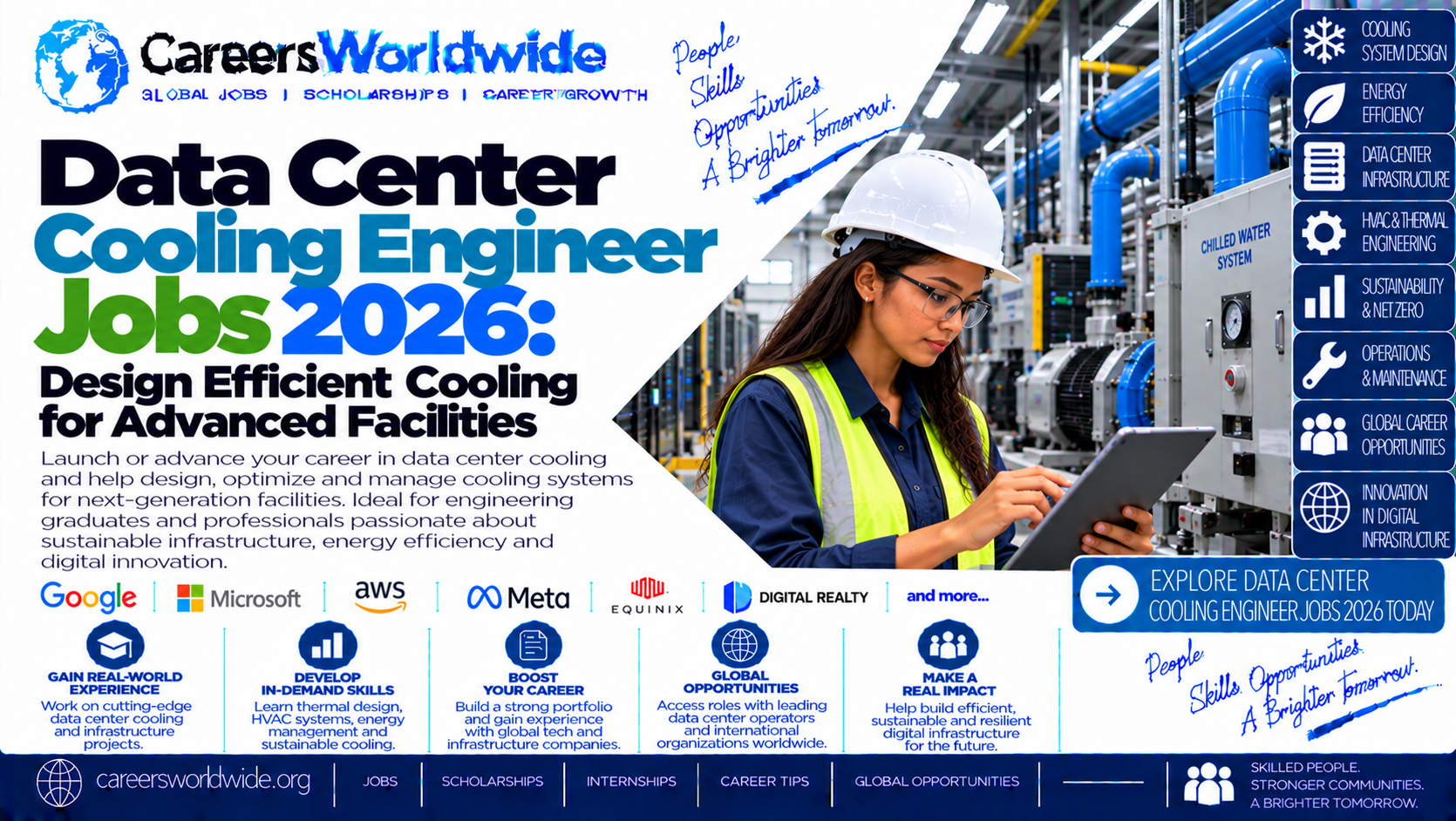

Excerpt: Data Center Cooling Engineer jobs are becoming increasingly important as AI, cloud computing, high-performance computing, and hyperscale infrastructure push rack power densities higher. Discover the skills, qualifications, technologies, career opportunities, and practical steps needed to build a career designing efficient cooling systems for advanced data centers in 2026.
Introduction
The rapid expansion of artificial intelligence, cloud computing, machine learning, high-performance computing, and digital services is changing the engineering requirements of modern data centers.
As computing equipment becomes more powerful, it also produces more heat. Traditional air-conditioning systems remain important, but many advanced facilities are increasingly incorporating liquid cooling, advanced heat exchangers, sophisticated controls, economization, and high-efficiency heat-rejection technologies.
This transformation is creating opportunities for engineers who understand both thermal engineering and mission-critical infrastructure.
Data Center Cooling Engineer jobs can involve designing HVAC systems, chilled-water infrastructure, cooling distribution systems, direct-to-chip liquid cooling, rear-door heat exchangers, cooling towers, pumps, heat-rejection systems, controls, and energy-optimization strategies.
The 2026 market is particularly interesting because AI workloads are accelerating demand for high-density computing. ASHRAE’s 2026 AI Data Center Energy Performance Framework recommends liquid or liquid-assisted cooling architectures for high-density AI environments and emphasizes advanced controls, economization, monitoring, and continuous commissioning.
For mechanical, thermal, HVAC, energy, and facilities engineers, this creates a specialized career path with applications across cloud providers, semiconductor companies, server manufacturers, engineering consultancies, colocation companies, and large technology organizations.
What Does a Data Center Cooling Engineer Do?
A Data Center Cooling Engineer is responsible for ensuring that computing infrastructure operates within appropriate thermal conditions while maintaining reliability, efficiency, scalability, and safety.
The position can combine mechanical engineering, thermal-fluid sciences, HVAC engineering, controls, facilities engineering, energy management, and data-center operations.
Typical responsibilities may include:
- Designing cooling distribution systems.
- Selecting chillers, pumps, cooling towers, heat exchangers, and air-handling equipment.
- Designing chilled-water or water-based cooling loops.
- Evaluating direct-to-chip liquid cooling.
- Supporting rear-door heat exchanger installations.
- Evaluating immersion cooling technologies.
- Performing thermal and hydraulic calculations.
- Conducting computational fluid dynamics analysis.
- Designing airflow-management systems.
- Optimizing CRAC and CRAH systems.
- Supporting commissioning and testing.
- Monitoring temperature, pressure, flow, and humidity.
- Troubleshooting cooling failures.
- Performing root-cause analysis.
- Developing energy-efficiency strategies.
- Supporting preventive and predictive maintenance.
- Working with building management systems.
- Coordinating with electrical, controls, IT, and construction teams.
A current Supermicro Data Center Thermal Engineer role illustrates how the field is evolving. The position includes liquid-cooling infrastructure, coolant distribution units, high-density GPU thermal management, heat-rejection loops, cooling towers, fluid chemistry, instrumentation, controls, and telemetry.
This means the modern cooling engineer is increasingly expected to understand more than conventional HVAC.
Why Data Center Cooling Jobs Are Growing in 2026
The fundamental driver is computing density.
AI accelerators and high-performance processors can generate significantly more heat than traditional enterprise computing equipment. As a result, cooling systems must evolve alongside server architecture.
ASHRAE’s current AI data-center guidance specifically discusses cooling architectures for rack densities of 50–100+ kW and recommends liquid cooling approaches such as direct-to-chip systems and rear-door heat exchangers for appropriate high-density environments.
The U.S. Department of Energy also highlights direct-liquid-cooling technologies such as cold plates and immersion cooling as important approaches for high-performance computing environments.
Several trends are therefore increasing demand for specialized thermal engineers.
1. Artificial Intelligence
AI training and inference workloads require large quantities of computing power.
GPU clusters can produce concentrated heat loads that challenge traditional air-based cooling architectures.
2. Hyperscale Cloud Computing
Cloud providers continue to expand data-center capacity to support enterprise applications, AI, analytics, storage, and digital services.
AWS, for example, describes its data-center organization as working with custom silicon, liquid cooling, and AI-driven automation at large scale.
3. High-Performance Computing
Scientific computing, financial modeling, weather prediction, engineering simulation, and research increasingly depend on high-performance computing infrastructure.
4. Energy Efficiency
Cooling can represent a significant component of data-center infrastructure energy consumption.
Engineers are therefore expected to reduce mechanical cooling demand while maintaining reliability.
5. Sustainability
Companies are increasingly concerned about energy consumption, water use, carbon emissions, and heat reuse.
Modern cooling engineers may contribute directly to sustainability objectives.
Major Cooling Technologies Engineers Should Know
1. CRAC and CRAH Systems
Computer Room Air Conditioning and Computer Room Air Handling systems remain fundamental technologies in many facilities.
Engineers may work with:
- Air distribution.
- Chilled-water systems.
- Refrigeration systems.
- Fans.
- Filters.
- Humidity control.
- Temperature sensors.
- Control systems.
However, high-density AI facilities increasingly require additional cooling strategies.
2. Direct-to-Chip Liquid Cooling
Direct-to-chip cooling places a cold plate or similar heat-transfer mechanism directly against heat-producing components.
Liquid carries heat away from processors more effectively than air in high-density applications.
ASHRAE’s 2026 framework recommends direct-to-chip liquid cooling and other liquid-assisted approaches for appropriate AI workloads.
3. Coolant Distribution Units
A Coolant Distribution Unit, or CDU, manages the interface between facility-level cooling infrastructure and IT equipment cooling loops.
Engineers may need to understand:
- Flow rates.
- Pressure.
- Temperature.
- Heat-exchange performance.
- Redundancy.
- Pump operation.
- Sensors.
- Controls.
- Fluid chemistry.
4. Rear-Door Heat Exchangers
Rear-door heat exchangers can remove heat from server exhaust air before it enters the wider data-center environment.
They can be useful when organizations want to increase rack density without completely replacing existing infrastructure.
5. Immersion Cooling
Immersion cooling places electronic equipment into a specialized cooling fluid.
This approach is especially relevant to high-density computing and specialized HPC environments.
The Open Compute Project’s Cooling Environments initiative focuses on cold plates, CDUs, immersion cooling, door heat exchangers, and heat reuse.
6. Economization
Economizers can reduce reliance on mechanical refrigeration when outdoor conditions permit.
ASHRAE recommends airside, waterside, and refrigerant-based economization strategies as part of energy-efficient data-center design.
Skills Employers Look For
A strong Data Center Cooling Engineer candidate should combine theoretical knowledge with practical engineering skills.
Mechanical Engineering
You should understand:
- Thermodynamics.
- Fluid mechanics.
- Heat transfer.
- HVAC engineering.
- Pump systems.
- Heat exchangers.
- Refrigeration.
- Piping.
- Pressure losses.
- Equipment selection.
Thermal Analysis
Knowledge of thermal modeling can be highly valuable.
Potential tools and techniques include:
- Computational Fluid Dynamics.
- Finite Element Analysis.
- Thermal modeling.
- Airflow analysis.
- Heat-load calculations.
- Hydraulic modeling.
- Temperature mapping.
A current Dell engineering posting, for example, lists advanced cooling systems, coolant chemistry, corrosion control, filtration, CDUs, hybrid and immersion cooling, CFD/FEA modeling, and laboratory validation among desirable capabilities.
Data Center Infrastructure
Candidates should understand:
- Server racks.
- Rack power density.
- Cooling distribution.
- Chillers.
- Cooling towers.
- CRAH units.
- CRAC units.
- Pumps.
- Heat exchangers.
- Water loops.
- Redundant systems.
- Backup infrastructure.
Google’s current data-center mechanical engineering requirements include knowledge of chillers, air-handling units, pumps, CRAC/CRAH systems, building-management controls, and water chemistry.
Controls and Automation
Modern cooling systems rely heavily on automation.
Useful knowledge includes:
- Building Management Systems.
- PLCs.
- Sensors.
- Telemetry.
- Control logic.
- Automated alarms.
- Variable-frequency drives.
- Predictive controls.
- Data acquisition.
Data Analysis
Cooling engineers increasingly work with operational data.
You may analyze:
- Temperature.
- Humidity.
- Flow.
- Pressure.
- Power consumption.
- Cooling efficiency.
- Equipment alarms.
- Pump performance.
- Chiller performance.
- Rack thermal behavior.
Education Requirements
Many Data Center Cooling Engineer positions prefer or require a bachelor’s degree in a relevant engineering discipline.
Potential degrees include:
- Mechanical Engineering.
- Thermal Engineering.
- Energy Engineering.
- HVAC Engineering.
- Building Services Engineering.
- Electrical Engineering with relevant mechanical experience.
- Chemical Engineering for certain thermal-fluid applications.
A master’s degree can be valuable for research-heavy positions involving advanced thermal management, CFD, liquid cooling, or semiconductor cooling.
However, not every data-center cooling career begins with an engineering degree.
Technical roles can provide an entry route into the industry through:
- HVAC maintenance.
- Mechanical technician work.
- Facilities operations.
- Industrial maintenance.
- Critical-environment operations.
- Data-center technician positions.
Microsoft’s current data-center career information shows that some critical-environment roles accept technical experience in mechanical, electrical, HVAC, energy, industrial maintenance, or related environments, with technical certifications also valued.
Certifications That Can Strengthen Your Profile
Certifications should complement, rather than replace, engineering fundamentals.
Depending on your target position, consider qualifications related to:
- HVAC.
- Refrigeration.
- Building systems.
- Energy management.
- Data-center operations.
- Project management.
- Health and safety.
- Facilities management.
Professional development through organizations such as ASHRAE can also help candidates stay current with thermal-management practices and industry standards.
ASHRAE maintains a professional job board and serves a global community of heating, refrigeration, and air-conditioning professionals.
Practical Portfolio Projects for Aspiring Cooling Engineers
If you have limited data-center experience, a practical engineering portfolio can demonstrate your skills.
Project 1: Data Center Cooling Load Model
Create a model for a hypothetical 1 MW data center.
Calculate:
- IT load.
- Heat generation.
- Cooling load.
- Airflow requirements.
- Chilled-water demand.
- Cooling equipment capacity.
- Redundancy requirements.
Project 2: Liquid-Cooled AI Rack
Design a conceptual liquid-cooled rack.
Document:
- Rack heat load.
- Coolant flow.
- Supply temperature.
- Return temperature.
- CDU requirements.
- Pump requirements.
- Heat exchanger capacity.
- Monitoring points.
Project 3: CFD Airflow Study
Model airflow through a server room.
Analyze:
- Hot spots.
- Cold spots.
- Supply-air distribution.
- Return-air behavior.
- Containment.
- Rack placement.
Project 4: Cooling-Efficiency Analysis
Build a spreadsheet comparing:
- Traditional air cooling.
- Hybrid cooling.
- Direct-to-chip cooling.
Estimate energy consumption under different operating conditions.
Project 5: Cooling Failure Scenario
Create a troubleshooting exercise involving:
A server rack begins experiencing high inlet temperatures despite normal room temperature.
Investigate:
- Sensor accuracy.
- Airflow obstruction.
- Fan failure.
- CRAC/CRAH performance.
- Rack density.
- Hot-air recirculation.
- Containment problems.
- Cooling-water temperature.
- Pump performance.
- Control-system faults.
This type of project demonstrates engineering reasoning rather than simply theoretical knowledge.
Data Center Cooling Engineer Career Paths
A cooling engineer can progress through several career directions.
Entry-Level
Possible titles include:
- Graduate Mechanical Engineer.
- Junior Thermal Engineer.
- HVAC Engineer.
- Facilities Engineer.
- Data Center Facilities Engineer.
- Mechanical Engineering Technician.
- Critical Environment Technician.
Mid-Level
Possible titles include:
- Data Center Cooling Engineer.
- Thermal Engineer.
- Mechanical Engineer.
- Data Center Mechanical Engineer.
- Liquid Cooling Engineer.
- Facilities Engineering Manager.
Senior-Level
Experienced professionals may move into:
- Senior Thermal Engineer.
- Principal Mechanical Engineer.
- Data Center Thermal Architect.
- Critical Facilities Engineering Manager.
- Cooling Systems Architect.
- Director of Data Center Engineering.
Specialist Track
Engineers can also specialize in:
- Liquid cooling.
- AI infrastructure.
- Thermal simulation.
- Cooling controls.
- Energy optimization.
- Heat recovery.
- Water management.
- Data-center sustainability.
Industries Hiring Cooling Engineers
Potential employers include:
- Cloud providers.
- Hyperscale data-center operators.
- Colocation companies.
- Semiconductor manufacturers.
- Server manufacturers.
- Networking companies.
- Engineering consultancies.
- HVAC companies.
- Construction and commissioning firms.
- Government research laboratories.
- Financial institutions.
- Telecommunications companies.
- AI infrastructure companies.
Microsoft, for example, describes its data-center engineering organization as involving mechanical engineers responsible for complex mechanical-system design and delivery.
AWS also maintains a dedicated data-center careers area with engineering and infrastructure opportunities.
Salary Expectations
Compensation varies substantially by:
- Country.
- City.
- Engineering discipline.
- Experience.
- Education.
- Industry.
- Clearance requirements.
- Specialized liquid-cooling expertise.
- Management responsibility.
Do not assume that every Data Center Cooling Engineer position pays the same amount.
For example, a 2026 Dell mechanical principal-engineering posting focused on advanced data-center cooling listed a U.S. compensation range of approximately $145,000–$187,000 base salary, with a broader total compensation range also stated.
This is an example rather than a universal salary benchmark.
Candidates should always verify compensation directly in the specific job advertisement.
How to Make Your CV Stand Out
A strong CV should immediately communicate your technical specialization.
Instead of writing:
Mechanical Engineer interested in data centers.
Use a stronger positioning statement such as:
Mechanical engineer specializing in thermal management, HVAC systems, liquid cooling, energy efficiency, and mission-critical infrastructure.
Include measurable achievements wherever possible.
For example:
- Designed a cooling system supporting a specified thermal load.
- Reduced modeled cooling energy consumption by a defined percentage.
- Completed CFD analysis of server-room airflow.
- Developed a chilled-water system model.
- Troubleshot HVAC equipment in a mission-critical environment.
- Designed a liquid-cooling concept for high-density computing.
Relevant keywords can include:
Thermal Management, HVAC, Data Centers, Liquid Cooling, Direct-to-Chip Cooling, CFD, Heat Transfer, Fluid Mechanics, Chillers, CRAH, CRAC, CDU, Cooling Towers, BMS, PLC, Energy Efficiency, Commissioning, Root Cause Analysis, AI Infrastructure.
Interview Questions to Prepare For
Candidates should expect technical and behavioral questions.
Technical questions
How would you calculate the cooling load of a data center?
Explain the IT load, electrical losses, environmental loads, redundancy requirements, and other heat sources.
Why is liquid cooling increasingly important for AI infrastructure?
Discuss increasing rack densities and the ability of liquid systems to remove concentrated heat efficiently.
What is a CDU?
Explain its role in separating or managing facility and technology cooling loops and controlling coolant delivery.
How would you troubleshoot a rack overheating?
Start with instrumentation and sensor verification, then investigate airflow, cooling capacity, rack density, circulation, controls, and possible equipment failures.
What is economization?
Explain how environmental conditions can be used to reduce mechanical refrigeration requirements.
How do you improve cooling efficiency?
Discuss airflow management, temperature setpoints, containment, economization, controls, equipment efficiency, liquid cooling, and continuous commissioning.
Practical Guidance for Job Seekers
If you want to enter this field in 2026, do not focus exclusively on traditional HVAC.
Build a broader profile.
Step 1: Strengthen fundamentals
Study:
- Thermodynamics.
- Heat transfer.
- Fluid mechanics.
- HVAC.
- Refrigeration.
- Controls.
Step 2: Learn data-center architecture
Understand:
- Rack layouts.
- Power density.
- Redundancy.
- Cooling distribution.
- Mechanical rooms.
- Heat rejection.
- Critical environments.
Step 3: Learn liquid cooling
Study:
- Cold plates.
- CDUs.
- Rear-door heat exchangers.
- Immersion cooling.
- Coolant chemistry.
- Flow management.
Step 4: Learn simulation
Develop practical knowledge of CFD and thermal modeling.
Step 5: Understand energy efficiency
Learn PUE, WUE, heat recovery, economization, and other data-center performance concepts.
ASHRAE’s 2026 framework specifically encourages tracking metrics such as PUE, WUE, WUI, CUE, and other performance indicators to guide continuous improvement.
Step 6: Apply broadly
Search for titles beyond “Data Center Cooling Engineer.”
Try:
- Data Center Mechanical Engineer.
- Thermal Engineer.
- Data Center Facilities Engineer.
- Liquid Cooling Engineer.
- Critical Facilities Engineer.
- Mechanical Systems Engineer.
- HVAC Engineer.
- Data Center Plant Engineer.
- Thermal Systems Engineer.
- Cooling Systems Engineer.
Summary Table
| Category | Details |
|---|---|
| Career field | Data center engineering |
| Main specialization | Cooling and thermal management |
| Key industries | Cloud, AI, HPC, semiconductors, colocation |
| Core degree | Mechanical or related engineering |
| Important skills | HVAC, thermodynamics, heat transfer, fluid mechanics |
| Emerging technology | Direct-to-chip liquid cooling |
| Other technologies | CDUs, immersion, rear-door heat exchangers |
| Software | CFD, thermal modeling, BMS/controls platforms |
| Important systems | Chillers, CRAH, CRAC, pumps, cooling towers |
| Sustainability focus | Energy, water, carbon and heat reuse |
| Career levels | Graduate through principal/architect |
| Useful employers | Cloud providers, technology firms, data-center operators |
| Job-search strategy | Search both cooling-specific and critical-facilities roles |
How to Apply for Data Center Cooling Engineer Jobs in 2026
Start by searching official employer career portals rather than relying exclusively on third-party job boards.
Step 1: Search for relevant job titles
Use combinations such as:
- “Data Center Mechanical Engineer”
- “Data Center Thermal Engineer”
- “Cooling Systems Engineer”
- “Liquid Cooling Engineer”
- “Thermal Engineer”
- “Critical Facilities Engineer”
- “Data Center Plant Engineer”
Step 2: Match your technical experience
Read the complete requirements carefully.
Highlight experience involving:
- HVAC.
- Mechanical systems.
- Cooling infrastructure.
- Chillers.
- Pumps.
- Controls.
- Thermal analysis.
- Commissioning.
- Mission-critical facilities.
Step 3: Customize your CV
Place the most relevant engineering experience near the top.
Use the terminology appearing in the specific vacancy, provided it accurately describes your experience.
Step 4: Prepare technical examples
Be ready to explain an engineering problem, your analysis, your calculations, the solution, and the measurable result.
Step 5: Apply through official career portals
Microsoft’s careers guidance recommends creating a profile, checking qualifications, completing required questions, uploading a resume, and submitting the application through its careers platform.
Official Application Resources
ASHRAE
ASHRAE provides technical resources covering data-center thermal management as well as a professional job board.
U.S. Department of Energy
The Department of Energy provides data-center energy-efficiency guidance and career opportunities.
DOE Data Center Energy-Efficiency Guide
Microsoft Careers
Microsoft’s data-center organization includes mechanical engineering and critical-environment opportunities.
AWS Careers
AWS maintains a dedicated careers area for data-center infrastructure and engineering opportunities.
Open Compute Project
The Open Compute Project provides technical resources and training related to advanced cooling technologies.
Open Compute Project Cooling Environments
Supermicro Careers
Supermicro’s current data-center thermal engineering opportunities demonstrate the growing importance of liquid cooling, high-density GPU thermal management, CDUs, instrumentation, and heat rejection.
Supermicro Data Center Thermal Engineer Jobs
FAQ
What is a Data Center Cooling Engineer?
A Data Center Cooling Engineer designs, operates, analyzes, and improves systems that control heat and environmental conditions in data centers.
Is mechanical engineering a good degree for data-center cooling jobs?
Yes. Mechanical engineering provides a strong foundation in thermodynamics, heat transfer, fluid mechanics, HVAC, and mechanical systems.
Do data-center cooling engineers need liquid-cooling experience?
Not every role requires it, but liquid cooling is increasingly important for high-density AI and HPC environments, making it a valuable specialization.
What is the difference between CRAC and CRAH?
CRAC systems generally use direct-expansion refrigeration, while CRAH systems typically use chilled water and air-handling equipment.
What is direct-to-chip cooling?
Direct-to-chip cooling uses a liquid-cooled interface, commonly a cold plate, to remove heat directly from high-heat-generating components.
What is a Coolant Distribution Unit?
A CDU manages coolant circulation and heat transfer between facility cooling infrastructure and technology cooling loops.
Can HVAC engineers move into data centers?
Yes. HVAC and mechanical engineers can transition into data-center roles by developing knowledge of mission-critical infrastructure, redundancy, controls, cooling distribution, and data-center operating practices.
Are data-center cooling jobs only available in the United States?
No. Data centers operate globally, and opportunities exist across North America, Europe, Asia-Pacific, the Middle East, Africa, and other regions.
Can graduates apply for data-center engineering jobs?
Yes. Graduate and junior opportunities exist, although some positions require previous mission-critical, HVAC, facilities, or mechanical experience.
Is CFD useful for data-center cooling careers?
Yes. CFD can help engineers analyze airflow, temperature distribution, pressure, thermal performance, and cooling-system behavior.
What should I learn first?
Start with thermodynamics, heat transfer, fluid mechanics, HVAC, cooling equipment, data-center infrastructure, and then develop knowledge of liquid cooling and controls.
Final Thoughts
Data Center Cooling Engineer jobs are becoming an increasingly specialized opportunity for engineers who want to work at the intersection of mechanical engineering, computing infrastructure, AI, energy efficiency, and sustainability.
The industry’s direction is clear: higher computing density requires better thermal management.
Traditional HVAC knowledge remains valuable, but the strongest candidates in 2026 can increasingly combine HVAC and mechanical fundamentals with liquid cooling, thermal analysis, controls, data-center infrastructure, energy optimization, and advanced monitoring.
ASHRAE’s 2026 AI Data Center Energy Performance Framework reflects this evolution by emphasizing high-density cooling architectures, economization, intelligent controls, continuous commissioning, and holistic energy and water performance.
For aspiring engineers, the opportunity is therefore broader than simply learning how to operate a chiller.
The future data-center cooling professional may be designing thermal systems for AI clusters, modeling liquid flow through thousands of processors, optimizing cooling energy, integrating digital controls, supporting commissioning, and developing infrastructure capable of operating reliably around the clock.
If you are building a career in mechanical engineering, HVAC, thermal systems, energy engineering, or critical infrastructure, developing data-center cooling expertise can position you for an increasingly important area of the digital economy.
Disclaimer
This article is provided for general career and educational information. Job titles, qualifications, salaries, locations, benefits, work authorization requirements, and application deadlines vary by employer and may change without notice. A role discussed in this article should not be interpreted as a guarantee of employment or a currently open vacancy unless confirmed on the employer’s official careers website.
Applicants should verify all requirements and application instructions directly with the hiring organization before submitting personal information or documents. CareersWorldwide does not guarantee employment, interviews, sponsorship, compensation, or selection.
SEO Keywords
data center cooling engineer jobs 2026,
data center cooling jobs 2026,
data center mechanical engineer jobs 2026,
data center thermal engineer jobs 2026,
liquid cooling engineer jobs 2026,
data center HVAC engineer jobs 2026,
data center facilities engineer jobs 2026,
AI data center cooling jobs 2026,
AI cooling engineer jobs 2026,
data center thermal management jobs,
data center mechanical engineering careers,
data center cooling engineer career,
data center cooling systems engineer,
data center liquid cooling careers,
direct to chip cooling engineer jobs,
liquid cooling systems engineer jobs,
data center HVAC careers,
data center thermal engineering careers,
data center facilities careers,
critical facilities engineer jobs,
data center plant engineer jobs,
data center infrastructure engineer jobs,
data center engineering jobs 2026,
hyperscale data center engineering jobs,
AI infrastructure engineering jobs,
high performance computing cooling jobs,
HPC cooling engineer jobs,
GPU cooling engineer jobs,
GPU thermal engineer jobs,
AI thermal management jobs,
data center cooling systems,
data center thermal management,
data center HVAC systems,
data center cooling technology,
data center liquid cooling technology,
direct liquid cooling jobs,
direct to chip liquid cooling jobs,
immersion cooling engineer jobs,
rear door heat exchanger jobs,
coolant distribution unit engineer jobs,
CDU cooling engineer jobs,
data center chiller engineer jobs,
data center cooling tower engineer jobs,
data center heat exchanger engineer jobs,
data center energy efficiency jobs,
data center sustainability engineering jobs,
data center energy engineer jobs,
data center thermal design jobs,
data center cooling design engineer,
data center cooling systems design,
data center mechanical design engineer,
data center HVAC design engineer,
data center thermal analysis jobs,
data center CFD engineer jobs,
computational fluid dynamics data center jobs,
thermal modeling engineer jobs,
data center airflow engineer jobs,
data center heat transfer engineer jobs,
data center fluid mechanics engineer jobs,
data center commissioning engineer jobs,
data center controls engineer jobs,
data center BMS engineer jobs,
data center PLC engineer jobs,
data center cooling controls jobs,
data center critical environment jobs,
data center engineering careers for graduates,
graduate data center mechanical engineer jobs,
entry level data center engineer jobs,
junior thermal engineer jobs,
mechanical engineering jobs in data centers,
HVAC engineering jobs in data centers,
mechanical engineer AI infrastructure jobs,
thermal engineer AI infrastructure jobs,
data center engineer jobs USA 2026,
data center engineer jobs UK 2026,
data center engineer jobs Europe 2026,
data center engineer jobs Canada 2026,
data center engineer jobs Australia 2026,
data center engineer jobs Africa 2026,
remote data center engineering jobs,
data center engineering jobs with visa sponsorship,
high density data center cooling jobs,
AI rack cooling engineer jobs,
high density rack thermal management,
data center cooling optimization jobs,
data center energy optimization engineer,
data center water efficiency engineering jobs,
data center heat recovery engineer jobs,
data center economization engineer jobs,
ASHRAE data center cooling jobs,
data center cooling engineer skills,
data center thermal engineer skills,
data center mechanical engineer qualifications,
data center cooling engineer qualifications,
data center HVAC engineer qualifications,
liquid cooling engineer qualifications,
data center cooling engineer salary 2026,
data center thermal engineer salary 2026,
data center mechanical engineer salary 2026,
data center liquid cooling engineer salary,
best data center engineering careers 2026,
high paying data center engineering jobs,
AI data center careers 2026,
future data center engineering jobs,
data center jobs 2026,
data center careers 2026,
data center cooling technology careers,
data center thermal management careers,
data center infrastructure careers,
data center engineering opportunities 2026,
advanced cooling engineer jobs,
advanced data center cooling careers,
next generation data center engineering jobs,
AI cooling systems engineering,
advanced thermal engineering jobs,
data center mechanical systems engineering,
data center cooling infrastructure jobs,
data center cooling specialist jobs,
data center thermal systems engineer,
data center cooling project engineer,
data center cooling architect jobs,
principal thermal engineer data center jobs,
senior data center mechanical engineer jobs,
data center cooling consultant jobs,
data center engineering consultant jobs,
data center cooling project manager jobs,
careers in data center cooling,
how to become a data center cooling engineer,
how to get a data center cooling job,
data center cooling engineer career path,
data center thermal engineer career path,
mechanical engineer to data center engineer,
HVAC engineer to data center engineer,
liquid cooling career path,
AI thermal engineering career path,
data center engineering skills 2026,
data center cooling engineering skills,
future skills for data center engineers,
data center cooling certification,
ASHRAE data center training,
liquid cooling training,
data center thermal management training,
data center HVAC training,
data center engineering portfolio projects,
data center cooling engineering projects,
AI data center thermal projects,
data center CFD projects,
data center liquid cooling projects,
data center cooling interview questions,
data center mechanical engineer interview questions,
data center thermal engineer interview questions,
data center cooling engineer CV,
data center mechanical engineer resume,
data center thermal engineer resume,
data center engineering resume keywords,
data center cooling engineer cover letter,
data center engineering jobs CareersWorldwide,
data center cooling jobs CareersWorldwide,
Data Center Cooling Engineer Jobs 2026,
ALSO CHECK: Water Treatment Traineeships 2026: Develop Skills in Water Quality & InfrastructureOctober 6, 2026
Public Service Administration Traineeships 2026: Build Skills in Government Operations & Service DeliveryOctober 6, 2026
Precision Medicine Scholarships 2026–2027: Study Genomics, Data & Personalized HealthcareOctober 5, 2026