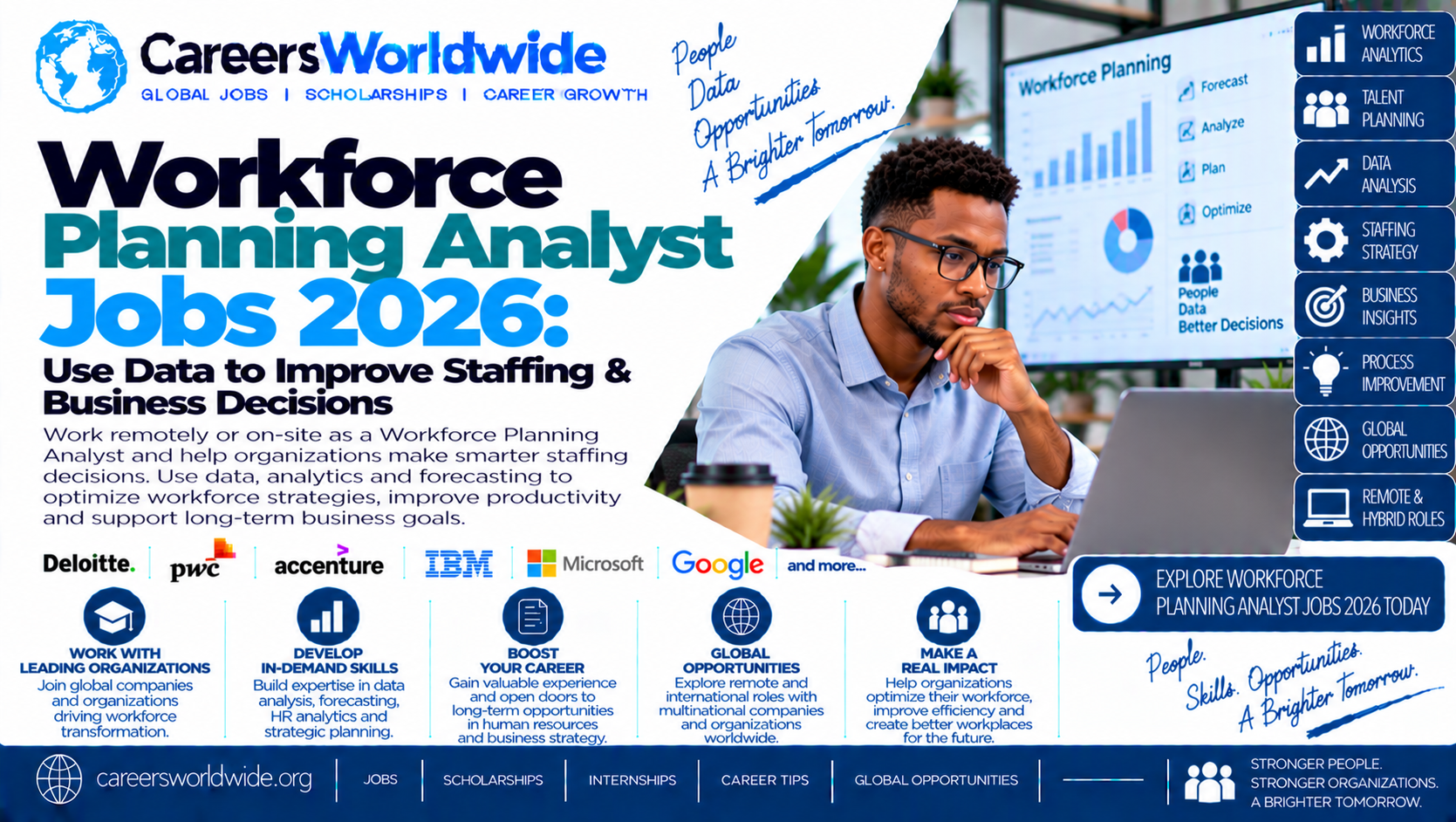

Excerpt: Workforce Planning Analyst Jobs 2026 are opening opportunities for professionals who can use data, forecasting and business analysis to help organizations plan staffing, control labor costs and match workforce capacity with demand. This guide explains the role, skills employers want, salary considerations, remote opportunities, how to apply and where to find legitimate workforce planning careers.
Organizations need the right number of employees with the right skills available at the right time.
Too few employees can create service delays, employee pressure and missed business targets. Too many employees can increase labor costs and leave valuable capacity underused.
This is where workforce planning analysts play an important role.
Workforce planning analysts use data to forecast staffing requirements, analyze workforce capacity, identify gaps and provide recommendations to business leaders.
The role sits at the intersection of:
- Data analytics
- Human resources
- Finance
- Operations
- Business strategy
- Workforce management
- Forecasting
Current 2026 vacancies demonstrate the variety of opportunities available.
For example, UnitedHealth Group currently advertises a Workforce Planning Analyst role involving forecasts, staffing plans, workforce models, performance analysis and recommendations to senior business leaders. The position is listed as remote within the United States, with an advertised hourly range of $29–$52.
Other current vacancies include workforce planning positions in manufacturing, financial services, healthcare, technology, aviation and customer operations.
This makes workforce planning a potentially valuable career path for people who enjoy working with numbers while also influencing practical business decisions.
What Does a Workforce Planning Analyst Do?
A workforce planning analyst studies current and future workforce requirements.
The objective is to help an organization understand:
How many employees do we need?
When will we need them?
Where should they be allocated?
What skills are required?
What happens if demand increases or decreases?
Are staffing costs consistent with the budget?
Typical responsibilities include:
- Workforce forecasting
- Headcount planning
- Capacity analysis
- Staffing models
- Demand forecasting
- Labor-cost analysis
- Workforce reporting
- Scenario modelling
- Data visualization
- Hiring-plan analysis
- Attrition analysis
- Productivity analysis
- Resource allocation
- Business reporting
- Stakeholder presentations
The exact role varies by organization.
A workforce planning analyst working in a contact center may forecast call volumes and determine the number of agents required.
A technology company may use workforce planning to determine how many engineers or project resources are needed.
A manufacturing organization may analyze staffing requirements for production ramps.
An aviation organization may use workforce analytics to support a complex operational workforce.
Airservices Australia, for example, currently lists a Workforce Planning Analyst position requiring complex data modelling, advanced Excel, business intelligence knowledge and the ability to communicate insights to senior stakeholders.
Workforce Planning Analyst Jobs 2026: Summary Table
| Role | Main Focus | Common Skills | Typical Work Setting |
|---|---|---|---|
| Workforce Planning Analyst | Staffing forecasts and capacity | Excel, forecasting, analytics | Office/Remote/Hybrid |
| Workforce Management Analyst | Operational staffing | WFM systems, reporting, forecasting | Remote/Hybrid |
| Workforce Analytics Analyst | Workforce data and insights | SQL, BI, analytics | Remote/Hybrid |
| Workforce Strategy Analyst | Long-term workforce strategy | Forecasting, strategy, modelling | Hybrid/Remote |
| Capacity Planning Analyst | Demand vs. resource capacity | Modelling, Excel, analytics | Remote/Hybrid |
| People Analytics Analyst | Workforce and employee data | SQL, HR analytics, visualization | Remote/Hybrid |
| Workforce Intelligence Analyst | Strategic workforce insights | Analytics, reporting, research | Remote/Hybrid |
| Resource Planning Analyst | Project and resource allocation | Forecasting, planning, Excel | Hybrid/Remote |
| Workforce Planning Consultant | Client workforce planning | WFM, consulting, analytics | Remote/Travel |
| Senior Workforce Planning Analyst | Advanced planning and leadership | Forecasting, modelling, stakeholder management | Remote/Hybrid |
Why Workforce Planning Matters in 2026
Workforce planning is becoming increasingly data-driven.
Organizations have access to large amounts of information about:
- Employee headcount
- Productivity
- Customer demand
- Hiring
- Attrition
- Absence
- Skills
- Labor costs
- Project requirements
- Work volumes
- Service levels
The challenge is converting this information into useful decisions.
A workforce planning analyst can help turn historical and current data into forecasts.
For example, suppose a company expects customer demand to increase by 20%.
The workforce planning analyst may need to determine:
- How much additional work will be created?
- How many employees are currently available?
- How much productive capacity exists?
- How many employees will be required?
- How long will recruitment take?
- How much training will be required?
- What will the additional labor cost be?
- What happens if demand is 10% higher or lower than expected?
This is essentially a business decision supported by data.
Workforce Planning vs Workforce Management
These terms are sometimes used interchangeably, but they can describe different activities.
Workforce Planning
Workforce planning tends to focus on future staffing requirements.
Examples include:
- Annual workforce plans
- Headcount forecasts
- Hiring requirements
- Capacity modelling
- Long-term resource planning
- Skills-gap analysis
Workforce Management
Workforce management often focuses more closely on operational execution.
Examples include:
- Scheduling
- Real-time staffing
- Shift management
- Attendance
- Intraday adjustments
- Service-level monitoring
In some companies, one analyst may work across both areas.
Job seekers should therefore search for both workforce planning and workforce management positions.
Current Workforce Planning Analyst Jobs to Watch
Workforce planning vacancies change frequently, so applicants should verify the current status of every position before applying.
UnitedHealth Group Workforce Planning Analyst
UnitedHealth Group currently lists a Workforce Planning Analyst position in Minnetonka, Minnesota, with a remote work arrangement within the United States. The role involves building and maintaining forecasts and staffing plans, analyzing operational performance, creating staffing models and presenting recommendations to business leaders.
The advertised hourly compensation range is $29–$52, depending on factors such as education, experience and labor market.
The listing asks for experience in business or finance analysis or workforce forecasting and planning, advanced Excel skills and experience analyzing multiple data sources.
This is a useful example of how workforce planning combines technical analysis with stakeholder communication.
Jabil Workforce Planning Analyst
Jabil currently lists a Workforce Planning Analyst position in St. Petersburg/Tampa, Florida.
The role supports new business growth, operational ramps and site expansions.
Responsibilities include forecasting staffing requirements, tracking hiring progress against workforce plans and working with Operations, Program Management, HR and functional leaders.
This demonstrates that workforce planning is not limited to contact centers.
It can also support manufacturing and operational expansion.
Vanguard Workforce & Portfolio Planning Analyst
Vanguard lists a Workforce & Portfolio Planning Analyst position in Malvern, Pennsylvania.
The role combines workforce planning with IT portfolio planning, budget forecasting and resource planning.
Responsibilities include analyzing resource capacity, staffing levels and workforce demand to identify gaps and risks.
This type of role can suit analysts interested in combining workforce planning with finance, technology and portfolio management.
Airservices Australia Workforce Planning Analyst
Airservices Australia currently lists a Workforce Planning Analyst position requiring a relevant bachelor’s degree or equivalent background, experience with complex data models, advanced Excel skills and knowledge of business intelligence tools.
The role demonstrates the importance of communication skills alongside technical analysis.
A workforce analyst must be able to explain what the numbers mean and what leaders should consider doing next.
Skills Employers Want in Workforce Planning Analysts
1. Microsoft Excel
Excel remains one of the most important tools for workforce planning.
You should understand:
- Pivot tables
- XLOOKUP
- VLOOKUP
- INDEX/MATCH
- IF statements
- SUMIFS
- COUNTIFS
- Conditional formatting
- Charts
- Data cleaning
- Scenario analysis
UnitedHealth Group’s current Workforce Planning Analyst listing specifically asks for advanced Excel skills, including large datasets, VLOOKUPs, pivot tables, graphs and standard formulas.
2. Forecasting
Forecasting is at the center of workforce planning.
You should understand how to analyze historical data and use it to estimate future demand.
Forecasting can involve:
- Headcount
- Customer volume
- Workload
- Attrition
- Hiring
- Productivity
- Capacity
A strong analyst should also understand forecast error.
If the forecast consistently differs from actual results, the model needs investigation.
3. Data Visualization
Workforce planning analysts often present information to executives.
Tools may include:
- Power BI
- Tableau
- Excel
- Looker
- Qlik
A good dashboard should answer questions quickly.
For example:
Current staffing: 420 employees
Required staffing: 455 employees
Gap: 35 employees
Expected attrition: 18 employees
Hiring requirement: approximately 53 employees
The exact calculation will depend on assumptions, but the principle is to convert complex workforce data into understandable decisions.
4. SQL
SQL is increasingly useful for workforce analytics.
You may use SQL to extract:
- Employee records
- Workforce transactions
- Staffing data
- Performance information
- Attendance records
- Hiring data
- Attrition data
Not every workforce planning role requires SQL.
However, learning SQL can expand the range of analytics positions you can target.
5. Workforce Management Systems
Some employers use specialized workforce management platforms.
Experience may include:
- NICE IEX
- Verint
- Genesys
- Aspect
- Workday
- SAP
- Oracle
- UKG
Requirements vary considerably by employer.
6. Business Communication
Technical skills alone are not enough.
A workforce planning analyst may need to explain findings to:
- HR leaders
- Finance teams
- Operations managers
- Department heads
- Executives
- Recruiting teams
You should be able to explain:
What happened?
Why did it happen?
What could happen next?
What action should the organization consider?
7. Scenario Modelling
Business conditions change.
A good workforce analyst can build “what-if” models.
For example:
Scenario A
Demand increases 5%.
Scenario B
Demand increases 15%.
Scenario C
Demand decreases 10%.
The analyst can then compare staffing requirements and financial implications.
This allows leaders to prepare for uncertainty rather than relying on one forecast.
Workforce Planning Analyst Career Path
A typical career progression can look like:
Workforce Planning Coordinator
↓
Workforce Planning Analyst
↓
Senior Workforce Planning Analyst
↓
Workforce Planning Manager
↓
Workforce Planning Director
Other possible transitions include:
- People Analytics
- HR Analytics
- Business Intelligence
- Financial Planning
- Operations Analytics
- Resource Management
- Business Strategy
- Data Analytics
- Workforce Technology
The analytical nature of the work can therefore create opportunities beyond traditional HR.
Workforce Planning Analyst Jobs for Beginners
Entry-level applicants should search for related positions rather than focusing exclusively on the exact title.
Search for:
- Workforce Analyst
- Workforce Coordinator
- Workforce Management Coordinator
- Resource Planning Analyst
- Junior Data Analyst
- HR Data Analyst
- People Analytics Analyst
- Operations Analyst
- Reporting Analyst
- Capacity Planning Analyst
- Business Analyst
Relevant experience can come from:
- Customer service
- Operations
- Finance
- HR
- Data analysis
- Contact center management
- Scheduling
- Business intelligence
For example, someone who has experience creating staffing reports or employee schedules may already have transferable workforce planning skills.
Qualifications for Workforce Planning Analyst Jobs
There is no single degree required for every position.
Relevant degrees include:
- Business Administration
- Finance
- Economics
- Statistics
- Mathematics
- Human Resources
- Data Analytics
- Operations Management
- Industrial Engineering
- Computer Science
- Information Systems
Some employers emphasize experience and technical skills more heavily than a specific degree.
Airservices Australia’s current listing, for example, requests a bachelor’s degree in a relevant HR or financial discipline alongside analytical and modelling experience.
Certifications That Can Help
Certifications are not always mandatory, but they may strengthen your profile.
Useful areas include:
- Microsoft Excel
- Power BI
- Tableau
- SQL
- Data analytics
- Workforce management
- Project management
- HR analytics
For contact-center workforce management, specialized WFM training can also be relevant.
However, applicants should prioritize practical ability.
A certificate is more useful when you can demonstrate how you used the underlying skill.
How to Build a Workforce Planning Portfolio
Analysts can create portfolio projects even without professional workforce planning experience.
For example, create a fictional contact center workforce model.
Start with:
- Historical call volume
- Average handling time
- Number of employees
- Working hours
- Absence
- Shrinkage
- Service-level target
Then calculate:
- Required staffing
- Capacity
- Staffing gap
- Hiring requirement
- Scenario forecasts
Create a Power BI or Excel dashboard showing:
- Demand
- Supply
- Capacity
- Forecast
- Staffing gap
- Cost
This can demonstrate practical skills to employers.
Do not present fictional results as real employment achievements.
Clearly label portfolio projects as simulated or educational.
How to Find Workforce Planning Analyst Jobs
Search using multiple job titles.
Try:
“Workforce Planning Analyst”
“Workforce Analyst”
“Workforce Management Analyst”
“Capacity Planning Analyst”
“Workforce Analytics Analyst”
“Resource Planning Analyst”
“People Analytics Analyst”
“Workforce Strategy Analyst”
“Workforce Intelligence Analyst”
“Operations Planning Analyst”
You can search on:
- LinkedIn Jobs
- Indeed
- Company career pages
- Greenhouse
- Lever
- Ashby
- Government career websites
- Professional HR organizations
Indeed’s current remote search results show openings across healthcare, insurance, technology, consumer businesses and workforce analytics, demonstrating the variety of industries hiring for related positions.
Remote Workforce Planning Analyst Jobs
Remote opportunities exist, but applicants should carefully read geographic restrictions.
For example, UnitedHealth Group currently lists a Workforce Planning Analyst position as remote within the United States.
Other current remote search results include positions from HealthEdge, Fortive, Empower, Visier and other employers.
However, remote does not automatically mean worldwide.
An employer may require:
- U.S. residency
- EMEA residency
- Specific state residency
- Specific time-zone availability
- Local work authorization
International applicants should therefore look specifically for phrases such as:
- Remote worldwide
- Remote EMEA
- Remote Africa
- International remote
- Work from anywhere
- Global remote
Workforce Planning Analyst Salary Considerations
Compensation varies based on:
- Country
- Experience
- Industry
- Seniority
- Technical skills
- Location
- Employment type
Current U.S. listings provide useful examples.
UnitedHealth Group lists $29–$52 per hour for a current Workforce Planning Analyst position.
HealthEdge lists a Senior Workforce Planning Analyst role with a published range of approximately $94,000–$100,000 annually in current remote search results.
Fortive’s Senior Analyst, Workforce Intelligence role is listed at approximately $99,600–$166,300.
These are individual employer ranges, not a universal salary benchmark.
International salaries can differ substantially.
Candidates should evaluate compensation alongside benefits, taxes, employment status, location requirements and cost of living.
How to Apply for Workforce Planning Analyst Jobs
Step 1: Tailor Your CV
Highlight measurable analytical work.
Instead of:
“Created workforce reports.”
Use:
“Built weekly staffing dashboards tracking headcount, capacity and demand across five operational teams.”
Only use metrics you can verify.
Step 2: Highlight Excel
Mention specific capabilities:
- Pivot tables
- Advanced formulas
- Forecasting
- Data cleaning
- Scenario analysis
Step 3: Highlight BI Tools
List Power BI, Tableau or other tools you genuinely use.
Step 4: Demonstrate Business Impact
Explain how your analysis helped:
- Reduce costs
- Improve staffing
- Identify capacity gaps
- Improve reporting
- Support planning
- Improve operational decisions
Step 5: Prepare for Analytical Interviews
You may be asked to analyze a workforce dataset or explain a staffing scenario.
Workforce Planning Analyst Interview Questions
Expect questions such as:
“How would you forecast staffing requirements?”
Explain how you would examine historical demand, productivity, attrition, capacity and business forecasts.
“What would you do if actual demand is consistently higher than forecast?”
Discuss forecast-error analysis, changes in demand drivers, model assumptions and stakeholder feedback.
“How would you identify a staffing gap?”
Compare forecast demand with available productive capacity while accounting for factors such as absence, attrition and productivity.
“How do you validate a workforce model?”
Explain back-testing, comparing forecasts with actual outcomes and monitoring error.
“What Excel functions do you use?”
Be prepared to discuss the formulas and techniques you actually know.
“How would you present workforce risks to an executive?”
Focus on concise insights:
- Current position
- Forecast
- Risk
- Financial/business impact
- Recommended options
30-Day Workforce Planning Job Search Plan
| Week | Focus | Action |
|---|---|---|
| Week 1 | Skills | Improve Excel, forecasting and analytics |
| Week 2 | Portfolio | Build a workforce planning dashboard |
| Week 3 | Applications | Apply to targeted analyst positions |
| Week 4 | Interviews | Practice forecasting and case-study questions |
Create a job tracker with:
- Employer
- Job title
- Location
- Remote status
- Salary
- Experience requirement
- Application date
- Application URL
- Interview stage
- Follow-up date
This makes the search easier to manage.
Industries Hiring Workforce Planning Analysts
Workforce planning is relevant across many sectors.
Healthcare
Hospitals, insurers and healthcare-service organizations need to forecast staffing and operational capacity.
Technology
Technology companies may plan engineering, customer-support and project resources.
Financial Services
Banks and financial institutions use workforce analytics for operations and service teams.
Retail
Retail organizations need to plan staffing around customer demand and seasonal changes.
Manufacturing
Manufacturers use workforce planning for production ramps, new facilities and operational expansion.
Aviation
Airports and aviation organizations have complex staffing requirements.
Telecommunications
Call centers and customer operations require sophisticated workforce forecasting.
Consulting
Consulting firms may help clients design workforce strategies and capacity models.
FAQ: Workforce Planning Analyst Jobs 2026
What does a workforce planning analyst do?
A workforce planning analyst uses data and forecasting to estimate staffing requirements, identify capacity gaps and support workforce-related business decisions.
What skills are needed for workforce planning?
Important skills include Excel, forecasting, data analysis, workforce modelling, data visualization, communication and business understanding.
Is workforce planning an HR job?
It can sit within HR, Operations, Finance or a dedicated Workforce Management function. The role is often highly analytical and cross-functional.
Can data analysts become workforce planning analysts?
Yes. Data analysts with experience in forecasting, reporting, business analysis or workforce-related datasets can have transferable skills.
Can HR professionals move into workforce planning?
Yes. HR professionals who develop strong Excel, analytics, forecasting and workforce-modelling skills can pursue workforce planning roles.
Do workforce planning analysts need SQL?
Not every position requires SQL. However, SQL can be valuable for roles involving large workforce datasets and advanced analytics.
Is Excel important?
Yes. Current workforce planning vacancies frequently request advanced Excel. UnitedHealth Group’s current Workforce Planning Analyst role explicitly lists advanced Excel skills as a requirement.
Are workforce planning analyst jobs remote?
Some are. Current remote listings include Workforce Planning Analyst and Senior Workforce Planning Analyst positions. However, many remote roles are restricted by country or region.
Can international applicants apply for U.S. remote workforce planning jobs?
Only when the employer permits employment from the applicant’s country and the applicant meets work-authorization requirements. A U.S. “remote” position may still require U.S. residency.
What degree is best for workforce planning?
Business, finance, economics, statistics, mathematics, HR, data analytics, operations management and related degrees can all be relevant.
Can I become a workforce planning analyst without experience?
Entry-level opportunities exist, but many analyst roles request prior experience in analytics, finance, operations, workforce management or business analysis. Related analyst and coordinator roles can provide a pathway.
What is the difference between workforce planning and capacity planning?
Workforce planning focuses on people and staffing requirements, while capacity planning can refer more broadly to matching available organizational resources with expected demand. In practice, the terms can overlap.
Official Job Search Resources
For current positions, use official employer career pages whenever possible.
UnitedHealth Group Careers:
UnitedHealth Group Workforce Planning Analyst Jobs
Jabil Careers:
Jabil Workforce Planning Careers
Vanguard Careers:
Vanguard Jobs
Airservices Australia Careers:
Airservices Australia Careers
HealthEdge Careers:
HealthEdge Careers
Indeed Workforce Planning Jobs:
Indeed Workforce Planning Analyst Jobs
LinkedIn Jobs:
Search for “Workforce Planning Analyst,” “Workforce Analytics Analyst,” “Capacity Planning Analyst” and related titles.
When using third-party job boards, verify that the position also appears on the employer’s official career website whenever possible.
Final Takeaway
Workforce Planning Analyst Jobs 2026 are designed for professionals who can turn workforce data into practical business decisions.
The role combines:
- Data analysis
- Forecasting
- Workforce strategy
- Finance
- Operations
- Human resources
- Business communication
Current vacancies show that workforce planning is used across healthcare, technology, manufacturing, financial services, aviation and other industries.
UnitedHealth Group’s current Workforce Planning Analyst vacancy, for example, involves forecasting, staffing models, operational analysis and recommendations to business leaders.
Jabil’s current role demonstrates how workforce planning can support new business growth, operational ramps and site expansions.
Vanguard’s Workforce & Portfolio Planning Analyst position shows another pathway, combining workforce planning with IT portfolio management, financial forecasting and resource planning.
For people entering the field, Excel should be one of the first technical priorities.
From there, develop forecasting, Power BI or Tableau, SQL, workforce management concepts and business communication.
A portfolio project can also help demonstrate practical capability. Building a simulated staffing forecast and dashboard can show employers that you understand how workforce data translates into decisions.
For experienced analysts, opportunities can extend into workforce strategy, people analytics, business intelligence, resource planning and management.
Remote opportunities are also available, but applicants should carefully check location restrictions. Current remote vacancies include roles restricted to the United States, while other employers advertise regional remote positions.
The most important strategy is to search broadly.
Do not rely only on the exact title Workforce Planning Analyst.
Also search for:
- Workforce Analyst
- Workforce Management Analyst
- Workforce Analytics Analyst
- Capacity Planning Analyst
- Resource Planning Analyst
- People Analytics Analyst
- Workforce Intelligence Analyst
- Workforce Strategy Analyst
- Operations Analyst
With strong analytical skills, practical forecasting experience and the ability to explain data clearly, workforce planning can provide a pathway into increasingly strategic business and analytics roles.
Disclaimer
This article is provided for informational and career-education purposes only. Job vacancies, salaries, benefits, employment arrangements, remote-work policies, eligibility requirements and application deadlines can change without notice. Salary figures cited in this article are individual employer-published ranges and should not be interpreted as universal market averages. A job advertised as remote may still be restricted to a particular country, state, region or time zone. Always verify the position and application instructions through the employer’s official careers website before applying. CareersWorldwide does not guarantee interviews, employment or hiring outcomes and does not charge applicants for access to job information.
SEO Information
SEO Title: Workforce Planning Analyst Jobs 2026: Data & Staffing Careers
Meta Description: Explore Workforce Planning Analyst Jobs 2026, including workforce analytics, staffing forecasts, capacity planning, remote roles, skills, salaries and application tips.
Focus Keyword: Workforce Planning Analyst Jobs 2026
URL Slug: workforce-planning-analyst-jobs-2026
Excerpt: Discover Workforce Planning Analyst Jobs 2026 and learn how to use data, forecasting, Excel and workforce analytics to improve staffing and business decisions.
SEO Keywords:
Workforce Planning Analyst Jobs 2026,
Workforce Planning Jobs 2026,
Workforce Planning Analyst Careers,
Workforce Planning Analyst Jobs,
Workforce Analytics Jobs 2026,
Workforce Management Analyst Jobs,
Remote Workforce Planning Analyst Jobs,
Remote Workforce Planning Jobs 2026,
Workforce Planning Jobs Remote,
Workforce Analyst Jobs 2026,
Workforce Analytics Analyst Jobs,
Workforce Strategy Analyst Jobs,
Workforce Intelligence Analyst Jobs,
Capacity Planning Analyst Jobs,
Resource Planning Analyst Jobs,
People Analytics Analyst Jobs,
HR Analytics Jobs 2026,
Workforce Management Jobs 2026,
Workforce Planning Careers,
Workforce Planning Jobs for Beginners,
Entry Level Workforce Planning Analyst Jobs,
Junior Workforce Analyst Jobs,
Senior Workforce Planning Analyst Jobs,
Workforce Planning Jobs for International Applicants,
Workforce Planning Jobs for African Applicants,
Remote Workforce Analyst Jobs,
Workforce Forecasting Jobs,
Workforce Forecasting Analyst Jobs,
Staffing Analyst Jobs 2026,
Staffing Planning Jobs,
Headcount Planning Analyst Jobs,
Workforce Capacity Planning Jobs,
Workforce Data Analyst Jobs,
Workforce Reporting Analyst Jobs,
Workforce Business Analyst Jobs,
Operations Workforce Analyst Jobs,
Workforce Planning and Analytics Jobs,
Workforce Planning Analyst Salary,
Workforce Planning Analyst Skills,
Workforce Planning Analyst Career Path,
Workforce Planning Analyst Requirements,
Workforce Planning Analyst Remote Jobs,
Workforce Planning Analyst Jobs USA,
Workforce Planning Analyst Jobs UK,
Workforce Planning Analyst Jobs Australia,
Workforce Planning Analyst Jobs Africa,
Workforce Analytics Careers 2026,
Workforce Strategy Careers,
Workforce Data Analytics Jobs,
People Analytics Careers 2026,
HR Workforce Planning Jobs,
Business Analytics Workforce Planning Jobs,
Data Analyst Workforce Planning Jobs,
Excel Workforce Planning Jobs,
Power BI Workforce Planning Jobs,
SQL Workforce Analytics Jobs,
Workforce Forecasting Careers,
Staffing Forecast Analyst Jobs,
Capacity Planning Careers 2026,
Workforce Planning Technology Jobs,
Workforce Planning Consultant Jobs,
Workforce Planning Manager Jobs,
Workforce Planning Specialist Jobs,
Workforce Planning and Forecasting Jobs,
Data Driven Workforce Planning Jobs,
Workforce Optimization Analyst Jobs,
Workforce Resource Planning Jobs,
Workforce Planning Business Analyst Jobs,
Workforce Planning Analyst 2026,
ALSO CHECK: Remote Content Strategist Jobs 2026: Build Digital Content & Brand GrowthSeptember 30, 2026
Remote UX Designer Jobs 2026: Design Better Digital Products & User ExperiencesSeptember 30, 2026
Marine Science Scholarships 2026–2027: Funding for Ocean Research & ConservationSeptember 30, 2026