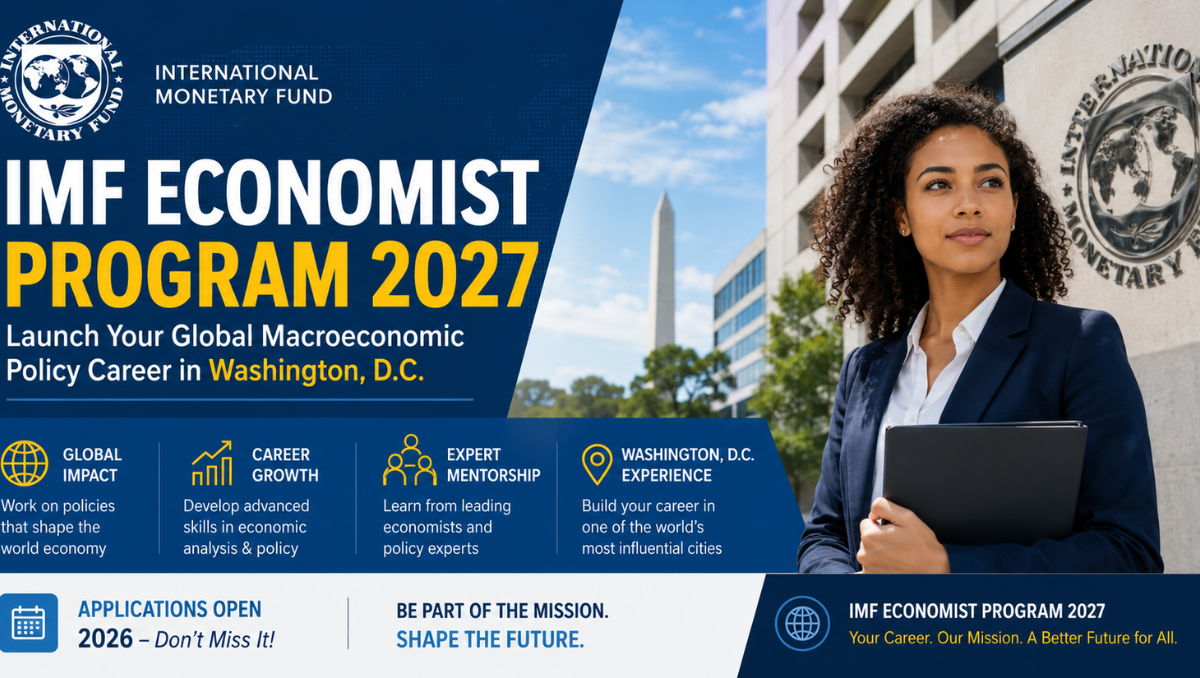

IMF Economist Program 2027: Launch Your Global Macroeconomic Policy Career in Washington, D.C..The architecture of global finance is facing an unprecedented period of structural transformation. As nations navigate complex inflationary pressures, sovereign debt vulnerabilities, shifting international trade frameworks, and the fiscal impacts of climate change, the demand for precise macroeconomic stewardship has never been more urgent. At the center of this global response is the International Monetary Fund (IMF). To build its next generation of leadership, the institution has launched the application cycle for the prestigious IMF Economist Program 2027. This flag-ship initiative stands as the premier global talent pipeline for exceptional young economists who want to influence international policy.
This elite, three-year program offers a rare entry point for recent PhD graduates and highly qualified Master’s degree holders who specialize in macroeconomics and financial sector dynamics. Rather than working on purely theoretical academic research, participants in the Economist Program (EP) are immediately embedded within the operational heart of the Fund. From day one, these young professionals are treated as full staff economists, contributing directly to real-world country surveillance, sovereign program designs, and groundbreaking policy analysis across a diverse network of 190 member countries.
Securing a position within the IMF Economist Program places you at the pinnacle of global economic governance. The track provides an unmatched platform for early-career economists who want to apply rigorous quantitative modeling and empirical research directly to planetary-scale economic challenges. This comprehensive guide serves as your analytical manual for the 2027 recruitment cycle, breaking down the dual-department rotation framework, core candidate prerequisites, and advanced strategies to optimize your job market paper and profile for the IMF selection panels.
Quick Reference Career Signals:
- Target Institution: International Monetary Fund (IMF)
- Program Track: Economist Program (EP) — 2027 Intake
- Primary Workspace: Washington, D.C. (Global Headquarters) with extensive international travel
- Age Threshold: Must be below the age of 34 at the time of entry into the program
- Core Framework: 3-Year structured institutional rotation (Two 18-month assignments across distinct departments)
IMF Economist Program 2027: Launch Your Global Macroeconomic Policy Career in Washington, D.C.
Background & Job Description
Headquartered in Washington, D.C., the International Monetary Fund is an organization of 190 countries working together to foster global monetary cooperation, secure financial stability, facilitate international trade, promote high employment and sustainable economic growth, and reduce poverty around the world. The Fund achieves these macro-level objectives through three interconnected operational pillars: surveillance (monitoring country economic health), technical assistance (capacity building), and lending (providing temporary financing to countries facing balance-of-payments crises).
The IMF Economist Program is engineered to transform brilliant academic specialists into versatile, policy-oriented macroeconomists. The program is structurally organized around two distinct 18-month rotations. Typically, an EP participant spends one rotation inside an Area Department (such as the African, European, or Western Hemisphere Departments) focusing on country-specific surveillance and macro-financial modeling. The second rotation is completed within a Functional Department (such as Fiscal Affairs, Monetary and Capital Markets, or Research), where the focus shifts toward cross-cutting global policy formulations, capital market tracking, and structural research.
This rotation model is essential to the IMF’s broader organizational goals. By systematically exposing entry-level economists to both regional field realities and centralized functional analysis, the Fund develops agile leaders capable of navigating an economy’s fiscal, monetary, and exchange rate linkages simultaneously. Throughout the three-year timeline, participants work alongside world-renowned economic experts, receiving considerable operational responsibility and representing the IMF on official country delegations.
Key Responsibilities
The daily operational portfolio of an IMF Economist Program participant bridges advanced econometric processing with high-level diplomatic communication and real-time policy evaluation.
Primary duties and cross-functional responsibilities include:
- Country Surveillance and Monitoring: Tracking real-time macroeconomic developments inside assigned member nations, focusing heavily on production indices, consumer prices, labor market shifts, and trade balances.
- Macroeconomic Modeling and Forecasting: Building, refining, and executing quantitative models to forecast country-level fiscal trajectories, balance-of-payments positions, and debt sustainability metrics.
- Sovereign Program Design: Contributing technical data inputs to help formulate structural policy adjustments, exchange rate changes, or fiscal targets for member countries utilizing IMF financial assistance.
- Participation in Article IV Missions: Travelling internationally as an official delegation member on country missions to engage directly with central banks, ministries of finance, and local financial institutions.
- Policy Paper and Briefing Formulation: Drafting high-quality analytical briefs, country report sections, and shorter targeted notes to guide the executive board’s operational choices.
- Cross-Cutting Policy Research: Conducting empirical research using tools like Stata, R, or MATLAB on critical macro-linked topics such as digital currencies, climate-related fiscal risks, or income inequality.
- Inter-Departmental Collaboration: Participating in horizontal working groups to ensure country-specific models line up cleanly with global macroeconomic trends and functional guidelines.
Qualifications
Gaining entry into this ultra-competitive track requires meeting rigid academic thresholds alongside proving deep structural versatility across multiple economic sectors.
Education & Certification
- PhD Track Requirements: Candidates must have recently completed or be on track to successfully complete their PhD within one year of joining the program (by Autumn 2027). Core fields of study include Macroeconomics, Finance, Monetary Economics, Public Finance, International Economics, Trade, Econometrics, or related macroeconomic fields.
- Master’s Track Pathway: In select cases, candidates holding a Master’s degree in macroeconomics or a closely related field may be considered, provided they possess a superior academic record and a proven track record of relevant, high-level professional experience inside a central bank or ministry of finance.
Experience
- Age Limit Prerequisite: Applicants must strictly be below the age of 34 on their formal date of entry into the program in September 2027.
- National Citizenship: Candidates must hold citizenship in one of the IMF’s 190 member countries.
- Technical & Quantitative Mastery: Proven expert-level proficiency in empirical econometrics, quantitative data management, and scientific computation applications (such as Stata, MATLAB, R, Fortran, or Python).
- Macroeconomic Literacy: A flawless understanding of integrated macroeconomic frameworks. Candidates must prove they can trace shock transmissions across the real, fiscal, monetary, and external sectors of an economy.
- Communication Competence: Superior written and oral communication skills in English are mandatory. The ability to speak other widely used international languages (such as French, Spanish, Arabic, Chinese, or Russian) is a valuable asset but not an absolute requirement.
Why Apply for This Position
Entering the IMF through the Economist Program offers a unique set of career development advantages, systemic exposure, and global positioning that traditional academic or corporate economic paths cannot provide.
Unparalleled Global Policy Impact
While academic researchers often spend years waiting for their papers to clear peer reviews, IMF economists see their analysis applied directly to national legislation in real time. The forecasts you compile and the policy linkages you identify will directly inform sovereign debt restructurings, central bank interest rate pathways, and national safety net configurations. It is a rare space where your day-to-day quantitative output directly impacts the economic stability and welfare of millions of citizens across the globe.
Accelerated Professional and Executive Mobility
The IMF is universally recognized as the world’s premier training ground for macroeconomists. Completing the three-year Economist Program serves as a gold-standard credential on a global scale. Successful participants are typically offered a regular, permanent staff appointment at the Fund. For those who eventually choose to transition out, the experience opens immediate pathways to executive-level positions within central banks, international investment banks, elite global hedge funds, national ministries of finance, and top-tier academic faculties worldwide.
Elite Intercultural Diplomacy and Field Experience
The program takes you out of the research lab and places you directly at the negotiating table with world leaders. Travelling on official missions allows you to practice economic diplomacy firsthand, learning how to balance technical model requirements with a nation’s complex political and social realities. Working within the IMF’s deeply multicultural headquarters alongside elite minds from 190 nations builds an extraordinary level of professional agility, emotional intelligence, and global perspectives.
Application Tips & Insights
Because the IMF Economist Program attracts thousands of elite doctoral applications globally, navigating the multi-stage review process requires a highly strategic approach that highlights both technical depth and operational versatility.
Elevate and Refine Your Job Market Paper
Your Job Market Paper (JMP) is the single most critical piece of your application package. While academic hiring committees look for abstract theoretical novelty, the IMF selection panel reviews your paper to evaluate your policy relevance and structural grounding. Ensure your introduction clearly answers two fundamental questions: What real-world macroeconomic vulnerability does this research address, and how can a central bank or ministry of finance use these findings to guide their policy choices? Keep your quantitative methodologies crystal clear and transparent.
Prepare for the Core Macroeconomic Linkages Test
If you clear the initial application review, you will face a rigorous preliminary technical interview. A common mistake candidates make is over-specializing in their specific dissertation sub-field while neglecting core, cross-sector macroeconomics. The panel will test your ability to think on your feet about broad economic systems.
You must be ready to explain, step-by-step, how a specific macroeconomic change—such as a sudden tightening of monetary policy in a major global economy—transmits through a developing country’s banking sector, impacts its fiscal deficit, shifts its balance of payments, and alters its external debt sustainability. Brush up on your core national accounting identities and sector balance linkages.
Understand the Extended Selection Timeline
The recruitment track for the IMF Economist Program is long and carefully structured. Applications generally close in the autumn of the preceding year, followed by preliminary video or online interviews running through November and December.
Promising candidates are then advanced to the final stage in the early months of the intake year. This final tier includes an intensive panel interview, a timed analytical writing test, and a formal presentation of your job market paper to a department-specific review committee. Offers are systematically finalized in the spring, ahead of the unified global intake and onboarding process in September.
Additional Information
- Compensation Structure: The IMF provides an elite, world-class global compensation framework. Base salaries are highly competitive, matching top-tier private financial institutions, and are tax-free for non-U.S. citizens.
- Benefits and Well-Being: Includes comprehensive international health, dental, and vision insurance networks, an exceptional institutional pension plan, generous relocation allowances, worldwide emergency travel coverage, and dedicated educational allowances for dependent children.
- Work Location Framework: The position is permanently anchored at the IMF global headquarters campus in Washington, D.C., but requires a strong willingness to travel internationally for country missions (typically 1 to 2 major missions per 18-month assignment).
- Contract and Permanent Conversion: The Economist Program is a structured three-year contractual appointment. Upon successful completion of the program, participants who demonstrate strong performance are systematically converted into regular, permanent IMF staff members without needing to go through further open competition.
- Diversity and Inclusion Mandate: The IMF is globally EDGE certified and dedicated to promoting complete gender equality, geographic diversity, and institutional inclusion. The Fund actively seeks out qualified applicants from all 190 member countries, welcoming varied backgrounds, viewpoints, and lived experiences.
How to Apply
To formally enter your profile into the 2027 Economist Program recruitment track, follow this structured application pipeline:
1.Access the IMF Workday Career System:Step 1.
Navigate to the official IMF Recruitment portal, locate the specific listing for the Economist Program (EP) 2027 Intake, and establish your personal candidate profile.
2.Populate Your Academic and Personal Data:Step 2.
Complete the detailed digital application fields, ensuring your citizenship information, age declaration, and complete institutional history are recorded accurately.
3.Upload Required Technical Dossier Files:Step 3.
Attach your comprehensive CV, a detailed Cover Letter explaining your policy motivation, your complete graduate school academic transcripts, and a copy of your main Job Market Paper. Ensure each individual file is under the 250 KB system limit.
4.Review Statement of Interest and Submit:Step 4.
Verify that your statement of interest clearly highlights your quantitative capacities and field of economic expertise. Complete the submission tracking sequence before the formal autumn closing deadline.
Frequently Asked Questions
Can Master’s degree holders compete effectively with PhD applicants in this program?
While the vast majority of selected candidates hold a PhD or are in the final stages of completing their doctoral dissertation, the program does consider exceptional Master’s degree holders. To compete effectively, a Master’s applicant must demonstrate a flawless academic record combined with several years of highly relevant, practical macroeconomic policy experience gained within a central bank, ministry of finance, or prominent international financial institution.
Are there any specific country quotas for the IMF Economist Program?
No, there are no rigid country-specific quotas for the program. The IMF selects candidates based purely on technical merit, quantitative excellence, and leadership potential. However, because the Fund represents 190 member countries, the recruitment team makes a deliberate, proactive effort to ensure the incoming cohort reflects a diverse, geographically balanced mix of nationalities.
What happens if my Job Market Paper is still a working draft at the time of application?
That is completely standard and expected. The selection committee fully understands that doctoral candidates applying in the autumn are still refining their research. You should upload your most complete, advanced working draft. The core requirement is that the paper clearly demonstrates your quantitative modeling methodology, empirical rigor, and understanding of macroeconomic policy implications.
Suggested Focus Keywords
IMF Economist Program 2027, International Monetary Fund vacancies, young economist programs, macroeconomics PhD jobs, central bank research careers, financial sector policy positions, Washington DC economist vacancies, IMF recruitment pipeline, quantitative economic modeling jobs, econometric analysis vacancies, international financial institution tracks, Article IV mission careers
Meta Title
IMF Economist Program 2027: Global Recruitment Guide
Image Alt Text Suggestions
- Modern architectural interior view of the International Monetary Fund headquarters atrium building in Washington, D.C.
- Close-up of complex macroeconomic data trends, econometrics modeling, and policy forecasting graphs on a digital monitor.
- Group of multicultural economic professionals collaborating on financial data architectures inside an international organization meeting room.
Disclaimer: careersworldwide.org is not affiliated with the International Monetary Fund or any featured global financial institution. This post is published strictly for informational, career development, and educational purposes to assist global job seekers. For official application windows, current system requirements, and active portals, please visit the official IMF Careers webpage directly.
ALSO CHECK : Human Rights Watch Is Hiring Researchers: Global Human Rights Careers with Salaries up to US$88,000June 26, 2026
Inside the UNDP Interview Process: How to Pass the Competency-Based AssessmentJune 26, 2026
Inside the Chevening Selection Process: What the UK Wants to See This YearJune 26, 2026